
Introduction to Data
Communications
Chapter 1
What is data communication?
 Not to be confused with telecommunication—
– Any process that permits the passage from a
sender to one or more receivers of information of
any nature, delivered in any easy to use form by
any electromagnetic system.
 Data communication-
– Defined as a subset of telecommunication
involving the transmission of data to and from
computers and components of computer systems.
• More specifically data communication is transmitted via
mediums such as wires, coaxial cables, fiber optics, or
radiated electromagnetic waves such as broadcast radio,
infrared light, microwaves, and satellites.
History of Telecommunications
 Invention of telegraph Samuel Morse –
1837
 Invention of telephone- Alexander
Graham Bell – 1876
 Development of wireless By ??? – 1896
 Concept of universal access and growth
of AT&T
 Divestiture of AT&T—what year??
History of Telecommunications
Continued….
 Telecommunications Act of 1996
 Three main developments that led to the
growth of data communications systems:
– Large-scale integration of circuits reduced the cost
and size of terminals and comm equipment
– Developments of software systems made
establishment of communication networks easy
– Competition among providers of transmission
facilities reduced the cost of data circuits
Features of Communication
 Four things required
– Sender, receiver, medium, and message
 Types of messages
– File
– Request
– Response
– Status
– Control
– Correspondence
 Understandability
 Error Detection
Network Applications
 The network applications environment
consists of several important
components:
– Application programs
– Operating systems
– Data communication systems
– Database management systems
 The application environment is
illustrated in Figure 1-10
Figure 1-10
Other Data Communication
Applications
 Batch applications
 Data entry
applications
 Distributed
applications
 Inquiry/response
applications
 Interactive
applications
 Sensor-based
applications
 Combined
applications
Application Service Providers
 Many businesses have turned to third-party
services for some or all of their business and
data communications applications
 Application service providers (ASPs) are
third-party organizations that manage and
distribute software and services to other
companies over the Web
 Many ASPs specialize in integrated e-
commerce and e-business applications
Business Data Communications
Issues
 Major data communications issues
include:
– Cost-effectiveness
– The Internet
– Bandwidth
– Evolving technologies
– Convergence
– Standards
– Privacy and security
Introduction to Networks
 Can be defined as a single computer ,
called a host, together with
communication circuits, communication
equipment, and terminals.
 There are many different types of
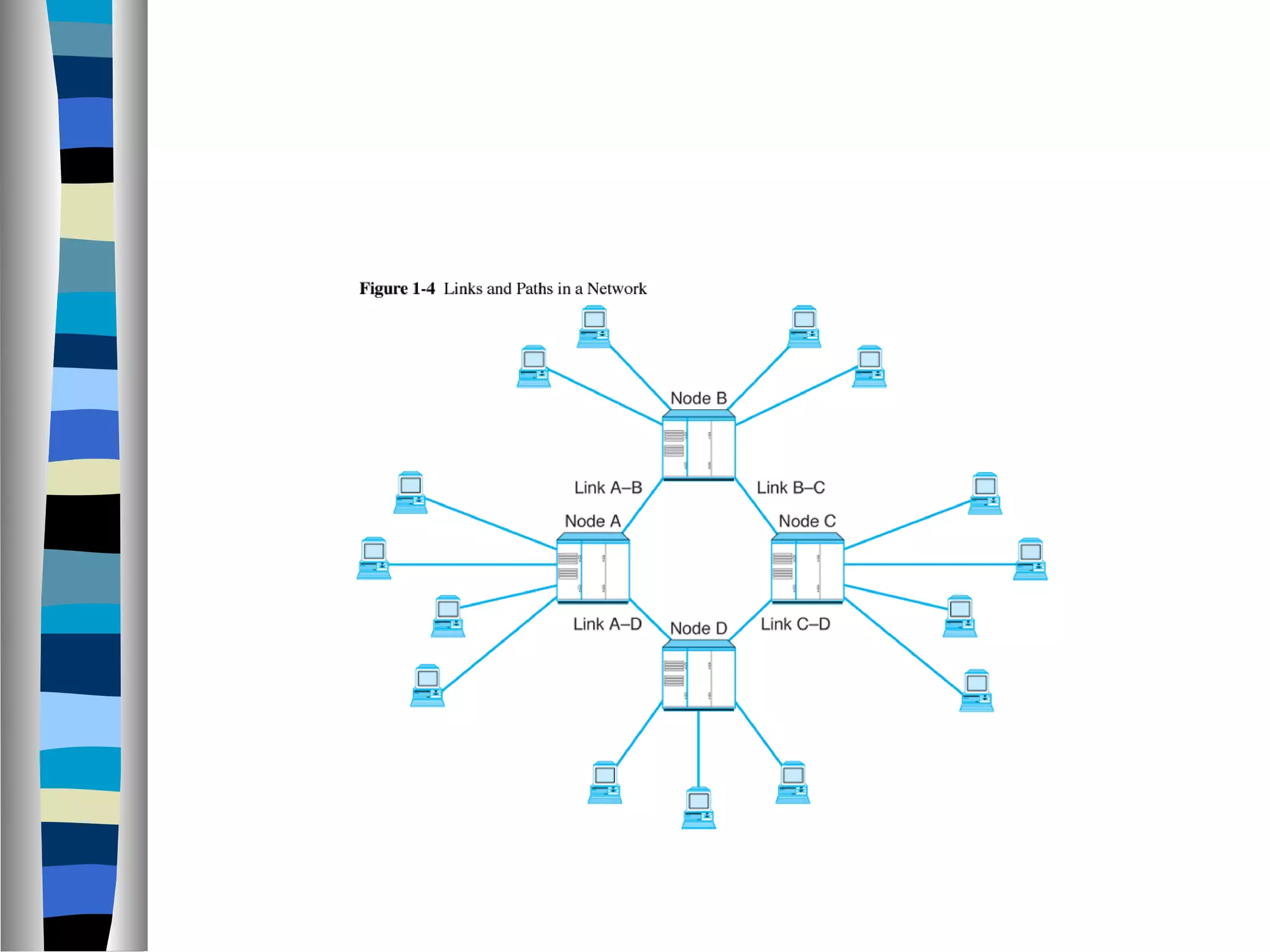
network configurations (see figures1-4
to 1-8)
Key Data Communication Concepts
 Session: communication dialog between network users or
applications
 Network: interconnected group of computers and
communication devices
 Node: a network-attached computer
 Link: connects adjacent nodes (see Figure 1-4)
 Path: end-to-end route within a network
 Circuit: the conduit over which data travels
 Packetizing: dividing messages into fixed-length packets prior
to transmission over a network’s communication media
 Routing: determining a message’s path from sending to
receiving nodes.
Store-and-Forward Systems
 Messages may be stored at intermediate
nodes along the transmission path between
sender and receiver in store-and-forward
systems
– This helps ensure message delivery without
obligating the sender to wait until a message is
delivered before transmitting other messages
– It also helps ensure message delivery in the case
of link or destination failure while the message is
in transit
– Store-and forward algorithms are valuable in time-
staged delivery systems and in networks that
assign priorities to different messages
Network Topology, Architecture,
and Complexity
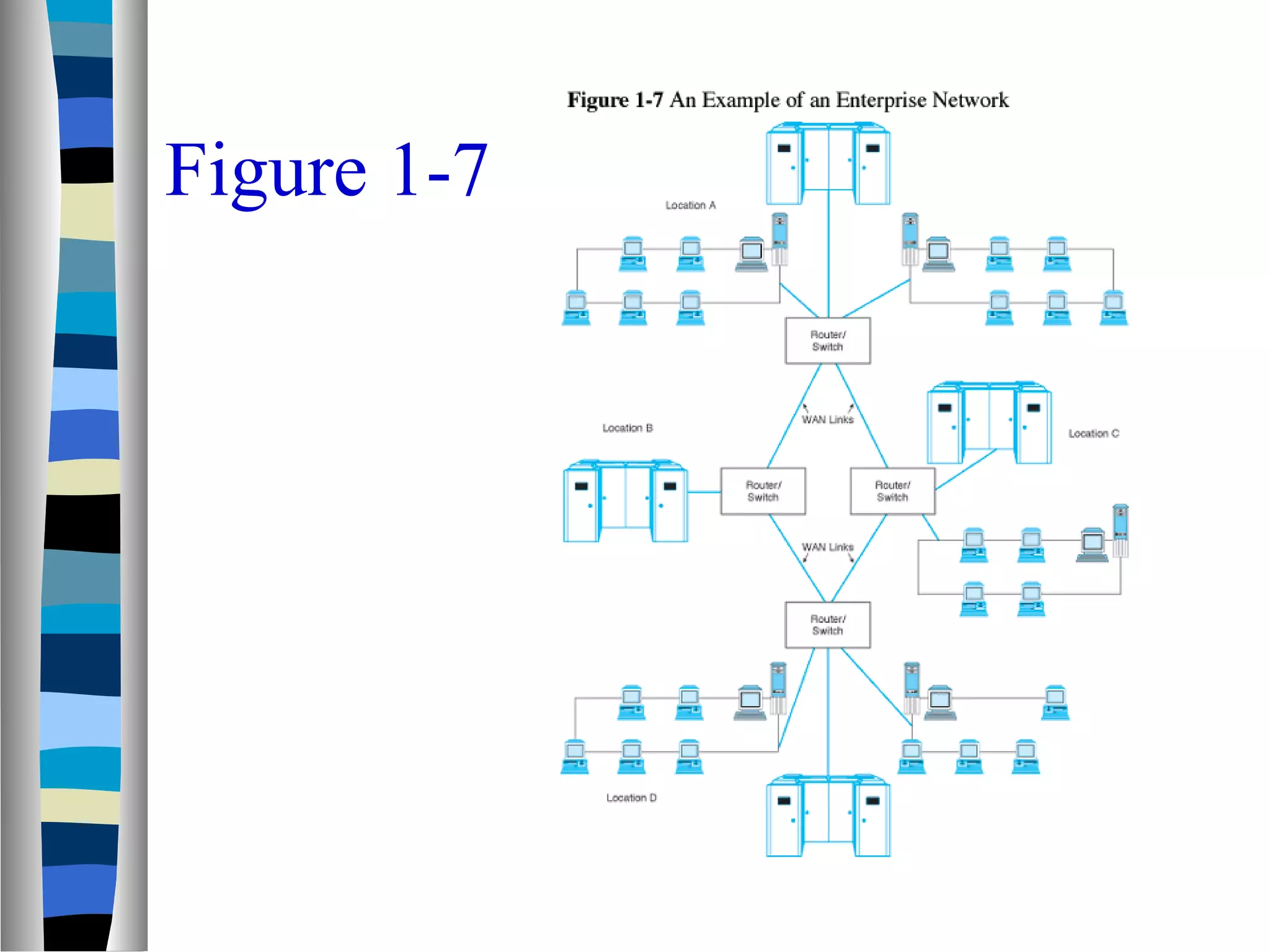
 Network topology refers to the physical layout
of a network, the way that nodes attach to the
communication medium
 Network architecture refers to the way in
which media, hardware, and software are
integrated to form a network
 Network complexity is concerned with extent
to which network architectures are simple or
diverse in their make
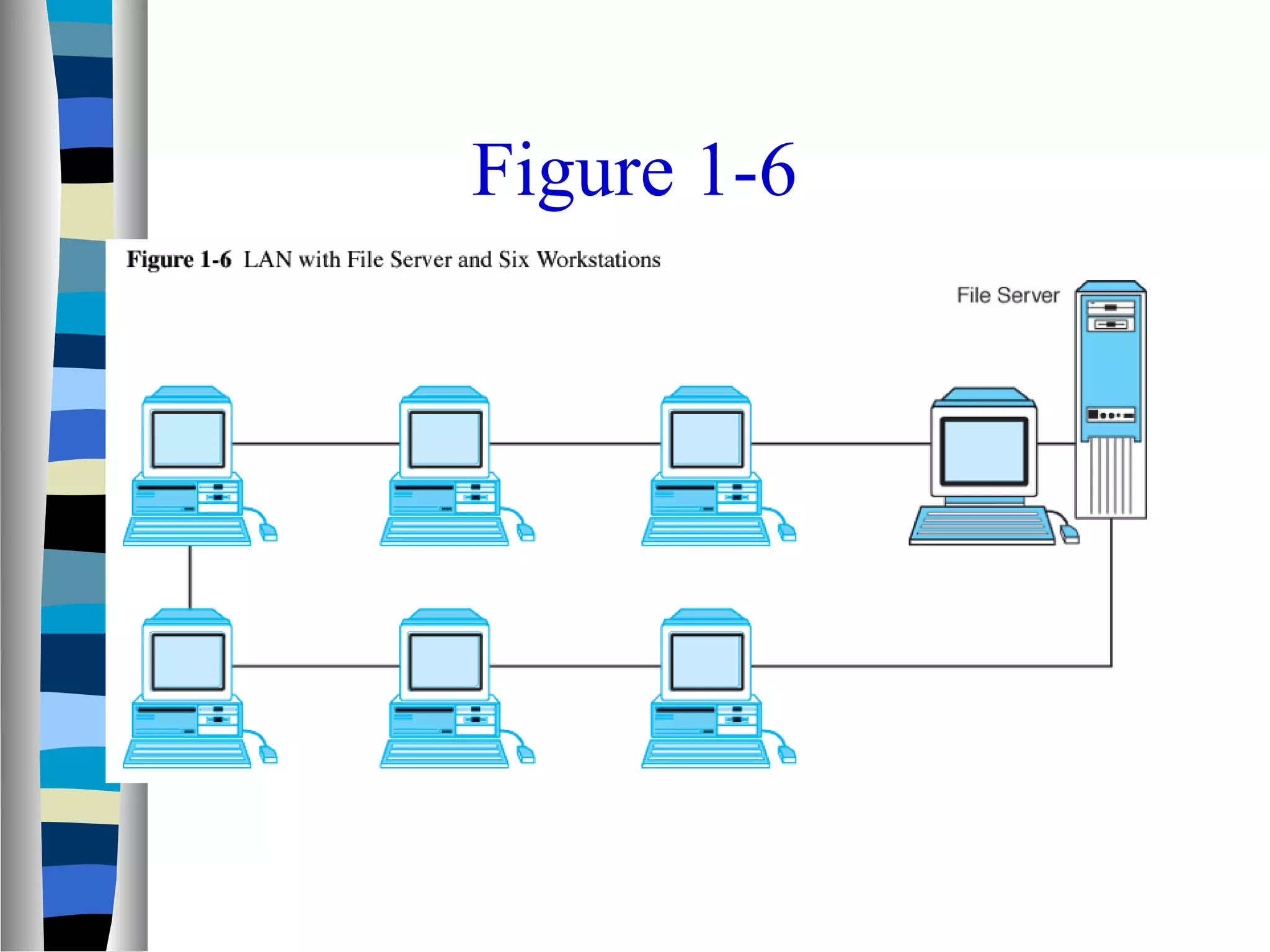
– Figures 1-5, 1-6, and 1-7 illustrate various levels of
complexity
Figure 1-5
Figure 1-6
Figure 1-7
Telecom Channels
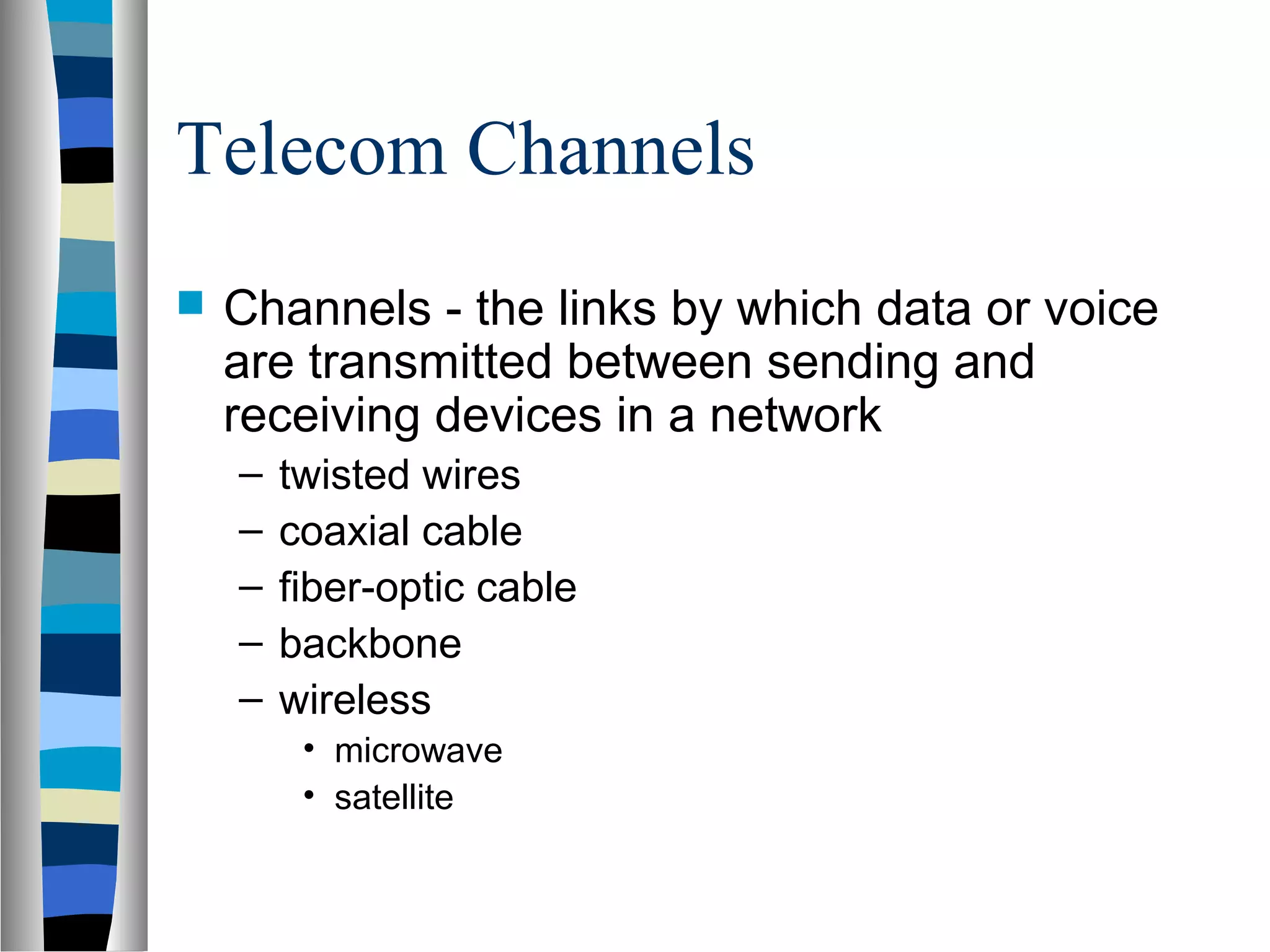
 Channels - the links by which data or voice
are transmitted between sending and
receiving devices in a network
– twisted wires
– coaxial cable
– fiber-optic cable
– backbone
– wireless
• microwave
• satellite
Telecom Channels – continued-
other Wireless
 Cellular
 Mobile data networks (2-way)
 PCS (personal communication
systems)- to the end user acts like
cellular, but different
 Personal data assistants
 smart phones
Data Communication
Frameworks
 Two major data communication
frameworks have been developed to
help ensure that networks meet
business and communication
requirements:
– Open Systems Interconnection (OSI)
reference model developed by the
International Standards Organization (ISO)
– Transmission Control Protocol/Internet
Protocol (TCP/IP) suite
data communication

data communication

  • 1.
  • 2.
    What is datacommunication?  Not to be confused with telecommunication— – Any process that permits the passage from a sender to one or more receivers of information of any nature, delivered in any easy to use form by any electromagnetic system.  Data communication- – Defined as a subset of telecommunication involving the transmission of data to and from computers and components of computer systems. • More specifically data communication is transmitted via mediums such as wires, coaxial cables, fiber optics, or radiated electromagnetic waves such as broadcast radio, infrared light, microwaves, and satellites.
  • 3.
    History of Telecommunications Invention of telegraph Samuel Morse – 1837  Invention of telephone- Alexander Graham Bell – 1876  Development of wireless By ??? – 1896  Concept of universal access and growth of AT&T  Divestiture of AT&T—what year??
  • 4.
    History of Telecommunications Continued…. Telecommunications Act of 1996  Three main developments that led to the growth of data communications systems: – Large-scale integration of circuits reduced the cost and size of terminals and comm equipment – Developments of software systems made establishment of communication networks easy – Competition among providers of transmission facilities reduced the cost of data circuits
  • 5.
    Features of Communication Four things required – Sender, receiver, medium, and message  Types of messages – File – Request – Response – Status – Control – Correspondence  Understandability  Error Detection
  • 7.
    Network Applications  Thenetwork applications environment consists of several important components: – Application programs – Operating systems – Data communication systems – Database management systems  The application environment is illustrated in Figure 1-10
  • 8.
  • 9.
    Other Data Communication Applications Batch applications  Data entry applications  Distributed applications  Inquiry/response applications  Interactive applications  Sensor-based applications  Combined applications
  • 10.
    Application Service Providers Many businesses have turned to third-party services for some or all of their business and data communications applications  Application service providers (ASPs) are third-party organizations that manage and distribute software and services to other companies over the Web  Many ASPs specialize in integrated e- commerce and e-business applications
  • 11.
    Business Data Communications Issues Major data communications issues include: – Cost-effectiveness – The Internet – Bandwidth – Evolving technologies – Convergence – Standards – Privacy and security
  • 12.
    Introduction to Networks Can be defined as a single computer , called a host, together with communication circuits, communication equipment, and terminals.  There are many different types of network configurations (see figures1-4 to 1-8)
  • 13.
    Key Data CommunicationConcepts  Session: communication dialog between network users or applications  Network: interconnected group of computers and communication devices  Node: a network-attached computer  Link: connects adjacent nodes (see Figure 1-4)  Path: end-to-end route within a network  Circuit: the conduit over which data travels  Packetizing: dividing messages into fixed-length packets prior to transmission over a network’s communication media  Routing: determining a message’s path from sending to receiving nodes.
  • 15.
    Store-and-Forward Systems  Messagesmay be stored at intermediate nodes along the transmission path between sender and receiver in store-and-forward systems – This helps ensure message delivery without obligating the sender to wait until a message is delivered before transmitting other messages – It also helps ensure message delivery in the case of link or destination failure while the message is in transit – Store-and forward algorithms are valuable in time- staged delivery systems and in networks that assign priorities to different messages
  • 16.
    Network Topology, Architecture, andComplexity  Network topology refers to the physical layout of a network, the way that nodes attach to the communication medium  Network architecture refers to the way in which media, hardware, and software are integrated to form a network  Network complexity is concerned with extent to which network architectures are simple or diverse in their make – Figures 1-5, 1-6, and 1-7 illustrate various levels of complexity
  • 17.
  • 18.
  • 19.
  • 20.
    Telecom Channels  Channels- the links by which data or voice are transmitted between sending and receiving devices in a network – twisted wires – coaxial cable – fiber-optic cable – backbone – wireless • microwave • satellite
  • 21.
    Telecom Channels –continued- other Wireless  Cellular  Mobile data networks (2-way)  PCS (personal communication systems)- to the end user acts like cellular, but different  Personal data assistants  smart phones
  • 22.
    Data Communication Frameworks  Twomajor data communication frameworks have been developed to help ensure that networks meet business and communication requirements: – Open Systems Interconnection (OSI) reference model developed by the International Standards Organization (ISO) – Transmission Control Protocol/Internet Protocol (TCP/IP) suite