OBJECTIVES
At the endof the lesson the students will be able to:
• Know the basic the concepts of data communications and
networking.
• Know the data communications components, data
representation, and data flow.
• Know the structure of networks that carry data.
• List the different network topologies, categories of
networks, and the general idea behind the Internet.
• Know the different protocols and standards used in data
communication.
3.
DATA COMMUNICATIONS
When wecommunicate, we are sharing information. This sharing
can be local or remote. Between individuals, local communication
usually occurs face to face, while remote communication takes
place over distance. The term telecommunication, which includes
telephony, telegraphy, and television, means communication at a
distance (tele is Greek for "far").
4.
FOUR FUNDAMENTAL CHARACTERISTICS
OFAN EFFECTIVE DATA
COMMUNICATIONS SYSTEM
1. Delivery. The system must deliver data to the correct destination. Data
must be received by the intended device or user and only by that device or
user.
2. Accuracy. The system must deliver the data accurately. Data that have been
altered in transmission and left uncorrected are unusable.
3. Timeliness. The system must deliver data in a timely manner. Data delivered
late are useless. In the case of video and audio, timely delivery means
delivering data as they are produced, in the same order that they are
produced, and without significant delay. This kind of delivery is called real-
time transmission.
4. Jitter. Jitter refers to the variation in the packet arrival time. It is the uneven
delay in the delivery of audio or video packets. For example, let us assume
that video packets are sent every 3D ms. If some of the packets arrive with
3D-ms delay and others with 4D-ms delay, an uneven quality in the video is
the result.
5.
COMPONENTS OF DATA
COMMUNICATIONSSYSTEM
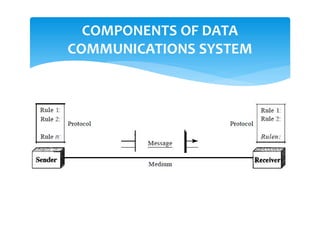
1. Message. The message is the information (data) to be communicated. Popular
forms of information include text, numbers, pictures, audio, and video.
2. Sender. The sender is the device that sends the data message. It can be a
computer, workstation, telephone handset, video camera, and so on.
3. Receiver. The receiver is the device that receives the message. It can be a
computer, workstation, telephone handset, television, and so on.
4. Transmission medium. The transmission medium is the physical path by which a
message travels from sender to receiver. Some examples of transmission media
include twisted-pair wire, coaxial cable, fiber-optic cable, and radio waves.
5. Protocol. A protocol is a set of rules that govern data communications. It
represents an agreement between the communicating devices. Without a
protocol, two devices may be connected but not communicating, just as a
person speaking French cannot be understood by a person who speaks only
Japanese.
DATA REPRESENTATION
Information todaycomes in different forms such as text, numbers,
images, audio, and video.
Text
In data communications, text is represented as a bit pattern, a sequence
of bits (0’s or 1’s). Different sets of bit patterns have been designed to
represent text symbols. Each set is called a code, and the process of
representing symbols is called coding. Today, the prevalent coding
system is called Unicode, which uses 32 bits to represent a symbol or
character used in any language in the world. The American Standard
Code for Information Interchange (ASCII), developed some decades
ago in the United States, now constitutes the first 127 characters in
Unicode and is also referred to as Basic Latin.
8.
Numbers
Numbers are alsorepresented by bit patterns. However, a code
such as ASCII is not used to represent numbers; the number is
directly converted to a binary number to simplify mathematical
operations.
Images
Images are also represented by bit patterns. In its simplest form,
an image is composed of a matrix of pixels (picture elements),
where each pixel is a small dot. The size of the pixel depends on
the resolution. For example, an image can be divided into 1000
pixels or 10,000 pixels. In the second case, there is a better
representation of the image (better resolution), but more
memory is needed to store the image.
9.
Audio
Audio refers tothe recording or broadcasting of sound or music.
Audio is by nature different from text, numbers, or images. It is
continuous, not discrete. Even when we use a microphone to
change voice or music to an electric signal, we create a
continuous signal.
Video
Video refers to the recording or broadcasting of a picture or
movie. Video can either be produced as a continuous entity (e.g.,
by a TV camera), or it can be a combination of images, each a
discrete entity, arranged to convey the idea of motion.
10.
DATA FLOW
Dataflow isthe movement of data through a system comprised of
software, hardware or a combination of both. Dataflow is often defined
using a model or diagram in which the entire process of data movement
is mapped as it passes from one component to the next within a
program or a system, taking into consideration how it changes form
during the process.
TYPES OF DATA FLOW:
1. SIMPLEX
2. HALF-DUPLEX
3. FULL DUPLEX
11.
Simplex
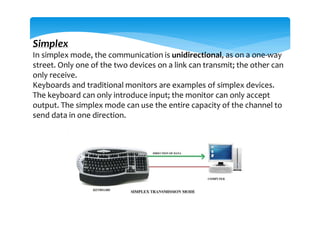
In simplex mode,the communication is unidirectional, as on a one-way
street. Only one of the two devices on a link can transmit; the other can
only receive.
Keyboards and traditional monitors are examples of simplex devices.
The keyboard can only introduce input; the monitor can only accept
output. The simplex mode can use the entire capacity of the channel to
send data in one direction.
12.
Half-Duplex
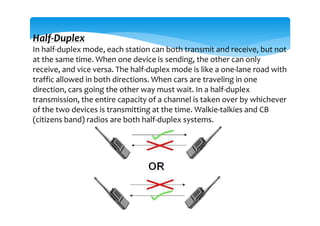
In half-duplex mode,each station can both transmit and receive, but not
at the same time. When one device is sending, the other can only
receive, and vice versa. The half-duplex mode is like a one-lane road with
traffic allowed in both directions. When cars are traveling in one
direction, cars going the other way must wait. In a half-duplex
transmission, the entire capacity of a channel is taken over by whichever
of the two devices is transmitting at the time. Walkie-talkies and CB
(citizens band) radios are both half-duplex systems.
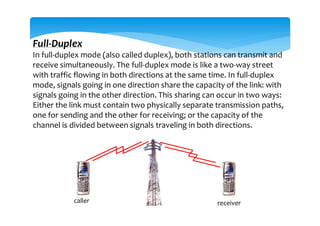
13.
Full-Duplex
In full-duplex mode(also called duplex), both stations can transmit and
receive simultaneously. The full-duplex mode is like a two-way street
with traffic flowing in both directions at the same time. In full-duplex
mode, signals going in one direction share the capacity of the link: with
signals going in the other direction. This sharing can occur in two ways:
Either the link must contain two physically separate transmission paths,
one for sending and the other for receiving; or the capacity of the
channel is divided between signals traveling in both directions.
caller receiver
14.
NETWORKS
A network isa set of devices (often referred to as nodes)
connected by communication links. A node can be a computer,
printer, or any other device capable of sending and/or receiving
data generated by other nodes on the network. Most networks
use distributed processing, in which a task is divided among
multiple computers. Instead of one single large machine being
responsible for all aspects of a process, separate computers
(usually a personal computer or workstation) handle a subset.
NETWORK CRITERIA
A network must be able to meet a certain number of criteria. The
most important of these are performance, reliability, and
security.
15.
PERFORMANCE
Performance can bemeasured in many ways, including transit
time and response time. Transit time is the amount of time
required for a message to travel from one device to another.
Response time is the elapsed time between an inquiry and a
response. The performance of a network depends on a number of
factors, including the number of users, the type of transmission
medium, the capabilities of the connected hardware, and the
efficiency of the software. Performance is often evaluated by two
networking metrics: throughput and delay. We often need more
throughput and less delay. However, these two criteria are often
contradictory. If we try to send more data to the network, we
may increase throughput but we increase the delay because of
traffic congestion in the network.
16.
RELIABILITY
In addition toaccuracy of delivery, network reliability is measured
by the frequency of failure, the time it takes a link to recover
from a failure, and the network's robustness in a catastrophe.
SECURITY
Network security issues include protecting data from
unauthorized access, protecting data from damage and
development, and implementing policies and procedures for
recovery from breaches and data losses.
17.
NETWORK PHYSICAL
STRUCTURES
Type ofConnection:
Point-to-Point connection provides a dedicated link between two
devices. The entire capacity of the link is reserved for transmission
between those two devices. Most point-to-point connections use
an actual length of wire or cable to connect the two ends, but
other options, such as microwave or satellite links, are also
possible. When you change television channels by infrared remote
control, you are establishing a point-to-point connection between
the remote control and the television's control system.
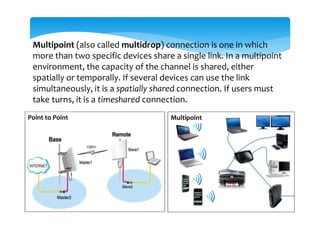
18.
Multipoint (also calledmultidrop) connection is one in which
more than two specific devices share a single link. In a multipoint
environment, the capacity of the channel is shared, either
spatially or temporally. If several devices can use the link
simultaneously, it is a spatially shared connection. If users must
take turns, it is a timeshared connection.
Point to Point Multipoint
19.
PHYSICAL TOPOLOGY
The termphysical topology refers to the way in which a network is
laid out physically. Two or more devices connect to a link; two or
more links form a topology. The topology of a network is the
geometric representation of the relationship of all the links and
linking devices (usually called nodes) to one another.
Four Basic Network Topology:
1. MESH
2. STAR
3. BUS
4. RING
20.
MESH TOPOLOGY
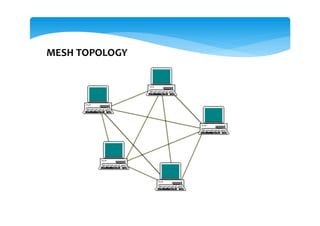
In amesh topology, every device has a dedicated point-to-point
link to every other device. The term dedicated means that the link
carries traffic only between the two devices it connects. To find
the number of physical links in a fully connected mesh network
with n nodes, we first consider that each node must be connected
to every other node. Node 1 must be connected to n - I nodes,
node 2 must be connected to n – 1 nodes, and finally node n must
be connected to n - 1 nodes. We need n(n - 1) physical links.
However, if each physical link allows communication in both
directions (duplex mode), we can divide the number of links by 2.
In other words, we can say that in a mesh topology, we need
n(n -1) /2 number of duplex-mode links
STAR TOPOLOGY
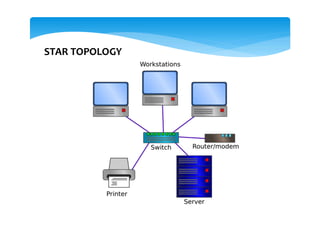
In astar topology, each device has a dedicated point-to-point link
only to a central controller, usually called a hub. The devices are
not directly linked to one another. Unlike a mesh topology, a star
topology does not allow direct traffic between devices. The
controller acts as an exchange: If one device wants to send data
to another, it sends the data to the controller, which then relays
the data to the other connected device.
BUS TOPOLOGY
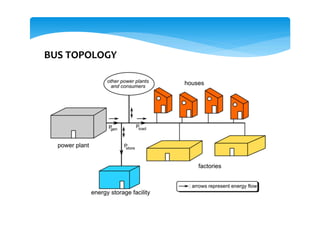
A bustopology, on the other hand, is multipoint connection. One
long cable acts as a backbone to link all the devices in a network.
Nodes are connected to the bus cable by drop lines and taps. A
drop line is a connection running between the device and the
main cable. A tap is a connector that either splices into the main
cable or punctures the sheathing of a cable to create a contact
with the metallic core. As a signal travels along the backbone,
some of its energy is transformed into heat. Therefore, it
becomes weaker and weaker as it travels farther and farther. For
this reason there is a limit on the number of taps a bus can
support and on the distance between those taps.
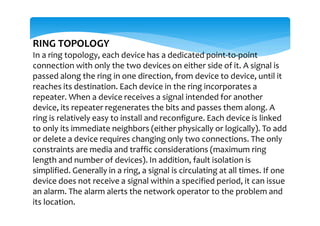
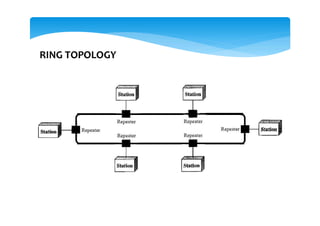
RING TOPOLOGY
In aring topology, each device has a dedicated point-to-point
connection with only the two devices on either side of it. A signal is
passed along the ring in one direction, from device to device, until it
reaches its destination. Each device in the ring incorporates a
repeater. When a device receives a signal intended for another
device, its repeater regenerates the bits and passes them along. A
ring is relatively easy to install and reconfigure. Each device is linked
to only its immediate neighbors (either physically or logically). To add
or delete a device requires changing only two connections. The only
constraints are media and traffic considerations (maximum ring
length and number of devices). In addition, fault isolation is
simplified. Generally in a ring, a signal is circulating at all times. If one
device does not receive a signal within a specified period, it can issue
an alarm. The alarm alerts the network operator to the problem and
its location.
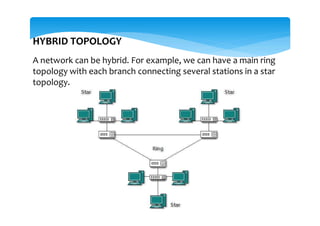
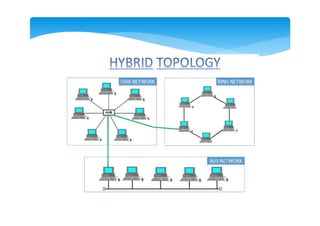
HYBRID TOPOLOGY
A networkcan be hybrid. For example, we can have a main ring
topology with each branch connecting several stations in a star
topology.
30.
CATEGORIES OF NETWORKS
LOCALAREA NETWORK
A local area network (LAN) is usually privately owned and links the
devices in a single office, building, or campus. Depending on the needs
of an organization and the type of technology used, a LAN can be as
simple as two PCs and a printer in someone's home office; or it can
extend throughout a company and include audio and video peripherals.
Currently, LAN size is limited to a few kilometers. LANs are designed to
allow resources to be shared between personal computers or
workstations. The resources to be shared can include hardware (e.g., a
printer), software (e.g., an application program), or data.
In addition to size, LANs are distinguished from other types of networks
by their transmission media and topology. In general, a given LAN will
use only one type of transmission medium. The most common LAN
topologies are bus, ring, and star.
31.
WIDE AREA NETWORK
Awide area network (WAN) provides long-distance transmission of
data, image, audio, and video information over large geographic areas
that may comprise a country, a continent, or even the whole world. A
WAN can be as complex as the backbones that connect the Internet or
as simple as a dial-up line that connects a home computer to the
Internet. We normally refer to the first as a switched WAN and to the
second as a point-to-point WAN. The switched WAN connects the end
systems, which usually comprise a router (internetworking connecting
device) that connects to another LAN or WAN. The point-to-point WAN
is normally a line leased from a telephone or cable TV provider that
connects a home computer or a small LAN to an Internet service
provider (lSP). This type of WAN is often used to provide Internet
access.
32.
METROPOLITAN AREA NETWORKS
Ametropolitan area network (MAN) is a network with a size between a
LAN and a WAN. It normally covers the area inside a town or a city. It is
designed for customers who need a high-speed connectivity, normally
to the Internet, and have endpoints spread over a city or part of city. A
good example of a MAN is the part of the telephone company network
that can provide a high-speed DSL line to the customer. Another
example is the cable TV network that originally was designed for cable
TV, but today can also be used for high-speed data connection to the
Internet.