Predictive Analysis Case
Study
By:DeepeshSinghSuryavanshi
ABSTRACT
Cars are being sold more than ever. Developing countries adopt the lease
culture instead of buying a new car due to affordability. Therefore, the rise
of used cars sales is exponentially increasing. Car sellers sometimes take
advantage of this scenario by listing unrealistic prices owing to the
demand. Therefore, arises a need for a model that can assign a price for a
vehicle by evaluating its features taking the prices of other cars into
consideration, supervised learning method namely Random Forest is used
to predict the prices of used cars.
BUSINESS GOAL
I am required to model the price of cars with the available independent variables. It will be used
by the management to understand how exactly the prices vary with the independent variables.
They can accordingly manipulate the design of the cars, the business strategy etc. to meet certain
price levels. Further, the model will be a good way for management to understand the pricing
dynamics of a new market.
DATA READING AND UNDERSTANDING
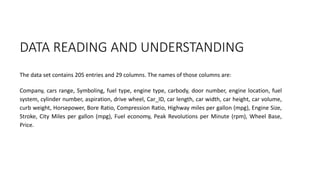
The data set contains 205 entries and 29 columns. The names of those columns are:
Company, cars range, Symboling, fuel type, engine type, carbody, door number, engine location, fuel
system, cylinder number, aspiration, drive wheel, Car_ID, car length, car width, car height, car volume,
curb weight, Horsepower, Bore Ratio, Compression Ratio, Highway miles per gallon (mpg), Engine Size,
Stroke, City Miles per gallon (mpg), Fuel economy, Peak Revolutions per Minute (rpm), Wheel Base,
Price.
ASSUMPTIONS
Car Company: We have assumed that volkswagen, vokswagen, and vw are the same companies, and same for others.
Data Cleansing: We have renamed the car company names to their correct names, as per our understanding. We have
converted all the data to lower case to avoid any case errors. The duplicated function searched for any duplicate values
in our data and found none.
There were no missing values in the data and by performing the above steps, we prepared our data for analysis.
A separate data set corr was created that dealt only with the correlation of our target variable, price. This was done in
order to select the best response variables for our study.
Another dataset cars was created that included only the columns that we selected based on our data exploration.
Exploratory Data
Analysis
Based on our data exploration,
we chose the best features that
would help us predict the prices
of the cars. These are :
Wheel Base, Car Length, Car
Width, Curb Weight, Engine
Size, Bore Ratio, Horsepower,
Car Volume, Fuel Economy,
Cars Range, Car Body, Fuel
Type, Engine Type, Aspiration,
Cylinder Number, Drive wheel
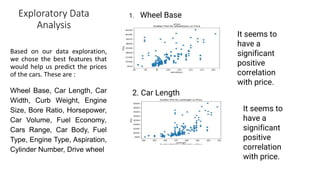
1. Wheel Base
It seems to
have a
significant
positive
correlation
with price.
2. Car Length
It seems to
have a
significant
positive
correlation
with price.
Exploratory Data
Analysis
Based on our data exploration,
we chose the best features that
would help us predict the prices
of the cars. These are :
Wheel Base, Car Length, Car
Width, Curb Weight, Engine
Size, Bore Ratio, Horsepower,
Car Volume, Fuel Economy,
Cars Range, Car Body, Fuel
Type, Engine Type, Aspiration,
Cylinder Number, Drive wheel
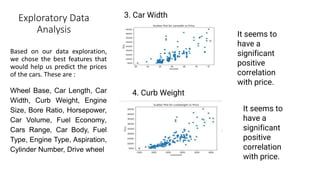
3. Car Width
It seems to
have a
significant
positive
correlation
with price.
4. Curb Weight
It seems to
have a
significant
positive
correlation
with price.
Exploratory Data
Analysis
Based on our data exploration,
we chose the best features that
would help us predict the prices
of the cars. These are :
Wheel Base, Car Length, Car
Width, Curb Weight, Engine
Size, Bore Ratio, Horsepower,
Car Volume, Fuel Economy,
Cars Range, Car Body, Fuel
Type, Engine Type, Aspiration,
Cylinder Number, Drive wheel
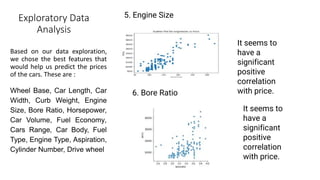
5. Engine Size
It seems to
have a
significant
positive
correlation
with price.
6. Bore Ratio
It seems to
have a
significant
positive
correlation
with price.
Exploratory Data
Analysis
Based on our data exploration,
we chose the best features that
would help us predict the prices
of the cars. These are :
Wheel Base, Car Length, Car
Width, Curb Weight, Engine
Size, Bore Ratio, Horsepower,
Car Volume, Fuel Economy,
Cars Range, Car Body, Fuel
Type, Engine Type, Aspiration,
Cylinder Number, Drive wheel
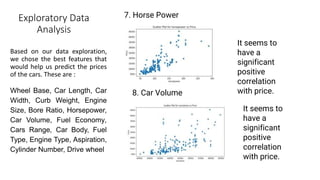
7. Horse Power
It seems to
have a
significant
positive
correlation
with price.
8. Car Volume
It seems to
have a
significant
positive
correlation
with price.
Exploratory Data
Analysis
Based on our data exploration,
we chose the best features that
would help us predict the prices
of the cars. These are :
Wheel Base, Car Length, Car
Width, Curb Weight, Engine
Size, Bore Ratio, Horsepower,
Car Volume, Fuel Economy,
Cars Range, Car Body, Fuel
Type, Engine Type, Aspiration,
Cylinder Number, Drive wheel
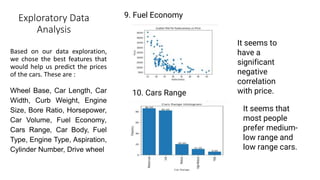
9. Fuel Economy
It seems to
have a
significant
negative
correlation
with price.
10. Cars Range
It seems that
most people
prefer medium-
low range and
low range cars.
Exploratory Data
Analysis
Based on our data exploration,
we chose the best features that
would help us predict the prices
of the cars. These are :
Wheel Base, Car Length, Car
Width, Curb Weight, Engine
Size, Bore Ratio, Horsepower,
Car Volume, Fuel Economy,
Cars Range, Car Body, Fuel
Type, Engine Type, Aspiration,
Cylinder Number, Drive wheel
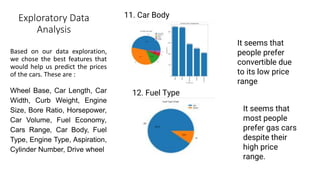
11. Car Body
It seems that
people prefer
convertible due
to its low price
range
12. Fuel Type
It seems that
most people
prefer gas cars
despite their
high price
range.
Exploratory Data
Analysis
Based on our data exploration,
we chose the best features that
would help us predict the prices
of the cars. These are :
Wheel Base, Car Length, Car
Width, Curb Weight, Engine
Size, Bore Ratio, Horsepower,
Car Volume, Fuel Economy,
Cars Range, Car Body, Fuel
Type, Engine Type, Aspiration,
Cylinder Number, Drive wheel
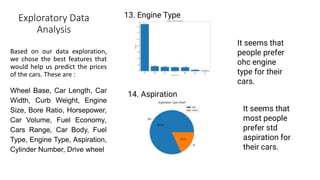
13. Engine Type
It seems that
people prefer
ohc engine
type for their
cars.
14. Aspiration
It seems that
most people
prefer std
aspiration for
their cars.
Exploratory Data
Analysis
Based on our data exploration,
we chose the best features that
would help us predict the prices
of the cars. These are :
Wheel Base, Car Length, Car
Width, Curb Weight, Engine
Size, Bore Ratio, Horsepower,
Car Volume, Fuel Economy,
Cars Range, Car Body, Fuel
Type, Engine Type, Aspiration,
Cylinder Number, Drive wheel
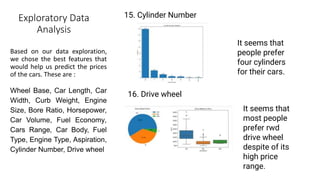
15. Cylinder Number
It seems that
people prefer
four cylinders
for their cars.
16. Drive wheel
It seems that
most people
prefer rwd
drive wheel
despite of its
high price
range.
1. Cars Range is one of the most significant variables for deciding price. Hence, the company should select their price
range within 18500$ to 30000$ initially.
2. Fuel Economy of the car is very important for the customers these days. The company should make sure the fuel
economy of cars is not less than 5 litres/100km.
3. The company should make sure to have cars with drive wheel ‘rwd’ because people prefer it despite its high price.
4. Most of the cars should have petrol fuel type, because people prefer petrol way more than diesel.
5. Most people prefer convertible despite its price range being medium-high. Hence, company should focus on this as
well.
SUGESSTIONS AND INSIGHTS
THANKS

Car pricing prediction ppt.pptx ppt car study

  • 1.
  • 2.
    ABSTRACT Cars are beingsold more than ever. Developing countries adopt the lease culture instead of buying a new car due to affordability. Therefore, the rise of used cars sales is exponentially increasing. Car sellers sometimes take advantage of this scenario by listing unrealistic prices owing to the demand. Therefore, arises a need for a model that can assign a price for a vehicle by evaluating its features taking the prices of other cars into consideration, supervised learning method namely Random Forest is used to predict the prices of used cars.
  • 3.
    BUSINESS GOAL I amrequired to model the price of cars with the available independent variables. It will be used by the management to understand how exactly the prices vary with the independent variables. They can accordingly manipulate the design of the cars, the business strategy etc. to meet certain price levels. Further, the model will be a good way for management to understand the pricing dynamics of a new market.
  • 4.
    DATA READING ANDUNDERSTANDING The data set contains 205 entries and 29 columns. The names of those columns are: Company, cars range, Symboling, fuel type, engine type, carbody, door number, engine location, fuel system, cylinder number, aspiration, drive wheel, Car_ID, car length, car width, car height, car volume, curb weight, Horsepower, Bore Ratio, Compression Ratio, Highway miles per gallon (mpg), Engine Size, Stroke, City Miles per gallon (mpg), Fuel economy, Peak Revolutions per Minute (rpm), Wheel Base, Price.
  • 5.
    ASSUMPTIONS Car Company: Wehave assumed that volkswagen, vokswagen, and vw are the same companies, and same for others. Data Cleansing: We have renamed the car company names to their correct names, as per our understanding. We have converted all the data to lower case to avoid any case errors. The duplicated function searched for any duplicate values in our data and found none. There were no missing values in the data and by performing the above steps, we prepared our data for analysis. A separate data set corr was created that dealt only with the correlation of our target variable, price. This was done in order to select the best response variables for our study. Another dataset cars was created that included only the columns that we selected based on our data exploration.
  • 6.
    Exploratory Data Analysis Based onour data exploration, we chose the best features that would help us predict the prices of the cars. These are : Wheel Base, Car Length, Car Width, Curb Weight, Engine Size, Bore Ratio, Horsepower, Car Volume, Fuel Economy, Cars Range, Car Body, Fuel Type, Engine Type, Aspiration, Cylinder Number, Drive wheel 1. Wheel Base It seems to have a significant positive correlation with price. 2. Car Length It seems to have a significant positive correlation with price.
  • 7.
    Exploratory Data Analysis Based onour data exploration, we chose the best features that would help us predict the prices of the cars. These are : Wheel Base, Car Length, Car Width, Curb Weight, Engine Size, Bore Ratio, Horsepower, Car Volume, Fuel Economy, Cars Range, Car Body, Fuel Type, Engine Type, Aspiration, Cylinder Number, Drive wheel 3. Car Width It seems to have a significant positive correlation with price. 4. Curb Weight It seems to have a significant positive correlation with price.
  • 8.
    Exploratory Data Analysis Based onour data exploration, we chose the best features that would help us predict the prices of the cars. These are : Wheel Base, Car Length, Car Width, Curb Weight, Engine Size, Bore Ratio, Horsepower, Car Volume, Fuel Economy, Cars Range, Car Body, Fuel Type, Engine Type, Aspiration, Cylinder Number, Drive wheel 5. Engine Size It seems to have a significant positive correlation with price. 6. Bore Ratio It seems to have a significant positive correlation with price.
  • 9.
    Exploratory Data Analysis Based onour data exploration, we chose the best features that would help us predict the prices of the cars. These are : Wheel Base, Car Length, Car Width, Curb Weight, Engine Size, Bore Ratio, Horsepower, Car Volume, Fuel Economy, Cars Range, Car Body, Fuel Type, Engine Type, Aspiration, Cylinder Number, Drive wheel 7. Horse Power It seems to have a significant positive correlation with price. 8. Car Volume It seems to have a significant positive correlation with price.
  • 10.
    Exploratory Data Analysis Based onour data exploration, we chose the best features that would help us predict the prices of the cars. These are : Wheel Base, Car Length, Car Width, Curb Weight, Engine Size, Bore Ratio, Horsepower, Car Volume, Fuel Economy, Cars Range, Car Body, Fuel Type, Engine Type, Aspiration, Cylinder Number, Drive wheel 9. Fuel Economy It seems to have a significant negative correlation with price. 10. Cars Range It seems that most people prefer medium- low range and low range cars.
  • 11.
    Exploratory Data Analysis Based onour data exploration, we chose the best features that would help us predict the prices of the cars. These are : Wheel Base, Car Length, Car Width, Curb Weight, Engine Size, Bore Ratio, Horsepower, Car Volume, Fuel Economy, Cars Range, Car Body, Fuel Type, Engine Type, Aspiration, Cylinder Number, Drive wheel 11. Car Body It seems that people prefer convertible due to its low price range 12. Fuel Type It seems that most people prefer gas cars despite their high price range.
  • 12.
    Exploratory Data Analysis Based onour data exploration, we chose the best features that would help us predict the prices of the cars. These are : Wheel Base, Car Length, Car Width, Curb Weight, Engine Size, Bore Ratio, Horsepower, Car Volume, Fuel Economy, Cars Range, Car Body, Fuel Type, Engine Type, Aspiration, Cylinder Number, Drive wheel 13. Engine Type It seems that people prefer ohc engine type for their cars. 14. Aspiration It seems that most people prefer std aspiration for their cars.
  • 13.
    Exploratory Data Analysis Based onour data exploration, we chose the best features that would help us predict the prices of the cars. These are : Wheel Base, Car Length, Car Width, Curb Weight, Engine Size, Bore Ratio, Horsepower, Car Volume, Fuel Economy, Cars Range, Car Body, Fuel Type, Engine Type, Aspiration, Cylinder Number, Drive wheel 15. Cylinder Number It seems that people prefer four cylinders for their cars. 16. Drive wheel It seems that most people prefer rwd drive wheel despite of its high price range.
  • 14.
    1. Cars Rangeis one of the most significant variables for deciding price. Hence, the company should select their price range within 18500$ to 30000$ initially. 2. Fuel Economy of the car is very important for the customers these days. The company should make sure the fuel economy of cars is not less than 5 litres/100km. 3. The company should make sure to have cars with drive wheel ‘rwd’ because people prefer it despite its high price. 4. Most of the cars should have petrol fuel type, because people prefer petrol way more than diesel. 5. Most people prefer convertible despite its price range being medium-high. Hence, company should focus on this as well. SUGESSTIONS AND INSIGHTS
  • 15.