Data Science
and Machine
Learning
Internship
This presentation details my recent internship experience at the
YBI Foundation, focusing on a used car price prediction model.
Through this project, I honed my data science skills and gained
valuable practical experience.
Internship Overview
1 Host
YBI Foundation, a non-profit organization dedicated to empowering youth in
data science.
2 Project
Used Car Price Prediction Model: Developing a machine learning model to
accurately predict used car prices.
3 Duration
The internship spanned a period of 1-month, providing ample time for
comprehensive data analysis and model development.
4 Goal
The primary objective was to build a robust model capable of providing
reliable used car price predictions for both buyers and sellers.
Acknowledgements
YBI Foundation
Expressing sincere gratitude to the YBI Foundation for providing this
valuable internship opportunity, fostering my growth and skill
development.
Mentors
Acknowledging the guidance and support of my mentors, who
provided invaluable insights and expertise throughout the internship.
Colleagues
Extending appreciation to my fellow interns and colleagues for their
collaboration, knowledge sharing, and positive contributions to the
project.
Project Background
The Challenge
The used car market is dynamic, with prices
influenced by a complex interplay of factors such as
vehicle age, mileage, brand reputation, and market
demand. This makes accurate price estimation
challenging for both buyers and sellers.
The Solution
Leveraging machine learning, a data-driven approach
can effectively analyze historical car data to identify
patterns, build predictive models, and improve price
estimation accuracy.
Data Collection and Sources
Data Source Description
Public Datasets Accessed publicly available
datasets containing extensive
information on used car sales,
including features like vehicle
details, price history, and market
trends.
Web Scraping Utilized web scraping techniques
to extract data from online car
marketplaces and classifieds,
expanding the dataset with real-
time information.
Data Preprocessing
1 Data Cleaning
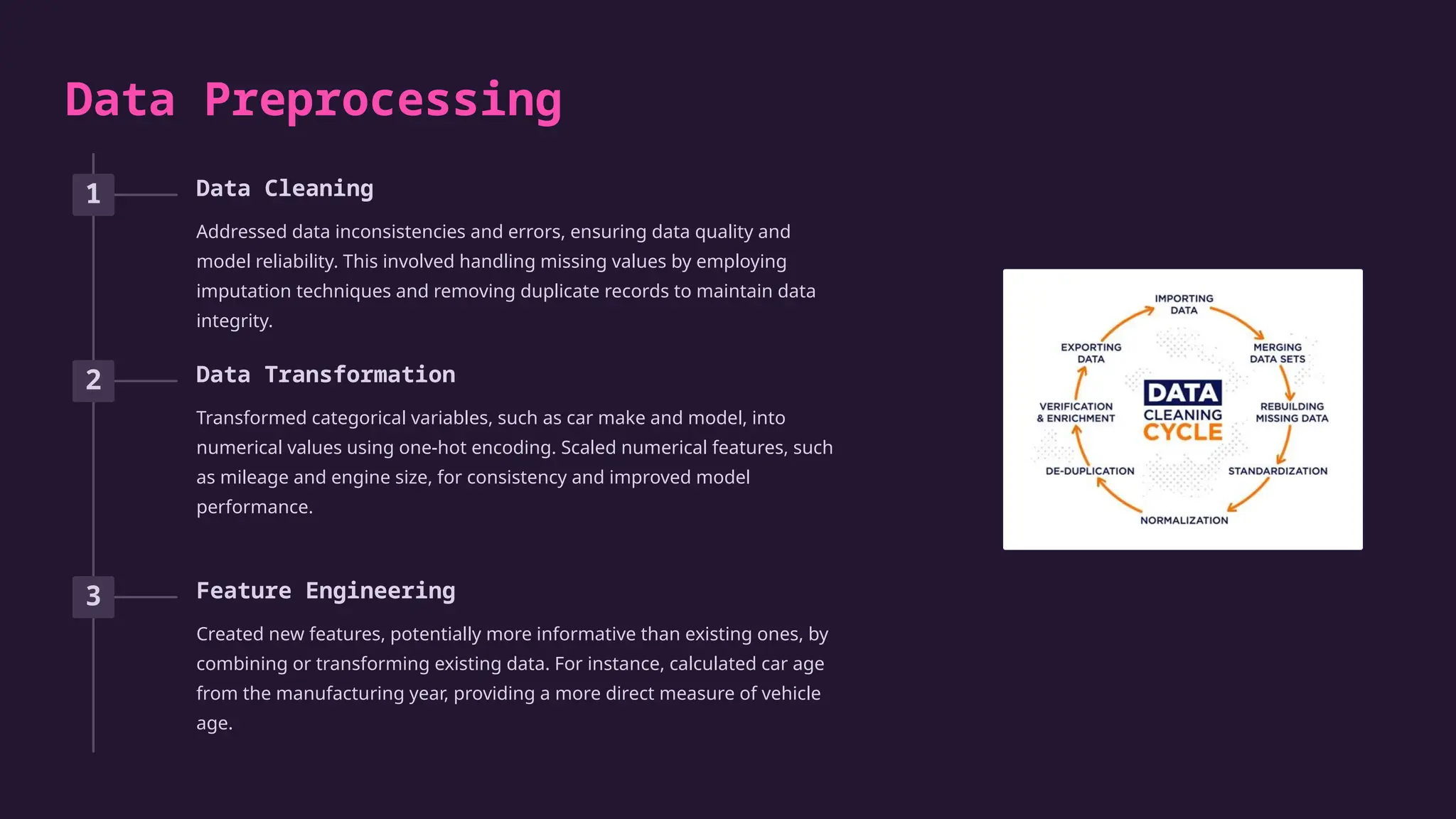
Addressed data inconsistencies and errors, ensuring data quality and
model reliability. This involved handling missing values by employing
imputation techniques and removing duplicate records to maintain data
integrity.
2 Data Transformation
Transformed categorical variables, such as car make and model, into
numerical values using one-hot encoding. Scaled numerical features, such
as mileage and engine size, for consistency and improved model
performance.
3 Feature Engineering
Created new features, potentially more informative than existing ones, by
combining or transforming existing data. For instance, calculated car age
from the manufacturing year, providing a more direct measure of vehicle
age.
Exploratory Data Analysis (EDA)
Scatter Plots
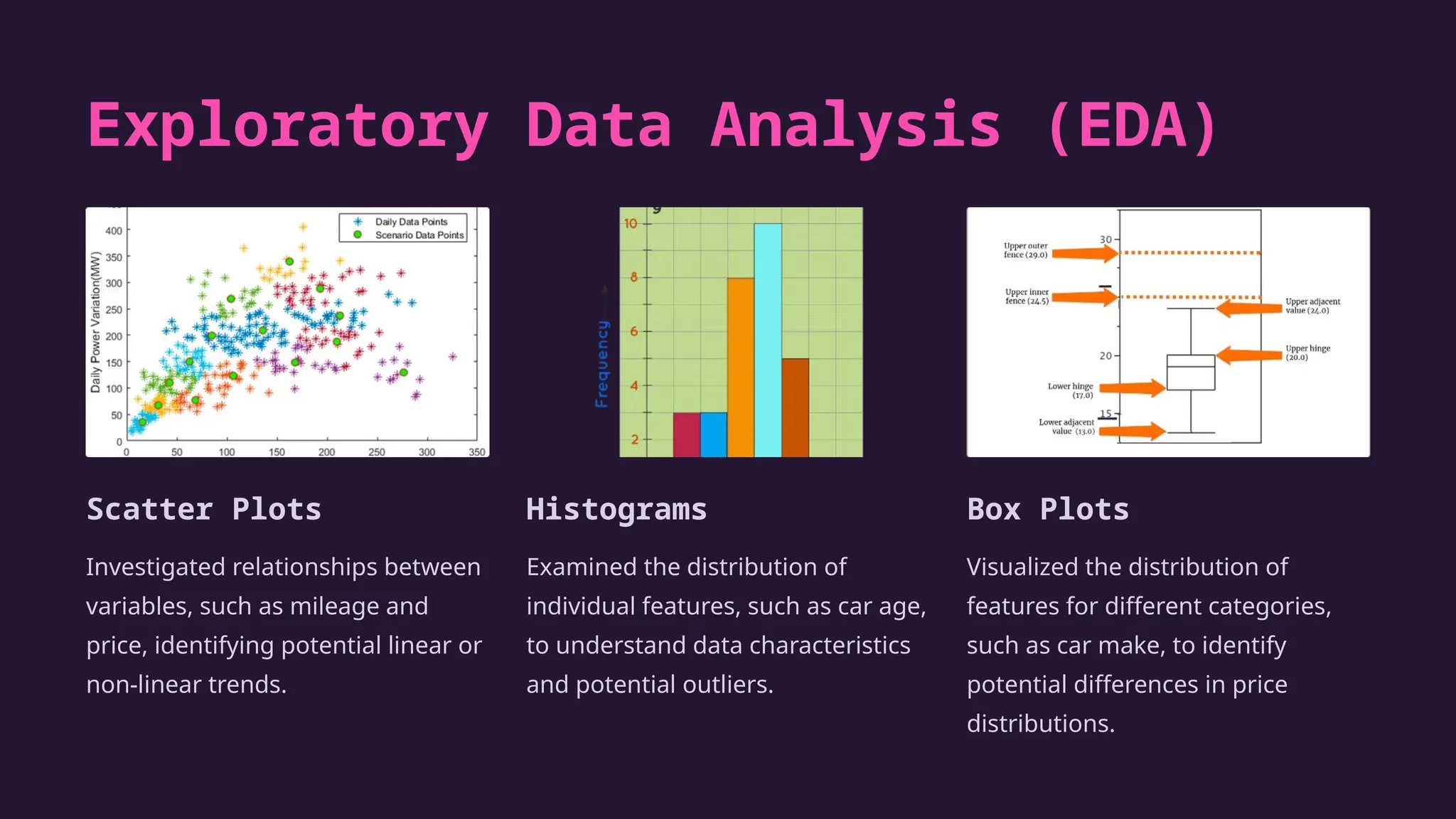
Investigated relationships between
variables, such as mileage and
price, identifying potential linear or
non-linear trends.
Histograms
Examined the distribution of
individual features, such as car age,
to understand data characteristics
and potential outliers.
Box Plots
Visualized the distribution of
features for different categories,
such as car make, to identify
potential differences in price
distributions.
Model Selection
Linear Regression
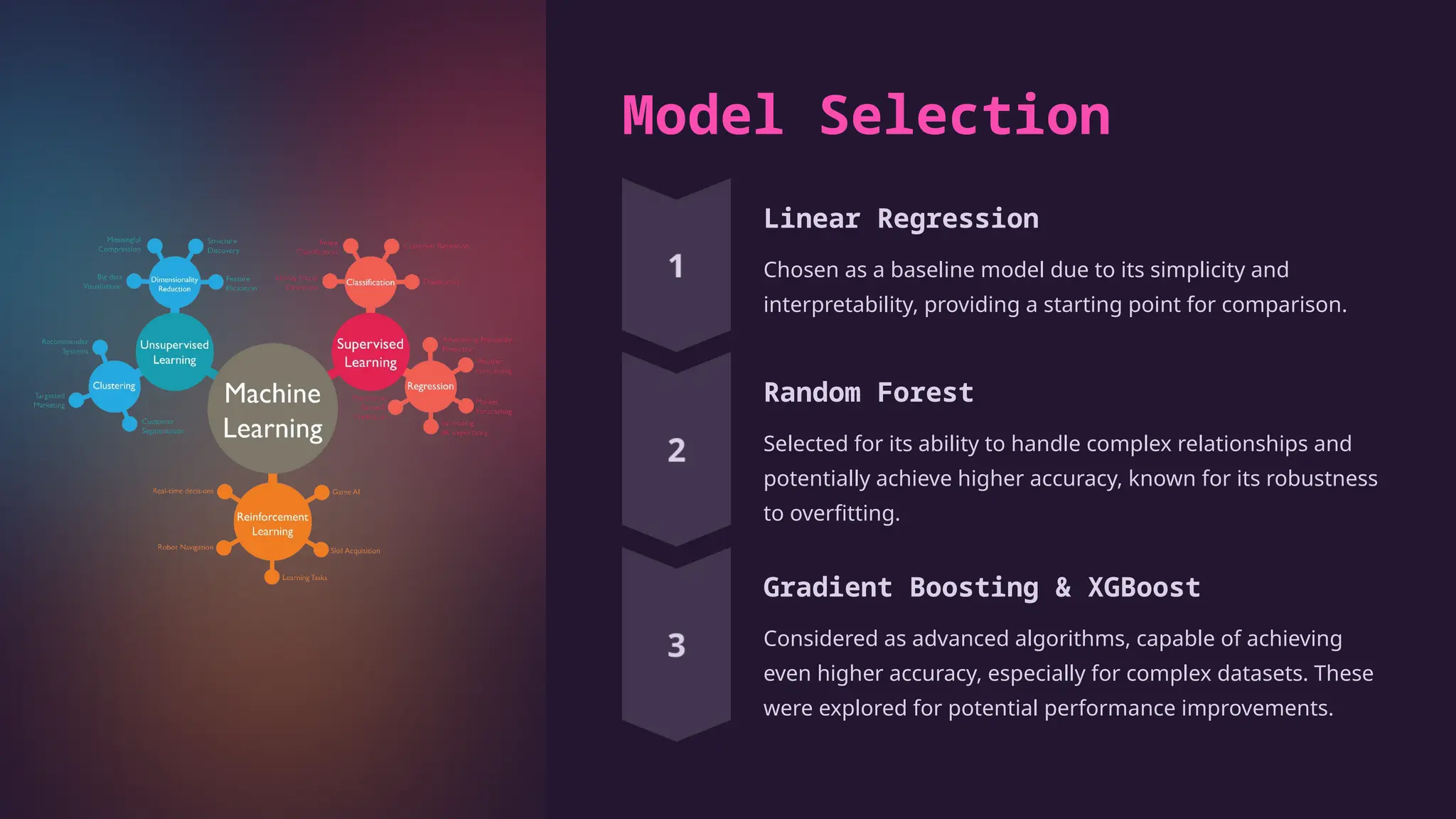
Chosen as a baseline model due to its simplicity and
interpretability, providing a starting point for comparison.
Random Forest
Selected for its ability to handle complex relationships and
potentially achieve higher accuracy, known for its robustness
to overfitting.
Gradient Boosting & XGBoost
Considered as advanced algorithms, capable of achieving
even higher accuracy, especially for complex datasets. These
were explored for potential performance improvements.
Model Training and Validation
Training Data
Utilized of the dataset for training
the models, allowing them to
learn patterns and relationships
from historical data.
Testing Data
Reserved of the dataset for
evaluating the performance of
trained models on unseen data,
providing an unbiased
assessment of generalization
ability.
Cross-Validation
Employed cross-validation
techniques to fine-tune model
parameters, preventing
overfitting by splitting the training
data into multiple folds and
iteratively training and evaluating
models on different combinations
of folds.
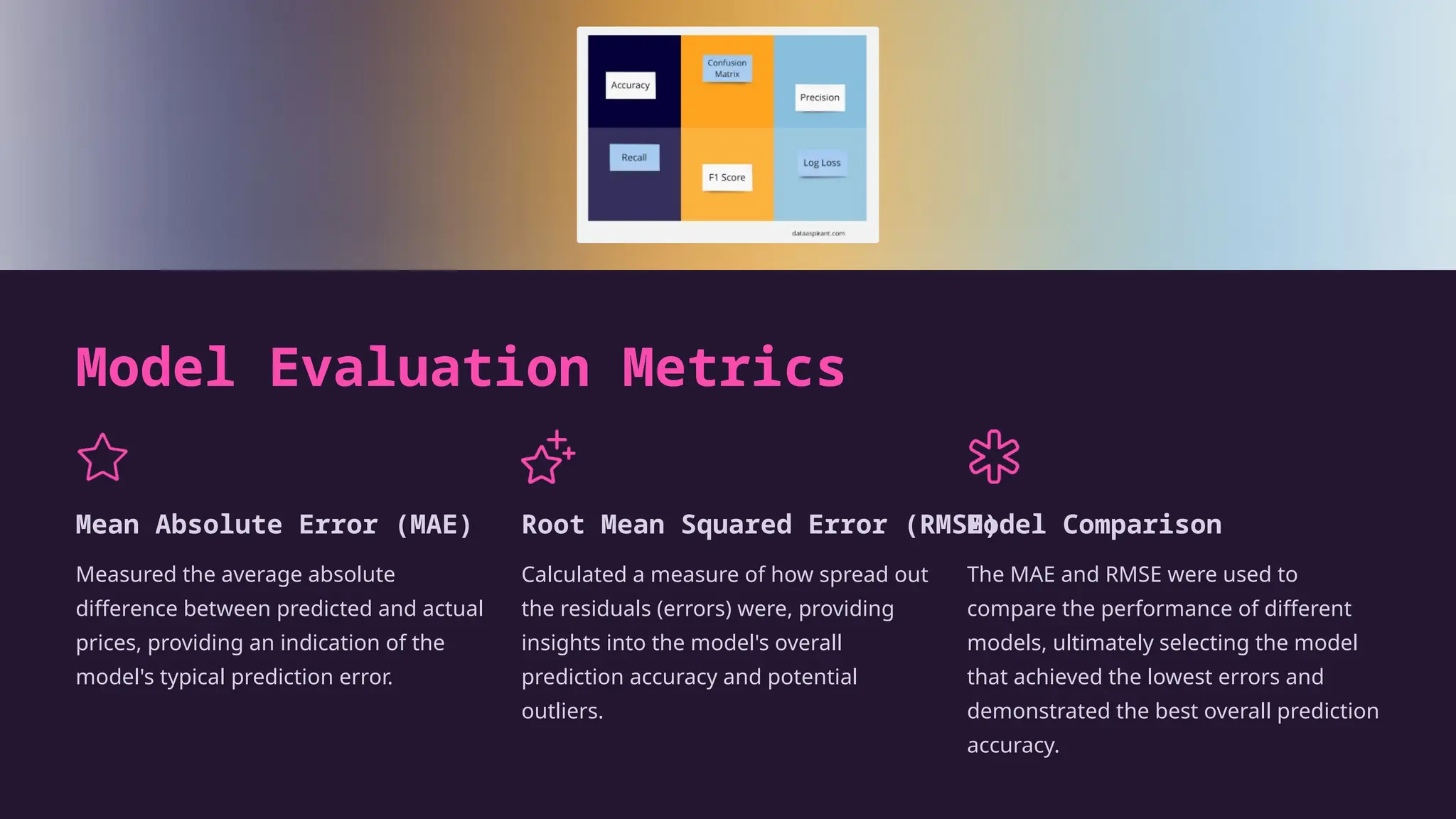
Model Evaluation Metrics
Mean Absolute Error (MAE)
Measured the average absolute
difference between predicted and actual
prices, providing an indication of the
model's typical prediction error.
Root Mean Squared Error (RMSE)
Calculated a measure of how spread out
the residuals (errors) were, providing
insights into the model's overall
prediction accuracy and potential
outliers.
Model Comparison
The MAE and RMSE were used to
compare the performance of different
models, ultimately selecting the model
that achieved the lowest errors and
demonstrated the best overall prediction
accuracy.
Used Car Price
Prediction
Model
This presentation showcases a powerful machine learning model
designed to predict used car prices accurately.
Results and Model Comparison
Model Performance
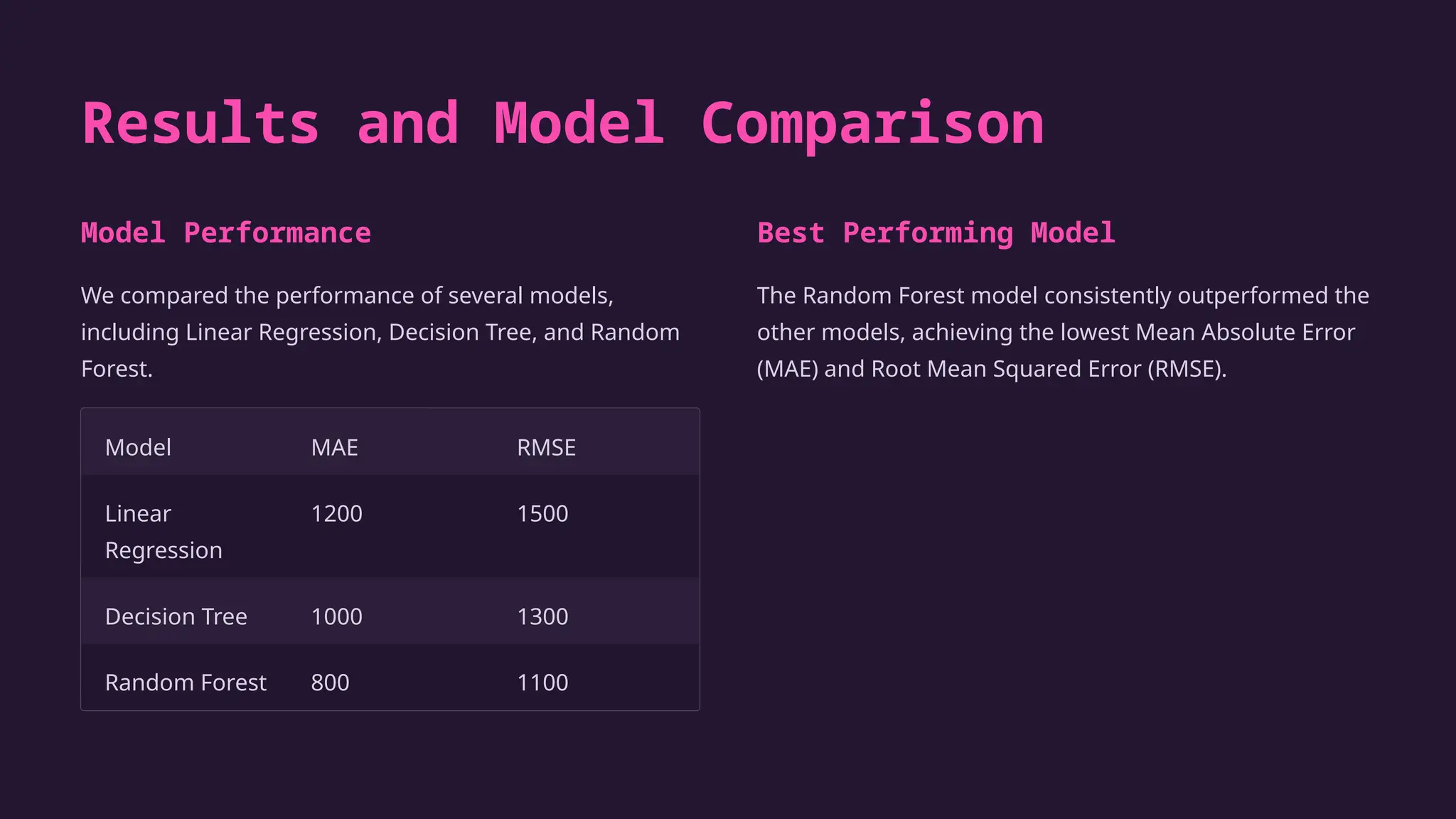
We compared the performance of several models,
including Linear Regression, Decision Tree, and Random
Forest.
Model MAE RMSE
Linear
Regression
1200 1500
Decision Tree 1000 1300
Random Forest 800 1100
Best Performing Model
The Random Forest model consistently outperformed the
other models, achieving the lowest Mean Absolute Error
(MAE) and Root Mean Squared Error (RMSE).
Random Forest Model - Deep Dive
1 Robustness to Outliers
Random Forest is less sensitive to outliers compared to linear models,
making it a better choice for datasets with potential data errors.
2 Handling Non-linear Relationships
The model can capture complex relationships between features and target
variable, enhancing its predictive power.
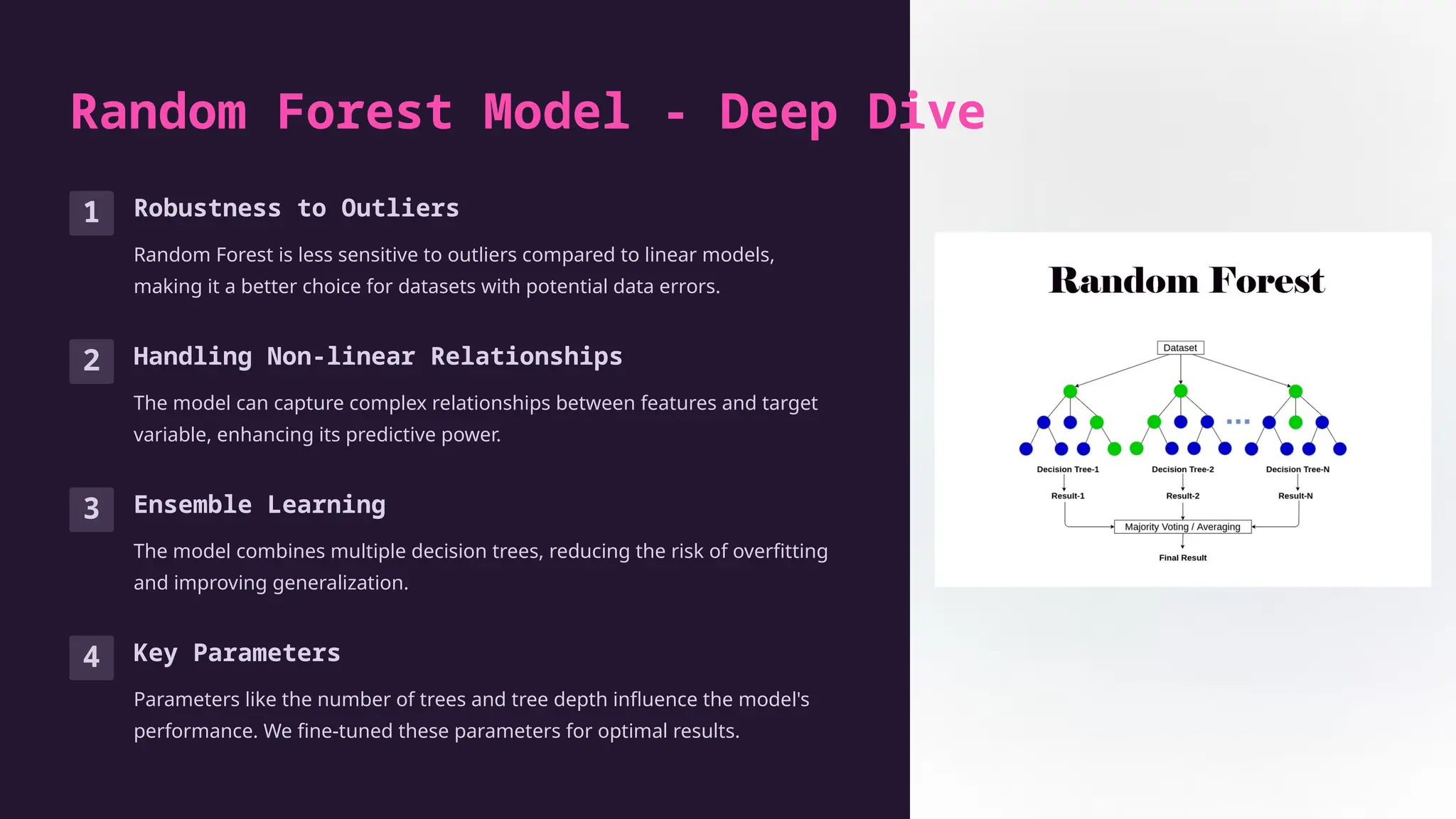
3 Ensemble Learning
The model combines multiple decision trees, reducing the risk of overfitting
and improving generalization.
4 Key Parameters
Parameters like the number of trees and tree depth influence the model's
performance. We fine-tuned these parameters for optimal results.
Project Outcomes and Impact
Successful Model
Development
We successfully developed a highly
accurate used car price prediction
model.
Improved Price Estimation
The model empowers buyers and
sellers with more accurate price
estimations, fostering more
transparent transactions.
Informed Decision Making
The model provides valuable
insights into factors influencing
used car prices, supporting
informed decision-making in the
market.
Future Work and
Enhancements
Incorporating Additional Features
We plan to include market trends data and geographic
location information to enhance model accuracy.
Model Updates
Regular retraining with new data is crucial to maintain
model accuracy as market conditions evolve.
Real-time Price Predictions
Integrating the model with real-time data sources can
enable instant price estimations for specific cars.
Thank You

Python machine learning case study ppt.pptx

  • 1.
    Data Science and Machine Learning Internship Thispresentation details my recent internship experience at the YBI Foundation, focusing on a used car price prediction model. Through this project, I honed my data science skills and gained valuable practical experience.
  • 2.
    Internship Overview 1 Host YBIFoundation, a non-profit organization dedicated to empowering youth in data science. 2 Project Used Car Price Prediction Model: Developing a machine learning model to accurately predict used car prices. 3 Duration The internship spanned a period of 1-month, providing ample time for comprehensive data analysis and model development. 4 Goal The primary objective was to build a robust model capable of providing reliable used car price predictions for both buyers and sellers.
  • 3.
    Acknowledgements YBI Foundation Expressing sinceregratitude to the YBI Foundation for providing this valuable internship opportunity, fostering my growth and skill development. Mentors Acknowledging the guidance and support of my mentors, who provided invaluable insights and expertise throughout the internship. Colleagues Extending appreciation to my fellow interns and colleagues for their collaboration, knowledge sharing, and positive contributions to the project.
  • 4.
    Project Background The Challenge Theused car market is dynamic, with prices influenced by a complex interplay of factors such as vehicle age, mileage, brand reputation, and market demand. This makes accurate price estimation challenging for both buyers and sellers. The Solution Leveraging machine learning, a data-driven approach can effectively analyze historical car data to identify patterns, build predictive models, and improve price estimation accuracy.
  • 5.
    Data Collection andSources Data Source Description Public Datasets Accessed publicly available datasets containing extensive information on used car sales, including features like vehicle details, price history, and market trends. Web Scraping Utilized web scraping techniques to extract data from online car marketplaces and classifieds, expanding the dataset with real- time information.
  • 6.
    Data Preprocessing 1 DataCleaning Addressed data inconsistencies and errors, ensuring data quality and model reliability. This involved handling missing values by employing imputation techniques and removing duplicate records to maintain data integrity. 2 Data Transformation Transformed categorical variables, such as car make and model, into numerical values using one-hot encoding. Scaled numerical features, such as mileage and engine size, for consistency and improved model performance. 3 Feature Engineering Created new features, potentially more informative than existing ones, by combining or transforming existing data. For instance, calculated car age from the manufacturing year, providing a more direct measure of vehicle age.
  • 7.
    Exploratory Data Analysis(EDA) Scatter Plots Investigated relationships between variables, such as mileage and price, identifying potential linear or non-linear trends. Histograms Examined the distribution of individual features, such as car age, to understand data characteristics and potential outliers. Box Plots Visualized the distribution of features for different categories, such as car make, to identify potential differences in price distributions.
  • 8.
    Model Selection Linear Regression Chosenas a baseline model due to its simplicity and interpretability, providing a starting point for comparison. Random Forest Selected for its ability to handle complex relationships and potentially achieve higher accuracy, known for its robustness to overfitting. Gradient Boosting & XGBoost Considered as advanced algorithms, capable of achieving even higher accuracy, especially for complex datasets. These were explored for potential performance improvements.
  • 9.
    Model Training andValidation Training Data Utilized of the dataset for training the models, allowing them to learn patterns and relationships from historical data. Testing Data Reserved of the dataset for evaluating the performance of trained models on unseen data, providing an unbiased assessment of generalization ability. Cross-Validation Employed cross-validation techniques to fine-tune model parameters, preventing overfitting by splitting the training data into multiple folds and iteratively training and evaluating models on different combinations of folds.
  • 10.
    Model Evaluation Metrics MeanAbsolute Error (MAE) Measured the average absolute difference between predicted and actual prices, providing an indication of the model's typical prediction error. Root Mean Squared Error (RMSE) Calculated a measure of how spread out the residuals (errors) were, providing insights into the model's overall prediction accuracy and potential outliers. Model Comparison The MAE and RMSE were used to compare the performance of different models, ultimately selecting the model that achieved the lowest errors and demonstrated the best overall prediction accuracy.
  • 11.
    Used Car Price Prediction Model Thispresentation showcases a powerful machine learning model designed to predict used car prices accurately.
  • 12.
    Results and ModelComparison Model Performance We compared the performance of several models, including Linear Regression, Decision Tree, and Random Forest. Model MAE RMSE Linear Regression 1200 1500 Decision Tree 1000 1300 Random Forest 800 1100 Best Performing Model The Random Forest model consistently outperformed the other models, achieving the lowest Mean Absolute Error (MAE) and Root Mean Squared Error (RMSE).
  • 13.
    Random Forest Model- Deep Dive 1 Robustness to Outliers Random Forest is less sensitive to outliers compared to linear models, making it a better choice for datasets with potential data errors. 2 Handling Non-linear Relationships The model can capture complex relationships between features and target variable, enhancing its predictive power. 3 Ensemble Learning The model combines multiple decision trees, reducing the risk of overfitting and improving generalization. 4 Key Parameters Parameters like the number of trees and tree depth influence the model's performance. We fine-tuned these parameters for optimal results.
  • 14.
    Project Outcomes andImpact Successful Model Development We successfully developed a highly accurate used car price prediction model. Improved Price Estimation The model empowers buyers and sellers with more accurate price estimations, fostering more transparent transactions. Informed Decision Making The model provides valuable insights into factors influencing used car prices, supporting informed decision-making in the market.
  • 15.
    Future Work and Enhancements IncorporatingAdditional Features We plan to include market trends data and geographic location information to enhance model accuracy. Model Updates Regular retraining with new data is crucial to maintain model accuracy as market conditions evolve. Real-time Price Predictions Integrating the model with real-time data sources can enable instant price estimations for specific cars.
  • 16.