PROJECT
on
“Networked Data Acquisition System
for Indian Black Tea
Manufacturing Process”
05/16/18 1
AbstrAct
The main objective of this project is to study manufacturing
processes of Indian black tea, its key parameters attributing to
quality of manufactured tea and to realize the characteristics of
various sensors and advanced instrumentation systems at critical
unit operations for making availability of flexible research
infrastructure for improvement of quality and productivity of the
tea and also achieving the consistency of the quality along with
savings of electrical energy in the system.
05/16/18 2
INtrODUctION
Tea is one of the most important and highest foreign exchange
earning agricultural products of India. The Indian states of Assam,
Meghalaya, Tripura, North Bengal (Darjeeling), and Sikkim
contribute significantly to the overall tea production in the country.
There are three major varieties of tea produced worldwide such as
Orthodox, CTC & Green Tea. India produces 850 million Kgs of Tea
annually, which is 30% of world production. Physical property of
Orthodox tea gives more flavors and less liquor; whereas CTC tea
gives strong liquor but less flavors.
05/16/18 3
ObJEctIVE OF tHE WOrK
 To explore various electronic sensors.
 To explore Data Acquisition card (NI USB 6008).
 To design signal conditioning circuit for sensor data acquisition.
 To test the final set up of the networked based data acquisition system
making for the tea processing factory at C-DAC, Kolkata Laboratory and
used my PC as a Central Server computer.
 To Control the environment and carefully notice the value at different time
measuring by the RTD and RH sensors.
 To store the collected data from various sensors for a miniature tea
processing factory and compare them also the normal data for making
better quality of tea in future.
05/16/18 4
blOcK DIAgrAm OF tHE WOrK DEVElOpED
At c-DAc lAbOrAtOry
2 5 0 O h m
2 5 0 O h m
2 5 0 O h m
2 5 0 O h m
N I P o w e r
S u p p l y
2 4 - 2 8 V D C
+ + - -
R T D +
S E N S O R
1 -
R T D +
S E N S O R
2 -
R H
S E N S O R
1 +
-
H u m i d i t y O / P
T e m p . O / P
R H
S E N S O R
2
+
-
H u m i d i t y O / P
T e m p . O / P
A n a l o g P o r t
N A T I O N A L I N S T R U M E N T S
D A Q C A R D
N I U S B 6 0 0 8
8 I n p u t s , 1 2 - b i t , 1 0 K S / s M u l t i f u n c t i o n
I / O
D i g i t a l P o r t
L a b V I E W
P r o g r a m m i n g
a n d
R e s u l t a n t
D a t a S t o r e d
C e n t r a l S e r v e r P C
05/16/18 5
WHAt Is DAtA AcqUIsItION & Its
cOmpONENt?
Data acquisition is the process of sampling signals that measure
real world physical conditions and converting the resulting
samples into digital numeric values that can be manipulated by a
computer. Data acquisition systems typically convert analog
waveforms into digital values for processing.
05/16/18 6
mAIN prOcEssEs OF tEA mANUFActUrINg
a) Withering- In this process, leaf is allowed to partially dry or wither to
reduce its Moisture content.
b) Rolling & CTC- In CTC machine leaf is filled into a gap between two
rollers having circumferential cutting edges and running at differential
speeds.
c) Fermentation - After the leaf cells have been damaged by rolling the leaf is
left to ferment. Exposure to air produces a copper like and fragrant aroma.
d) Drying - With a view to check fermentation and drying of the leaf, it is
subjected to a blast of hot air provided by means of furnace.
05/16/18 7
HARDWARE DESCRIPTION
In this part we make a wired signal transmission circuit board includes two
different types sensor and for connecting we used twisted pair cable because of
it less transmission loss, less noise creating capacity and higher transmission
rate.
Resistance Temperature Detector(RTD):-
Resistance thermometers, also called resistance temperature detectors (RTDs),
are sensors used to measure temperature by correlating the resistance of the
RTD element with temperature. Here we use LTX 3000-H RTD sensor.
05/16/18 8
HUMIDITY SENSORS
Humidity is the amount of water vapour in the air. Humidity indicates the
likelihood of fog. There are three main measurements of humidity: Absolute,
Relative and Specific. In this project we used RHTX-D4030 model RH sensor
which produced by Electro life System Company.
05/16/18 9
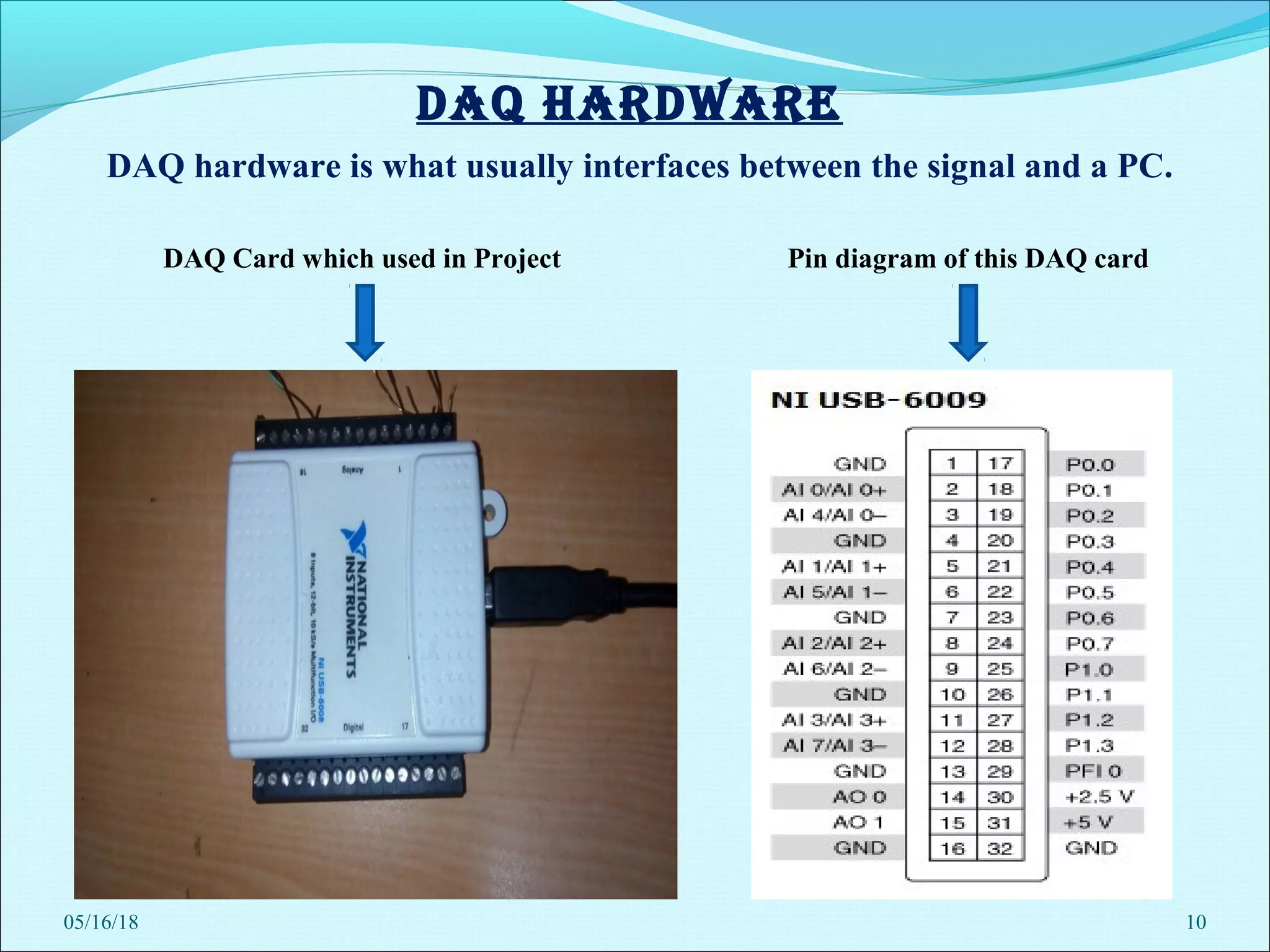
DAQ HARDWARE
DAQ hardware is what usually interfaces between the signal and a PC.
05/16/18 10
DAQ Card which used in Project Pin diagram of this DAQ card
HARDWARE SETUP AT DIffERENT lOCATION IN C-
DAC
05/16/18 11
Preliminary Hardware setup into the central server PC Sensor’s setup at the corner of LAB
HARDWARE SETUP AT DIffERENT
lOCATION
05/16/18 12
Full hardware setup on server PC table Sensor setup on the roof of office
SOfTWARE DESCRIPTION
The software part is for data acquisition from the different sensors
Software used:-
a) NI Lab VIEW 11- It is the latest version of the only system design
software that provides engineers and scientists with the tools they need to
create any measurement and control systems.
b) Measurements and automation explore 5.1-
The Measurement & Automation Explorer (MAX) provides access to your
National Instruments devices and systems.
05/16/18 13
lAB VIEW PROGRAMMING & ITS
IMPORTANCE
 a) Simplicity:- Lab VIEW is an easy to learn programming language and
engineering tool. It’s can create applications without writing any lines of
text-based code.
b) Flexibility:-It gives us the flexibility of a powerful programming
language without the complexity of traditional development environments.
c) Easy to Interface Hardware:- It delivers seamless
connectivity with Measurement hardware.
05/16/18 14
Software Setup of thiS work
Temperature and Humidity measurement using RTD and RH sensor through
DAQ card in LabVIEW:-
05/16/18 15
LabVIEW Block Diagram for this work
LabView front paneL Showing the finaL reSuLt
In the above window we display the value of temp. and humidity value
collecting from the environment by using different sensors
05/16/18 16
The 30 days time stumped value of temperature collected by RTD1 sensor
Day No. Temp. Value .C Day No. Temp. value .C
1 22.57 16 24.43
2 20.05 17 24.40
3 25.09 18 23.74
4 25.54 19 23.01
5 21.11 20 24.73
6 27.86 21 24.03
7 22.98 22 24.62
8 24.17 23 23.21
9 22.67 24 24.58
10 21.97 25 30.84
11 22.45 26 25.56
12 30.42 27 23.84
13 26.36 28 28.76
14 24.01 29 22.95
15 23.89 30 24.0205/16/18 17
thiS graph prepared from the aboVe data
05/16/18 18
The 30 days time stumped value of temperature collected by RTD2 sensor
Day No. Temp.
Value .C
Day No. Temp.
value .C
1 23.00 16 23.76
2 21.07 17 24.62
3 23.99 18 23.29
4 23.23 19 25.22
5 21.63 20 25.36
6 20.92 21 23.86
7 22.33 22 24.00
8 29.14 23 23.82
9 24.11 24 23.62
10 26.92 25 32.68
11 23.32 26 26.00
12 28.60 27 21.89
13 24.14 28 24.63
14 24.32 29 29.65
24.21 24.89
05/16/18 19
thiS graph prepared from the aboVe
data
05/16/18 20
The 30 days time stumped value of humidity collected by RH sensor
Day No. % RH value Day No. % RH value
1 51.84 16 62.28
2 48.29 17 71.74
3 59.06 18 73.56
4 64.54 19 71.09
5 62.89 20 74.19
6 56.57 21 72.12
7 58.79 22 56.62
8 51.72 23 83.29
9 60.89 24 80.48
10 86.12 25 73.62
11 78.95 26 43.68
12 57.25 27 46.58
13 62.42 28 54.89
14 66.39 29 44.29
15 72.99 30 65.2905/16/18 21
This graph prepared from The above daTa
05/16/18 22
ConClusion
In this project which I completed at C-DAC laboratory, I learnt more valuable
things working with this electronics components, at first I knew the basic
principle of application electronics that how the environmental data can be
acquire by using DAQ card through a twisted pair cable as a medium. The main
important thing which I learnt from this work that use of LabVIEW software. I
also learnt from it the specification and what’s the correct way to use this RTD
and RH sensors.
Here I also learnt the various function of ENV system and E-Tongue and how
we can easily test the quality of a tea by using this machine. And also knew the
difference between E-Tongue and human tongue.
05/16/18 23
fuTure sCope of This work
The results of the project work, namely, “Networked Data Acquisition system
for Indian Black Tea Manufacturing” shows valuable data collection and
archival system which can be replicated in bigger way for tea manufacturing
factory to create a reliable, objective data bank for future analysis and research
work by tea scientist for substantial improvement of made tea quality and
productivity. The DAQ system, as presented here, may also be explored using
wireless smart sensors for reducing installation time, cost and hardware count,
and thus improving reliability further.
05/16/18 24
referenCes
www.ni.com
www.ti.com
Sensors and transducers (Progress in Technology Automotive Electronics
series) , 2nd
edition, written by Ronald K. Jurgen.
Wireless Sensor Networks, written by Rghavendra.
Cabling- The complete guide to copper and fiber-optic networking 5th
edition, written by Andrew Oliviero & Bill Woodward.
Power transformers by Khanna Publisher.
PC Interfacing and Data Acquisition written by James.
LabVIEW graphical programming written by Gary W.Johnson & Richard
Jennings.
05/16/18 25
Thank You
05/16/18 26

DAQ Presentation@Habibur Rahaman

  • 1.
    PROJECT on “Networked Data AcquisitionSystem for Indian Black Tea Manufacturing Process” 05/16/18 1
  • 2.
    AbstrAct The main objectiveof this project is to study manufacturing processes of Indian black tea, its key parameters attributing to quality of manufactured tea and to realize the characteristics of various sensors and advanced instrumentation systems at critical unit operations for making availability of flexible research infrastructure for improvement of quality and productivity of the tea and also achieving the consistency of the quality along with savings of electrical energy in the system. 05/16/18 2
  • 3.
    INtrODUctION Tea is oneof the most important and highest foreign exchange earning agricultural products of India. The Indian states of Assam, Meghalaya, Tripura, North Bengal (Darjeeling), and Sikkim contribute significantly to the overall tea production in the country. There are three major varieties of tea produced worldwide such as Orthodox, CTC & Green Tea. India produces 850 million Kgs of Tea annually, which is 30% of world production. Physical property of Orthodox tea gives more flavors and less liquor; whereas CTC tea gives strong liquor but less flavors. 05/16/18 3
  • 4.
    ObJEctIVE OF tHEWOrK  To explore various electronic sensors.  To explore Data Acquisition card (NI USB 6008).  To design signal conditioning circuit for sensor data acquisition.  To test the final set up of the networked based data acquisition system making for the tea processing factory at C-DAC, Kolkata Laboratory and used my PC as a Central Server computer.  To Control the environment and carefully notice the value at different time measuring by the RTD and RH sensors.  To store the collected data from various sensors for a miniature tea processing factory and compare them also the normal data for making better quality of tea in future. 05/16/18 4
  • 5.
    blOcK DIAgrAm OFtHE WOrK DEVElOpED At c-DAc lAbOrAtOry 2 5 0 O h m 2 5 0 O h m 2 5 0 O h m 2 5 0 O h m N I P o w e r S u p p l y 2 4 - 2 8 V D C + + - - R T D + S E N S O R 1 - R T D + S E N S O R 2 - R H S E N S O R 1 + - H u m i d i t y O / P T e m p . O / P R H S E N S O R 2 + - H u m i d i t y O / P T e m p . O / P A n a l o g P o r t N A T I O N A L I N S T R U M E N T S D A Q C A R D N I U S B 6 0 0 8 8 I n p u t s , 1 2 - b i t , 1 0 K S / s M u l t i f u n c t i o n I / O D i g i t a l P o r t L a b V I E W P r o g r a m m i n g a n d R e s u l t a n t D a t a S t o r e d C e n t r a l S e r v e r P C 05/16/18 5
  • 6.
    WHAt Is DAtAAcqUIsItION & Its cOmpONENt? Data acquisition is the process of sampling signals that measure real world physical conditions and converting the resulting samples into digital numeric values that can be manipulated by a computer. Data acquisition systems typically convert analog waveforms into digital values for processing. 05/16/18 6
  • 7.
    mAIN prOcEssEs OFtEA mANUFActUrINg a) Withering- In this process, leaf is allowed to partially dry or wither to reduce its Moisture content. b) Rolling & CTC- In CTC machine leaf is filled into a gap between two rollers having circumferential cutting edges and running at differential speeds. c) Fermentation - After the leaf cells have been damaged by rolling the leaf is left to ferment. Exposure to air produces a copper like and fragrant aroma. d) Drying - With a view to check fermentation and drying of the leaf, it is subjected to a blast of hot air provided by means of furnace. 05/16/18 7
  • 8.
    HARDWARE DESCRIPTION In thispart we make a wired signal transmission circuit board includes two different types sensor and for connecting we used twisted pair cable because of it less transmission loss, less noise creating capacity and higher transmission rate. Resistance Temperature Detector(RTD):- Resistance thermometers, also called resistance temperature detectors (RTDs), are sensors used to measure temperature by correlating the resistance of the RTD element with temperature. Here we use LTX 3000-H RTD sensor. 05/16/18 8
  • 9.
    HUMIDITY SENSORS Humidity isthe amount of water vapour in the air. Humidity indicates the likelihood of fog. There are three main measurements of humidity: Absolute, Relative and Specific. In this project we used RHTX-D4030 model RH sensor which produced by Electro life System Company. 05/16/18 9
  • 10.
    DAQ HARDWARE DAQ hardwareis what usually interfaces between the signal and a PC. 05/16/18 10 DAQ Card which used in Project Pin diagram of this DAQ card
  • 11.
    HARDWARE SETUP ATDIffERENT lOCATION IN C- DAC 05/16/18 11 Preliminary Hardware setup into the central server PC Sensor’s setup at the corner of LAB
  • 12.
    HARDWARE SETUP ATDIffERENT lOCATION 05/16/18 12 Full hardware setup on server PC table Sensor setup on the roof of office
  • 13.
    SOfTWARE DESCRIPTION The softwarepart is for data acquisition from the different sensors Software used:- a) NI Lab VIEW 11- It is the latest version of the only system design software that provides engineers and scientists with the tools they need to create any measurement and control systems. b) Measurements and automation explore 5.1- The Measurement & Automation Explorer (MAX) provides access to your National Instruments devices and systems. 05/16/18 13
  • 14.
    lAB VIEW PROGRAMMING& ITS IMPORTANCE  a) Simplicity:- Lab VIEW is an easy to learn programming language and engineering tool. It’s can create applications without writing any lines of text-based code. b) Flexibility:-It gives us the flexibility of a powerful programming language without the complexity of traditional development environments. c) Easy to Interface Hardware:- It delivers seamless connectivity with Measurement hardware. 05/16/18 14
  • 15.
    Software Setup ofthiS work Temperature and Humidity measurement using RTD and RH sensor through DAQ card in LabVIEW:- 05/16/18 15 LabVIEW Block Diagram for this work
  • 16.
    LabView front paneLShowing the finaL reSuLt In the above window we display the value of temp. and humidity value collecting from the environment by using different sensors 05/16/18 16
  • 17.
    The 30 daystime stumped value of temperature collected by RTD1 sensor Day No. Temp. Value .C Day No. Temp. value .C 1 22.57 16 24.43 2 20.05 17 24.40 3 25.09 18 23.74 4 25.54 19 23.01 5 21.11 20 24.73 6 27.86 21 24.03 7 22.98 22 24.62 8 24.17 23 23.21 9 22.67 24 24.58 10 21.97 25 30.84 11 22.45 26 25.56 12 30.42 27 23.84 13 26.36 28 28.76 14 24.01 29 22.95 15 23.89 30 24.0205/16/18 17
  • 18.
    thiS graph preparedfrom the aboVe data 05/16/18 18
  • 19.
    The 30 daystime stumped value of temperature collected by RTD2 sensor Day No. Temp. Value .C Day No. Temp. value .C 1 23.00 16 23.76 2 21.07 17 24.62 3 23.99 18 23.29 4 23.23 19 25.22 5 21.63 20 25.36 6 20.92 21 23.86 7 22.33 22 24.00 8 29.14 23 23.82 9 24.11 24 23.62 10 26.92 25 32.68 11 23.32 26 26.00 12 28.60 27 21.89 13 24.14 28 24.63 14 24.32 29 29.65 24.21 24.89 05/16/18 19
  • 20.
    thiS graph preparedfrom the aboVe data 05/16/18 20
  • 21.
    The 30 daystime stumped value of humidity collected by RH sensor Day No. % RH value Day No. % RH value 1 51.84 16 62.28 2 48.29 17 71.74 3 59.06 18 73.56 4 64.54 19 71.09 5 62.89 20 74.19 6 56.57 21 72.12 7 58.79 22 56.62 8 51.72 23 83.29 9 60.89 24 80.48 10 86.12 25 73.62 11 78.95 26 43.68 12 57.25 27 46.58 13 62.42 28 54.89 14 66.39 29 44.29 15 72.99 30 65.2905/16/18 21
  • 22.
    This graph preparedfrom The above daTa 05/16/18 22
  • 23.
    ConClusion In this projectwhich I completed at C-DAC laboratory, I learnt more valuable things working with this electronics components, at first I knew the basic principle of application electronics that how the environmental data can be acquire by using DAQ card through a twisted pair cable as a medium. The main important thing which I learnt from this work that use of LabVIEW software. I also learnt from it the specification and what’s the correct way to use this RTD and RH sensors. Here I also learnt the various function of ENV system and E-Tongue and how we can easily test the quality of a tea by using this machine. And also knew the difference between E-Tongue and human tongue. 05/16/18 23
  • 24.
    fuTure sCope ofThis work The results of the project work, namely, “Networked Data Acquisition system for Indian Black Tea Manufacturing” shows valuable data collection and archival system which can be replicated in bigger way for tea manufacturing factory to create a reliable, objective data bank for future analysis and research work by tea scientist for substantial improvement of made tea quality and productivity. The DAQ system, as presented here, may also be explored using wireless smart sensors for reducing installation time, cost and hardware count, and thus improving reliability further. 05/16/18 24
  • 25.
    referenCes www.ni.com www.ti.com Sensors and transducers(Progress in Technology Automotive Electronics series) , 2nd edition, written by Ronald K. Jurgen. Wireless Sensor Networks, written by Rghavendra. Cabling- The complete guide to copper and fiber-optic networking 5th edition, written by Andrew Oliviero & Bill Woodward. Power transformers by Khanna Publisher. PC Interfacing and Data Acquisition written by James. LabVIEW graphical programming written by Gary W.Johnson & Richard Jennings. 05/16/18 25
  • 26.