20502040203020202010
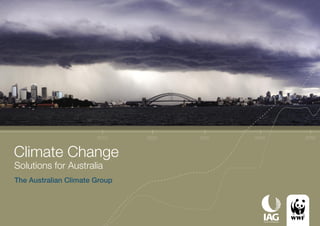
Climate Change
Solutions for Australia
The Australian Climate Group
First published in June 2004 by WWF Australia
© WWF Australia 2004. All Rights Reserved.
ISBN: 1875 94169X
Authors:
Tony Coleman
Professor Ove Hoegh-Guldberg
Professor David Karoly
Professor Ian Lowe
Professor Tony McMichael
Dr Chris Mitchell
Dr Graeme Pearman
Dr Peter Scaife
Anna Reynolds
The opinions expressed in this publication are those of the authors and
do not necessarily reflect the views of WWF.
WWF Australia
GPO Box 528
Sydney NSW Australia
Tel: +612 9281 5515
Fax: +612 9281 1060
www.wwf.org.au
For copies of this report or a full list of WWF Australia publications on a wide range of
conservation issues, please contact us on publications@wwf.org.au or call 1800 032 551.
Cover image: Shock and Awe © Andrew Pade (www.andrewpade.com).
Printed on Monza Satin recycled.
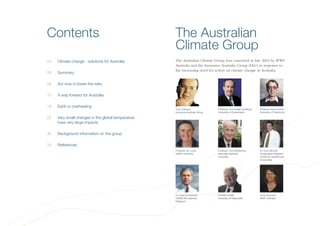
Contents The Australian
Climate Group
The Australian Climate Group was convened in late 2003 by WWF
Australia and the Insurance Australia Group (IAG) in response to
the increasing need for action on climate change in Australia.
04 Climate change - solutions for Australia
06 Summary
08 Act now to lower the risks
10 A way forward for Australia
16 Earth is overheating
22 Very small changes in the global temperature
have very large impacts
30 Background information on the group
34 References
Tony Coleman
Insurance Australia Group
Professor Ove Hoegh-Guldberg
University of Queensland
Professor David Karoly
University of Oklahoma
Professor Ian Lowe
Griffith University
Professor Tony McMichael
Australian National
University
Dr Chris Mitchell
Cooperative Research
Centre for Greenhouse
Accounting
Dr Graeme Pearman
CSIRO Atmospheric
Research
Dr Peter Scaife
University of Newcastle
Anna Reynolds
WWF Australia
2040203020202010 2050
Introduction
There are moments in time when global threats arise, and when action is imperative. One of the major risks to the security of people
around the world is climate change.
Never has there been a greater need for inspiring leadership to protect and defend our future against the rising threat of climate change.
We know that our world’s temperature is now rising unusually fast. Climate change has the potential to threaten millions of lives, the
capacity of the world to feed itself, the availability of fresh water, the control and spread of disease, the survival of species, the direction in
which our oceans flow and the severity of our weather.
The choice is before us: Do we sit and wait for climate change to get worse, or do we draw on our heritage of innovation and resilience to help
prevent the worst-case scenarios of climate change from occurring?
This group proposes the following set of solutions to lower the risk that climate change will reach a dangerous level:
1. REDUCE: Australia’s political leaders must work with business and the community to take immediate action to cut our greenhouse gas
emissions by 60% by 2050.
2. TRADE: Establish market mechanisms to trade greenhouse gas emissions, providing the business sector with a powerful tool to meet
reduction targets.
3. ACT: All Australians to take responsibility for their own role in reducing greenhouse gas emissions by using energy more wisely.
Climate Change –
Solutions for Australia
04. Climate Change – Solutions for Australia
4. ADAPT: Put in place measures to minimise the impacts of climate change, from building improvements to deal with more intense
storms, to investing in new agricultural industries which require less fresh water.
5. INNOVATE: New business opportunities must be developed and implemented as the rest of the world moves to low carbon
energy futures.
6. LEAD: A leadership role must be taken to identify and implement solutions to reduce the impacts of human-induced climate change.
As one of the wealthiest and best-educated nations in our region, we can share our innovations and technologies with nations of the
Asia Pacific.
Why should Australia attempt to sort out the climate change problem? After all, we know that even if we halted all our emissions
tomorrow, ongoing global climate change would still damage our country.
The reason we must is that dangerous climate change is a potential global outcome that would hurt Australia. The reason we can is because
we have always ‘punched well above our weight’ in international forums and have been leaders in formulating and implementing good
ideas. Australia has led the world in the establishment of voting rights for women, universal suffrage, fair wages for all and human rights.
Bold leadership, not just from politicians, business leaders, and scientists, but from all Australians is our best way forward.
Tony Coleman Professor Ove Hoegh-Gulberg
Professor David Karoly Professor Ian Lowe
Professor Tony McMichael Dr Chris Mitchell
Dr Graeme Pearman Dr Peter Scaife
Anna Reynolds
The Australian Climate Group
June 2004
05.Climate Change – Solutions for Australia
1. Act now to lower the risks
We hold the future in our hands and we still have choices. Our
actions today in Australia and in influencing the rest of the
world to reduce emissions will make a major difference to the
level of change that faces Australia. The main reasons to act
now are:
• Our way of life is at risk because Australia is vulnerable to
climate change. To argue that Australia cannot make a
difference to this global problem is to effectively resign
ourselves to global greenhouse emissions causing major
disruption to our climate and our lives.
• Leadership now will significantly reduce the risks and
future impact of climate change on us. The coming
decades are the crucial time to act if we are to avoid
higher levels of climate change.
2040203020202010 2050
06. Summary
Summary
• Greater occurrence of heavy rainfall events yet declining
total rainfall in metropolitan and agricultural regions,
particularly in south-western and south-eastern Australia
• Increasing severity of drought and bushfire
• Increases in the frequency of intense cyclones
• Rising sea levels.
4. Only small changes in the global temperature will have
large impacts
With just a 1 or 2 °C increase in the average global
temperature, Australia will need to deal with:
• Shifting rainfall patterns that reduce runoff to rivers and
recharge of water supplies
• Increasing agricultural and other economic losses from
natural disasters
• More damage to homes, business and infrastructure caused
by extreme weather
• Increased and new threats to the health of Australians
• Irreversible change to some natural ecosystems.
• We have the chance to seize new business and employment
opportunities in the emerging global economy that is
growing in response to the certainty of climate change.
2. A way forward for Australia starts today
The following key steps, if taken today, will make an
important impact for generations to come by reducing
emissions of carbon dioxide (and other greenhouse gases):
• Reduce emissions sufficient to make a difference by:
– Setting a national target for a reduction of emissions of
60% by 2050
– Implementing an emissions trading scheme by 2007 to
start progress towards this target being met
– Cutting energy costs by using energy more efficiently
• Adapt to a new climate - measures need to begin now
• Encourage the new business opportunities that will come
with a new era
• Ensure Australia is a lead player in the international arena.
3. Earth is overheating
Evidence that global warming is happening in Australia
today includes:
• Rising average temperatures leading to increased
frequency of hot days
07.Summary
We hold the future in our hands and we still have choices.
Our actions today, both here and in influencing the rest of the
world to reduce emissions, will make a major difference to the
level of threat that faces Australia.
Global warming is unlike other environmental challenges.
Usually we wait until the environmental problem is having
a major impact before we take action to fix it. But global
warming is different because greenhouse gases stay in the
atmosphere for many decades. The heat-trapping gases we add
to the atmosphere now will still be having a warming effect
late this century.
So decisive action now is one of the most important steps that
we can take to reduce the risks from global warming.
Three reasons to act now
1. Our way of life is at risk
The impacts of climate change are occurring sooner than
2040203020202010 2050
08. Act now to lower the risks
“Some risks are worse than others, appearing harmless at first
but ultimately having a devastating impact if not addressed
quickly. Climate change is such a risk.” Tony Coleman
Act now to
lower the risks
2. Active leadership now will reduce the risks and future impact
of climate change on us
Australia is particularly vulnerable to climate change,
especially because the water resources of our arid continent
will be greatly affected.
Practical leadership from our elected, business, and
community leaders is needed to help Australians understand
the choices facing our nation. We need to discuss the social
and economic changes that need to be made for the good of
the whole community, and to get organised to tackle
climate change.
If we do not respond to these challenges, gaps will widen
between rich and poor, urban and rural, north and south.
Some people will be buffered from the changes while
others will experience increasing hardship with increasing
temperatures and lack of water. Not dealing with these
realities could undermine Australian society.
3. We can seize new business and employment opportunities
Climate change affects the economy as well as the
environment, and brings opportunities as well as threats.
In fact, it demands a whole new global economy, in which
Australia must play a leading role as a forward-thinking nation.
New energy, transport and other services to cope with climate
change will bring many new business and employment
opportunities. Our global competitors are already moving to a
low-carbon economy, and some are now selling new
technologies to our Asian neighbours. We cannot afford to be
left behind.
we thought. When the first assessments were made in the
early 1990s, scientists expected the impacts to emerge
decades later – however impacts are being seen today.
The concentration of the major greenhouse gas, carbon
dioxide, in the atmosphere today depends on emissions
from at least the previous hundred years. The climate
system responds slowly to increasing carbon dioxide,
mainly because the oceans take a long time to adjust to the
increased heat.
This means we are already ‘locked into’ a future at least 1°C
warmer than the pre-industrial average temperature of
several hundred years ago.
While 1°C sounds small, this is the minimum level of change
we can expect. Consider that there is a difference of only
about 5°C between the modern climate and the Ice Age
thousands of years ago. This temperature difference brought
about massive changes to sea levels and the global
distribution of ecosystems. Today’s changes in temperatures
are happening much faster than those of the past.
But we do have choices - the earlier we reduce greenhouse-
gas emissions, the less risk we have of compromising the
Australian way of life and the less it will cost. Even simple
everyday things we take for granted – like washing the car,
putting petrol in it, and going to the beach – won’t be so
readily available in a future Australia dealing with
climate change.
This means we have to adapt. Part of adapting is changing
the way our lifestyle affects the atmosphere. We must
recognise that global warming is happening, take control and
make decisions that protect our way of life.
09.Act now to lower the risks
Bold leadership can trigger changes that bring more benefits
than anticipated. Australia needs a long-term national strategy
to avoid dangerous climate change. Important steps can be
taken today to trigger a momentum for change. Key steps
taken today will make an important impact that will be
appreciated by generations to come:
1. Set a national target of 60% reduction in greenhouse gas
emissions by 2050
To avoid a high level of climate-change damage, Australia
must cut emissions by at least 60% below current levels, as
must the rest of the world. The sooner we get to this point,
the lower the eventual temperature increase will be, and the
lower the risks for Australia.
Such a reduction target is challenging, but an
unprecedented threat like climate change needs a
challenging counter-response.
2040203020202010 2050
10. A way forward for Australia
A way forward for
Australia
“We need to make changes, but with these changes come
opportunity if we are able to see it.” Chris Mitchell
• encourage innovation – new technologies and business
practices that can provide our energy and transport
without emitting carbon dioxide to the atmosphere.
The proposed target can help to guide decisions today. A
decision made today that does not reduce emissions will
make the problem worse. Long lived infrastructure (like
power stations, freeways, housing development) can lock in
the release of millions of tonnes of carbon dioxide
emissions. Infrastructure proposals such as these should
now be considered for their climate impact as well as their
economic impact.
An uncertain regulatory environment threatens investment.
A ‘60% by 2050’ goal would increase certainty. It would
send an important signal to the business community, whose
investment decisions critically affect our ability to achieve
the 60% reduction by 2050.
The Energy Supply Association of Australia recently called
on the Australian Government to set a greenhouse gas
reduction target for the whole of Australia in order to
remove the current uncertainty about the future treatment of
large-scale, long-lived energy investments.
2. Implement a national emissions trading scheme by 2007 to
help ensure the target is met
An economically efficient way to encourage a major
reduction in emissions is to create a market for the main
greenhouse gas, carbon dioxide.
11.A way forward for Australia
An important first step is to agree that these cuts will need
to happen - then develop a strategy for how we can make it
happen to make the most of new opportunities and
minimise disruption.
The United Kingdom recently released a strategy for
achieving a 60% cut in energy emissions by 2050. Germany
has expressed a willingness to commit to a 40% emission
reduction target by 2020. Australia currently has a target to
increase emissions (as they were at 1990) by 8% by 2010.
This group thinks it would be prudent for the Australian
Government to set a 60% emission reduction goal by 2050.
This target can be reviewed which could strengthen or relax
the targets, as new scientific information becomes available.
As the target is long term, the Government needs to set
milestones, so that we make progressive reductions by
2020, 2030 and 2040 along the way to meeting the longer-
term goal.
To achieve the 60% emissions reduction by 2050 a full
range of policies and technologies will need to be on
the agenda and pursued with vigour. A solution that follows
a single path or depends on a single technology will not be
sufficient to reduce emissions to the extent required. All
levels of government and industry need to:
• aggressively pursue fuel switching - shifting to the full
range of cleaner energy technologies
• aggressively pursue energy conservation – stopping the
waste of energy
In this greenhouse world, the atmosphere can no longer
provide a free service – it has reached its capacity to absorb
excess greenhouse gases without creating other costs. Until
we place a value on the atmosphere, based on the costs of
damage caused by greenhouse gases, we make it difficult
for businesses to be guided toward the end goal in the most
efficient and effective manner.
As the regulator, the Government can create a market by
setting a ‘cap’, that is, deciding what the national volume
of carbon dioxide emissions will be. The market can then
determine the price of each ‘unit’ of carbon dioxide.
Through trading, the cost of meeting the ‘60 by 50’ target
will be lower and distributed more evenly across a wide
range of sectors.
More importantly, this strategy should unleash the creativity
and innovation of private industry providing a springboard
for capturing new business opportunities. This approach is
being taken in Europe and several states in the United
States of America.
There is a successful example of cutting pollution through
the approach of setting a cap and then allowing companies
to trade their pollution entitlements - the United States
trading scheme for sulphur dioxide, a gas that causes acid
rain. In 1980 sulphur dioxide emissions were 17.3 million
tonnes, and by 2000 they were 11.2 million tonnes. The
cost of meeting the pollution reduction targets became
cheaper for companies as there was money to be made
through innovation.
The strategy should spell out how this emissions target is
set: for example, how the cap is expressed (simple tonnes,
or per capita, or a relative target), who the target should
apply to (everyone, large emitters only, or some other sub-
sector), the penalties for exceeding the targets, and the
incentives for staying below the targets.
3. All Australians taking responsibility for their emissions
The fundamental requirement is easy to understand: we
need to do more with less – all Australians need to cut their
energy use by being more efficient.
The International Energy Agency reported that in 2001
Australia used 10.3 thousand kilowatt hours of electricity
per person compared to an average for industrialised
countries (OECD) of 7.9 thousand kilowatt hours per person.
There are direct economic benefits from using energy
more efficiently.
For example, lighting consumes 30 – 40% of a commercial
building’s electricity and a further 10% is needed as cooling
to offset the heat from lights. For buildings that have not had
lighting upgrades in the past 5 years, lighting costs can be cut
by 50 – 75% with investment in more efficient lights
recovered from cheaper electricity bills in just 1 – 3 years.
12. A way forward for Australia
The Council of Australian Government’s (COAG) National
Framework on Energy Efficiency Group estimates that
energy consumption could be reduced by up to 30% with
the use of current technologies.
4. Adapting to a new climate - measures need to begin now
If the world can reduce greenhouse gas emissions in the
order of 60% in the next fifty years, there is a greater chance
of limiting the total global average temperature increase to
around 2°C above the pre-industrial average. There will be
significant impacts on Australia, but much less than under
the higher emission scenarios that could see the global
temperature rise by up to 6°C.
Australians must now accept that our future climate will be
different to that of today. It is far better to plan for the
changes and take action now, than wait for the dramatic
outcomes and clean up the mess. This group believes that it
is prudent to begin adapting to an Australia that has:
1. Less water availability in southern Australia – this means
that we will need a national program to increase the
conservation and reuse of water.
2. More severe bushfires – this means that through
revamped planning laws we need to separate high
bushfire-risk areas and human settlements.
3. Longer and more intense droughts – this means we
need to assist rural industries to shift to new crops and
management practices that are more resilient.
4. Sea levels rising and changes in storm surges with
impacts on coastal communities – there needs to be a
detailed national assessment undertaken to identify
communities that are vulnerable to sea level rise and
coastal flooding. Once identified, planning in sensitive
coastal regions will have to factor in sea level rise. In the
longer term, it may be necessary to fund the protection
or relocation of some infrastructure.
5. Higher risk of insect-borne diseases of both humans and
animals in northern Australia and their shift southwards –
this means that additional resources need to be devoted
to increasing surveillance and control of diseases, both in
current at risk areas and in regions further south.
6. More intense heat during summer – this means
that building design codes will need to be
modified to improve the liveability of buildings in
extreme temperatures.
7. More extreme weather – national building regulations
will need to be reviewed to improve the resistance of
houses and buildings to higher winds and more intense
rainfall. Flood prone areas need to be identified with
the use of climate change models, and development in
these areas limited.
13.A way forward for Australia
5. Develop and encourage the new business opportunities that
will come with a new era
Energy pervades our life. It is fundamental to providing
food, water, and transport; producing materials for housing;
for developing and operating our urban infrastructure; for
powering industry and employment.
The business opportunities in responding to climate change
are unprecedented. The challenge of reducing emissions
will stimulate technological innovation and create new
markets. New products will be needed which are less
energy and carbon-intensive over their entire life cycle.
Imagine an Australia where every car we produce is driven
by fuel cells or better technology. Our homes all have solar
hot water systems, and solar cell panels so that we can even
sell the electricity our roof system generates onto the grid.
All new homes are built with full insulation, and with
windows that are directed to allow the sun to warm the
home in winter and cool it in summer. Lights turn off
automatically when people leave the room. In such an
Australia there would be no more huge power bills, gas
bills or petrol bills.
Business opportunities include the increasing use of renewable
energy, the potential hydrogen economy and increasing the
efficiency of the generation, distribution and use of fossil fuel
electricity. Currently, some renewable energy technologies are
growing by over 30% per year worldwide. Opportunities exist
in technologies, such as solar, geo-thermal, and wind power.
There are opportunities in the urban environment, such as
the design of infrastructure and energy efficient buildings,
including their components. There will be major changes in
transport systems. Existing car technology enables fuel
consumption, and the related emissions, to be reduced by
50% without changing overall performance.
Responding to climate change impacts will also mean new
business – new agricultural practices, better ways of storing
and saving water, building for more severe storms.
Australia can develop useful technology and practical
solutions, and export these worldwide, in particular to the
Asian-Pacific region.
Now imagine an Australia, situated in the fastest growing
region of the world, with ready access to markets in China
and India. Our climate-friendly cars, solar hot water
systems, solar panels, new building technologies and more,
in easy reach of the markets of billions.
There are major benefits to Australian business by making a
transition now to lower greenhouse gas-emission
technologies. Australia’s economy will be better placed
in a changing world if we ensure that our business sector is
part of this change. Any reductions in oil consumption will
also benefit our balance of payments, since oil imports are
predicted to increase rapidly as local reserves are depleted.
There are a number of initiatives already underway at a
government level (Federal, State and local) to support the
development of opportunities. More initiatives that are carefully
targeted should be progressively but urgently implemented.
14. A way forward for Australia
“I am increasingly of the view that major reductions in greenhouse gas
emissions can be achieved in many sectors of the economy, without
adversely impacting on our standard of living.” Peter Scaife
6. Australia’s international leadership can make a difference
Although Australia’s relative contribution to global emissions
is small, our per capita emissions are among the largest
in the world. We reside in a part of the world that will be
significantly affected by climate change, including our own
landmass. Our nation needs to reduce our emissions, but on
our own we cannot protect Australia from a dangerous level
of climate change. In order to encourage other countries to
address their emissions we must take action ourselves
and lead by example.
Australia has been at the forefront of major international
issues for over a century. As we have all heard in discussions
about Australia’s role in the world, we ‘punch above our
weight’. We pride ourselves in finding innovative solutions
to major problems, and to never shirking our responsibilities.
Global warming represents an example of a global crisis
that needs all hands to the wheel. It is not the Australian
way to run away from the battle. We need to work with
people from around the world and fix the problem.
As we all know, actions speak louder than words. Only
through bold leadership, domestic action and global
agreements will we fix this problem. We must meet tough
targets ourselves, and encourage our friends and neighbours
to do the same. To protect Australia we need others such as
the United States, China and India to move in a way which
minimises the impacts of the climate change. We can only
achieve the result we need globally if we take a stronger
leadership role. This needs to be backed up by a positive
approach at home to reduce emissions from all sectors,
particularly those growing rapidly like energy and transport.
15.A way forward for Australia
Twenty years ago, the idea of human societies altering the
atmosphere of the entire planet to a point where life on earth
is changed forever sounded like a science-fiction story line.
These days it is science-fact. We know now that our world is
overheating, faster than ever before in human history.
And importantly, science has established cause and effect. The
changes in temperature cannot be explained by natural change
alone. The world’s thermostat is out of kilter because our use of
fossil fuels is changing the balance of gases in the atmosphere.
Australia is a warmer continent today than it used to be. The
unusually rapid warming over recent decades can be explained
only by increasing levels of greenhouse gases accumulating in
the atmosphere. This change in the atmosphere is the direct
result of our own actions. Each year human societies emit over
20 billion tonnes of carbon dioxide — the main greenhouse
16. Earth is overheating
2040203020202010 2050
Earth is
overheating
“The more I have studied this subject, the clearer it has become
that global warming is occurring now and it is going to get
much larger in the future.” David Karoly
gas — into the air mostly as a result of burning fossil fuels
for electricity and transport. This amount now exceeds the
capacity of the world’s natural ‘sinks’ – the oceans, forests and
soils - to absorb.
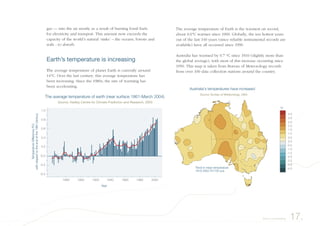
Earth’s temperature is increasing
The average temperature of planet Earth is currently around
14°C. Over the last century, this average temperature has
been increasing. Since the 1980s, the rate of warming has
been accelerating.
The average temperature of Earth is the warmest on record,
about 0.6°C warmer since 1900. Globally, the ten hottest years
out of the last 140 years (since reliable instrumental records are
available) have all occurred since 1990.
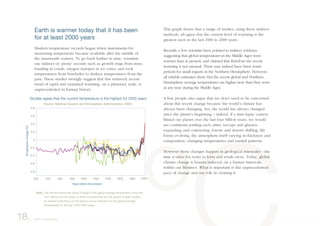
Australia has warmed by 0.7 °C since 1910 (slightly more than
the global average), with most of this increase occurring since
1950. This map is taken from Bureau of Meteorology records
from over 100 data collection stations around the country.
���
��
���
���
���
���
���
���
���
����
����
����
����
����
����
����
����������� ������������ ���� ���������
������� ������ �� ������������ ����
����� �� ���� �����������
��������� ������� ����
17.Earth is overheating
������� ������ ������ ��� ������� ���������� ��� ��������� ����
����
����
����
���
���
���
���
���
���� ���� ���� ���� ���� ���� ����
�������������������������
�����������������������������������
��� ������� ����������� �� ����� ����� ������� ���������� �����
����
This graph shows that a range of studies, using these indirect
methods, all agree that the current level of warming is the
greatest seen in the last 1000 to 2000 years.
Recently a few scientists have pointed to indirect evidence
suggesting that global temperatures in the Middle Ages were
warmer than at present, and claimed that therefore the recent
warming is not unusual. There may indeed have been warm
periods for small regions in the Northern Hemisphere. However,
all reliable estimates show that the recent global and Northern
Hemisphere average temperatures are higher now than they were
at any time during the Middle Ages.
A few people also argue that we don’t need to be concerned
about this recent change because the world’s climate has
always been changing. Yes, the world has always changed
since the planet’s beginning – indeed, if a time-lapse camera
filmed our planet over the last four billion years, we would
see continents jostling each other, icecaps and glaciers
expanding and contracting, forests and deserts shifting, life
forms evolving, the atmosphere itself varying in thickness and
composition, changing temperatures and rainfall patterns.
However these changes happen in geological timescales - the
time it takes for rocks to form and erode away. Today, global
climate change is human-induced, on a human timescale,
within our lifetimes. What is important is this unprecedented
pace of change and our role in creating it.
18. Earth is overheating
Earth is warmer today that it has been
for at least 2000 years
Modern temperature records began when instruments for
measuring temperature became available after the middle of
the nineteenth century. To go back further in time, scientists
use indirect or ‘proxy’ records such as growth rings from trees,
banding in corals, oxygen isotopes in ice cores, and rock
temperatures from boreholes to deduce temperatures from the
past. These studies strongly suggest that this relatively recent
trend of rapid and sustained warming, on a planetary scale, is
unprecedented in human history.
����
����
����
������� ����� ���� ��� ������� ����������� �� ��� ������� ��� ���� �����
������� �������� ������� ��� ����������� ��������������� ����
���������������������
��� ��� ��� ��� ���� ���� ���� ���� ���� ����
����� ������ ��� �������
���
���
���
���
�
����
��� ��� ���� ������ ��� ������ ������ �� ��� ������ ������� ����������� ����� ���
��������� ��� ��� ����� �� ����� �������� ����� ��� ��� ������� �� ����� �������
�� ������� ������������ �� ��� ����� �� ����� ���������� �� ��� ������ �������
����������� ��� ��� ���� ��������� ������
�����
This group is certain that carbon
dioxide is at a level unprecedented
in human history
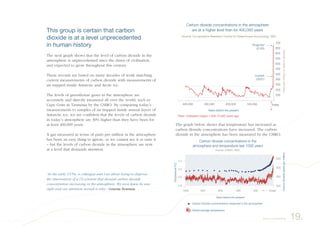
The next graph shows that the level of carbon dioxide in the
atmosphere is unprecedented since the dawn of civilisation,
and expected to grow throughout this century.
These records are based on many decades of work matching
current measurements of carbon dioxide with measurements of
air trapped inside Antarctic and Arctic ice.
The levels of greenhouse gases in the atmosphere are
accurately and directly measured all over the world, such as
Cape Grim in Tasmania by the CSIRO. By comparing today’s
measurements to samples of air trapped inside annual layers of
Antarctic ice, we are confident that the levels of carbon dioxide
in today’s atmosphere are 30% higher than they have been for
at least 400,000 years.
A gas measured in terms of parts per million in the atmosphere
has been an easy thing to ignore, as we cannot see it or taste it
– but the levels of carbon dioxide in the atmosphere are now
at a level that demands attention.
“In the early 1970s, a colleague and I set about trying to disprove
the observations of a US scientist that showed carbon dioxide
concentration increasing in the atmosphere. We soon knew he was
right and our attention turned to why.” Graeme Pearman
19.Earth is overheating
����
���
���
���
���� ��� ��� ��� ��� �����
���
���
���
���
������ ������� �������������� �� ���
���������� ��� ���������������� ���� �����
������� ������ ����
���������������
������������������������������
����� ������ ��� �������
������ ������� �������������� �������� �� ��� ����������
������ ������� �����������
The graph below shows that temperature has increased as
carbon dioxide concentrations have increased. The carbon
dioxide in the atmosphere has been measured by the CSIRO.
������� ������� ������� ������� �����
���
���
���
���
���
���
���
���
���
���
���
������ ������� �������������� �� ��� ����������
��� �� � ������ ����� ���� ��� ������� �����
������������������������������
������� ������������ �������� ������ ��� ���������� ����������� ����
���������
������
�������
������
����� ������ ��� ������� �
������ ������������ ����� ������������ ����� ���
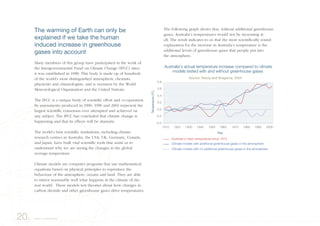
The following graph shows that, without additional greenhouse
gases, Australia’s temperatures would not be increasing at
all. The result indicates to us that the most scientifically sound
explanation for the increase in Australia’s temperature is the
additional levels of greenhouse gases that people put into
the atmosphere.
20. Earth is overheating
The warming of Earth can only be
explained if we take the human
induced increase in greenhouse
gases into account
Many members of this group have participated in the work of
the Intergovernmental Panel on Climate Change (IPCC) since
it was established in 1988. This body is made up of hundreds
of the world’s most distinguished atmospheric chemists,
physicists and climatologists, and is overseen by the World
Meteorological Organisation and the United Nations.
The IPCC is a unique body of scientific effort and co-operation.
Its assessments produced in 1990, 1996 and 2001 represent the
largest scientific consensus ever attempted and achieved on
any subject. The IPCC has concluded that climate change is
happening and that its effects will be dramatic.
The world’s best scientific institutions, including climate
research centres in Australia, the USA, UK, Germany, Canada,
and Japan, have built vital scientific tools that assist us to
understand why we are seeing the changes in the global
average temperature.
Climate models are computer programs that use mathematical
equations based on physical principles to reproduce the
behaviour of the atmosphere, oceans and land. They are able
to mirror reasonably well what happens in the climate of the
real world. These models test theories about how changes in
carbon dioxide and other greenhouse gases drive temperatures.
����
����
���
���
���
���
���
����������� ������ ����������� �������� �������� �� �������
������ ������ ���� ��� ������� ���������� �����
������� ������ ��� ��������� ����
���������������
����
���� ���� ���� ���� ���� ���� ���� ���� ���� ����
������� ������ ���� ���������� ���������� ����� �� ��� ����������
������� ������ ���� �� ���������� ���������� ����� �� ��� ����������
����������� ���� ����������� ����� ����
21.Earth is overheating
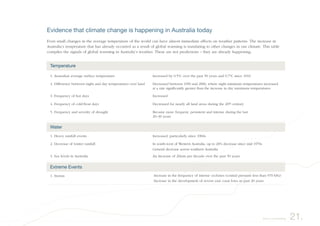
Evidence that climate change is happening in Australia today
Even small changes in the average temperature of the world can have almost immediate effects on weather patterns. The increase in
Australia’s temperature that has already occurred as a result of global warming is translating to other changes in our climate. This table
compiles the signals of global warming in Australia’s weather. These are not predictions – they are already happening:
Temperature
1. Australian average surface temperature Increased by 0.5ºC over the past 50 years and 0.7ºC since 1910
2. Difference between night and day temperatures over land Decreased between 1950 and 2000, where night minimum temperatures increased
at a rate significantly greater than the increase in day maximum temperatures
3. Frequency of hot days Increased
4. Frequency of cold/frost days Decreased for nearly all land areas during the 20th century
5. Frequency and severity of drought Became more frequent, persistent and intense during the last
20–30 years
Water
1. Heavy rainfall events Increased, particularly since 1960s
2. Decrease of winter rainfall In south-west of Western Australia, up to 20% decrease since mid 1970s
General decrease across southern Australia
3. Sea levels in Australia An Increase of 20mm per decade over the past 50 years
Extreme Events
1. Storms Increase in the frequency of intense cyclones (central pressure less than 970 hPa)
Increase in the development of severe east coast lows in past 20 years
22. Very small changes in the global temperature have very large impacts
Most people do not realise that even small changes in the
global average temperature can result in very significant
impacts. When people hear scientists warn of 2°, 3° and 5°C
increases in temperature they relate this to the changes in
temperature that they feel on any day, which is always a range
of temperatures larger than 2 to 5°C.
The key to understanding is to look back to the last ice-age
where the world and Australia were very different places, even
though the global average temperature at that time was only
about 5°C lower than today.
There is strong evidence that a range of climate change
impacts are occurring in Australia today – even with only a
low level of global warming. Further warming will continue
this process of change – and even a further 1°C increase in
the global temperature could bring deeper problems to these
areas of rainfall and drought, natural disasters, health and
natural ecosystems.
2040203020202010 2050
Very small changes in the
global temperature have very
large impacts
“All the work we are doing on other environmental problems
will be irrelevant if we don’t restore the balance of the climate
system.” Ian Lowe
Australia’s rain patterns will be disrupted
This group believes that the recent downward trends in rainfall
in parts of Australia are closely linked to global warming. For
each season that rainfall fails to replenish dams, the available
water supply diminishes further. This is causing serious
problems for water supply for cities and agriculture, with many
of the dams of our southern capital cities at only 50% capacity.
Many of our ecological and agricultural systems already exist at
the margins of sustainability partly due to water availability.
Much of Australia’s rainfall is affected by irregular changes in
Southern Hemisphere circulation of the atmosphere and oceans
such as the El Niño-Southern Oscillation (ENSO), and the
major Pacific and Indian Ocean currents. As a result, Australia’s
rainfall is fickle, with high variability from year to year. There
is a risk that our rainfall is particularly sensitive to changes in
the global climate.
Australia’s most important seasonal rain is delivered from
frontal systems in the southern fringes of the continent and
through the summer monsoon in the north.
A number of regions that are important for agriculture
have seen a substantial decline in rainfall over the past few
decades. In southwest Australia, rainfall declined sharply
during the 1970s by 15-20%. The sudden change seen in this
part of Australia suggests that changes can be sudden. In
southern Victoria, adjacent parts of South Australia, and north-
eastern Tasmania, rainfall has been low over the past decade
compared to the long-term average.
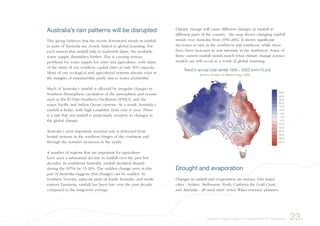
Climate change will cause different changes in rainfall in
different parts of the country - the map shows changing rainfall
trends over Australia from 1950-2002. It shows significant
decreases in rain in the southwest and southeast, while there
have been increases in rain intensity in the northwest. Some of
these current rainfall trends match what climate change science
models say will occur as a result of global warming.
Drought and evaporation
Changes in rainfall and evaporation are serious. Our major
cities - Sydney, Melbourne, Perth, Canberra the Gold Coast
and Adelaide - all need more water. Water resource planners
����
����
����
����
����
����
���
���
����
�����
�����
�����
�����
�����
�����
����� �� ������ ����� �������� ���� � ���� ������ ����
������� ������ �� ������������ ����
23.Very small changes in the global temperature have very large impacts
Economic losses from Australia’s natural
disasters are increasing
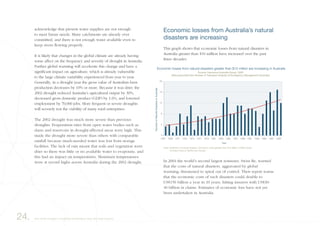
This graph shows that economic losses from natural disasters in
Australia greater than $10 million have increased over the past
three decades.
In 2004 the world’s second largest reinsurer, Swiss Re, warned
that the costs of natural disasters, aggravated by global
warming, threatened to spiral out of control. Their report warns
that the economic costs of such disasters could double to
US$150 billion a year in 10 years, hitting insurers with US$30-
40 billion in claims. Estimates of economic loss have not yet
been undertaken in Australia.
�
�
�
��
��
��
�������� ������ ���� ������� ��������� ������� ���� ��� ������� ��� ���������� �� ���������
������� ��������� ��������� ������ ����
�������������� ���� ������ �� ��������� �������� �� ��������� ���������� ����������
�����������������������������������
���� ���� ���� ���� ���� ���� ���� ���� ���� ���� ���� ���� ���� ���� ���� ���� ����
����� ���������� �� ������� ��������� �������� ����� ������� ���� ��� ������� ����� �������
�������� ����� �� ������ ��� ���������
����
24. Very small changes in the global temperature have very large impacts
acknowledge that present water supplies are not enough
to meet future needs. Many catchments are already over
committed, and there is not enough water available even to
keep rivers flowing properly.
It is likely that changes in the global climate are already having
some affect on the frequency and severity of drought in Australia.
Further global warming will accelerate this change and have a
significant impact on agriculture, which is already vulnerable
to the large climate variability experienced from year to year.
Generally, in a drought year the gross value of Australian farm
production decreases by 10% or more. Because it was drier, the
2002 drought reduced Australia’s agricultural output by 30%,
decreased gross domestic product (GDP) by 1.6%, and lowered
employment by 70,000 jobs. More frequent or severe droughts
will severely test the viability of many rural enterprises.
The 2002 drought was much more severe than previous
droughts. Evaporation rates from open water bodies such as
dams and reservoirs in drought-affected areas were high. This
made the drought more severe than others with comparable
rainfall because much-needed water was lost from storage
facilities. The lack of rain meant that soils and vegetation were
drier so there was little or no available water to evaporate, and
this had an impact on temperatures. Maximum temperatures
were at record highs across Australia during the 2002 drought.
Damage to infrastructure caused by
extreme weather
Small global temperature increases of only a degree or two can
cause big changes in the frequency and intensity of extreme
weather events: heatwaves, storms with stronger winds and
hail, intense rainfall and flooding, extreme bushfire conditions
more often. The effect is amplified again in terms of damage
to our buildings and infrastructure, because they have usually
been designed to deal with historical weather patterns. We are
also observing a widening gap between insured and economic
losses. This difference in losses will ultimately have to be paid
by the taxpayer.
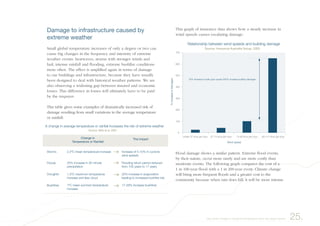
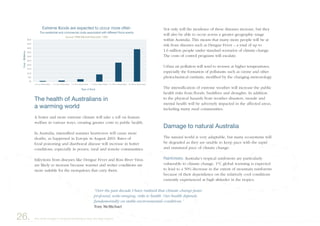
This table gives some examples of dramatically increased risk of
damage resulting from small variations in the average temperature
or rainfall:
This graph of insurance data shows how a steady increase in
wind speeds causes escalating damage:
Flood damage shows a similar pattern. Extreme flood events,
by their nature, occur more rarely and are more costly than
moderate events. The following graph compares the cost of a
1 in 100-year flood with a 1 in 200-year event. Climate change
will bring more frequent floods and a greater cost to the
community because when rain does fall, it will be more intense.
�
���
���
���
���
���
���
���
����� �� ��� ��� ���� ����� ��� ��� ���� ����� ��� ��� ���� ������ ��� ��� ����
��� �������� �� ���� ���� ������ ���� �������� �������� �������
������������ ������� ���� ������ ��� �������� ������
������� ��������� ��������� ������ ����
������������������
���� �����
A change in average temperature or rainfall increases the risk of extreme weather
Source: Mills et al, 2001
Storms
Floods
Droughts
Bushfires
2.2ºC mean temperature increase
25% increase in 30 minute
precipitation
1.3ºC maximum temperature
increase and less cloud
1ºC mean summer temperature
increase
Increase of 5-10% in cyclone
wind speeds
Flooding return period reduced
from 100 years to 17 years
25% increase in evaporation
leading to increased bushfire risk
17-28% increase bushfires
Change in
Temperature or Rainfall
The Impact
25.Very small changes in the global temperature have very large impacts
Not only will the incidence of these diseases increase, but they
will also be able to occur across a greater geographic range
within Australia. This means that many more people will be at
risk from diseases such as Dengue Fever – a total of up to
1.6 million people under standard scenarios of climate change.
The costs of control programs will escalate.
Urban air pollution will tend to worsen at higher temperatures,
especially the formation of pollutants such as ozone and other
photochemical oxidants, modified by the changing meteorology.
The intensification of extreme weather will increase the public
health risks from floods, bushfires and droughts. In addition
to the physical hazards from weather disasters, morale and
mental health will be adversely impacted in the affected areas,
including many rural communities.
Damage to natural Australia
The natural world is very adaptable, but many ecosystems will
be degraded as they are unable to keep pace with the rapid
and unnatural pace of climate change:
Rainforests: Australia’s tropical rainforests are particularly
vulnerable to climate change. 1°C global warming is expected
to lead to a 50% decrease in the extent of mountain rainforests
because of their dependence on the relatively cool conditions
currently experienced at high altitudes in the tropics.
26. Very small changes in the global temperature have very large impacts
The health of Australians in
a warming world
A hotter and more extreme climate will take a toll on human
welfare in various ways, creating greater costs to public health.
In Australia, intensified summer heatwaves will cause more
deaths, as happened in Europe in August 2003. Rates of
food poisoning and diarrhoeal disease will increase in hotter
conditions, especially in poorer, rural and remote communities.
Infections from diseases like Dengue Fever and Ross River Virus
are likely to increase because warmer and wetter conditions are
more suitable for the mosquitoes that carry them.
“Over the past decade I have realised that climate change poses
profound, wide-ranging, risks to health. Our health depends
fundamentally on stable environmental conditions.”
Tony McMichael
��
����
���
����
����
����
����
����
����
����
����
� �� � �� ����� ����� � �� �� �� ����� ����� � �� �� �� ����� ����� � �� �� �� ����� ����� � �� ��� �� ����� ����� � �� ��� �� ����� �����
��� ����������� ��� ���������� ����� ���������� ���� ��������� ����� ������
������� ��� �������� ��������� ����
���� �� �����
��������������
������� ������ ��� �������� �� ����� ���� �����
Coral reefs: Australia is home to the world’s largest coral reef.
Due to rising water temperatures, the reef is facing its greatest
challenge for survival.
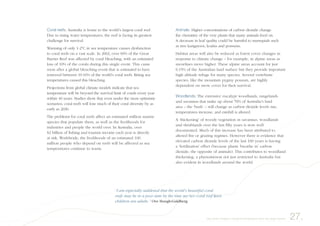
Warming of only 1-2ºC in sea temperature causes dysfunction
to coral reefs on a vast scale. In 2002, over 60% of the Great
Barrier Reef was affected by coral bleaching, with an estimated
loss of 10% of the corals during this single event. This came
soon after a global bleaching event that is estimated to have
removed between 10-16% of the world’s coral reefs. Rising sea
temperatures caused this bleaching.
Projections from global climate models indicate that sea
temperature will be beyond the survival limit of corals every year
within 40 years. Studies show that even under the most optimistic
scenarios, coral reefs will lose much of their coral diversity by as
early as 2030.
The problems for coral reefs affect an estimated million marine
species that populate them, as well as the livelihoods for
industries and people the world over. In Australia, over
$2 billion of fishing and tourism income each year is directly
at risk. Worldwide, the livelihoods of an estimated 100
million people who depend on reefs will be affected as sea
temperatures continue to warm.
Animals: Higher concentrations of carbon dioxide change
the chemistry of the very plants that many animals feed on.
A decrease in leaf quality could be harmful to marsupials such
as tree kangaroos, koalas and possums.
Habitat areas will also be reduced as forest cover changes in
response to climate change – for example, in alpine areas as
snowlines move higher. These alpine areas account for just
0.15% of the Australian land surface but they provide important
high altitude refuge for many species. Several vertebrate
species, like the mountain pygmy possum, are highly
dependent on snow cover for their survival.
Woodlands: The extensive eucalypt woodlands, rangelands
and savannas that make up about 70% of Australia’s land
area – the ‘bush’ – will change as carbon dioxide levels rise,
temperatures increase, and rainfall is altered.
A ‘thickening’ of woody vegetation in savannas, woodlands
and shrublands over the last fifty years is now well
documented. Much of this increase has been attributed to
altered fire or grazing regimes. However there is evidence that
elevated carbon dioxide levels of the last 100 years is having
a ‘fertilisation’ effect (because plants ‘breathe in’ carbon
dioxide, the opposite of animals). This contributes to woodland
thickening, a phenomenon not just restricted to Australia but
also evident in woodlands around the world.
27.Very small changes in the global temperature have very large impacts
“I am especially saddened that the world’s beautiful coral
reefs may be in a poor state by the time my two coral reef-keen
children are adults.” Ove Hoegh-Guldberg
The risk of dramatic changes
The risks of climate change increase as the rate of temperature
change increases. One of the common misconceptions is that
global warming will proceed smoothly, as will accompanying
climate changes. But this is not the case. As we have seen,
climate can and does change suddenly. We may encounter
abrupt changes, at least for some regions of the Earth, if the
climate crosses a particular threshold in the global average
temperature. We do not know what this threshold is.
However, we do know that the fundamental life support
systems of the world – the atmosphere, the oceans and biology
- are linked together in complex feedback mechanisms that
normally keep the climate relatively stable. A change to the
conditions of one system can trigger unpredictable changes
to the other – such as a surprise flip from the current state to
a very different one in a matter of decades.
Evidence is emerging that change occurring to the atmosphere
will alter the workings of important global systems such as
ocean circulation systems and polar ice sheets. This could
trigger unpredictable and sudden shifts in how the planet
works. For example, a slowing of deep ocean circulation that
appears to be happening now, if accelerated, could have very
significant impacts. It could affect the capacity of the oceans
to absorb carbon dioxide, regional climate conditions and
the oxygenation of the deep oceans and thus their capacity
to support life. We do not know enough about this today,
but it represents a risk which needs further exploration and
underlines the need for caution.
28. Very small changes in the global temperature have very large impacts
Bushfires: Analysis of drought records commissioned by the
Federal Parliamentary Inquiry into the 2003 bushfire season
concluded that “climate change may have played a role in the
fire weather recorded in 2003.”
Fire is an essential part of Australia’s ecology, but hotter
temperatures from climate change will make the conditions
for dealing with these fires much more difficult. Vegetation
that has been dried by higher than average temperatures and
lower rainfall is a much more flammable fuel.
There will need to be a major increase in funds spent on
bushfire management to be able to deal with more dangerous
bushfire conditions in the coming decades.
Snow: Current and past observations indicate that middle to
late season snow depths in the Victorian Alps have decreased
over the past 50 years. Further decrease will have dramatic
consequences for the snow tourism industry.
Perhaps more subtlely, yet potentially as important, the
disintegration of the Greenland and West Antarctic ice sheets
is a threshold we must aim to avoid. This would cause much
higher and irreversible increases in sea levels – as much as
4-6 metres higher than today. It is conceivable that some major
changes to the oceans could occur over the next century.
Other changes might be triggered over the next few decades,
but not be felt for centuries to come.
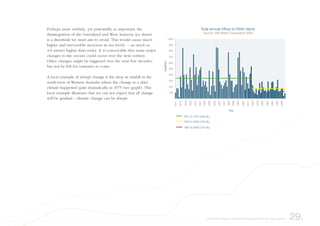
A local example of abrupt change is the drop in rainfall in the
south-west of Western Australia where the change to a drier
climate happened quite dramatically in 1975 (see graph). This
local example illustrates that we can not expect that all change
will be gradual – climatic change can be abrupt.
29.Very small changes in the global temperature have very large impacts
����
���
���
���
���
���
���
���
���
���
����������
����
����
����
����
����
����
����
����
����
����
����
����
����
����
����
����
����
����
����
����
����
����
����
���� �� ���� ���� ���
���� �� ���� ���� ���
���� �� ���� ���� ���
����� ������ ������ �� ����� ����
������� �� ����� ����������� ����
����
Tony Coleman BA MBA FIA FIAA
Tony Coleman is the Chief Risk Officer and Group Actuary
of Insurance Australia Group (IAG), Australasia’s leading
general insurance group. He is responsible for the overall
risk management function at IAG, which includes insurance
product pricing, reserving for claim liabilities, R&D, operating
risk monitoring, control of fraud and security risk and the
compliance function. Prior to joining IAG he was a senior
corporate finance partner of PricewaterhouseCoopers.
Throughout his career, Tony has played a very active role
in the actuarial profession. In 2001 he was President of the
Institute of Actuaries of Australia and was later chairman of the
IAAust’s HIH Royal Commission Taskforce.
On the international front, he is vice-chairperson of the
Financial Risks Committee of the International Actuarial
Association and is a member of the IAA Insurer
Solvency Subcommittee.
2040203020202010 2050
30. Background information on the group
Background
information on
the group
“As a professional risk manager and actuary I often see the
results of failure to mitigate risks. Some risks are worse than
others, appearing harmless at first but ultimately having a
devastating impact if not addressed quickly. Climate change is
such a risk. The serious health risks associated with the use of
both asbestos and tobacco were denied for many years (often
by vested interests) before the truth was realised and their
impact on people’s lives recognised. Educating the community
about the risks involved achieved this change. In my view, the
threat to our existing way of life posed by global warming and
climate change is far greater than is presently recognised in
our community. Hence I am pleased to be associated with this
initiative that seeks to improve community awareness of this
issue and what can be done about it.” Tony Coleman
Professor Ove Hoegh-Guldberg
Ove Hoegh-Guldberg is Head of the Centre for Marine Studies
at the University of Queensland. Professor Hoegh-Gulberg has
established an international reputation in coral reef ecology,
and in 1999 was awarded the Eureka Prize for Scientific
Research for his work on coral bleaching and climate change.
He is currently chair of the World Bank-UNESCO targeted
research group on coral bleaching and climate change.
“In the early 1990s, I felt that coral reefs like the Great Barrier
Reef were robust enough to survive climate change in the
short-term. During the 90s, change began on a level that saw
whole communities of corals rapidly extinguished. The scale of
these changes is potentially horrifying. While I am personally
concerned, I am especially saddened that the world’s beautiful
coral reefs may be in a poor state by the time my two coral reef-
keen children are adults. This group has begun the important
task of outlining the risks and opportunities for Australia in
a century of rapid environmental change and has come up
with one inescapable conclusion - climate change is set to
dramatically change our lives and those of future generations.
It is no longer an issue to relegate to the bottom of the national
agenda. If Australia is to continue to prosper, it must face the
climate change issue, which may be one of the most challenging
of any in its history.” Ove Hoegh-Guldberg
Professor David Karoly
David Karoly is the Williams Chair Professor of Meteorology
at University of Oklahoma. Between 1995 and 2000 he was
Professor of Meteorology and Director of the Cooperative
Research Centre for Southern Hemisphere Meteorology at
Monash University, then from 2001 to 2002, he was Head
of the School of Mathematical Sciences at Monash He was
lead author of the chapter “Detection of Climate Change and
Attribution of Causes” for the 2001 Intergovernmental Panel on
Climate Change Assessment Report. In 1998, he received the
Norbert Gerbier-Mumm International Award from the World
Meteorological Organisation for joint research. In 1999, he was
elected a Fellow of the American Meteorological Society for
outstanding contributions to the atmospheric sciences.
“When I started working on climate variability and change in
1985, I set out to prove that climate change due to increasing
greenhouse gases was not occurring. The more I have studied
this subject, the clearer it has become that global warming is
occurring now and it is going to get much larger in the future.”
David Karoly
31.Background information on the group
Professor Ian Lowe
Ian Lowe is an Emeritus Professor at Griffith University in
Brisbane, where he was previously Head of the School of
Science. He directed the Commission for the Future in 1988
and chaired the advisory council that produced Australia’s
first national report on the state of the environment in 1996.
He was named Australian Humanist of the Year in 1988 and
delivered the 1991 Boyer Lectures for the ABC. In 2000 he
received the Queensland Premier’s Millennium Award for
Excellence in Science and the Prime Minister’s Environmental
Award for Outstanding Individual Achievement. He writes a
weekly column for New Scientist.
“I have been following the science of climate change for 25
years, becoming steadily more alarmed by the growing evidence
that we are disrupting the fine balance of natural systems. All
the work we are doing on other environmental problems will be
irrelevant if we don’t restore the balance of the climate system.”
Ian Lowe
Professor Tony McMichael
Tony McMichael is Director of the National Centre for
Epidemiology and Population Health, at the Australian National
University in Canberra. From 1994 until 2001, he was Professor
of Epidemiology at the London School of Hygiene and Tropical
Medicine. He returned to Australia in 2001, supported by
an inaugural 5-year Burnet Award from the National Health
and Medical Research Council. Since 1993 he has coordinated
the assessment of health impacts for the United Nation’s
Intergovernmental Panel on Climate Change. Recently he edited
the World Health Organisation / United Nations book: “Climate
Change and Human Health: Risks and Responses” (2003).
“As a biomedical scientist, I have studied diverse environmental
influences on human health. Over the past decade I have
realised that climate change poses profound, wide-ranging,
risks to health. Indeed, health and medical researchers must
understand that this is ‘environmental health’ writ very
large, affecting populations everywhere. Our health depends
fundamentally on stable environmental conditions. Climate
change disrupts the conditions of Life on Earth, for humans
and other species.” Tony McMichael
Dr Chris Mitchell
Chris Mitchell is the CEO of the Cooperative Research Centre
for Greenhouse Accounting. Before his appointment to the CRC
in October 2001, he coordinated the Climate Change Research
program at the CSIRO, Australia’s largest science agency. He
has also worked at CSIRO Energy Technology where he was
responsible for the development of new programs directed
towards the mitigation of greenhouse gas emissions.
“I have worked on the greenhouse and climate change issue
for the past fifteen years. Over that time I have seen the science
underlying climate change challenged and challenged - as
it should be. Through that time the science has withstood
this intense scrutiny. Climate change poses an enormous
32. Background information on the group
developmental challenge for human societies over the coming
century. There is little doubt in my mind that the present
trajectory we are following is unsustainable. We need to make
changes, but with these changes come opportunity if we are
able to see it.” Chris Mitchell
Dr. Graeme Pearman
Graeme Pearman is a corporate fellow and former Chief Scientist
at CSIRO Atmospheric Research. He has published over 150
scientific papers. He was elected to the Fellowship of the Australian
Academy of Science in 1988. He was a recipient of a United Nation’s
Environment Program Global 500 Award in 1989 for his active
involvement in a national awareness program on climate change. In
1999 he was awarded the Australian Medal of the Order of Australia
for his services to atmospheric science and promotion of the science
of climate change to the public.
“In the early 1970s, a colleague and I set about trying to disprove
the observations of a US scientist that showed carbon dioxide
concentration increasing in the atmosphere. We soon knew he was
right and our attention turned to why, and how much will it change
in the future? Today, we have a good understanding of these things
but also rapidly improving knowledge of how these change the global
climate system.
It is clear that we can’t go on warming the planet indefinitely - we
need to modify the way we do things. Change always invites detractors
and debate. No more so than when the issues are as complex as
climate change and impinge on something fundamental to our way of
life - our use of energy. This document attempts to redress a growing
disconnect between the popular understanding of the issue of climate
33.Background information on the group
change and the decisions being taken by both the private and public
sectors. Read it, be informed and be part of the decisions concerning
the vision and the options.” Graeme Pearman
Dr Peter Scaife
Peter Scaife is the Director of the Centre for Sustainable Technology
at the University of Newcastle, in which role he is involved in
sustainability issues in the energy and metals industries. Between
1996 and1998 he was the Chief Environmental Scientist for BHP
responsible for providing scientific support to strategic environmental
issues in BHP and in particular, greenhouse.
“I am increasingly of the view that major reductions in greenhouse gas
emissions can be achieved in many sectors of the economy, without
adversely impacting on our standard of living. What is lacking is a
recognition by Australians that the problem of climate change is of
growing severity, that more should be done, and that major business
opportunities will emerge, as we build resilience and adaptability into
our energy, water, urban design and agricultural systems.”
Peter Scaife
Anna Reynolds
Convenor
Anna Reynolds is the Manager of WWF Australia’s Climate Change
Program which she established in 2002. Since 1996 she has been
working for national environmental organisations advising on climate
change science and policy.
2040203020202010 2050
34. References
References
Australian Government, (2003): Tracking to the Kyoto Target
2003 – Australia’s Greenhouse Emission Trends 1990 to 2008
– 2012 and 2020. Canberra.
IPCC, (2001): Climate Change 2001: Synthesis Report.A
Contribution of Working Groups I, II, and III to the Third
Assessment Report of the Integovernmental Panel on Climate
Change [Watson, R.T. and the Core Writing Team (eds.)].
Cambridge University Press, Cambridge, United Kingdom, and
New York, NY, USA, 398 pp.
Hoegh-Guldberg, O. (1999) Coral bleaching, Climate Change
and the future of the world’s Coral Reefs. Review, Marine and
Freshwater Research Marine Freshwater Research (CSIRO).
50:839-866.
House of Representatives Select Committee on the Recent
Australian Bushfires, (2003) A Nation Charred, Canberra.
D.J. Karoly, (2003): Ozone and climate change. Science 302,
236-237.
D.J. Karoly and K. Braganza (2004) Attribution of recent
temperature changes in the Australian region. J Climate, in press.
Mann, M.E., Ammann, C.M., Bradley, R.S., Briffa, K.R., Crowley,
T.J., Hughes, M.K., Jones, P.D., Oppenheimer, M., Osborn, T.J.,
Overpeck, J.T., Rutherford, S., Trenberth, K.E., Wigley, T.M.L.,
(2003) On Past Temperatures and Anomalous Late 20th Century
Warmth, Eos, 84, 256-258.
Mann, M.E., Ammann, C.M., Bradley, R.S., Briffa, K.R., Crowley,
T.J., Hughes, M.K., Jones, P.D., Oppenheimer, M., Osborn, T.J.,
Overpeck, J. T., Rutherford, S., Trenberth, K.E., Wigley, T.M.L.,
(2003b) Response to Comment on ‘On Past Temperatures and
Anomalous Late 20th Century Warmth’, Eos, 84, 473.
McMichael, A., Woodruff, R., Whetton, P., Hennessy, K.,
Nicholls, N., Hales, S., Woodward, A., Kjellstrom, T., (2002).
Human Health and Climate Change in Oceania:A Risk
Assessment. Commonwealth of Australia, Canberra.
Mills, E, E. Lecomte and A. Peara, (2001). US Insurance
Industry Perspectives on Climate Change, February 2001, US
Dept of Energy, Berkeley California.
National Oceanic and Atmospheric Administration, (2003).
Global Surface Temperatures over the Past Two Millennia,
found at - http://www.ngdc.noaa.gov/paleo/pubs/mann2003b/
mann2003b.html
Pittock, B. (ed). (2003). Climate Change:An Australian Guide to
the Science and Potential Impacts, Commonwealth of Australia,
Canberra.
Steffen, W. Jager, J. Matson, P. Moore, B. Oldfield, F.
Richardson, K. Sanderson, A. Schnellnhuber, J. Turner,B.L.
Tyson, P. & Wasson, R. (2003), Global Change and the Earth
System:A Planet Under Pressure, Springer-Verlag Berlin
Walther G R, Post E, Convey P, Menzel A, Parmesan C, Beebee
TRJ, Fromentin JM, Hoegh-Guldberg O & Bairlein F (2002).
Ecological responses to recent climate change. Nature 416:
389-395.
35.References
2040203020202010 2050

cl020_climate_change_solutions_for_australia_1jun04

  • 1.
    20502040203020202010 Climate Change Solutions forAustralia The Australian Climate Group
  • 2.
    First published inJune 2004 by WWF Australia © WWF Australia 2004. All Rights Reserved. ISBN: 1875 94169X Authors: Tony Coleman Professor Ove Hoegh-Guldberg Professor David Karoly Professor Ian Lowe Professor Tony McMichael Dr Chris Mitchell Dr Graeme Pearman Dr Peter Scaife Anna Reynolds The opinions expressed in this publication are those of the authors and do not necessarily reflect the views of WWF. WWF Australia GPO Box 528 Sydney NSW Australia Tel: +612 9281 5515 Fax: +612 9281 1060 www.wwf.org.au For copies of this report or a full list of WWF Australia publications on a wide range of conservation issues, please contact us on publications@wwf.org.au or call 1800 032 551. Cover image: Shock and Awe © Andrew Pade (www.andrewpade.com). Printed on Monza Satin recycled.
  • 3.
    Contents The Australian ClimateGroup The Australian Climate Group was convened in late 2003 by WWF Australia and the Insurance Australia Group (IAG) in response to the increasing need for action on climate change in Australia. 04 Climate change - solutions for Australia 06 Summary 08 Act now to lower the risks 10 A way forward for Australia 16 Earth is overheating 22 Very small changes in the global temperature have very large impacts 30 Background information on the group 34 References Tony Coleman Insurance Australia Group Professor Ove Hoegh-Guldberg University of Queensland Professor David Karoly University of Oklahoma Professor Ian Lowe Griffith University Professor Tony McMichael Australian National University Dr Chris Mitchell Cooperative Research Centre for Greenhouse Accounting Dr Graeme Pearman CSIRO Atmospheric Research Dr Peter Scaife University of Newcastle Anna Reynolds WWF Australia
  • 4.
    2040203020202010 2050 Introduction There aremoments in time when global threats arise, and when action is imperative. One of the major risks to the security of people around the world is climate change. Never has there been a greater need for inspiring leadership to protect and defend our future against the rising threat of climate change. We know that our world’s temperature is now rising unusually fast. Climate change has the potential to threaten millions of lives, the capacity of the world to feed itself, the availability of fresh water, the control and spread of disease, the survival of species, the direction in which our oceans flow and the severity of our weather. The choice is before us: Do we sit and wait for climate change to get worse, or do we draw on our heritage of innovation and resilience to help prevent the worst-case scenarios of climate change from occurring? This group proposes the following set of solutions to lower the risk that climate change will reach a dangerous level: 1. REDUCE: Australia’s political leaders must work with business and the community to take immediate action to cut our greenhouse gas emissions by 60% by 2050. 2. TRADE: Establish market mechanisms to trade greenhouse gas emissions, providing the business sector with a powerful tool to meet reduction targets. 3. ACT: All Australians to take responsibility for their own role in reducing greenhouse gas emissions by using energy more wisely. Climate Change – Solutions for Australia 04. Climate Change – Solutions for Australia
  • 5.
    4. ADAPT: Putin place measures to minimise the impacts of climate change, from building improvements to deal with more intense storms, to investing in new agricultural industries which require less fresh water. 5. INNOVATE: New business opportunities must be developed and implemented as the rest of the world moves to low carbon energy futures. 6. LEAD: A leadership role must be taken to identify and implement solutions to reduce the impacts of human-induced climate change. As one of the wealthiest and best-educated nations in our region, we can share our innovations and technologies with nations of the Asia Pacific. Why should Australia attempt to sort out the climate change problem? After all, we know that even if we halted all our emissions tomorrow, ongoing global climate change would still damage our country. The reason we must is that dangerous climate change is a potential global outcome that would hurt Australia. The reason we can is because we have always ‘punched well above our weight’ in international forums and have been leaders in formulating and implementing good ideas. Australia has led the world in the establishment of voting rights for women, universal suffrage, fair wages for all and human rights. Bold leadership, not just from politicians, business leaders, and scientists, but from all Australians is our best way forward. Tony Coleman Professor Ove Hoegh-Gulberg Professor David Karoly Professor Ian Lowe Professor Tony McMichael Dr Chris Mitchell Dr Graeme Pearman Dr Peter Scaife Anna Reynolds The Australian Climate Group June 2004 05.Climate Change – Solutions for Australia
  • 6.
    1. Act nowto lower the risks We hold the future in our hands and we still have choices. Our actions today in Australia and in influencing the rest of the world to reduce emissions will make a major difference to the level of change that faces Australia. The main reasons to act now are: • Our way of life is at risk because Australia is vulnerable to climate change. To argue that Australia cannot make a difference to this global problem is to effectively resign ourselves to global greenhouse emissions causing major disruption to our climate and our lives. • Leadership now will significantly reduce the risks and future impact of climate change on us. The coming decades are the crucial time to act if we are to avoid higher levels of climate change. 2040203020202010 2050 06. Summary Summary
  • 7.
    • Greater occurrenceof heavy rainfall events yet declining total rainfall in metropolitan and agricultural regions, particularly in south-western and south-eastern Australia • Increasing severity of drought and bushfire • Increases in the frequency of intense cyclones • Rising sea levels. 4. Only small changes in the global temperature will have large impacts With just a 1 or 2 °C increase in the average global temperature, Australia will need to deal with: • Shifting rainfall patterns that reduce runoff to rivers and recharge of water supplies • Increasing agricultural and other economic losses from natural disasters • More damage to homes, business and infrastructure caused by extreme weather • Increased and new threats to the health of Australians • Irreversible change to some natural ecosystems. • We have the chance to seize new business and employment opportunities in the emerging global economy that is growing in response to the certainty of climate change. 2. A way forward for Australia starts today The following key steps, if taken today, will make an important impact for generations to come by reducing emissions of carbon dioxide (and other greenhouse gases): • Reduce emissions sufficient to make a difference by: – Setting a national target for a reduction of emissions of 60% by 2050 – Implementing an emissions trading scheme by 2007 to start progress towards this target being met – Cutting energy costs by using energy more efficiently • Adapt to a new climate - measures need to begin now • Encourage the new business opportunities that will come with a new era • Ensure Australia is a lead player in the international arena. 3. Earth is overheating Evidence that global warming is happening in Australia today includes: • Rising average temperatures leading to increased frequency of hot days 07.Summary
  • 8.
    We hold thefuture in our hands and we still have choices. Our actions today, both here and in influencing the rest of the world to reduce emissions, will make a major difference to the level of threat that faces Australia. Global warming is unlike other environmental challenges. Usually we wait until the environmental problem is having a major impact before we take action to fix it. But global warming is different because greenhouse gases stay in the atmosphere for many decades. The heat-trapping gases we add to the atmosphere now will still be having a warming effect late this century. So decisive action now is one of the most important steps that we can take to reduce the risks from global warming. Three reasons to act now 1. Our way of life is at risk The impacts of climate change are occurring sooner than 2040203020202010 2050 08. Act now to lower the risks “Some risks are worse than others, appearing harmless at first but ultimately having a devastating impact if not addressed quickly. Climate change is such a risk.” Tony Coleman Act now to lower the risks
  • 9.
    2. Active leadershipnow will reduce the risks and future impact of climate change on us Australia is particularly vulnerable to climate change, especially because the water resources of our arid continent will be greatly affected. Practical leadership from our elected, business, and community leaders is needed to help Australians understand the choices facing our nation. We need to discuss the social and economic changes that need to be made for the good of the whole community, and to get organised to tackle climate change. If we do not respond to these challenges, gaps will widen between rich and poor, urban and rural, north and south. Some people will be buffered from the changes while others will experience increasing hardship with increasing temperatures and lack of water. Not dealing with these realities could undermine Australian society. 3. We can seize new business and employment opportunities Climate change affects the economy as well as the environment, and brings opportunities as well as threats. In fact, it demands a whole new global economy, in which Australia must play a leading role as a forward-thinking nation. New energy, transport and other services to cope with climate change will bring many new business and employment opportunities. Our global competitors are already moving to a low-carbon economy, and some are now selling new technologies to our Asian neighbours. We cannot afford to be left behind. we thought. When the first assessments were made in the early 1990s, scientists expected the impacts to emerge decades later – however impacts are being seen today. The concentration of the major greenhouse gas, carbon dioxide, in the atmosphere today depends on emissions from at least the previous hundred years. The climate system responds slowly to increasing carbon dioxide, mainly because the oceans take a long time to adjust to the increased heat. This means we are already ‘locked into’ a future at least 1°C warmer than the pre-industrial average temperature of several hundred years ago. While 1°C sounds small, this is the minimum level of change we can expect. Consider that there is a difference of only about 5°C between the modern climate and the Ice Age thousands of years ago. This temperature difference brought about massive changes to sea levels and the global distribution of ecosystems. Today’s changes in temperatures are happening much faster than those of the past. But we do have choices - the earlier we reduce greenhouse- gas emissions, the less risk we have of compromising the Australian way of life and the less it will cost. Even simple everyday things we take for granted – like washing the car, putting petrol in it, and going to the beach – won’t be so readily available in a future Australia dealing with climate change. This means we have to adapt. Part of adapting is changing the way our lifestyle affects the atmosphere. We must recognise that global warming is happening, take control and make decisions that protect our way of life. 09.Act now to lower the risks
  • 10.
    Bold leadership cantrigger changes that bring more benefits than anticipated. Australia needs a long-term national strategy to avoid dangerous climate change. Important steps can be taken today to trigger a momentum for change. Key steps taken today will make an important impact that will be appreciated by generations to come: 1. Set a national target of 60% reduction in greenhouse gas emissions by 2050 To avoid a high level of climate-change damage, Australia must cut emissions by at least 60% below current levels, as must the rest of the world. The sooner we get to this point, the lower the eventual temperature increase will be, and the lower the risks for Australia. Such a reduction target is challenging, but an unprecedented threat like climate change needs a challenging counter-response. 2040203020202010 2050 10. A way forward for Australia A way forward for Australia “We need to make changes, but with these changes come opportunity if we are able to see it.” Chris Mitchell
  • 11.
    • encourage innovation– new technologies and business practices that can provide our energy and transport without emitting carbon dioxide to the atmosphere. The proposed target can help to guide decisions today. A decision made today that does not reduce emissions will make the problem worse. Long lived infrastructure (like power stations, freeways, housing development) can lock in the release of millions of tonnes of carbon dioxide emissions. Infrastructure proposals such as these should now be considered for their climate impact as well as their economic impact. An uncertain regulatory environment threatens investment. A ‘60% by 2050’ goal would increase certainty. It would send an important signal to the business community, whose investment decisions critically affect our ability to achieve the 60% reduction by 2050. The Energy Supply Association of Australia recently called on the Australian Government to set a greenhouse gas reduction target for the whole of Australia in order to remove the current uncertainty about the future treatment of large-scale, long-lived energy investments. 2. Implement a national emissions trading scheme by 2007 to help ensure the target is met An economically efficient way to encourage a major reduction in emissions is to create a market for the main greenhouse gas, carbon dioxide. 11.A way forward for Australia An important first step is to agree that these cuts will need to happen - then develop a strategy for how we can make it happen to make the most of new opportunities and minimise disruption. The United Kingdom recently released a strategy for achieving a 60% cut in energy emissions by 2050. Germany has expressed a willingness to commit to a 40% emission reduction target by 2020. Australia currently has a target to increase emissions (as they were at 1990) by 8% by 2010. This group thinks it would be prudent for the Australian Government to set a 60% emission reduction goal by 2050. This target can be reviewed which could strengthen or relax the targets, as new scientific information becomes available. As the target is long term, the Government needs to set milestones, so that we make progressive reductions by 2020, 2030 and 2040 along the way to meeting the longer- term goal. To achieve the 60% emissions reduction by 2050 a full range of policies and technologies will need to be on the agenda and pursued with vigour. A solution that follows a single path or depends on a single technology will not be sufficient to reduce emissions to the extent required. All levels of government and industry need to: • aggressively pursue fuel switching - shifting to the full range of cleaner energy technologies • aggressively pursue energy conservation – stopping the waste of energy
  • 12.
    In this greenhouseworld, the atmosphere can no longer provide a free service – it has reached its capacity to absorb excess greenhouse gases without creating other costs. Until we place a value on the atmosphere, based on the costs of damage caused by greenhouse gases, we make it difficult for businesses to be guided toward the end goal in the most efficient and effective manner. As the regulator, the Government can create a market by setting a ‘cap’, that is, deciding what the national volume of carbon dioxide emissions will be. The market can then determine the price of each ‘unit’ of carbon dioxide. Through trading, the cost of meeting the ‘60 by 50’ target will be lower and distributed more evenly across a wide range of sectors. More importantly, this strategy should unleash the creativity and innovation of private industry providing a springboard for capturing new business opportunities. This approach is being taken in Europe and several states in the United States of America. There is a successful example of cutting pollution through the approach of setting a cap and then allowing companies to trade their pollution entitlements - the United States trading scheme for sulphur dioxide, a gas that causes acid rain. In 1980 sulphur dioxide emissions were 17.3 million tonnes, and by 2000 they were 11.2 million tonnes. The cost of meeting the pollution reduction targets became cheaper for companies as there was money to be made through innovation. The strategy should spell out how this emissions target is set: for example, how the cap is expressed (simple tonnes, or per capita, or a relative target), who the target should apply to (everyone, large emitters only, or some other sub- sector), the penalties for exceeding the targets, and the incentives for staying below the targets. 3. All Australians taking responsibility for their emissions The fundamental requirement is easy to understand: we need to do more with less – all Australians need to cut their energy use by being more efficient. The International Energy Agency reported that in 2001 Australia used 10.3 thousand kilowatt hours of electricity per person compared to an average for industrialised countries (OECD) of 7.9 thousand kilowatt hours per person. There are direct economic benefits from using energy more efficiently. For example, lighting consumes 30 – 40% of a commercial building’s electricity and a further 10% is needed as cooling to offset the heat from lights. For buildings that have not had lighting upgrades in the past 5 years, lighting costs can be cut by 50 – 75% with investment in more efficient lights recovered from cheaper electricity bills in just 1 – 3 years. 12. A way forward for Australia
  • 13.
    The Council ofAustralian Government’s (COAG) National Framework on Energy Efficiency Group estimates that energy consumption could be reduced by up to 30% with the use of current technologies. 4. Adapting to a new climate - measures need to begin now If the world can reduce greenhouse gas emissions in the order of 60% in the next fifty years, there is a greater chance of limiting the total global average temperature increase to around 2°C above the pre-industrial average. There will be significant impacts on Australia, but much less than under the higher emission scenarios that could see the global temperature rise by up to 6°C. Australians must now accept that our future climate will be different to that of today. It is far better to plan for the changes and take action now, than wait for the dramatic outcomes and clean up the mess. This group believes that it is prudent to begin adapting to an Australia that has: 1. Less water availability in southern Australia – this means that we will need a national program to increase the conservation and reuse of water. 2. More severe bushfires – this means that through revamped planning laws we need to separate high bushfire-risk areas and human settlements. 3. Longer and more intense droughts – this means we need to assist rural industries to shift to new crops and management practices that are more resilient. 4. Sea levels rising and changes in storm surges with impacts on coastal communities – there needs to be a detailed national assessment undertaken to identify communities that are vulnerable to sea level rise and coastal flooding. Once identified, planning in sensitive coastal regions will have to factor in sea level rise. In the longer term, it may be necessary to fund the protection or relocation of some infrastructure. 5. Higher risk of insect-borne diseases of both humans and animals in northern Australia and their shift southwards – this means that additional resources need to be devoted to increasing surveillance and control of diseases, both in current at risk areas and in regions further south. 6. More intense heat during summer – this means that building design codes will need to be modified to improve the liveability of buildings in extreme temperatures. 7. More extreme weather – national building regulations will need to be reviewed to improve the resistance of houses and buildings to higher winds and more intense rainfall. Flood prone areas need to be identified with the use of climate change models, and development in these areas limited. 13.A way forward for Australia
  • 14.
    5. Develop andencourage the new business opportunities that will come with a new era Energy pervades our life. It is fundamental to providing food, water, and transport; producing materials for housing; for developing and operating our urban infrastructure; for powering industry and employment. The business opportunities in responding to climate change are unprecedented. The challenge of reducing emissions will stimulate technological innovation and create new markets. New products will be needed which are less energy and carbon-intensive over their entire life cycle. Imagine an Australia where every car we produce is driven by fuel cells or better technology. Our homes all have solar hot water systems, and solar cell panels so that we can even sell the electricity our roof system generates onto the grid. All new homes are built with full insulation, and with windows that are directed to allow the sun to warm the home in winter and cool it in summer. Lights turn off automatically when people leave the room. In such an Australia there would be no more huge power bills, gas bills or petrol bills. Business opportunities include the increasing use of renewable energy, the potential hydrogen economy and increasing the efficiency of the generation, distribution and use of fossil fuel electricity. Currently, some renewable energy technologies are growing by over 30% per year worldwide. Opportunities exist in technologies, such as solar, geo-thermal, and wind power. There are opportunities in the urban environment, such as the design of infrastructure and energy efficient buildings, including their components. There will be major changes in transport systems. Existing car technology enables fuel consumption, and the related emissions, to be reduced by 50% without changing overall performance. Responding to climate change impacts will also mean new business – new agricultural practices, better ways of storing and saving water, building for more severe storms. Australia can develop useful technology and practical solutions, and export these worldwide, in particular to the Asian-Pacific region. Now imagine an Australia, situated in the fastest growing region of the world, with ready access to markets in China and India. Our climate-friendly cars, solar hot water systems, solar panels, new building technologies and more, in easy reach of the markets of billions. There are major benefits to Australian business by making a transition now to lower greenhouse gas-emission technologies. Australia’s economy will be better placed in a changing world if we ensure that our business sector is part of this change. Any reductions in oil consumption will also benefit our balance of payments, since oil imports are predicted to increase rapidly as local reserves are depleted. There are a number of initiatives already underway at a government level (Federal, State and local) to support the development of opportunities. More initiatives that are carefully targeted should be progressively but urgently implemented. 14. A way forward for Australia “I am increasingly of the view that major reductions in greenhouse gas emissions can be achieved in many sectors of the economy, without adversely impacting on our standard of living.” Peter Scaife
  • 15.
    6. Australia’s internationalleadership can make a difference Although Australia’s relative contribution to global emissions is small, our per capita emissions are among the largest in the world. We reside in a part of the world that will be significantly affected by climate change, including our own landmass. Our nation needs to reduce our emissions, but on our own we cannot protect Australia from a dangerous level of climate change. In order to encourage other countries to address their emissions we must take action ourselves and lead by example. Australia has been at the forefront of major international issues for over a century. As we have all heard in discussions about Australia’s role in the world, we ‘punch above our weight’. We pride ourselves in finding innovative solutions to major problems, and to never shirking our responsibilities. Global warming represents an example of a global crisis that needs all hands to the wheel. It is not the Australian way to run away from the battle. We need to work with people from around the world and fix the problem. As we all know, actions speak louder than words. Only through bold leadership, domestic action and global agreements will we fix this problem. We must meet tough targets ourselves, and encourage our friends and neighbours to do the same. To protect Australia we need others such as the United States, China and India to move in a way which minimises the impacts of the climate change. We can only achieve the result we need globally if we take a stronger leadership role. This needs to be backed up by a positive approach at home to reduce emissions from all sectors, particularly those growing rapidly like energy and transport. 15.A way forward for Australia
  • 16.
    Twenty years ago,the idea of human societies altering the atmosphere of the entire planet to a point where life on earth is changed forever sounded like a science-fiction story line. These days it is science-fact. We know now that our world is overheating, faster than ever before in human history. And importantly, science has established cause and effect. The changes in temperature cannot be explained by natural change alone. The world’s thermostat is out of kilter because our use of fossil fuels is changing the balance of gases in the atmosphere. Australia is a warmer continent today than it used to be. The unusually rapid warming over recent decades can be explained only by increasing levels of greenhouse gases accumulating in the atmosphere. This change in the atmosphere is the direct result of our own actions. Each year human societies emit over 20 billion tonnes of carbon dioxide — the main greenhouse 16. Earth is overheating 2040203020202010 2050 Earth is overheating “The more I have studied this subject, the clearer it has become that global warming is occurring now and it is going to get much larger in the future.” David Karoly
  • 17.
    gas — intothe air mostly as a result of burning fossil fuels for electricity and transport. This amount now exceeds the capacity of the world’s natural ‘sinks’ – the oceans, forests and soils - to absorb. Earth’s temperature is increasing The average temperature of planet Earth is currently around 14°C. Over the last century, this average temperature has been increasing. Since the 1980s, the rate of warming has been accelerating. The average temperature of Earth is the warmest on record, about 0.6°C warmer since 1900. Globally, the ten hottest years out of the last 140 years (since reliable instrumental records are available) have all occurred since 1990. Australia has warmed by 0.7 °C since 1910 (slightly more than the global average), with most of this increase occurring since 1950. This map is taken from Bureau of Meteorology records from over 100 data collection stations around the country. ��� �� ��� ��� ��� ��� ��� ��� ��� ���� ���� ���� ���� ���� ���� ���� ����������� ������������ ���� ��������� ������� ������ �� ������������ ���� ����� �� ���� ����������� ��������� ������� ���� 17.Earth is overheating ������� ������ ������ ��� ������� ���������� ��� ��������� ���� ���� ���� ���� ��� ��� ��� ��� ��� ���� ���� ���� ���� ���� ���� ���� ������������������������� ����������������������������������� ��� ������� ����������� �� ����� ����� ������� ���������� ����� ����
  • 18.
    This graph showsthat a range of studies, using these indirect methods, all agree that the current level of warming is the greatest seen in the last 1000 to 2000 years. Recently a few scientists have pointed to indirect evidence suggesting that global temperatures in the Middle Ages were warmer than at present, and claimed that therefore the recent warming is not unusual. There may indeed have been warm periods for small regions in the Northern Hemisphere. However, all reliable estimates show that the recent global and Northern Hemisphere average temperatures are higher now than they were at any time during the Middle Ages. A few people also argue that we don’t need to be concerned about this recent change because the world’s climate has always been changing. Yes, the world has always changed since the planet’s beginning – indeed, if a time-lapse camera filmed our planet over the last four billion years, we would see continents jostling each other, icecaps and glaciers expanding and contracting, forests and deserts shifting, life forms evolving, the atmosphere itself varying in thickness and composition, changing temperatures and rainfall patterns. However these changes happen in geological timescales - the time it takes for rocks to form and erode away. Today, global climate change is human-induced, on a human timescale, within our lifetimes. What is important is this unprecedented pace of change and our role in creating it. 18. Earth is overheating Earth is warmer today that it has been for at least 2000 years Modern temperature records began when instruments for measuring temperature became available after the middle of the nineteenth century. To go back further in time, scientists use indirect or ‘proxy’ records such as growth rings from trees, banding in corals, oxygen isotopes in ice cores, and rock temperatures from boreholes to deduce temperatures from the past. These studies strongly suggest that this relatively recent trend of rapid and sustained warming, on a planetary scale, is unprecedented in human history. ���� ���� ���� ������� ����� ���� ��� ������� ����������� �� ��� ������� ��� ���� ����� ������� �������� ������� ��� ����������� ��������������� ���� ��������������������� ��� ��� ��� ��� ���� ���� ���� ���� ���� ���� ����� ������ ��� ������� ��� ��� ��� ��� � ���� ��� ��� ���� ������ ��� ������ ������ �� ��� ������ ������� ����������� ����� ��� ��������� ��� ��� ����� �� ����� �������� ����� ��� ��� ������� �� ����� ������� �� ������� ������������ �� ��� ����� �� ����� ���������� �� ��� ������ ������� ����������� ��� ��� ���� ��������� ������ �����
  • 19.
    This group iscertain that carbon dioxide is at a level unprecedented in human history The next graph shows that the level of carbon dioxide in the atmosphere is unprecedented since the dawn of civilisation, and expected to grow throughout this century. These records are based on many decades of work matching current measurements of carbon dioxide with measurements of air trapped inside Antarctic and Arctic ice. The levels of greenhouse gases in the atmosphere are accurately and directly measured all over the world, such as Cape Grim in Tasmania by the CSIRO. By comparing today’s measurements to samples of air trapped inside annual layers of Antarctic ice, we are confident that the levels of carbon dioxide in today’s atmosphere are 30% higher than they have been for at least 400,000 years. A gas measured in terms of parts per million in the atmosphere has been an easy thing to ignore, as we cannot see it or taste it – but the levels of carbon dioxide in the atmosphere are now at a level that demands attention. “In the early 1970s, a colleague and I set about trying to disprove the observations of a US scientist that showed carbon dioxide concentration increasing in the atmosphere. We soon knew he was right and our attention turned to why.” Graeme Pearman 19.Earth is overheating ���� ��� ��� ��� ���� ��� ��� ��� ��� ����� ��� ��� ��� ��� ������ ������� �������������� �� ��� ���������� ��� ���������������� ���� ����� ������� ������ ���� ��������������� ������������������������������ ����� ������ ��� ������� ������ ������� �������������� �������� �� ��� ���������� ������ ������� ����������� The graph below shows that temperature has increased as carbon dioxide concentrations have increased. The carbon dioxide in the atmosphere has been measured by the CSIRO. ������� ������� ������� ������� ����� ��� ��� ��� ��� ��� ��� ��� ��� ��� ��� ��� ������ ������� �������������� �� ��� ���������� ��� �� � ������ ����� ���� ��� ������� ����� ������������������������������ ������� ������������ �������� ������ ��� ���������� ����������� ���� ��������� ������ ������� ������ ����� ������ ��� ������� � ������ ������������ ����� ������������ ����� ���
  • 20.
    The following graphshows that, without additional greenhouse gases, Australia’s temperatures would not be increasing at all. The result indicates to us that the most scientifically sound explanation for the increase in Australia’s temperature is the additional levels of greenhouse gases that people put into the atmosphere. 20. Earth is overheating The warming of Earth can only be explained if we take the human induced increase in greenhouse gases into account Many members of this group have participated in the work of the Intergovernmental Panel on Climate Change (IPCC) since it was established in 1988. This body is made up of hundreds of the world’s most distinguished atmospheric chemists, physicists and climatologists, and is overseen by the World Meteorological Organisation and the United Nations. The IPCC is a unique body of scientific effort and co-operation. Its assessments produced in 1990, 1996 and 2001 represent the largest scientific consensus ever attempted and achieved on any subject. The IPCC has concluded that climate change is happening and that its effects will be dramatic. The world’s best scientific institutions, including climate research centres in Australia, the USA, UK, Germany, Canada, and Japan, have built vital scientific tools that assist us to understand why we are seeing the changes in the global average temperature. Climate models are computer programs that use mathematical equations based on physical principles to reproduce the behaviour of the atmosphere, oceans and land. They are able to mirror reasonably well what happens in the climate of the real world. These models test theories about how changes in carbon dioxide and other greenhouse gases drive temperatures. ���� ���� ��� ��� ��� ��� ��� ����������� ������ ����������� �������� �������� �� ������� ������ ������ ���� ��� ������� ���������� ����� ������� ������ ��� ��������� ���� ��������������� ���� ���� ���� ���� ���� ���� ���� ���� ���� ���� ���� ������� ������ ���� ���������� ���������� ����� �� ��� ���������� ������� ������ ���� �� ���������� ���������� ����� �� ��� ���������� ����������� ���� ����������� ����� ����
  • 21.
    21.Earth is overheating Evidencethat climate change is happening in Australia today Even small changes in the average temperature of the world can have almost immediate effects on weather patterns. The increase in Australia’s temperature that has already occurred as a result of global warming is translating to other changes in our climate. This table compiles the signals of global warming in Australia’s weather. These are not predictions – they are already happening: Temperature 1. Australian average surface temperature Increased by 0.5ºC over the past 50 years and 0.7ºC since 1910 2. Difference between night and day temperatures over land Decreased between 1950 and 2000, where night minimum temperatures increased at a rate significantly greater than the increase in day maximum temperatures 3. Frequency of hot days Increased 4. Frequency of cold/frost days Decreased for nearly all land areas during the 20th century 5. Frequency and severity of drought Became more frequent, persistent and intense during the last 20–30 years Water 1. Heavy rainfall events Increased, particularly since 1960s 2. Decrease of winter rainfall In south-west of Western Australia, up to 20% decrease since mid 1970s General decrease across southern Australia 3. Sea levels in Australia An Increase of 20mm per decade over the past 50 years Extreme Events 1. Storms Increase in the frequency of intense cyclones (central pressure less than 970 hPa) Increase in the development of severe east coast lows in past 20 years
  • 22.
    22. Very smallchanges in the global temperature have very large impacts Most people do not realise that even small changes in the global average temperature can result in very significant impacts. When people hear scientists warn of 2°, 3° and 5°C increases in temperature they relate this to the changes in temperature that they feel on any day, which is always a range of temperatures larger than 2 to 5°C. The key to understanding is to look back to the last ice-age where the world and Australia were very different places, even though the global average temperature at that time was only about 5°C lower than today. There is strong evidence that a range of climate change impacts are occurring in Australia today – even with only a low level of global warming. Further warming will continue this process of change – and even a further 1°C increase in the global temperature could bring deeper problems to these areas of rainfall and drought, natural disasters, health and natural ecosystems. 2040203020202010 2050 Very small changes in the global temperature have very large impacts “All the work we are doing on other environmental problems will be irrelevant if we don’t restore the balance of the climate system.” Ian Lowe
  • 23.
    Australia’s rain patternswill be disrupted This group believes that the recent downward trends in rainfall in parts of Australia are closely linked to global warming. For each season that rainfall fails to replenish dams, the available water supply diminishes further. This is causing serious problems for water supply for cities and agriculture, with many of the dams of our southern capital cities at only 50% capacity. Many of our ecological and agricultural systems already exist at the margins of sustainability partly due to water availability. Much of Australia’s rainfall is affected by irregular changes in Southern Hemisphere circulation of the atmosphere and oceans such as the El Niño-Southern Oscillation (ENSO), and the major Pacific and Indian Ocean currents. As a result, Australia’s rainfall is fickle, with high variability from year to year. There is a risk that our rainfall is particularly sensitive to changes in the global climate. Australia’s most important seasonal rain is delivered from frontal systems in the southern fringes of the continent and through the summer monsoon in the north. A number of regions that are important for agriculture have seen a substantial decline in rainfall over the past few decades. In southwest Australia, rainfall declined sharply during the 1970s by 15-20%. The sudden change seen in this part of Australia suggests that changes can be sudden. In southern Victoria, adjacent parts of South Australia, and north- eastern Tasmania, rainfall has been low over the past decade compared to the long-term average. Climate change will cause different changes in rainfall in different parts of the country - the map shows changing rainfall trends over Australia from 1950-2002. It shows significant decreases in rain in the southwest and southeast, while there have been increases in rain intensity in the northwest. Some of these current rainfall trends match what climate change science models say will occur as a result of global warming. Drought and evaporation Changes in rainfall and evaporation are serious. Our major cities - Sydney, Melbourne, Perth, Canberra the Gold Coast and Adelaide - all need more water. Water resource planners ���� ���� ���� ���� ���� ���� ��� ��� ���� ����� ����� ����� ����� ����� ����� ����� �� ������ ����� �������� ���� � ���� ������ ���� ������� ������ �� ������������ ���� 23.Very small changes in the global temperature have very large impacts
  • 24.
    Economic losses fromAustralia’s natural disasters are increasing This graph shows that economic losses from natural disasters in Australia greater than $10 million have increased over the past three decades. In 2004 the world’s second largest reinsurer, Swiss Re, warned that the costs of natural disasters, aggravated by global warming, threatened to spiral out of control. Their report warns that the economic costs of such disasters could double to US$150 billion a year in 10 years, hitting insurers with US$30- 40 billion in claims. Estimates of economic loss have not yet been undertaken in Australia. � � � �� �� �� �������� ������ ���� ������� ��������� ������� ���� ��� ������� ��� ���������� �� ��������� ������� ��������� ��������� ������ ���� �������������� ���� ������ �� ��������� �������� �� ��������� ���������� ���������� ����������������������������������� ���� ���� ���� ���� ���� ���� ���� ���� ���� ���� ���� ���� ���� ���� ���� ���� ���� ����� ���������� �� ������� ��������� �������� ����� ������� ���� ��� ������� ����� ������� �������� ����� �� ������ ��� ��������� ���� 24. Very small changes in the global temperature have very large impacts acknowledge that present water supplies are not enough to meet future needs. Many catchments are already over committed, and there is not enough water available even to keep rivers flowing properly. It is likely that changes in the global climate are already having some affect on the frequency and severity of drought in Australia. Further global warming will accelerate this change and have a significant impact on agriculture, which is already vulnerable to the large climate variability experienced from year to year. Generally, in a drought year the gross value of Australian farm production decreases by 10% or more. Because it was drier, the 2002 drought reduced Australia’s agricultural output by 30%, decreased gross domestic product (GDP) by 1.6%, and lowered employment by 70,000 jobs. More frequent or severe droughts will severely test the viability of many rural enterprises. The 2002 drought was much more severe than previous droughts. Evaporation rates from open water bodies such as dams and reservoirs in drought-affected areas were high. This made the drought more severe than others with comparable rainfall because much-needed water was lost from storage facilities. The lack of rain meant that soils and vegetation were drier so there was little or no available water to evaporate, and this had an impact on temperatures. Maximum temperatures were at record highs across Australia during the 2002 drought.
  • 25.
    Damage to infrastructurecaused by extreme weather Small global temperature increases of only a degree or two can cause big changes in the frequency and intensity of extreme weather events: heatwaves, storms with stronger winds and hail, intense rainfall and flooding, extreme bushfire conditions more often. The effect is amplified again in terms of damage to our buildings and infrastructure, because they have usually been designed to deal with historical weather patterns. We are also observing a widening gap between insured and economic losses. This difference in losses will ultimately have to be paid by the taxpayer. This table gives some examples of dramatically increased risk of damage resulting from small variations in the average temperature or rainfall: This graph of insurance data shows how a steady increase in wind speeds causes escalating damage: Flood damage shows a similar pattern. Extreme flood events, by their nature, occur more rarely and are more costly than moderate events. The following graph compares the cost of a 1 in 100-year flood with a 1 in 200-year event. Climate change will bring more frequent floods and a greater cost to the community because when rain does fall, it will be more intense. � ��� ��� ��� ��� ��� ��� ��� ����� �� ��� ��� ���� ����� ��� ��� ���� ����� ��� ��� ���� ������ ��� ��� ���� ��� �������� �� ���� ���� ������ ���� �������� �������� ������� ������������ ������� ���� ������ ��� �������� ������ ������� ��������� ��������� ������ ���� ������������������ ���� ����� A change in average temperature or rainfall increases the risk of extreme weather Source: Mills et al, 2001 Storms Floods Droughts Bushfires 2.2ºC mean temperature increase 25% increase in 30 minute precipitation 1.3ºC maximum temperature increase and less cloud 1ºC mean summer temperature increase Increase of 5-10% in cyclone wind speeds Flooding return period reduced from 100 years to 17 years 25% increase in evaporation leading to increased bushfire risk 17-28% increase bushfires Change in Temperature or Rainfall The Impact 25.Very small changes in the global temperature have very large impacts
  • 26.
    Not only willthe incidence of these diseases increase, but they will also be able to occur across a greater geographic range within Australia. This means that many more people will be at risk from diseases such as Dengue Fever – a total of up to 1.6 million people under standard scenarios of climate change. The costs of control programs will escalate. Urban air pollution will tend to worsen at higher temperatures, especially the formation of pollutants such as ozone and other photochemical oxidants, modified by the changing meteorology. The intensification of extreme weather will increase the public health risks from floods, bushfires and droughts. In addition to the physical hazards from weather disasters, morale and mental health will be adversely impacted in the affected areas, including many rural communities. Damage to natural Australia The natural world is very adaptable, but many ecosystems will be degraded as they are unable to keep pace with the rapid and unnatural pace of climate change: Rainforests: Australia’s tropical rainforests are particularly vulnerable to climate change. 1°C global warming is expected to lead to a 50% decrease in the extent of mountain rainforests because of their dependence on the relatively cool conditions currently experienced at high altitudes in the tropics. 26. Very small changes in the global temperature have very large impacts The health of Australians in a warming world A hotter and more extreme climate will take a toll on human welfare in various ways, creating greater costs to public health. In Australia, intensified summer heatwaves will cause more deaths, as happened in Europe in August 2003. Rates of food poisoning and diarrhoeal disease will increase in hotter conditions, especially in poorer, rural and remote communities. Infections from diseases like Dengue Fever and Ross River Virus are likely to increase because warmer and wetter conditions are more suitable for the mosquitoes that carry them. “Over the past decade I have realised that climate change poses profound, wide-ranging, risks to health. Our health depends fundamentally on stable environmental conditions.” Tony McMichael �� ���� ��� ���� ���� ���� ���� ���� ���� ���� ���� � �� � �� ����� ����� � �� �� �� ����� ����� � �� �� �� ����� ����� � �� �� �� ����� ����� � �� ��� �� ����� ����� � �� ��� �� ����� ����� ��� ����������� ��� ���������� ����� ���������� ���� ��������� ����� ������ ������� ��� �������� ��������� ���� ���� �� ����� �������������� ������� ������ ��� �������� �� ����� ���� �����
  • 27.
    Coral reefs: Australiais home to the world’s largest coral reef. Due to rising water temperatures, the reef is facing its greatest challenge for survival. Warming of only 1-2ºC in sea temperature causes dysfunction to coral reefs on a vast scale. In 2002, over 60% of the Great Barrier Reef was affected by coral bleaching, with an estimated loss of 10% of the corals during this single event. This came soon after a global bleaching event that is estimated to have removed between 10-16% of the world’s coral reefs. Rising sea temperatures caused this bleaching. Projections from global climate models indicate that sea temperature will be beyond the survival limit of corals every year within 40 years. Studies show that even under the most optimistic scenarios, coral reefs will lose much of their coral diversity by as early as 2030. The problems for coral reefs affect an estimated million marine species that populate them, as well as the livelihoods for industries and people the world over. In Australia, over $2 billion of fishing and tourism income each year is directly at risk. Worldwide, the livelihoods of an estimated 100 million people who depend on reefs will be affected as sea temperatures continue to warm. Animals: Higher concentrations of carbon dioxide change the chemistry of the very plants that many animals feed on. A decrease in leaf quality could be harmful to marsupials such as tree kangaroos, koalas and possums. Habitat areas will also be reduced as forest cover changes in response to climate change – for example, in alpine areas as snowlines move higher. These alpine areas account for just 0.15% of the Australian land surface but they provide important high altitude refuge for many species. Several vertebrate species, like the mountain pygmy possum, are highly dependent on snow cover for their survival. Woodlands: The extensive eucalypt woodlands, rangelands and savannas that make up about 70% of Australia’s land area – the ‘bush’ – will change as carbon dioxide levels rise, temperatures increase, and rainfall is altered. A ‘thickening’ of woody vegetation in savannas, woodlands and shrublands over the last fifty years is now well documented. Much of this increase has been attributed to altered fire or grazing regimes. However there is evidence that elevated carbon dioxide levels of the last 100 years is having a ‘fertilisation’ effect (because plants ‘breathe in’ carbon dioxide, the opposite of animals). This contributes to woodland thickening, a phenomenon not just restricted to Australia but also evident in woodlands around the world. 27.Very small changes in the global temperature have very large impacts “I am especially saddened that the world’s beautiful coral reefs may be in a poor state by the time my two coral reef-keen children are adults.” Ove Hoegh-Guldberg
  • 28.
    The risk ofdramatic changes The risks of climate change increase as the rate of temperature change increases. One of the common misconceptions is that global warming will proceed smoothly, as will accompanying climate changes. But this is not the case. As we have seen, climate can and does change suddenly. We may encounter abrupt changes, at least for some regions of the Earth, if the climate crosses a particular threshold in the global average temperature. We do not know what this threshold is. However, we do know that the fundamental life support systems of the world – the atmosphere, the oceans and biology - are linked together in complex feedback mechanisms that normally keep the climate relatively stable. A change to the conditions of one system can trigger unpredictable changes to the other – such as a surprise flip from the current state to a very different one in a matter of decades. Evidence is emerging that change occurring to the atmosphere will alter the workings of important global systems such as ocean circulation systems and polar ice sheets. This could trigger unpredictable and sudden shifts in how the planet works. For example, a slowing of deep ocean circulation that appears to be happening now, if accelerated, could have very significant impacts. It could affect the capacity of the oceans to absorb carbon dioxide, regional climate conditions and the oxygenation of the deep oceans and thus their capacity to support life. We do not know enough about this today, but it represents a risk which needs further exploration and underlines the need for caution. 28. Very small changes in the global temperature have very large impacts Bushfires: Analysis of drought records commissioned by the Federal Parliamentary Inquiry into the 2003 bushfire season concluded that “climate change may have played a role in the fire weather recorded in 2003.” Fire is an essential part of Australia’s ecology, but hotter temperatures from climate change will make the conditions for dealing with these fires much more difficult. Vegetation that has been dried by higher than average temperatures and lower rainfall is a much more flammable fuel. There will need to be a major increase in funds spent on bushfire management to be able to deal with more dangerous bushfire conditions in the coming decades. Snow: Current and past observations indicate that middle to late season snow depths in the Victorian Alps have decreased over the past 50 years. Further decrease will have dramatic consequences for the snow tourism industry.
  • 29.
    Perhaps more subtlely,yet potentially as important, the disintegration of the Greenland and West Antarctic ice sheets is a threshold we must aim to avoid. This would cause much higher and irreversible increases in sea levels – as much as 4-6 metres higher than today. It is conceivable that some major changes to the oceans could occur over the next century. Other changes might be triggered over the next few decades, but not be felt for centuries to come. A local example of abrupt change is the drop in rainfall in the south-west of Western Australia where the change to a drier climate happened quite dramatically in 1975 (see graph). This local example illustrates that we can not expect that all change will be gradual – climatic change can be abrupt. 29.Very small changes in the global temperature have very large impacts ���� ��� ��� ��� ��� ��� ��� ��� ��� ��� ���������� ���� ���� ���� ���� ���� ���� ���� ���� ���� ���� ���� ���� ���� ���� ���� ���� ���� ���� ���� ���� ���� ���� ���� ���� �� ���� ���� ��� ���� �� ���� ���� ��� ���� �� ���� ���� ��� ����� ������ ������ �� ����� ���� ������� �� ����� ����������� ���� ����
  • 30.
    Tony Coleman BAMBA FIA FIAA Tony Coleman is the Chief Risk Officer and Group Actuary of Insurance Australia Group (IAG), Australasia’s leading general insurance group. He is responsible for the overall risk management function at IAG, which includes insurance product pricing, reserving for claim liabilities, R&D, operating risk monitoring, control of fraud and security risk and the compliance function. Prior to joining IAG he was a senior corporate finance partner of PricewaterhouseCoopers. Throughout his career, Tony has played a very active role in the actuarial profession. In 2001 he was President of the Institute of Actuaries of Australia and was later chairman of the IAAust’s HIH Royal Commission Taskforce. On the international front, he is vice-chairperson of the Financial Risks Committee of the International Actuarial Association and is a member of the IAA Insurer Solvency Subcommittee. 2040203020202010 2050 30. Background information on the group Background information on the group
  • 31.
    “As a professionalrisk manager and actuary I often see the results of failure to mitigate risks. Some risks are worse than others, appearing harmless at first but ultimately having a devastating impact if not addressed quickly. Climate change is such a risk. The serious health risks associated with the use of both asbestos and tobacco were denied for many years (often by vested interests) before the truth was realised and their impact on people’s lives recognised. Educating the community about the risks involved achieved this change. In my view, the threat to our existing way of life posed by global warming and climate change is far greater than is presently recognised in our community. Hence I am pleased to be associated with this initiative that seeks to improve community awareness of this issue and what can be done about it.” Tony Coleman Professor Ove Hoegh-Guldberg Ove Hoegh-Guldberg is Head of the Centre for Marine Studies at the University of Queensland. Professor Hoegh-Gulberg has established an international reputation in coral reef ecology, and in 1999 was awarded the Eureka Prize for Scientific Research for his work on coral bleaching and climate change. He is currently chair of the World Bank-UNESCO targeted research group on coral bleaching and climate change. “In the early 1990s, I felt that coral reefs like the Great Barrier Reef were robust enough to survive climate change in the short-term. During the 90s, change began on a level that saw whole communities of corals rapidly extinguished. The scale of these changes is potentially horrifying. While I am personally concerned, I am especially saddened that the world’s beautiful coral reefs may be in a poor state by the time my two coral reef- keen children are adults. This group has begun the important task of outlining the risks and opportunities for Australia in a century of rapid environmental change and has come up with one inescapable conclusion - climate change is set to dramatically change our lives and those of future generations. It is no longer an issue to relegate to the bottom of the national agenda. If Australia is to continue to prosper, it must face the climate change issue, which may be one of the most challenging of any in its history.” Ove Hoegh-Guldberg Professor David Karoly David Karoly is the Williams Chair Professor of Meteorology at University of Oklahoma. Between 1995 and 2000 he was Professor of Meteorology and Director of the Cooperative Research Centre for Southern Hemisphere Meteorology at Monash University, then from 2001 to 2002, he was Head of the School of Mathematical Sciences at Monash He was lead author of the chapter “Detection of Climate Change and Attribution of Causes” for the 2001 Intergovernmental Panel on Climate Change Assessment Report. In 1998, he received the Norbert Gerbier-Mumm International Award from the World Meteorological Organisation for joint research. In 1999, he was elected a Fellow of the American Meteorological Society for outstanding contributions to the atmospheric sciences. “When I started working on climate variability and change in 1985, I set out to prove that climate change due to increasing greenhouse gases was not occurring. The more I have studied this subject, the clearer it has become that global warming is occurring now and it is going to get much larger in the future.” David Karoly 31.Background information on the group
  • 32.
    Professor Ian Lowe IanLowe is an Emeritus Professor at Griffith University in Brisbane, where he was previously Head of the School of Science. He directed the Commission for the Future in 1988 and chaired the advisory council that produced Australia’s first national report on the state of the environment in 1996. He was named Australian Humanist of the Year in 1988 and delivered the 1991 Boyer Lectures for the ABC. In 2000 he received the Queensland Premier’s Millennium Award for Excellence in Science and the Prime Minister’s Environmental Award for Outstanding Individual Achievement. He writes a weekly column for New Scientist. “I have been following the science of climate change for 25 years, becoming steadily more alarmed by the growing evidence that we are disrupting the fine balance of natural systems. All the work we are doing on other environmental problems will be irrelevant if we don’t restore the balance of the climate system.” Ian Lowe Professor Tony McMichael Tony McMichael is Director of the National Centre for Epidemiology and Population Health, at the Australian National University in Canberra. From 1994 until 2001, he was Professor of Epidemiology at the London School of Hygiene and Tropical Medicine. He returned to Australia in 2001, supported by an inaugural 5-year Burnet Award from the National Health and Medical Research Council. Since 1993 he has coordinated the assessment of health impacts for the United Nation’s Intergovernmental Panel on Climate Change. Recently he edited the World Health Organisation / United Nations book: “Climate Change and Human Health: Risks and Responses” (2003). “As a biomedical scientist, I have studied diverse environmental influences on human health. Over the past decade I have realised that climate change poses profound, wide-ranging, risks to health. Indeed, health and medical researchers must understand that this is ‘environmental health’ writ very large, affecting populations everywhere. Our health depends fundamentally on stable environmental conditions. Climate change disrupts the conditions of Life on Earth, for humans and other species.” Tony McMichael Dr Chris Mitchell Chris Mitchell is the CEO of the Cooperative Research Centre for Greenhouse Accounting. Before his appointment to the CRC in October 2001, he coordinated the Climate Change Research program at the CSIRO, Australia’s largest science agency. He has also worked at CSIRO Energy Technology where he was responsible for the development of new programs directed towards the mitigation of greenhouse gas emissions. “I have worked on the greenhouse and climate change issue for the past fifteen years. Over that time I have seen the science underlying climate change challenged and challenged - as it should be. Through that time the science has withstood this intense scrutiny. Climate change poses an enormous 32. Background information on the group
  • 33.
    developmental challenge forhuman societies over the coming century. There is little doubt in my mind that the present trajectory we are following is unsustainable. We need to make changes, but with these changes come opportunity if we are able to see it.” Chris Mitchell Dr. Graeme Pearman Graeme Pearman is a corporate fellow and former Chief Scientist at CSIRO Atmospheric Research. He has published over 150 scientific papers. He was elected to the Fellowship of the Australian Academy of Science in 1988. He was a recipient of a United Nation’s Environment Program Global 500 Award in 1989 for his active involvement in a national awareness program on climate change. In 1999 he was awarded the Australian Medal of the Order of Australia for his services to atmospheric science and promotion of the science of climate change to the public. “In the early 1970s, a colleague and I set about trying to disprove the observations of a US scientist that showed carbon dioxide concentration increasing in the atmosphere. We soon knew he was right and our attention turned to why, and how much will it change in the future? Today, we have a good understanding of these things but also rapidly improving knowledge of how these change the global climate system. It is clear that we can’t go on warming the planet indefinitely - we need to modify the way we do things. Change always invites detractors and debate. No more so than when the issues are as complex as climate change and impinge on something fundamental to our way of life - our use of energy. This document attempts to redress a growing disconnect between the popular understanding of the issue of climate 33.Background information on the group change and the decisions being taken by both the private and public sectors. Read it, be informed and be part of the decisions concerning the vision and the options.” Graeme Pearman Dr Peter Scaife Peter Scaife is the Director of the Centre for Sustainable Technology at the University of Newcastle, in which role he is involved in sustainability issues in the energy and metals industries. Between 1996 and1998 he was the Chief Environmental Scientist for BHP responsible for providing scientific support to strategic environmental issues in BHP and in particular, greenhouse. “I am increasingly of the view that major reductions in greenhouse gas emissions can be achieved in many sectors of the economy, without adversely impacting on our standard of living. What is lacking is a recognition by Australians that the problem of climate change is of growing severity, that more should be done, and that major business opportunities will emerge, as we build resilience and adaptability into our energy, water, urban design and agricultural systems.” Peter Scaife Anna Reynolds Convenor Anna Reynolds is the Manager of WWF Australia’s Climate Change Program which she established in 2002. Since 1996 she has been working for national environmental organisations advising on climate change science and policy.
  • 34.
    2040203020202010 2050 34. References References AustralianGovernment, (2003): Tracking to the Kyoto Target 2003 – Australia’s Greenhouse Emission Trends 1990 to 2008 – 2012 and 2020. Canberra. IPCC, (2001): Climate Change 2001: Synthesis Report.A Contribution of Working Groups I, II, and III to the Third Assessment Report of the Integovernmental Panel on Climate Change [Watson, R.T. and the Core Writing Team (eds.)]. Cambridge University Press, Cambridge, United Kingdom, and New York, NY, USA, 398 pp. Hoegh-Guldberg, O. (1999) Coral bleaching, Climate Change and the future of the world’s Coral Reefs. Review, Marine and Freshwater Research Marine Freshwater Research (CSIRO). 50:839-866.
  • 35.
    House of RepresentativesSelect Committee on the Recent Australian Bushfires, (2003) A Nation Charred, Canberra. D.J. Karoly, (2003): Ozone and climate change. Science 302, 236-237. D.J. Karoly and K. Braganza (2004) Attribution of recent temperature changes in the Australian region. J Climate, in press. Mann, M.E., Ammann, C.M., Bradley, R.S., Briffa, K.R., Crowley, T.J., Hughes, M.K., Jones, P.D., Oppenheimer, M., Osborn, T.J., Overpeck, J.T., Rutherford, S., Trenberth, K.E., Wigley, T.M.L., (2003) On Past Temperatures and Anomalous Late 20th Century Warmth, Eos, 84, 256-258. Mann, M.E., Ammann, C.M., Bradley, R.S., Briffa, K.R., Crowley, T.J., Hughes, M.K., Jones, P.D., Oppenheimer, M., Osborn, T.J., Overpeck, J. T., Rutherford, S., Trenberth, K.E., Wigley, T.M.L., (2003b) Response to Comment on ‘On Past Temperatures and Anomalous Late 20th Century Warmth’, Eos, 84, 473. McMichael, A., Woodruff, R., Whetton, P., Hennessy, K., Nicholls, N., Hales, S., Woodward, A., Kjellstrom, T., (2002). Human Health and Climate Change in Oceania:A Risk Assessment. Commonwealth of Australia, Canberra. Mills, E, E. Lecomte and A. Peara, (2001). US Insurance Industry Perspectives on Climate Change, February 2001, US Dept of Energy, Berkeley California. National Oceanic and Atmospheric Administration, (2003). Global Surface Temperatures over the Past Two Millennia, found at - http://www.ngdc.noaa.gov/paleo/pubs/mann2003b/ mann2003b.html Pittock, B. (ed). (2003). Climate Change:An Australian Guide to the Science and Potential Impacts, Commonwealth of Australia, Canberra. Steffen, W. Jager, J. Matson, P. Moore, B. Oldfield, F. Richardson, K. Sanderson, A. Schnellnhuber, J. Turner,B.L. Tyson, P. & Wasson, R. (2003), Global Change and the Earth System:A Planet Under Pressure, Springer-Verlag Berlin Walther G R, Post E, Convey P, Menzel A, Parmesan C, Beebee TRJ, Fromentin JM, Hoegh-Guldberg O & Bairlein F (2002). Ecological responses to recent climate change. Nature 416: 389-395. 35.References
  • 36.