URBACT II : CITY LAB Benefiting from Migration 26 th  May 2009 Brussels Damian Duffy Lead Expert OPENCities
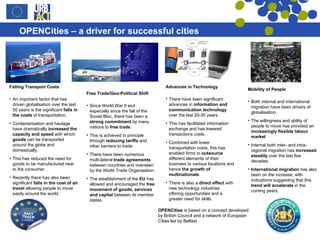
Free Trade/Geo-Political Shift Since World War II and especially since the fall of the Soviet Bloc, there has been a  strong commitment  by many nations to  free trade . This is achieved in principle through  reducing tariffs  and other barriers to trade. There have been numerous multi-lateral  trade agreements  between countries and overseen by the World Trade Organisation. The establishment of the  EU  has allowed and encouraged the  free movement of goods, services and capital  between its member states. Falling Transport Costs An important factor that has driven globalisation over the last 50 years is the significant  falls in the costs  of transportation. Containerisation and haulage have dramatically  increased the capacity and speed  with which  goods  can be transported around the globe and domestically. This has reduced the need for goods to be manufactured near to the consumer. Recently there has also been significant  falls in the cost of air travel  allowing people to move easily around the world. Advances in Technology There have been significant advances in  information and communication technology  over the last 20-30 years. This has facilitated information exchange and has lowered transactions costs. Combined with lower transportation costs, this has enabled firms to  outsource  different elements of their business to various locations and hence  the growth of multinationals . There is also a  direct effect  with new technology industries offering opportunities and a greater need for skills. Mobility of People Both internal and international migration have been drivers of globalisation. The willingness and ability of people to move has provided an  increasingly flexible labour market   Internal both inter- and intra-regional migration has  increased steadily  over the last few decades. International migration  has also been on the increase, with indications suggesting that this  trend will accelerate  in the coming years,
OPENCities Drivers Long Term Drivers: Economic Internationalisation. Human mobility and demographics. Environmental change and challenge. Technology development. Urbanisation of poverty and inequality. Continental governance. How cities and regions respond matters. Governance, investment, strategy, leadership, marketing & branding, catalyst, collaboration, inclusion, openness …
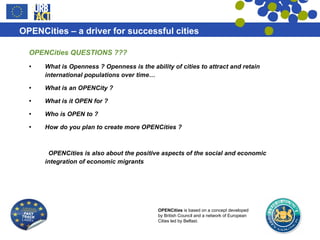
OPENCities QUESTIONS ??? What is Openness ?  Openness is the ability of cities to attract and retain international populations over time… What is an OPENCity ? What is it OPEN for ?  Who is OPEN to ?  How do you plan to create more OPENCities ?  OPENCities is also about the positive aspects of the social and economic integration of economic migrants
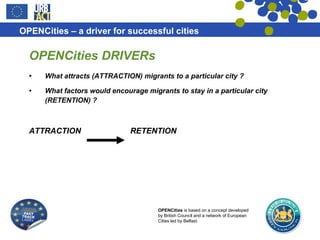
OPENCities DRIVERs W hat attracts (ATTRACTION) migrants to a particular city ? What factors would encourage migrants to stay in a particular city (RETENTION) ? ATTRACTION  RETENTION
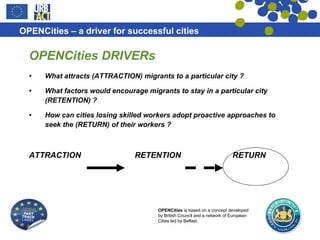
OPENCities DRIVERs W hat attracts (ATTRACTION) migrants to a particular city ? What factors would encourage migrants to stay in a particular city (RETENTION) ? How can cities losing skilled workers adopt proactive approaches to seek the (RETURN) of their workers ? ATTRACTION  RETENTION  RETURN
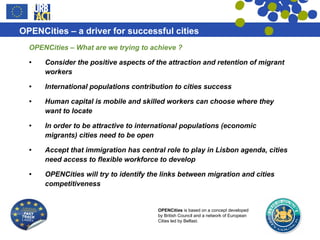
OPENCities – What are we trying to achieve ? Consider the positive aspects of the attraction and retention of migrant workers International populations contribution to cities success Human capital is mobile and skilled workers can choose where they want to locate In order to be attractive to international populations (economic migrants) cities need to be open Accept that immigration has central role to play in Lisbon agenda, cities need access to flexible workforce to develop OPENCities will try to identify the links between migration and cities competitiveness
OPENCities – Benefits of Migration Offers competitive advantage of diversity Flexible workers with new skills Intercultural interaction and dialogue enhances quality of life Efforts should be made to exploit the huge potential of the cultural and social diversity  Knowledge economies require interaction and exchange of ideas New arrivals are spur to creativity and innovation
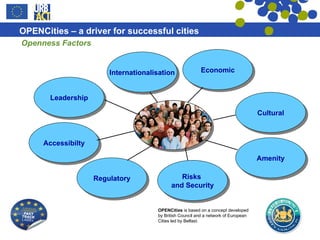
Openness Factors Economic Internationalisation Accessibilty Regulatory Risks  and Security Leadership Amenity Cultural low qualified migrants
OPENCities Factors and Measures 8 factors and 40 measures of Openness? Economic factors: Population, Employment, Enterprise, Skills & Qualifications.  Regulatory factors:  Citizenship, Welfare, Health, Housing, social inclusion.  Cultural factors:  Civic organisations, mixed marriages, creative expressions,  media, food. Amenity factors: Signage/information, language, education, retail, and  neighbourhood mix.  Connectivity/Accessibility factors:  Ports and Gateways, digital access, public transport, city    centres.  Internationalisation factors:  International populations, business, events, institutions, visitors,  and students. Risk factors:  Crime, security, disasters, deportation, racism and xenophobia.  Leadership factors:  Diversity strategy, brand and belonging, voting and representation,    active projects.
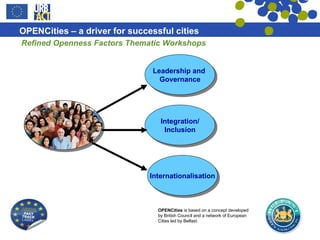
Refined Openness Factors Thematic Workshops Integration/ Inclusion Internationalisation Leadership and  Governance low qualified migrants
OPENCities Emerging themes / Observations Recent enlargement of EU has created flows of migrant workers across Europe Difficulties in some cities in tracking and measuring how many and which nationalities  Economic growth creates demand for new arrivals Pressure on public sector budgets to support new arrivals Need to develop leadership resources for new groups to facilitate integration Language barriers to integration across generations  Barriers to labour market, education and enterprise Integration V Assimilation Different groups of migrants – EU and third country nationals Population decline in many larger cities amongst indigenous population  Need to ringfence ESF/ERDF funds to deal with integration challenges ????
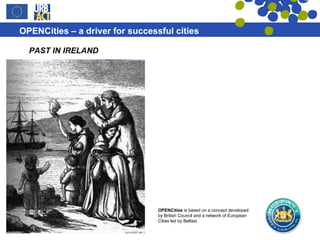
PAST IN IRELAND
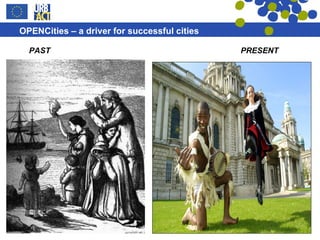
PAST  PRESENT
Damian Duffy OPENCities Lead Expert [email_address] www.tribalgroup.co.uk

Damien Duffy URBACT Open Cities

  • 1.
    URBACT II :CITY LAB Benefiting from Migration 26 th May 2009 Brussels Damian Duffy Lead Expert OPENCities
  • 2.
    Free Trade/Geo-Political ShiftSince World War II and especially since the fall of the Soviet Bloc, there has been a strong commitment by many nations to free trade . This is achieved in principle through reducing tariffs and other barriers to trade. There have been numerous multi-lateral trade agreements between countries and overseen by the World Trade Organisation. The establishment of the EU has allowed and encouraged the free movement of goods, services and capital between its member states. Falling Transport Costs An important factor that has driven globalisation over the last 50 years is the significant falls in the costs of transportation. Containerisation and haulage have dramatically increased the capacity and speed with which goods can be transported around the globe and domestically. This has reduced the need for goods to be manufactured near to the consumer. Recently there has also been significant falls in the cost of air travel allowing people to move easily around the world. Advances in Technology There have been significant advances in information and communication technology over the last 20-30 years. This has facilitated information exchange and has lowered transactions costs. Combined with lower transportation costs, this has enabled firms to outsource different elements of their business to various locations and hence the growth of multinationals . There is also a direct effect with new technology industries offering opportunities and a greater need for skills. Mobility of People Both internal and international migration have been drivers of globalisation. The willingness and ability of people to move has provided an increasingly flexible labour market Internal both inter- and intra-regional migration has increased steadily over the last few decades. International migration has also been on the increase, with indications suggesting that this trend will accelerate in the coming years,
  • 3.
    OPENCities Drivers LongTerm Drivers: Economic Internationalisation. Human mobility and demographics. Environmental change and challenge. Technology development. Urbanisation of poverty and inequality. Continental governance. How cities and regions respond matters. Governance, investment, strategy, leadership, marketing & branding, catalyst, collaboration, inclusion, openness …
  • 4.
    OPENCities QUESTIONS ???What is Openness ? Openness is the ability of cities to attract and retain international populations over time… What is an OPENCity ? What is it OPEN for ? Who is OPEN to ? How do you plan to create more OPENCities ? OPENCities is also about the positive aspects of the social and economic integration of economic migrants
  • 5.
    OPENCities DRIVERs What attracts (ATTRACTION) migrants to a particular city ? What factors would encourage migrants to stay in a particular city (RETENTION) ? ATTRACTION RETENTION
  • 6.
    OPENCities DRIVERs What attracts (ATTRACTION) migrants to a particular city ? What factors would encourage migrants to stay in a particular city (RETENTION) ? How can cities losing skilled workers adopt proactive approaches to seek the (RETURN) of their workers ? ATTRACTION RETENTION RETURN
  • 7.
    OPENCities – Whatare we trying to achieve ? Consider the positive aspects of the attraction and retention of migrant workers International populations contribution to cities success Human capital is mobile and skilled workers can choose where they want to locate In order to be attractive to international populations (economic migrants) cities need to be open Accept that immigration has central role to play in Lisbon agenda, cities need access to flexible workforce to develop OPENCities will try to identify the links between migration and cities competitiveness
  • 8.
    OPENCities – Benefitsof Migration Offers competitive advantage of diversity Flexible workers with new skills Intercultural interaction and dialogue enhances quality of life Efforts should be made to exploit the huge potential of the cultural and social diversity Knowledge economies require interaction and exchange of ideas New arrivals are spur to creativity and innovation
  • 9.
    Openness Factors EconomicInternationalisation Accessibilty Regulatory Risks and Security Leadership Amenity Cultural low qualified migrants
  • 10.
    OPENCities Factors andMeasures 8 factors and 40 measures of Openness? Economic factors: Population, Employment, Enterprise, Skills & Qualifications. Regulatory factors: Citizenship, Welfare, Health, Housing, social inclusion. Cultural factors: Civic organisations, mixed marriages, creative expressions, media, food. Amenity factors: Signage/information, language, education, retail, and neighbourhood mix. Connectivity/Accessibility factors: Ports and Gateways, digital access, public transport, city centres. Internationalisation factors: International populations, business, events, institutions, visitors, and students. Risk factors: Crime, security, disasters, deportation, racism and xenophobia. Leadership factors: Diversity strategy, brand and belonging, voting and representation, active projects.
  • 11.
    Refined Openness FactorsThematic Workshops Integration/ Inclusion Internationalisation Leadership and Governance low qualified migrants
  • 12.
    OPENCities Emerging themes/ Observations Recent enlargement of EU has created flows of migrant workers across Europe Difficulties in some cities in tracking and measuring how many and which nationalities Economic growth creates demand for new arrivals Pressure on public sector budgets to support new arrivals Need to develop leadership resources for new groups to facilitate integration Language barriers to integration across generations Barriers to labour market, education and enterprise Integration V Assimilation Different groups of migrants – EU and third country nationals Population decline in many larger cities amongst indigenous population Need to ringfence ESF/ERDF funds to deal with integration challenges ????
  • 13.
  • 14.
  • 15.
    Damian Duffy OPENCitiesLead Expert [email_address] www.tribalgroup.co.uk