Changing policy regimes:
From (stale) migration policies to
(innovative) policy initiatives
Yevgeny Kuznetsov
Migration Policy Institute
Washington DC
February 25
1
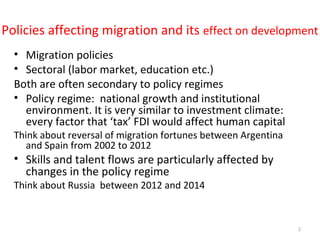
Policies affecting migration and its effect on development
• Migration policies
• Sectoral (labor market, education etc.)
Both are often secondary to policy regimes
• Policy regime: national growth and institutional
environment. It is very similar to investment climate:
every factor that ‘tax’ FDI would affect human capital
Think about reversal of migration fortunes between Argentina
and Spain from 2002 to 2012
• Skills and talent flows are particularly affected by
changes in the policy regime
Think about Russia between 2012 and 2014
2
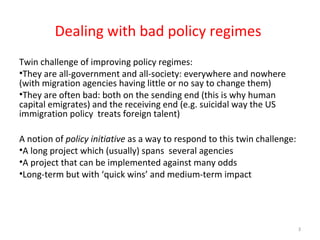
Dealing with bad policy regimes
Twin challenge of improving policy regimes:
•They are all-government and all-society: everywhere and nowhere
(with migration agencies having little or no say to change them)
•They are often bad: both on the sending end (this is why human
capital emigrates) and the receiving end (e.g. suicidal way the US
immigration policy treats foreign talent)
A notion of policy initiative as a way to respond to this twin challenge:
•A long project which (usually) spans several agencies
•A project that can be implemented against many odds
•Long-term but with ‘quick wins’ and medium-term impact
3
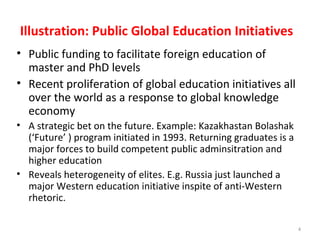
Illustration: Public Global Education Initiatives
• Public funding to facilitate foreign education of
master and PhD levels
• Recent proliferation of global education initiatives all
over the world as a response to global knowledge
economy
• A strategic bet on the future. Example: Kazakhastan Bolashak
(‘Future’ ) program initiated in 1993. Returning graduates is a
major forces to build competent public adminsitration and
higher education
• Reveals heterogeneity of elites. E.g. Russia just launched a
major Western education initiative inspite of anti-Western
rhetoric.
4
Agency designing and implementing
migration-related policies
• State capability as endogenous variable: capable of growing
rather than given
• Key issue: heterogeneity (internal diversity) of the state.
Capabilities can be low in general but some segments are
dynamic, creative and problem solving
• Creative state: state designing new ‘out-of-box’ solutions to
deal with migration and development challenges (Natasha
Iskander’s book on Creative State in Mexico and Morocco)
• A hypothesis (a paradox?): migration-related capabilities
tend to be either very low (when immigration is part of
security agenda) or unusually high (when policy innovation
emerges in response to persistent challenge: Iskander’s
Creative State )
5
Implications for 2016 OECD Perspectives on
Global Development
• Endeavor policy synthesis: include a chapter
on new migration-related policy initiatives
• But avoid the ‘best practice’ approach
(‘development church’ dispensing the latest
wisdom)
• Instead, focus on local policy innovations and
how it diffuses. This is policy ‘glocalization’:
local innovation informed by global
experience
6
©Knowledge for Development, WBI
2. What does the policy manage?
Migration chains
Traditional migration chains
1. Low skilled migration chains: ‘Birds of Passage’ (M. Piore)
in which the success of one villager in a low-skill job abroad
attracts first one neighbor or cousin, then the next
2. Internal job ladders
where high skill employers work and learn by progressing
from one task to a hierarchically more demanding one
within a closed corporation
7
©Knowledge for Development, WBI
Open Migration chains
In the knowledge economy, one is beginning to
see fusion of traditional migration chains and
internal job ladders into open migration chains
Open migration chains are sequences of educational
or job opportunities which allow a migrant to move to progressively
complex educational and job tasks necessary to work in the global
environment
Evidence:
-- high skilled mobility (India, Greater China)
-- mid-skilled migration
Mid-level skills: tacit skills learnt through experience (e.g. construction
Workers)
E.g. Progression from manual labor to management
8
Skills in the knowledge economy
• Skills are measured by one dimension: years of schooling.
Hence high-skilled migrants (whom everyone wants) and low
skilled.
• Codifiable skills can be automated (AMT trends, thanks of
drivers)
• There is a second crucial dimension of uniqueness of skill:
talent -a knack for problem solving
This is because automation and other modern trends
• Hence, two new categories:
Mid-skilled migrants with tacit skills (whom everyone needs):
nannies, construction workers
High achievers: the stars of each profession
9
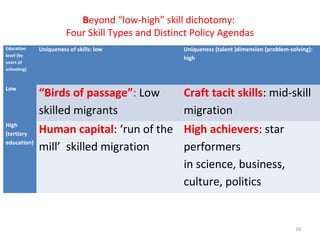
Beyond “low-high” skill dichotomy:
Four Skill Types and Distinct Policy Agendas
Education
level (by
years of
schooling)
Uniqueness of skills: low Uniqueness (talent )dimension (problem-solving):
high
Low
“Birds of passage”: Low
skilled migrants
Craft tacit skills: mid-skill
migration
High
(tertiary
education)
Human capital: ‘run of the
mill’ skilled migration
High achievers: star
performers
in science, business,
culture, politics
10
Questions for Scenarios
• How would migration chains change in each of
the scenarios?
E.g. in automation scenario, open migration are
pervasive. What are the implications for
policy?
• What is the weight of the uniqueness factor in
skills? E.g. what is the scope of ‘winner take
all’ stars?
11

Yevgeny Kuznetsov's presentation - OECD - PGD Expert Meeting

  • 1.
    Changing policy regimes: From(stale) migration policies to (innovative) policy initiatives Yevgeny Kuznetsov Migration Policy Institute Washington DC February 25 1
  • 2.
    Policies affecting migrationand its effect on development • Migration policies • Sectoral (labor market, education etc.) Both are often secondary to policy regimes • Policy regime: national growth and institutional environment. It is very similar to investment climate: every factor that ‘tax’ FDI would affect human capital Think about reversal of migration fortunes between Argentina and Spain from 2002 to 2012 • Skills and talent flows are particularly affected by changes in the policy regime Think about Russia between 2012 and 2014 2
  • 3.
    Dealing with badpolicy regimes Twin challenge of improving policy regimes: •They are all-government and all-society: everywhere and nowhere (with migration agencies having little or no say to change them) •They are often bad: both on the sending end (this is why human capital emigrates) and the receiving end (e.g. suicidal way the US immigration policy treats foreign talent) A notion of policy initiative as a way to respond to this twin challenge: •A long project which (usually) spans several agencies •A project that can be implemented against many odds •Long-term but with ‘quick wins’ and medium-term impact 3
  • 4.
    Illustration: Public GlobalEducation Initiatives • Public funding to facilitate foreign education of master and PhD levels • Recent proliferation of global education initiatives all over the world as a response to global knowledge economy • A strategic bet on the future. Example: Kazakhastan Bolashak (‘Future’ ) program initiated in 1993. Returning graduates is a major forces to build competent public adminsitration and higher education • Reveals heterogeneity of elites. E.g. Russia just launched a major Western education initiative inspite of anti-Western rhetoric. 4
  • 5.
    Agency designing andimplementing migration-related policies • State capability as endogenous variable: capable of growing rather than given • Key issue: heterogeneity (internal diversity) of the state. Capabilities can be low in general but some segments are dynamic, creative and problem solving • Creative state: state designing new ‘out-of-box’ solutions to deal with migration and development challenges (Natasha Iskander’s book on Creative State in Mexico and Morocco) • A hypothesis (a paradox?): migration-related capabilities tend to be either very low (when immigration is part of security agenda) or unusually high (when policy innovation emerges in response to persistent challenge: Iskander’s Creative State ) 5
  • 6.
    Implications for 2016OECD Perspectives on Global Development • Endeavor policy synthesis: include a chapter on new migration-related policy initiatives • But avoid the ‘best practice’ approach (‘development church’ dispensing the latest wisdom) • Instead, focus on local policy innovations and how it diffuses. This is policy ‘glocalization’: local innovation informed by global experience 6
  • 7.
    ©Knowledge for Development,WBI 2. What does the policy manage? Migration chains Traditional migration chains 1. Low skilled migration chains: ‘Birds of Passage’ (M. Piore) in which the success of one villager in a low-skill job abroad attracts first one neighbor or cousin, then the next 2. Internal job ladders where high skill employers work and learn by progressing from one task to a hierarchically more demanding one within a closed corporation 7
  • 8.
    ©Knowledge for Development,WBI Open Migration chains In the knowledge economy, one is beginning to see fusion of traditional migration chains and internal job ladders into open migration chains Open migration chains are sequences of educational or job opportunities which allow a migrant to move to progressively complex educational and job tasks necessary to work in the global environment Evidence: -- high skilled mobility (India, Greater China) -- mid-skilled migration Mid-level skills: tacit skills learnt through experience (e.g. construction Workers) E.g. Progression from manual labor to management 8
  • 9.
    Skills in theknowledge economy • Skills are measured by one dimension: years of schooling. Hence high-skilled migrants (whom everyone wants) and low skilled. • Codifiable skills can be automated (AMT trends, thanks of drivers) • There is a second crucial dimension of uniqueness of skill: talent -a knack for problem solving This is because automation and other modern trends • Hence, two new categories: Mid-skilled migrants with tacit skills (whom everyone needs): nannies, construction workers High achievers: the stars of each profession 9
  • 10.
    Beyond “low-high” skilldichotomy: Four Skill Types and Distinct Policy Agendas Education level (by years of schooling) Uniqueness of skills: low Uniqueness (talent )dimension (problem-solving): high Low “Birds of passage”: Low skilled migrants Craft tacit skills: mid-skill migration High (tertiary education) Human capital: ‘run of the mill’ skilled migration High achievers: star performers in science, business, culture, politics 10
  • 11.
    Questions for Scenarios •How would migration chains change in each of the scenarios? E.g. in automation scenario, open migration are pervasive. What are the implications for policy? • What is the weight of the uniqueness factor in skills? E.g. what is the scope of ‘winner take all’ stars? 11