Going Global  Cameron Dunn Chief Examiner, Edexcel
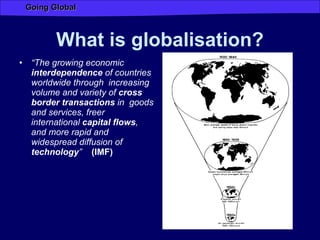
What is globalisation? “ The growing economic  interdependence  of countries worldwide through  increasing volume and variety of  cross border transactions  in  goods and services, freer international  capital flows , and more rapid and widespread diffusion of  technology ”   (IMF)
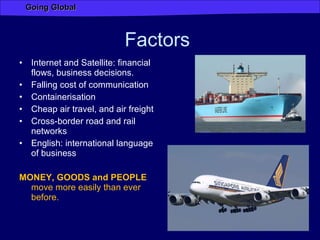
Factors  Internet and Satellite: financial flows, business decisions. Falling cost of communication Containerisation  Cheap air travel, and air freight Cross-border road and rail networks English: international language of business MONEY, GOODS and PEOPLE  move more easily than ever before.
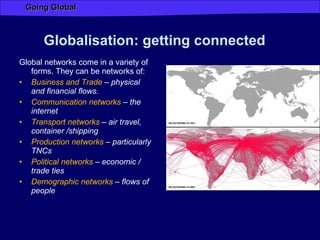
Globalisation: getting connected  Global networks come in a variety of forms. They can be networks of: Business and Trade  – physical and financial flows. Communication networks  – the internet  Transport networks  – air travel,  container /shipping Production networks  – particularly  TNCs Political networks  – economic / trade ties  Demographic networks  – flows of people
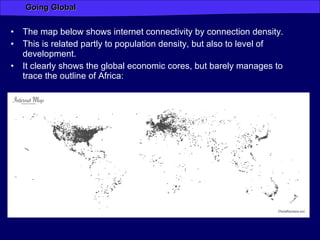
The map below shows internet connectivity by connection density. This is related partly to population density, but also to level of development.  It clearly shows the global economic cores, but barely manages to trace the outline of Africa:
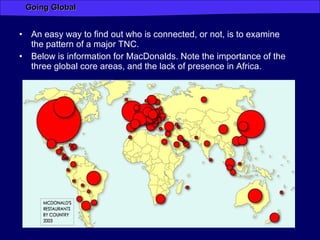
An easy way to find out who is connected, or not, is to examine the pattern of a major TNC. Below is information for MacDonalds. Note the importance of the three global core areas, and the lack of presence in Africa.
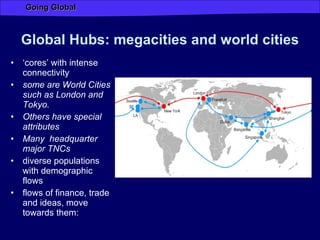
Global Hubs: megacities and world cities  ‘ cores’ with intense connectivity some are World Cities such as London and Tokyo.  Others have special attributes Many  headquarter major TNCs diverse populations with demographic flows flows of finance, trade and ideas, move towards them:
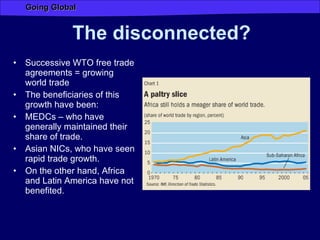
The   disconnected? Successive WTO free trade agreements = growing world trade  The beneficiaries of this growth have been: MEDCs – who have generally maintained their share of trade. Asian NICs, who have seen rapid trade growth. On the other hand, Africa and Latin America have not benefited.
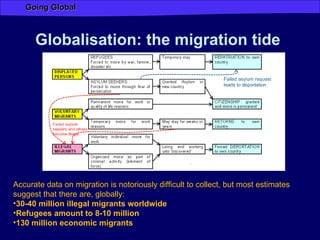
Globalisation: the migration tide  Accurate data on migration is notoriously difficult to collect, but most estimates suggest that there are, globally: 30-40 million illegal migrants worldwide Refugees amount to 8-10 million  130 million economic migrants
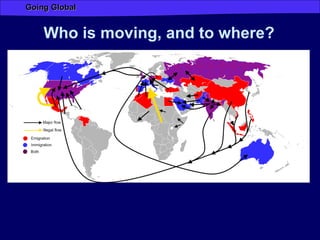
Who is moving, and to where?
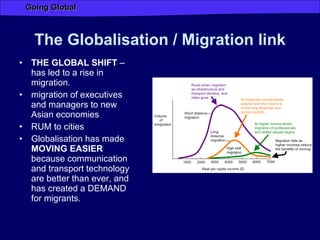
The Globalisation / Migration link THE GLOBAL SHIFT  – has led to a rise in migration.  migration of executives and managers to new Asian economies RUM to cities Globalisation has made  MOVING EASIER  because communication and transport technology are better than ever, and has created a DEMAND for migrants.
Summary:  Globalisattion has shrunk the world; as a process it continues to increase connectivity. Connectivity is most intense in global hubs; many of these are megacities. Megacities attract migrants, both rural-urban ones and international ones, further fuelling megacity growth  In turn globalization contributes to the ability of people to migrate  Despite globalization some people remain disconnected

Going Global

  • 1.
    Going Global Cameron Dunn Chief Examiner, Edexcel
  • 2.
    What is globalisation?“ The growing economic interdependence of countries worldwide through increasing volume and variety of cross border transactions in goods and services, freer international capital flows , and more rapid and widespread diffusion of technology ” (IMF)
  • 3.
    Factors Internetand Satellite: financial flows, business decisions. Falling cost of communication Containerisation Cheap air travel, and air freight Cross-border road and rail networks English: international language of business MONEY, GOODS and PEOPLE move more easily than ever before.
  • 4.
    Globalisation: getting connected Global networks come in a variety of forms. They can be networks of: Business and Trade – physical and financial flows. Communication networks – the internet Transport networks – air travel, container /shipping Production networks – particularly TNCs Political networks – economic / trade ties Demographic networks – flows of people
  • 5.
    The map belowshows internet connectivity by connection density. This is related partly to population density, but also to level of development. It clearly shows the global economic cores, but barely manages to trace the outline of Africa:
  • 6.
    An easy wayto find out who is connected, or not, is to examine the pattern of a major TNC. Below is information for MacDonalds. Note the importance of the three global core areas, and the lack of presence in Africa.
  • 7.
    Global Hubs: megacitiesand world cities ‘ cores’ with intense connectivity some are World Cities such as London and Tokyo. Others have special attributes Many headquarter major TNCs diverse populations with demographic flows flows of finance, trade and ideas, move towards them:
  • 8.
    The disconnected? Successive WTO free trade agreements = growing world trade The beneficiaries of this growth have been: MEDCs – who have generally maintained their share of trade. Asian NICs, who have seen rapid trade growth. On the other hand, Africa and Latin America have not benefited.
  • 9.
    Globalisation: the migrationtide Accurate data on migration is notoriously difficult to collect, but most estimates suggest that there are, globally: 30-40 million illegal migrants worldwide Refugees amount to 8-10 million 130 million economic migrants
  • 10.
    Who is moving,and to where?
  • 11.
    The Globalisation /Migration link THE GLOBAL SHIFT – has led to a rise in migration. migration of executives and managers to new Asian economies RUM to cities Globalisation has made MOVING EASIER because communication and transport technology are better than ever, and has created a DEMAND for migrants.
  • 12.
    Summary: Globalisattionhas shrunk the world; as a process it continues to increase connectivity. Connectivity is most intense in global hubs; many of these are megacities. Megacities attract migrants, both rural-urban ones and international ones, further fuelling megacity growth In turn globalization contributes to the ability of people to migrate Despite globalization some people remain disconnected