Journal of Economics and Sustainable Development www.iiste.org 
ISSN 2222-1700 (Paper) ISSN 2222-2855 (Online) 
Vol.5, No.15 2014 
Aspects of Information and Communication Technology (ICT) 
developments in the growth of Tourism in India 
Dr.HaseenaV.A 
Assistant Professor 
Post Graduate Department of Economics, M.E.S Asmabi College, P.Vemballur,Pin 680671 
Email:economicsasmabi@gmail.com 
Abstract 
Tourism being a smokeless industry is now a multi-billion, multi-sectoral and multi-dimensional activity in the 
world. Twenty first century tourism has reached up to space when a Russian rocket carried the space vehicle of 
Dennis Tito, an American businessman and the world’s first space tourist, to the space station. Time is not too 
far to carry tourists to moon and other planets in specially launched vehicles. Tourism is being considered as an 
agent of social change bridging gaps among nations, regions and people and helping them to open up. It is a 
promoter of development-material and spiritual both at macro and micro level. The General Assembly of the 
United Nations, in designating the year 1967 as ‘International Tourism Year’ recognized the importance of 
international travel as a means of fostering understanding among people, and giving them a knowledge of the 
rich heritage of the past civilizations, a better appreciation of the values of different cultures, thus contributing to 
the strengthening of world peace. It adopted the theme “Tourism-Passport to peace”. Our veteran national 
leader and the first Prime Minister of India, Jawaharlal Nehru had said” welcome a tourist and send back a 
friend” which indicates the need for extending friendly hospitality to the in bound tourists. 
Keywords: Tourism-Passport to peace, social mobility, Percapita Income 
Introduction 
The revolution in ICTs has profound implications for economic and social development. It has pervaded every 
aspect of human life whether it is health, education, economics, governance, entertainment etc. Dissemination, 
propagation and accessibility of these technologies are viewed to be integral to a country’s development strategy. 
The most important benefit associated with the access to the new technologies is the increase in the supply of 
information. Information is shared and disseminated to larger audience. Secondly it reduces the cost of 
production. Knowledge is produced, transmitted, accessed and shared at the minimum cost. With the reduction in 
the transactional costs, there is also a reduction in the degree of inefficiencies and uncertainty. Thirdly it has 
overcome the constraints of distance and geography. ICTs have cut across the geographic boundaries of the 
nation states. Buyers and sellers are able to share information, specifications, production process etc across the 
national borders. It enables all to know the comparative advantage in the market economy. It leads to the larger 
markets and increased access to global supply chains. Fourthly it has led to more transparency. Networking and 
information sharing definitely leads to demands for greater openness and transparency. Whether you want to 
know the status of the central banks’ foreign exchange agency or the cost prize of potatoes in the local market, 
ICTs empowers the individual with the information access, which is transparent. Efforts are under way to 
integrate ICTs to all sectors and developmental activity. Tourism is one such potential area. Tourism and 
economy are closely interconnected. Discussion on Tourism involves the discussion on economic enterprise also. 
Development of Information and Communication Technologies (ICT) has transformed the contemporary 
business environment. It has led to new information economy which is digital in nature. ICT is a broad 
terminology referring to multiple communication technologies which range from simple and complex namely 
Cell Phone applications (SMS), Digital Cameras, Internet, Wireless (WiFi and WiMAN), VOIP,GPS, GIS, 
Convergence (data, voice, media), Digital radio, 
These technologies are creating a new global market place, which is more competitive. With e-commerce 
and e business the market has more opportunities and possibilities than ever before. The ability to 
reach a global audience, obtain instant market information and conduct electronic business transactions has 
increased economic efficiency and has opened markets for goods and services from the developing world. 
E- commerce is expected to benefit economic development in several ways: 
1. Through allowing local business access to global markets 
2. By providing new opportunities to export a wider range of goods and services 
3. By improving the internal efficiency with in the firms. 
First, e-commerce allows business to reach a global audience. In Africa, for example, the tourism and 
handicrafts industries are realizing their ability to deliver their product information directly to consumers. Tourist 
lodges, hotels, and governments across the continent now maintain sophisticated websites advertising their 
unique features, handling booking order, and promoting specials to interested consumers. Similarly, small 
manufacturers of traditional handicrafts are discovering how ICTs can assist the marketing and distribution of 
138
Journal of Economics and Sustainable Development www.iiste.org 
ISSN 2222-1700 (Paper) ISSN 2222-2855 (Online) 
Vol.5, No.15 2014 
their wares. Secondly opportunities created by e-commerce and its predecessor technologies is that ICTs can 
create digital market places to manage supply chains and automate transaction, increasing efficiency and opening 
previously closed markets to firms in developing countries. Thirdly, e-commerce is improving the culture of 
business. There are now better intra-firm communications, cost savings procedures, and reductions in the 
inventory costs leading to better management. 
Thus ICTs are the backbone of the capital accumulation. They are connected with new business opportunities, 
increased trade and investment although they are risks involved sometimes. It suggests a positive relationship 
between ICT development and economic growth. Indeed an often cited achievements of Indian economy during 
the last decade has been the emergence of an ICT sector which has shown remarkably vibrancy in terms of 
output and export growth. However, the contribution of ICT to an economy can be viewed at two different levels. 
They are contribution on account on ICT growth and contribution on account of ICT diffusion. While the former 
refers to the contribution in output, employment, export earning etc on account of the production of ICT related 
goods and services, the later refers to ICT induced development through enhanced productivity, competitiveness, 
growth and human welfare on account of the diffusion of this technology to the different sectors of the economy 
and society. (Karmer and Derick 1992). 
ICT and Tourism 
Contemporary information society has made Tourism a highly information-intensive industry as ICT has a 
potential impact on tourism business. The role of ICT in tourism industry cannot be underestimated and it is 
crucial driving force in the current information driven society. It has provided new tools and enabled new 
distribution channels, thus creating a new business environment. ICT tools have facilitated business transaction 
in the industry by networking with trading partners, distribution of product services and providing information to 
consumers across the globe. On the other hand consumers are also using online to obtain information and plan 
their trip and travel. Information is the key element in the tourism industry. ICT pervades almost all aspects of 
tourism and related industry. For instance, we depend upon it right from the scratch while identifying and 
developing tourisms site and destinations itself. The use of Geospatial Information Technologies in the recent 
years across the globe for varied purposes is popularly known and Tourism industry has not been an exception in 
availing its advantages. It can be used by tourist professionals to define the boundaries of the proposed tourist 
site as well its surrounding areas and the communities living in it. It can also get information on roads linking to 
the sites and availability of other utilities like water, power, market etc. Such technologies are also useful for site 
management and monitoring. The role of ICT tools in the industry for marketing, operation, and management of 
customer is widely known. Marketing techniques can be more innovative through ICT tools. The table below 
reveals the potential use of ICT tools in the industry. 
Different aspects of industry: Application 
Site development: GIS used for identification of Tourist site and destinations 
Marketing: Advertisement, promotion 
Operations: Buying and management of supplies and services 
Customer services: Management of customer relationships through booking travel, lodge etc 
Monitoring: GIS and GPS is also used for managing and monitoring tourist sites. 
139 
Key factors for applying ICT in tourism 
1. IT education and training for policy makers, managers and other players in the industry 
2. Integration of various sectors like transport, lodge etc. 
3. Technical Infrastructure 
4. Human Infrastructure, which includes skilled people, vision and management. 
5. Legal Infrastructure 
a. Regulation of telecommunication providers 
b. Subsides for Internet service providers 
c. Legal framework for online advertisement or official endorsement for online marketing. 
6. ICT culture 
a. Create and sustain ICT environment 
b. Maintenance and updation of websites 
c. ICT training for all level of workers 
d. Establish electronic linkages between all related sectors 
Nexus between ICT and Tourism: A Review 
Recent Studies on ICT and tourism has revealed the transition in the industry as a result of ICT impact and have 
explored its possibility and potential. Poon (1993) analyses some of the major challenges facing tourism industry 
and outlines the nexus between tourism and ICT. He traces the rapid shift-taking place between ‘traditional
Journal of Economics and Sustainable Development www.iiste.org 
ISSN 2222-1700 (Paper) ISSN 2222-2855 (Online) 
Vol.5, No.15 2014 
tourism sector’ and ‘new tourism industry’. Technology has a strategic role in reshaping the value chain in the 
industry and in the process, consumers are gradually adapting to the new values, lifestyles and new tourism 
products, which has re-engineered by the new technologies. Although some of the technologies described are 
now obsolete, the implicit message is relevant and gives an overall review of the changing face of the tourism 
industry. Inkpen (1998) and Sheldon (1997) have examined the main characteristics of the industry structure and 
the operation of the new technologies in it. ICT applications in different sectors like airlines, hotels, tour 
operators, road and rail transport etc is dealt in detail with informative case studies. Some of the world’s largest 
GDS (Global Distribution System) namely Sabre, Galileo, Amadeus and Worldspsan are examined. Besides 
analyzing the telecommunication technologies in the industry, the hospitality sector, entertainment sector, 
transport sector, management sector and other intermediaries have been diligently explored. 
Werthner (1999) provides a more detailed and logical understating of the industry’s structure by 
focusing on the concepts, definitions, consumer behavior, economic aspect, market transactions, etc. Information 
Technology ( hardware & software developments), information management, intelligent applications and 
system integration etc are examined carefully. Additional information on business strategy exploring the 
relationship between ICT, strategy and organization is also articulated. Buhalis (2003) also stressed on strategic 
management in his book providing a comprehensive overview of both operational and strategic management. 
Connor‘s (1999) work serves as a textbook on electronic distribution with its logical explanation and 
case studies. GDS, CRS and DMS are analyzed with example of cases from across the western world. The 
growing phenomenon of travel distribution through Internet and its impact on distribution channels structure and 
functionality is explored with rigor. Carter & Bedard (2001)and Carter & Richer (1999) have focused on the 
operators in the tourism industry. Developments of the e commerce and DMO (Development Management 
Organizations ) and their changing value chains are analyzed intelligently and clearly so that importance of 
internet presence for consumers, intermediaries, travel media and other players in the industry is noted and 
understood through their works. Marcussen (1999) attempts to provide an overview of innovative developments 
in distribution of travel and tourism services in Europe. It documents the wealth of statistical data on travel and 
related transactions in the European tourism industry. However, most of the experiences are based on the 
western developed world, which could possibly a limitation while trying to understand the nexus of ICT and 
Tourism in an Indian context. Jennifer et al (2003) have examined the way ICT and Internet have gradually 
changed the tourism industry in China. They have used the existing theoretical framework on ICT and e-tourism 
developments in other parts of the world namely Europe and America to examine their impact of ICT application 
in the tourism industry contemporary China. There have been tremendous developments at the destinations 
levels in the recent years. Internet, Intranet etc have been extensively employed by the (DMOs) which has 
integrated the functioning process and made the system more efficient. Studies like (Poon 1993, Sheldon 1997, 
Werthner & Klein 1999, Alford 2000, Werthner and Klein 1999, Alford 2000, WTO 2001) have revealed that 
Internet and strategic implementation of IT is now critical for companies to survive in the global economy. 
However, not many efforts are made to study e-tourism developments in India and other developing countries 
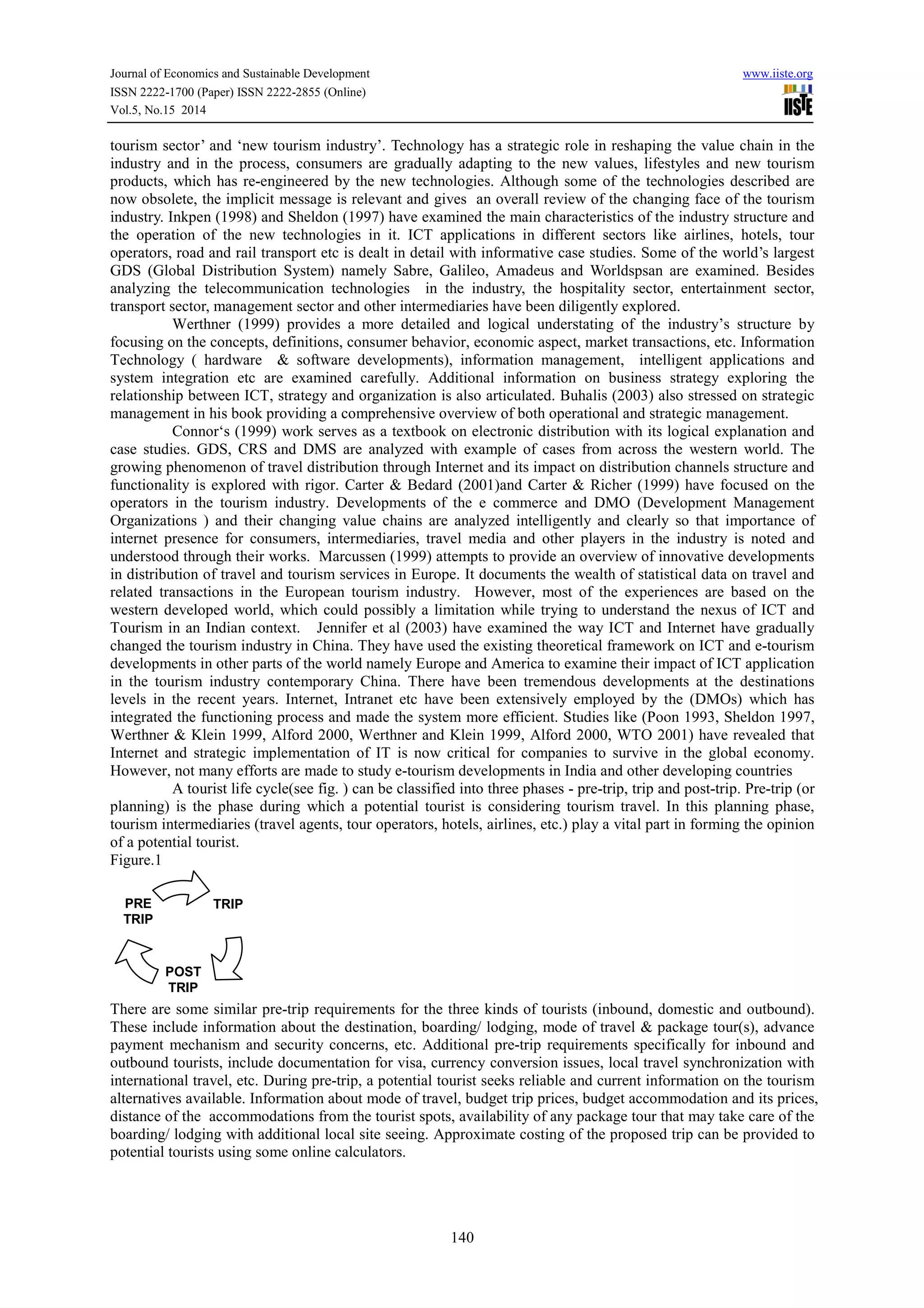
A tourist life cycle(see fig. ) can be classified into three phases - pre-trip, trip and post-trip. Pre-trip (or 
planning) is the phase during which a potential tourist is considering tourism travel. In this planning phase, 
tourism intermediaries (travel agents, tour operators, hotels, airlines, etc.) play a vital part in forming the opinion 
of a potential tourist. 
Figure.1 
140 
TRIP 
POST 
TRIP 
PRE 
TRIP 
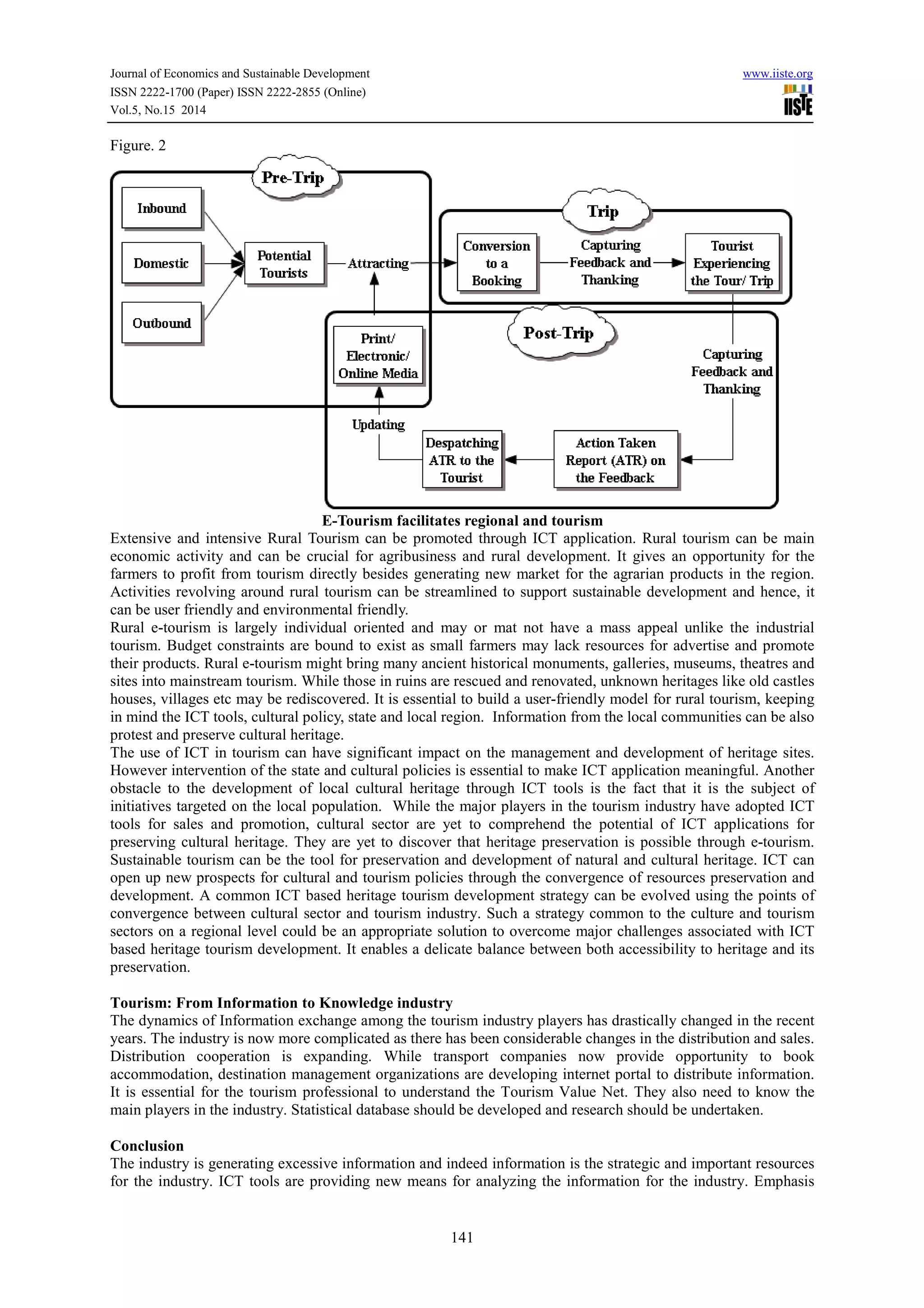
There are some similar pre-trip requirements for the three kinds of tourists (inbound, domestic and outbound). 
These include information about the destination, boarding/ lodging, mode of travel & package tour(s), advance 
payment mechanism and security concerns, etc. Additional pre-trip requirements specifically for inbound and 
outbound tourists, include documentation for visa, currency conversion issues, local travel synchronization with 
international travel, etc. During pre-trip, a potential tourist seeks reliable and current information on the tourism 
alternatives available. Information about mode of travel, budget trip prices, budget accommodation and its prices, 
distance of the accommodations from the tourist spots, availability of any package tour that may take care of the 
boarding/ lodging with additional local site seeing. Approximate costing of the proposed trip can be provided to 
potential tourists using some online calculators.
Journal of Economics and Sustainable Development www.iiste.org 
ISSN 2222-1700 (Paper) ISSN 2222-2855 (Online) 
Vol.5, No.15 2014 
141 
Figure. 2 
E-Tourism facilitates regional and tourism 
Extensive and intensive Rural Tourism can be promoted through ICT application. Rural tourism can be main 
economic activity and can be crucial for agribusiness and rural development. It gives an opportunity for the 
farmers to profit from tourism directly besides generating new market for the agrarian products in the region. 
Activities revolving around rural tourism can be streamlined to support sustainable development and hence, it 
can be user friendly and environmental friendly. 
Rural e-tourism is largely individual oriented and may or mat not have a mass appeal unlike the industrial 
tourism. Budget constraints are bound to exist as small farmers may lack resources for advertise and promote 
their products. Rural e-tourism might bring many ancient historical monuments, galleries, museums, theatres and 
sites into mainstream tourism. While those in ruins are rescued and renovated, unknown heritages like old castles 
houses, villages etc may be rediscovered. It is essential to build a user-friendly model for rural tourism, keeping 
in mind the ICT tools, cultural policy, state and local region. Information from the local communities can be also 
protest and preserve cultural heritage. 
The use of ICT in tourism can have significant impact on the management and development of heritage sites. 
However intervention of the state and cultural policies is essential to make ICT application meaningful. Another 
obstacle to the development of local cultural heritage through ICT tools is the fact that it is the subject of 
initiatives targeted on the local population. While the major players in the tourism industry have adopted ICT 
tools for sales and promotion, cultural sector are yet to comprehend the potential of ICT applications for 
preserving cultural heritage. They are yet to discover that heritage preservation is possible through e-tourism. 
Sustainable tourism can be the tool for preservation and development of natural and cultural heritage. ICT can 
open up new prospects for cultural and tourism policies through the convergence of resources preservation and 
development. A common ICT based heritage tourism development strategy can be evolved using the points of 
convergence between cultural sector and tourism industry. Such a strategy common to the culture and tourism 
sectors on a regional level could be an appropriate solution to overcome major challenges associated with ICT 
based heritage tourism development. It enables a delicate balance between both accessibility to heritage and its 
preservation. 
Tourism: From Information to Knowledge industry 
The dynamics of Information exchange among the tourism industry players has drastically changed in the recent 
years. The industry is now more complicated as there has been considerable changes in the distribution and sales. 
Distribution cooperation is expanding. While transport companies now provide opportunity to book 
accommodation, destination management organizations are developing internet portal to distribute information. 
It is essential for the tourism professional to understand the Tourism Value Net. They also need to know the 
main players in the industry. Statistical database should be developed and research should be undertaken. 
Conclusion 
The industry is generating excessive information and indeed information is the strategic and important resources 
for the industry. ICT tools are providing new means for analyzing the information for the industry. Emphasis
Journal of Economics and Sustainable Development www.iiste.org 
ISSN 2222-1700 (Paper) ISSN 2222-2855 (Online) 
Vol.5, No.15 2014 
should be upon converting this valuable information to knowledge system. There should be gradual transition 
from data system to profound knowledge system for the benefit of future generations. Educational institutions 
should have access to such knowledge. Educational institute should promote ICT based courses. It should be 
supported with technical training as well as field based training and practical experience in the industry. 
Educational institute specialized on Tourism education, IT educational institutions and tourism industry players 
like travel agencies, tour operators, hotels, technology providers etc should have a network and have constant 
interaction in order to develop a skill base for successful tourism industry and a successful navigation. 
References 
Buhalis, D & Laws, E. (eds) (2001). Tourism Distribution Channels-Practices, Issues and Transformations, 
142 
Continuum Publishing, London. 
Buhalis, D. (2003). e tourism –Information Technology for strategic tourism management, Prentice Hall, Harlow, 
UK. 
Carter R & Bedard, F. (2001). E-Business for Tourism-Practical Guidelines for Tourism Destinations and 
Business, WTO Business Council, Madrid. 
Carter R & Richer P. (1999). Marketing Tourism Destination Online, WTO Business Council, Madrid. 
European e- business market Watch, Sector Report, No 13 II/July (2003). 
Gupta, S & Bansal, S.P. (2001). Tourism Towards 21st Century, Deep and Deep. New Delhi. 
Inkpen, G. (1998). Information Technology for Travel and Tourism, Addison Wesley Logman, Essex UK . 
Jennifer X. M, Dimitrios, B & Haiyan, S. (2003). Information Journal of Information Management. Vol 23. Issue 
6. Pg. 451-467. 
Kramer, K.L & Derick, J. (2002). Information Technology and Economic Development: Results and Policy 
Implications of Cross-Country Studies, in Pohjola M. (ed) Information Technology, Productivity and 
Economic Growth, Oxford University Press. 
Marcussen, C. (1999). Internet Distribution of European Travel and Tourism Services, Research Centre of 
Bornholm, Denmark. 
O’Connor, P. (1999). Electronic Information Distribution in Tourism and Hospitality, CABI Publishing, UK. 
Poon , A. (1993). Tourism, Technology and Competitive Strategies, Cab International. 
Sabado, O. (2005) www.estig.blogspot.com/2005/10/role-of-ict.html. 
Sheldon, P. (1997). Tourism Information Technology, CA International, Wallingford, UK 
Werthner, H & Klein, S. (1999). Information Technology and Tourism – A Challenging Relationship, Springer, 
Wien and New York.
The IISTE is a pioneer in the Open-Access hosting service and academic event 
management. The aim of the firm is Accelerating Global Knowledge Sharing. 
More information about the firm can be found on the homepage: 
http://www.iiste.org 
CALL FOR JOURNAL PAPERS 
There are more than 30 peer-reviewed academic journals hosted under the hosting 
platform. 
Prospective authors of journals can find the submission instruction on the 
following page: http://www.iiste.org/journals/ All the journals articles are available 
online to the readers all over the world without financial, legal, or technical barriers 
other than those inseparable from gaining access to the internet itself. Paper version 
of the journals is also available upon request of readers and authors. 
MORE RESOURCES 
Book publication information: http://www.iiste.org/book/ 
IISTE Knowledge Sharing Partners 
EBSCO, Index Copernicus, Ulrich's Periodicals Directory, JournalTOCS, PKP Open 
Archives Harvester, Bielefeld Academic Search Engine, Elektronische 
Zeitschriftenbibliothek EZB, Open J-Gate, OCLC WorldCat, Universe Digtial 
Library , NewJour, Google Scholar

Aspects of information and communication technology (ict) developments in the growth of tourism in india

  • 1.
    Journal of Economicsand Sustainable Development www.iiste.org ISSN 2222-1700 (Paper) ISSN 2222-2855 (Online) Vol.5, No.15 2014 Aspects of Information and Communication Technology (ICT) developments in the growth of Tourism in India Dr.HaseenaV.A Assistant Professor Post Graduate Department of Economics, M.E.S Asmabi College, P.Vemballur,Pin 680671 Email:economicsasmabi@gmail.com Abstract Tourism being a smokeless industry is now a multi-billion, multi-sectoral and multi-dimensional activity in the world. Twenty first century tourism has reached up to space when a Russian rocket carried the space vehicle of Dennis Tito, an American businessman and the world’s first space tourist, to the space station. Time is not too far to carry tourists to moon and other planets in specially launched vehicles. Tourism is being considered as an agent of social change bridging gaps among nations, regions and people and helping them to open up. It is a promoter of development-material and spiritual both at macro and micro level. The General Assembly of the United Nations, in designating the year 1967 as ‘International Tourism Year’ recognized the importance of international travel as a means of fostering understanding among people, and giving them a knowledge of the rich heritage of the past civilizations, a better appreciation of the values of different cultures, thus contributing to the strengthening of world peace. It adopted the theme “Tourism-Passport to peace”. Our veteran national leader and the first Prime Minister of India, Jawaharlal Nehru had said” welcome a tourist and send back a friend” which indicates the need for extending friendly hospitality to the in bound tourists. Keywords: Tourism-Passport to peace, social mobility, Percapita Income Introduction The revolution in ICTs has profound implications for economic and social development. It has pervaded every aspect of human life whether it is health, education, economics, governance, entertainment etc. Dissemination, propagation and accessibility of these technologies are viewed to be integral to a country’s development strategy. The most important benefit associated with the access to the new technologies is the increase in the supply of information. Information is shared and disseminated to larger audience. Secondly it reduces the cost of production. Knowledge is produced, transmitted, accessed and shared at the minimum cost. With the reduction in the transactional costs, there is also a reduction in the degree of inefficiencies and uncertainty. Thirdly it has overcome the constraints of distance and geography. ICTs have cut across the geographic boundaries of the nation states. Buyers and sellers are able to share information, specifications, production process etc across the national borders. It enables all to know the comparative advantage in the market economy. It leads to the larger markets and increased access to global supply chains. Fourthly it has led to more transparency. Networking and information sharing definitely leads to demands for greater openness and transparency. Whether you want to know the status of the central banks’ foreign exchange agency or the cost prize of potatoes in the local market, ICTs empowers the individual with the information access, which is transparent. Efforts are under way to integrate ICTs to all sectors and developmental activity. Tourism is one such potential area. Tourism and economy are closely interconnected. Discussion on Tourism involves the discussion on economic enterprise also. Development of Information and Communication Technologies (ICT) has transformed the contemporary business environment. It has led to new information economy which is digital in nature. ICT is a broad terminology referring to multiple communication technologies which range from simple and complex namely Cell Phone applications (SMS), Digital Cameras, Internet, Wireless (WiFi and WiMAN), VOIP,GPS, GIS, Convergence (data, voice, media), Digital radio, These technologies are creating a new global market place, which is more competitive. With e-commerce and e business the market has more opportunities and possibilities than ever before. The ability to reach a global audience, obtain instant market information and conduct electronic business transactions has increased economic efficiency and has opened markets for goods and services from the developing world. E- commerce is expected to benefit economic development in several ways: 1. Through allowing local business access to global markets 2. By providing new opportunities to export a wider range of goods and services 3. By improving the internal efficiency with in the firms. First, e-commerce allows business to reach a global audience. In Africa, for example, the tourism and handicrafts industries are realizing their ability to deliver their product information directly to consumers. Tourist lodges, hotels, and governments across the continent now maintain sophisticated websites advertising their unique features, handling booking order, and promoting specials to interested consumers. Similarly, small manufacturers of traditional handicrafts are discovering how ICTs can assist the marketing and distribution of 138
  • 2.
    Journal of Economicsand Sustainable Development www.iiste.org ISSN 2222-1700 (Paper) ISSN 2222-2855 (Online) Vol.5, No.15 2014 their wares. Secondly opportunities created by e-commerce and its predecessor technologies is that ICTs can create digital market places to manage supply chains and automate transaction, increasing efficiency and opening previously closed markets to firms in developing countries. Thirdly, e-commerce is improving the culture of business. There are now better intra-firm communications, cost savings procedures, and reductions in the inventory costs leading to better management. Thus ICTs are the backbone of the capital accumulation. They are connected with new business opportunities, increased trade and investment although they are risks involved sometimes. It suggests a positive relationship between ICT development and economic growth. Indeed an often cited achievements of Indian economy during the last decade has been the emergence of an ICT sector which has shown remarkably vibrancy in terms of output and export growth. However, the contribution of ICT to an economy can be viewed at two different levels. They are contribution on account on ICT growth and contribution on account of ICT diffusion. While the former refers to the contribution in output, employment, export earning etc on account of the production of ICT related goods and services, the later refers to ICT induced development through enhanced productivity, competitiveness, growth and human welfare on account of the diffusion of this technology to the different sectors of the economy and society. (Karmer and Derick 1992). ICT and Tourism Contemporary information society has made Tourism a highly information-intensive industry as ICT has a potential impact on tourism business. The role of ICT in tourism industry cannot be underestimated and it is crucial driving force in the current information driven society. It has provided new tools and enabled new distribution channels, thus creating a new business environment. ICT tools have facilitated business transaction in the industry by networking with trading partners, distribution of product services and providing information to consumers across the globe. On the other hand consumers are also using online to obtain information and plan their trip and travel. Information is the key element in the tourism industry. ICT pervades almost all aspects of tourism and related industry. For instance, we depend upon it right from the scratch while identifying and developing tourisms site and destinations itself. The use of Geospatial Information Technologies in the recent years across the globe for varied purposes is popularly known and Tourism industry has not been an exception in availing its advantages. It can be used by tourist professionals to define the boundaries of the proposed tourist site as well its surrounding areas and the communities living in it. It can also get information on roads linking to the sites and availability of other utilities like water, power, market etc. Such technologies are also useful for site management and monitoring. The role of ICT tools in the industry for marketing, operation, and management of customer is widely known. Marketing techniques can be more innovative through ICT tools. The table below reveals the potential use of ICT tools in the industry. Different aspects of industry: Application Site development: GIS used for identification of Tourist site and destinations Marketing: Advertisement, promotion Operations: Buying and management of supplies and services Customer services: Management of customer relationships through booking travel, lodge etc Monitoring: GIS and GPS is also used for managing and monitoring tourist sites. 139 Key factors for applying ICT in tourism 1. IT education and training for policy makers, managers and other players in the industry 2. Integration of various sectors like transport, lodge etc. 3. Technical Infrastructure 4. Human Infrastructure, which includes skilled people, vision and management. 5. Legal Infrastructure a. Regulation of telecommunication providers b. Subsides for Internet service providers c. Legal framework for online advertisement or official endorsement for online marketing. 6. ICT culture a. Create and sustain ICT environment b. Maintenance and updation of websites c. ICT training for all level of workers d. Establish electronic linkages between all related sectors Nexus between ICT and Tourism: A Review Recent Studies on ICT and tourism has revealed the transition in the industry as a result of ICT impact and have explored its possibility and potential. Poon (1993) analyses some of the major challenges facing tourism industry and outlines the nexus between tourism and ICT. He traces the rapid shift-taking place between ‘traditional
  • 3.
    Journal of Economicsand Sustainable Development www.iiste.org ISSN 2222-1700 (Paper) ISSN 2222-2855 (Online) Vol.5, No.15 2014 tourism sector’ and ‘new tourism industry’. Technology has a strategic role in reshaping the value chain in the industry and in the process, consumers are gradually adapting to the new values, lifestyles and new tourism products, which has re-engineered by the new technologies. Although some of the technologies described are now obsolete, the implicit message is relevant and gives an overall review of the changing face of the tourism industry. Inkpen (1998) and Sheldon (1997) have examined the main characteristics of the industry structure and the operation of the new technologies in it. ICT applications in different sectors like airlines, hotels, tour operators, road and rail transport etc is dealt in detail with informative case studies. Some of the world’s largest GDS (Global Distribution System) namely Sabre, Galileo, Amadeus and Worldspsan are examined. Besides analyzing the telecommunication technologies in the industry, the hospitality sector, entertainment sector, transport sector, management sector and other intermediaries have been diligently explored. Werthner (1999) provides a more detailed and logical understating of the industry’s structure by focusing on the concepts, definitions, consumer behavior, economic aspect, market transactions, etc. Information Technology ( hardware & software developments), information management, intelligent applications and system integration etc are examined carefully. Additional information on business strategy exploring the relationship between ICT, strategy and organization is also articulated. Buhalis (2003) also stressed on strategic management in his book providing a comprehensive overview of both operational and strategic management. Connor‘s (1999) work serves as a textbook on electronic distribution with its logical explanation and case studies. GDS, CRS and DMS are analyzed with example of cases from across the western world. The growing phenomenon of travel distribution through Internet and its impact on distribution channels structure and functionality is explored with rigor. Carter & Bedard (2001)and Carter & Richer (1999) have focused on the operators in the tourism industry. Developments of the e commerce and DMO (Development Management Organizations ) and their changing value chains are analyzed intelligently and clearly so that importance of internet presence for consumers, intermediaries, travel media and other players in the industry is noted and understood through their works. Marcussen (1999) attempts to provide an overview of innovative developments in distribution of travel and tourism services in Europe. It documents the wealth of statistical data on travel and related transactions in the European tourism industry. However, most of the experiences are based on the western developed world, which could possibly a limitation while trying to understand the nexus of ICT and Tourism in an Indian context. Jennifer et al (2003) have examined the way ICT and Internet have gradually changed the tourism industry in China. They have used the existing theoretical framework on ICT and e-tourism developments in other parts of the world namely Europe and America to examine their impact of ICT application in the tourism industry contemporary China. There have been tremendous developments at the destinations levels in the recent years. Internet, Intranet etc have been extensively employed by the (DMOs) which has integrated the functioning process and made the system more efficient. Studies like (Poon 1993, Sheldon 1997, Werthner & Klein 1999, Alford 2000, Werthner and Klein 1999, Alford 2000, WTO 2001) have revealed that Internet and strategic implementation of IT is now critical for companies to survive in the global economy. However, not many efforts are made to study e-tourism developments in India and other developing countries A tourist life cycle(see fig. ) can be classified into three phases - pre-trip, trip and post-trip. Pre-trip (or planning) is the phase during which a potential tourist is considering tourism travel. In this planning phase, tourism intermediaries (travel agents, tour operators, hotels, airlines, etc.) play a vital part in forming the opinion of a potential tourist. Figure.1 140 TRIP POST TRIP PRE TRIP There are some similar pre-trip requirements for the three kinds of tourists (inbound, domestic and outbound). These include information about the destination, boarding/ lodging, mode of travel & package tour(s), advance payment mechanism and security concerns, etc. Additional pre-trip requirements specifically for inbound and outbound tourists, include documentation for visa, currency conversion issues, local travel synchronization with international travel, etc. During pre-trip, a potential tourist seeks reliable and current information on the tourism alternatives available. Information about mode of travel, budget trip prices, budget accommodation and its prices, distance of the accommodations from the tourist spots, availability of any package tour that may take care of the boarding/ lodging with additional local site seeing. Approximate costing of the proposed trip can be provided to potential tourists using some online calculators.
  • 4.
    Journal of Economicsand Sustainable Development www.iiste.org ISSN 2222-1700 (Paper) ISSN 2222-2855 (Online) Vol.5, No.15 2014 141 Figure. 2 E-Tourism facilitates regional and tourism Extensive and intensive Rural Tourism can be promoted through ICT application. Rural tourism can be main economic activity and can be crucial for agribusiness and rural development. It gives an opportunity for the farmers to profit from tourism directly besides generating new market for the agrarian products in the region. Activities revolving around rural tourism can be streamlined to support sustainable development and hence, it can be user friendly and environmental friendly. Rural e-tourism is largely individual oriented and may or mat not have a mass appeal unlike the industrial tourism. Budget constraints are bound to exist as small farmers may lack resources for advertise and promote their products. Rural e-tourism might bring many ancient historical monuments, galleries, museums, theatres and sites into mainstream tourism. While those in ruins are rescued and renovated, unknown heritages like old castles houses, villages etc may be rediscovered. It is essential to build a user-friendly model for rural tourism, keeping in mind the ICT tools, cultural policy, state and local region. Information from the local communities can be also protest and preserve cultural heritage. The use of ICT in tourism can have significant impact on the management and development of heritage sites. However intervention of the state and cultural policies is essential to make ICT application meaningful. Another obstacle to the development of local cultural heritage through ICT tools is the fact that it is the subject of initiatives targeted on the local population. While the major players in the tourism industry have adopted ICT tools for sales and promotion, cultural sector are yet to comprehend the potential of ICT applications for preserving cultural heritage. They are yet to discover that heritage preservation is possible through e-tourism. Sustainable tourism can be the tool for preservation and development of natural and cultural heritage. ICT can open up new prospects for cultural and tourism policies through the convergence of resources preservation and development. A common ICT based heritage tourism development strategy can be evolved using the points of convergence between cultural sector and tourism industry. Such a strategy common to the culture and tourism sectors on a regional level could be an appropriate solution to overcome major challenges associated with ICT based heritage tourism development. It enables a delicate balance between both accessibility to heritage and its preservation. Tourism: From Information to Knowledge industry The dynamics of Information exchange among the tourism industry players has drastically changed in the recent years. The industry is now more complicated as there has been considerable changes in the distribution and sales. Distribution cooperation is expanding. While transport companies now provide opportunity to book accommodation, destination management organizations are developing internet portal to distribute information. It is essential for the tourism professional to understand the Tourism Value Net. They also need to know the main players in the industry. Statistical database should be developed and research should be undertaken. Conclusion The industry is generating excessive information and indeed information is the strategic and important resources for the industry. ICT tools are providing new means for analyzing the information for the industry. Emphasis
  • 5.
    Journal of Economicsand Sustainable Development www.iiste.org ISSN 2222-1700 (Paper) ISSN 2222-2855 (Online) Vol.5, No.15 2014 should be upon converting this valuable information to knowledge system. There should be gradual transition from data system to profound knowledge system for the benefit of future generations. Educational institutions should have access to such knowledge. Educational institute should promote ICT based courses. It should be supported with technical training as well as field based training and practical experience in the industry. Educational institute specialized on Tourism education, IT educational institutions and tourism industry players like travel agencies, tour operators, hotels, technology providers etc should have a network and have constant interaction in order to develop a skill base for successful tourism industry and a successful navigation. References Buhalis, D & Laws, E. (eds) (2001). Tourism Distribution Channels-Practices, Issues and Transformations, 142 Continuum Publishing, London. Buhalis, D. (2003). e tourism –Information Technology for strategic tourism management, Prentice Hall, Harlow, UK. Carter R & Bedard, F. (2001). E-Business for Tourism-Practical Guidelines for Tourism Destinations and Business, WTO Business Council, Madrid. Carter R & Richer P. (1999). Marketing Tourism Destination Online, WTO Business Council, Madrid. European e- business market Watch, Sector Report, No 13 II/July (2003). Gupta, S & Bansal, S.P. (2001). Tourism Towards 21st Century, Deep and Deep. New Delhi. Inkpen, G. (1998). Information Technology for Travel and Tourism, Addison Wesley Logman, Essex UK . Jennifer X. M, Dimitrios, B & Haiyan, S. (2003). Information Journal of Information Management. Vol 23. Issue 6. Pg. 451-467. Kramer, K.L & Derick, J. (2002). Information Technology and Economic Development: Results and Policy Implications of Cross-Country Studies, in Pohjola M. (ed) Information Technology, Productivity and Economic Growth, Oxford University Press. Marcussen, C. (1999). Internet Distribution of European Travel and Tourism Services, Research Centre of Bornholm, Denmark. O’Connor, P. (1999). Electronic Information Distribution in Tourism and Hospitality, CABI Publishing, UK. Poon , A. (1993). Tourism, Technology and Competitive Strategies, Cab International. Sabado, O. (2005) www.estig.blogspot.com/2005/10/role-of-ict.html. Sheldon, P. (1997). Tourism Information Technology, CA International, Wallingford, UK Werthner, H & Klein, S. (1999). Information Technology and Tourism – A Challenging Relationship, Springer, Wien and New York.
  • 6.
    The IISTE isa pioneer in the Open-Access hosting service and academic event management. The aim of the firm is Accelerating Global Knowledge Sharing. More information about the firm can be found on the homepage: http://www.iiste.org CALL FOR JOURNAL PAPERS There are more than 30 peer-reviewed academic journals hosted under the hosting platform. Prospective authors of journals can find the submission instruction on the following page: http://www.iiste.org/journals/ All the journals articles are available online to the readers all over the world without financial, legal, or technical barriers other than those inseparable from gaining access to the internet itself. Paper version of the journals is also available upon request of readers and authors. MORE RESOURCES Book publication information: http://www.iiste.org/book/ IISTE Knowledge Sharing Partners EBSCO, Index Copernicus, Ulrich's Periodicals Directory, JournalTOCS, PKP Open Archives Harvester, Bielefeld Academic Search Engine, Elektronische Zeitschriftenbibliothek EZB, Open J-Gate, OCLC WorldCat, Universe Digtial Library , NewJour, Google Scholar