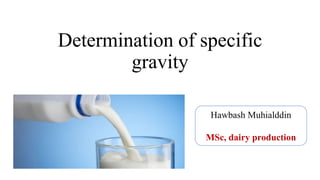
Determination of specific
gravity
Hawbash Muhialddin
MSc, dairy production
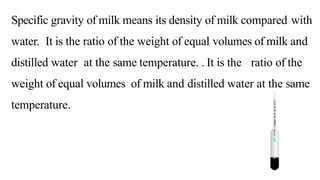
Specific gravity of milk means its density of milk compared with
water. It is the ratio of the weight of equal volumes of milk and
distilled water at the same temperature. . It is the ratio of the
weight of equal volumes of milk and distilled water at the same
temperature.
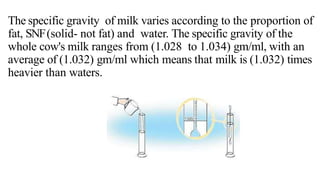
The specific gravity of milk varies according to the proportion of
fat, SNF(solid- not fat) and water. The specific gravity of the
whole cow's milk ranges from (1.028 to 1.034) gm/ml, with an
average of (1.032) gm/ml which means that milk is (1.032) times
heavier than waters.
• To determine the basic nature of milk.
• To identify the adulteration of milk
Partial skimming increases the specific gravity of milk.
Adulteration of milk with water lowers the specific gravity.
Aim
Significance of the test
Lactometer is a special hydrometer designed for use with milk graduated in
the range of (1.024 to 1.037). Lactometers are used for rapid determination
of specific gravity. The method is based on law of floatation which states that
when a solid is immersed in a liquid. It is subject to upward thrust equal to
the weight of the liquid displaced by the body and acting in upward direction
Lactometer
Material and method
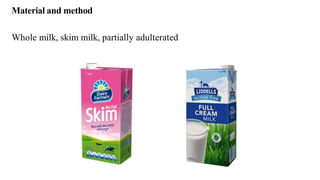
Whole milk, skim milk, partially adulterated
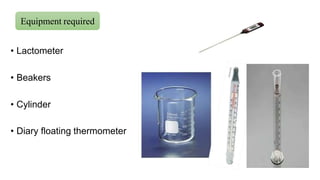
• Lactometer
• Beakers
• Cylinder
• Diary floating thermometer
Equipment required
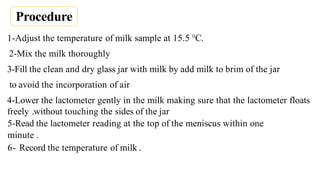
1-Adjust the temperature of milk sample at 15.5 °C.
2-Mix the milk thoroughly
3-Fill the clean and dry glass jar with milk by add milk to brim of the jar
to avoid the incorporation of air
4-Lower the lactometer gently in the milk making sure that the lactometer floats
freely .without touching the sides of the jar
5-Read the lactometer reading at the top of the meniscus within one
minute .
6- Record the temperature of milk .
Procedure
Calculation
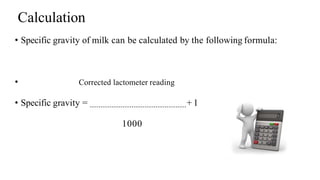
• Specific gravity of milk can be calculated by the following formula:
• Corrected lactometer reading
• Specific gravity = + 1
1000
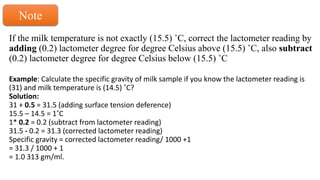
If the milk temperature is not exactly (15.5) ˚C, correct the lactometer reading by
adding (0.2) lactometer degree for degree Celsius above (15.5) ˚C, also subtract
(0.2) lactometer degree for degree Celsius below (15.5) ˚C
Example: Calculate the specific gravity of milk sample if you know the lactometer reading is
(31) and milk temperature is (14.5) ˚C?
Solution:
31 + 0.5 = 31.5 (adding surface tension deference)
15.5 – 14.5 = 1˚C
1* 0.2 = 0.2 (subtract from lactometer reading)
31.5 - 0.2 = 31.3 (corrected lactometer reading)
Specific gravity = corrected lactometer reading/ 1000 +1
= 31.3 / 1000 + 1
= 1.0 313 gm/ml.
Note

Determination of specific gravity

  • 1.
    Determination of specific gravity HawbashMuhialddin MSc, dairy production
  • 2.
    Specific gravity ofmilk means its density of milk compared with water. It is the ratio of the weight of equal volumes of milk and distilled water at the same temperature. . It is the ratio of the weight of equal volumes of milk and distilled water at the same temperature.
  • 3.
    The specific gravityof milk varies according to the proportion of fat, SNF(solid- not fat) and water. The specific gravity of the whole cow's milk ranges from (1.028 to 1.034) gm/ml, with an average of (1.032) gm/ml which means that milk is (1.032) times heavier than waters.
  • 4.
    • To determinethe basic nature of milk. • To identify the adulteration of milk Partial skimming increases the specific gravity of milk. Adulteration of milk with water lowers the specific gravity. Aim Significance of the test
  • 5.
    Lactometer is aspecial hydrometer designed for use with milk graduated in the range of (1.024 to 1.037). Lactometers are used for rapid determination of specific gravity. The method is based on law of floatation which states that when a solid is immersed in a liquid. It is subject to upward thrust equal to the weight of the liquid displaced by the body and acting in upward direction Lactometer
  • 6.
    Material and method Wholemilk, skim milk, partially adulterated
  • 7.
    • Lactometer • Beakers •Cylinder • Diary floating thermometer Equipment required
  • 8.
    1-Adjust the temperatureof milk sample at 15.5 °C. 2-Mix the milk thoroughly 3-Fill the clean and dry glass jar with milk by add milk to brim of the jar to avoid the incorporation of air 4-Lower the lactometer gently in the milk making sure that the lactometer floats freely .without touching the sides of the jar 5-Read the lactometer reading at the top of the meniscus within one minute . 6- Record the temperature of milk . Procedure
  • 9.
    Calculation • Specific gravityof milk can be calculated by the following formula: • Corrected lactometer reading • Specific gravity = + 1 1000
  • 10.
    If the milktemperature is not exactly (15.5) ˚C, correct the lactometer reading by adding (0.2) lactometer degree for degree Celsius above (15.5) ˚C, also subtract (0.2) lactometer degree for degree Celsius below (15.5) ˚C Example: Calculate the specific gravity of milk sample if you know the lactometer reading is (31) and milk temperature is (14.5) ˚C? Solution: 31 + 0.5 = 31.5 (adding surface tension deference) 15.5 – 14.5 = 1˚C 1* 0.2 = 0.2 (subtract from lactometer reading) 31.5 - 0.2 = 31.3 (corrected lactometer reading) Specific gravity = corrected lactometer reading/ 1000 +1 = 31.3 / 1000 + 1 = 1.0 313 gm/ml. Note