MILK RECEPTION
PRESENTED BY :-
SOUMYA GUPTA
“
Milk Reception Or
Milk Delivery
Refers To The
Accepted Transfer Of
Raw Milk From The
Farm or collection
centre By A Dairy
COLLECTION
Collection directly or indirectly depends on the
◦ Size of the dairy plant
◦ Type of climate condition
◦ distance to dairy plant
◦ Development feature
◦ Scattered and scanty milk production
Within four hours of milking milk should be cooled or should be
sent to chilling centers
Milk is collected :
◦Directly from the producers
◦Through agents
◦Corporative structure
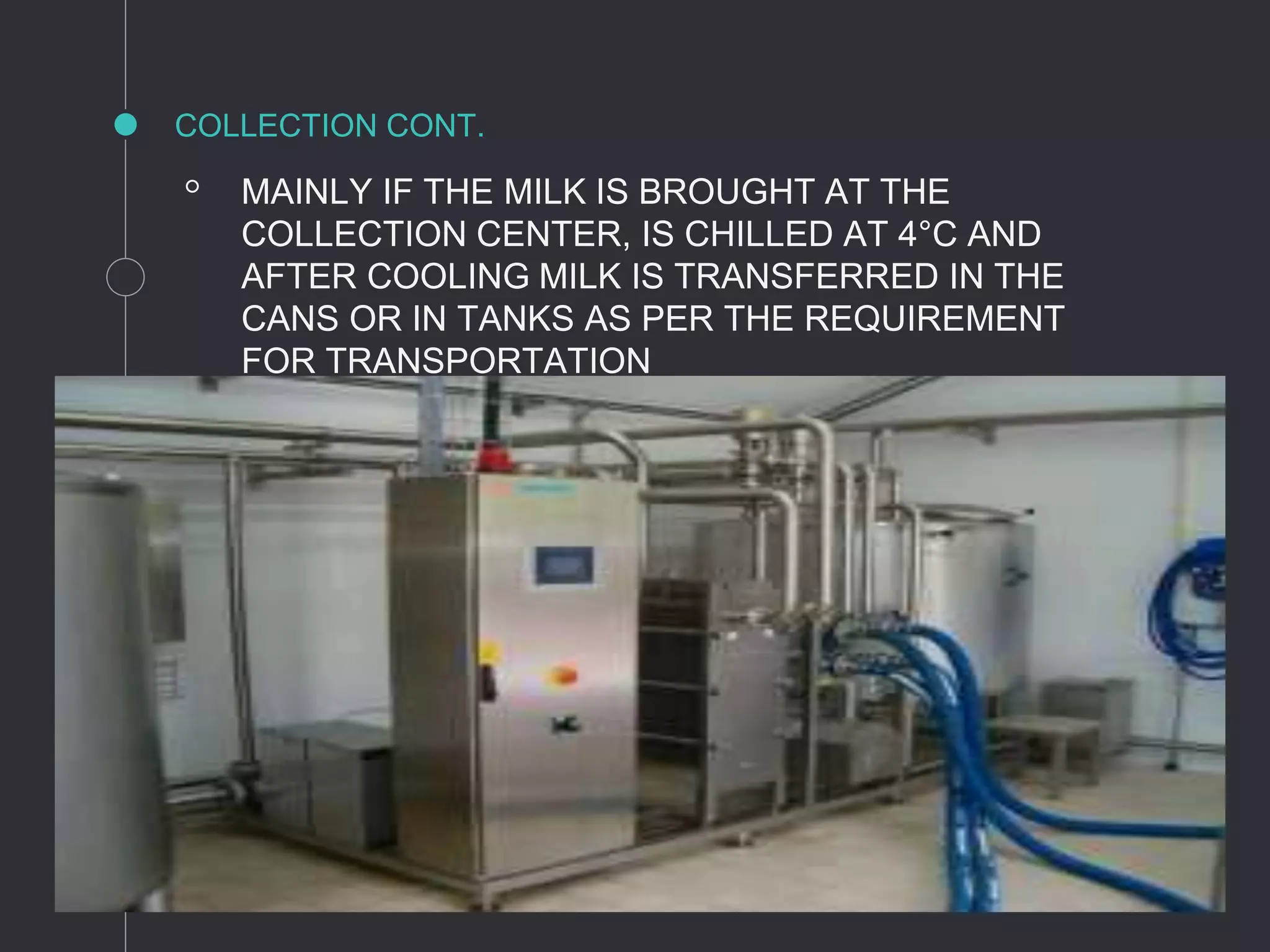
COLLECTION CONT.
◦ MAINLY IF THE MILK IS BROUGHT AT THE
COLLECTION CENTER, IS CHILLED AT 4°C AND
AFTER COOLING MILK IS TRANSFERRED IN THE
CANS OR IN TANKS AS PER THE REQUIREMENT
FOR TRANSPORTATION
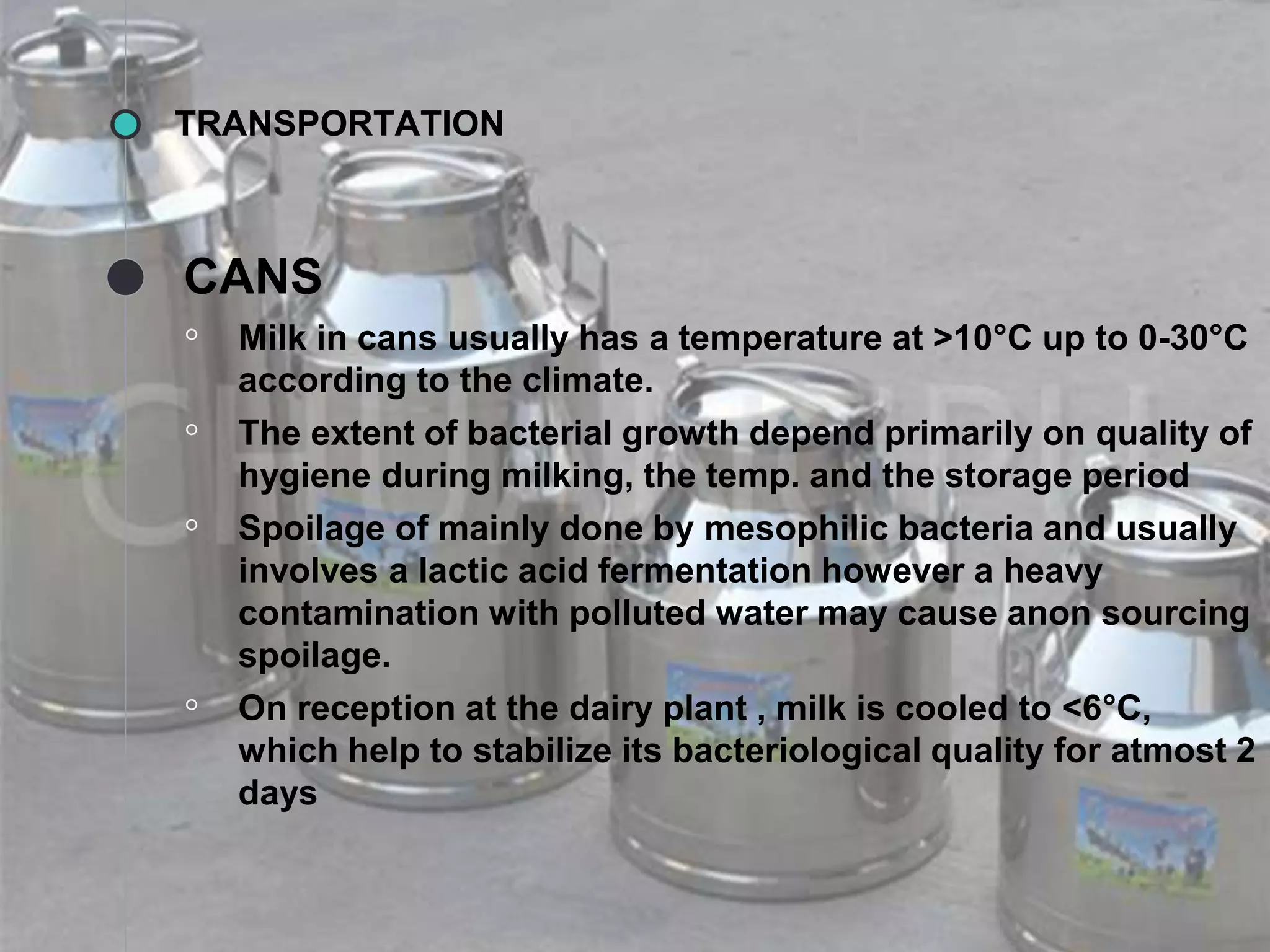
TRANSPORTATION
CANS
◦ Milk in cans usually has a temperature at >10°C up to 0-30°C
according to the climate.
◦ The extent of bacterial growth depend primarily on quality of
hygiene during milking, the temp. and the storage period
◦ Spoilage of mainly done by mesophilic bacteria and usually
involves a lactic acid fermentation however a heavy
contamination with polluted water may cause anon sourcing
spoilage.
◦ On reception at the dairy plant , milk is cooled to <6°C,
which help to stabilize its bacteriological quality for atmost 2
days
Transportation
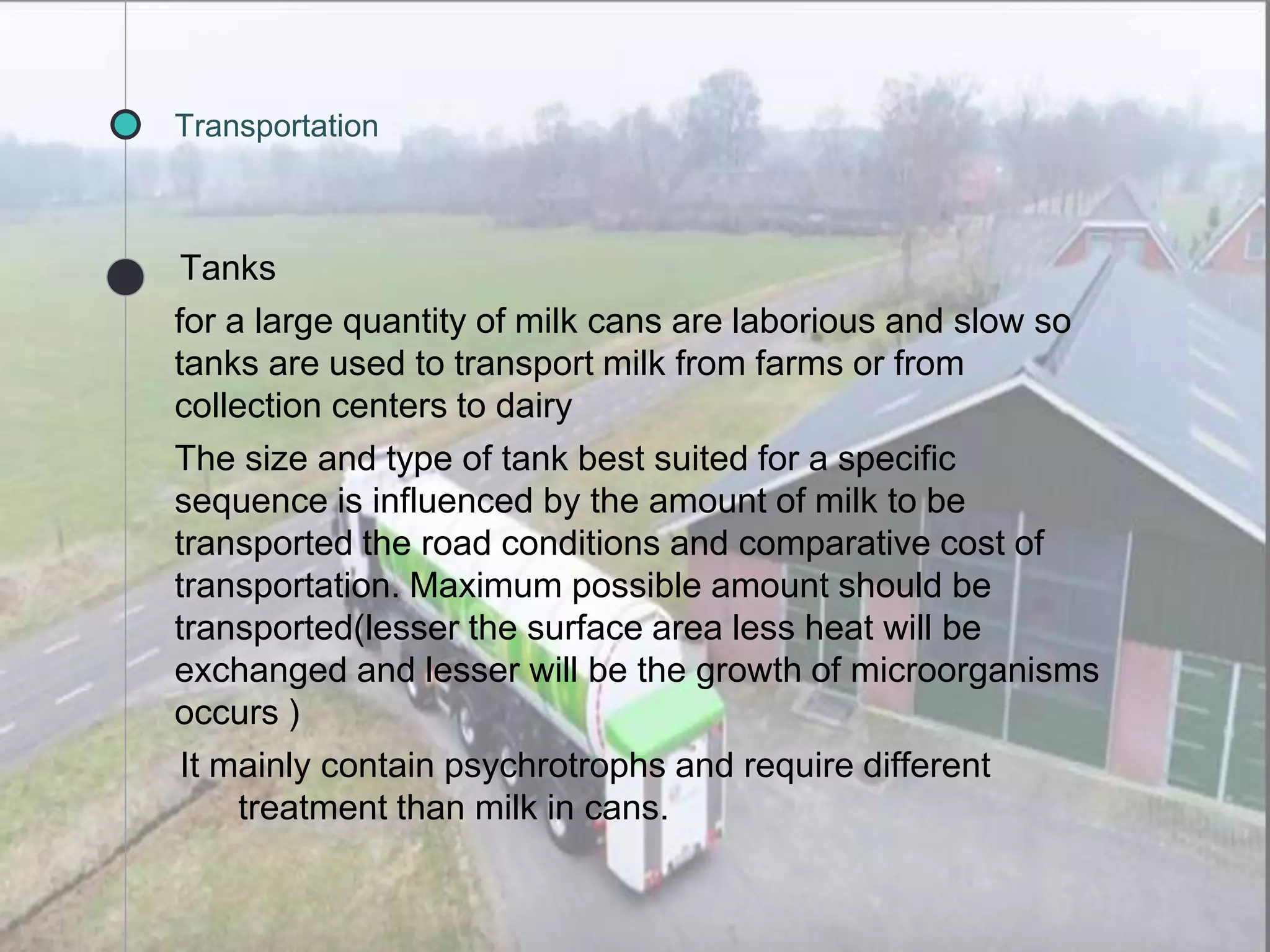
Tanks
for a large quantity of milk cans are laborious and slow so
tanks are used to transport milk from farms or from
collection centers to dairy
The size and type of tank best suited for a specific
sequence is influenced by the amount of milk to be
transported the road conditions and comparative cost of
transportation. Maximum possible amount should be
transported(lesser the surface area less heat will be
exchanged and lesser will be the growth of microorganisms
occurs )
It mainly contain psychrotrophs and require different
treatment than milk in cans.
RAW MILK RECEPTION DOCK
Rmrd constist of
◦ Unloading
◦ Sampling
◦ Testing/ grading
◦ Weighing
◦ Measuring or recording
◦ The first stage of the process of reception involves unloading of cans over
the tip tank or weigh tank if milk is received in cans
◦ This process may be done by hand , by a mechanical inverter or by hand
assisted method.
◦ Hand assisted method hereby as it falls the cam is guided in a regulated
manner into inverted position . This process of may be a serious source
of contamination of tipped milk by soil on the exterior of the can.
◦ A CAN may hold up to 40 lit and takes 30 s to unload
◦ Where weigh-tanks are installed, after the weight of the consignment has
been recorded, the contents are discharged into a tank immediately
below it from which the milk is pumped through a cooler to a storage tank.
◦ Where milk is measured volumetrically, the cans are tipped directly into
the tip-tank, from which milk is pumped to the cooler.
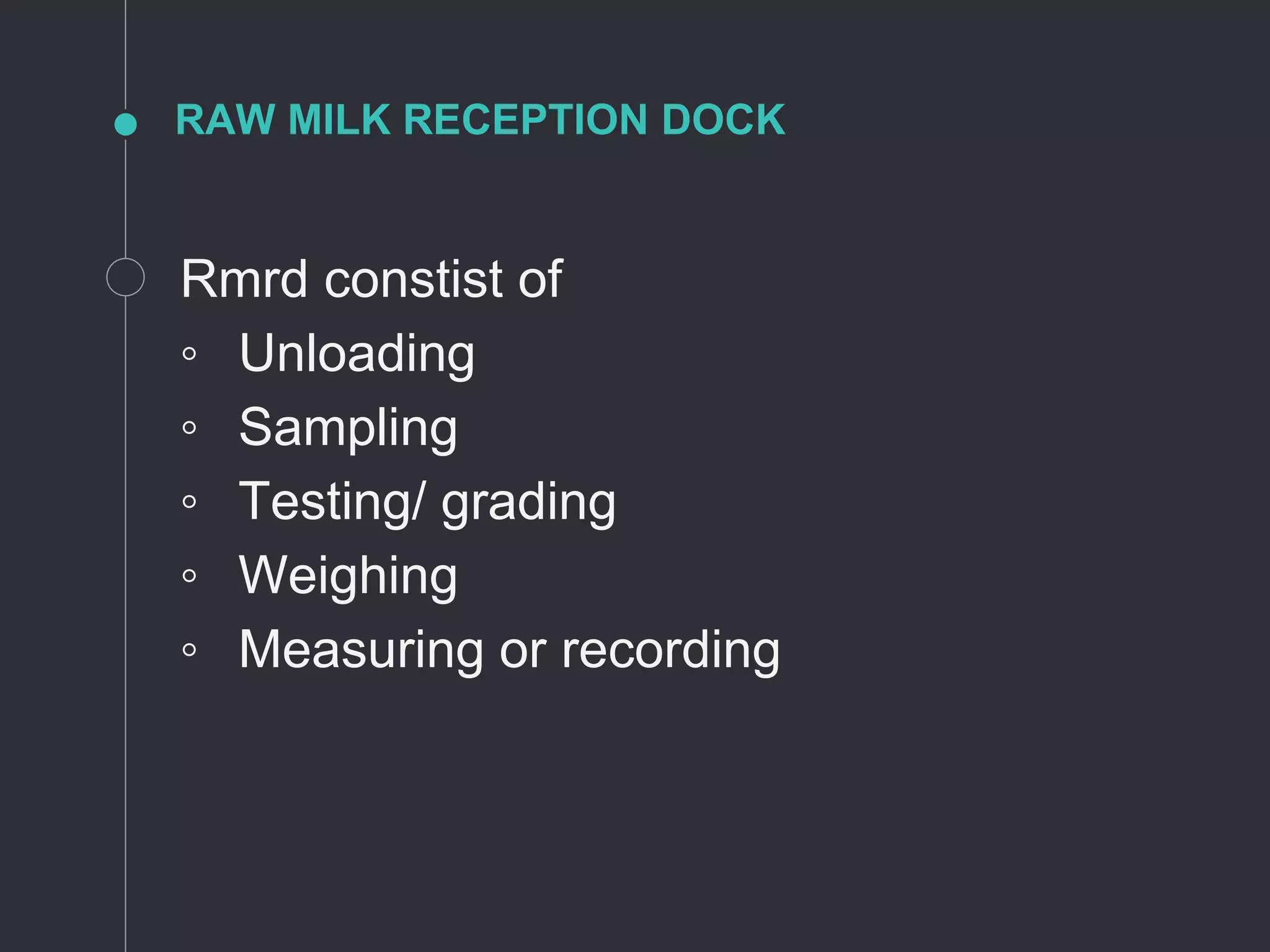
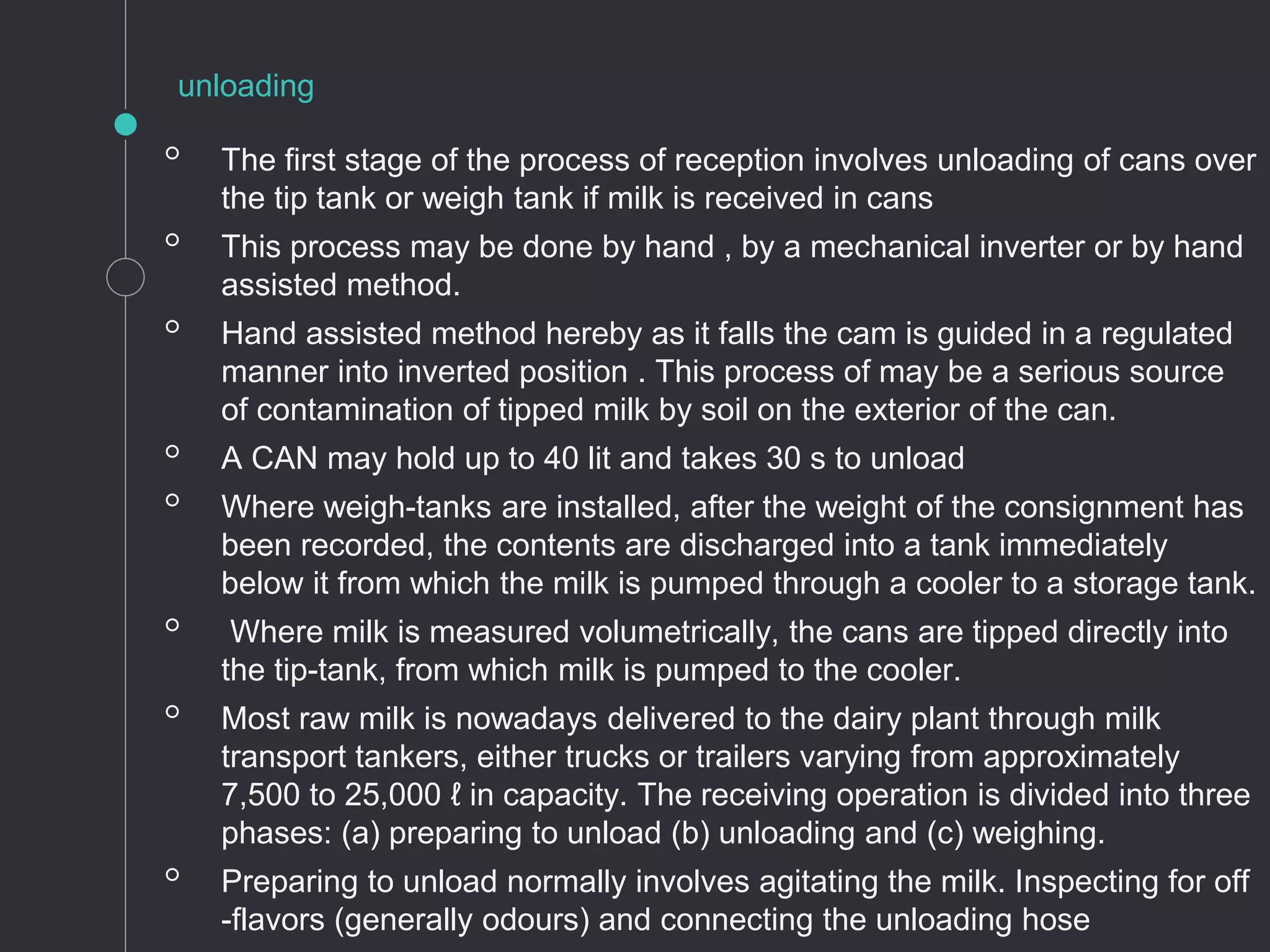
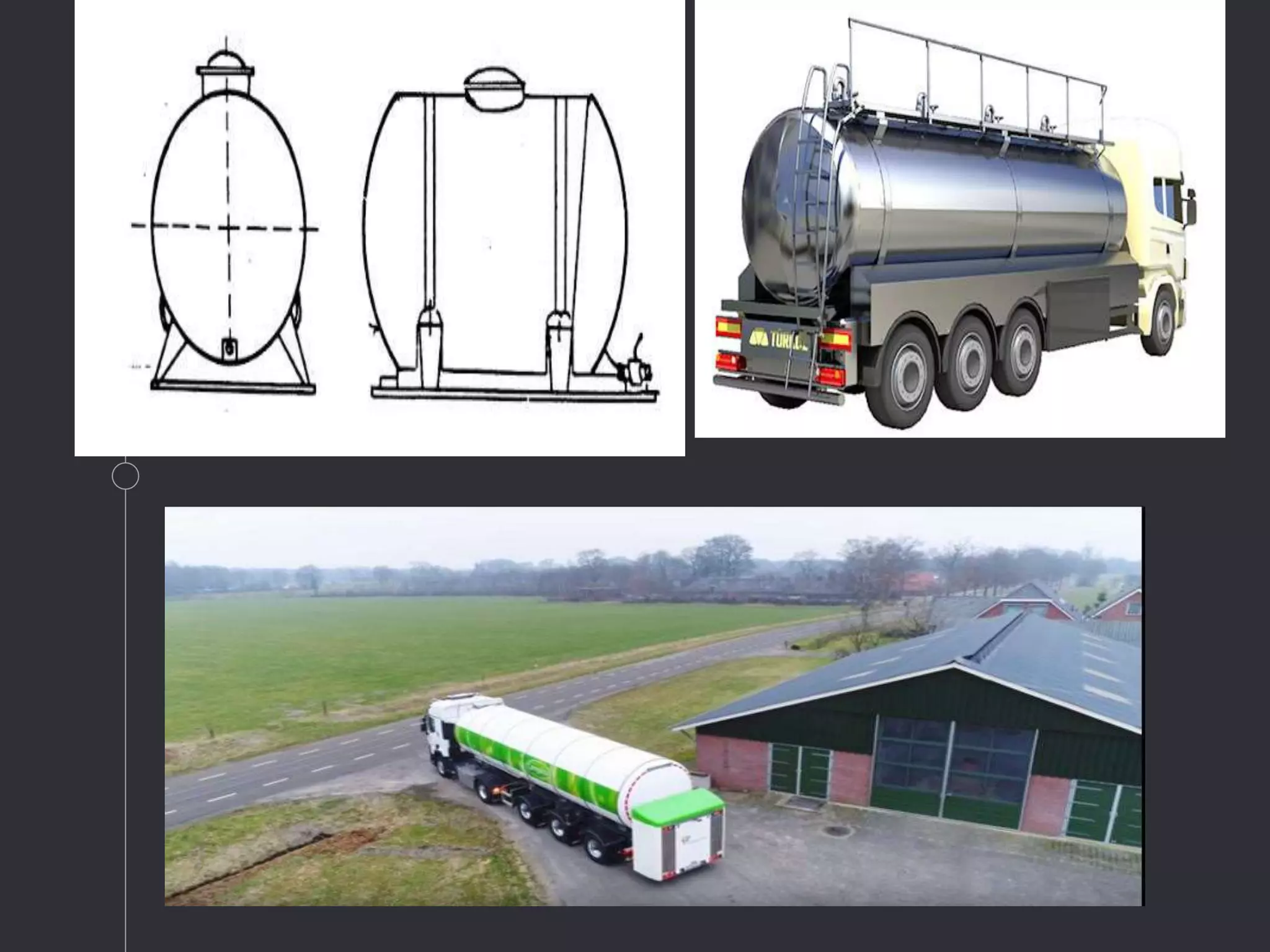
◦ Most raw milk is nowadays delivered to the dairy plant through milk
transport tankers, either trucks or trailers varying from approximately
7,500 to 25,000 ℓ in capacity. The receiving operation is divided into three
phases: (a) preparing to unload (b) unloading and (c) weighing.
◦ Preparing to unload normally involves agitating the milk. Inspecting for off
-flavors (generally odours) and connecting the unloading hose
unloading
The significance of reception dock test is as follows :
◦ Sedimentation tests point to the quality of milk production at the
farm
◦ Antibiotics test indicates if milk from sick animals were commingled
with milk from healthy cows .if such commingled occurs the entire
tank load is rejected. Presence of antibiotic in the milk poses a 2 fold
danger. First, antibiotic sensitive individual can suffer from consuming
tainted milk. Secondly, in the manufacturing of cultured milk products,
the presence of antibiotics may pose barrier for acidity development
by inhibiting the starter culture growth.
◦ Somatic cell counts are indicative of general animal heath. If they
are <500000 per milliliter is good for consumption if it exceeds.
1000000 per milliliter indicates the presence of mastitis in one or more
in the herd which isn't good .
◦ Protein and fat contents are used to determine the payments and to
gain full accounting of raw material received (also helps balancing
calculation and losses occurring during packaging and processing )
◦ Freezing point of milk is another important test to determine
adulteration with water whether accidental or intentional. Adulteration
of milk is a prosecutable offence
Testing / grading
◦ The classification of milk on the basis of quality is usually referred to
“grading of milk". So grading of milk is done on the basis of platform
tests which include organoleptic as well as preliminary tests.
◦ The technique of grading milk is as follows:
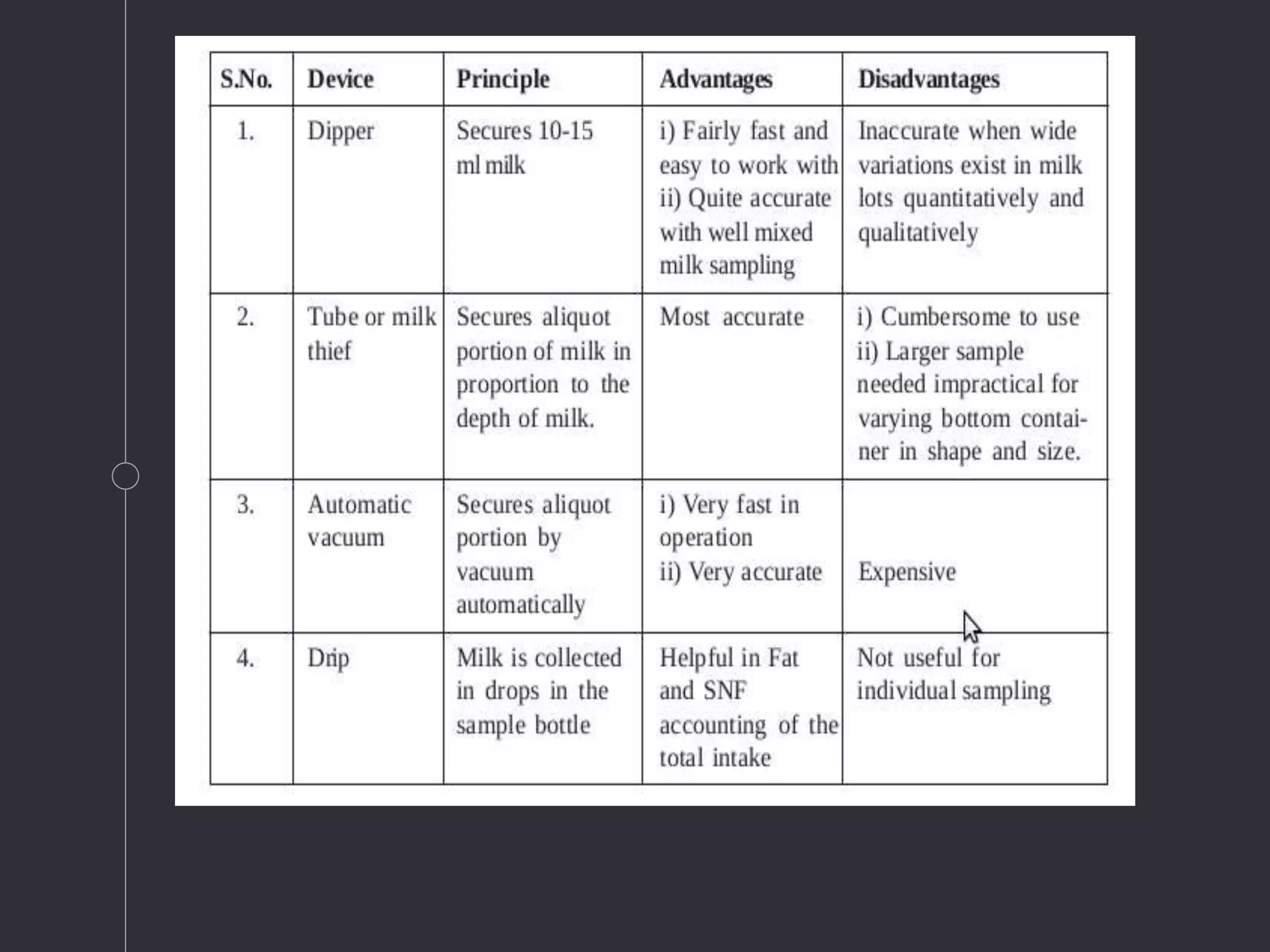
- Appearance Observing each can of milk for any floating extraneous
matter, off colour, or partially churned milk. The milk should be normal in
colour, free from churned fat globules and reasonably free from any
floating extraneous material.
- Smell (Odour) In making the test, the cover of each can is removed,
inverted and raised to the nose. The headspace in milk can is smelled.
The milk should be free from any off flavours.
- Temperature The temperature at which milk is delivered is often an
indication of its quality. With practice, the grader can tell with a high
degree of accuracy whether the milk is sufficiently cold by touching the
side of the can. A temperature of 5°C or below is satisfactory.
Testing / Grading
Testing / Grading
- Sediment shows the visible foreign matter contained in the milk. For
this purpose a reliable sediment tester (such as an off-the-bottom
sediment tester) is used. Any method by which maximum sediment
is obtained should be considered satisfactory.
- A low sediment is desirable. Sediment test is performed to judge the
cleanliness of milk. There is no correlation between the amount of
sediment and the bacteriological quality of milk.
- Measured quantity of milk is filtered or centrifuged and checked for
sediment. A good quality milk gives no visible dirt whereas poor
quality milk shows dark or blackish deposits on the filter pad
- Acidity ‘Natural’ or 'apparent' acidity of milk is desirable which does
not adversely affects its heat stability. However, ‘developed acidity’
(Natural + Developed = Titratable acidity) adversely affects the
quality of milk which cannot be processed in pasteurizer.
- Lactometer reading The addition of water to milk results in lowering
its density. Hence, this test is applied for detection of adulteration of
milk with water. The reading for cow and buffalo milk should be
about 28 to 30 and 30 to 32 respectively, when measured at 15.5°C.
-
sampling
- The importance of securing an accurate and representative sample of
milk for chemical and bacteriological analysis cannot be over-
emphasized. While strict precautions regarding sterility of the stirrer,
sampler, container etc. are required for obtaining a bacteriological
sample, dryness and cleanliness of the above equipment should be
sufficient for a chemical sample. The first pre-requisite of sampling is
thorough mixing of milk. This can be done with a plunger or stirrer
(agitator), operated manually or mechanically for milk contained in
cans or tankers, as the case maybe. With the former, a representative
sample may be taken after dumping the milk in the weigh tank,
whereby it gets mixed in so thoroughly that a representative sample
may be taken without further mixing.
- The composite milk sample must not spoil by the time it is analyzed.
This is accomplished by use of a preservative. It is wise to place the
preservative in an empty bottle before milk is added. A wide mouthed
glass bottle with a rubber stopper is suitable for keeping composite
samples of milk or cream. The common preservatives used are as
follows:
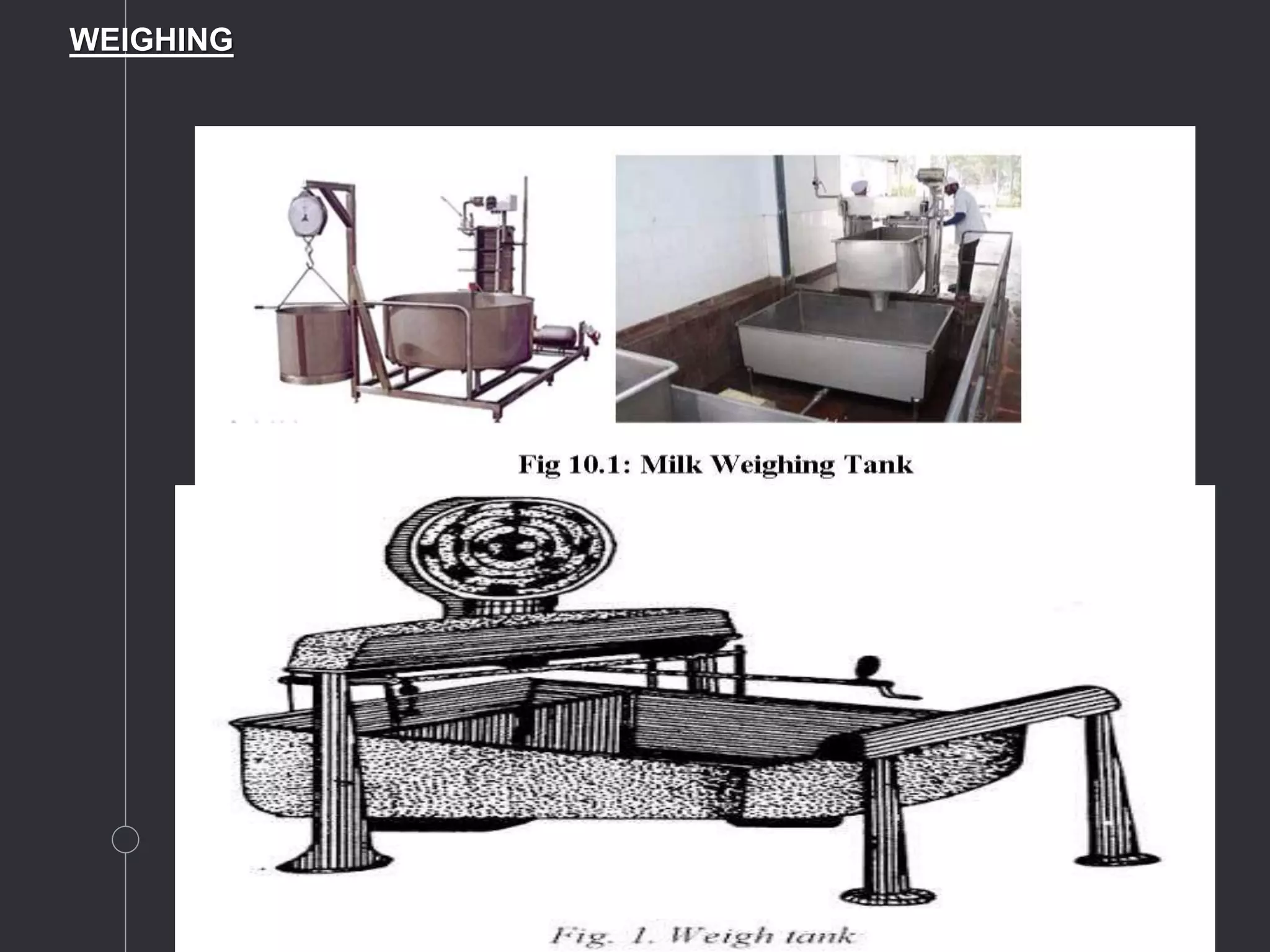
WEIGHING
◦ This is an essential step in accounting for milk receipts,
disposal and making payments for milk. The milk from cans
is dumped into the weigh tank, either manually or
mechanically. The tank is mounted on scales and the scale
dial set at zero when the tank is empty. Automatic printing of
the weight is now becoming a practice.
The milk in tankers (road or rail) may be measured by
volume by passing it through a flow meter, and its
measurement converted into weight by multiplying volume
with density (m = d x v). In case of road milk tankers
weighbridge can be used to determine its weight (weight of
tanker when full – weight when empty).
◦
“ Thank you

Milk reception /raw milk reception dock

  • 1.
  • 2.
    “ Milk Reception Or MilkDelivery Refers To The Accepted Transfer Of Raw Milk From The Farm or collection centre By A Dairy
  • 3.
    COLLECTION Collection directly orindirectly depends on the ◦ Size of the dairy plant ◦ Type of climate condition ◦ distance to dairy plant ◦ Development feature ◦ Scattered and scanty milk production Within four hours of milking milk should be cooled or should be sent to chilling centers Milk is collected : ◦Directly from the producers ◦Through agents ◦Corporative structure
  • 4.
    COLLECTION CONT. ◦ MAINLYIF THE MILK IS BROUGHT AT THE COLLECTION CENTER, IS CHILLED AT 4°C AND AFTER COOLING MILK IS TRANSFERRED IN THE CANS OR IN TANKS AS PER THE REQUIREMENT FOR TRANSPORTATION
  • 5.
    TRANSPORTATION CANS ◦ Milk incans usually has a temperature at >10°C up to 0-30°C according to the climate. ◦ The extent of bacterial growth depend primarily on quality of hygiene during milking, the temp. and the storage period ◦ Spoilage of mainly done by mesophilic bacteria and usually involves a lactic acid fermentation however a heavy contamination with polluted water may cause anon sourcing spoilage. ◦ On reception at the dairy plant , milk is cooled to <6°C, which help to stabilize its bacteriological quality for atmost 2 days
  • 6.
    Transportation Tanks for a largequantity of milk cans are laborious and slow so tanks are used to transport milk from farms or from collection centers to dairy The size and type of tank best suited for a specific sequence is influenced by the amount of milk to be transported the road conditions and comparative cost of transportation. Maximum possible amount should be transported(lesser the surface area less heat will be exchanged and lesser will be the growth of microorganisms occurs ) It mainly contain psychrotrophs and require different treatment than milk in cans.
  • 7.
    RAW MILK RECEPTIONDOCK Rmrd constist of ◦ Unloading ◦ Sampling ◦ Testing/ grading ◦ Weighing ◦ Measuring or recording
  • 8.
    ◦ The firststage of the process of reception involves unloading of cans over the tip tank or weigh tank if milk is received in cans ◦ This process may be done by hand , by a mechanical inverter or by hand assisted method. ◦ Hand assisted method hereby as it falls the cam is guided in a regulated manner into inverted position . This process of may be a serious source of contamination of tipped milk by soil on the exterior of the can. ◦ A CAN may hold up to 40 lit and takes 30 s to unload ◦ Where weigh-tanks are installed, after the weight of the consignment has been recorded, the contents are discharged into a tank immediately below it from which the milk is pumped through a cooler to a storage tank. ◦ Where milk is measured volumetrically, the cans are tipped directly into the tip-tank, from which milk is pumped to the cooler. ◦ Most raw milk is nowadays delivered to the dairy plant through milk transport tankers, either trucks or trailers varying from approximately 7,500 to 25,000 ℓ in capacity. The receiving operation is divided into three phases: (a) preparing to unload (b) unloading and (c) weighing. ◦ Preparing to unload normally involves agitating the milk. Inspecting for off -flavors (generally odours) and connecting the unloading hose unloading
  • 11.
    The significance ofreception dock test is as follows : ◦ Sedimentation tests point to the quality of milk production at the farm ◦ Antibiotics test indicates if milk from sick animals were commingled with milk from healthy cows .if such commingled occurs the entire tank load is rejected. Presence of antibiotic in the milk poses a 2 fold danger. First, antibiotic sensitive individual can suffer from consuming tainted milk. Secondly, in the manufacturing of cultured milk products, the presence of antibiotics may pose barrier for acidity development by inhibiting the starter culture growth. ◦ Somatic cell counts are indicative of general animal heath. If they are <500000 per milliliter is good for consumption if it exceeds. 1000000 per milliliter indicates the presence of mastitis in one or more in the herd which isn't good . ◦ Protein and fat contents are used to determine the payments and to gain full accounting of raw material received (also helps balancing calculation and losses occurring during packaging and processing ) ◦ Freezing point of milk is another important test to determine adulteration with water whether accidental or intentional. Adulteration of milk is a prosecutable offence Testing / grading
  • 12.
    ◦ The classificationof milk on the basis of quality is usually referred to “grading of milk". So grading of milk is done on the basis of platform tests which include organoleptic as well as preliminary tests. ◦ The technique of grading milk is as follows: - Appearance Observing each can of milk for any floating extraneous matter, off colour, or partially churned milk. The milk should be normal in colour, free from churned fat globules and reasonably free from any floating extraneous material. - Smell (Odour) In making the test, the cover of each can is removed, inverted and raised to the nose. The headspace in milk can is smelled. The milk should be free from any off flavours. - Temperature The temperature at which milk is delivered is often an indication of its quality. With practice, the grader can tell with a high degree of accuracy whether the milk is sufficiently cold by touching the side of the can. A temperature of 5°C or below is satisfactory. Testing / Grading
  • 13.
    Testing / Grading -Sediment shows the visible foreign matter contained in the milk. For this purpose a reliable sediment tester (such as an off-the-bottom sediment tester) is used. Any method by which maximum sediment is obtained should be considered satisfactory. - A low sediment is desirable. Sediment test is performed to judge the cleanliness of milk. There is no correlation between the amount of sediment and the bacteriological quality of milk. - Measured quantity of milk is filtered or centrifuged and checked for sediment. A good quality milk gives no visible dirt whereas poor quality milk shows dark or blackish deposits on the filter pad - Acidity ‘Natural’ or 'apparent' acidity of milk is desirable which does not adversely affects its heat stability. However, ‘developed acidity’ (Natural + Developed = Titratable acidity) adversely affects the quality of milk which cannot be processed in pasteurizer. - Lactometer reading The addition of water to milk results in lowering its density. Hence, this test is applied for detection of adulteration of milk with water. The reading for cow and buffalo milk should be about 28 to 30 and 30 to 32 respectively, when measured at 15.5°C. -
  • 14.
    sampling - The importanceof securing an accurate and representative sample of milk for chemical and bacteriological analysis cannot be over- emphasized. While strict precautions regarding sterility of the stirrer, sampler, container etc. are required for obtaining a bacteriological sample, dryness and cleanliness of the above equipment should be sufficient for a chemical sample. The first pre-requisite of sampling is thorough mixing of milk. This can be done with a plunger or stirrer (agitator), operated manually or mechanically for milk contained in cans or tankers, as the case maybe. With the former, a representative sample may be taken after dumping the milk in the weigh tank, whereby it gets mixed in so thoroughly that a representative sample may be taken without further mixing. - The composite milk sample must not spoil by the time it is analyzed. This is accomplished by use of a preservative. It is wise to place the preservative in an empty bottle before milk is added. A wide mouthed glass bottle with a rubber stopper is suitable for keeping composite samples of milk or cream. The common preservatives used are as follows:
  • 16.
  • 17.
    ◦ This isan essential step in accounting for milk receipts, disposal and making payments for milk. The milk from cans is dumped into the weigh tank, either manually or mechanically. The tank is mounted on scales and the scale dial set at zero when the tank is empty. Automatic printing of the weight is now becoming a practice. The milk in tankers (road or rail) may be measured by volume by passing it through a flow meter, and its measurement converted into weight by multiplying volume with density (m = d x v). In case of road milk tankers weighbridge can be used to determine its weight (weight of tanker when full – weight when empty). ◦
  • 21.

Editor's Notes

  • #4 After milking, milk is directly collected in milk cans( sterilized or cleaned). In the simplest, door-to-door milk collection system, the milk truck stops at each farm, loads the milk cans and leaves an equal number of cleaned, sterilized empties