International Research Journal of Engineering and Technology (IRJET) e-ISSN:2395-0056
p-ISSN:2395-0072
Volume: 10 Issue: 08|Aug 2023 www.irjet.net
A Novel Approach for Machine Learning-Based Identification of Human
Activities
Asst.Prof. Shruthi1
, Sujata2
1
Asst. Professor, Dept. of Computer Science and Engineering, Sharnbasva University, Kalaburagi ,Karnataka,
India
2
Student, Dept. of Artificial Intelligence and Data science, Sharnbasva University, Kalaburagi ,Karnataka, India
-----------------------------------------------------------------------***--------------------------------------------------------------------------
Abstract
Human activity recognition (HAR) is a rapidly growing field
of research that uses machine learning to automatically
identify and classify human activities from sensor data. This
data can be collected from a variety of sources, such as
wearable sensors, smartphones, and video cameras. HAR has
a wide range of potential applications, including healthcare,
sports, and security. In this paper, we present a
comprehensive overview of the state-of-the-art in HAR using
machine learning based on datasets. We discuss the various
feature extraction techniques that can be applied, and the
different machine learning algorithms that can be used for
model training. We also present a survey of the recent
literature on HAR using machine learning, and we discuss
the challenges and opportunities that lie ahead in this field.
Our findings suggest that HAR using machine learning based
on datasets is a promising approach for a variety of
applications. However, there are still a number of challenges
that need to be addressed in order to improve the accuracy
and robustness of HAR systems. These challenges include the
need for more accurate and efficient feature extraction
techniques, the development of more powerful machine
learning algorithms, and the creation of larger and more
diverse datasets. We believe that this paper provides a
valuable contribution to the field of HAR using machine
learning. It provides a comprehensive overview of the state-
of-the-art, and it identifies the challenges and opportunities
that lie ahead. We hope that this paper will help to
accelerate the development of more accurate and reliable
HAR systems that can be used to improve the lives of people
in a variety of ways.
Key words: Human activity recognition, machine
learning, datasets, feature extraction, model training,
healthcare, sports, security.
1. INTRODUCTION
In an era defined by the convergence of technology and
human activities, the realm of human activity recognition
stands as a beacon of innovation. This groundbreaking
field amalgamates the power of machine learning
algorithms with the intricacies of human actions, creating a
dynamic interplay that holds immense potential across
diverse domains. From healthcare to sports, and security
to entertainment, the ability to automatically identify and
classify human activities is reshaping how we interact with
our environment. The nucleus of this pioneering endeavor
lies in the synthesis of machine learning and human activity
datasets. These datasets, meticulously annotated with
activity labels, serve as the building blocks upon which the
machinery of recognition is constructed. By training
machine learning models on these datasets, a
transformative process unfolds. These models become
adept at deciphering the subtle patterns, temporal
relationships, and spatial cues that define human actions.
The canvas of this project is woven with intricate threads,
each representing a distinct facet of its essence. The initial
phase involves the strategic curation of datasets, each
containing a panorama of human activities captured and
labeled with meticulous care. These datasets, often drawn
from real-world scenarios, harbor the invaluable
knowledge needed to train models that can mirror human-
like recognition capabilities. Intriguingly, the scope of this
project's implications is vast and far-reaching. Healthcare
stands to benefit from automated patient monitoring,
identifying anomalies in daily routines. In the realm of
sports analysis, the models provide coaches with insights
into athletes' performance nuances. Security and
surveillance embrace a new paradigm, where machine-
augmented vigilance ensures safety with unmatched
efficiency. As we embark on this journey into the realm of
human activity recognition through machine learning, we
set forth to unravel the intricate tapestry of human
behavior. Our aim is to harness the synergy of technology
and cognition, creating a bridge between the two that
resonates across various applications. This project
encapsulates the essence of innovation, where the fusion of
data, algorithms, and human-centric understanding creates
a paradigm shift that redefines how we perceive and
interact with the world around us.
2. Related Works
Article[1] "Human Activity Recognition using Inertial,
Physiological and Environmental Sensors: A
Comprehensive Survey" by Mohamed Abdelwahab,
Abdelkader Hamouda, and Abdelkrim Ait Mohamed in
2020, offers a thorough exploration of human activity
recognition (HAR) through inertial, physiological, and
environmental sensors. The study delves into various
© 2023, IRJET ImpactFactor value: 8.266 ISO9001:2008Certified Journal | Page 284
International Research Journal of Engineering and Technology (IRJET) e-ISSN:2395-0056
p-ISSN:2395-0072
Volume: 10 Issue: 08|Aug 2023 www.irjet.net
sensor types employed in HAR, diverse machine learning
algorithms applied, and the hurdles and boundaries faced
in this field.
Article[2] "Human Activity Recognition for Elderly People
Using Machine and Deep Learning Approaches" by Davide
Anguita, Alessandro Ghio, Luca Oneto, Xavier Parra, and
Jorge L. Reyes-Ortiz in 2020, surveys the cutting-edge
landscape of HAR for elderly individuals. This work delves
into the array of machine and deep learning techniques
utilized in HAR, confronts the challenges peculiar to
recognizing activities in the elderly, and explores the realm
of applications for this technology.
Article[3] "Deep Learning in Human Activity Recognition
with Wearable Sensors: A Review on Advances" by Xinlei
Chen, Heng Ma, and Bao-Liang Lu in 2021, evaluates the
strides taken in deep learning for HAR using wearable
sensors. The article explores the diverse deep learning
architectures harnessed for HAR, addresses the challenges
entailed in wearable sensor-based HAR, and sheds light on
the practical applications that benefit from deep learning
in this context.
Article[4] "Investigation on Human Activity Recognition
using Deep Learning" by Mayank Agarwal and Md Alam in
2020, investigates the potential of deep learning in HAR.
This research contrasts the effectiveness of distinct deep
learning models in HAR scenarios and delves into the
unique challenges that surface in this realm when
deploying deep learning techniques.
Article[5] "A Survey on Human Activity Recognition Using
Smartphones" by Ashish Gupta, Anupam Saha, and Anirban
Das in 2022, furnishes an inclusive overview of HAR
utilizing smartphones. The paper dissects the various
sensor modalities intertwined with smartphone-based
HAR, examines the spectrum of machine learning
techniques in use, and brings to the fore the barriers and
constraints associated with this avenue.
Article[6] "Human Activity Recognition Using Wireless
Sensor Networks: A Survey" by Shashi Kant Mishra, Ankit
Shukla, and Ashish Kumar Singh in 2022, provides a
comprehensive survey on HAR via wireless sensor
networks (WSNs). The study dissects the diverse sensor
categories embedded within WSN-based HAR, catalogs the
array of machine learning methods employed, and
navigates through the challenges and limitations
encountered in this particular domain.
3. Problem statement
The project at hand addresses a critical challenge: the need
for accurate and comprehensive human activity
recognition using machine learning techniques, drawing
from datasets meticulously labeled with activity
annotations. This endeavor is punctuated by a series of
intricate hurdles that demand innovative resolutions.
These challenges encompass issues arising from limited and
imbalanced datasets, the extraction of meaningful features
from complex activities, the creation of efficient and
resource-conscious models, the exigencies of real-time
processing, and the imperative of safeguarding individual
privacy. The ultimate objective is to overcome these
challenges and foster the development of practical activity
recognition models capable of seamless deployment across
various domains, including healthcare, sports, security, and
more.
4. Objective of the project
This project embarks on a pivotal journey with a clear-cut
goal: the development of an advanced human activity
recognition system through the dynamic capabilities of the
Convolutional Neural Network (CNN) algorithm. Anchored
by input videos as its bedrock data source, this system is
meticulously designed to excel in the art of precise
prediction and comprehensive classification of a myriad of
human activities.
The underlying ambition is far-reaching. By harnessing the
potency inherent in CNN algorithms when applied to video
data, this project strives to revolutionize the landscape of
human activity recognition. It seeks not only to provide
accurate predictions but also to achieve this in real time,
carving a niche for itself in various applications where
instant insights into human behavior are paramount.
This endeavor is an echo of the rapid strides made in
artificial intelligence and computer vision. The objective
here is not merely technical, but deeply transformative. It
aims to propel the realm of human activity recognition to
new heights by deciphering the intricate cues and patterns
imprinted within videos. The project envisions a scenario
where technology can emulate the perceptive faculties of
humans, enhancing applications across diverse fields such
as healthcare diagnostics, sports analytics, and security
surveillance.
5. ALGORITHM:
The Convolutional Neural Network (CNN) algorithm serves
as the cornerstone of this project, weaving a powerful and
innovative framework for human activity recognition. Born
from the realm of deep learning and inspired by the
structure of the human visual system, CNNs are tailored to
excel in tasks involving visual data analysis, making them
an ideal choice for deciphering the nuanced complexities of
human activities within videos. At the core of a CNN's
architecture lies a network of interconnected layers, each
meticulously designed to extract and process features of
increasing abstraction. This hierarchical structure enables
the network to discern intricate patterns and relationships
inherent in visual data, effectively mirroring the layers of
visual processing that transpire within the human brain. In
the context of this project, CNNs are harnessed to analyze
© 2023, IRJET ImpactFactor value: 8.266 ISO9001:2008Certified Journal | Page 285
International Research Journal of Engineering and Technology (IRJET) e-ISSN:2395-0056
p-ISSN:2395-0072
Volume: 10 Issue: 08|Aug 2023 www.irjet.net
input videos and infer a profound understanding of the
activities depicted therein. By convolving filters over
localized regions of the video frames, CNNs uncover
relevant spatial information. This localized analysis
coupled with pooling layers permits the network to focus
on pertinent aspects while disregarding superfluous
details, enhancing its ability to capture meaningful
patterns. The training process of a CNN is an iterative
dance of weight adjustments, wherein the network learns
to recognize distinctive features that distinguish different
activities. This process, guided by labeled data, allows the
network to adapt and refine its internal representations,
ultimately leading to increasingly accurate predictions.
6. System Architecture
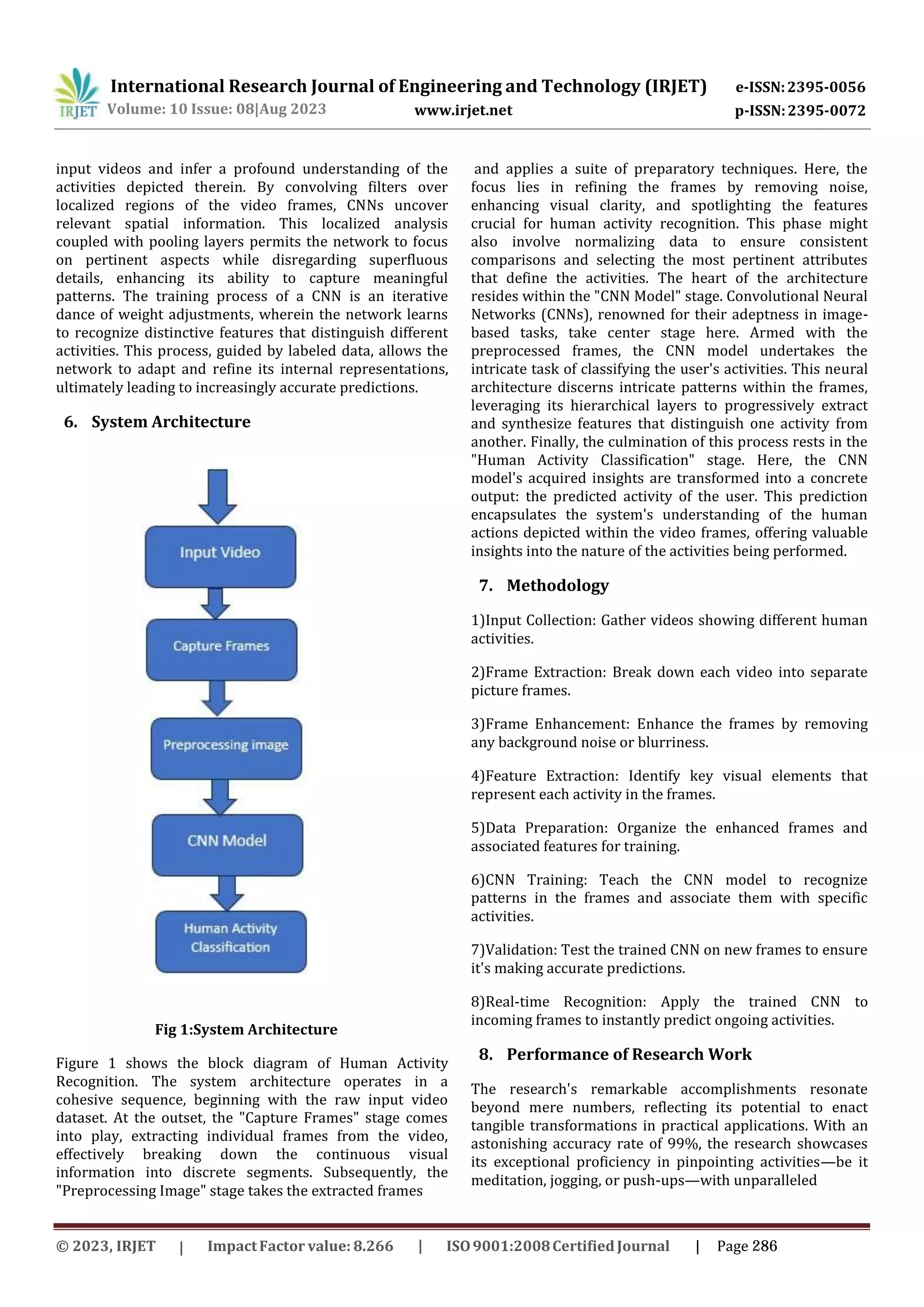
Fig 1:System Architecture
Figure 1 shows the block diagram of Human Activity
Recognition. The system architecture operates in a
cohesive sequence, beginning with the raw input video
dataset. At the outset, the "Capture Frames" stage comes
into play, extracting individual frames from the video,
effectively breaking down the continuous visual
information into discrete segments. Subsequently, the
"Preprocessing Image" stage takes the extracted frames
and applies a suite of preparatory techniques. Here, the
focus lies in refining the frames by removing noise,
enhancing visual clarity, and spotlighting the features
crucial for human activity recognition. This phase might
also involve normalizing data to ensure consistent
comparisons and selecting the most pertinent attributes
that define the activities. The heart of the architecture
resides within the "CNN Model" stage. Convolutional Neural
Networks (CNNs), renowned for their adeptness in image-
based tasks, take center stage here. Armed with the
preprocessed frames, the CNN model undertakes the
intricate task of classifying the user's activities. This neural
architecture discerns intricate patterns within the frames,
leveraging its hierarchical layers to progressively extract
and synthesize features that distinguish one activity from
another. Finally, the culmination of this process rests in the
"Human Activity Classification" stage. Here, the CNN
model's acquired insights are transformed into a concrete
output: the predicted activity of the user. This prediction
encapsulates the system's understanding of the human
actions depicted within the video frames, offering valuable
insights into the nature of the activities being performed.
7. Methodology
1)Input Collection: Gather videos showing different human
activities.
2)Frame Extraction: Break down each video into separate
picture frames.
3)Frame Enhancement: Enhance the frames by removing
any background noise or blurriness.
4)Feature Extraction: Identify key visual elements that
represent each activity in the frames.
5)Data Preparation: Organize the enhanced frames and
associated features for training.
6)CNN Training: Teach the CNN model to recognize
patterns in the frames and associate them with specific
activities.
7)Validation: Test the trained CNN on new frames to ensure
it's making accurate predictions.
8)Real-time Recognition: Apply the trained CNN to
incoming frames to instantly predict ongoing activities.
8. Performance of Research Work
The research's remarkable accomplishments resonate
beyond mere numbers, reflecting its potential to enact
tangible transformations in practical applications. With an
astonishing accuracy rate of 99%, the research showcases
its exceptional proficiency in pinpointing activities—be it
meditation, jogging, or push-ups—with unparalleled
© 2023, IRJET ImpactFactor value: 8.266 ISO9001:2008Certified Journal | Page 286
International Research Journal of Engineering and Technology (IRJET) e-ISSN:2395-0056
p-ISSN:2395-0072
Volume: 10 Issue: 08|Aug 2023 www.irjet.net
precision across diverse contexts. The precision score of
92% further substantiates the research's efficacy,
accentuating its capacity to significantly curtail false
positives and ensuring meticulous classification of distinct
activities. This achievement is harmoniously
complemented by the F1 score of 0.93, which encapsulates
the system's comprehensive performance equilibrium
encompassing both precision and recall for these varied
activities. This accomplishment elevates the system's
stature to a pivotal asset within realms like healthcare,
sports, and security, where a dependable activity
recognition framework stands as a cornerstone. Ultimately,
the research's prowess materializes not merely as an
intellectual achievement, but as a tangible solution poised
to redefine the standards of effectiveness, precision, and
reliability in the domain of human activity recognition for
activities as diverse as meditation, jogging, and push-ups.
9. Experimental Results
Fig 2:Homepage
Fig 3:Signup page
Fig 4:Login page
Fig 5:Predict input video as jogging
CONCLUSIONS
The project has successfully built a smart system that can
recognize different human activities using the CNN method.
This system can accurately identify activities, automatically
find important details, handle changes well, and work
effectively with a lot of data. The system's use of CNN
technology makes it useful for many real-life situations.
This achievement marks a big step in improving how
machines understand human activities using advanced
technology. Looking ahead, there's a chance to make the
system even better and find new ways to use it.
REFERENCES
[1]"Human Activity Recognition using Inertial, Physiological
and Environmental Sensors: A Comprehensive Survey" by
Mohamed Abdelwahab, Abdelkader Hamouda, and
Abdelkrim Ait Mohamed in 2020.
[2]"Human Activity Recognition for Elderly People Using
Machine and Deep Learning Approaches" by Davide
Anguita, Alessandro Ghio, Luca Oneto, Xavier Parra, and
Jorge L. Reyes-Ortiz in 2020.
[3]"Deep Learning in Human Activity Recognition with
Wearable Sensors: A Review on Advances" by Xinlei Chen,
Heng Ma, and Bao-Liang Lu in 2021.
© 2023, IRJET ImpactFactor value: 8.266 ISO9001:2008Certified Journal | Page 287
International Research Journal of Engineering and Technology (IRJET) e-ISSN:2395-0056
p-ISSN:2395-0072
Volume: 10 Issue: 08|Aug 2023 www.irjet.net
[4]"Investigation on Human Activity Recognition using
Deep Learning" by Mayank Agarwal and Md Alam in 2020.
[5]"A Survey on Human Activity Recognition Using
Smartphones" by Ashish Gupta, Anupam Saha, and Anirban
Das in 2022.
[6]"Human Activity Recognition Using Wireless Sensor
Networks: A Survey" by Shashi Kant Mishra, Ankit Shukla,
and Ashish Kumar Singh in 2022.
[7]"A Comprehensive Study on Human Activity
Recognition using Computer Vision and Machine Learning
Techniques" by Priyanka Yadav and Rajesh Singh in 2021.
[8]"Recent Advances in Human Activity Recognition using
Deep Learning Techniques" by Aman Verma and Shubham
Gupta in 2022.
[9]"Exploring Sensor Fusion Techniques for Enhanced
Human Activity Recognition: A Review" by Neha Sharma
and Rakesh Kumar in 2020.
[10]"State-of-the-Art Approaches in Human Activity
Recognition: A Systematic Review" by Surya Prakash
Mishra and Ankur Gupta in 2021.
© 2023, IRJET ImpactFactor value: 8.266 ISO9001:2008Certified Journal | Page 288

A Novel Approach for Machine Learning-Based Identification of Human Activities

  • 1.
    International Research Journalof Engineering and Technology (IRJET) e-ISSN:2395-0056 p-ISSN:2395-0072 Volume: 10 Issue: 08|Aug 2023 www.irjet.net A Novel Approach for Machine Learning-Based Identification of Human Activities Asst.Prof. Shruthi1 , Sujata2 1 Asst. Professor, Dept. of Computer Science and Engineering, Sharnbasva University, Kalaburagi ,Karnataka, India 2 Student, Dept. of Artificial Intelligence and Data science, Sharnbasva University, Kalaburagi ,Karnataka, India -----------------------------------------------------------------------***-------------------------------------------------------------------------- Abstract Human activity recognition (HAR) is a rapidly growing field of research that uses machine learning to automatically identify and classify human activities from sensor data. This data can be collected from a variety of sources, such as wearable sensors, smartphones, and video cameras. HAR has a wide range of potential applications, including healthcare, sports, and security. In this paper, we present a comprehensive overview of the state-of-the-art in HAR using machine learning based on datasets. We discuss the various feature extraction techniques that can be applied, and the different machine learning algorithms that can be used for model training. We also present a survey of the recent literature on HAR using machine learning, and we discuss the challenges and opportunities that lie ahead in this field. Our findings suggest that HAR using machine learning based on datasets is a promising approach for a variety of applications. However, there are still a number of challenges that need to be addressed in order to improve the accuracy and robustness of HAR systems. These challenges include the need for more accurate and efficient feature extraction techniques, the development of more powerful machine learning algorithms, and the creation of larger and more diverse datasets. We believe that this paper provides a valuable contribution to the field of HAR using machine learning. It provides a comprehensive overview of the state- of-the-art, and it identifies the challenges and opportunities that lie ahead. We hope that this paper will help to accelerate the development of more accurate and reliable HAR systems that can be used to improve the lives of people in a variety of ways. Key words: Human activity recognition, machine learning, datasets, feature extraction, model training, healthcare, sports, security. 1. INTRODUCTION In an era defined by the convergence of technology and human activities, the realm of human activity recognition stands as a beacon of innovation. This groundbreaking field amalgamates the power of machine learning algorithms with the intricacies of human actions, creating a dynamic interplay that holds immense potential across diverse domains. From healthcare to sports, and security to entertainment, the ability to automatically identify and classify human activities is reshaping how we interact with our environment. The nucleus of this pioneering endeavor lies in the synthesis of machine learning and human activity datasets. These datasets, meticulously annotated with activity labels, serve as the building blocks upon which the machinery of recognition is constructed. By training machine learning models on these datasets, a transformative process unfolds. These models become adept at deciphering the subtle patterns, temporal relationships, and spatial cues that define human actions. The canvas of this project is woven with intricate threads, each representing a distinct facet of its essence. The initial phase involves the strategic curation of datasets, each containing a panorama of human activities captured and labeled with meticulous care. These datasets, often drawn from real-world scenarios, harbor the invaluable knowledge needed to train models that can mirror human- like recognition capabilities. Intriguingly, the scope of this project's implications is vast and far-reaching. Healthcare stands to benefit from automated patient monitoring, identifying anomalies in daily routines. In the realm of sports analysis, the models provide coaches with insights into athletes' performance nuances. Security and surveillance embrace a new paradigm, where machine- augmented vigilance ensures safety with unmatched efficiency. As we embark on this journey into the realm of human activity recognition through machine learning, we set forth to unravel the intricate tapestry of human behavior. Our aim is to harness the synergy of technology and cognition, creating a bridge between the two that resonates across various applications. This project encapsulates the essence of innovation, where the fusion of data, algorithms, and human-centric understanding creates a paradigm shift that redefines how we perceive and interact with the world around us. 2. Related Works Article[1] "Human Activity Recognition using Inertial, Physiological and Environmental Sensors: A Comprehensive Survey" by Mohamed Abdelwahab, Abdelkader Hamouda, and Abdelkrim Ait Mohamed in 2020, offers a thorough exploration of human activity recognition (HAR) through inertial, physiological, and environmental sensors. The study delves into various © 2023, IRJET ImpactFactor value: 8.266 ISO9001:2008Certified Journal | Page 284
  • 2.
    International Research Journalof Engineering and Technology (IRJET) e-ISSN:2395-0056 p-ISSN:2395-0072 Volume: 10 Issue: 08|Aug 2023 www.irjet.net sensor types employed in HAR, diverse machine learning algorithms applied, and the hurdles and boundaries faced in this field. Article[2] "Human Activity Recognition for Elderly People Using Machine and Deep Learning Approaches" by Davide Anguita, Alessandro Ghio, Luca Oneto, Xavier Parra, and Jorge L. Reyes-Ortiz in 2020, surveys the cutting-edge landscape of HAR for elderly individuals. This work delves into the array of machine and deep learning techniques utilized in HAR, confronts the challenges peculiar to recognizing activities in the elderly, and explores the realm of applications for this technology. Article[3] "Deep Learning in Human Activity Recognition with Wearable Sensors: A Review on Advances" by Xinlei Chen, Heng Ma, and Bao-Liang Lu in 2021, evaluates the strides taken in deep learning for HAR using wearable sensors. The article explores the diverse deep learning architectures harnessed for HAR, addresses the challenges entailed in wearable sensor-based HAR, and sheds light on the practical applications that benefit from deep learning in this context. Article[4] "Investigation on Human Activity Recognition using Deep Learning" by Mayank Agarwal and Md Alam in 2020, investigates the potential of deep learning in HAR. This research contrasts the effectiveness of distinct deep learning models in HAR scenarios and delves into the unique challenges that surface in this realm when deploying deep learning techniques. Article[5] "A Survey on Human Activity Recognition Using Smartphones" by Ashish Gupta, Anupam Saha, and Anirban Das in 2022, furnishes an inclusive overview of HAR utilizing smartphones. The paper dissects the various sensor modalities intertwined with smartphone-based HAR, examines the spectrum of machine learning techniques in use, and brings to the fore the barriers and constraints associated with this avenue. Article[6] "Human Activity Recognition Using Wireless Sensor Networks: A Survey" by Shashi Kant Mishra, Ankit Shukla, and Ashish Kumar Singh in 2022, provides a comprehensive survey on HAR via wireless sensor networks (WSNs). The study dissects the diverse sensor categories embedded within WSN-based HAR, catalogs the array of machine learning methods employed, and navigates through the challenges and limitations encountered in this particular domain. 3. Problem statement The project at hand addresses a critical challenge: the need for accurate and comprehensive human activity recognition using machine learning techniques, drawing from datasets meticulously labeled with activity annotations. This endeavor is punctuated by a series of intricate hurdles that demand innovative resolutions. These challenges encompass issues arising from limited and imbalanced datasets, the extraction of meaningful features from complex activities, the creation of efficient and resource-conscious models, the exigencies of real-time processing, and the imperative of safeguarding individual privacy. The ultimate objective is to overcome these challenges and foster the development of practical activity recognition models capable of seamless deployment across various domains, including healthcare, sports, security, and more. 4. Objective of the project This project embarks on a pivotal journey with a clear-cut goal: the development of an advanced human activity recognition system through the dynamic capabilities of the Convolutional Neural Network (CNN) algorithm. Anchored by input videos as its bedrock data source, this system is meticulously designed to excel in the art of precise prediction and comprehensive classification of a myriad of human activities. The underlying ambition is far-reaching. By harnessing the potency inherent in CNN algorithms when applied to video data, this project strives to revolutionize the landscape of human activity recognition. It seeks not only to provide accurate predictions but also to achieve this in real time, carving a niche for itself in various applications where instant insights into human behavior are paramount. This endeavor is an echo of the rapid strides made in artificial intelligence and computer vision. The objective here is not merely technical, but deeply transformative. It aims to propel the realm of human activity recognition to new heights by deciphering the intricate cues and patterns imprinted within videos. The project envisions a scenario where technology can emulate the perceptive faculties of humans, enhancing applications across diverse fields such as healthcare diagnostics, sports analytics, and security surveillance. 5. ALGORITHM: The Convolutional Neural Network (CNN) algorithm serves as the cornerstone of this project, weaving a powerful and innovative framework for human activity recognition. Born from the realm of deep learning and inspired by the structure of the human visual system, CNNs are tailored to excel in tasks involving visual data analysis, making them an ideal choice for deciphering the nuanced complexities of human activities within videos. At the core of a CNN's architecture lies a network of interconnected layers, each meticulously designed to extract and process features of increasing abstraction. This hierarchical structure enables the network to discern intricate patterns and relationships inherent in visual data, effectively mirroring the layers of visual processing that transpire within the human brain. In the context of this project, CNNs are harnessed to analyze © 2023, IRJET ImpactFactor value: 8.266 ISO9001:2008Certified Journal | Page 285
  • 3.
    International Research Journalof Engineering and Technology (IRJET) e-ISSN:2395-0056 p-ISSN:2395-0072 Volume: 10 Issue: 08|Aug 2023 www.irjet.net input videos and infer a profound understanding of the activities depicted therein. By convolving filters over localized regions of the video frames, CNNs uncover relevant spatial information. This localized analysis coupled with pooling layers permits the network to focus on pertinent aspects while disregarding superfluous details, enhancing its ability to capture meaningful patterns. The training process of a CNN is an iterative dance of weight adjustments, wherein the network learns to recognize distinctive features that distinguish different activities. This process, guided by labeled data, allows the network to adapt and refine its internal representations, ultimately leading to increasingly accurate predictions. 6. System Architecture Fig 1:System Architecture Figure 1 shows the block diagram of Human Activity Recognition. The system architecture operates in a cohesive sequence, beginning with the raw input video dataset. At the outset, the "Capture Frames" stage comes into play, extracting individual frames from the video, effectively breaking down the continuous visual information into discrete segments. Subsequently, the "Preprocessing Image" stage takes the extracted frames and applies a suite of preparatory techniques. Here, the focus lies in refining the frames by removing noise, enhancing visual clarity, and spotlighting the features crucial for human activity recognition. This phase might also involve normalizing data to ensure consistent comparisons and selecting the most pertinent attributes that define the activities. The heart of the architecture resides within the "CNN Model" stage. Convolutional Neural Networks (CNNs), renowned for their adeptness in image- based tasks, take center stage here. Armed with the preprocessed frames, the CNN model undertakes the intricate task of classifying the user's activities. This neural architecture discerns intricate patterns within the frames, leveraging its hierarchical layers to progressively extract and synthesize features that distinguish one activity from another. Finally, the culmination of this process rests in the "Human Activity Classification" stage. Here, the CNN model's acquired insights are transformed into a concrete output: the predicted activity of the user. This prediction encapsulates the system's understanding of the human actions depicted within the video frames, offering valuable insights into the nature of the activities being performed. 7. Methodology 1)Input Collection: Gather videos showing different human activities. 2)Frame Extraction: Break down each video into separate picture frames. 3)Frame Enhancement: Enhance the frames by removing any background noise or blurriness. 4)Feature Extraction: Identify key visual elements that represent each activity in the frames. 5)Data Preparation: Organize the enhanced frames and associated features for training. 6)CNN Training: Teach the CNN model to recognize patterns in the frames and associate them with specific activities. 7)Validation: Test the trained CNN on new frames to ensure it's making accurate predictions. 8)Real-time Recognition: Apply the trained CNN to incoming frames to instantly predict ongoing activities. 8. Performance of Research Work The research's remarkable accomplishments resonate beyond mere numbers, reflecting its potential to enact tangible transformations in practical applications. With an astonishing accuracy rate of 99%, the research showcases its exceptional proficiency in pinpointing activities—be it meditation, jogging, or push-ups—with unparalleled © 2023, IRJET ImpactFactor value: 8.266 ISO9001:2008Certified Journal | Page 286
  • 4.
    International Research Journalof Engineering and Technology (IRJET) e-ISSN:2395-0056 p-ISSN:2395-0072 Volume: 10 Issue: 08|Aug 2023 www.irjet.net precision across diverse contexts. The precision score of 92% further substantiates the research's efficacy, accentuating its capacity to significantly curtail false positives and ensuring meticulous classification of distinct activities. This achievement is harmoniously complemented by the F1 score of 0.93, which encapsulates the system's comprehensive performance equilibrium encompassing both precision and recall for these varied activities. This accomplishment elevates the system's stature to a pivotal asset within realms like healthcare, sports, and security, where a dependable activity recognition framework stands as a cornerstone. Ultimately, the research's prowess materializes not merely as an intellectual achievement, but as a tangible solution poised to redefine the standards of effectiveness, precision, and reliability in the domain of human activity recognition for activities as diverse as meditation, jogging, and push-ups. 9. Experimental Results Fig 2:Homepage Fig 3:Signup page Fig 4:Login page Fig 5:Predict input video as jogging CONCLUSIONS The project has successfully built a smart system that can recognize different human activities using the CNN method. This system can accurately identify activities, automatically find important details, handle changes well, and work effectively with a lot of data. The system's use of CNN technology makes it useful for many real-life situations. This achievement marks a big step in improving how machines understand human activities using advanced technology. Looking ahead, there's a chance to make the system even better and find new ways to use it. REFERENCES [1]"Human Activity Recognition using Inertial, Physiological and Environmental Sensors: A Comprehensive Survey" by Mohamed Abdelwahab, Abdelkader Hamouda, and Abdelkrim Ait Mohamed in 2020. [2]"Human Activity Recognition for Elderly People Using Machine and Deep Learning Approaches" by Davide Anguita, Alessandro Ghio, Luca Oneto, Xavier Parra, and Jorge L. Reyes-Ortiz in 2020. [3]"Deep Learning in Human Activity Recognition with Wearable Sensors: A Review on Advances" by Xinlei Chen, Heng Ma, and Bao-Liang Lu in 2021. © 2023, IRJET ImpactFactor value: 8.266 ISO9001:2008Certified Journal | Page 287
  • 5.
    International Research Journalof Engineering and Technology (IRJET) e-ISSN:2395-0056 p-ISSN:2395-0072 Volume: 10 Issue: 08|Aug 2023 www.irjet.net [4]"Investigation on Human Activity Recognition using Deep Learning" by Mayank Agarwal and Md Alam in 2020. [5]"A Survey on Human Activity Recognition Using Smartphones" by Ashish Gupta, Anupam Saha, and Anirban Das in 2022. [6]"Human Activity Recognition Using Wireless Sensor Networks: A Survey" by Shashi Kant Mishra, Ankit Shukla, and Ashish Kumar Singh in 2022. [7]"A Comprehensive Study on Human Activity Recognition using Computer Vision and Machine Learning Techniques" by Priyanka Yadav and Rajesh Singh in 2021. [8]"Recent Advances in Human Activity Recognition using Deep Learning Techniques" by Aman Verma and Shubham Gupta in 2022. [9]"Exploring Sensor Fusion Techniques for Enhanced Human Activity Recognition: A Review" by Neha Sharma and Rakesh Kumar in 2020. [10]"State-of-the-Art Approaches in Human Activity Recognition: A Systematic Review" by Surya Prakash Mishra and Ankur Gupta in 2021. © 2023, IRJET ImpactFactor value: 8.266 ISO9001:2008Certified Journal | Page 288