CHANCE AND SKILL IN GAME
DESIGN
DR. LENNART NACKE
Associate Professor, HCI Games Group, Department of Drama and Speech Communication
DAC 300/ENGL 303/SPCOM 300
INTRODUCTION TO GAME DESIGN
CHANCE AND SKILL IN GAME DESIGN
DEFINITION OF CHANCE IN GAMES
▸ Mixture of chance and skill
▸ Balancing
▸ Children’s games
▸ Gambling
CHANCE AND SKILL IN GAME DESIGN
WHY ADD CHANCE?
▸ Benefits of adding chance to the game
CHANCE AND SKILL IN GAME DESIGN
SOLVABILITY
▸ Stops people from mastering the game
▸ Makes the game less “solvable”
▸ Reduces boredom caused by constant
patterns
▸ Makes the game less predictable
CHANCE AND SKILL IN GAME DESIGN
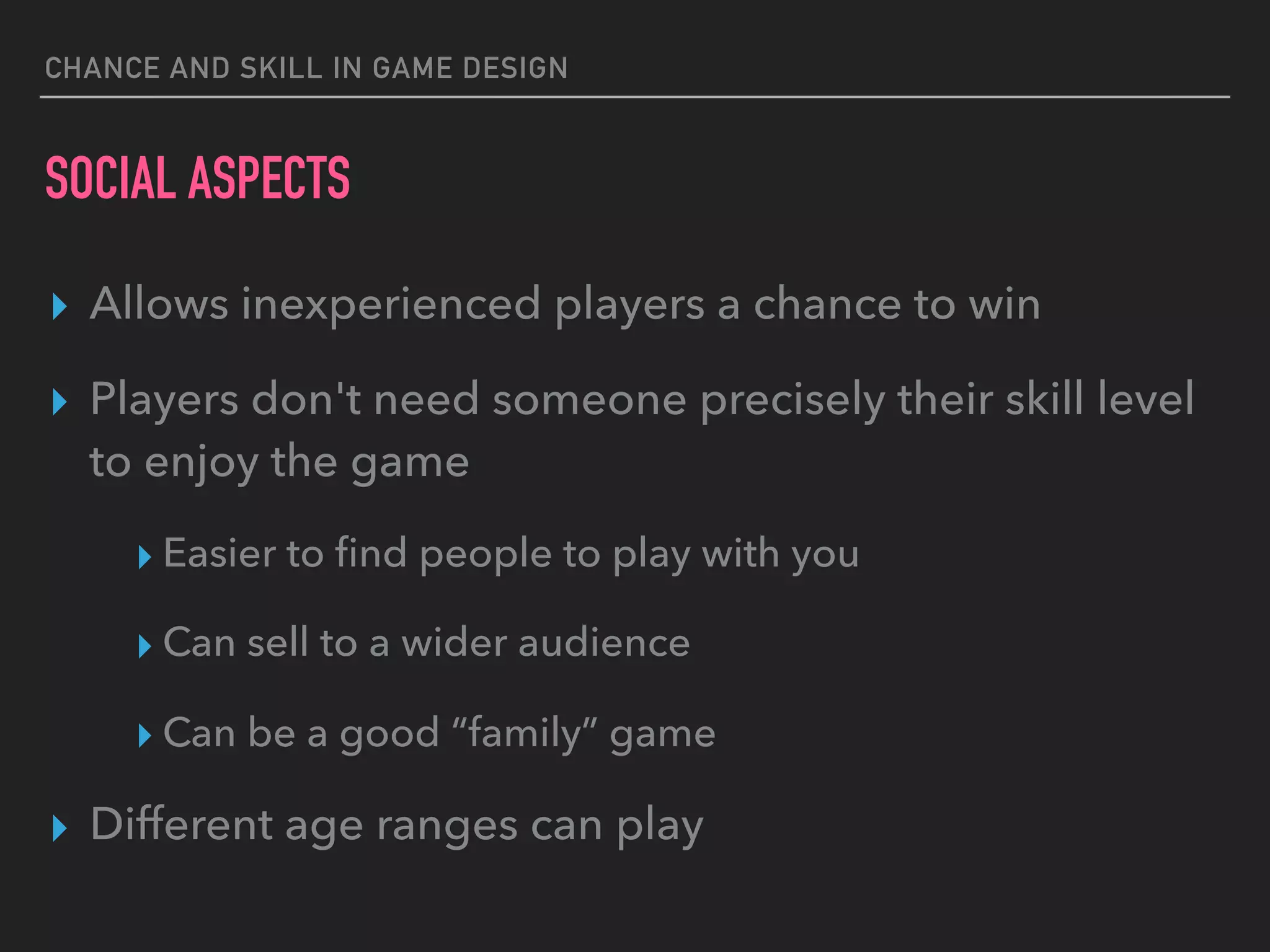
SOCIAL ASPECTS
▸ Allows inexperienced players a chance to win
▸ Players don't need someone precisely their skill level
to enjoy the game
▸ Easier to find people to play with you
▸ Can sell to a wider audience
▸ Can be a good “family” game
▸ Different age ranges can play
CHANCE AND SKILL IN GAME DESIGN
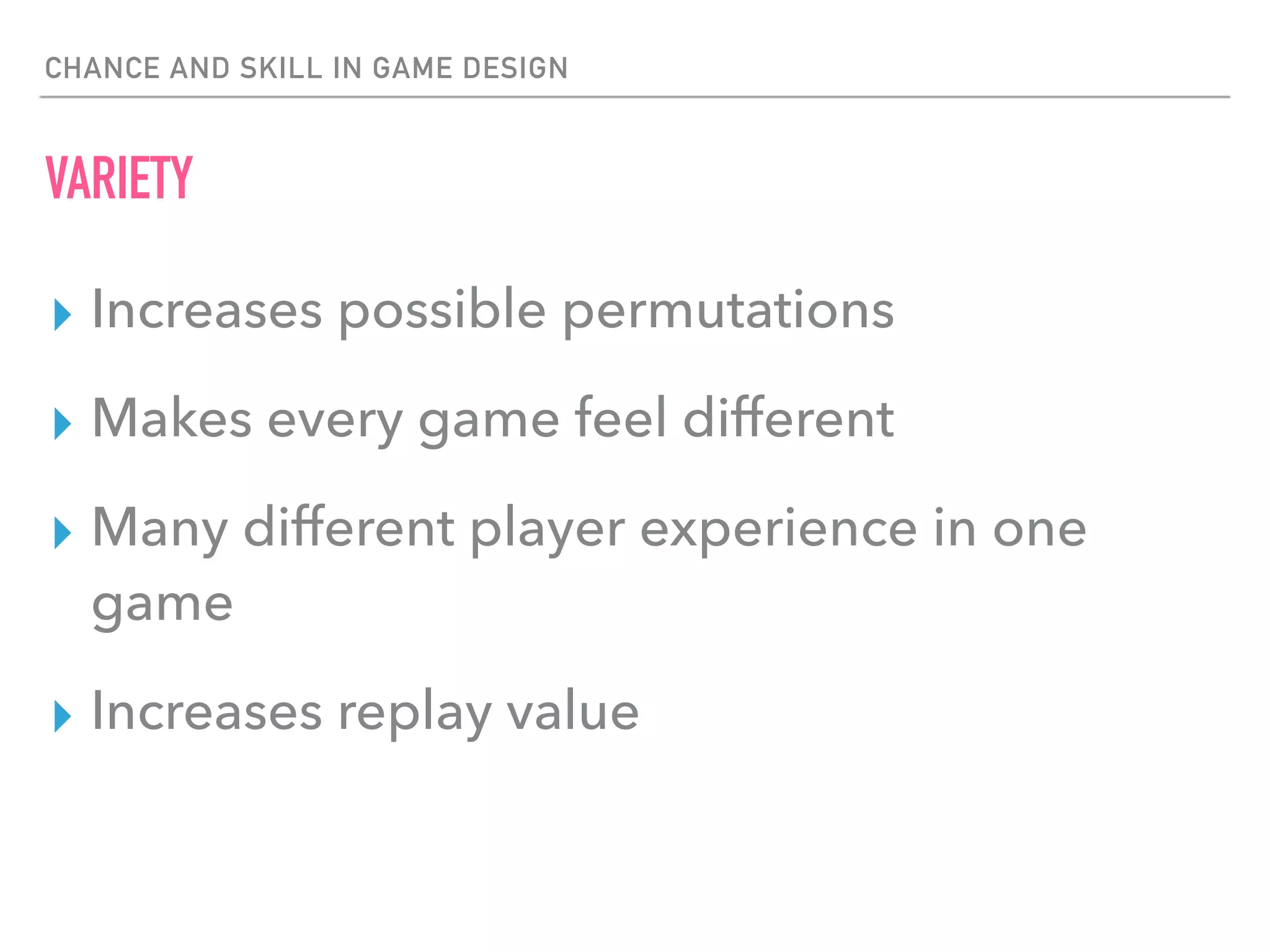
VARIETY
▸ Increases possible permutations
▸ Makes every game feel different
▸ Many different player experience in one
game
▸ Increases replay value
CHANCE AND SKILL IN GAME DESIGN
EMOTIONAL
▸ Create drama
▸ Drastic changes in strategy
▸ Creates excitement
▸ Tension
▸ Chance lets people feel like they aren't bad
players but instead have bad luck
CHANCE AND SKILL IN GAME DESIGN
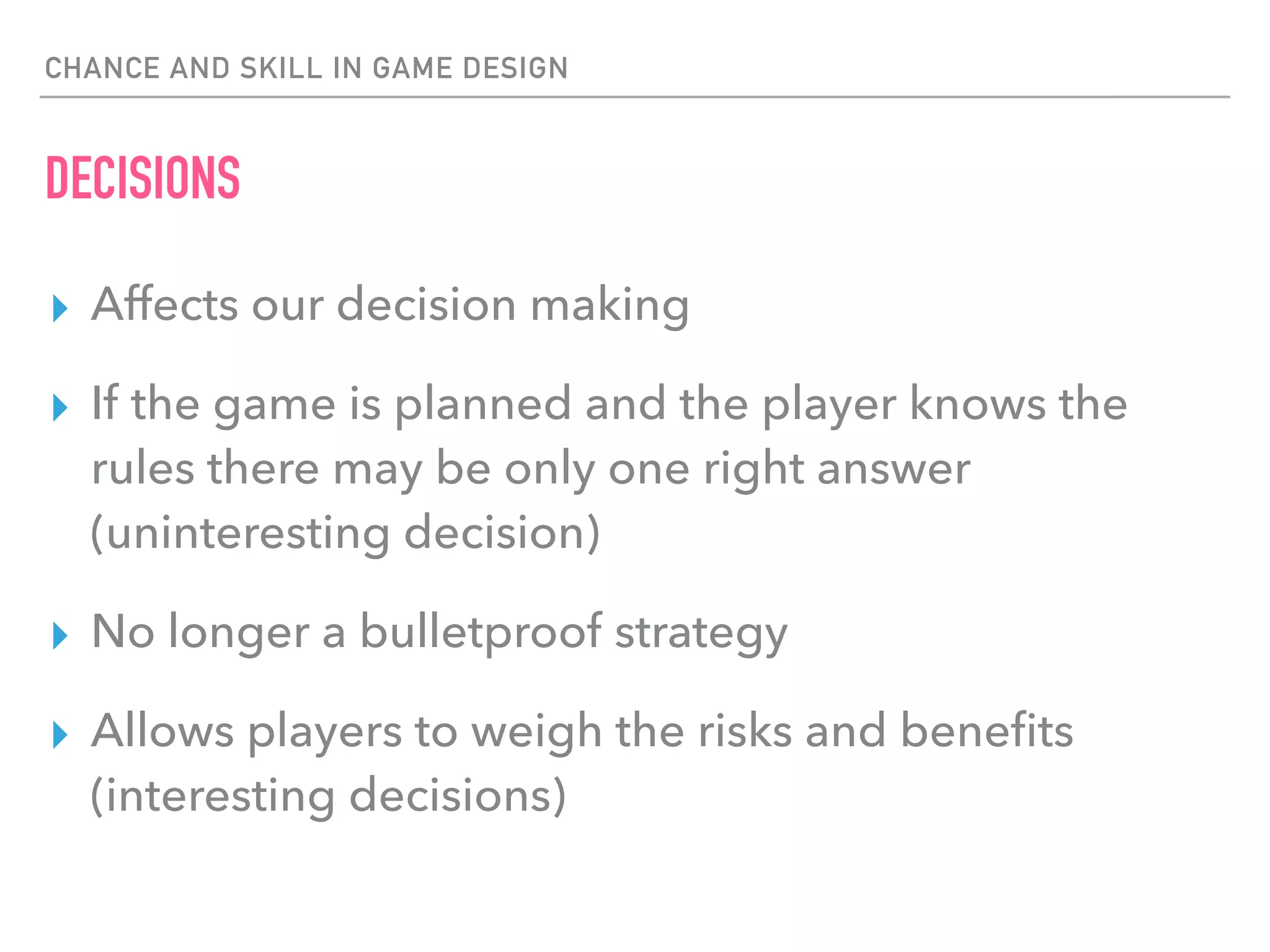
DECISIONS
▸ Affects our decision making
▸ If the game is planned and the player knows the
rules there may be only one right answer
(uninteresting decision)
▸ No longer a bulletproof strategy
▸ Allows players to weigh the risks and benefits
(interesting decisions)
WHY NOT ADD CHANCE?


POSSIBLE DISADVANTAGES
CHANCE AND SKILL IN GAME DESIGN
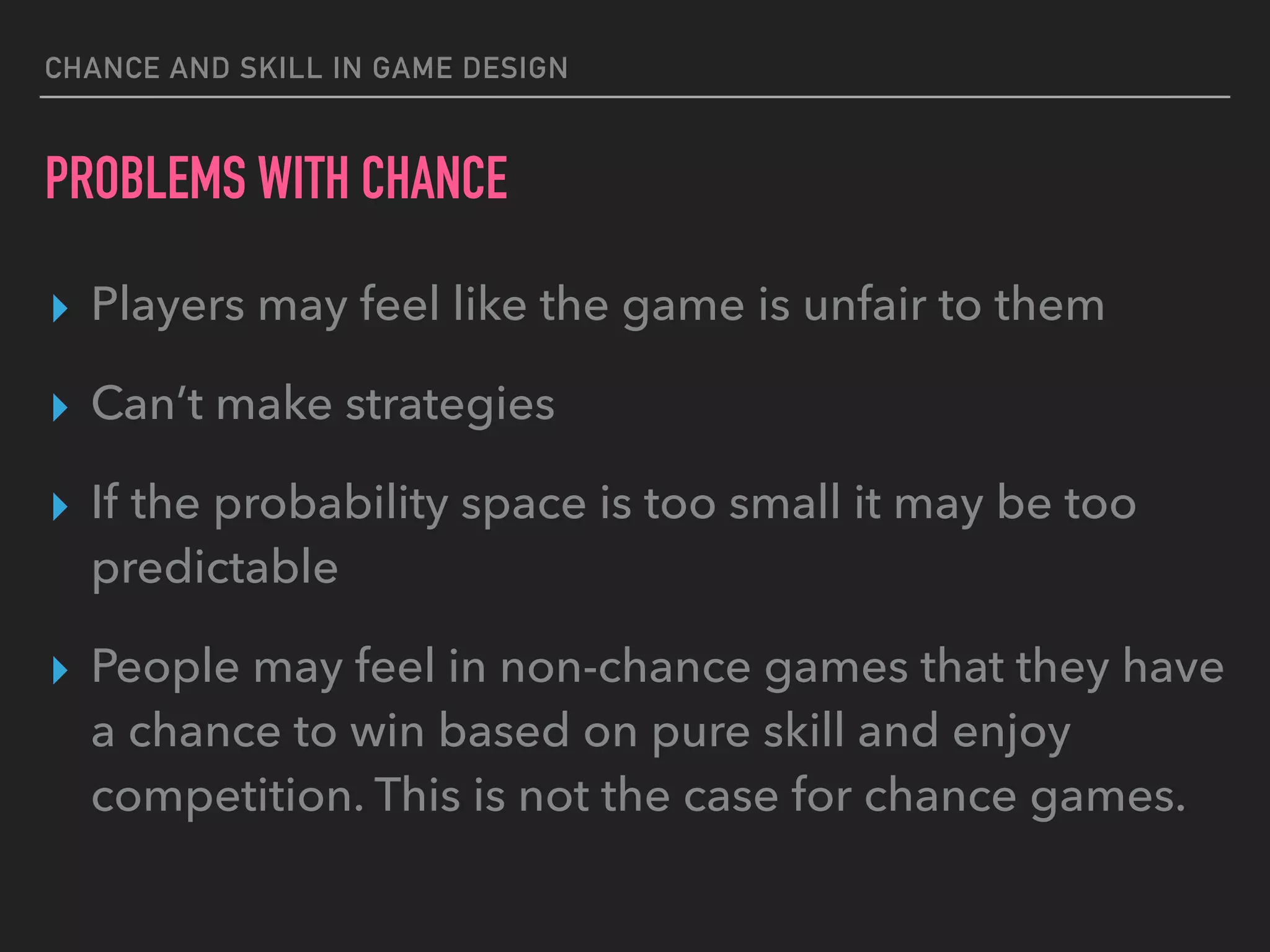
PROBLEMS WITH CHANCE
▸ Players may feel like the game is unfair to them
▸ Can’t make strategies
▸ If the probability space is too small it may be too
predictable
▸ People may feel in non-chance games that they have
a chance to win based on pure skill and enjoy
competition. This is not the case for chance games.
HOW CAN WE ADD CHANCE?
MECHANICS, MATERIALS AND GAME
DESIGN PRINCIPLES
CHANCE AND SKILL IN GAME DESIGN
HOW TO ADD CHANCE
▸ Dice
▸ Cards
▸ Drawing numbers
▸ Pseudo-random number generation
▸ Picking from a hat
▸ Drawing tiles from a bag
uHidden Information
uSpinners
uCoin flips
uGame bits
CHANCE AND SKILL IN GAME DESIGN
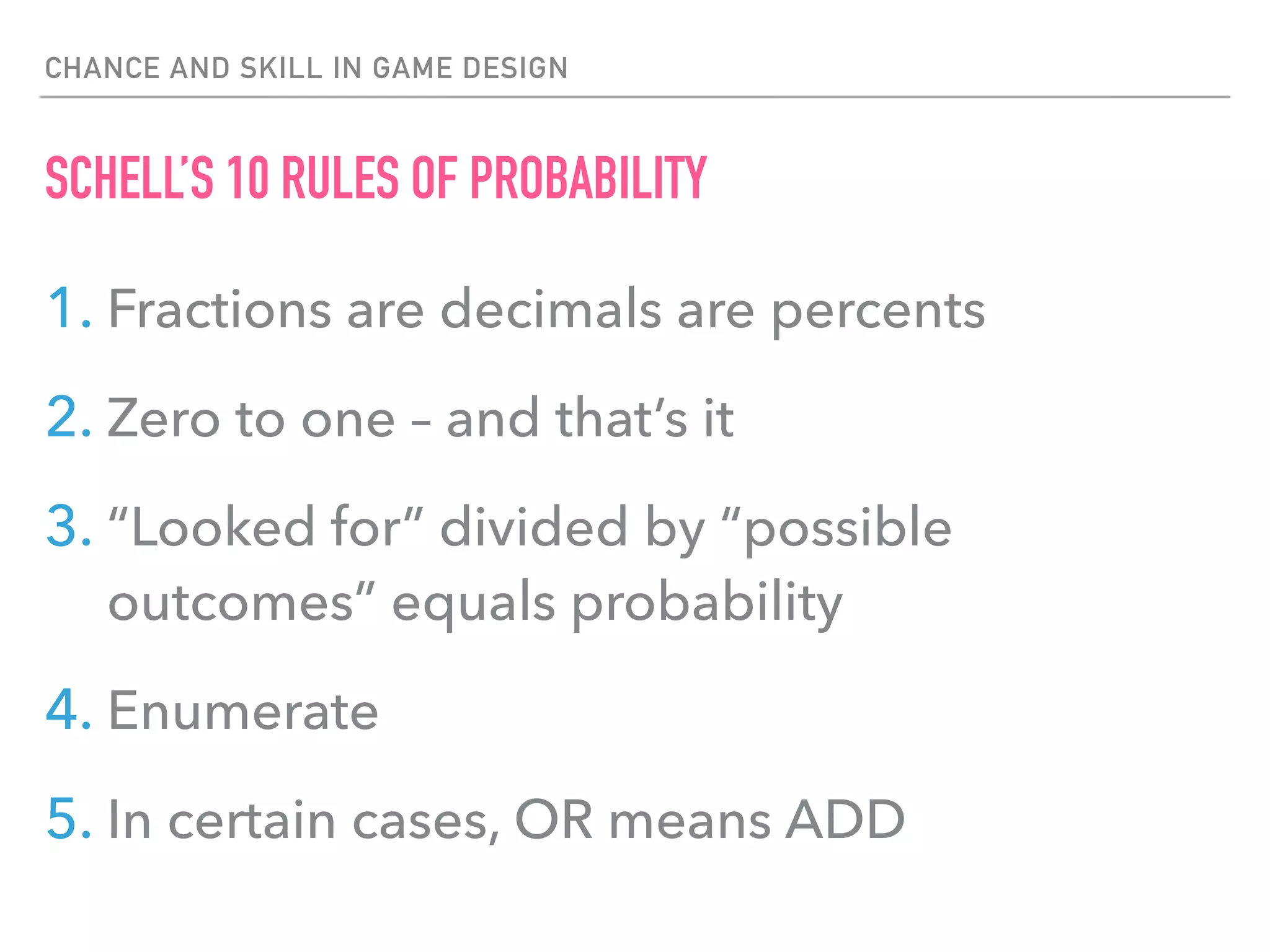
SCHELL’S 10 RULES OF PROBABILITY
1. Fractions are decimals are percents
2. Zero to one – and that’s it
3. “Looked for” divided by “possible
outcomes” equals probability
4. Enumerate
5. In certain cases, OR means ADD
CHANCE AND SKILL IN GAME DESIGN
SCHELL’S 10 RULES OF PROBABILITY
6. In certain cases, AND means MULTIPLY
7. One minus “does” equals “doesn’t”
8. The sum of multiple linear random
selections is NOT a linear random selection
9. Roll the die
10.Geeks love showing off
CHANCE AND SKILL IN GAME DESIGN
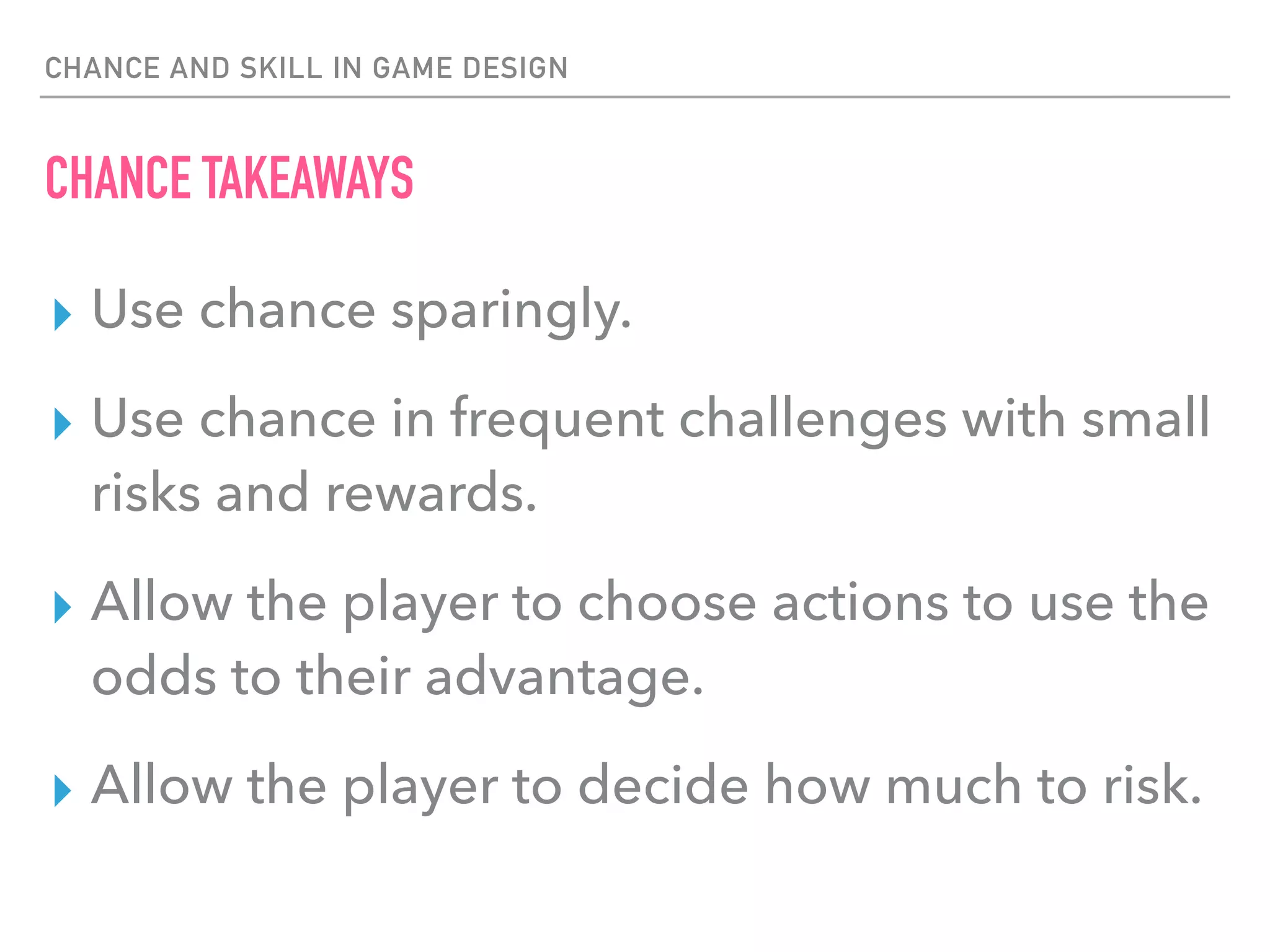
CHANCE TAKEAWAYS
▸ Use chance sparingly.
▸ Use chance in frequent challenges with small
risks and rewards.
▸ Allow the player to choose actions to use the
odds to their advantage.
▸ Allow the player to decide how much to risk.
CHANCE AND SKILL IN GAME DESIGN
EXERCISE: LUCK TAC TOE
▸ Modify the skill game Tic Tac Toe by adding one or more chance-
based mechanics. You may also add other skill-based mechanics
provided that the game still resembles Tic-Tac-Toe at its core.
▸ At the same time, you must make the game good for adult players,
a significant challenge, particularly since they are often jaded
about the game.
▸ Remember that rolling a D10 to decide where you place your X or
your O isn’t likely to result in riveting gameplay. However, out there
some combination of mechanics exists that can make this old
standby compelling again.
SKILL
CHANCE AND SKILL IN GAME DESIGN
THREE TYPES OF GAMES
▸ Games of chance. These games can often be
enhanced by adding twitch and strategic
elements to them.
▸ Games of twitch skill. These are games that are
focused on a challenge of dexterity.
▸ Games of strategic skill. These games can feel
tense and slow, because they involve a lot of
thinking.
CHANCE AND SKILL IN GAME DESIGN
SCHELL’S THREE MAIN SKILL CATEGORIES
▸ Physical skills: Skills like dexterity, coordination,
strength, and physical endurance.
▸ Mental skills: Skills like observation, memory, and
puzzle solving.
▸ Social skills: Skills like reading an opponent,
tricking an opponent, and coordinating with
teammates. These relate to a player’s ability to
make friends and influence people in a game.
CHANCE AND SKILL IN GAME DESIGN
ADDING STRATEGIC SKILL
▸ Adding mechanics that (hopefully) create strategy
and tactics
▸ Strategy and skill can increase the replay value of
the game
▸ We look for patterns naturally
▸ Seek to master the patterns presented
▸ Fun through learning and mastery
CHANCE AND SKILL IN GAME DESIGN
UNDERSTANDING STRATEGIC SKILL
▸ If a game can be thought of as a series of
decisions then skill is ones ability to make
decisions correctly to yield a favorable
outcome
▸ Use of skill should have immediate feedback
▸ Create a chain of thought
▸ “Now what”
CHANCE AND SKILL IN GAME DESIGN
MENTAL STATE OF THE PLAYER
▸ Csikszentmihalyi’s Flow State
▸Skill level matches challenges to keep player in
flow state
▸Improper matching can cause boredom or anxiety
▸ “Magic Circle”
▸Player feels pulled into the game world
CHANCE AND SKILL IN GAME DESIGN
TRADE OFFS
▸ Purchases
▸ Limited-use Special Abilities
▸ Dynamic Limited-use Special Abilities
▸ Explicit Choices
▸ Limited Actions
▸ Trading and Negotiations
▸ Auctions
CHANCE AND SKILL IN GAME DESIGN
AUCTIONS
▸ Player bids on item using resources
▸ Open auction
▸ Sequential auction
▸ Silent auction or closed auction
▸ Fixed-price auction
▸ Dutch auction
▸ Reverse auction
CHANCE AND SKILL IN GAME DESIGN
DECISIONS AND GAME PACING
▸ Game pacing based on the frequency of decisions
▸ How often is the player making decisions?
▸ Every 10 minutes? Or every few seconds?
▸ Long Term Decision
▸ How far ahead are players planning when making a long
term decision?
CHANCE AND SKILL IN GAME DESIGN
ASSESSING AND EVALUATING
▸ How can we tell if the strategy we put in
matters to the player?
▸ Do players care when others are taking their turns?
▸ Are players planning for the long term?
▸ Are there multiple strategies?
▸ Do they use different strategies for different
games?
CHANCE AND SKILL IN GAME DESIGN
WHO IS YOUR TARGET MARKET?
▸Children
▸Gamblers
▸Competitive gamers
▸Social gamers
▸Professional Players
▸Families
CHANCE AND SKILL IN GAME DESIGN
HOW DO YOUR PLAYERS FEEL?
▸ Bored?
▸ Bored on all but their turn?
▸ Players never engaged or are
confused?
▸ Does one player beats all other players
by a wide margin?
CHANCE AND SKILL IN GAME DESIGN
TWITCH MECHANICS
▸Speed
▸Timing
▸Precision
▸Avoidance
▸Time Pressure
CHANCE AND SKILL IN GAME DESIGN
EXERCISE: THE ALIEN IN THE DESERT
▸ So many games of chance focus on dice or cards. An under-used
mechanic in non-digital games is the fog of war, although it’s a
staple in many video games. If your character can’t see it, neither
can you. It is this concept you will apply to a new tile-based game,
The Alien in the Desert. Your game must use the following:
▸ Tiles similar to those used in games like Carcassonne or Settlers
of Catan
▸ The name The Alien in the Desert, although its interpretation is
up to you
▸ Fog of war
THANK YOU VERY MUCH FOR YOUR ATTENTION
THANK YOU
Contact me:
len@uwaterloo.ca
@acagamic (Twitter)
hcigames.com

DAC 300: Chance and Skill in Game Design

  • 1.
    CHANCE AND SKILLIN GAME DESIGN DR. LENNART NACKE Associate Professor, HCI Games Group, Department of Drama and Speech Communication DAC 300/ENGL 303/SPCOM 300 INTRODUCTION TO GAME DESIGN
  • 2.
    CHANCE AND SKILLIN GAME DESIGN DEFINITION OF CHANCE IN GAMES ▸ Mixture of chance and skill ▸ Balancing ▸ Children’s games ▸ Gambling
  • 3.
    CHANCE AND SKILLIN GAME DESIGN WHY ADD CHANCE? ▸ Benefits of adding chance to the game
  • 4.
    CHANCE AND SKILLIN GAME DESIGN SOLVABILITY ▸ Stops people from mastering the game ▸ Makes the game less “solvable” ▸ Reduces boredom caused by constant patterns ▸ Makes the game less predictable
  • 5.
    CHANCE AND SKILLIN GAME DESIGN SOCIAL ASPECTS ▸ Allows inexperienced players a chance to win ▸ Players don't need someone precisely their skill level to enjoy the game ▸ Easier to find people to play with you ▸ Can sell to a wider audience ▸ Can be a good “family” game ▸ Different age ranges can play
  • 6.
    CHANCE AND SKILLIN GAME DESIGN VARIETY ▸ Increases possible permutations ▸ Makes every game feel different ▸ Many different player experience in one game ▸ Increases replay value
  • 7.
    CHANCE AND SKILLIN GAME DESIGN EMOTIONAL ▸ Create drama ▸ Drastic changes in strategy ▸ Creates excitement ▸ Tension ▸ Chance lets people feel like they aren't bad players but instead have bad luck
  • 8.
    CHANCE AND SKILLIN GAME DESIGN DECISIONS ▸ Affects our decision making ▸ If the game is planned and the player knows the rules there may be only one right answer (uninteresting decision) ▸ No longer a bulletproof strategy ▸ Allows players to weigh the risks and benefits (interesting decisions)
  • 9.
    WHY NOT ADDCHANCE? 
 POSSIBLE DISADVANTAGES
  • 10.
    CHANCE AND SKILLIN GAME DESIGN PROBLEMS WITH CHANCE ▸ Players may feel like the game is unfair to them ▸ Can’t make strategies ▸ If the probability space is too small it may be too predictable ▸ People may feel in non-chance games that they have a chance to win based on pure skill and enjoy competition. This is not the case for chance games.
  • 11.
    HOW CAN WEADD CHANCE? MECHANICS, MATERIALS AND GAME DESIGN PRINCIPLES
  • 12.
    CHANCE AND SKILLIN GAME DESIGN HOW TO ADD CHANCE ▸ Dice ▸ Cards ▸ Drawing numbers ▸ Pseudo-random number generation ▸ Picking from a hat ▸ Drawing tiles from a bag uHidden Information uSpinners uCoin flips uGame bits
  • 13.
    CHANCE AND SKILLIN GAME DESIGN SCHELL’S 10 RULES OF PROBABILITY 1. Fractions are decimals are percents 2. Zero to one – and that’s it 3. “Looked for” divided by “possible outcomes” equals probability 4. Enumerate 5. In certain cases, OR means ADD
  • 14.
    CHANCE AND SKILLIN GAME DESIGN SCHELL’S 10 RULES OF PROBABILITY 6. In certain cases, AND means MULTIPLY 7. One minus “does” equals “doesn’t” 8. The sum of multiple linear random selections is NOT a linear random selection 9. Roll the die 10.Geeks love showing off
  • 15.
    CHANCE AND SKILLIN GAME DESIGN CHANCE TAKEAWAYS ▸ Use chance sparingly. ▸ Use chance in frequent challenges with small risks and rewards. ▸ Allow the player to choose actions to use the odds to their advantage. ▸ Allow the player to decide how much to risk.
  • 16.
    CHANCE AND SKILLIN GAME DESIGN EXERCISE: LUCK TAC TOE ▸ Modify the skill game Tic Tac Toe by adding one or more chance- based mechanics. You may also add other skill-based mechanics provided that the game still resembles Tic-Tac-Toe at its core. ▸ At the same time, you must make the game good for adult players, a significant challenge, particularly since they are often jaded about the game. ▸ Remember that rolling a D10 to decide where you place your X or your O isn’t likely to result in riveting gameplay. However, out there some combination of mechanics exists that can make this old standby compelling again.
  • 17.
  • 18.
    CHANCE AND SKILLIN GAME DESIGN THREE TYPES OF GAMES ▸ Games of chance. These games can often be enhanced by adding twitch and strategic elements to them. ▸ Games of twitch skill. These are games that are focused on a challenge of dexterity. ▸ Games of strategic skill. These games can feel tense and slow, because they involve a lot of thinking.
  • 19.
    CHANCE AND SKILLIN GAME DESIGN SCHELL’S THREE MAIN SKILL CATEGORIES ▸ Physical skills: Skills like dexterity, coordination, strength, and physical endurance. ▸ Mental skills: Skills like observation, memory, and puzzle solving. ▸ Social skills: Skills like reading an opponent, tricking an opponent, and coordinating with teammates. These relate to a player’s ability to make friends and influence people in a game.
  • 20.
    CHANCE AND SKILLIN GAME DESIGN ADDING STRATEGIC SKILL ▸ Adding mechanics that (hopefully) create strategy and tactics ▸ Strategy and skill can increase the replay value of the game ▸ We look for patterns naturally ▸ Seek to master the patterns presented ▸ Fun through learning and mastery
  • 21.
    CHANCE AND SKILLIN GAME DESIGN UNDERSTANDING STRATEGIC SKILL ▸ If a game can be thought of as a series of decisions then skill is ones ability to make decisions correctly to yield a favorable outcome ▸ Use of skill should have immediate feedback ▸ Create a chain of thought ▸ “Now what”
  • 22.
    CHANCE AND SKILLIN GAME DESIGN MENTAL STATE OF THE PLAYER ▸ Csikszentmihalyi’s Flow State ▸Skill level matches challenges to keep player in flow state ▸Improper matching can cause boredom or anxiety ▸ “Magic Circle” ▸Player feels pulled into the game world
  • 23.
    CHANCE AND SKILLIN GAME DESIGN TRADE OFFS ▸ Purchases ▸ Limited-use Special Abilities ▸ Dynamic Limited-use Special Abilities ▸ Explicit Choices ▸ Limited Actions ▸ Trading and Negotiations ▸ Auctions
  • 24.
    CHANCE AND SKILLIN GAME DESIGN AUCTIONS ▸ Player bids on item using resources ▸ Open auction ▸ Sequential auction ▸ Silent auction or closed auction ▸ Fixed-price auction ▸ Dutch auction ▸ Reverse auction
  • 25.
    CHANCE AND SKILLIN GAME DESIGN DECISIONS AND GAME PACING ▸ Game pacing based on the frequency of decisions ▸ How often is the player making decisions? ▸ Every 10 minutes? Or every few seconds? ▸ Long Term Decision ▸ How far ahead are players planning when making a long term decision?
  • 26.
    CHANCE AND SKILLIN GAME DESIGN ASSESSING AND EVALUATING ▸ How can we tell if the strategy we put in matters to the player? ▸ Do players care when others are taking their turns? ▸ Are players planning for the long term? ▸ Are there multiple strategies? ▸ Do they use different strategies for different games?
  • 27.
    CHANCE AND SKILLIN GAME DESIGN WHO IS YOUR TARGET MARKET? ▸Children ▸Gamblers ▸Competitive gamers ▸Social gamers ▸Professional Players ▸Families
  • 28.
    CHANCE AND SKILLIN GAME DESIGN HOW DO YOUR PLAYERS FEEL? ▸ Bored? ▸ Bored on all but their turn? ▸ Players never engaged or are confused? ▸ Does one player beats all other players by a wide margin?
  • 29.
    CHANCE AND SKILLIN GAME DESIGN TWITCH MECHANICS ▸Speed ▸Timing ▸Precision ▸Avoidance ▸Time Pressure
  • 30.
    CHANCE AND SKILLIN GAME DESIGN EXERCISE: THE ALIEN IN THE DESERT ▸ So many games of chance focus on dice or cards. An under-used mechanic in non-digital games is the fog of war, although it’s a staple in many video games. If your character can’t see it, neither can you. It is this concept you will apply to a new tile-based game, The Alien in the Desert. Your game must use the following: ▸ Tiles similar to those used in games like Carcassonne or Settlers of Catan ▸ The name The Alien in the Desert, although its interpretation is up to you ▸ Fog of war
  • 31.
    THANK YOU VERYMUCH FOR YOUR ATTENTION THANK YOU Contact me: len@uwaterloo.ca @acagamic (Twitter) hcigames.com