Unit-1
Abhimanyu Mishra
1
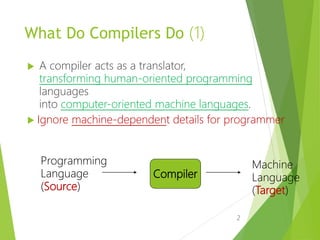
What Do Compilers Do (1)
 A compiler acts as a translator,
transforming human-oriented programming
languages
into computer-oriented machine languages.
 Ignore machine-dependent details for programmer
2
Programming
Language
(Source)
Compiler
Machine
Language
(Target)
What Do Compilers Do (2)
 Compilers may generate three types of code:
 Pure Machine Code
 Machine instruction set without assuming the existence of any
operating system or library.
 Mostly being OS or embedded applications.
 Augmented Machine Code
 Code with OS routines and runtime support routines.
 More often
 Virtual Machine Code
 Virtual instructions, can be run on any architecture with a
virtual machine interpreter or a just-in-time compiler
 Ex. Java
3
What Do Compilers Do (3)
 Another way that compilers
differ from one another is in the format of the target
machine code they generate:
 Assembly or other source format
 Relocatable binary
 Relative address
 A linkage step is required
 Absolute binary
 Absolute address
 Can be executed directly
4
The Structure of a Compiler
(1)
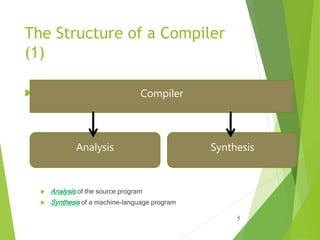
 Any compiler must perform two major
tasks
 Analysis of the source program
 Synthesis of a machine-language program
5
Compiler
Analysis Synthesis
The Structure of a Compiler (2)
6
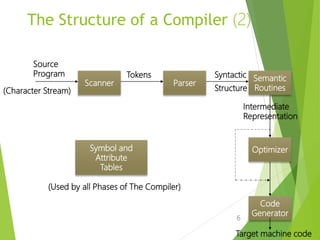
Scanner Parser
Semantic
Routines
Code
Generator
Optimizer
Source
Program Tokens Syntactic
Structure
Symbol and
Attribute
Tables
(Used by all Phases of The Compiler)
(Character Stream)
Intermediate
Representation
Target machine code
The Structure of a Compiler (3)
7
Scanner Parser
Semantic
Routines
Code
Generator
Optimizer
Source
Program Tokens Syntactic
Structure
Symbol and
Attribute
Tables
(Used by all
Phases of
The Compiler)
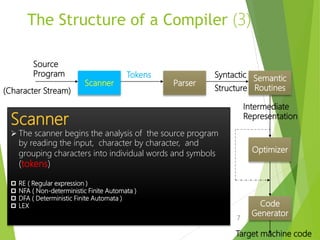
Scanner
 The scanner begins the analysis of the source program
by reading the input, character by character, and
grouping characters into individual words and symbols
(tokens)
 RE ( Regular expression )
 NFA ( Non-deterministic Finite Automata )
 DFA ( Deterministic Finite Automata )
 LEX
(Character Stream)
Intermediate
Representation
Target machine code
The Structure of a Compiler (4)
8
Scanner Parser
Semantic
Routines
Code
Generator
Optimizer
Source
Program Tokens Syntactic
Structure
Symbol and
Attribute
Tables
(Used by all
Phases of
The Compiler)
Parser
 Given a formal syntax specification (typically as a context-
free grammar [CFG] ), the parse reads tokens and groups
them into units as specified by the productions of the
CFG being used.
 As syntactic structure is recognized, the parser either calls
corresponding semantic routines directly or builds a
syntax tree.
 CFG ( Context-Free Grammar )
 BNF ( Backus-Naur Form )
 GAA ( Grammar Analysis Algorithms )
 LL, LR, SLR, LALR Parsers
 YACC
(Character Stream)
Intermediate
Representation
Target machine code
The Structure of a Compiler (5)
9
Scanner Parser
Semantic
Routines
Code
Generator
Optimizer
Source
Program
(Character Stream)
Tokens Syntactic
Structure
Intermediate
Representation
Symbol and
Attribute
Tables
(Used by all
Phases of
The Compiler)
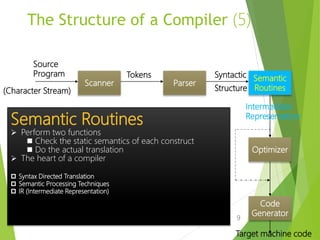
Semantic Routines
 Perform two functions
 Check the static semantics of each construct
 Do the actual translation
 The heart of a compiler
 Syntax Directed Translation
 Semantic Processing Techniques
 IR (Intermediate Representation)
Target machine code
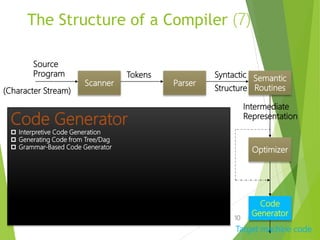
The Structure of a Compiler (7)
10
Source
Program
(Character Stream)
Scanner
Tokens
Parser
Syntactic
Structure
Semantic
Routines
Intermediate
Representation
Optimizer
Code
Generator
Code Generator
 Interpretive Code Generation
 Generating Code from Tree/Dag
 Grammar-Based Code Generator
Target machine code
The Structure of a Compiler
(8)
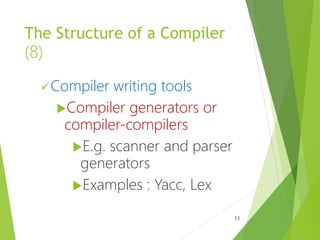
Compiler writing tools
Compiler generators or
compiler-compilers
E.g. scanner and parser
generators
Examples : Yacc, Lex
11
The Syntax and Semantics of
Programming Language (1)
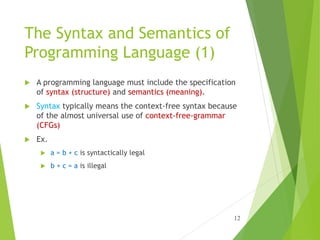
 A programming language must include the specification
of syntax (structure) and semantics (meaning).
 Syntax typically means the context-free syntax because
of the almost universal use of context-free-grammar
(CFGs)
 Ex.
 a = b + c is syntactically legal
 b + c = a is illegal
12
The Syntax and Semantics of
Programming Language (2)
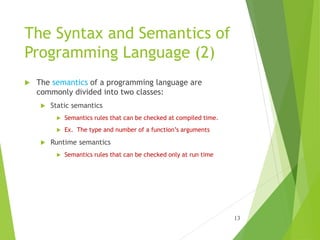
 The semantics of a programming language are
commonly divided into two classes:
 Static semantics
 Semantics rules that can be checked at compiled time.
 Ex. The type and number of a function’s arguments
 Runtime semantics
 Semantics rules that can be checked only at run time
13
Compiler Design and
Programming Language Design (1)
 An interesting aspect is how programming language
design and compiler design influence one another.
 Programming languages that are easy to compile have
many advantages
14
Compiler Design and
Programming Language Design(2)
 Languages such as Snobol and APL are
usually considered noncompilable
 What attributes must be found in a
programming language to allow compilation?
 Can the scope and binding of each identifier
reference be determined before execution begins?
 Can the type of object be determined before
execution begins?
 Can existing program text be changed or added to
during execution?
15
Computer Architecture and Compiler Design
 Compilers should exploit the hardware-specific feature
and computing capability to optimize code.
 The problems encountered in modern computing
platforms:
 Instruction sets for some popular architectures are highly
nonuniform.
 High-level programming language operations are not
always easy to support.
 Ex. exceptions, threads, dynamic heap access …
 Exploiting architectural features such as cache, distributed
processors and memory
 Effective use of a large number of processors
16
Compiler Design
Considerations
 Debugging Compilers
 Designed to aid in the development and debugging of
programs.
 Optimizing Compilers
 Designed to produce efficient target code
 Retargetable Compilers
 A compiler whose target architecture can be changed
without its machine-independent components having to be
rewritten.
17

Cd unit i

  • 1.
  • 2.
    What Do CompilersDo (1)  A compiler acts as a translator, transforming human-oriented programming languages into computer-oriented machine languages.  Ignore machine-dependent details for programmer 2 Programming Language (Source) Compiler Machine Language (Target)
  • 3.
    What Do CompilersDo (2)  Compilers may generate three types of code:  Pure Machine Code  Machine instruction set without assuming the existence of any operating system or library.  Mostly being OS or embedded applications.  Augmented Machine Code  Code with OS routines and runtime support routines.  More often  Virtual Machine Code  Virtual instructions, can be run on any architecture with a virtual machine interpreter or a just-in-time compiler  Ex. Java 3
  • 4.
    What Do CompilersDo (3)  Another way that compilers differ from one another is in the format of the target machine code they generate:  Assembly or other source format  Relocatable binary  Relative address  A linkage step is required  Absolute binary  Absolute address  Can be executed directly 4
  • 5.
    The Structure ofa Compiler (1)  Any compiler must perform two major tasks  Analysis of the source program  Synthesis of a machine-language program 5 Compiler Analysis Synthesis
  • 6.
    The Structure ofa Compiler (2) 6 Scanner Parser Semantic Routines Code Generator Optimizer Source Program Tokens Syntactic Structure Symbol and Attribute Tables (Used by all Phases of The Compiler) (Character Stream) Intermediate Representation Target machine code
  • 7.
    The Structure ofa Compiler (3) 7 Scanner Parser Semantic Routines Code Generator Optimizer Source Program Tokens Syntactic Structure Symbol and Attribute Tables (Used by all Phases of The Compiler) Scanner  The scanner begins the analysis of the source program by reading the input, character by character, and grouping characters into individual words and symbols (tokens)  RE ( Regular expression )  NFA ( Non-deterministic Finite Automata )  DFA ( Deterministic Finite Automata )  LEX (Character Stream) Intermediate Representation Target machine code
  • 8.
    The Structure ofa Compiler (4) 8 Scanner Parser Semantic Routines Code Generator Optimizer Source Program Tokens Syntactic Structure Symbol and Attribute Tables (Used by all Phases of The Compiler) Parser  Given a formal syntax specification (typically as a context- free grammar [CFG] ), the parse reads tokens and groups them into units as specified by the productions of the CFG being used.  As syntactic structure is recognized, the parser either calls corresponding semantic routines directly or builds a syntax tree.  CFG ( Context-Free Grammar )  BNF ( Backus-Naur Form )  GAA ( Grammar Analysis Algorithms )  LL, LR, SLR, LALR Parsers  YACC (Character Stream) Intermediate Representation Target machine code
  • 9.
    The Structure ofa Compiler (5) 9 Scanner Parser Semantic Routines Code Generator Optimizer Source Program (Character Stream) Tokens Syntactic Structure Intermediate Representation Symbol and Attribute Tables (Used by all Phases of The Compiler) Semantic Routines  Perform two functions  Check the static semantics of each construct  Do the actual translation  The heart of a compiler  Syntax Directed Translation  Semantic Processing Techniques  IR (Intermediate Representation) Target machine code
  • 10.
    The Structure ofa Compiler (7) 10 Source Program (Character Stream) Scanner Tokens Parser Syntactic Structure Semantic Routines Intermediate Representation Optimizer Code Generator Code Generator  Interpretive Code Generation  Generating Code from Tree/Dag  Grammar-Based Code Generator Target machine code
  • 11.
    The Structure ofa Compiler (8) Compiler writing tools Compiler generators or compiler-compilers E.g. scanner and parser generators Examples : Yacc, Lex 11
  • 12.
    The Syntax andSemantics of Programming Language (1)  A programming language must include the specification of syntax (structure) and semantics (meaning).  Syntax typically means the context-free syntax because of the almost universal use of context-free-grammar (CFGs)  Ex.  a = b + c is syntactically legal  b + c = a is illegal 12
  • 13.
    The Syntax andSemantics of Programming Language (2)  The semantics of a programming language are commonly divided into two classes:  Static semantics  Semantics rules that can be checked at compiled time.  Ex. The type and number of a function’s arguments  Runtime semantics  Semantics rules that can be checked only at run time 13
  • 14.
    Compiler Design and ProgrammingLanguage Design (1)  An interesting aspect is how programming language design and compiler design influence one another.  Programming languages that are easy to compile have many advantages 14
  • 15.
    Compiler Design and ProgrammingLanguage Design(2)  Languages such as Snobol and APL are usually considered noncompilable  What attributes must be found in a programming language to allow compilation?  Can the scope and binding of each identifier reference be determined before execution begins?  Can the type of object be determined before execution begins?  Can existing program text be changed or added to during execution? 15
  • 16.
    Computer Architecture andCompiler Design  Compilers should exploit the hardware-specific feature and computing capability to optimize code.  The problems encountered in modern computing platforms:  Instruction sets for some popular architectures are highly nonuniform.  High-level programming language operations are not always easy to support.  Ex. exceptions, threads, dynamic heap access …  Exploiting architectural features such as cache, distributed processors and memory  Effective use of a large number of processors 16
  • 17.
    Compiler Design Considerations  DebuggingCompilers  Designed to aid in the development and debugging of programs.  Optimizing Compilers  Designed to produce efficient target code  Retargetable Compilers  A compiler whose target architecture can be changed without its machine-independent components having to be rewritten. 17