DIRECT3D12 AND THE FUTURE OF
GRAPHICS APIS
Dave Oldcorn, Direct3D12 Technical Lead, AMD
2 | AMD Direct3D Futures | March 20th, 2014
THE PROBLEM
3 | AMD Direct3D Futures | March 20th, 2014
THE PROBLEM
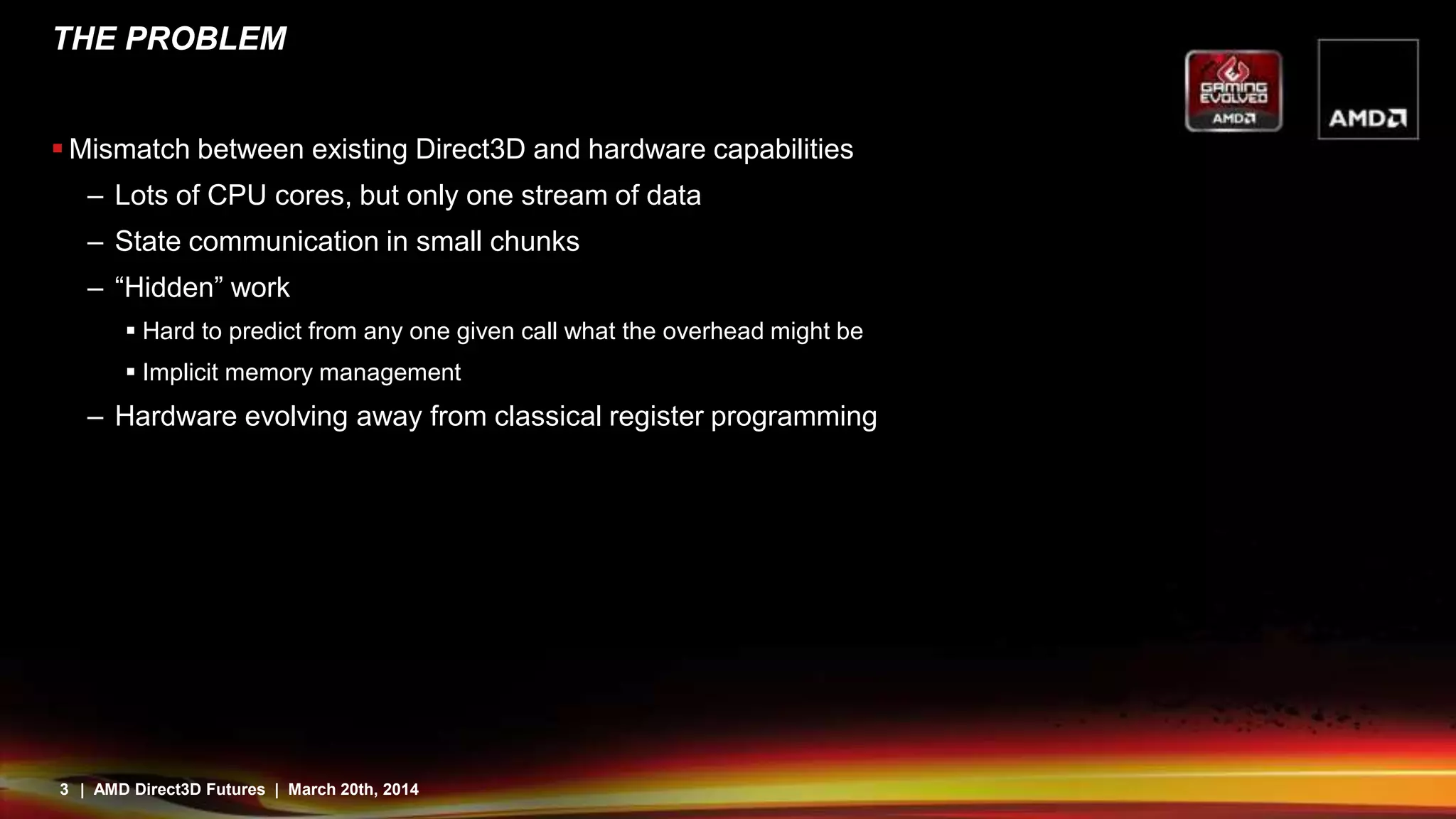
 Mismatch between existing Direct3D and hardware capabilities
– Lots of CPU cores, but only one stream of data
– State communication in small chunks
– “Hidden” work
 Hard to predict from any one given call what the overhead might be
 Implicit memory management
– Hardware evolving away from classical register programming
4 | AMD Direct3D Futures | March 20th, 2014
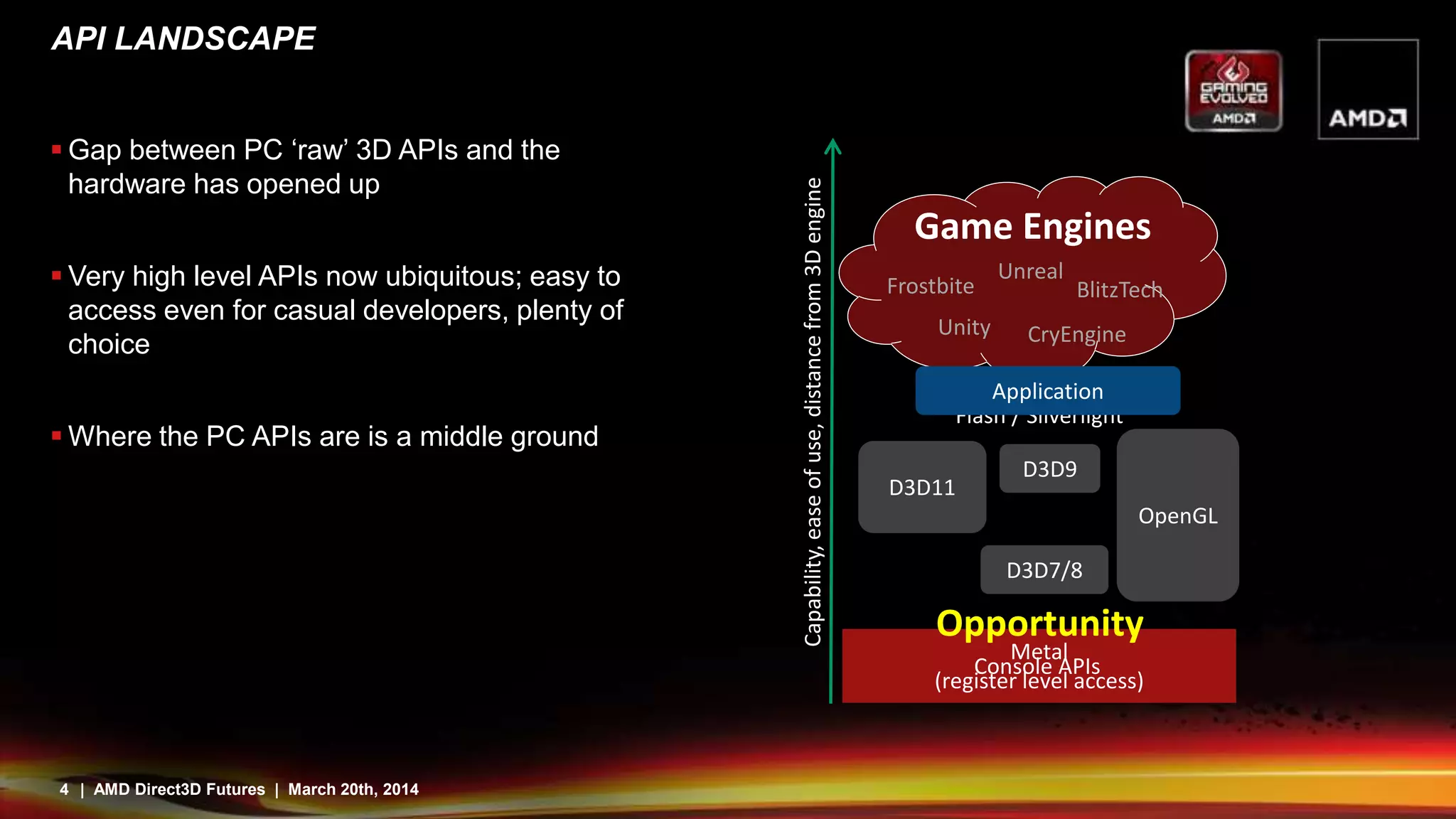
Metal
(register level access)
API LANDSCAPE
 Gap between PC ‘raw’ 3D APIs and the
hardware has opened up
 Very high level APIs now ubiquitous; easy to
access even for casual developers, plenty of
choice
 Where the PC APIs are is a middle ground
Capability,easeofuse,distancefrom3Dengine
Game Engines
Frostbite
Unity
Unreal
CryEngine
BlitzTech
Flash / Silverlight
Console APIs
Opportunity
D3D9
OpenGL
D3D11
D3D7/8
Application
5 | AMD Direct3D Futures | March 20th, 2014
WHAT ARE THE CONSEQUENCES?
WHAT ARE THE SOLUTIONS?
6 | AMD Direct3D Futures | March 20th, 2014
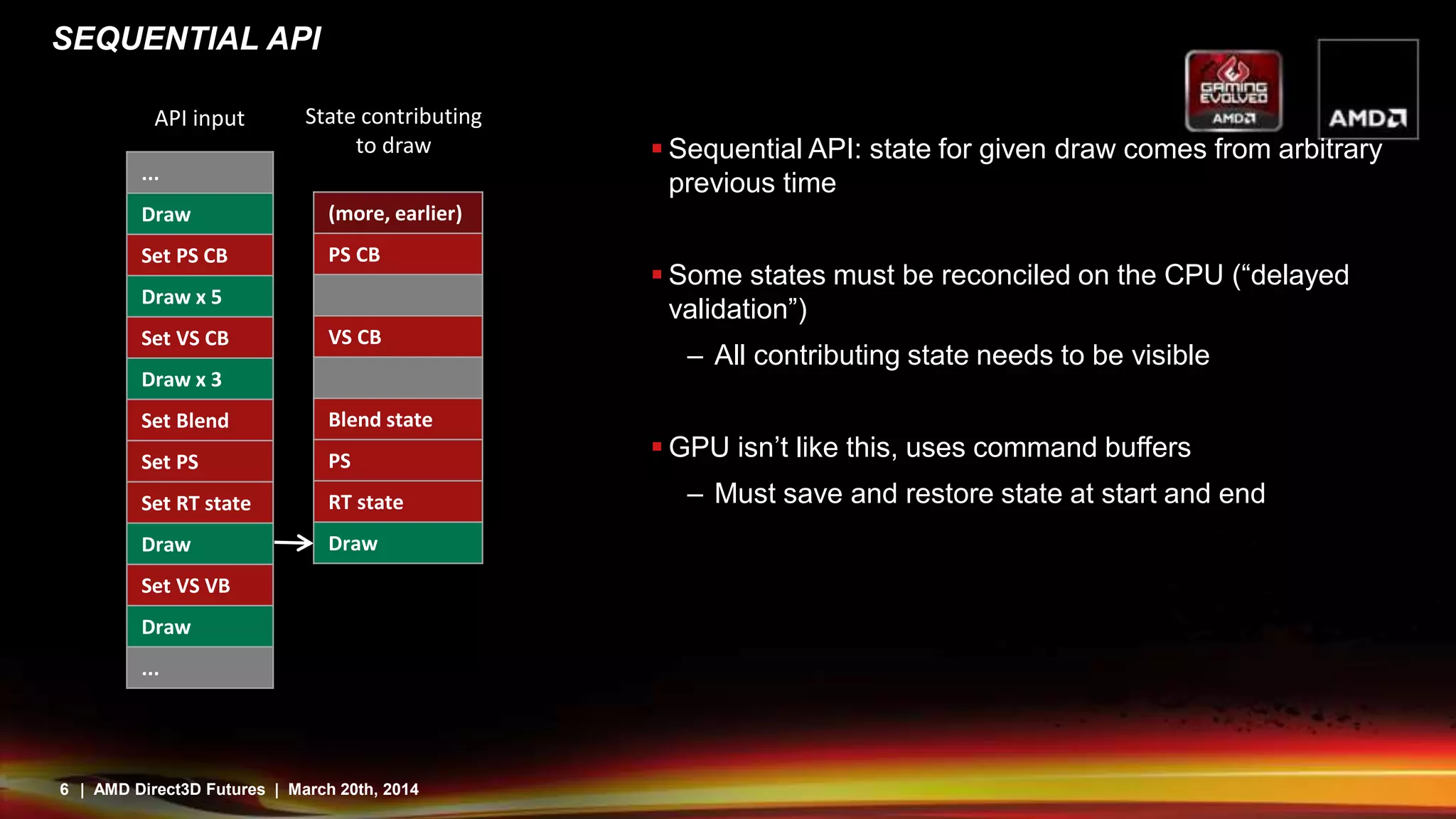
SEQUENTIAL API
 Sequential API: state for given draw comes from arbitrary
previous time
 Some states must be reconciled on the CPU (“delayed
validation”)
– All contributing state needs to be visible
 GPU isn’t like this, uses command buffers
– Must save and restore state at start and end
...
Draw
Set PS CB
Draw x 5
Set VS CB
Draw x 3
Set Blend
Set PS
Set RT state
Draw
Set VS VB
Draw
...
(more, earlier)
PS CB
VS CB
Blend state
PS
RT state
Draw
State contributing
to draw
API input
7 | AMD Direct3D Futures | March 20th, 2014
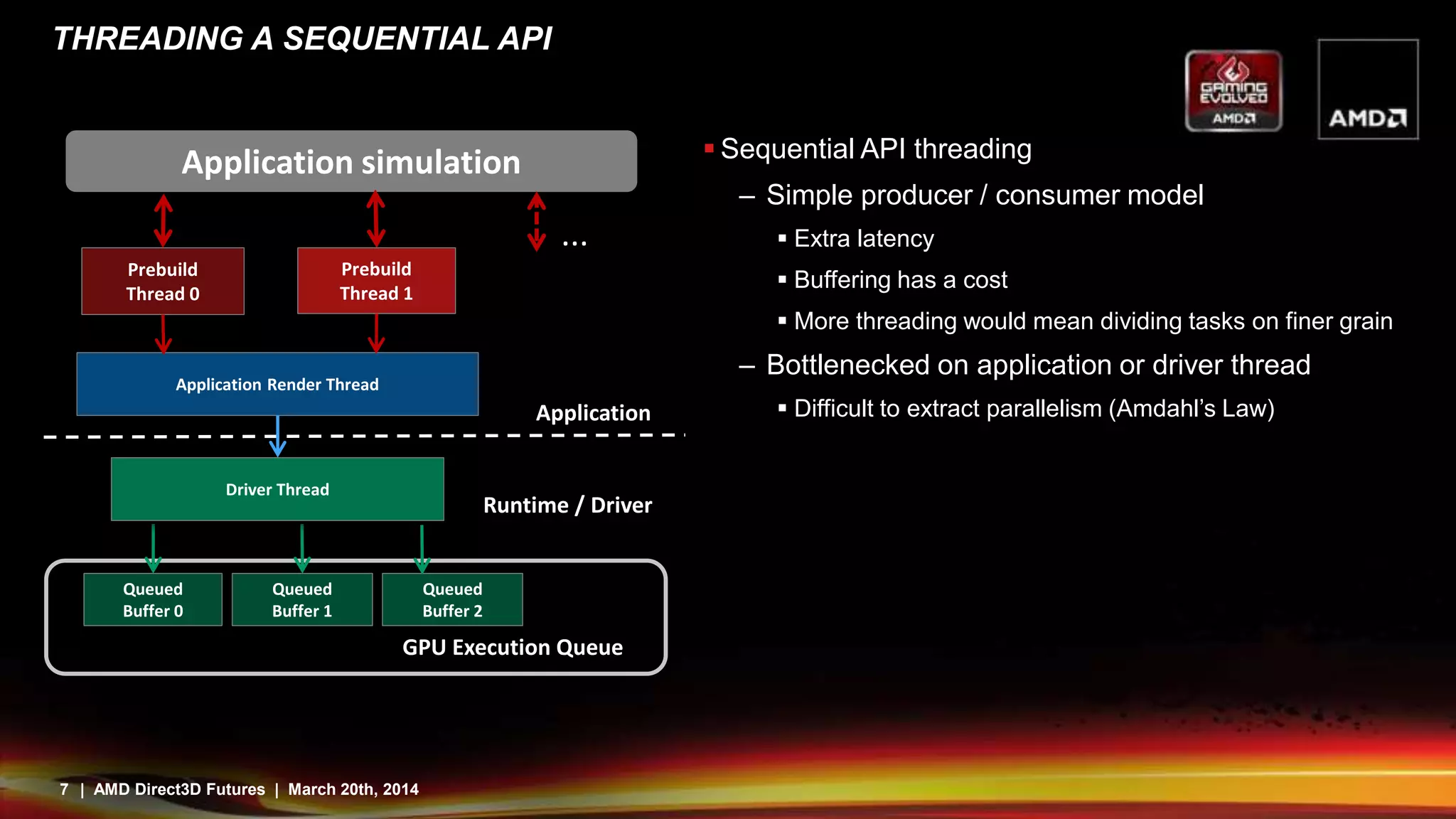
THREADING A SEQUENTIAL API
 Sequential API threading
– Simple producer / consumer model
 Extra latency
 Buffering has a cost
 More threading would mean dividing tasks on finer grain
– Bottlenecked on application or driver thread
 Difficult to extract parallelism (Amdahl’s Law)
Application simulation
Prebuild
Thread 0
Prebuild
Thread 1
Application Render Thread
GPU Execution Queue
Queued
Buffer 0
Queued
Buffer 1
...
Runtime / Driver
Application
Driver Thread
Queued
Buffer 2
8 | AMD Direct3D Futures | March 20th, 2014
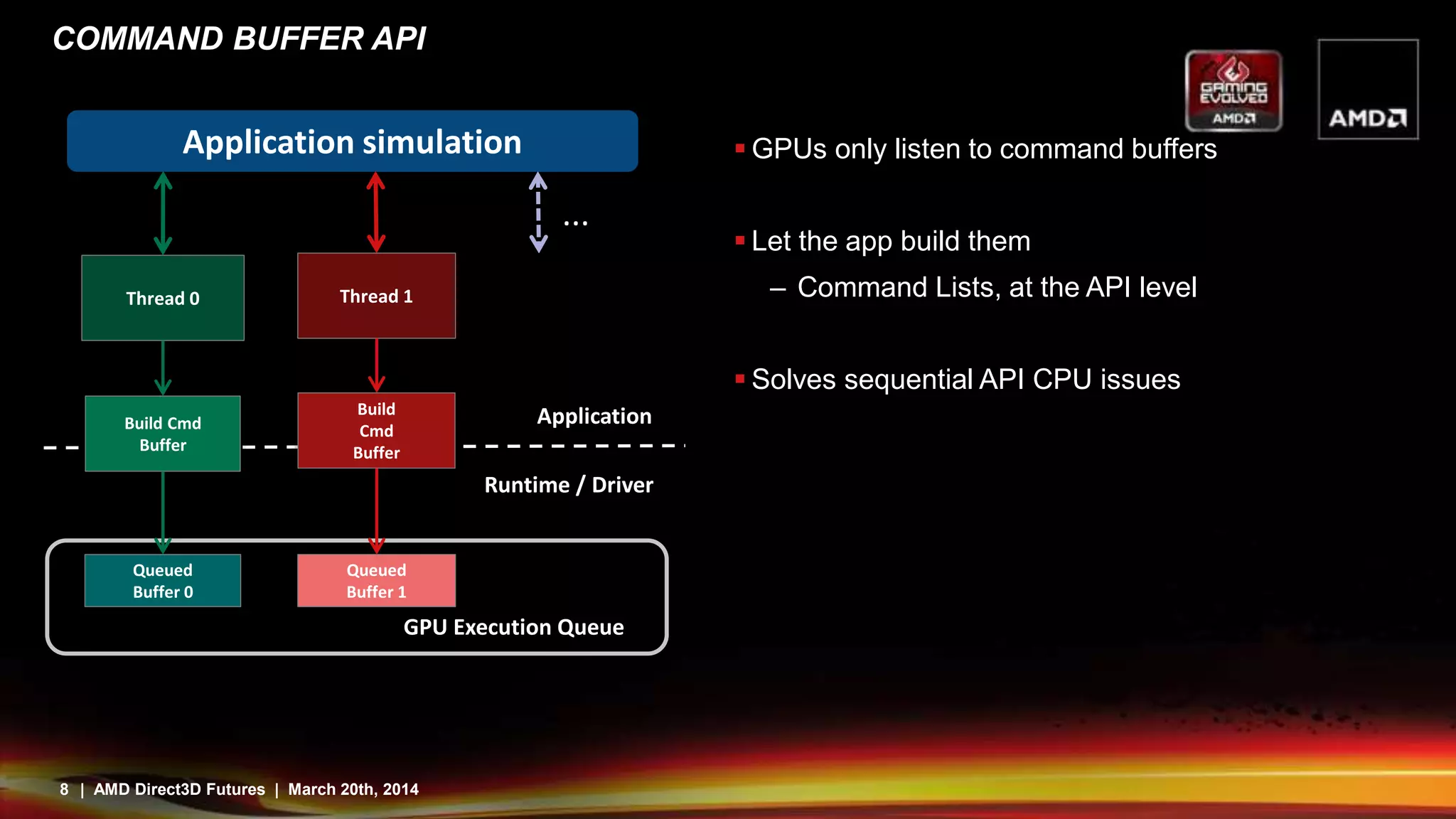
COMMAND BUFFER API
 GPUs only listen to command buffers
 Let the app build them
– Command Lists, at the API level
 Solves sequential API CPU issues
Application simulation
Thread 0 Thread 1
Build Cmd
Buffer
Build
Cmd
Buffer
GPU Execution Queue
Queued
Buffer 0
Queued
Buffer 1
...
Runtime / Driver
Application
9 | AMD Direct3D Futures | March 20th, 2014
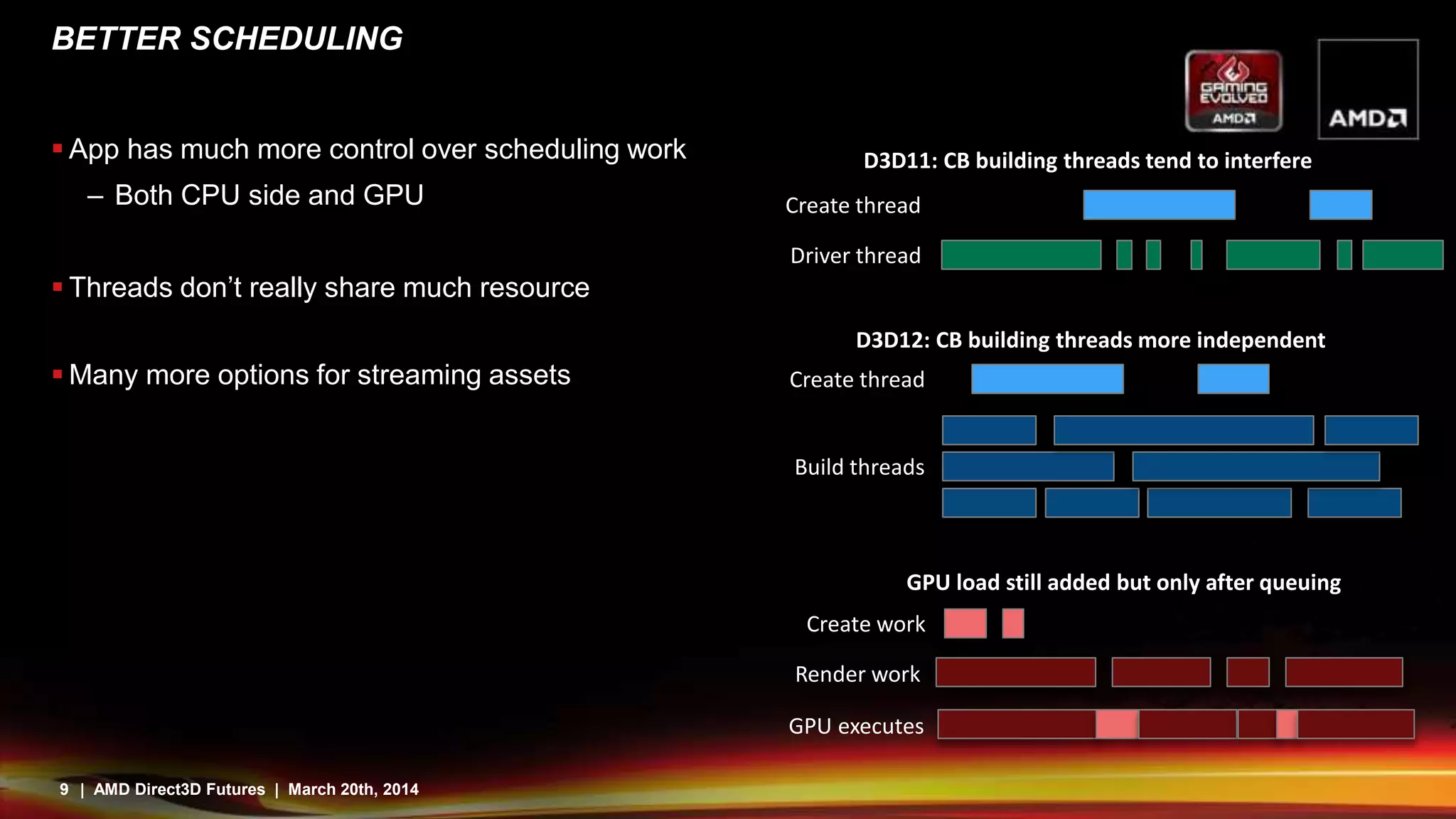
BETTER SCHEDULING
 App has much more control over scheduling work
– Both CPU side and GPU
 Threads don’t really share much resource
 Many more options for streaming assets
Driver thread
Create thread
D3D11: CB building threads tend to interfere
GPU load still added but only after queuing
Render work
Create work
GPU executes
D3D12: CB building threads more independent
Create thread
Build threads
10 | AMD Direct3D Futures | March 20th, 2014
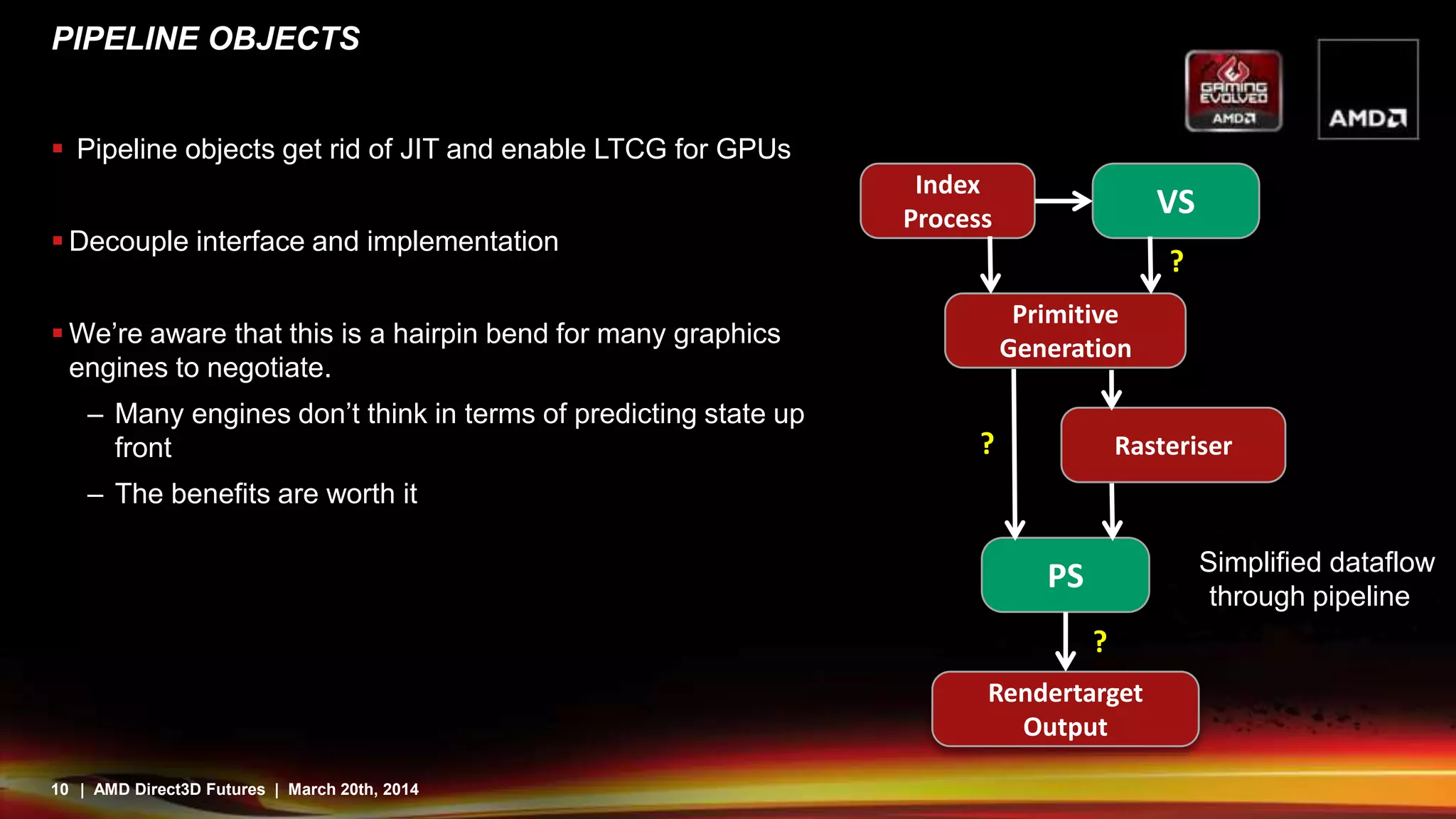
PIPELINE OBJECTS
 Pipeline objects get rid of JIT and enable LTCG for GPUs
 Decouple interface and implementation
 We’re aware that this is a hairpin bend for many graphics
engines to negotiate.
– Many engines don’t think in terms of predicting state up
front
– The benefits are worth it
Simplified dataflow
through pipeline
VS
PS
Index
Process
Primitive
Generation
Rasteriser
Rendertarget
Output
?
?
?
11 | AMD Direct3D Futures | March 20th, 2014
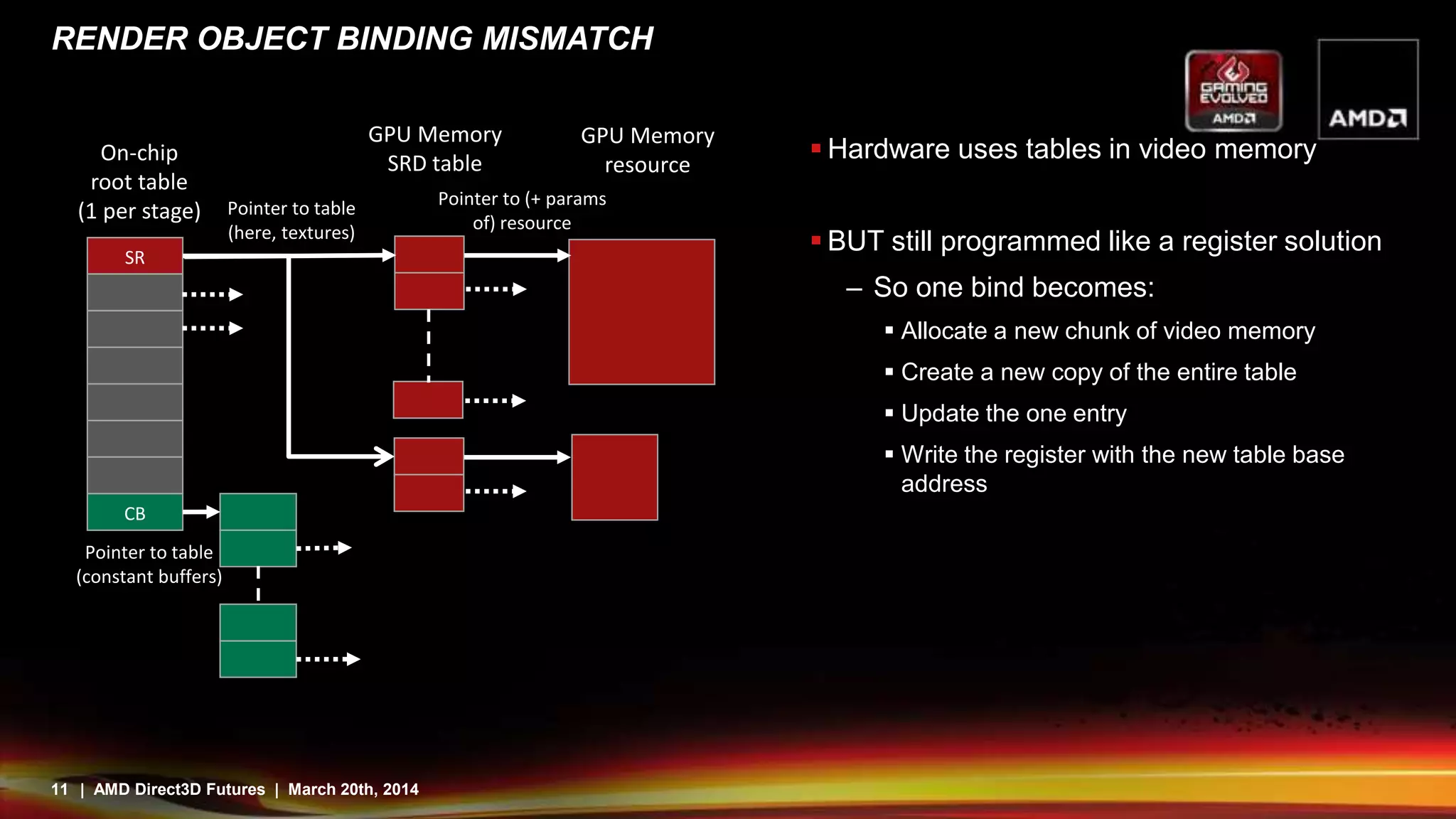
RENDER OBJECT BINDING MISMATCH
 Hardware uses tables in video memory
 BUT still programmed like a register solution
– So one bind becomes:
 Allocate a new chunk of video memory
 Create a new copy of the entire table
 Update the one entry
 Write the register with the new table base
address
SR
CB
On-chip
root table
(1 per stage) Pointer to table
(here, textures)
GPU Memory
SRD table
GPU Memory
resource
Pointer to table
(constant buffers)
Pointer to (+ params
of) resource
12 | AMD Direct3D Futures | March 20th, 2014
DESCRIPTOR TABLES
 Several tables of each type of resource
– Easy to divide up by frequency
 Tables can be of arbitrary size; dynamically indexed to
provide bindless textures
 Changing a pointer in the root table is cheap
 Updating a descriptor in a table is not so cheap
– Some dynamic descriptors are a requirement but avoid
in general.
SR.T[0]
SR.T[3]
SR.T[2]
SR.T[1]
UAV
CB.T[1]
CB.T[0]
Samp
SR.T[0][0]
SR.T[0][2]
SR.T[0][1]
CB.T[1][0]
CB.T[1][1]
On-chip
root table Pointer to table
(textures table 0)
GPU Memory
SRD table
Pointer to table
(constbuf table 1)
13 | AMD Direct3D Futures | March 20th, 2014
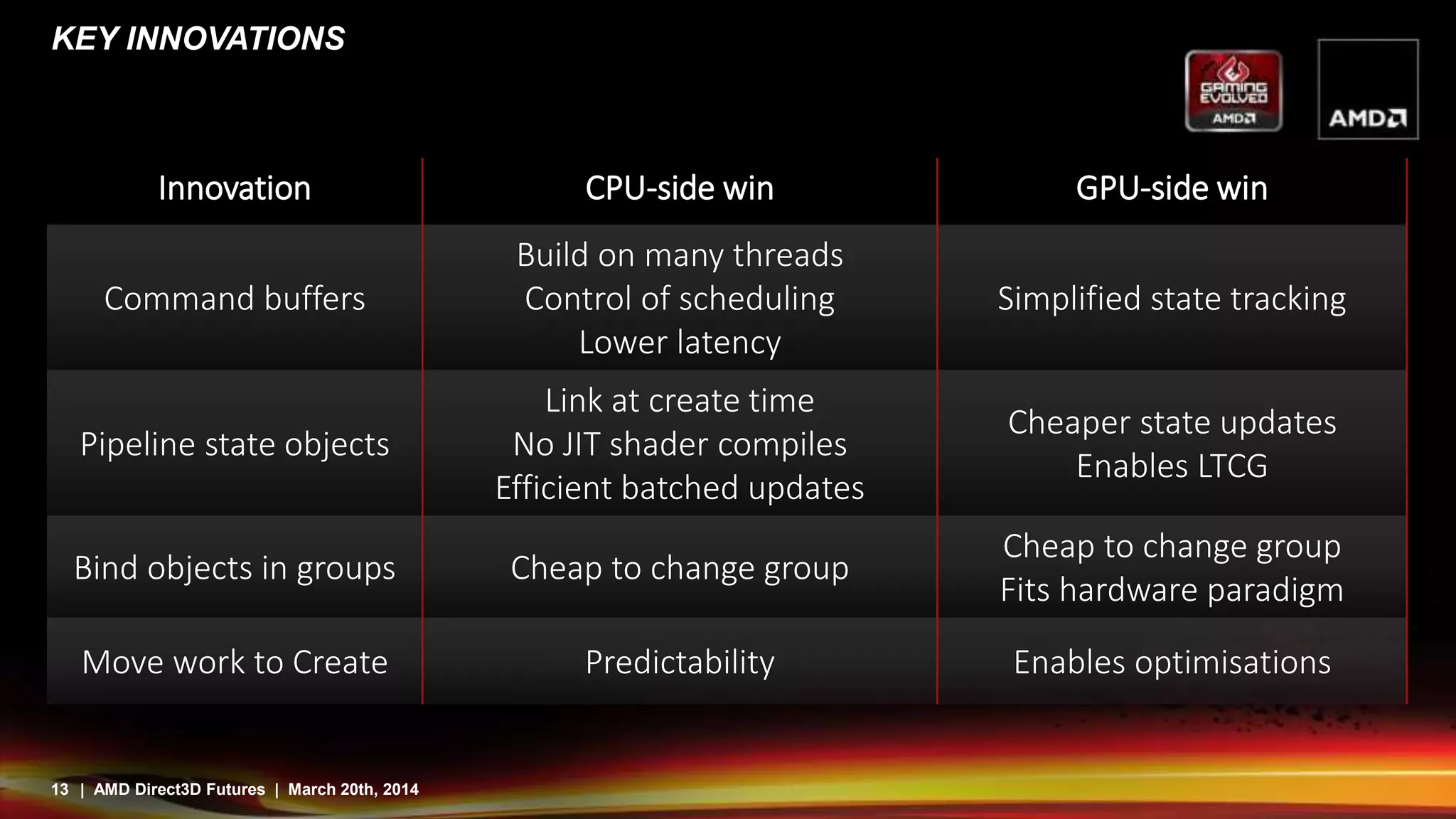
KEY INNOVATIONS
Innovation CPU-side win GPU-side win
Command buffers
Build on many threads
Control of scheduling
Lower latency
Simplified state tracking
Pipeline state objects
Link at create time
No JIT shader compiles
Efficient batched updates
Cheaper state updates
Enables LTCG
Bind objects in groups Cheap to change group
Cheap to change group
Fits hardware paradigm
Move work to Create Predictability Enables optimisations
14 | AMD Direct3D Futures | March 20th, 2014
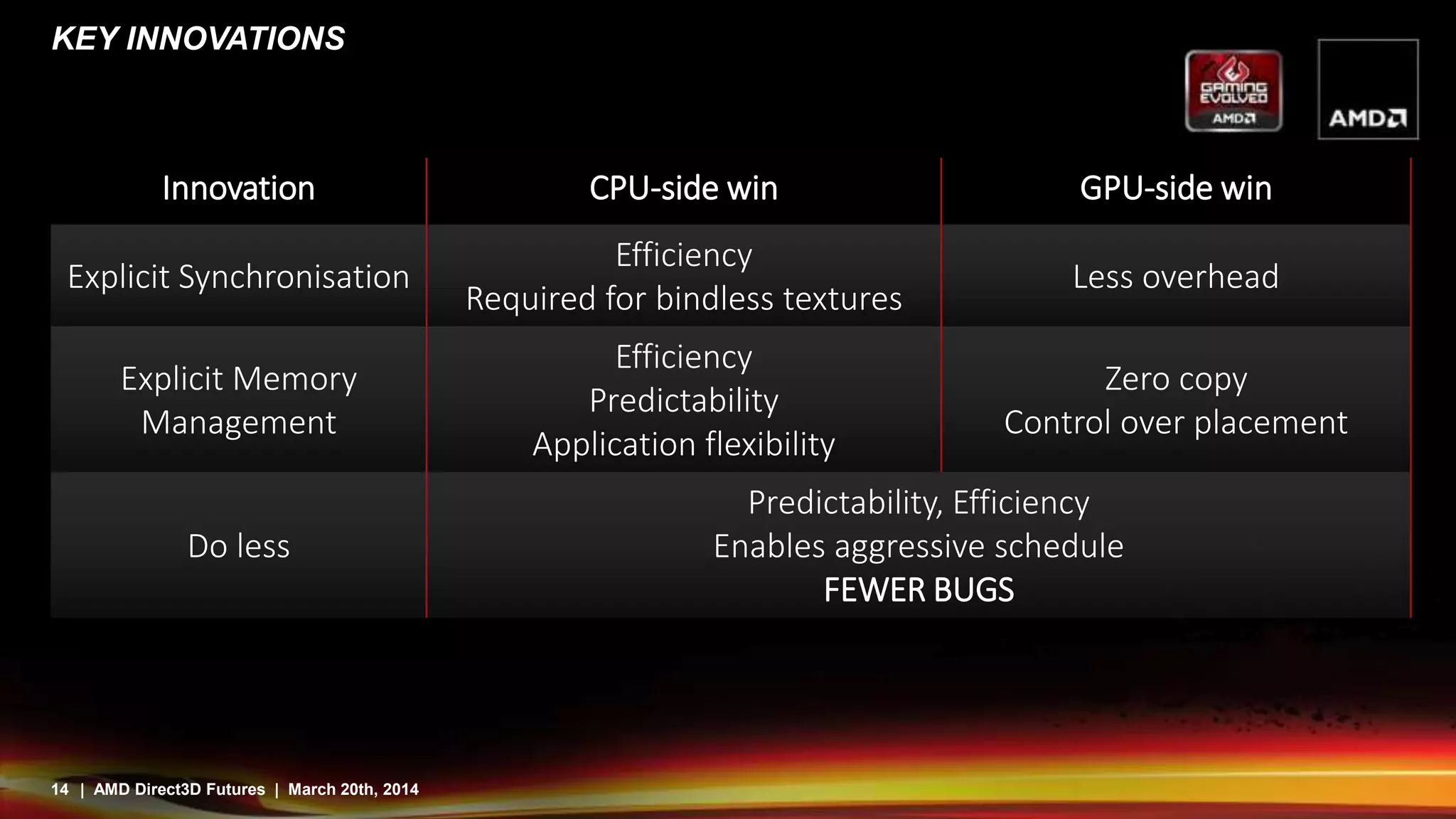
KEY INNOVATIONS
Innovation CPU-side win GPU-side win
Explicit Synchronisation
Efficiency
Required for bindless textures
Less overhead
Explicit Memory
Management
Efficiency
Predictability
Application flexibility
Zero copy
Control over placement
Do less
Predictability, Efficiency
Enables aggressive schedule
FEWER BUGS
15 | AMD Direct3D Futures | March 20th, 2014
NEW PROBLEMS
(AND TIPS TO SOLVE THEM)
16 | AMD Direct3D Futures | March 20th, 2014
NEW VISIBLE LIMITS
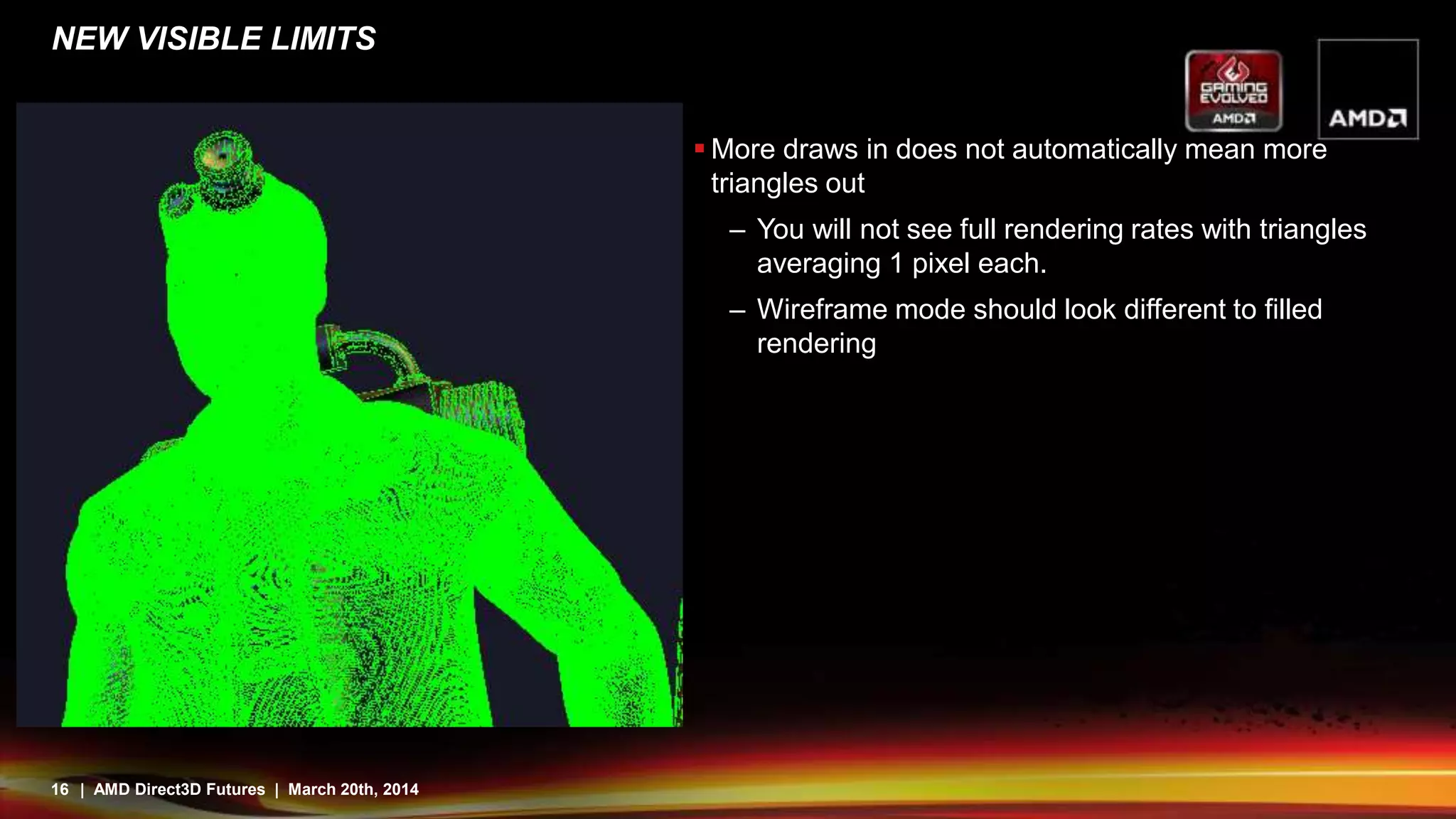
 More draws in does not automatically mean more
triangles out
– You will not see full rendering rates with triangles
averaging 1 pixel each.
– Wireframe mode should look different to filled
rendering
17 | AMD Direct3D Futures | March 20th, 2014
NEW VISIBLE LIMITS
 Feeding the GPU much more efficiently means exploring interesting new limits that weren’t visible before
 10k/frame of anything is ~1µs per thing.
 GPU pipeline depth is likely to be 1-10µs (1k-10k cycles).
 Specific limit: context registers
– Root shader table is NOT in the context
– Compute doesn’t bottleneck on context
18 | AMD Direct3D Futures | March 20th, 2014
APPLICATION IN CHARGE
 Application is arbiter of correct rendering
– This is a serious responsibility
– The benefits of D3D12 aren’t readily available without this condition
Applications must be warning-free on the debug layer
 Different opportunities for driver intervention
 Consider controlling risk by avoiding riskier techniques
19 | AMD Direct3D Futures | March 20th, 2014
APPLICATION IN CHARGE
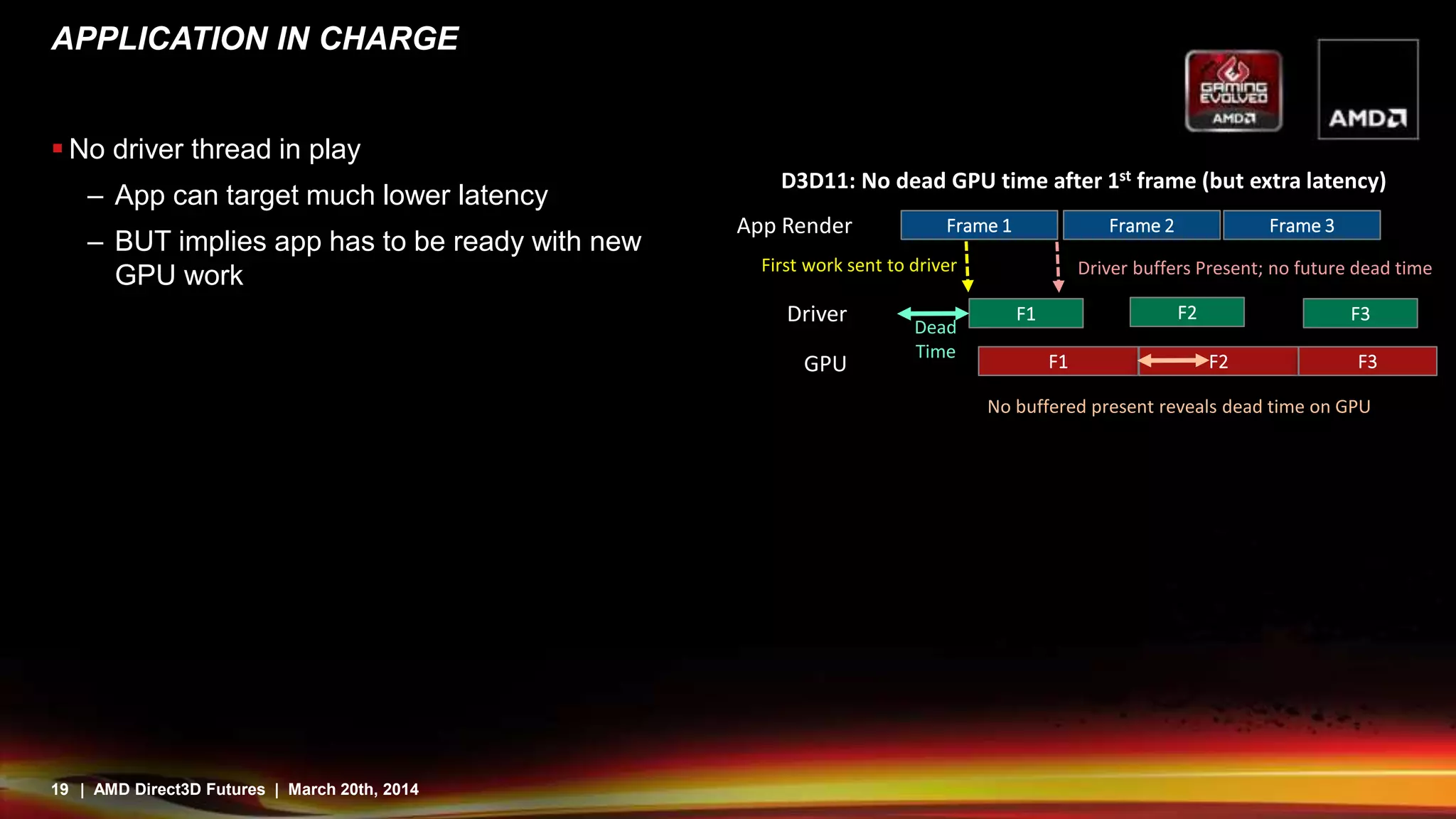
 No driver thread in play
– App can target much lower latency
– BUT implies app has to be ready with new
GPU work
Driver F1
App Render Frame 1
GPU F1
Frame 2
F2
F2
Frame 3
F3
F3
D3D11: No dead GPU time after 1st frame (but extra latency)
Dead
Time
First work sent to driver Driver buffers Present; no future dead time
No buffered present reveals dead time on GPU
20 | AMD Direct3D Futures | March 20th, 2014
USE COMMAND BUFFERS SPARINGLY
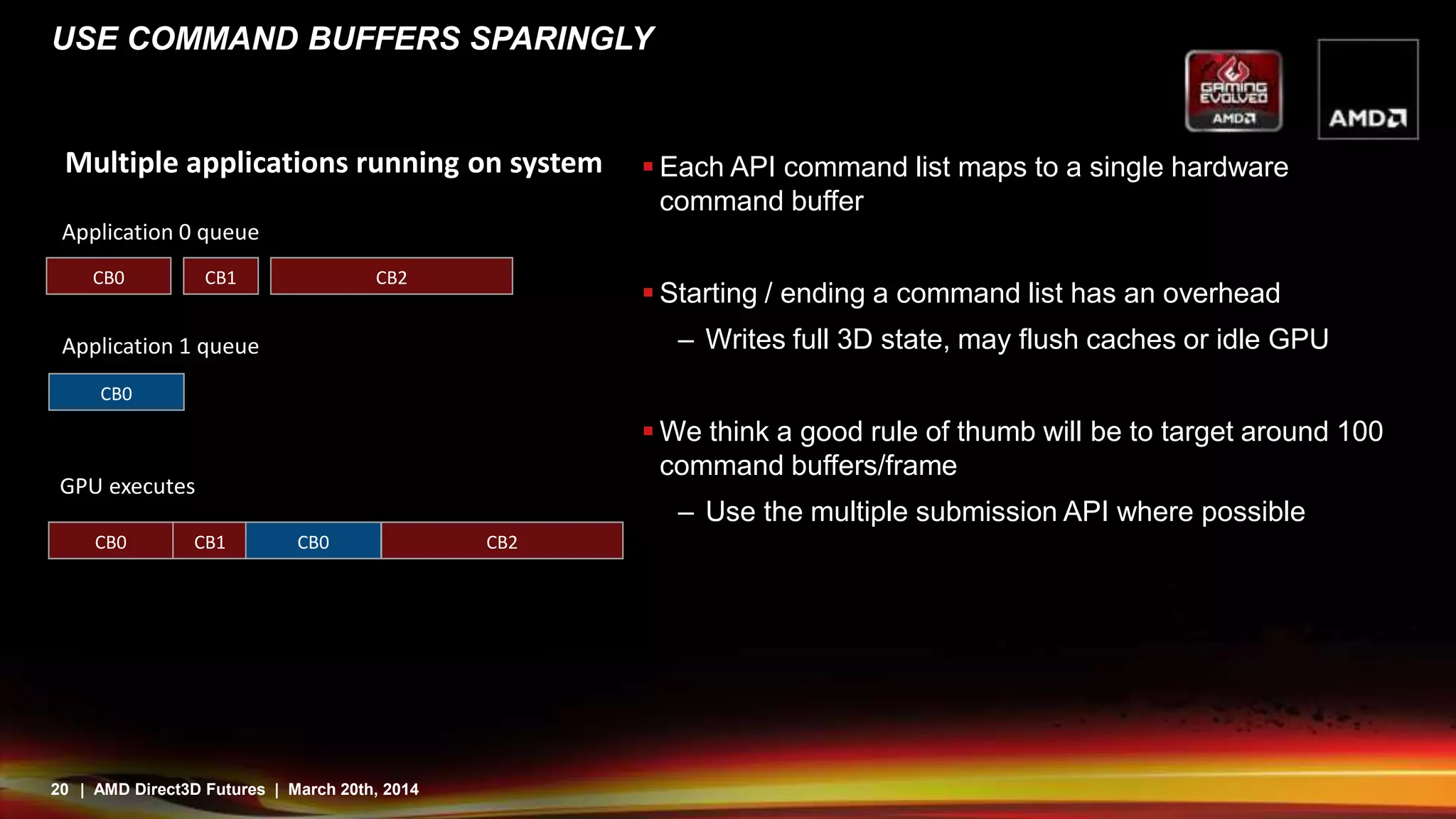
 Each API command list maps to a single hardware
command buffer
 Starting / ending a command list has an overhead
– Writes full 3D state, may flush caches or idle GPU
 We think a good rule of thumb will be to target around 100
command buffers/frame
– Use the multiple submission API where possible
CB0 CB1 CB2CB0
Multiple applications running on system
Application 0 queue
CB0 CB1 CB2
CB0
Application 1 queue
GPU executes
21 | AMD Direct3D Futures | March 20th, 2014
ROUND-UP
22 | AMD Direct3D Futures | March 20th, 2014
ALL-NEW
 There’s a learning curve here for all of us
 In the main it’s a shallow one
– Compared at least to the general problem of multithreaded rendering
 Multithread is always hard.
– Simpler design means fewer bugs and more predictable performance
23 | AMD Direct3D Futures | March 20th, 2014
WHAT AMD PLAN TO DELIVER
 Release driver for Direct3D12 launch
 Continuous engagement
– With Microsoft
– With ISVs
 Bring your opinions to us and to Microsoft.
24 | AMD Direct3D Futures | March 20th, 2014
QUESTIONS

Direct3D12 and the Future of Graphics APIs by Dave Oldcorn

  • 1.
    DIRECT3D12 AND THEFUTURE OF GRAPHICS APIS Dave Oldcorn, Direct3D12 Technical Lead, AMD
  • 2.
    2 | AMDDirect3D Futures | March 20th, 2014 THE PROBLEM
  • 3.
    3 | AMDDirect3D Futures | March 20th, 2014 THE PROBLEM  Mismatch between existing Direct3D and hardware capabilities – Lots of CPU cores, but only one stream of data – State communication in small chunks – “Hidden” work  Hard to predict from any one given call what the overhead might be  Implicit memory management – Hardware evolving away from classical register programming
  • 4.
    4 | AMDDirect3D Futures | March 20th, 2014 Metal (register level access) API LANDSCAPE  Gap between PC ‘raw’ 3D APIs and the hardware has opened up  Very high level APIs now ubiquitous; easy to access even for casual developers, plenty of choice  Where the PC APIs are is a middle ground Capability,easeofuse,distancefrom3Dengine Game Engines Frostbite Unity Unreal CryEngine BlitzTech Flash / Silverlight Console APIs Opportunity D3D9 OpenGL D3D11 D3D7/8 Application
  • 5.
    5 | AMDDirect3D Futures | March 20th, 2014 WHAT ARE THE CONSEQUENCES? WHAT ARE THE SOLUTIONS?
  • 6.
    6 | AMDDirect3D Futures | March 20th, 2014 SEQUENTIAL API  Sequential API: state for given draw comes from arbitrary previous time  Some states must be reconciled on the CPU (“delayed validation”) – All contributing state needs to be visible  GPU isn’t like this, uses command buffers – Must save and restore state at start and end ... Draw Set PS CB Draw x 5 Set VS CB Draw x 3 Set Blend Set PS Set RT state Draw Set VS VB Draw ... (more, earlier) PS CB VS CB Blend state PS RT state Draw State contributing to draw API input
  • 7.
    7 | AMDDirect3D Futures | March 20th, 2014 THREADING A SEQUENTIAL API  Sequential API threading – Simple producer / consumer model  Extra latency  Buffering has a cost  More threading would mean dividing tasks on finer grain – Bottlenecked on application or driver thread  Difficult to extract parallelism (Amdahl’s Law) Application simulation Prebuild Thread 0 Prebuild Thread 1 Application Render Thread GPU Execution Queue Queued Buffer 0 Queued Buffer 1 ... Runtime / Driver Application Driver Thread Queued Buffer 2
  • 8.
    8 | AMDDirect3D Futures | March 20th, 2014 COMMAND BUFFER API  GPUs only listen to command buffers  Let the app build them – Command Lists, at the API level  Solves sequential API CPU issues Application simulation Thread 0 Thread 1 Build Cmd Buffer Build Cmd Buffer GPU Execution Queue Queued Buffer 0 Queued Buffer 1 ... Runtime / Driver Application
  • 9.
    9 | AMDDirect3D Futures | March 20th, 2014 BETTER SCHEDULING  App has much more control over scheduling work – Both CPU side and GPU  Threads don’t really share much resource  Many more options for streaming assets Driver thread Create thread D3D11: CB building threads tend to interfere GPU load still added but only after queuing Render work Create work GPU executes D3D12: CB building threads more independent Create thread Build threads
  • 10.
    10 | AMDDirect3D Futures | March 20th, 2014 PIPELINE OBJECTS  Pipeline objects get rid of JIT and enable LTCG for GPUs  Decouple interface and implementation  We’re aware that this is a hairpin bend for many graphics engines to negotiate. – Many engines don’t think in terms of predicting state up front – The benefits are worth it Simplified dataflow through pipeline VS PS Index Process Primitive Generation Rasteriser Rendertarget Output ? ? ?
  • 11.
    11 | AMDDirect3D Futures | March 20th, 2014 RENDER OBJECT BINDING MISMATCH  Hardware uses tables in video memory  BUT still programmed like a register solution – So one bind becomes:  Allocate a new chunk of video memory  Create a new copy of the entire table  Update the one entry  Write the register with the new table base address SR CB On-chip root table (1 per stage) Pointer to table (here, textures) GPU Memory SRD table GPU Memory resource Pointer to table (constant buffers) Pointer to (+ params of) resource
  • 12.
    12 | AMDDirect3D Futures | March 20th, 2014 DESCRIPTOR TABLES  Several tables of each type of resource – Easy to divide up by frequency  Tables can be of arbitrary size; dynamically indexed to provide bindless textures  Changing a pointer in the root table is cheap  Updating a descriptor in a table is not so cheap – Some dynamic descriptors are a requirement but avoid in general. SR.T[0] SR.T[3] SR.T[2] SR.T[1] UAV CB.T[1] CB.T[0] Samp SR.T[0][0] SR.T[0][2] SR.T[0][1] CB.T[1][0] CB.T[1][1] On-chip root table Pointer to table (textures table 0) GPU Memory SRD table Pointer to table (constbuf table 1)
  • 13.
    13 | AMDDirect3D Futures | March 20th, 2014 KEY INNOVATIONS Innovation CPU-side win GPU-side win Command buffers Build on many threads Control of scheduling Lower latency Simplified state tracking Pipeline state objects Link at create time No JIT shader compiles Efficient batched updates Cheaper state updates Enables LTCG Bind objects in groups Cheap to change group Cheap to change group Fits hardware paradigm Move work to Create Predictability Enables optimisations
  • 14.
    14 | AMDDirect3D Futures | March 20th, 2014 KEY INNOVATIONS Innovation CPU-side win GPU-side win Explicit Synchronisation Efficiency Required for bindless textures Less overhead Explicit Memory Management Efficiency Predictability Application flexibility Zero copy Control over placement Do less Predictability, Efficiency Enables aggressive schedule FEWER BUGS
  • 15.
    15 | AMDDirect3D Futures | March 20th, 2014 NEW PROBLEMS (AND TIPS TO SOLVE THEM)
  • 16.
    16 | AMDDirect3D Futures | March 20th, 2014 NEW VISIBLE LIMITS  More draws in does not automatically mean more triangles out – You will not see full rendering rates with triangles averaging 1 pixel each. – Wireframe mode should look different to filled rendering
  • 17.
    17 | AMDDirect3D Futures | March 20th, 2014 NEW VISIBLE LIMITS  Feeding the GPU much more efficiently means exploring interesting new limits that weren’t visible before  10k/frame of anything is ~1µs per thing.  GPU pipeline depth is likely to be 1-10µs (1k-10k cycles).  Specific limit: context registers – Root shader table is NOT in the context – Compute doesn’t bottleneck on context
  • 18.
    18 | AMDDirect3D Futures | March 20th, 2014 APPLICATION IN CHARGE  Application is arbiter of correct rendering – This is a serious responsibility – The benefits of D3D12 aren’t readily available without this condition Applications must be warning-free on the debug layer  Different opportunities for driver intervention  Consider controlling risk by avoiding riskier techniques
  • 19.
    19 | AMDDirect3D Futures | March 20th, 2014 APPLICATION IN CHARGE  No driver thread in play – App can target much lower latency – BUT implies app has to be ready with new GPU work Driver F1 App Render Frame 1 GPU F1 Frame 2 F2 F2 Frame 3 F3 F3 D3D11: No dead GPU time after 1st frame (but extra latency) Dead Time First work sent to driver Driver buffers Present; no future dead time No buffered present reveals dead time on GPU
  • 20.
    20 | AMDDirect3D Futures | March 20th, 2014 USE COMMAND BUFFERS SPARINGLY  Each API command list maps to a single hardware command buffer  Starting / ending a command list has an overhead – Writes full 3D state, may flush caches or idle GPU  We think a good rule of thumb will be to target around 100 command buffers/frame – Use the multiple submission API where possible CB0 CB1 CB2CB0 Multiple applications running on system Application 0 queue CB0 CB1 CB2 CB0 Application 1 queue GPU executes
  • 21.
    21 | AMDDirect3D Futures | March 20th, 2014 ROUND-UP
  • 22.
    22 | AMDDirect3D Futures | March 20th, 2014 ALL-NEW  There’s a learning curve here for all of us  In the main it’s a shallow one – Compared at least to the general problem of multithreaded rendering  Multithread is always hard. – Simpler design means fewer bugs and more predictable performance
  • 23.
    23 | AMDDirect3D Futures | March 20th, 2014 WHAT AMD PLAN TO DELIVER  Release driver for Direct3D12 launch  Continuous engagement – With Microsoft – With ISVs  Bring your opinions to us and to Microsoft.
  • 24.
    24 | AMDDirect3D Futures | March 20th, 2014 QUESTIONS