Overview on
glyphosate resistant
weed mechanisms

Dr. Doug Sammons
23/3/2010
Monsanto Company
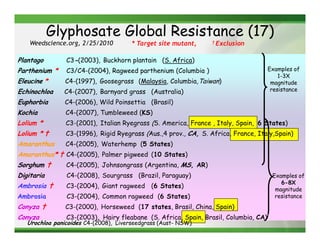
Glyphosate Global Resistance (17)
    Weedscience.org, 2/25/2010         * Target site mutant,    † Exclusion


Plantago        C3-(2003), Buckhorn plantain (S. Africa)
Parthenium *    C3/C4-(2004), Ragweed parthenium (Columbia )                       Examples of
                                                                                       1-3X
Eleucine *      C4-(1997), Goosegrass (Malaysia, Columbia,Taiwan)                   magnitude
Echinochloa    C4-(2007), Barnyard grass (Australia)                                resistance

Euphorbia       C4-(2006), Wild Poinsettia (Brasil)
Kochia          C4-(2007), Tumbleweed (KS)
Lolium *        C3-(2001), Italian Ryegrass (S. America, France , Italy, Spain, 6 States)
Lolium * †      C3-(1996), Rigid Ryegrass (Aus.,4 prov., CA, S. Africa, France, Italy,Spain)
Amaranthus      C4-(2005), Waterhemp (5 States)
Amaranthus* † C4-(2005), Palmer pigweed (10 States)
Sorghum †       C4-(2005), Johnsongrass (Argentina, MS, AR)
Digitaria       C4-(2008), Sourgrass (Brazil, Paraguay)                               Examples of
                                                                                         6-8X
Ambrosia †      C3-(2004), Giant ragweed (6 States)
                                                                                       magnitude
Ambrosia        C3-(2004), Common ragweed (6 States)                                   resistance
Conyza †        C3-(2000), Horseweed (17 states, Brasil, China, Spain)
Conyza          C3-(2003), Hairy fleabane (S. Africa, Spain, Brasil, Columbia, CA))
   Urochloa panicoides C4-(2008), Liverseedgrass (Aust- NSW)
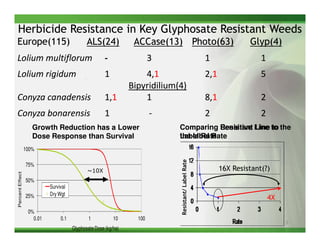
Herbicide Resistance in Key Glyphosate Resistant Weeds
Europe(115)                                  ALS(24)             ACCase(13) Photo(63)                               Glyp(4)
Lolium multiflorum                                    -                 3                            1                  1
Lolium rigidum                                        1             4,1                              2,1                5
                                                                Bipyridilium(4)
Conyza canadensis                                     1,1           1                                8,1                2
Conyza bonarensis                                     1                 -                            2                  2
                    Growth Reduction has a Lower                             Comparing Sensitive Line to the
                                                                                         Resistant Line to
                    Dose Response than Survival                              the label Rate
                                                                             Label Rate
                 100%


                                                                             Resistant/ Label Rate
                 75%
                                             ~10X                                                          16X Resistant(?)
Percent Effect


                 50%
                           Survival
                 25%       Dry Wgt
                                                                                                                            4X
                  0%
                    0.01        0.1           1           10      100
                                                                                                                                 3
                                      Glyphosate Dose (kg/ha)
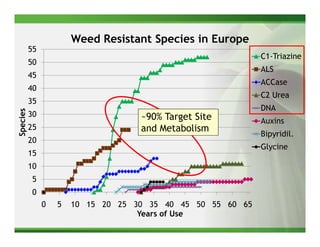
Weed Resistant Species in Europe
          55
                                                             C1-Triazine
          50
                                                             ALS
          45
                                                             ACCase
          40
                                                             C2 Urea
          35
                                                             DNA
Species


          30                        ~90% Target Site         Auxins
          25                        and Metabolism
                                                             Bipyridil.
          20
                                                             Glycine
          15
          10
           5
           0
               0   5   10 15 20 25 30 35 40 45 50 55 60 65
                                    Years of Use
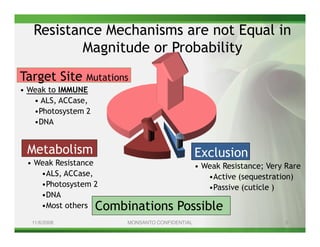
Resistance Mechanisms are not Equal in
          Magnitude or Probability
Target Site    Mutations
• Weak to IMMUNE
   • ALS, ACCase,
   •Photosystem 2
   •DNA


 Metabolism                                    Exclusion
 • Weak Resistance                             • Weak Resistance; Very Rare
    •ALS, ACCase,                                 •Active (sequestration)
    •Photosystem 2                                •Passive (cuticle )
    •DNA
    •Most others Combinations          Possible
  11/6/2008            MONSANTO CONFIDENTIAL                          5
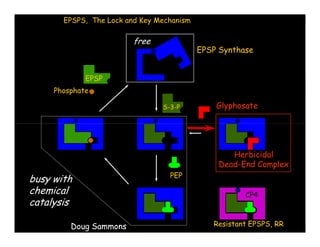
EPSPS, The Lock and Key Mechanism

                         free
                                                EPSP Synthase


             EPSP
     Phosphate

                                    S-3-P           Glyphosate


                                                        Herbicidal
                                                     Dead-End Complex
                                       PEP
busy with
chemical                                                   CP4
catalysis

         Doug Sammons
                         Company Confidential      Resistant EPSPS, RR
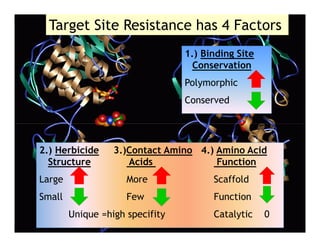
Target Site Resistance has 4 Factors
                                        1.) Binding Site
                                          Conservation
                                        Polymorphic
                                        Conserved


  2.) Herbicide          3.)Contact Amino 4.) Amino Acid
    Structure               Acids             Function
  Large                     More              Scaffold
  Small                     Few               Function

MONSANTO
               Unique =high specifity         Catalytic    0
CONFIDENTIAL
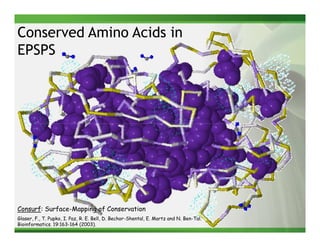
Conserved Amino Acids in
EPSPS


Consurf: Surface-Mapping of Conservation
Glaser, F., T. Pupko, I. Paz, R. E. Bell, D. Bechor-Shental, E. Martz and N. Ben-Tal.
Bioinformatics. 19:163-164 (2003).
Glyphosate mimics the Tetrahedral
        Intermediate of the reaction.
                 Schönbrunn et al. 2001, PNAS 98:1376


[EPSPS:Tetrahedral Intermediate]       [ EPSPS:S3P:Glyphosate ]
 9                                           complex
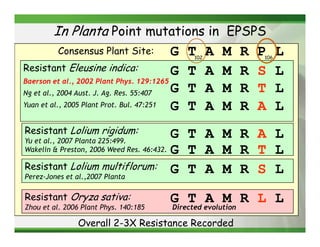
In Planta Point mutations in EPSPS
          Consensus Plant Site:           G     T       A   M    R   P     L
                                                  102                106

Resistant Eleusine indica:                G     T       A   M    R   S     L
Baerson et al., 2002 Plant Phys. 129:1265
Ng et al., 2004 Aust. J. Ag. Res. 55:407  G     T       A   M    R   T     L
Yuan et al., 2005 Plant Prot. Bul. 47:251 G     T       A   M    R   A     L
Resistant Lolium rigidum:                   G T A M R A L
Yu et al., 2007 Planta 225:499.
Wakelin & Preston, 2006 Weed Res. 46:432.   G T A M R T L
Resistant Lolium multiflorum:               G T A M R S L
Perez-Jones et al.,2007 Planta

Resistant Oryza sativa:                     G T A M R L L
Zhou et al. 2006 Plant Phys. 140:185        Directed evolution

                Overall 2-3X Resistance Recorded
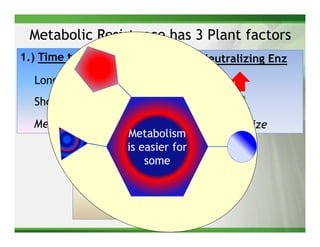
Metabolic Resistance has 3 Plant factors
1.) Time to Die    Based on the 2.) Neutralizing Enz
                  MOA & Species
  Long                            More
  Short                           Less
  Mechanism                              Seed Size
                    Metabolism
          3.) Herbicide in the Plant
                    is easier for
                        some
             Lower Rates
              Higher Rates
                  Use Rate
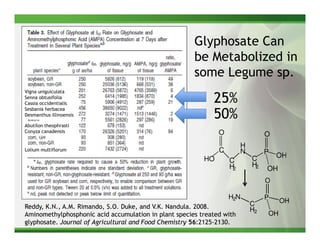
Glyphosate Can
                                                       be Metabolized in
                                                       some Legume sp.
Vigna uniguiculata
Senna obtusifolia
Cassia occidentialis                                         25%
Sesbania herbacea
Desmanthus illinoensis                                       50%
Abutilon theophrasti
Conyza canadensis                                              O                 O
                                                                        H
Lolium multiflorum                                             C        N        P
                                                                            C        OH
                                                          HO       C
                                                                   H        H2
                                                                    2            OH
                                                                                 O

                                                                   H2N           P
                                                                            C         OH
Reddy, K.N., A.M. Rimando, S.O. Duke, and V.K. Nandula. 2008.               H2
Aminomethylphosphonic acid accumulation in plant species treated with            OH
glyphosate. Journal of Agricultural and Food Chemistry 56:2125-2130.
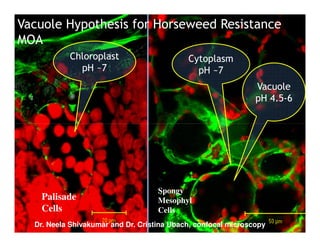
Vacuole Hypothesis for Horseweed Resistance
MOA
           Chloroplast                      Cytoplasm
             pH ~7                            pH ~7
                                                               Vacuole
                                                               pH 4.5-6


                                    Spongy
    Palisade                        Mesophyl
    Cells                           Cells
  Dr. Neela Shivakumar and Dr. Cristina Ubach, confocal microscopy
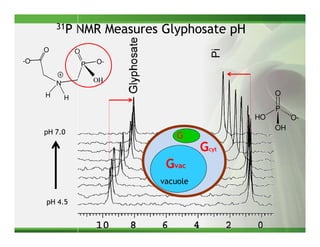
31P     NMR Measures Glyphosate pH
     O           O
-O                   P   O-


         N               OH

     H                                              O
             H
                                                    P
                                               HO        O-
                                                    OH
     pH 7.0
                                  G
                                        Gcyt
                               Gvac
                              vacuole

     pH 4.5
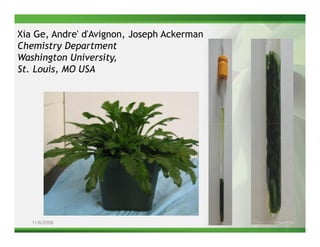
Xia Ge, Andre' d'Avignon, Joseph Ackerman
Chemistry Department
Washington University,
St. Louis, MO USA


   11/6/2008                                15
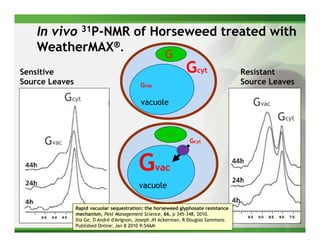
In vivo 31P-NMR of Horseweed treated with
    WeatherMAX®.
                                                     G
Sensitive                                                     Gcyt                  Resistant
Source Leaves                              Gvac                                     Source Leaves

            Gcyt                           vacuole                                     Gvac
                                                                                              Gcyt
                                                       G

     Gvac                                                       Gcyt


                                          G       vac
                                          vacuole

                Rapid vacuolar sequestration: the horseweed glyphosate resistance
                mechanism, Pest Management Science, 66, p 345-348, 2010.
                Xia Ge, D André d'Avignon, Joseph JH Ackerman, R Douglas Sammons
                Published Online: Jan 8 2010 9:54AM
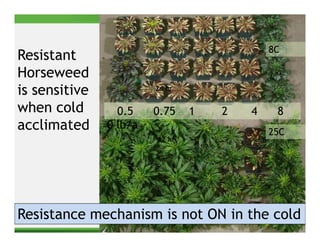
8C
Resistant
Horseweed
is sensitive            24 hr

when cold        0.5    0.75     1   2   4    8
acclimated     0 lb/a
                                             25C
                        12 hr


                          2 hr


Resistance mechanism is not ON in the cold
    42 DAT
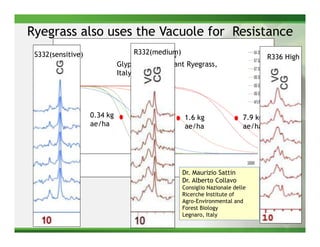
Ryegrass also uses the Vacuole for Resistance
 S332(sensitive)                    R332(medium)
                                                                                   R336 High
                               Glyphosate Resistant Ryegrass,
                               Italy
       % Mortality


                     0.34 kg                       1.6 kg                 7.9 kg
                     ae/ha                         ae/ha                  ae/ha


                                                   Dr. Maurizio Sattin
                                                   Dr. Alberto Collavo
                                                   Consiglio Nazionale delle
                                                   Ricerche Institute of
                                                   Agro-Environmental and
                                                   Forest Biology
                                                   Legnaro, Italy
                                                                                       18
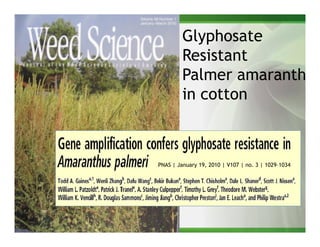
Glyphosate
         Resistant
         Palmer amaranth
         in cotton


PNAS | January 19, 2010 | V107 | no. 3 | 1029–1034
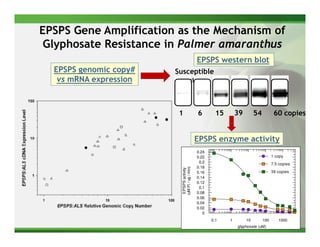
EPSPS Gene Amplification as the Mechanism of
 Glyphosate Resistance in Palmer amaranthus
                                               EPSPS western blot
  EPSPS genomic copy#   Susceptible
   vs mRNA expression   Resistant


                         1                     6        15       39        54          60 copies


                                               EPSPS enzyme activity
                                               0.24
                                               0.22                                   1 copy
                                                0.2                                   7.5 copies
                                               0.18


                          (uM Pi / ug / min)
                           EPSPS activity
                                               0.16                                   39 copies
                                               0.14
                                               0.12
                                                0.1
                                               0.08
                                               0.06
                                               0.04
                                               0.02
                                                  0
                                                      0.1    1        10        100      1000
                                                                 glyphosate (uM)
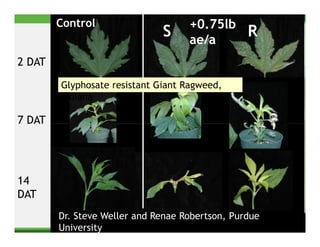
Control                     +0.75lb
                              S     ae/a
                                                 R
2 DAT

        Glyphosate resistant Giant Ragweed,
        Indiana

7 DAT


14
DAT
        Dr. Steve Weller and Renae Robertson, Purdue
        University
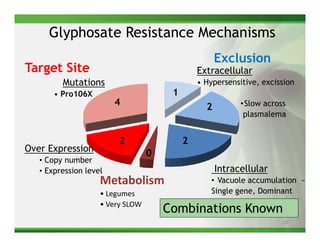
Glyphosate Resistance Mechanisms
                                                     Exclusion
Target Site                                    Extracellular
         Mutations                             • Hypersensitive, excission
       • Pro106X                       1
                        4                        2         •Slow across
                                                            plasmalema


                         2                 2
Over Expression                   0
   • Copy number
   • Expression level                                Intracellular
                    Metabolism                     • Vacuole accumulation ~8
                    • Legumes                      Single gene, Dominant
                    • Very SLOW
                                      Combinations Known
                                                                      22
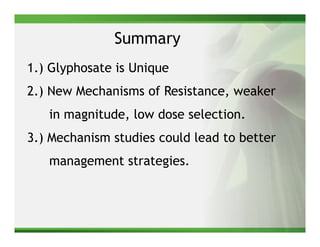
Summary
1.) Glyphosate is Unique
2.) New Mechanisms of Resistance, weaker
   in magnitude, low dose selection.
3.) Mechanism studies could lead to better
   management strategies.
A Global Commitment To Growing Yield Sustainably®
THREE MAIN GOALS ARE AT THE HEART OF THIS EFFORT


Help farmers                                   REDUCE by 1/3 the
DOUBLE YIELDS                                  inputs required per
in corn, cotton &                                   unit of output
soybeans by 2030


                    IMPROVE THE LIVES of
                    farmers around the world
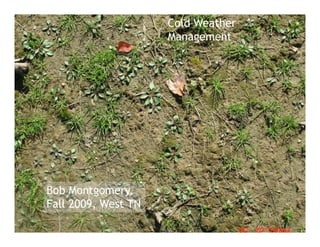
Cold Weather
                          Management
                            Horseweed control appears to be
                            100 % for first 3 application dates.
                            This is the Jan application.
                            Applied another on 2/28/2010
  Jan close
  up


4 Fall applications to   Feb Jan             Dec             Nov
horseweed

  Bob Montgomery,
  Fall 2009, West TN
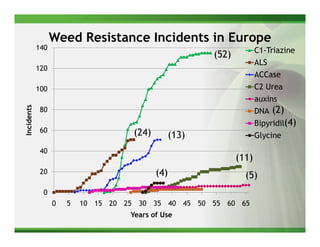
Weed Resistance Incidents in Europe
            140                                                    C1-Triazine
                                                     (52)
                                                                   ALS
            120
                                                                   ACCase
            100                                                    C2 Urea
                                                                   auxins
Incidents


             80                                                    DNA (2)
                                                                            (4)
                                                                   Bipyridil.
             60                      (24)     (13)                 Glycine
             40
                                                            (11)
             20                             (4)               (5)
              0
                  0   5   10 15 20 25 30 35 40 45 50 55 60 65
                                    Years of Use
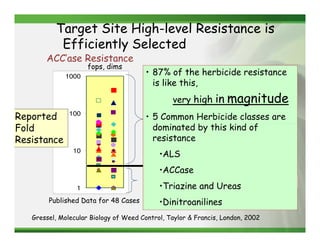
Target Site High-level Resistance is
           Efficiently Selected
       ACC’ase Resistance
                         fops, dims
             1000
                                       • 87% of the herbicide resistance
                                         is like this,
                                              very high in magnitude
Reported       100
                                       • 5 43 casesHerbicide classes are
                                           Common NOT controlled,
Fold                                     dominated by thisselected
                                            resistance IS kind of
Resistance                                resistance
                10
                                            •ALS
                                              7 cases < 3X
                                          •ACCase
                                       Only these cases Ureas controlled
                                          •Triazine and can be
                 1   0         1


        Published Data for 48 Cases         •Dinitroanilines
   Gressel, Molecular Biology of Weed Control, Taylor & Francis, London, 2002
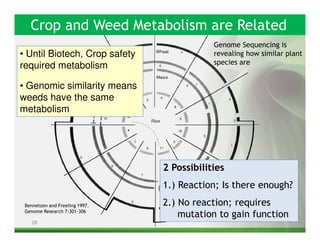
Crop and Weed Metabolism are Related
                                            Genome Sequencing is
• Until Biotech, Crop safety                revealing how similar plant
                                            species are
required metabolism

• Genomic similarity means
weeds have the same
metabolism


                                2 Possibilities
                                1.) Reaction; Is there enough?
 Bennetzen and Freeling 1997.   2.) No reaction; requires
 Genome Research 7:301-306
                                    mutation to gain function
    28

D Sammons

  • 1.
    Overview on glyphosate resistant weedmechanisms Dr. Doug Sammons 23/3/2010 Monsanto Company
  • 2.
    Glyphosate Global Resistance(17) Weedscience.org, 2/25/2010 * Target site mutant, † Exclusion Plantago C3-(2003), Buckhorn plantain (S. Africa) Parthenium * C3/C4-(2004), Ragweed parthenium (Columbia ) Examples of 1-3X Eleucine * C4-(1997), Goosegrass (Malaysia, Columbia,Taiwan) magnitude Echinochloa C4-(2007), Barnyard grass (Australia) resistance Euphorbia C4-(2006), Wild Poinsettia (Brasil) Kochia C4-(2007), Tumbleweed (KS) Lolium * C3-(2001), Italian Ryegrass (S. America, France , Italy, Spain, 6 States) Lolium * † C3-(1996), Rigid Ryegrass (Aus.,4 prov., CA, S. Africa, France, Italy,Spain) Amaranthus C4-(2005), Waterhemp (5 States) Amaranthus* † C4-(2005), Palmer pigweed (10 States) Sorghum † C4-(2005), Johnsongrass (Argentina, MS, AR) Digitaria C4-(2008), Sourgrass (Brazil, Paraguay) Examples of 6-8X Ambrosia † C3-(2004), Giant ragweed (6 States) magnitude Ambrosia C3-(2004), Common ragweed (6 States) resistance Conyza † C3-(2000), Horseweed (17 states, Brasil, China, Spain) Conyza C3-(2003), Hairy fleabane (S. Africa, Spain, Brasil, Columbia, CA)) Urochloa panicoides C4-(2008), Liverseedgrass (Aust- NSW)
  • 3.
    Herbicide Resistance inKey Glyphosate Resistant Weeds Europe(115) ALS(24) ACCase(13) Photo(63) Glyp(4) Lolium multiflorum - 3 1 1 Lolium rigidum 1 4,1 2,1 5 Bipyridilium(4) Conyza canadensis 1,1 1 8,1 2 Conyza bonarensis 1 - 2 2 Growth Reduction has a Lower Comparing Sensitive Line to the Resistant Line to Dose Response than Survival the label Rate Label Rate 100% Resistant/ Label Rate 75% ~10X 16X Resistant(?) Percent Effect 50% Survival 25% Dry Wgt 4X 0% 0.01 0.1 1 10 100 3 Glyphosate Dose (kg/ha)
  • 4.
    Weed Resistant Speciesin Europe 55 C1-Triazine 50 ALS 45 ACCase 40 C2 Urea 35 DNA Species 30 ~90% Target Site Auxins 25 and Metabolism Bipyridil. 20 Glycine 15 10 5 0 0 5 10 15 20 25 30 35 40 45 50 55 60 65 Years of Use
  • 5.
    Resistance Mechanisms arenot Equal in Magnitude or Probability Target Site Mutations • Weak to IMMUNE • ALS, ACCase, •Photosystem 2 •DNA Metabolism Exclusion • Weak Resistance • Weak Resistance; Very Rare •ALS, ACCase, •Active (sequestration) •Photosystem 2 •Passive (cuticle ) •DNA •Most others Combinations Possible 11/6/2008 MONSANTO CONFIDENTIAL 5
  • 6.
    EPSPS, The Lockand Key Mechanism free EPSP Synthase EPSP Phosphate S-3-P Glyphosate Herbicidal Dead-End Complex PEP busy with chemical CP4 catalysis Doug Sammons Company Confidential Resistant EPSPS, RR
  • 7.
    Target Site Resistancehas 4 Factors 1.) Binding Site Conservation Polymorphic Conserved 2.) Herbicide 3.)Contact Amino 4.) Amino Acid Structure Acids Function Large More Scaffold Small Few Function MONSANTO Unique =high specifity Catalytic 0 CONFIDENTIAL
  • 8.
    Conserved Amino Acidsin EPSPS Consurf: Surface-Mapping of Conservation Glaser, F., T. Pupko, I. Paz, R. E. Bell, D. Bechor-Shental, E. Martz and N. Ben-Tal. Bioinformatics. 19:163-164 (2003).
  • 9.
    Glyphosate mimics theTetrahedral Intermediate of the reaction. Schönbrunn et al. 2001, PNAS 98:1376 [EPSPS:Tetrahedral Intermediate] [ EPSPS:S3P:Glyphosate ] 9 complex
  • 10.
    In Planta Pointmutations in EPSPS Consensus Plant Site: G T A M R P L 102 106 Resistant Eleusine indica: G T A M R S L Baerson et al., 2002 Plant Phys. 129:1265 Ng et al., 2004 Aust. J. Ag. Res. 55:407 G T A M R T L Yuan et al., 2005 Plant Prot. Bul. 47:251 G T A M R A L Resistant Lolium rigidum: G T A M R A L Yu et al., 2007 Planta 225:499. Wakelin & Preston, 2006 Weed Res. 46:432. G T A M R T L Resistant Lolium multiflorum: G T A M R S L Perez-Jones et al.,2007 Planta Resistant Oryza sativa: G T A M R L L Zhou et al. 2006 Plant Phys. 140:185 Directed evolution Overall 2-3X Resistance Recorded
  • 11.
    Metabolic Resistance has3 Plant factors 1.) Time to Die Based on the 2.) Neutralizing Enz MOA & Species Long More Short Less Mechanism Seed Size Metabolism 3.) Herbicide in the Plant is easier for some Lower Rates Higher Rates Use Rate
  • 12.
    Glyphosate Can be Metabolized in some Legume sp. Vigna uniguiculata Senna obtusifolia Cassia occidentialis 25% Sesbania herbacea Desmanthus illinoensis 50% Abutilon theophrasti Conyza canadensis O O H Lolium multiflorum C N P C OH HO C H H2 2 OH O H2N P C OH Reddy, K.N., A.M. Rimando, S.O. Duke, and V.K. Nandula. 2008. H2 Aminomethylphosphonic acid accumulation in plant species treated with OH glyphosate. Journal of Agricultural and Food Chemistry 56:2125-2130.
  • 13.
    Vacuole Hypothesis forHorseweed Resistance MOA Chloroplast Cytoplasm pH ~7 pH ~7 Vacuole pH 4.5-6 Spongy Palisade Mesophyl Cells Cells Dr. Neela Shivakumar and Dr. Cristina Ubach, confocal microscopy
  • 14.
    31P NMR Measures Glyphosate pH O O -O P O- N OH H O H P HO O- OH pH 7.0 G Gcyt Gvac vacuole pH 4.5
  • 15.
    Xia Ge, Andre'd'Avignon, Joseph Ackerman Chemistry Department Washington University, St. Louis, MO USA 11/6/2008 15
  • 16.
    In vivo 31P-NMRof Horseweed treated with WeatherMAX®. G Sensitive Gcyt Resistant Source Leaves Gvac Source Leaves Gcyt vacuole Gvac Gcyt G Gvac Gcyt G vac vacuole Rapid vacuolar sequestration: the horseweed glyphosate resistance mechanism, Pest Management Science, 66, p 345-348, 2010. Xia Ge, D André d'Avignon, Joseph JH Ackerman, R Douglas Sammons Published Online: Jan 8 2010 9:54AM
  • 17.
    8C Resistant Horseweed is sensitive 24 hr when cold 0.5 0.75 1 2 4 8 acclimated 0 lb/a 25C 12 hr 2 hr Resistance mechanism is not ON in the cold 42 DAT
  • 18.
    Ryegrass also usesthe Vacuole for Resistance S332(sensitive) R332(medium) R336 High Glyphosate Resistant Ryegrass, Italy % Mortality 0.34 kg 1.6 kg 7.9 kg ae/ha ae/ha ae/ha Dr. Maurizio Sattin Dr. Alberto Collavo Consiglio Nazionale delle Ricerche Institute of Agro-Environmental and Forest Biology Legnaro, Italy 18
  • 19.
    Glyphosate Resistant Palmer amaranth in cotton PNAS | January 19, 2010 | V107 | no. 3 | 1029–1034
  • 20.
    EPSPS Gene Amplificationas the Mechanism of Glyphosate Resistance in Palmer amaranthus EPSPS western blot EPSPS genomic copy# Susceptible vs mRNA expression Resistant 1 6 15 39 54 60 copies EPSPS enzyme activity 0.24 0.22 1 copy 0.2 7.5 copies 0.18 (uM Pi / ug / min) EPSPS activity 0.16 39 copies 0.14 0.12 0.1 0.08 0.06 0.04 0.02 0 0.1 1 10 100 1000 glyphosate (uM)
  • 21.
    Control +0.75lb S ae/a R 2 DAT Glyphosate resistant Giant Ragweed, Indiana 7 DAT 14 DAT Dr. Steve Weller and Renae Robertson, Purdue University
  • 22.
    Glyphosate Resistance Mechanisms Exclusion Target Site Extracellular Mutations • Hypersensitive, excission • Pro106X 1 4 2 •Slow across plasmalema 2 2 Over Expression 0 • Copy number • Expression level Intracellular Metabolism • Vacuole accumulation ~8 • Legumes Single gene, Dominant • Very SLOW Combinations Known 22
  • 23.
    Summary 1.) Glyphosate isUnique 2.) New Mechanisms of Resistance, weaker in magnitude, low dose selection. 3.) Mechanism studies could lead to better management strategies.
  • 24.
    A Global CommitmentTo Growing Yield Sustainably® THREE MAIN GOALS ARE AT THE HEART OF THIS EFFORT Help farmers REDUCE by 1/3 the DOUBLE YIELDS inputs required per in corn, cotton & unit of output soybeans by 2030 IMPROVE THE LIVES of farmers around the world
  • 25.
    Cold Weather Management Horseweed control appears to be 100 % for first 3 application dates. This is the Jan application. Applied another on 2/28/2010 Jan close up 4 Fall applications to Feb Jan Dec Nov horseweed Bob Montgomery, Fall 2009, West TN
  • 26.
    Weed Resistance Incidentsin Europe 140 C1-Triazine (52) ALS 120 ACCase 100 C2 Urea auxins Incidents 80 DNA (2) (4) Bipyridil. 60 (24) (13) Glycine 40 (11) 20 (4) (5) 0 0 5 10 15 20 25 30 35 40 45 50 55 60 65 Years of Use
  • 27.
    Target Site High-levelResistance is Efficiently Selected ACC’ase Resistance fops, dims 1000 • 87% of the herbicide resistance is like this, very high in magnitude Reported 100 • 5 43 casesHerbicide classes are Common NOT controlled, Fold dominated by thisselected resistance IS kind of Resistance resistance 10 •ALS 7 cases < 3X •ACCase Only these cases Ureas controlled •Triazine and can be 1 0 1 Published Data for 48 Cases •Dinitroanilines Gressel, Molecular Biology of Weed Control, Taylor & Francis, London, 2002
  • 28.
    Crop and WeedMetabolism are Related Genome Sequencing is • Until Biotech, Crop safety revealing how similar plant species are required metabolism • Genomic similarity means weeds have the same metabolism 2 Possibilities 1.) Reaction; Is there enough? Bennetzen and Freeling 1997. 2.) No reaction; requires Genome Research 7:301-306 mutation to gain function 28