PRESENTED BY
RAJANI D. P
MICROCARE LABORATORY, SURAT.
DESAI P. B
DIRECTOR & HEAD
DEPARTMENT OF MICROBIOLOGY,
SHREE RAMKRISHNA INSTI. OF COMP. EDU. & APPL. SCIENCES, SURAT.
“ANTIMICROBIAL RESISTANCE PATTERNS
OF THE ORGANISMS ISOLATED FROM
URINE CULTURE IN SURAT REGION”
INTRODUCTION
Urinary tract infection (UTI) is common both in the community and
hospitalized patients.
The widespread use of antimicrobial agents often leads to the
emergence of resistant microorganisms to one or several of them. [1]
Urinary tract infection (UTI) is a broad term that encompasses both
asymptomatic microbial colonization of the urine and symptomatic
infection with microbial invasion and inflammation of urinary tract
structures .
ETIOLOGY
Majority of UTI are due to a single pathogen.
The Enterobacteriaceae responsible for 90% of all UTI
- gram negative bacilli
- facultative anaerobic
- common intestinal flora
Escherichia coli most commonly isolated pathogen 80% of all UTI (1)
Apart from the outer one-third of the female urethra, the urinary tract
is normally sterile (2)
.
From a microbiologic perspective, urinary tract infection exists when
pathogenic microorganisms are detected in the urine, urethra, bladder,
kidney, or prostate.
In most instances, growth of more than 105
organisms per milliliter
from a properly collected midstream "clean-catch" urine sample
indicates infection.
However, significant bacteriuria is lacking in some cases of true UTI
Especially in symptomatic patients, a smaller number of bacteria (102
to 104
/ml) may signify infection.
colony counts of >105
/ml of midstream urine are occasionally due to
specimen contamination, which is especially likely when multiple
species are found (3).
Every female has a 20% life time risk of coming down with a UTI (5)
In children approximately 5% of girls and 1% of boys have a UTI by
11 years of age (6).
Antibiotics which have been recommended to treat UTIs include
Ampicillin, Trimethoprim-Sulfamethoxazole, Flouroquinolones and
Nitrofurantoin (7)
However due to incessant abuse and misuse of these antibiotics,
extensive resistance of micro-organisms to these antibiotics has
developed.
AIM OF STUDY
Identification and characterization of pathogen from UTI cases.
To find out Resistant Pattern from isolated pathogen.
Find out prevalence of UTI in South Gujarat region.
MATERIALS AND METHOD
 The present study was conducted during June., 2009 to Nov., 2009.
Only patients who have clinical symptoms of UTI were studied
Total 538 mid-stream urine specimens were obtained by clean – catch
method (Kunin, 1987).
The samples were collected in sterile universal containers and cultured
within 30 minutes of collection by standard method.
Samples that showed pure growth of isolate in a count of ≥105
colony-
forming units (CFU) per ml of urine after overnight incubation were
considered to indicate significant bacteriuria (Sleigh and Timbury, 1986;
Gerald et al, 1990).
Identification of organism was by standard methods and further tested
for drug susceptibility testing by disc diffusion method (as per CLSI
guideline). (8)
RESULT
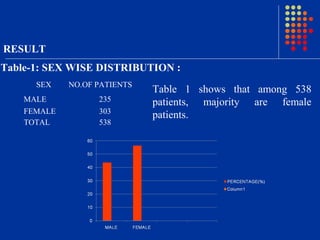
Table-1: SEX WISE DISTRIBUTION :
SEX NO.OF PATIENTS
MALE 235
FEMALE 303
TOTAL 538
Table 1 shows that among 538
patients, majority are female
patients.
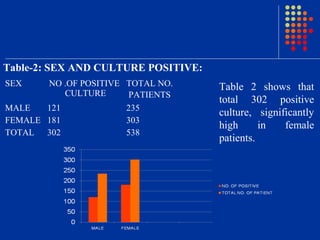
Table-2: SEX AND CULTURE POSITIVE:
SEX NO .OF POSITIVE
CULTURE
TOTAL NO.
PATIENTS
MALE 121 235
FEMALE 181 303
TOTAL 302 538
Table 2 shows that
total 302 positive
culture, significantly
high in female
patients.
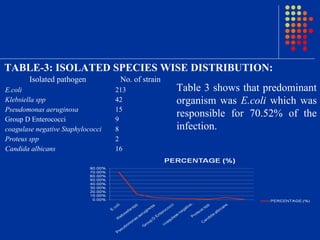
TABLE-3: ISOLATED SPECIES WISE DISTRIBUTION:
Isolated pathogen No. of strain
E.coli 213
Klebsiella spp 42
Pseudomonas aeruginosa 15
Group D Enterococci 9
coagulase negative Staphylococci 8
Proteus spp 2
Candida albicans 16
Table 3 shows that predominant
organism was E.coli which was
responsible for 70.52% of the
infection.
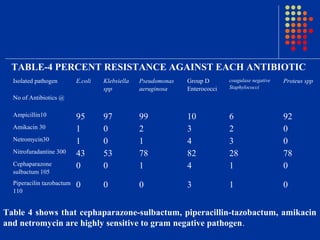
TABLE-4 PERCENT RESISTANCE AGAINST EACH ANTIBIOTIC
Isolated pathogen E.coli Klebsiella
spp
Pseudomonas
aeruginosa
Group D
Enterococci
coagulase negative
Staphylococci
Proteus spp
No of Antibiotics @
Ampicillin10 95 97 99 10 6 92
Amikacin 30 1 0 2 3 2 0
Netromycin30 1 0 1 4 3 0
Nitrofuradantine 300 43 53 78 82 28 78
Cephaparazone
sulbactum 105
0 0 1 4 1 0
Piperacilin tazobactum
110
0 0 0 3 1 0
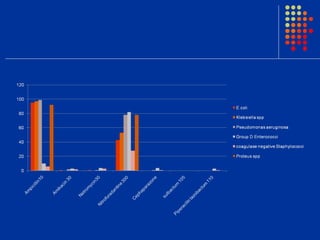
Table 4 shows that cephaparazone-sulbactum, piperacillin-tazobactum, amikacin
and netromycin are highly sensitive to gram negative pathogen.
DISCUSION
Our results demonstrate that drug resistance of Gram negative pathogen to
many antibiotics is high with the maximum prevalence of resistance being to
drugs that have been used for a long time, such as ampicillin.
Our results are similar to one other study that has been conducted in Iran.
They have reported Gram negative pathogen resistance to ampicillin of
96.8%. (11)
In this research, combination of two drug ccephaparazone-sulbactum, and
piperacillin-tazobactum were lowest resistant to all isolated pathogen compare
to other antibiotics.
Our result is similar to other study that has been conducted in Turkey. (12)
In present study also highly sensitive to amikacin and netromycin that is app.
(98-99%). Our result is some higher to other study that has been conducted in
Iran (13
CONCLUSION
The prevalence of UTI was significantly higher in women (56.32%)
than man with E.coli (70.52%) being the major isolated pathogen.
Gram negative pathogens were highly sensitive to amikacin,
netromycin, piperacillin/tazobactum and cefoperazone /sulbactum.
1. Calvin M. Cunin. Urinary Tract Infections and Pyelonephritis. In:
Goldman E. editor. Cecil Textbook of Medicine 21st edition. W. B.
Saunders Company; 2000. p. 138
REFERENCES
2. Bailey RR. Urinary Tract Infection. In: Oxford Textbook of Medicine
on CD-ROM. Oxford University Press and Electronic Publishing B. V;
1996 Section 20.8.1
3. Stamm EW. Urinary Tract Infections and Pyelonephritis. In: Harrison's
Principles of Internal Medicine 15th Edition on CD-ROM. McGraw and
Hill Companies Inc; 2001
4. Levi ME, Redington J Barth L. The Patient With Urinary Tract
Infection. In: Schrier RW editor. Manual of Nephrology, 6th Edition.
Lippincott Williams & Wilkins, 2005
8. Muller HJ, Hinton J : Proc Soc Expt Biol Med, 48:330-333,
9. Association of Clinical Pathologists Broadsheet. Antibiotic Sensitivity
Tests by Diffusion Methods. 1999; 55
10. Cowan S. T., Steel K. J. Manual for the Identification of Medical
Bacteria. Cambridge University Press. 2001
6. Jenson BH, Baltimore RS. Infectious Diseases.In: Kleigman RM,
Marcdante KJ, Jenson BH, Berhman RE editors. Nelson Essentials of
Paediatrics 5th edition. Philadelphia: Elsevier Inc; 2006. p. 522.
7. Peter I. A. Hendry‌1, Brian S. Gibson‌1 and Sandra Nicholson‌
Antibiotic Sensitivity of Bacteria from Urine Pathology 1975, Vol. 7,
No. 4, Pages 293-297
5. David Howes. Urinary Tract Infection, Male. eMedicine April 25
2005
11. Falahatkar S Sobhani M, Ghilpour H. Urinary tract infection in
spinal cord transected war. Arch Iran Med 2000; 13(3):133-5.
12. Ferhat Catal1, Nuket Bavbek2, 3 , Omer Bayrak4, Musemma
Karabel1 Antimicrobial resistance patterns of urinary tract pathogens
and rationale for empirical therapy in Turkish children for the years
2000–2006 .

D p ppp

  • 1.
    PRESENTED BY RAJANI D.P MICROCARE LABORATORY, SURAT. DESAI P. B DIRECTOR & HEAD DEPARTMENT OF MICROBIOLOGY, SHREE RAMKRISHNA INSTI. OF COMP. EDU. & APPL. SCIENCES, SURAT. “ANTIMICROBIAL RESISTANCE PATTERNS OF THE ORGANISMS ISOLATED FROM URINE CULTURE IN SURAT REGION”
  • 2.
    INTRODUCTION Urinary tract infection(UTI) is common both in the community and hospitalized patients. The widespread use of antimicrobial agents often leads to the emergence of resistant microorganisms to one or several of them. [1] Urinary tract infection (UTI) is a broad term that encompasses both asymptomatic microbial colonization of the urine and symptomatic infection with microbial invasion and inflammation of urinary tract structures .
  • 3.
    ETIOLOGY Majority of UTIare due to a single pathogen. The Enterobacteriaceae responsible for 90% of all UTI - gram negative bacilli - facultative anaerobic - common intestinal flora Escherichia coli most commonly isolated pathogen 80% of all UTI (1) Apart from the outer one-third of the female urethra, the urinary tract is normally sterile (2) .
  • 4.
    From a microbiologicperspective, urinary tract infection exists when pathogenic microorganisms are detected in the urine, urethra, bladder, kidney, or prostate. In most instances, growth of more than 105 organisms per milliliter from a properly collected midstream "clean-catch" urine sample indicates infection. However, significant bacteriuria is lacking in some cases of true UTI Especially in symptomatic patients, a smaller number of bacteria (102 to 104 /ml) may signify infection.
  • 5.
    colony counts of>105 /ml of midstream urine are occasionally due to specimen contamination, which is especially likely when multiple species are found (3). Every female has a 20% life time risk of coming down with a UTI (5) In children approximately 5% of girls and 1% of boys have a UTI by 11 years of age (6). Antibiotics which have been recommended to treat UTIs include Ampicillin, Trimethoprim-Sulfamethoxazole, Flouroquinolones and Nitrofurantoin (7) However due to incessant abuse and misuse of these antibiotics, extensive resistance of micro-organisms to these antibiotics has developed.
  • 6.
    AIM OF STUDY Identificationand characterization of pathogen from UTI cases. To find out Resistant Pattern from isolated pathogen. Find out prevalence of UTI in South Gujarat region.
  • 7.
    MATERIALS AND METHOD The present study was conducted during June., 2009 to Nov., 2009. Only patients who have clinical symptoms of UTI were studied Total 538 mid-stream urine specimens were obtained by clean – catch method (Kunin, 1987). The samples were collected in sterile universal containers and cultured within 30 minutes of collection by standard method.
  • 8.
    Samples that showedpure growth of isolate in a count of ≥105 colony- forming units (CFU) per ml of urine after overnight incubation were considered to indicate significant bacteriuria (Sleigh and Timbury, 1986; Gerald et al, 1990). Identification of organism was by standard methods and further tested for drug susceptibility testing by disc diffusion method (as per CLSI guideline). (8)
  • 9.
    RESULT Table-1: SEX WISEDISTRIBUTION : SEX NO.OF PATIENTS MALE 235 FEMALE 303 TOTAL 538 Table 1 shows that among 538 patients, majority are female patients.
  • 10.
    Table-2: SEX ANDCULTURE POSITIVE: SEX NO .OF POSITIVE CULTURE TOTAL NO. PATIENTS MALE 121 235 FEMALE 181 303 TOTAL 302 538 Table 2 shows that total 302 positive culture, significantly high in female patients.
  • 11.
    TABLE-3: ISOLATED SPECIESWISE DISTRIBUTION: Isolated pathogen No. of strain E.coli 213 Klebsiella spp 42 Pseudomonas aeruginosa 15 Group D Enterococci 9 coagulase negative Staphylococci 8 Proteus spp 2 Candida albicans 16 Table 3 shows that predominant organism was E.coli which was responsible for 70.52% of the infection.
  • 12.
    TABLE-4 PERCENT RESISTANCEAGAINST EACH ANTIBIOTIC Isolated pathogen E.coli Klebsiella spp Pseudomonas aeruginosa Group D Enterococci coagulase negative Staphylococci Proteus spp No of Antibiotics @ Ampicillin10 95 97 99 10 6 92 Amikacin 30 1 0 2 3 2 0 Netromycin30 1 0 1 4 3 0 Nitrofuradantine 300 43 53 78 82 28 78 Cephaparazone sulbactum 105 0 0 1 4 1 0 Piperacilin tazobactum 110 0 0 0 3 1 0 Table 4 shows that cephaparazone-sulbactum, piperacillin-tazobactum, amikacin and netromycin are highly sensitive to gram negative pathogen.
  • 14.
    DISCUSION Our results demonstratethat drug resistance of Gram negative pathogen to many antibiotics is high with the maximum prevalence of resistance being to drugs that have been used for a long time, such as ampicillin. Our results are similar to one other study that has been conducted in Iran. They have reported Gram negative pathogen resistance to ampicillin of 96.8%. (11) In this research, combination of two drug ccephaparazone-sulbactum, and piperacillin-tazobactum were lowest resistant to all isolated pathogen compare to other antibiotics. Our result is similar to other study that has been conducted in Turkey. (12) In present study also highly sensitive to amikacin and netromycin that is app. (98-99%). Our result is some higher to other study that has been conducted in Iran (13
  • 15.
    CONCLUSION The prevalence ofUTI was significantly higher in women (56.32%) than man with E.coli (70.52%) being the major isolated pathogen. Gram negative pathogens were highly sensitive to amikacin, netromycin, piperacillin/tazobactum and cefoperazone /sulbactum.
  • 16.
    1. Calvin M.Cunin. Urinary Tract Infections and Pyelonephritis. In: Goldman E. editor. Cecil Textbook of Medicine 21st edition. W. B. Saunders Company; 2000. p. 138 REFERENCES 2. Bailey RR. Urinary Tract Infection. In: Oxford Textbook of Medicine on CD-ROM. Oxford University Press and Electronic Publishing B. V; 1996 Section 20.8.1 3. Stamm EW. Urinary Tract Infections and Pyelonephritis. In: Harrison's Principles of Internal Medicine 15th Edition on CD-ROM. McGraw and Hill Companies Inc; 2001 4. Levi ME, Redington J Barth L. The Patient With Urinary Tract Infection. In: Schrier RW editor. Manual of Nephrology, 6th Edition. Lippincott Williams & Wilkins, 2005
  • 17.
    8. Muller HJ,Hinton J : Proc Soc Expt Biol Med, 48:330-333, 9. Association of Clinical Pathologists Broadsheet. Antibiotic Sensitivity Tests by Diffusion Methods. 1999; 55 10. Cowan S. T., Steel K. J. Manual for the Identification of Medical Bacteria. Cambridge University Press. 2001 6. Jenson BH, Baltimore RS. Infectious Diseases.In: Kleigman RM, Marcdante KJ, Jenson BH, Berhman RE editors. Nelson Essentials of Paediatrics 5th edition. Philadelphia: Elsevier Inc; 2006. p. 522. 7. Peter I. A. Hendry‌1, Brian S. Gibson‌1 and Sandra Nicholson‌ Antibiotic Sensitivity of Bacteria from Urine Pathology 1975, Vol. 7, No. 4, Pages 293-297 5. David Howes. Urinary Tract Infection, Male. eMedicine April 25 2005
  • 18.
    11. Falahatkar SSobhani M, Ghilpour H. Urinary tract infection in spinal cord transected war. Arch Iran Med 2000; 13(3):133-5. 12. Ferhat Catal1, Nuket Bavbek2, 3 , Omer Bayrak4, Musemma Karabel1 Antimicrobial resistance patterns of urinary tract pathogens and rationale for empirical therapy in Turkish children for the years 2000–2006 .