
D-Dimer Test
What is a D-Dimer Test?
*Wince* You cut yourself… again. You run to the bathroom, grab some
toilet paper, and use it to place pressure on the cut in an effort to stop
the bleeding, while simultaneously vowing to yourself to never cook a
recipe that requires you to “julienne” carrots again.
When you get a cut like this, your body begins to take a bunch of steps
to help stop the bleeding. One of those steps is to send a bunch of
proteins (called factors) to the injured area. These proteins work
together in a very specific way to make blood at the injury site clot,
creating a solid lump of blood that stops up the bleeding. It’s a normal
part of healing – without it, you’d keep bleeding and have a much
more serious problem to deal with.
What is a D-Dimer Test?
Once the bleeding stops, you don’t need the clot anymore, so your body
begins to take a series of steps in the other direction and breaks the clot
down. At the end of all that, you have some leftover substances floating
around in your blood – like how you’d have wood dust all over after a
building project.
One of those leftover substances is called D-dimer. A D-dimer is a fibrin
degradation product (FDP) – essentially a small protein fragment. It is
called a D-dimer because it contains two (di-) D fragments of the fibrin
protein that are joined together by a cross-link.
What is a D-Dimer Test?
Normally, with a little time, it goes away. But you can get high levels of
D-dimer in your blood if you have a major clot.
The D-Dimer Test measures the amount of D-dimer substance that is
released when a blood clot breaks up. Doctors may use the D-dimer test
when a person might have a dangerous blood-clotting problem or to
figure out whether you might have a blood clot. You may also hear this
test called Fragment D-dimer test or Fibrin degradation fragment test.
What is a D-Dimer Test?
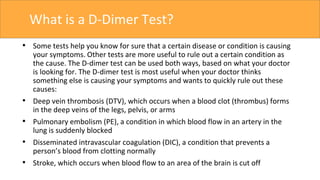
• Some tests help you know for sure that a certain disease or condition is causing
your symptoms. Other tests are more useful to rule out a certain condition as
the cause. The D-dimer test can be used both ways, based on what your doctor
is looking for. The D-dimer test is most useful when your doctor thinks
something else is causing your symptoms and wants to quickly rule out these
causes:
• Deep vein thrombosis (DTV), which occurs when a blood clot (thrombus) forms
in the deep veins of the legs, pelvis, or arms
• Pulmonary embolism (PE), a condition in which blood flow in an artery in the
lung is suddenly blocked
• Disseminated intravascular coagulation (DIC), a condition that prevents a
person’s blood from clotting normally
• Stroke, which occurs when blood flow to an area of the brain is cut off
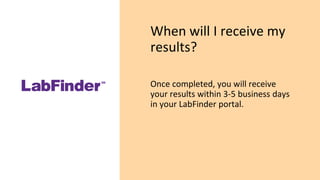
When will I receive my
results?
Once completed, you will receive
your results within 3-5 business days
in your LabFinder portal.
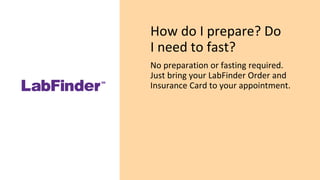
How do I prepare? Do
I need to fast?
No preparation or fasting required.
Just bring your LabFinder Order and
Insurance Card to your appointment.
Book a D-Dimer Test
www.labfinder.com

D Dimer Test

  • 1.
  • 2.
    What is aD-Dimer Test? *Wince* You cut yourself… again. You run to the bathroom, grab some toilet paper, and use it to place pressure on the cut in an effort to stop the bleeding, while simultaneously vowing to yourself to never cook a recipe that requires you to “julienne” carrots again. When you get a cut like this, your body begins to take a bunch of steps to help stop the bleeding. One of those steps is to send a bunch of proteins (called factors) to the injured area. These proteins work together in a very specific way to make blood at the injury site clot, creating a solid lump of blood that stops up the bleeding. It’s a normal part of healing – without it, you’d keep bleeding and have a much more serious problem to deal with.
  • 3.
    What is aD-Dimer Test? Once the bleeding stops, you don’t need the clot anymore, so your body begins to take a series of steps in the other direction and breaks the clot down. At the end of all that, you have some leftover substances floating around in your blood – like how you’d have wood dust all over after a building project. One of those leftover substances is called D-dimer. A D-dimer is a fibrin degradation product (FDP) – essentially a small protein fragment. It is called a D-dimer because it contains two (di-) D fragments of the fibrin protein that are joined together by a cross-link.
  • 4.
    What is aD-Dimer Test? Normally, with a little time, it goes away. But you can get high levels of D-dimer in your blood if you have a major clot. The D-Dimer Test measures the amount of D-dimer substance that is released when a blood clot breaks up. Doctors may use the D-dimer test when a person might have a dangerous blood-clotting problem or to figure out whether you might have a blood clot. You may also hear this test called Fragment D-dimer test or Fibrin degradation fragment test.
  • 5.
    What is aD-Dimer Test? • Some tests help you know for sure that a certain disease or condition is causing your symptoms. Other tests are more useful to rule out a certain condition as the cause. The D-dimer test can be used both ways, based on what your doctor is looking for. The D-dimer test is most useful when your doctor thinks something else is causing your symptoms and wants to quickly rule out these causes: • Deep vein thrombosis (DTV), which occurs when a blood clot (thrombus) forms in the deep veins of the legs, pelvis, or arms • Pulmonary embolism (PE), a condition in which blood flow in an artery in the lung is suddenly blocked • Disseminated intravascular coagulation (DIC), a condition that prevents a person’s blood from clotting normally • Stroke, which occurs when blood flow to an area of the brain is cut off
  • 6.
    When will Ireceive my results? Once completed, you will receive your results within 3-5 business days in your LabFinder portal.
  • 7.
    How do Iprepare? Do I need to fast? No preparation or fasting required. Just bring your LabFinder Order and Insurance Card to your appointment.
  • 8.
    Book a D-DimerTest www.labfinder.com