Philippine Normal University                          College of Arts and Sciences
Taft Avenue, Manila                                                  SY 2010-2011


                                     CYBERBULLYING


Olweus (1993)
  “A person is bullied when he or she is exposed, repeatedly and over time, to
  negative actions on the part of one or more other persons, and he or she has
  difficulty defending himself or herself."


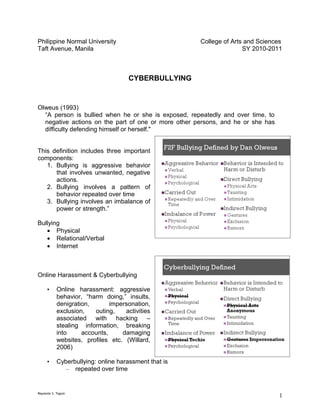
This definition includes three important
components:
   1. Bullying is aggressive behavior
      that involves unwanted, negative
      actions.
   2. Bullying involves a pattern of
      behavior repeated over time
   3. Bullying involves an imbalance of
      power or strength.”

Bullying
   • Physical
   • Relational/Verbal
   • Internet


Online Harassment & Cyberbullying

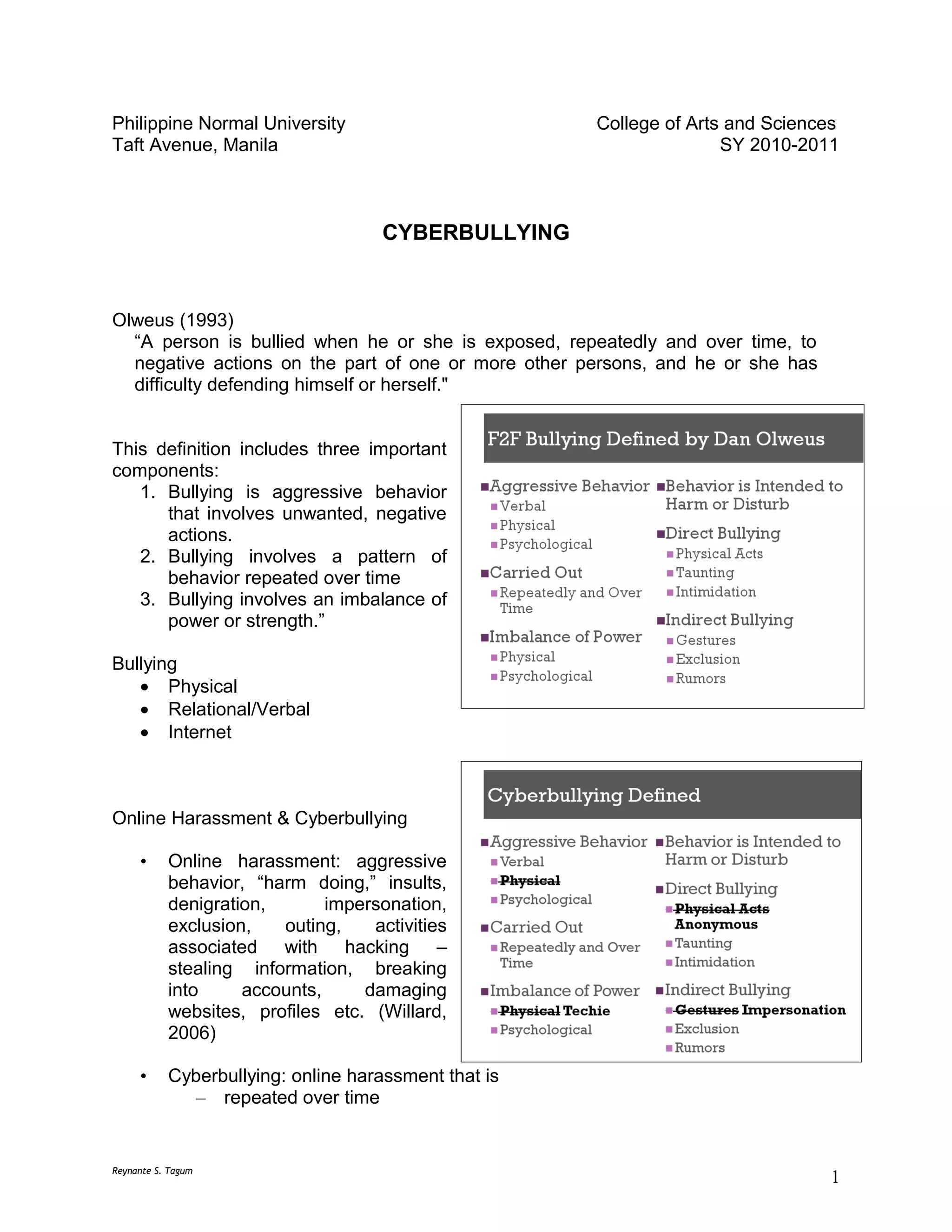
     •     Online harassment: aggressive
           behavior, “harm doing,” insults,
           denigration,       impersonation,
           exclusion,   outing,    activities
           associated with hacking –
           stealing information, breaking
           into     accounts,     damaging
           websites, profiles etc. (Willard,
           2006)

     •     Cyberbullying: online harassment that is
              – repeated over time


Reynante S. Tagum
                                                                                 1
–   Involves a power imbalance between a perpetrator and a victim. Power
                        imbalance may be differences in online skills.

     •     Other complicating factor -- perpetrators are also often victims, sometimes
           online, sometimes elsewhere. Internet bullying can be particularly hard to
           disentangle. (Willard, 2006)

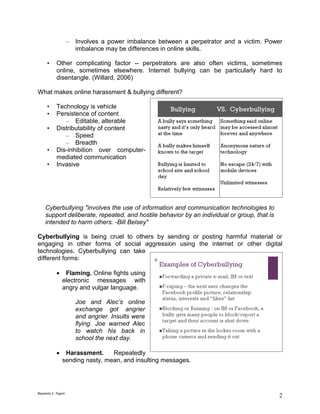
What makes online harassment & bullying different?

     •     Technology is vehicle
     •     Persistence of content
              – Editable, alterable
     •     Distributability of content
              – Speed
              – Breadth
     •     Dis-inhibition over computer-
           mediated communication
     •     Invasive


    Cyberbullying "involves the use of information and communication technologies to
    support deliberate, repeated, and hostile behavior by an individual or group, that is
    intended to harm others. -Bill Belsey"

Cyberbullying is being cruel to others by sending or posting harmful material or
engaging in other forms of social aggression using the internet or other digital
technologies. Cyberbullying can take
different forms:

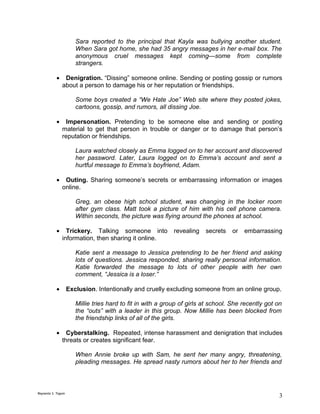
           •    Flaming. Online fights using
               electronic messages with
               angry and vulgar language.

                        Joe and Alec’s online
                        exchange got angrier
                        and angrier. Insults were
                        flying. Joe warned Alec
                        to watch his back in
                        school the next day.

           •    Harassment.     Repeatedly
               sending nasty, mean, and insulting messages.


Reynante S. Tagum
                                                                                            2
Sara reported to the principal that Kayla was bullying another student.
                       When Sara got home, she had 35 angry messages in her e-mail box. The
                       anonymous cruel messages kept coming—some from complete
                       strangers.

           •    Denigration. “Dissing” someone online. Sending or posting gossip or rumors
               about a person to damage his or her reputation or friendships.

                       Some boys created a “We Hate Joe” Web site where they posted jokes,
                       cartoons, gossip, and rumors, all dissing Joe.

           •    Impersonation. Pretending to be someone else and sending or posting
               material to get that person in trouble or danger or to damage that person’s
               reputation or friendships.

                       Laura watched closely as Emma logged on to her account and discovered
                       her password. Later, Laura logged on to Emma’s account and sent a
                       hurtful message to Emma’s boyfriend, Adam.

           •    Outing. Sharing someone’s secrets or embarrassing information or images
               online.

                       Greg, an obese high school student, was changing in the locker room
                       after gym class. Matt took a picture of him with his cell phone camera.
                       Within seconds, the picture was flying around the phones at school.

           •     Trickery. Talking someone into              revealing   secrets   or   embarrassing
               information, then sharing it online.

                       Katie sent a message to Jessica pretending to be her friend and asking
                       lots of questions. Jessica responded, sharing really personal information.
                       Katie forwarded the message to lots of other people with her own
                       comment, “Jessica is a loser.”

           •        Exclusion. Intentionally and cruelly excluding someone from an online group.

                       Millie tries hard to fit in with a group of girls at school. She recently got on
                       the “outs” with a leader in this group. Now Millie has been blocked from
                       the friendship links of all of the girls.

           •     Cyberstalking. Repeated, intense harassment and denigration that includes
               threats or creates significant fear.

                       When Annie broke up with Sam, he sent her many angry, threatening,
                       pleading messages. He spread nasty rumors about her to her friends and


Reynante S. Tagum
                                                                                                      3
posted a sexually suggestive picture she had given him in a sex-oriented
                    discussion group, along with her e-mail address and cell phone number.

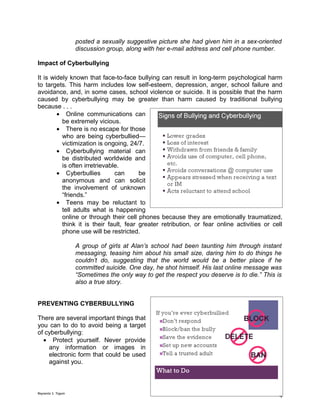
Impact of Cyberbullying

It is widely known that face-to-face bullying can result in long-term psychological harm
to targets. This harm includes low self-esteem, depression, anger, school failure and
avoidance, and, in some cases, school violence or suicide. It is possible that the harm
caused by cyberbullying may be greater than harm caused by traditional bullying
because . . .
        • Online communications can
          be extremely vicious.
        • There is no escape for those
          who are being cyberbullied—
          victimization is ongoing, 24/7.
        • Cyberbullying material can
          be distributed worldwide and
          is often irretrievable.
        • Cyberbullies         can      be
          anonymous and can solicit
          the involvement of unknown
          “friends.”
        • Teens may be reluctant to
          tell adults what is happening
          online or through their cell phones because they are emotionally traumatized,
          think it is their fault, fear greater retribution, or fear online activities or cell
          phone use will be restricted.

                    A group of girls at Alan’s school had been taunting him through instant
                    messaging, teasing him about his small size, daring him to do things he
                    couldn’t do, suggesting that the world would be a better place if he
                    committed suicide. One day, he shot himself. His last online message was
                    “Sometimes the only way to get the respect you deserve is to die.” This is
                    also a true story.


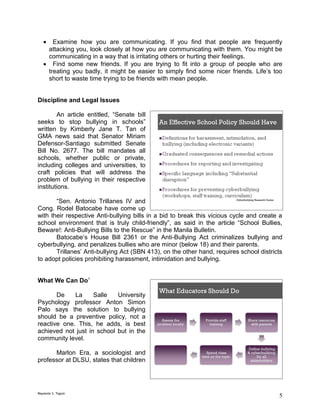
PREVENTING CYBERBULLYING

There are several important things that
you can to do to avoid being a target
of cyberbullying:
  • Protect yourself. Never provide
    any information or images in
    electronic form that could be used
    against you.


Reynante S. Tagum
                                                                                             4
•  Examine how you are communicating. If you find that people are frequently
    attacking you, look closely at how you are communicating with them. You might be
    communicating in a way that is irritating others or hurting their feelings.
   • Find some new friends. If you are trying to fit into a group of people who are
    treating you badly, it might be easier to simply find some nicer friends. Life’s too
    short to waste time trying to be friends with mean people.


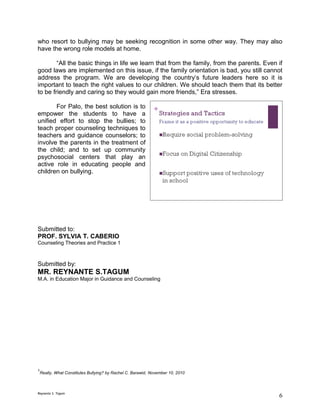
Discipline and Legal Issues

        An article entitled, “Senate bill
seeks to stop bullying in schools”
written by Kimberly Jane T. Tan of
GMA news said that Senator Miriam
Defensor-Santiago submitted Senate
Bill No. 2677. The bill mandates all
schools, whether public or private,
including colleges and universities, to
craft policies that will address the
problem of bullying in their respective
institutions.

       “Sen. Antonio Trillanes IV and
Cong. Rodel Batocabe have come up
with their respective Anti-bullying bills in a bid to break this vicious cycle and create a
school environment that is truly child-friendly”, as said in the article “School Bullies,
Beware!: Anti-Bullying Bills to the Rescue” in the Manila Bulletin.
       Batocabe’s House Bill 2361 or the Anti-Bullying Act criminalizes bullying and
cyberbullying, and penalizes bullies who are minor (below 18) and their parents.
       Trillanes’ Anti-bullying Act (SBN 413), on the other hand, requires school districts
to adopt policies prohibiting harassment, intimidation and bullying.


What We Can Do1

       De    La     Salle   University
Psychology professor Anton Simon
Palo says the solution to bullying
should be a preventive policy, not a
reactive one. This, he adds, is best
achieved not just in school but in the
community level.

      Marlon Era, a sociologist and
professor at DLSU, states that children


Reynante S. Tagum
                                                                                         5
who resort to bullying may be seeking recognition in some other way. They may also
have the wrong role models at home.

        “All the basic things in life we learn that from the family, from the parents. Even if
good laws are implemented on this issue, if the family orientation is bad, you still cannot
address the program. We are developing the country’s future leaders here so it is
important to teach the right values to our children. We should teach them that its better
to be friendly and caring so they would gain more friends,” Era stresses.

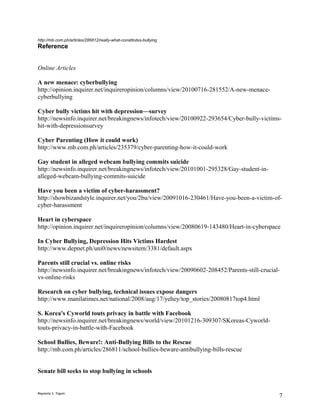
       For Palo, the best solution is to
empower the students to have a
unified effort to stop the bullies; to
teach proper counseling techniques to
teachers and guidance counselors; to
involve the parents in the treatment of
the child; and to set up community
psychosocial centers that play an
active role in educating people and
children on bullying.


Submitted to:
PROF. SYLVIA T. CABERIO
Counseling Theories and Practice 1


Submitted by:
MR. REYNANTE S.TAGUM
M.A. in Education Major in Guidance and Counseling


1
    Really, What Constitutes Bullying? by Rachel C. Barawid, November 10, 2010


Reynante S. Tagum
                                                                                            6
http://mb.com.ph/articles/286812/really-what-constitutes-bullying
Reference


Online Articles

A new menace: cyberbullying
http://opinion.inquirer.net/inquireropinion/columns/view/20100716-281552/A-new-menace-
cyberbullying

Cyber bully victims hit with depression—survey
http://newsinfo.inquirer.net/breakingnews/infotech/view/20100922-293654/Cyber-bully-victims-
hit-with-depressionsurvey

Cyber Parenting (How it could work)
http://www.mb.com.ph/articles/235379/cyber-parenting-how-it-could-work

Gay student in alleged webcam bullying commits suicide
http://newsinfo.inquirer.net/breakingnews/infotech/view/20101001-295328/Gay-student-in-
alleged-webcam-bullying-commits-suicide

Have you been a victim of cyber-harassment?
http://showbizandstyle.inquirer.net/you/2bu/view/20091016-230461/Have-you-been-a-victim-of-
cyber-harassment

Heart in cyberspace
http://opinion.inquirer.net/inquireropinion/columns/view/20080619-143480/Heart-in-cyberspace

In Cyber Bullying, Depression Hits Victims Hardest
http://www.depnet.ph/uni0/news/newsitem/3381/default.aspx

Parents still crucial vs. online risks
http://newsinfo.inquirer.net/breakingnews/infotech/view/20090602-208452/Parents-still-crucial-
vs-online-risks

Research on cyber bullying, technical issues expose dangers
http://www.manilatimes.net/national/2008/aug/17/yehey/top_stories/20080817top4.html

S. Korea's Cyworld touts privacy in battle with Facebook
http://newsinfo.inquirer.net/breakingnews/world/view/20101216-309307/SKoreas-Cyworld-
touts-privacy-in-battle-with-Facebook

School Bullies, Beware!: Anti-Bullying Bills to the Rescue
http://mb.com.ph/articles/286811/school-bullies-beware-antibullying-bills-rescue


Senate bill seeks to stop bullying in schools


Reynante S. Tagum
                                                                                             7
http://www.gmanews.tv/story/213952/senate-bill-seeks-to-stop-bullying-in-schools#

The Facebook Generation
http://showbizandstyle.inquirer.net/sim/sim/view/20101113-303030/The-Facebook-Generation

Tougher law vs cyber bullying pushed
http://www.journal.com.ph/index.php/national/20804-tougher-law-vs-cyber-bullying-
pushed.html


PDF File

Educator’s Guide to Cyberbullying and Cyberthreats by Nancy Williard, 2007


PowerPoint File

Bullying, Cyberbullying, Murder and Bullycide by Rick Shaw
www.awareity.com

Cyberbullying by Adrienne DeWolfe

Cyberbullying: What the research is telling us…
Amanda Lenhart
Pew Internet & American Life Project
http://www.pewinternet.org

Tech etiquette
www.SmallTalkBigResults.com


Reynante S. Tagum
                                                                                           8

CYBERBULLYING

  • 1.
    Philippine Normal University College of Arts and Sciences Taft Avenue, Manila SY 2010-2011 CYBERBULLYING Olweus (1993) “A person is bullied when he or she is exposed, repeatedly and over time, to negative actions on the part of one or more other persons, and he or she has difficulty defending himself or herself." This definition includes three important components: 1. Bullying is aggressive behavior that involves unwanted, negative actions. 2. Bullying involves a pattern of behavior repeated over time 3. Bullying involves an imbalance of power or strength.” Bullying • Physical • Relational/Verbal • Internet Online Harassment & Cyberbullying • Online harassment: aggressive behavior, “harm doing,” insults, denigration, impersonation, exclusion, outing, activities associated with hacking – stealing information, breaking into accounts, damaging websites, profiles etc. (Willard, 2006) • Cyberbullying: online harassment that is – repeated over time Reynante S. Tagum 1
  • 2.
    Involves a power imbalance between a perpetrator and a victim. Power imbalance may be differences in online skills. • Other complicating factor -- perpetrators are also often victims, sometimes online, sometimes elsewhere. Internet bullying can be particularly hard to disentangle. (Willard, 2006) What makes online harassment & bullying different? • Technology is vehicle • Persistence of content – Editable, alterable • Distributability of content – Speed – Breadth • Dis-inhibition over computer- mediated communication • Invasive Cyberbullying "involves the use of information and communication technologies to support deliberate, repeated, and hostile behavior by an individual or group, that is intended to harm others. -Bill Belsey" Cyberbullying is being cruel to others by sending or posting harmful material or engaging in other forms of social aggression using the internet or other digital technologies. Cyberbullying can take different forms: • Flaming. Online fights using electronic messages with angry and vulgar language. Joe and Alec’s online exchange got angrier and angrier. Insults were flying. Joe warned Alec to watch his back in school the next day. • Harassment. Repeatedly sending nasty, mean, and insulting messages. Reynante S. Tagum 2
  • 3.
    Sara reported tothe principal that Kayla was bullying another student. When Sara got home, she had 35 angry messages in her e-mail box. The anonymous cruel messages kept coming—some from complete strangers. • Denigration. “Dissing” someone online. Sending or posting gossip or rumors about a person to damage his or her reputation or friendships. Some boys created a “We Hate Joe” Web site where they posted jokes, cartoons, gossip, and rumors, all dissing Joe. • Impersonation. Pretending to be someone else and sending or posting material to get that person in trouble or danger or to damage that person’s reputation or friendships. Laura watched closely as Emma logged on to her account and discovered her password. Later, Laura logged on to Emma’s account and sent a hurtful message to Emma’s boyfriend, Adam. • Outing. Sharing someone’s secrets or embarrassing information or images online. Greg, an obese high school student, was changing in the locker room after gym class. Matt took a picture of him with his cell phone camera. Within seconds, the picture was flying around the phones at school. • Trickery. Talking someone into revealing secrets or embarrassing information, then sharing it online. Katie sent a message to Jessica pretending to be her friend and asking lots of questions. Jessica responded, sharing really personal information. Katie forwarded the message to lots of other people with her own comment, “Jessica is a loser.” • Exclusion. Intentionally and cruelly excluding someone from an online group. Millie tries hard to fit in with a group of girls at school. She recently got on the “outs” with a leader in this group. Now Millie has been blocked from the friendship links of all of the girls. • Cyberstalking. Repeated, intense harassment and denigration that includes threats or creates significant fear. When Annie broke up with Sam, he sent her many angry, threatening, pleading messages. He spread nasty rumors about her to her friends and Reynante S. Tagum 3
  • 4.
    posted a sexuallysuggestive picture she had given him in a sex-oriented discussion group, along with her e-mail address and cell phone number. Impact of Cyberbullying It is widely known that face-to-face bullying can result in long-term psychological harm to targets. This harm includes low self-esteem, depression, anger, school failure and avoidance, and, in some cases, school violence or suicide. It is possible that the harm caused by cyberbullying may be greater than harm caused by traditional bullying because . . . • Online communications can be extremely vicious. • There is no escape for those who are being cyberbullied— victimization is ongoing, 24/7. • Cyberbullying material can be distributed worldwide and is often irretrievable. • Cyberbullies can be anonymous and can solicit the involvement of unknown “friends.” • Teens may be reluctant to tell adults what is happening online or through their cell phones because they are emotionally traumatized, think it is their fault, fear greater retribution, or fear online activities or cell phone use will be restricted. A group of girls at Alan’s school had been taunting him through instant messaging, teasing him about his small size, daring him to do things he couldn’t do, suggesting that the world would be a better place if he committed suicide. One day, he shot himself. His last online message was “Sometimes the only way to get the respect you deserve is to die.” This is also a true story. PREVENTING CYBERBULLYING There are several important things that you can to do to avoid being a target of cyberbullying: • Protect yourself. Never provide any information or images in electronic form that could be used against you. Reynante S. Tagum 4
  • 5.
    • Examinehow you are communicating. If you find that people are frequently attacking you, look closely at how you are communicating with them. You might be communicating in a way that is irritating others or hurting their feelings. • Find some new friends. If you are trying to fit into a group of people who are treating you badly, it might be easier to simply find some nicer friends. Life’s too short to waste time trying to be friends with mean people. Discipline and Legal Issues An article entitled, “Senate bill seeks to stop bullying in schools” written by Kimberly Jane T. Tan of GMA news said that Senator Miriam Defensor-Santiago submitted Senate Bill No. 2677. The bill mandates all schools, whether public or private, including colleges and universities, to craft policies that will address the problem of bullying in their respective institutions. “Sen. Antonio Trillanes IV and Cong. Rodel Batocabe have come up with their respective Anti-bullying bills in a bid to break this vicious cycle and create a school environment that is truly child-friendly”, as said in the article “School Bullies, Beware!: Anti-Bullying Bills to the Rescue” in the Manila Bulletin. Batocabe’s House Bill 2361 or the Anti-Bullying Act criminalizes bullying and cyberbullying, and penalizes bullies who are minor (below 18) and their parents. Trillanes’ Anti-bullying Act (SBN 413), on the other hand, requires school districts to adopt policies prohibiting harassment, intimidation and bullying. What We Can Do1 De La Salle University Psychology professor Anton Simon Palo says the solution to bullying should be a preventive policy, not a reactive one. This, he adds, is best achieved not just in school but in the community level. Marlon Era, a sociologist and professor at DLSU, states that children Reynante S. Tagum 5
  • 6.
    who resort tobullying may be seeking recognition in some other way. They may also have the wrong role models at home. “All the basic things in life we learn that from the family, from the parents. Even if good laws are implemented on this issue, if the family orientation is bad, you still cannot address the program. We are developing the country’s future leaders here so it is important to teach the right values to our children. We should teach them that its better to be friendly and caring so they would gain more friends,” Era stresses. For Palo, the best solution is to empower the students to have a unified effort to stop the bullies; to teach proper counseling techniques to teachers and guidance counselors; to involve the parents in the treatment of the child; and to set up community psychosocial centers that play an active role in educating people and children on bullying. Submitted to: PROF. SYLVIA T. CABERIO Counseling Theories and Practice 1 Submitted by: MR. REYNANTE S.TAGUM M.A. in Education Major in Guidance and Counseling 1 Really, What Constitutes Bullying? by Rachel C. Barawid, November 10, 2010 Reynante S. Tagum 6
  • 7.
    http://mb.com.ph/articles/286812/really-what-constitutes-bullying Reference Online Articles A newmenace: cyberbullying http://opinion.inquirer.net/inquireropinion/columns/view/20100716-281552/A-new-menace- cyberbullying Cyber bully victims hit with depression—survey http://newsinfo.inquirer.net/breakingnews/infotech/view/20100922-293654/Cyber-bully-victims- hit-with-depressionsurvey Cyber Parenting (How it could work) http://www.mb.com.ph/articles/235379/cyber-parenting-how-it-could-work Gay student in alleged webcam bullying commits suicide http://newsinfo.inquirer.net/breakingnews/infotech/view/20101001-295328/Gay-student-in- alleged-webcam-bullying-commits-suicide Have you been a victim of cyber-harassment? http://showbizandstyle.inquirer.net/you/2bu/view/20091016-230461/Have-you-been-a-victim-of- cyber-harassment Heart in cyberspace http://opinion.inquirer.net/inquireropinion/columns/view/20080619-143480/Heart-in-cyberspace In Cyber Bullying, Depression Hits Victims Hardest http://www.depnet.ph/uni0/news/newsitem/3381/default.aspx Parents still crucial vs. online risks http://newsinfo.inquirer.net/breakingnews/infotech/view/20090602-208452/Parents-still-crucial- vs-online-risks Research on cyber bullying, technical issues expose dangers http://www.manilatimes.net/national/2008/aug/17/yehey/top_stories/20080817top4.html S. Korea's Cyworld touts privacy in battle with Facebook http://newsinfo.inquirer.net/breakingnews/world/view/20101216-309307/SKoreas-Cyworld- touts-privacy-in-battle-with-Facebook School Bullies, Beware!: Anti-Bullying Bills to the Rescue http://mb.com.ph/articles/286811/school-bullies-beware-antibullying-bills-rescue Senate bill seeks to stop bullying in schools Reynante S. Tagum 7
  • 8.
    http://www.gmanews.tv/story/213952/senate-bill-seeks-to-stop-bullying-in-schools# The Facebook Generation http://showbizandstyle.inquirer.net/sim/sim/view/20101113-303030/The-Facebook-Generation Tougherlaw vs cyber bullying pushed http://www.journal.com.ph/index.php/national/20804-tougher-law-vs-cyber-bullying- pushed.html PDF File Educator’s Guide to Cyberbullying and Cyberthreats by Nancy Williard, 2007 PowerPoint File Bullying, Cyberbullying, Murder and Bullycide by Rick Shaw www.awareity.com Cyberbullying by Adrienne DeWolfe Cyberbullying: What the research is telling us… Amanda Lenhart Pew Internet & American Life Project http://www.pewinternet.org Tech etiquette www.SmallTalkBigResults.com Reynante S. Tagum 8