CYBER BULLYING
By
Zarmeen Durrani
CYBER BULLYING
 Cyber bullying is bullying that takes place using
electronic technology.
 Electronic technology includes devices and
equipment such as cell phones, computers, and
tablets as well as communication tools including
social media sites, text messages, chat, and
websites.
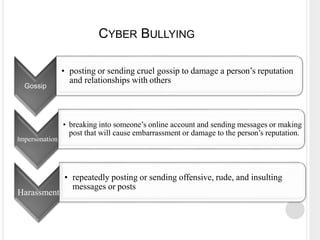
CYBER BULLYING
Gossip
• posting or sending cruel gossip to damage a person’s reputation
and relationships with others
Impersonation
• breaking into someone’s online account and sending messages or making
post that will cause embarrassment or damage to the person’s reputation.
Harassment
• repeatedly posting or sending offensive, rude, and insulting
messages or posts
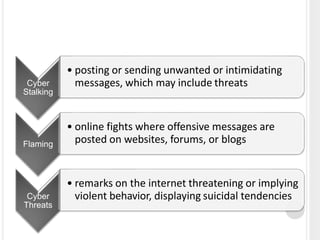
Cyber
Stalking
• posting or sending unwanted or intimidating
messages, which may include threats
Flaming
• online fights where offensive messages are
posted on websites, forums, or blogs
Cyber
Threats
• remarks on the internet threatening or implying
violent behavior, displaying suicidal tendencies
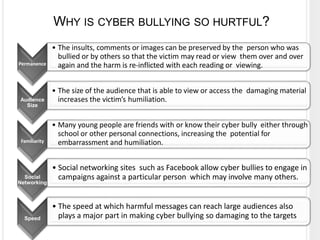
WHY IS CYBER BULLYING SO HURTFUL?
Permanence
• The insults, comments or images can be preserved by the person who was
bullied or by others so that the victim may read or view them over and over
again and the harm is re-inflicted with each reading or viewing.
Audience
Size
• The size of the audience that is able to view or access the damaging material
increases the victim’s humiliation.
Familiarity
• Many young people are friends with or know their cyber bully either through
school or other personal connections, increasing the potential for
embarrassment and humiliation.
Social
Networking
• Social networking sites such as Facebook allow cyber bullies to engage in
campaigns against a particular person which may involve many others.
Speed
• The speed at which harmful messages can reach large audiences also
plays a major part in making cyber bullying so damaging to the targets
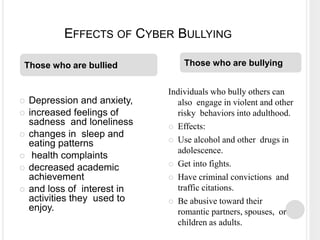
EFFECTS OF CYBER BULLYING
 Depression and anxiety,
 increased feelings of
sadness and loneliness
 changes in sleep and
eating patterns
 health complaints
 decreased academic
achievement
 and loss of interest in
activities they used to
enjoy.
Individuals who bully others can
also engage in violent and other
risky behaviors into adulthood.
 Effects:
 Use alcohol and other drugs in
adolescence.
 Get into fights.
 Have criminal convictions and
traffic citations.
 Be abusive toward their
romantic partners, spouses, or
children as adults.
Those who are bullied Those who are bullying
REASONS OF BULLYING
 There are numerous reasons researchers consider
the root cause for a person or a group of individuals
bullying others. These include
 Race
 religion
 social class
 physical or mental strength
 social reputation.
 Jealousy
 Peer pressure
 Fun
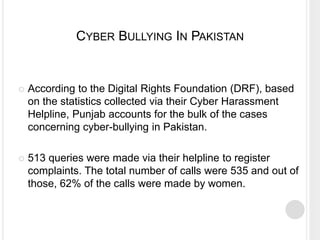
CYBER BULLYING IN PAKISTAN
 According to the Digital Rights Foundation (DRF), based
on the statistics collected via their Cyber Harassment
Helpline, Punjab accounts for the bulk of the cases
concerning cyber-bullying in Pakistan.
 513 queries were made via their helpline to register
complaints. The total number of calls were 535 and out of
those, 62% of the calls were made by women.
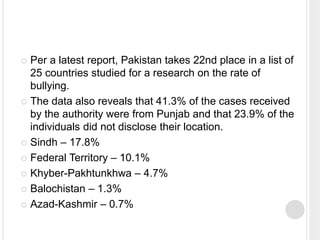
 Per a latest report, Pakistan takes 22nd place in a list of
25 countries studied for a research on the rate of
bullying.
 The data also reveals that 41.3% of the cases received
by the authority were from Punjab and that 23.9% of the
individuals did not disclose their location.
 Sindh – 17.8%
 Federal Territory – 10.1%
 Khyber-Pakhtunkhwa – 4.7%
 Balochistan – 1.3%
 Azad-Kashmir – 0.7%
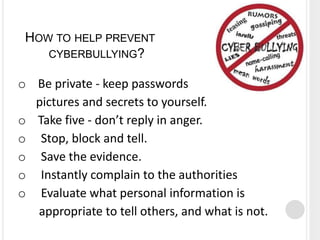
HOW TO HELP PREVENT
CYBERBULLYING?
o Be private - keep passwords
pictures and secrets to yourself.
o Take five - don’t reply in anger.
o Stop, block and tell.
o Save the evidence.
o Instantly complain to the authorities
o Evaluate what personal information is
appropriate to tell others, and what is not.
Cyber bullying

Cyber bullying

  • 1.
  • 2.
    CYBER BULLYING  Cyberbullying is bullying that takes place using electronic technology.  Electronic technology includes devices and equipment such as cell phones, computers, and tablets as well as communication tools including social media sites, text messages, chat, and websites.
  • 3.
    CYBER BULLYING Gossip • postingor sending cruel gossip to damage a person’s reputation and relationships with others Impersonation • breaking into someone’s online account and sending messages or making post that will cause embarrassment or damage to the person’s reputation. Harassment • repeatedly posting or sending offensive, rude, and insulting messages or posts
  • 4.
    Cyber Stalking • posting orsending unwanted or intimidating messages, which may include threats Flaming • online fights where offensive messages are posted on websites, forums, or blogs Cyber Threats • remarks on the internet threatening or implying violent behavior, displaying suicidal tendencies
  • 5.
    WHY IS CYBERBULLYING SO HURTFUL? Permanence • The insults, comments or images can be preserved by the person who was bullied or by others so that the victim may read or view them over and over again and the harm is re-inflicted with each reading or viewing. Audience Size • The size of the audience that is able to view or access the damaging material increases the victim’s humiliation. Familiarity • Many young people are friends with or know their cyber bully either through school or other personal connections, increasing the potential for embarrassment and humiliation. Social Networking • Social networking sites such as Facebook allow cyber bullies to engage in campaigns against a particular person which may involve many others. Speed • The speed at which harmful messages can reach large audiences also plays a major part in making cyber bullying so damaging to the targets
  • 6.
    EFFECTS OF CYBERBULLYING  Depression and anxiety,  increased feelings of sadness and loneliness  changes in sleep and eating patterns  health complaints  decreased academic achievement  and loss of interest in activities they used to enjoy. Individuals who bully others can also engage in violent and other risky behaviors into adulthood.  Effects:  Use alcohol and other drugs in adolescence.  Get into fights.  Have criminal convictions and traffic citations.  Be abusive toward their romantic partners, spouses, or children as adults. Those who are bullied Those who are bullying
  • 7.
    REASONS OF BULLYING There are numerous reasons researchers consider the root cause for a person or a group of individuals bullying others. These include  Race  religion  social class  physical or mental strength  social reputation.  Jealousy  Peer pressure  Fun
  • 8.
    CYBER BULLYING INPAKISTAN  According to the Digital Rights Foundation (DRF), based on the statistics collected via their Cyber Harassment Helpline, Punjab accounts for the bulk of the cases concerning cyber-bullying in Pakistan.  513 queries were made via their helpline to register complaints. The total number of calls were 535 and out of those, 62% of the calls were made by women.
  • 9.
     Per alatest report, Pakistan takes 22nd place in a list of 25 countries studied for a research on the rate of bullying.  The data also reveals that 41.3% of the cases received by the authority were from Punjab and that 23.9% of the individuals did not disclose their location.  Sindh – 17.8%  Federal Territory – 10.1%  Khyber-Pakhtunkhwa – 4.7%  Balochistan – 1.3%  Azad-Kashmir – 0.7%
  • 10.
    HOW TO HELPPREVENT CYBERBULLYING? o Be private - keep passwords pictures and secrets to yourself. o Take five - don’t reply in anger. o Stop, block and tell. o Save the evidence. o Instantly complain to the authorities o Evaluate what personal information is appropriate to tell others, and what is not.