Osprey Agency
 Ramon Abreu
  Rachel Billy
Lauren Dotterer
  Chris Keller
Angela Widener
Stop Cyberbullying!
• http://www.youtube.com/watch?v=pmD8OKl
  8vVM
What is “cyber bullying?”
• one minor harasses another minor using
  interactive, digital or internet technologies
• petty insults to offline contact from a hate
  group instigated by the cyber bully
• illegal under state harassment laws, but is
  normally not prosecuted as such
• Most cyber bullying is very different from
  typical school yard bullying
• It’s different every time, but you “know it
  when you see it.”
E-mail
Cell phones
Pager text messages
Instant messaging
Defamatory personal web sites
Defamatory online personal polling web sites
Chat rooms
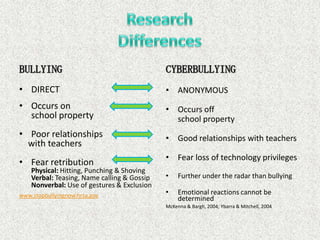
BULLYING                                     CYBERBULLYING
• DIRECT                                     • ANONYMOUS
• Occurs on                                  • Occurs off
  school property                              school property
• Poor relationships                         • Good relationships with teachers
  with teachers
                                             • Fear loss of technology privileges
• Fear retribution
    Physical: Hitting, Punching & Shoving
    Verbal: Teasing, Name calling & Gossip   •    Further under the radar than bullying
    Nonverbal: Use of gestures & Exclusion
www.stopbullyingnow.hrsa.gov                 •    Emotional reactions cannot be
                                                  determined
                                             McKenna & Bargh, 2004; Ybarra & Mitchell, 2004
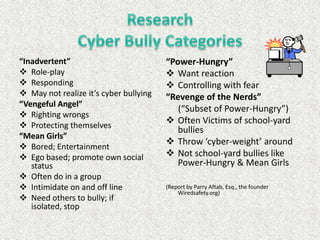
“Inadvertent”                           “Power-Hungry”
 Role-play                              Want reaction
 Responding                             Controlling with fear
 May not realize it’s cyber bullying   “Revenge of the Nerds”
“Vengeful Angel”
                                           (“Subset of Power-Hungry”)
 Righting wrongs
 Protecting themselves
                                         Often Victims of school-yard
                                           bullies
“Mean Girls”
                                         Throw ‘cyber-weight’ around
 Bored; Entertainment
 Ego based; promote own social          Not school-yard bullies like
   status                                  Power-Hungry & Mean Girls
 Often do in a group
 Intimidate on and off line            (Report by Parry Aftab, Esq., the founder
                                            Wiredsafety.org)
 Need others to bully; if
   isolated, stop
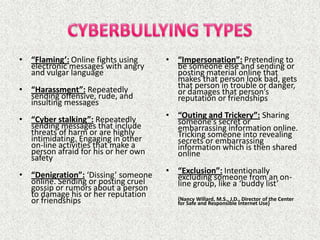
• “Flaming’: Online fights using     • “Impersonation”: Pretending to
  electronic messages with angry       be someone else and sending or
  and vulgar language                  posting material online that
                                       makes that person look bad, gets
• “Harassment”: Repeatedly             that person in trouble or danger,
  sending offensive, rude, and         or damages that person’s
  insulting messages                   reputation or friendships

• “Cyber stalking”: Repeatedly       • “Outing and Trickery”: Sharing
  sending messages that include        someone’s secret or
  threats of harm or are highly        embarrassing information online.
  intimidating. Engaging in other      Tricking someone into revealing
  on-line activities that make a       secrets or embarrassing
  person afraid for his or her own     information which is then shared
  safety                               online

• “Denigration”: ‘Dissing’ someone   • “Exclusion”: Intentionally
  online. Sending or posting cruel     excluding someone from an on-
  gossip or rumors about a person      line group, like a ‘buddy list’
  to damage his or her reputation       {Nancy Willard, M.S., J.D., Director of the Center
  or friendships                        for Safe and Responsible Internet Use}
Cyber bullying statistics

• Over half of adolescents and teens have been bullied
  online, and about the same number have engaged in
  cyber bullying.
• More than 1 in 3 young people
  have experienced cyber threats online.
• Over 25 percent of adolescents and teens have been
  bullied repeatedly through their cell phones or the
  Internet.
• Well over half of young people do not tell their
  parents when cyber bullying occurs.

Data from i-Safe foundation
• Influencers:
   – Parents - Parents need to be informed of the dangers of
      cyber bullying. They must be supportive of children and be
      a trusted place for children to go when things go wrong
      online and offline.
   – Teachers - Teachers can work with parents to stop and
      remedy cyber bullying situations. They can also educate
      the students on cyber ethics and the law.
   – Blogs - Blogs can inform people about the dangers of cyber
      bullying and how to prevent it.
• Partners:
   – Non-profit organizations & Awareness Groups -
     many non-profit organizations and awareness
     groups have been established with the aim of
     educating and providing resources for the public.
   – Pure Sight - an internet filtering software package
     that protects against cyber bullies and online
     predators.
• Victims: Elementary and middle school aged
  teens
   – The term "cyber bullying," does not include
     adults. Once adults become involved, it is
     plain and simple cyber-harassment or cyber
     stalking. Adult cyber-harassment or cyber
     stalking is NEVER called cyber bullying.
Goal 1: Inform the Jacksonville area by streamlining
resources at the local level.
Objectives
• Give information for free Pure Sight Bullying anti-
  bullying software
• Make public service announcements to bring
  awareness to cyber-bullying.
• Pitch to local radio stations at every major city to host a
  celebrity spokesperson that was harmed from bullying.
• Give away 50,000 promotional items to bring
  awareness to the issue and website
Goal 2: Educate parents, students and faculty of the new
issues facing them.
Objectives
• Educate at least 100,000 people about the issue of
   cyber-bullying in 2013
• Have programming in 50% of Jacksonville schools by
   2013 including: workshops, support groups and parent
   resource material.
• Host Stop, block and tell! assemblies at 200 schools.
• Educate counselors at every school of the new issues
   facing students
Goal 3: Inform teachers of symptoms and
provide network for help
Objectives
• Reduce Cyber-bullying 20% by Nov. 14, 2013
• Provide website information and direct
  hotlines for kids and faculty at all schools
Host in school Stop, block and tell! Assemblies at
200 middle and elementary schools
• Google yourself
• practice the Internet Golden Rule
• keep personal information private
Create awareness
• Create a Public Service Announcement
  featuring former bullied celebrities
• Run the PSA on local news stations and on
  cable channels during children’s programming
Pure Sight
• Partner with Pure Sight to set up educational
  booths at elementary and middle schools
  during parent teacher conferences and open
  house nights
• Pure Sight software available for parents to
  download at home
• Stop, Block and Tell ! Assemblies
  – Test the knowledge growth by surveying all students
    and teachers before and after the assembly
• Pure sight
  – Track software downloads by zip code, to see the
    effectiveness of our booths in different Jacksonville
    School Districts.
• Celebrity Public Service Announcement
  – Measure public exposure by tracking hits on Youtube
    and number of viewers when it airs on TV

Cyber-bullying

  • 1.
    Osprey Agency RamonAbreu Rachel Billy Lauren Dotterer Chris Keller Angela Widener
  • 2.
  • 3.
    What is “cyberbullying?” • one minor harasses another minor using interactive, digital or internet technologies • petty insults to offline contact from a hate group instigated by the cyber bully • illegal under state harassment laws, but is normally not prosecuted as such • Most cyber bullying is very different from typical school yard bullying • It’s different every time, but you “know it when you see it.”
  • 4.
    E-mail Cell phones Pager textmessages Instant messaging Defamatory personal web sites Defamatory online personal polling web sites Chat rooms
  • 5.
    BULLYING CYBERBULLYING • DIRECT • ANONYMOUS • Occurs on • Occurs off school property school property • Poor relationships • Good relationships with teachers with teachers • Fear loss of technology privileges • Fear retribution Physical: Hitting, Punching & Shoving Verbal: Teasing, Name calling & Gossip • Further under the radar than bullying Nonverbal: Use of gestures & Exclusion www.stopbullyingnow.hrsa.gov • Emotional reactions cannot be determined McKenna & Bargh, 2004; Ybarra & Mitchell, 2004
  • 6.
    “Inadvertent” “Power-Hungry”  Role-play  Want reaction  Responding  Controlling with fear  May not realize it’s cyber bullying “Revenge of the Nerds” “Vengeful Angel” (“Subset of Power-Hungry”)  Righting wrongs  Protecting themselves  Often Victims of school-yard bullies “Mean Girls”  Throw ‘cyber-weight’ around  Bored; Entertainment  Ego based; promote own social  Not school-yard bullies like status Power-Hungry & Mean Girls  Often do in a group  Intimidate on and off line (Report by Parry Aftab, Esq., the founder Wiredsafety.org)  Need others to bully; if isolated, stop
  • 7.
    • “Flaming’: Onlinefights using • “Impersonation”: Pretending to electronic messages with angry be someone else and sending or and vulgar language posting material online that makes that person look bad, gets • “Harassment”: Repeatedly that person in trouble or danger, sending offensive, rude, and or damages that person’s insulting messages reputation or friendships • “Cyber stalking”: Repeatedly • “Outing and Trickery”: Sharing sending messages that include someone’s secret or threats of harm or are highly embarrassing information online. intimidating. Engaging in other Tricking someone into revealing on-line activities that make a secrets or embarrassing person afraid for his or her own information which is then shared safety online • “Denigration”: ‘Dissing’ someone • “Exclusion”: Intentionally online. Sending or posting cruel excluding someone from an on- gossip or rumors about a person line group, like a ‘buddy list’ to damage his or her reputation {Nancy Willard, M.S., J.D., Director of the Center or friendships for Safe and Responsible Internet Use}
  • 8.
    Cyber bullying statistics •Over half of adolescents and teens have been bullied online, and about the same number have engaged in cyber bullying. • More than 1 in 3 young people have experienced cyber threats online. • Over 25 percent of adolescents and teens have been bullied repeatedly through their cell phones or the Internet. • Well over half of young people do not tell their parents when cyber bullying occurs. Data from i-Safe foundation
  • 9.
    • Influencers: – Parents - Parents need to be informed of the dangers of cyber bullying. They must be supportive of children and be a trusted place for children to go when things go wrong online and offline. – Teachers - Teachers can work with parents to stop and remedy cyber bullying situations. They can also educate the students on cyber ethics and the law. – Blogs - Blogs can inform people about the dangers of cyber bullying and how to prevent it.
  • 10.
    • Partners: – Non-profit organizations & Awareness Groups - many non-profit organizations and awareness groups have been established with the aim of educating and providing resources for the public. – Pure Sight - an internet filtering software package that protects against cyber bullies and online predators.
  • 11.
    • Victims: Elementaryand middle school aged teens – The term "cyber bullying," does not include adults. Once adults become involved, it is plain and simple cyber-harassment or cyber stalking. Adult cyber-harassment or cyber stalking is NEVER called cyber bullying.
  • 12.
    Goal 1: Informthe Jacksonville area by streamlining resources at the local level. Objectives • Give information for free Pure Sight Bullying anti- bullying software • Make public service announcements to bring awareness to cyber-bullying. • Pitch to local radio stations at every major city to host a celebrity spokesperson that was harmed from bullying. • Give away 50,000 promotional items to bring awareness to the issue and website
  • 13.
    Goal 2: Educateparents, students and faculty of the new issues facing them. Objectives • Educate at least 100,000 people about the issue of cyber-bullying in 2013 • Have programming in 50% of Jacksonville schools by 2013 including: workshops, support groups and parent resource material. • Host Stop, block and tell! assemblies at 200 schools. • Educate counselors at every school of the new issues facing students
  • 14.
    Goal 3: Informteachers of symptoms and provide network for help Objectives • Reduce Cyber-bullying 20% by Nov. 14, 2013 • Provide website information and direct hotlines for kids and faculty at all schools
  • 15.
    Host in schoolStop, block and tell! Assemblies at 200 middle and elementary schools • Google yourself • practice the Internet Golden Rule • keep personal information private
  • 16.
    Create awareness • Createa Public Service Announcement featuring former bullied celebrities • Run the PSA on local news stations and on cable channels during children’s programming
  • 17.
    Pure Sight • Partnerwith Pure Sight to set up educational booths at elementary and middle schools during parent teacher conferences and open house nights • Pure Sight software available for parents to download at home
  • 18.
    • Stop, Blockand Tell ! Assemblies – Test the knowledge growth by surveying all students and teachers before and after the assembly • Pure sight – Track software downloads by zip code, to see the effectiveness of our booths in different Jacksonville School Districts. • Celebrity Public Service Announcement – Measure public exposure by tracking hits on Youtube and number of viewers when it airs on TV

Editor's Notes

  • #4 It’s when one minor harasses another minor using interactive, digital or internet technologiesIt can range from petty insults to offline contact from a hate group instigated by the cyber bullyIt may be illegal under state harassment laws, but is normally not prosecuted as suchMost cyber bullying is very different from typical school yard bullying, although it can start offline and move online or vice versaIt’s different every time, but you “know it when you see it.”