Cyber Threat Intelligence:
It’s not just about the Feeds
Iain Dickson
@wan0net
Unless otherwise specified, this work is licensed under the Creative Commons Attribution-ShareAlike 4.0 International License. To view a copy of this
license, visit http://creativecommons.org/licenses/by-sa/4.0/ or send a letter to Creative Commons, PO Box 1866, Mountain View, CA 94042, USA.
● What is Cyber Threat Intelligence?
● What data source types support a CTI capability?
● What are the Lockheed Martin Cyber Kill Chain and Diamond Model?
● What data is required to generate actionable CTI?
● How does Cyber Threat Intelligence Support Defensive Cyber Ops?
What will I be covering?
What is Cyber Threat
Intelligence?
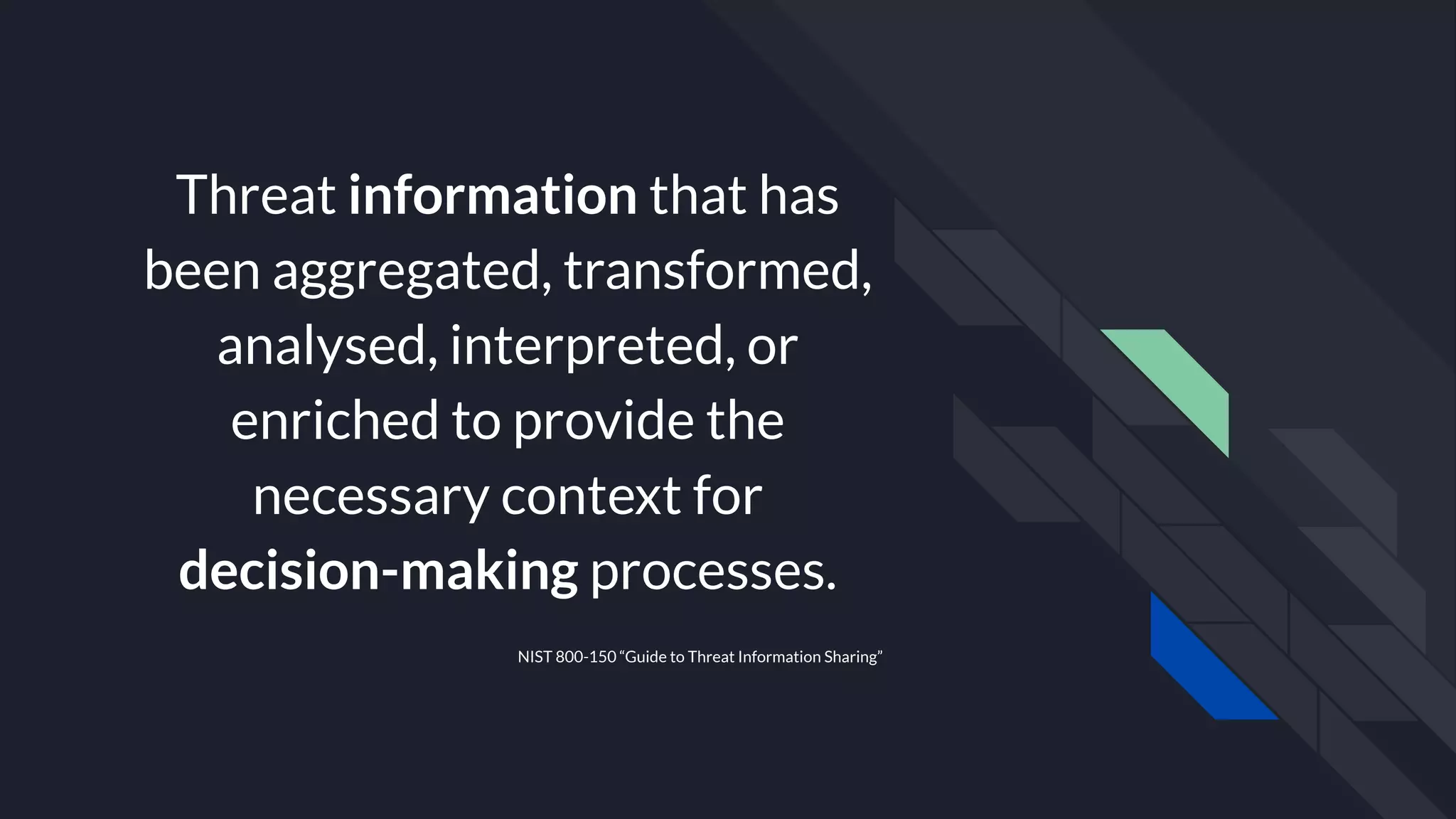
Threat information that has
been aggregated, transformed,
analysed, interpreted, or
enriched to provide the
necessary context for
decision-making processes.
NIST 800-150 “Guide to Threat Information Sharing”
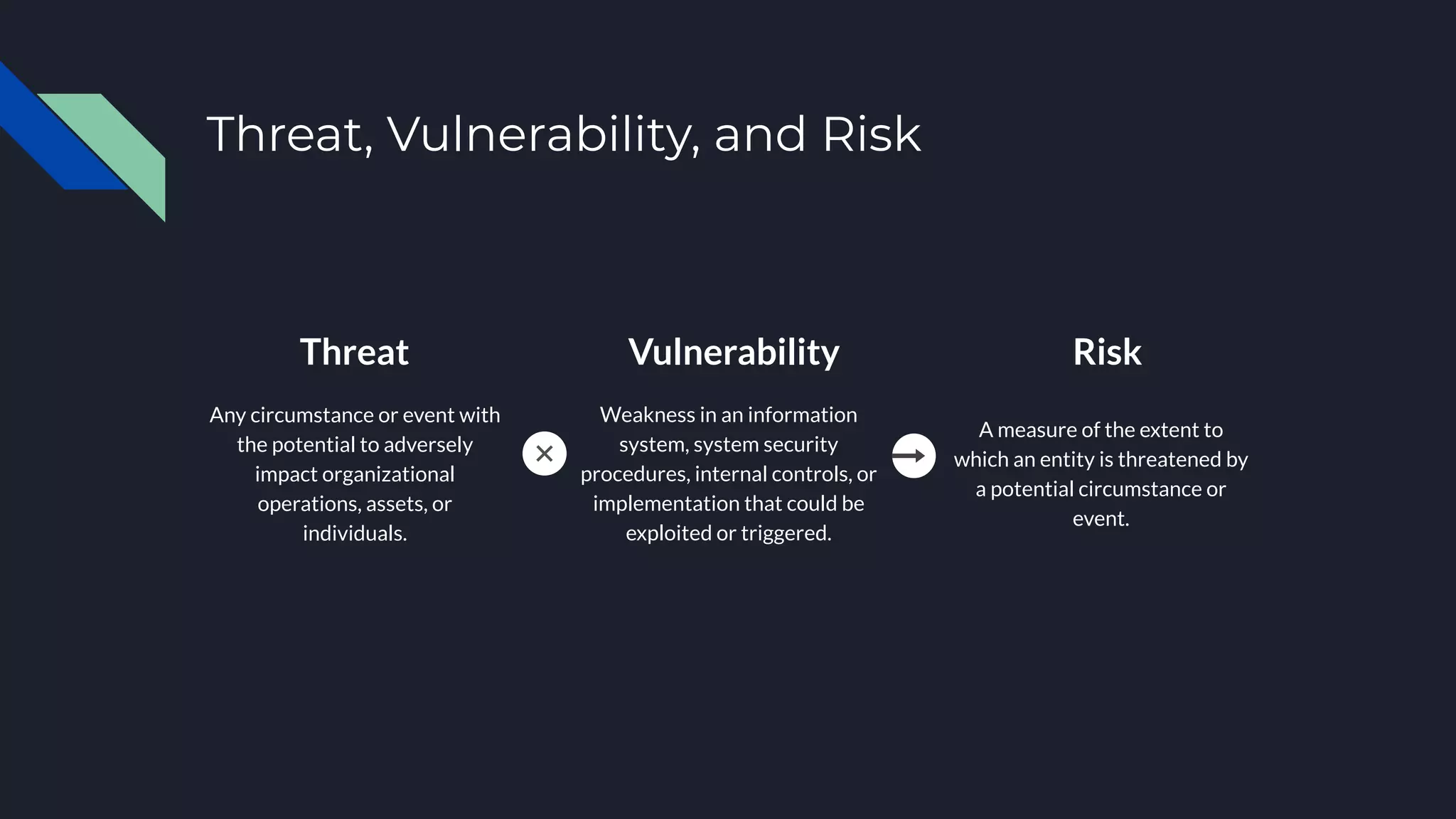
Risk
A measure of the extent to
which an entity is threatened by
a potential circumstance or
event.
Threat, Vulnerability, and Risk
Vulnerability
Weakness in an information
system, system security
procedures, internal controls, or
implementation that could be
exploited or triggered.
Threat
Any circumstance or event with
the potential to adversely
impact organizational
operations, assets, or
individuals.
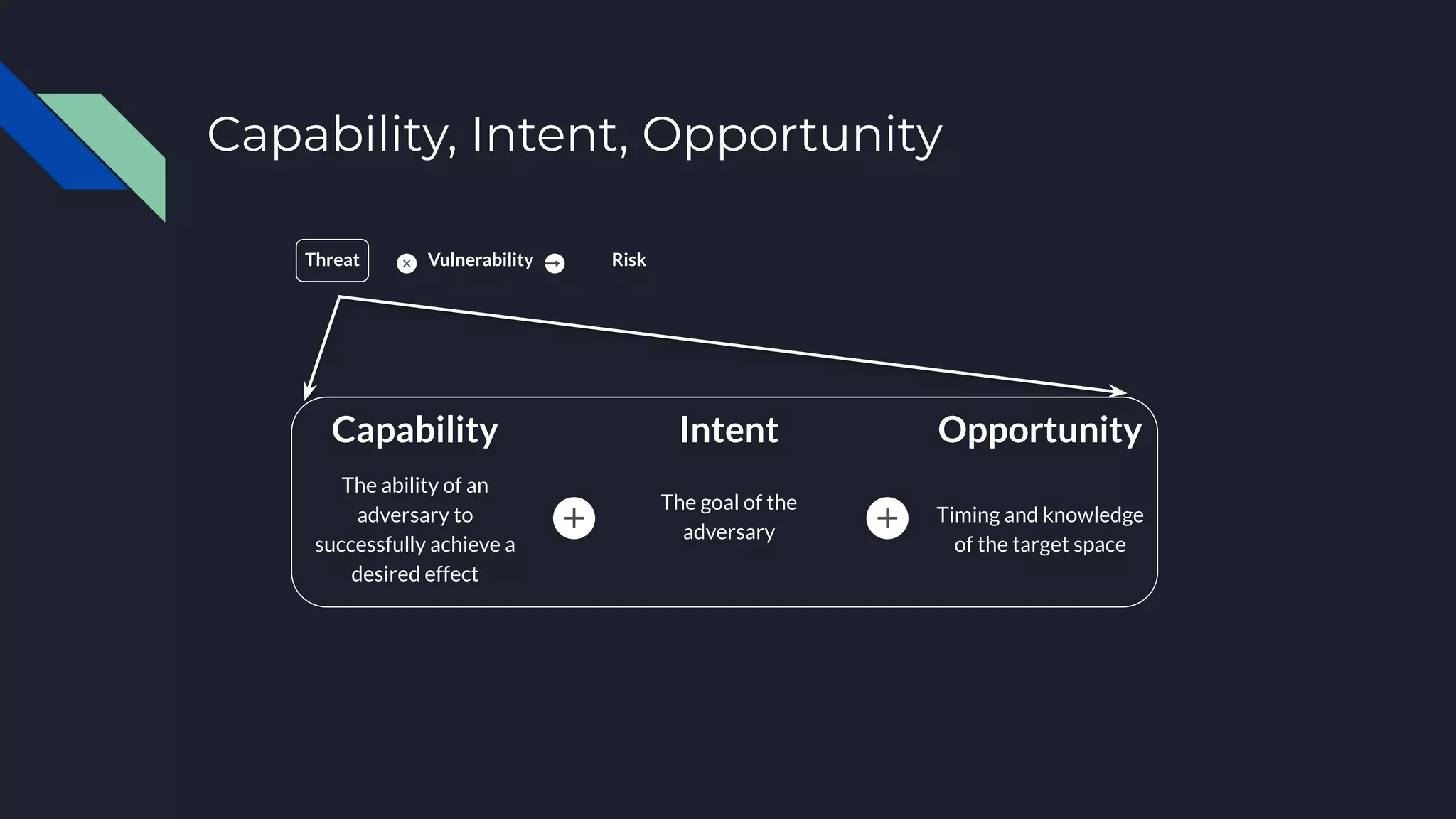
Capability, Intent, Opportunity
Vulnerability Risk
Intent
The goal of the
adversary
Capability
The ability of an
adversary to
successfully achieve a
desired effect
Threat
Opportunity
Timing and knowledge
of the target space
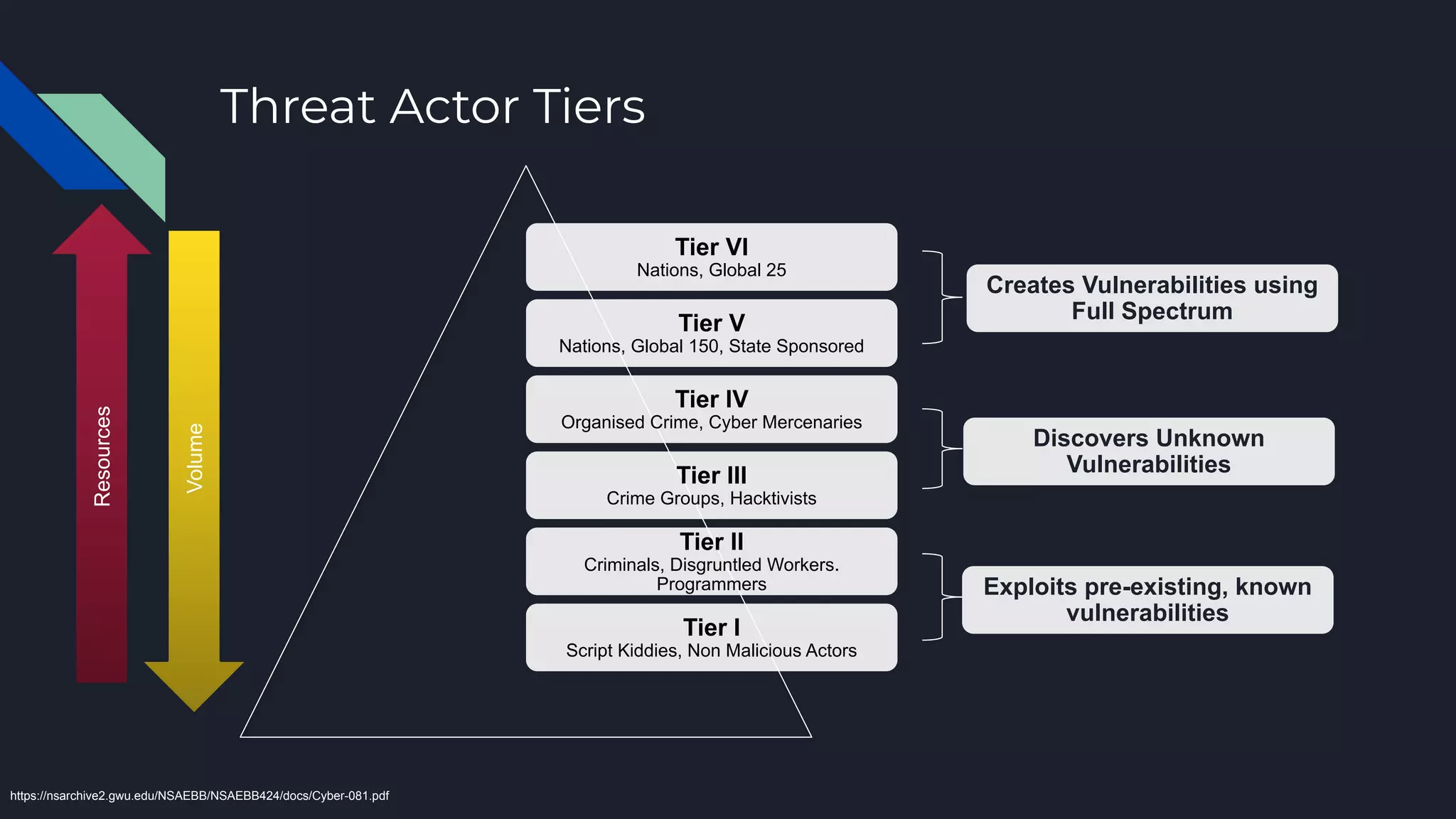
Threat Actor Tiers
Tier VI
Nations, Global 25
Tier V
Nations, Global 150, State Sponsored
Tier IV
Organised Crime, Cyber Mercenaries
Tier III
Crime Groups, Hacktivists
Tier II
Criminals, Disgruntled Workers.
Programmers
Tier I
Script Kiddies, Non Malicious Actors
Volume
Resources
Creates Vulnerabilities using
Full Spectrum
Discovers Unknown
Vulnerabilities
Exploits pre-existing, known
vulnerabilities
https://nsarchive2.gwu.edu/NSAEBB/NSAEBB424/docs/Cyber-081.pdf
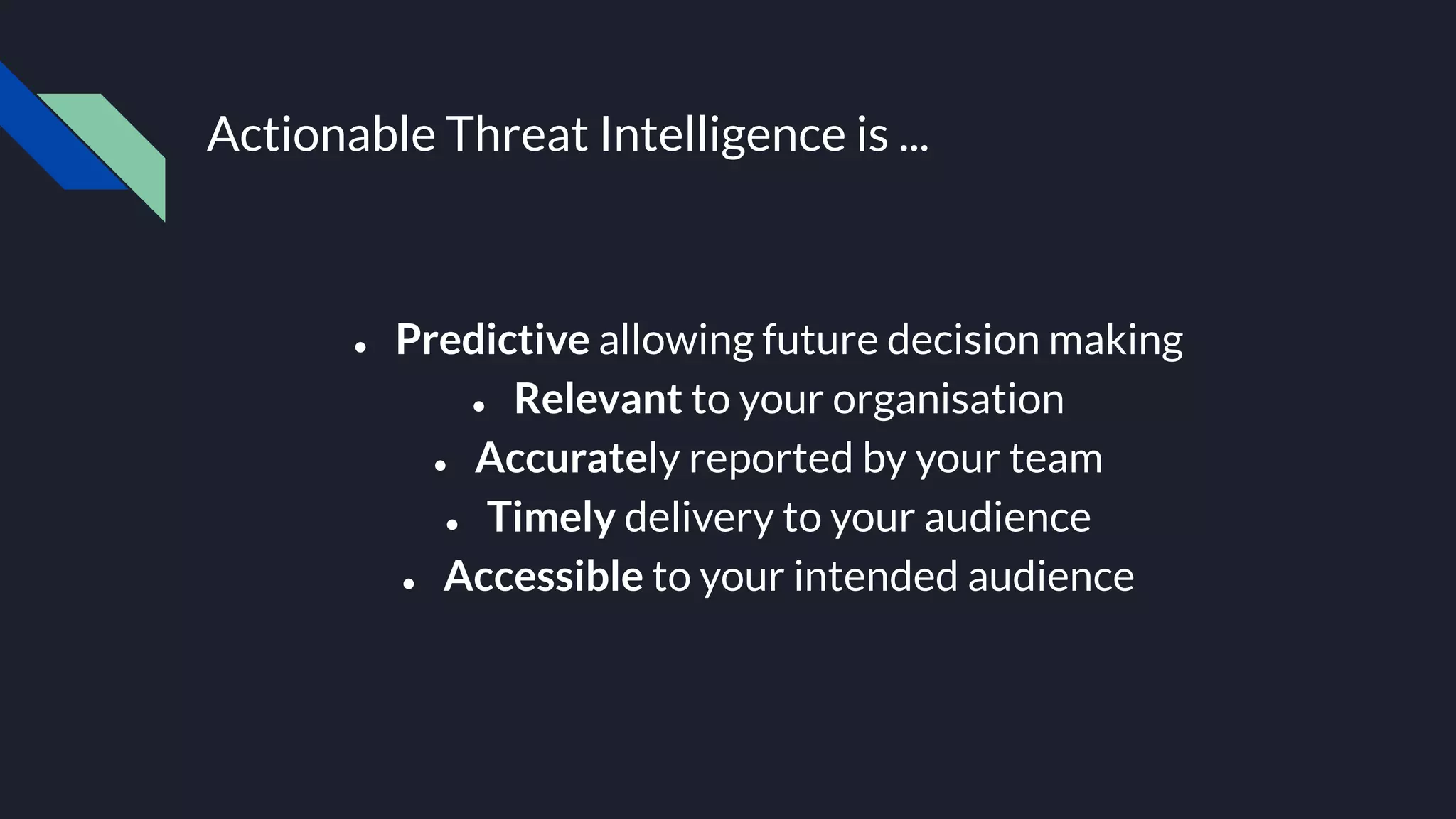
● Predictive allowing future decision making
● Relevant to your organisation
● Accurately reported by your team
● Timely delivery to your audience
● Accessible to your intended audience
Actionable Threat Intelligence is ...
What data sources types
support a CTI capability?
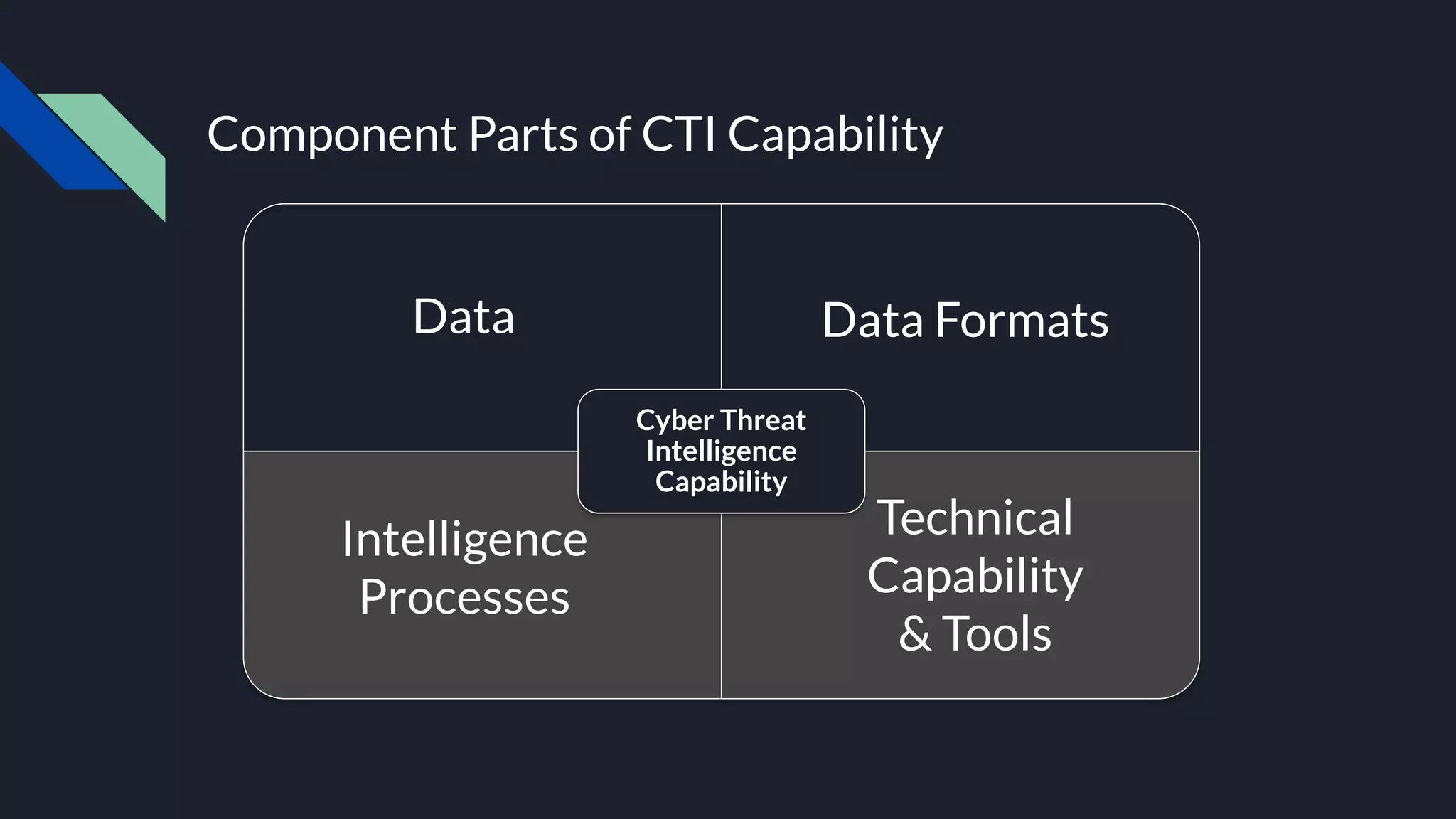
Component Parts of CTI Capability
Cyber Threat
Intelligence
Capability
Data Data Formats
Intelligence
Processes
Technical
Capability
& Tools
If you know the enemy and know
yourself, you need not fear the result
of a hundred battles. If you know
yourself but not the enemy, for every
victory gained you will also suffer a
defeat. If you know neither the enemy
nor yourself, you will succumb in every
battle.
- Sun Tzu
External
● External Threat Intelligence
○ External threat information that allows
you to identify potential future threats
from “patient zero” or provide context
about previous threats
● External Enrichment
○ Information about external networks,
business processes, people and data.
Internal
● Internal Incident and Event Data
○ Events occurring on your network, as well
as any identified security incidents.
● Internal Enrichment
○ Information about your IT networks,
business processes, people and data.
Data
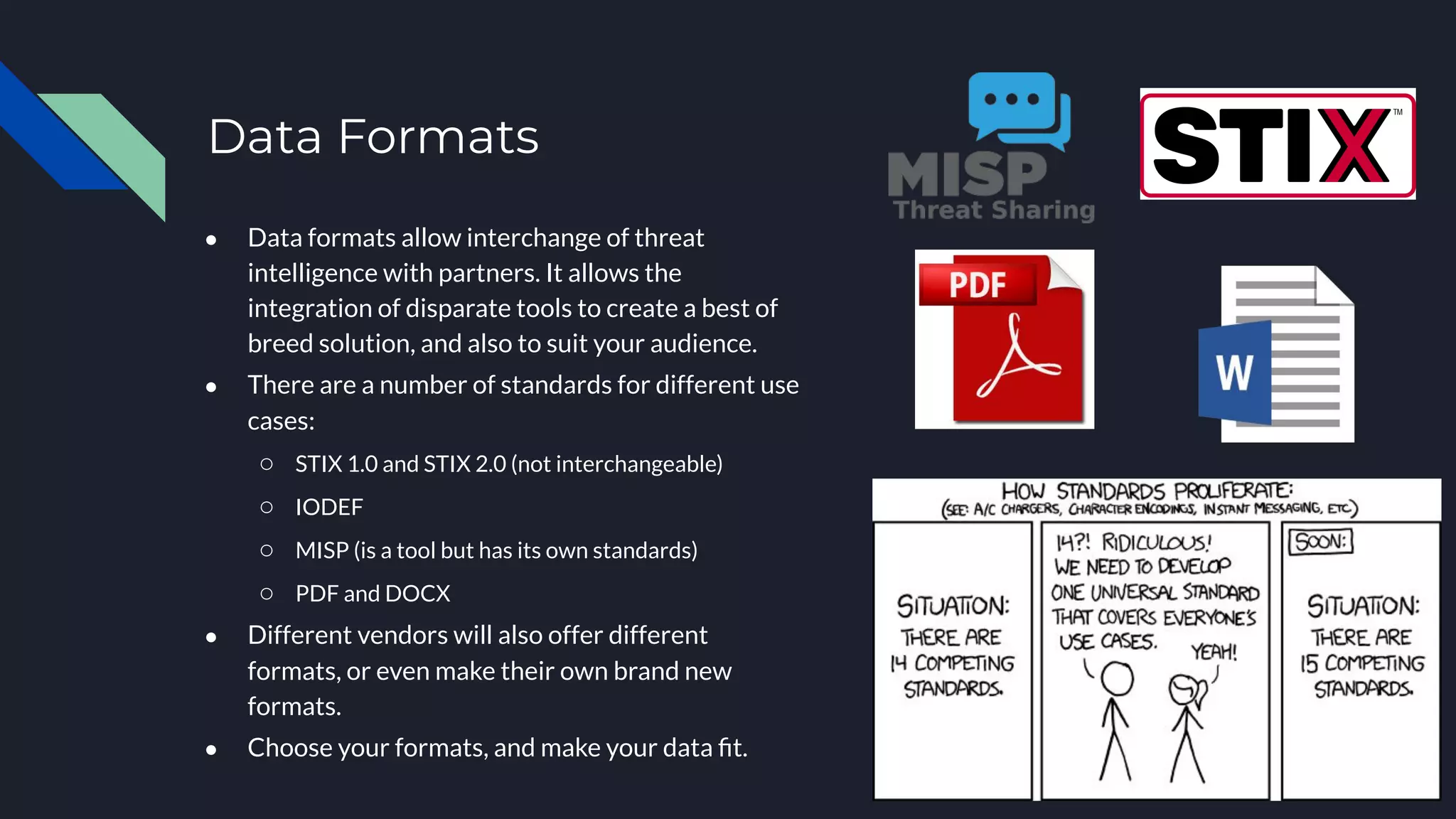
● Data formats allow interchange of threat
intelligence with partners. It allows the
integration of disparate tools to create a best of
breed solution, and also to suit your audience.
● There are a number of standards for different use
cases:
○ STIX 1.0 and STIX 2.0 (not interchangeable)
○ IODEF
○ MISP (is a tool but has its own standards)
○ PDF and DOCX
● Different vendors will also offer different
formats, or even make their own brand new
formats.
● Choose your formats, and make your data fit.
Data Formats
What are the Lockheed
Martin Cyber Kill Chain and
Diamond Model?
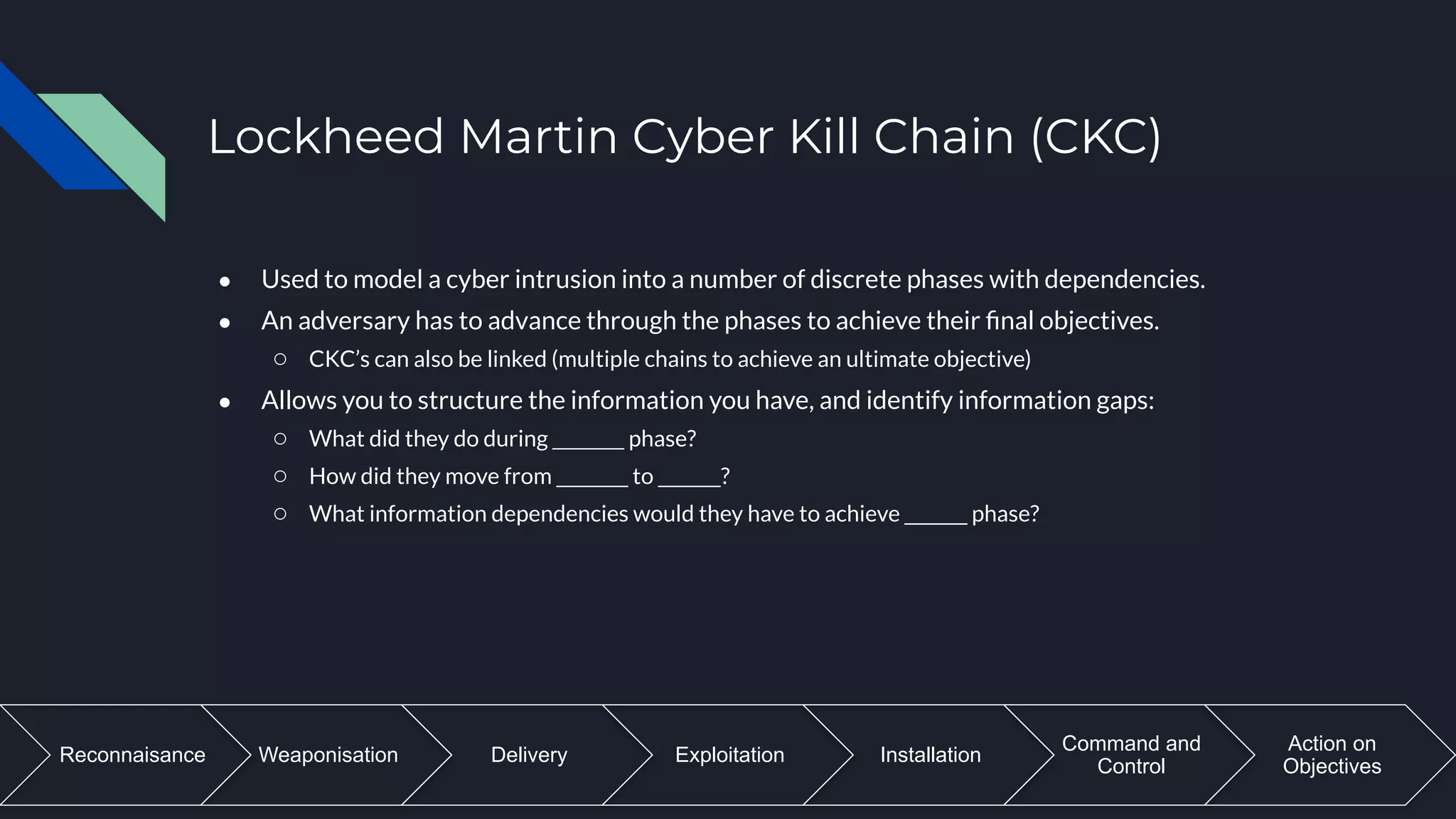
Weaponisation Delivery Exploitation Installation
Command and
Control
Action on
Objectives
Reconnaisance
Lockheed Martin Cyber Kill Chain (CKC)
● Used to model a cyber intrusion into a number of discrete phases with dependencies.
● An adversary has to advance through the phases to achieve their final objectives.
○ CKC’s can also be linked (multiple chains to achieve an ultimate objective)
● Allows you to structure the information you have, and identify information gaps:
○ What did they do during ________ phase?
○ How did they move from ________ to _______?
○ What information dependencies would they have to achieve _______ phase?
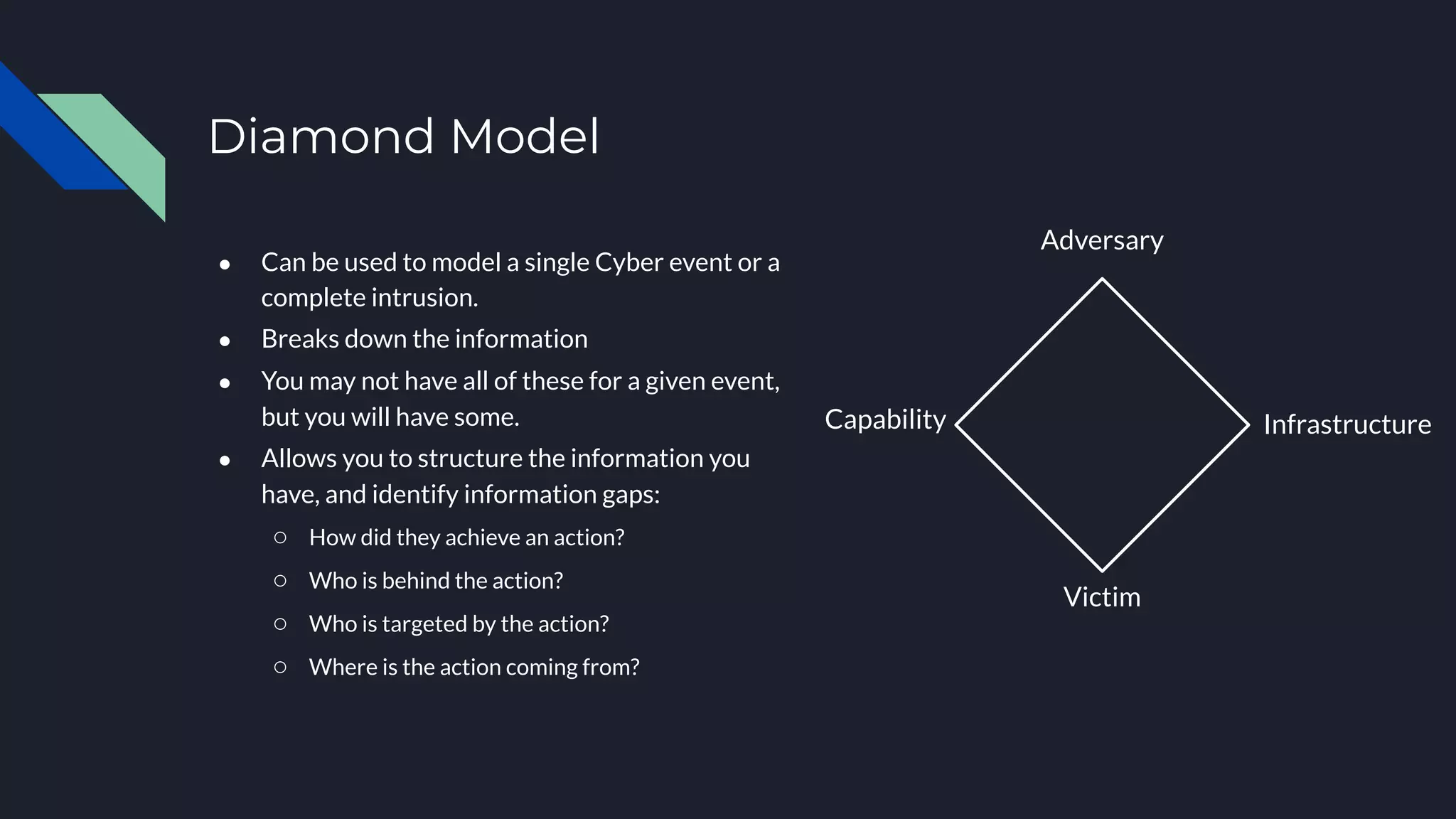
Infrastructure
Adversary
Victim
Capability
● Can be used to model a single Cyber event or a
complete intrusion.
● Breaks down the information
● You may not have all of these for a given event,
but you will have some.
● Allows you to structure the information you
have, and identify information gaps:
○ How did they achieve an action?
○ Who is behind the action?
○ Who is targeted by the action?
○ Where is the action coming from?
Diamond Model
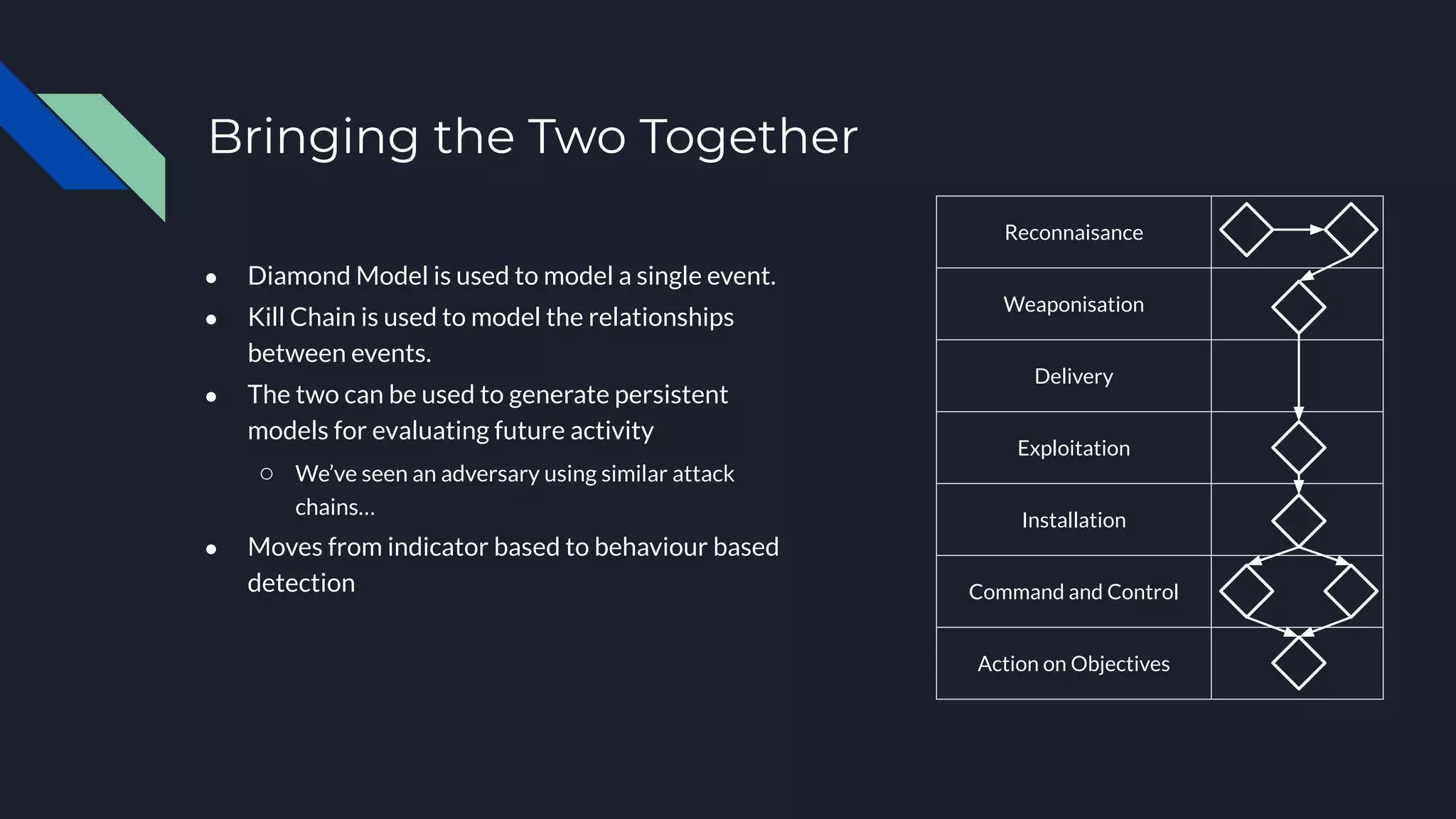
● Diamond Model is used to model a single event.
● Kill Chain is used to model the relationships
between events.
● The two can be used to generate persistent
models for evaluating future activity
○ We’ve seen an adversary using similar attack
chains…
● Moves from indicator based to behaviour based
detection
Analysis and Triage of Advanced Hacking Groups Targeting Western Countries Critical National Infrastructure:
APT28, RED October, and Regin: Theories, Methods, Tools and Technologies
Reconnaisance
Weaponisation
Delivery
Exploitation
Installation
Command and Control
Action on Objectives
Bringing the Two Together
What data is required to
generate actionable CTI?
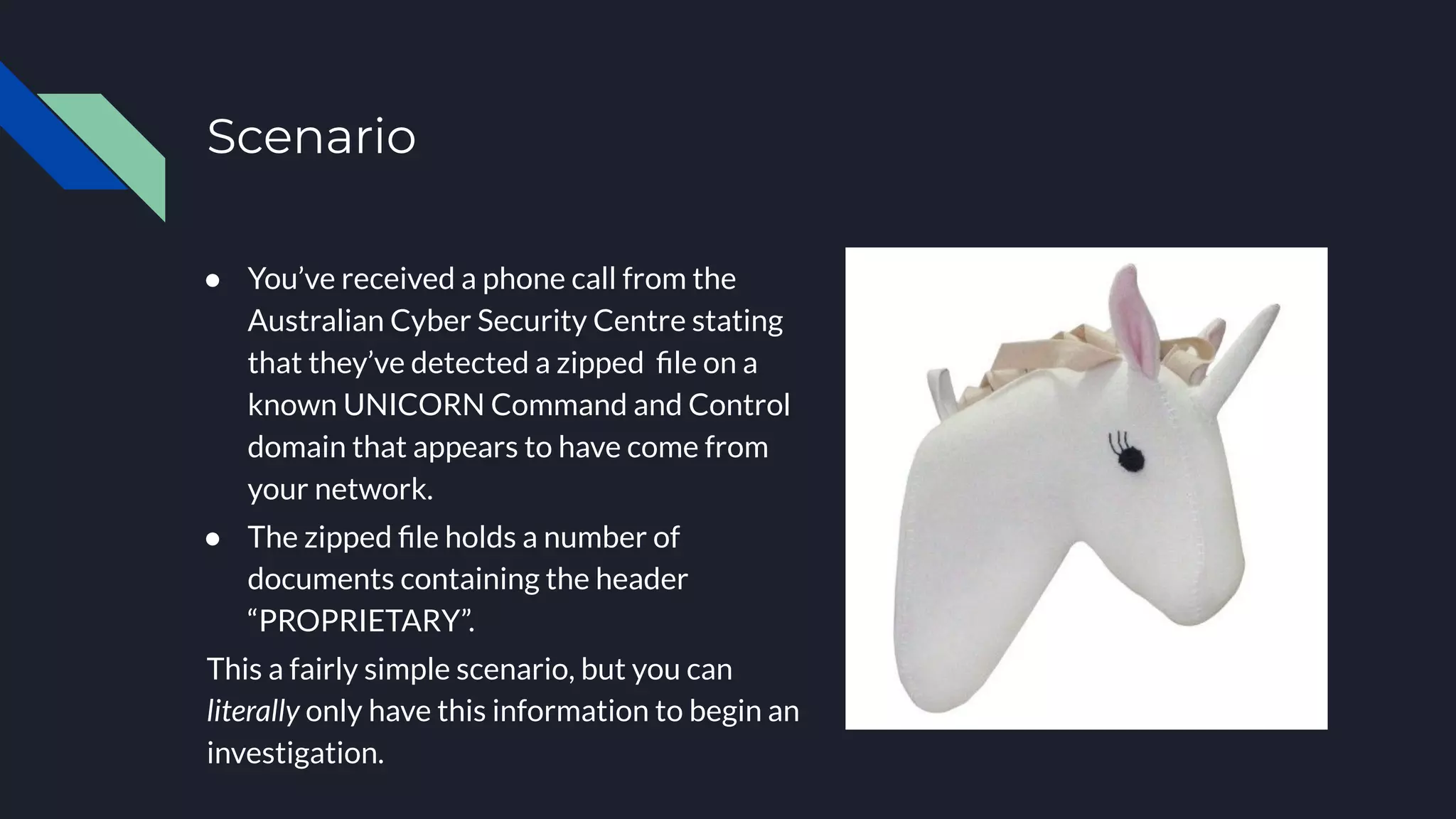
● You’ve received a phone call from the
Australian Cyber Security Centre stating
that they’ve detected a zipped file on a
known UNICORN Command and Control
domain that appears to have come from
your network.
● The zipped file holds a number of
documents containing the header
“PROPRIETARY”.
This a fairly simple scenario, but you can
literally only have this information to begin an
investigation.
Scenario
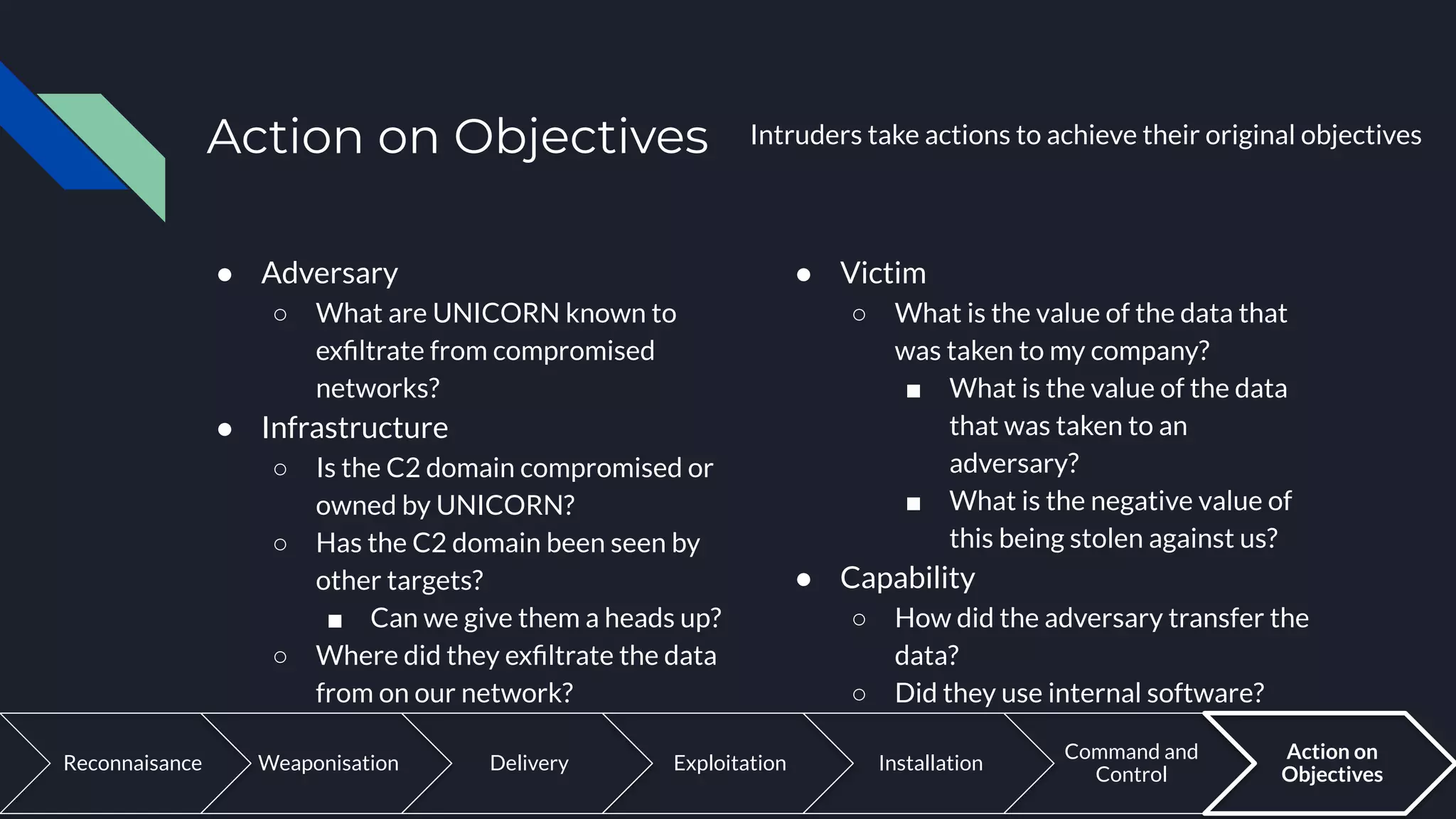
● Adversary
○ What are UNICORN known to
exfiltrate from compromised
networks?
● Infrastructure
○ Is the C2 domain compromised or
owned by UNICORN?
○ Has the C2 domain been seen by
other targets?
■ Can we give them a heads up?
○ Where did they exfiltrate the data
from on our network?
Action on Objectives
● Victim
○ What is the value of the data that
was taken to my company?
■ What is the value of the data
that was taken to an
adversary?
■ What is the negative value of
this being stolen against us?
● Capability
○ How did the adversary transfer the
data?
○ Did they use internal software?
Intruders take actions to achieve their original objectives
Weaponisation Delivery Exploitation Installation
Command and
Control
Action on
Objectives
Reconnaisance
Action on Objectives
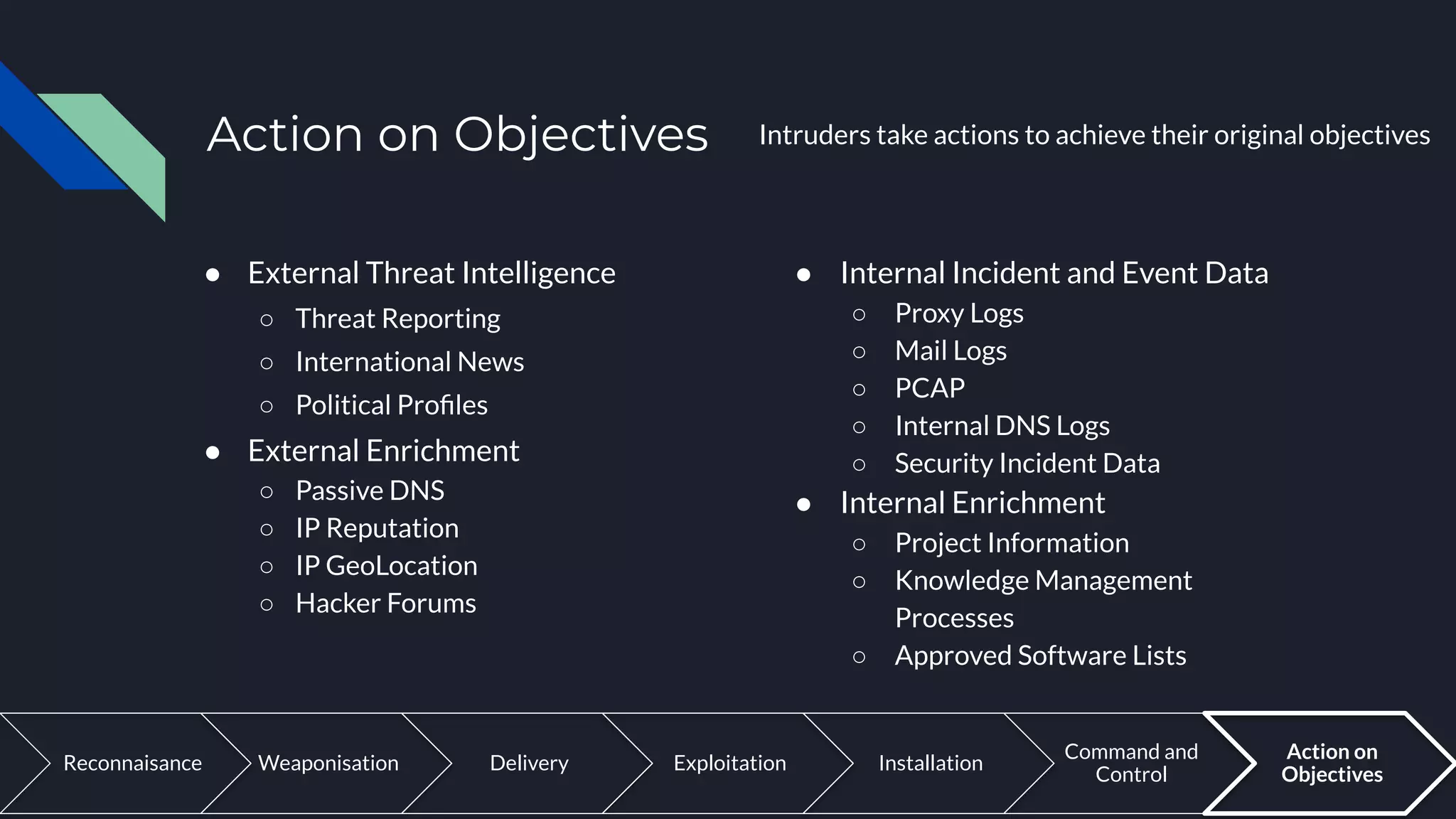
● Internal Incident and Event Data
○ Proxy Logs
○ Mail Logs
○ PCAP
○ Internal DNS Logs
○ Security Incident Data
● Internal Enrichment
○ Project Information
○ Knowledge Management
Processes
○ Approved Software Lists
Intruders take actions to achieve their original objectives
● External Threat Intelligence
○ Threat Reporting
○ International News
○ Political Profiles
● External Enrichment
○ Passive DNS
○ IP Reputation
○ IP GeoLocation
○ Hacker Forums
Weaponisation Delivery Exploitation Installation
Command and
Control
Action on
Objectives
Reconnaisance
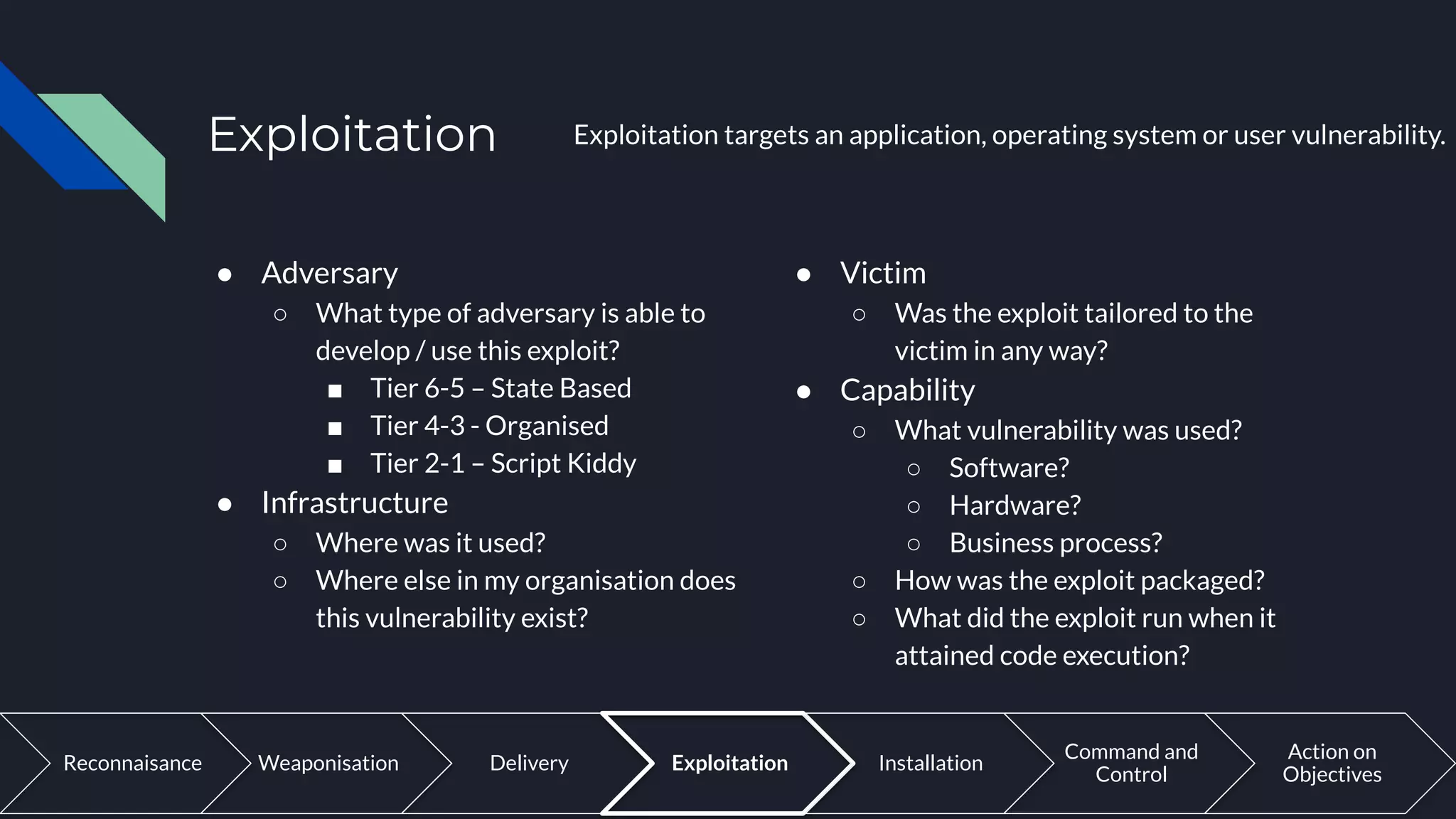
Exploitation Exploitation targets an application, operating system or user vulnerability.
Weaponisation Delivery Exploitation Installation
Command and
Control
Action on
Objectives
Reconnaisance
● Adversary
○ What type of adversary is able to
develop / use this exploit?
■ Tier 6-5 – State Based
■ Tier 4-3 - Organised
■ Tier 2-1 – Script Kiddy
● Infrastructure
○ Where was it used?
○ Where else in my organisation does
this vulnerability exist?
● Victim
○ Was the exploit tailored to the
victim in any way?
● Capability
○ What vulnerability was used?
○ Software?
○ Hardware?
○ Business process?
○ How was the exploit packaged?
○ What did the exploit run when it
attained code execution?
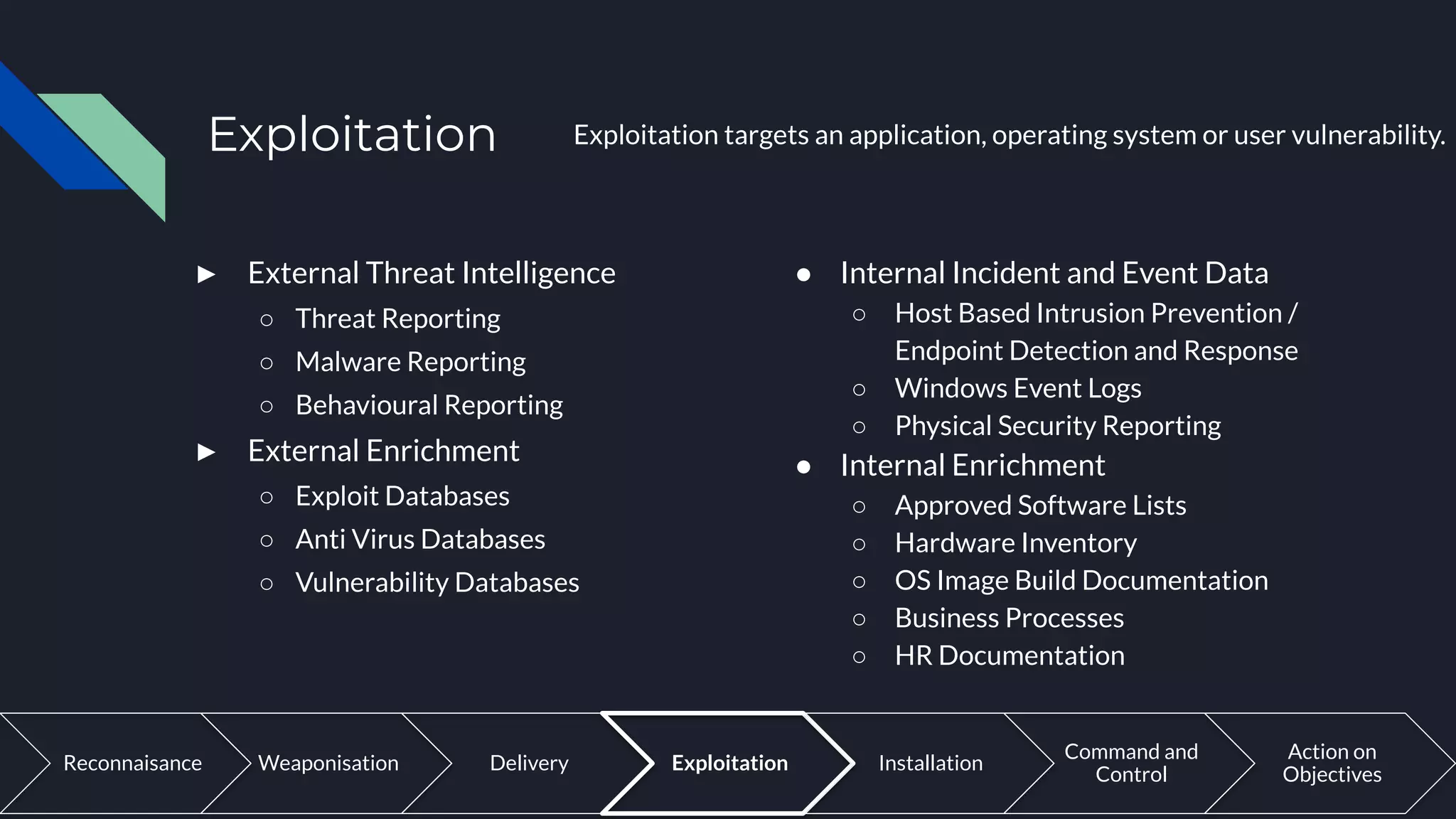
Exploitation Exploitation targets an application, operating system or user vulnerability.
Weaponisation Delivery Exploitation Installation
Command and
Control
Action on
Objectives
Reconnaisance
● Internal Incident and Event Data
○ Host Based Intrusion Prevention /
Endpoint Detection and Response
○ Windows Event Logs
○ Physical Security Reporting
● Internal Enrichment
○ Approved Software Lists
○ Hardware Inventory
○ OS Image Build Documentation
○ Business Processes
○ HR Documentation
▶ External Threat Intelligence
○ Threat Reporting
○ Malware Reporting
○ Behavioural Reporting
▶ External Enrichment
○ Exploit Databases
○ Anti Virus Databases
○ Vulnerability Databases
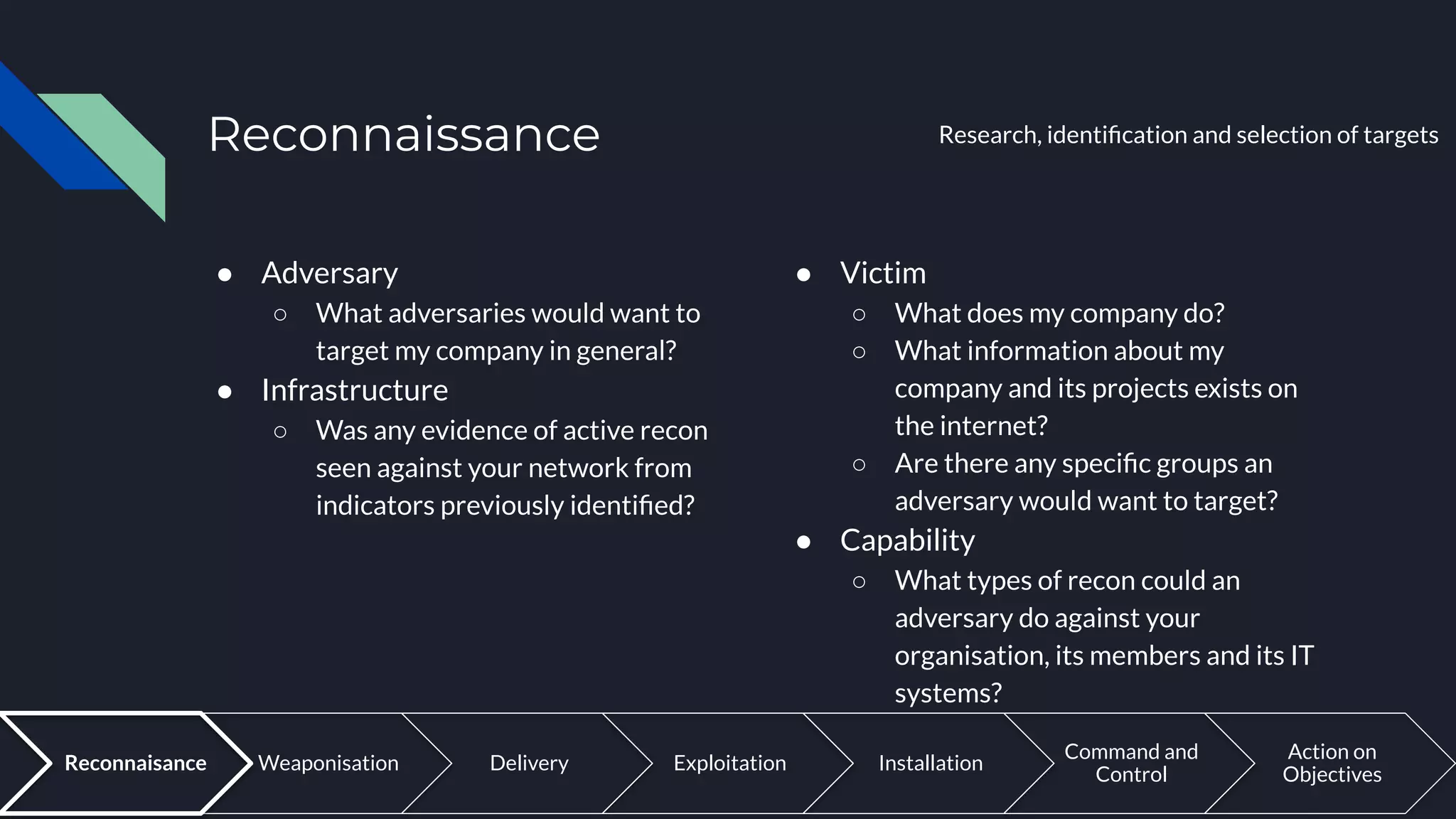
Reconnaissance Research, identification and selection of targets
Weaponisation Delivery Exploitation Installation
Command and
Control
Action on
Objectives
Reconnaisance
● Adversary
○ What adversaries would want to
target my company in general?
● Infrastructure
○ Was any evidence of active recon
seen against your network from
indicators previously identified?
● Victim
○ What does my company do?
○ What information about my
company and its projects exists on
the internet?
○ Are there any specific groups an
adversary would want to target?
● Capability
○ What types of recon could an
adversary do against your
organisation, its members and its IT
systems?
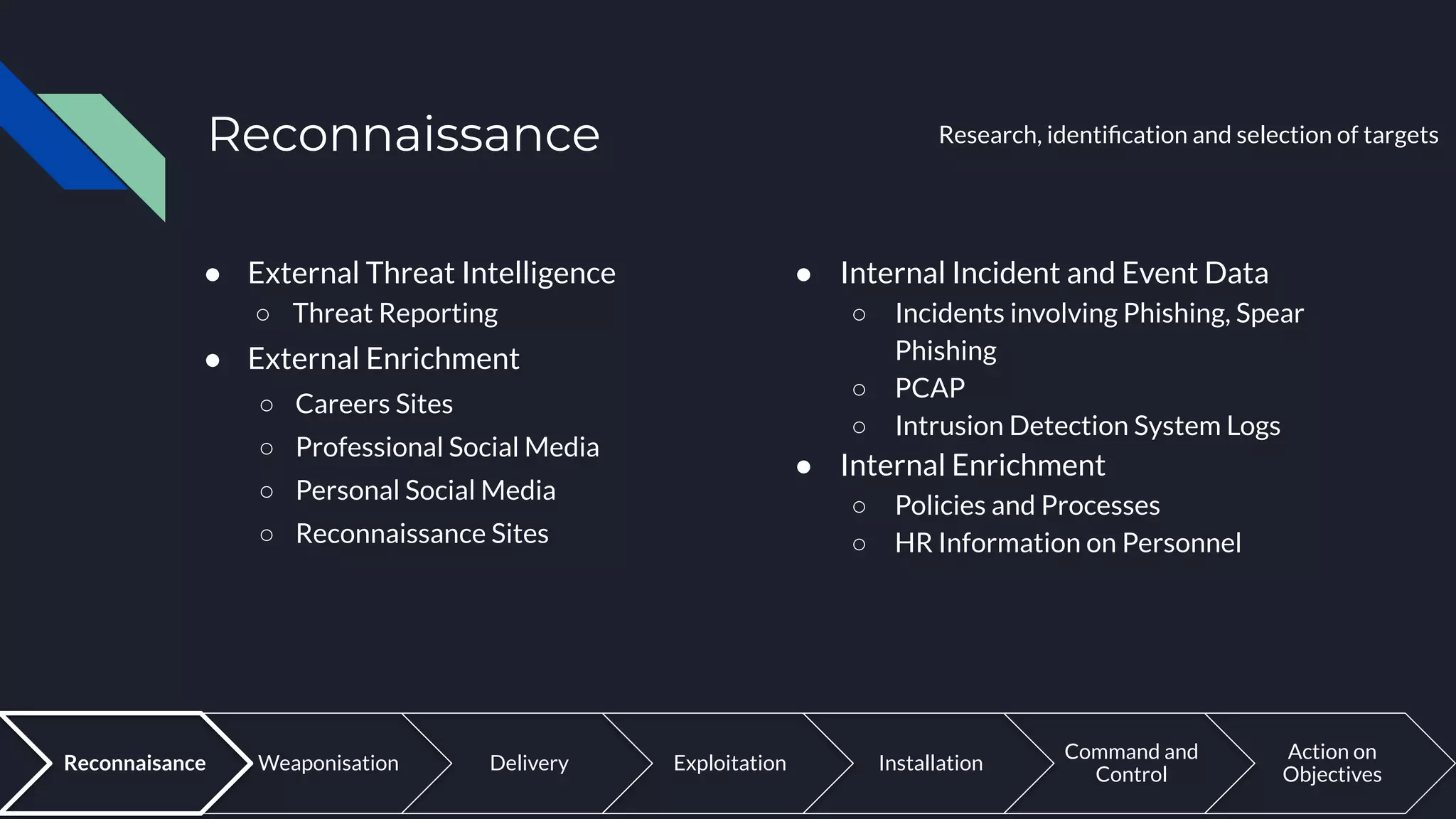
Reconnaissance Research, identification and selection of targets
Weaponisation Delivery Exploitation Installation
Command and
Control
Action on
Objectives
Reconnaisance
● Internal Incident and Event Data
○ Incidents involving Phishing, Spear
Phishing
○ PCAP
○ Intrusion Detection System Logs
● Internal Enrichment
○ Policies and Processes
○ HR Information on Personnel
● External Threat Intelligence
○ Threat Reporting
● External Enrichment
○ Careers Sites
○ Professional Social Media
○ Personal Social Media
○ Reconnaissance Sites
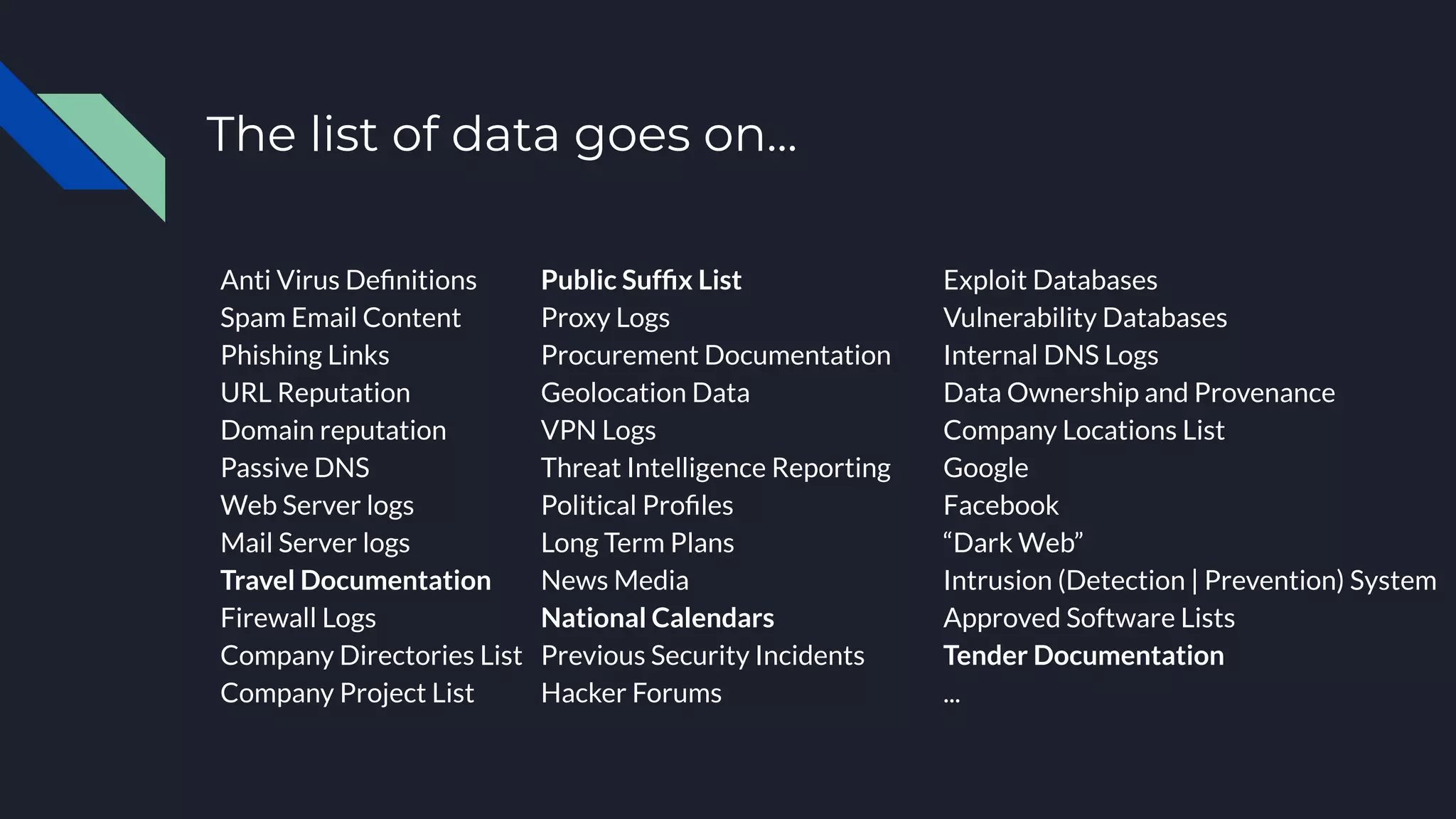
The list of data goes on...
Anti Virus Definitions
Spam Email Content
Phishing Links
URL Reputation
Domain reputation
Passive DNS
Web Server logs
Mail Server logs
Travel Documentation
Firewall Logs
Company Directories List
Company Project List
Public Suffix List
Proxy Logs
Procurement Documentation
Geolocation Data
VPN Logs
Threat Intelligence Reporting
Political Profiles
Long Term Plans
News Media
National Calendars
Previous Security Incidents
Hacker Forums
Exploit Databases
Vulnerability Databases
Internal DNS Logs
Data Ownership and Provenance
Company Locations List
Google
Facebook
“Dark Web”
Intrusion (Detection | Prevention) System
Approved Software Lists
Tender Documentation
...
How does actionable Cyber
Threat Intelligence support
Defensive Cyber Ops?
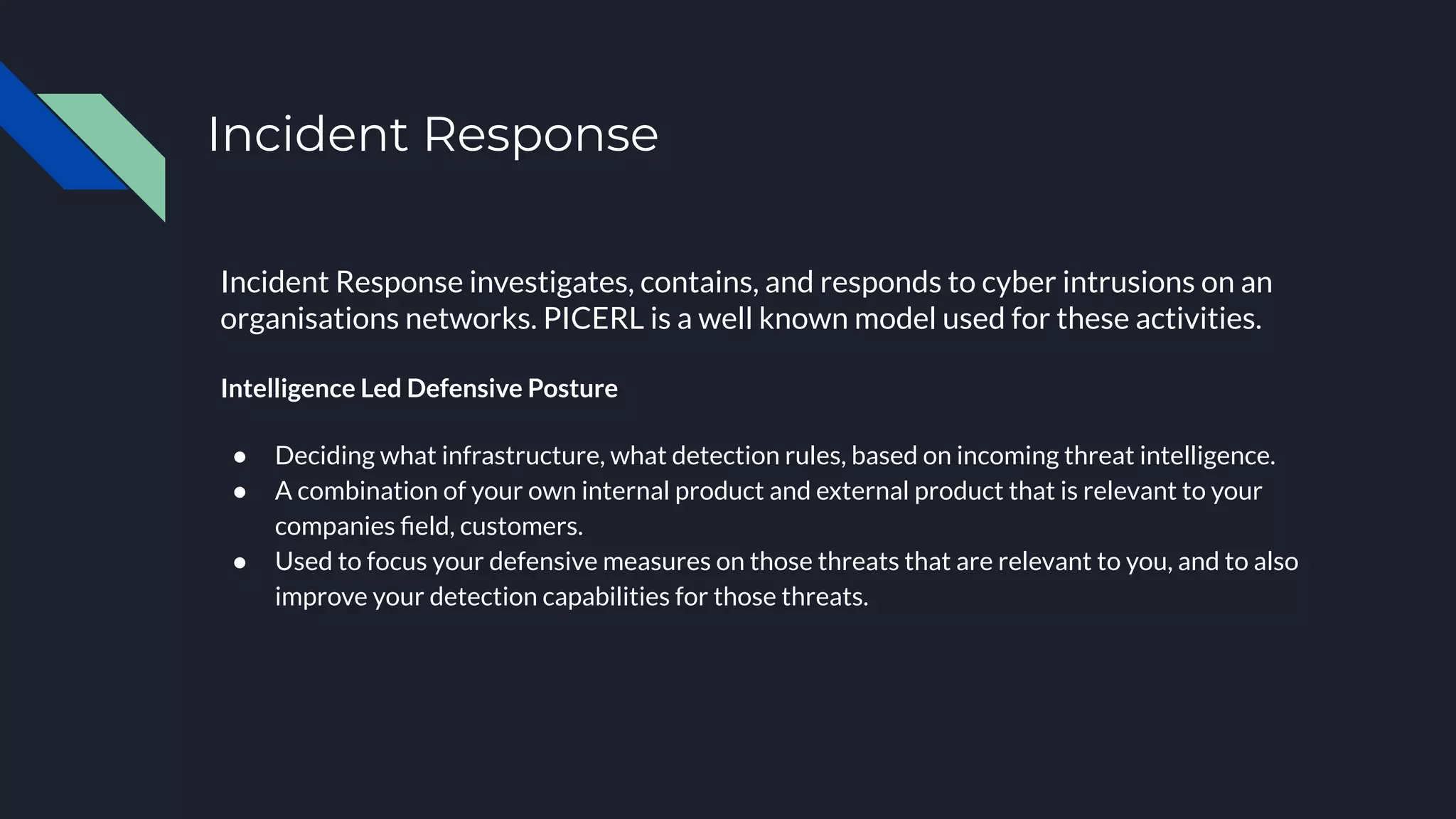
Incident Response
Incident Response investigates, contains, and responds to cyber intrusions on an
organisations networks. PICERL is a well known model used for these activities.
Intelligence Led Defensive Posture
● Deciding what infrastructure, what detection rules, based on incoming threat intelligence.
● A combination of your own internal product and external product that is relevant to your
companies field, customers.
● Used to focus your defensive measures on those threats that are relevant to you, and to also
improve your detection capabilities for those threats.
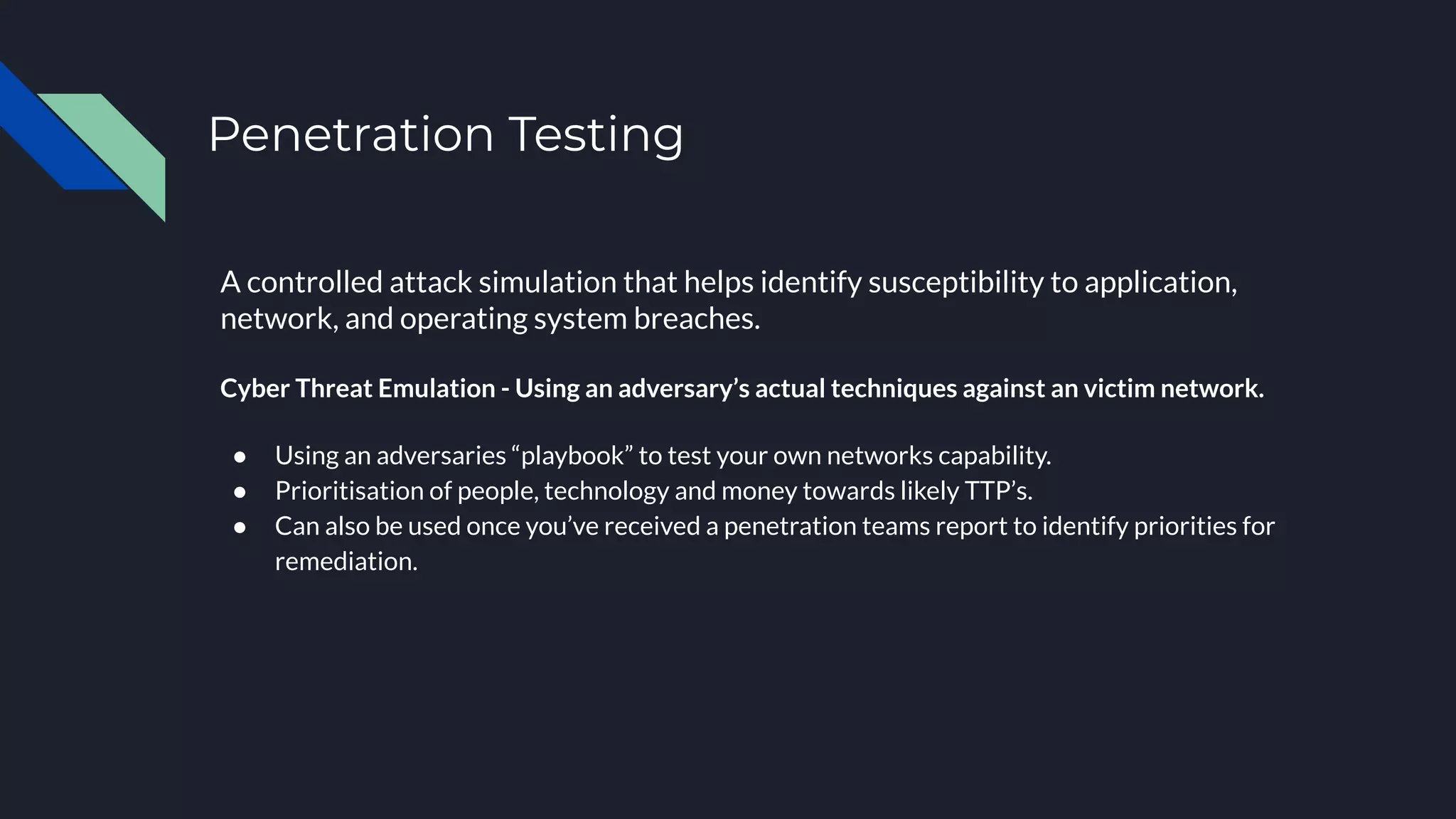
Penetration Testing
A controlled attack simulation that helps identify susceptibility to application,
network, and operating system breaches. 
Cyber Threat Emulation - Using an adversary’s actual techniques against an victim network.
● Using an adversaries “playbook” to test your own networks capability.
● Prioritisation of people, technology and money towards likely TTP’s.
● Can also be used once you’ve received a penetration teams report to identify priorities for
remediation.
In closing
Summary
● Cyber Threat Intelligence enables decision making. It allows you to fully understand risk in your
environment appropriately.
● It’s supported by a number of different data sources, both internal and external.
● The Lockheed Martin Cyber Kill Chain and Diamond Model can help you structure your
investigations, and then identify your information gaps before providing an end product.
● CTI can support defensive cyber operations in both a proactive and reactive manner, enabling
decisions to be made about improving a networks defensive posture.
31
Thanks!
Intelligence-Driven Computer Network Defense Informed by Analysis of Adversary Campaigns
and Intrusion Kill Chains
https://www.lockheedmartin.com/content/dam/lockheed-martin/rms/documents/cyber/LM-White-Pa
per-Intel-Driven-Defense.pdf
Diamond Model for Intrusion Analysis
https://apps.dtic.mil/dtic/tr/fulltext/u2/a586960.pdf
Little Bobby Comics
https://www.littlebobbycomic.com
icd@wan0.net
@wan0net

Cyber Threat Intelligence - It's not just about the feeds

  • 1.
    Cyber Threat Intelligence: It’snot just about the Feeds Iain Dickson @wan0net Unless otherwise specified, this work is licensed under the Creative Commons Attribution-ShareAlike 4.0 International License. To view a copy of this license, visit http://creativecommons.org/licenses/by-sa/4.0/ or send a letter to Creative Commons, PO Box 1866, Mountain View, CA 94042, USA.
  • 2.
    ● What isCyber Threat Intelligence? ● What data source types support a CTI capability? ● What are the Lockheed Martin Cyber Kill Chain and Diamond Model? ● What data is required to generate actionable CTI? ● How does Cyber Threat Intelligence Support Defensive Cyber Ops? What will I be covering?
  • 3.
    What is CyberThreat Intelligence?
  • 4.
    Threat information thathas been aggregated, transformed, analysed, interpreted, or enriched to provide the necessary context for decision-making processes. NIST 800-150 “Guide to Threat Information Sharing”
  • 5.
    Risk A measure ofthe extent to which an entity is threatened by a potential circumstance or event. Threat, Vulnerability, and Risk Vulnerability Weakness in an information system, system security procedures, internal controls, or implementation that could be exploited or triggered. Threat Any circumstance or event with the potential to adversely impact organizational operations, assets, or individuals.
  • 6.
    Capability, Intent, Opportunity VulnerabilityRisk Intent The goal of the adversary Capability The ability of an adversary to successfully achieve a desired effect Threat Opportunity Timing and knowledge of the target space
  • 7.
    Threat Actor Tiers TierVI Nations, Global 25 Tier V Nations, Global 150, State Sponsored Tier IV Organised Crime, Cyber Mercenaries Tier III Crime Groups, Hacktivists Tier II Criminals, Disgruntled Workers. Programmers Tier I Script Kiddies, Non Malicious Actors Volume Resources Creates Vulnerabilities using Full Spectrum Discovers Unknown Vulnerabilities Exploits pre-existing, known vulnerabilities https://nsarchive2.gwu.edu/NSAEBB/NSAEBB424/docs/Cyber-081.pdf
  • 8.
    ● Predictive allowingfuture decision making ● Relevant to your organisation ● Accurately reported by your team ● Timely delivery to your audience ● Accessible to your intended audience Actionable Threat Intelligence is ...
  • 9.
    What data sourcestypes support a CTI capability?
  • 10.
    Component Parts ofCTI Capability Cyber Threat Intelligence Capability Data Data Formats Intelligence Processes Technical Capability & Tools
  • 11.
    If you knowthe enemy and know yourself, you need not fear the result of a hundred battles. If you know yourself but not the enemy, for every victory gained you will also suffer a defeat. If you know neither the enemy nor yourself, you will succumb in every battle. - Sun Tzu
  • 12.
    External ● External ThreatIntelligence ○ External threat information that allows you to identify potential future threats from “patient zero” or provide context about previous threats ● External Enrichment ○ Information about external networks, business processes, people and data. Internal ● Internal Incident and Event Data ○ Events occurring on your network, as well as any identified security incidents. ● Internal Enrichment ○ Information about your IT networks, business processes, people and data. Data
  • 13.
    ● Data formatsallow interchange of threat intelligence with partners. It allows the integration of disparate tools to create a best of breed solution, and also to suit your audience. ● There are a number of standards for different use cases: ○ STIX 1.0 and STIX 2.0 (not interchangeable) ○ IODEF ○ MISP (is a tool but has its own standards) ○ PDF and DOCX ● Different vendors will also offer different formats, or even make their own brand new formats. ● Choose your formats, and make your data fit. Data Formats
  • 14.
    What are theLockheed Martin Cyber Kill Chain and Diamond Model?
  • 15.
    Weaponisation Delivery ExploitationInstallation Command and Control Action on Objectives Reconnaisance Lockheed Martin Cyber Kill Chain (CKC) ● Used to model a cyber intrusion into a number of discrete phases with dependencies. ● An adversary has to advance through the phases to achieve their final objectives. ○ CKC’s can also be linked (multiple chains to achieve an ultimate objective) ● Allows you to structure the information you have, and identify information gaps: ○ What did they do during ________ phase? ○ How did they move from ________ to _______? ○ What information dependencies would they have to achieve _______ phase?
  • 16.
    Infrastructure Adversary Victim Capability ● Can beused to model a single Cyber event or a complete intrusion. ● Breaks down the information ● You may not have all of these for a given event, but you will have some. ● Allows you to structure the information you have, and identify information gaps: ○ How did they achieve an action? ○ Who is behind the action? ○ Who is targeted by the action? ○ Where is the action coming from? Diamond Model
  • 17.
    ● Diamond Modelis used to model a single event. ● Kill Chain is used to model the relationships between events. ● The two can be used to generate persistent models for evaluating future activity ○ We’ve seen an adversary using similar attack chains… ● Moves from indicator based to behaviour based detection Analysis and Triage of Advanced Hacking Groups Targeting Western Countries Critical National Infrastructure: APT28, RED October, and Regin: Theories, Methods, Tools and Technologies Reconnaisance Weaponisation Delivery Exploitation Installation Command and Control Action on Objectives Bringing the Two Together
  • 18.
    What data isrequired to generate actionable CTI?
  • 19.
    ● You’ve receiveda phone call from the Australian Cyber Security Centre stating that they’ve detected a zipped file on a known UNICORN Command and Control domain that appears to have come from your network. ● The zipped file holds a number of documents containing the header “PROPRIETARY”. This a fairly simple scenario, but you can literally only have this information to begin an investigation. Scenario
  • 20.
    ● Adversary ○ Whatare UNICORN known to exfiltrate from compromised networks? ● Infrastructure ○ Is the C2 domain compromised or owned by UNICORN? ○ Has the C2 domain been seen by other targets? ■ Can we give them a heads up? ○ Where did they exfiltrate the data from on our network? Action on Objectives ● Victim ○ What is the value of the data that was taken to my company? ■ What is the value of the data that was taken to an adversary? ■ What is the negative value of this being stolen against us? ● Capability ○ How did the adversary transfer the data? ○ Did they use internal software? Intruders take actions to achieve their original objectives Weaponisation Delivery Exploitation Installation Command and Control Action on Objectives Reconnaisance
  • 21.
    Action on Objectives ●Internal Incident and Event Data ○ Proxy Logs ○ Mail Logs ○ PCAP ○ Internal DNS Logs ○ Security Incident Data ● Internal Enrichment ○ Project Information ○ Knowledge Management Processes ○ Approved Software Lists Intruders take actions to achieve their original objectives ● External Threat Intelligence ○ Threat Reporting ○ International News ○ Political Profiles ● External Enrichment ○ Passive DNS ○ IP Reputation ○ IP GeoLocation ○ Hacker Forums Weaponisation Delivery Exploitation Installation Command and Control Action on Objectives Reconnaisance
  • 22.
    Exploitation Exploitation targetsan application, operating system or user vulnerability. Weaponisation Delivery Exploitation Installation Command and Control Action on Objectives Reconnaisance ● Adversary ○ What type of adversary is able to develop / use this exploit? ■ Tier 6-5 – State Based ■ Tier 4-3 - Organised ■ Tier 2-1 – Script Kiddy ● Infrastructure ○ Where was it used? ○ Where else in my organisation does this vulnerability exist? ● Victim ○ Was the exploit tailored to the victim in any way? ● Capability ○ What vulnerability was used? ○ Software? ○ Hardware? ○ Business process? ○ How was the exploit packaged? ○ What did the exploit run when it attained code execution?
  • 23.
    Exploitation Exploitation targetsan application, operating system or user vulnerability. Weaponisation Delivery Exploitation Installation Command and Control Action on Objectives Reconnaisance ● Internal Incident and Event Data ○ Host Based Intrusion Prevention / Endpoint Detection and Response ○ Windows Event Logs ○ Physical Security Reporting ● Internal Enrichment ○ Approved Software Lists ○ Hardware Inventory ○ OS Image Build Documentation ○ Business Processes ○ HR Documentation ▶ External Threat Intelligence ○ Threat Reporting ○ Malware Reporting ○ Behavioural Reporting ▶ External Enrichment ○ Exploit Databases ○ Anti Virus Databases ○ Vulnerability Databases
  • 24.
    Reconnaissance Research, identificationand selection of targets Weaponisation Delivery Exploitation Installation Command and Control Action on Objectives Reconnaisance ● Adversary ○ What adversaries would want to target my company in general? ● Infrastructure ○ Was any evidence of active recon seen against your network from indicators previously identified? ● Victim ○ What does my company do? ○ What information about my company and its projects exists on the internet? ○ Are there any specific groups an adversary would want to target? ● Capability ○ What types of recon could an adversary do against your organisation, its members and its IT systems?
  • 25.
    Reconnaissance Research, identificationand selection of targets Weaponisation Delivery Exploitation Installation Command and Control Action on Objectives Reconnaisance ● Internal Incident and Event Data ○ Incidents involving Phishing, Spear Phishing ○ PCAP ○ Intrusion Detection System Logs ● Internal Enrichment ○ Policies and Processes ○ HR Information on Personnel ● External Threat Intelligence ○ Threat Reporting ● External Enrichment ○ Careers Sites ○ Professional Social Media ○ Personal Social Media ○ Reconnaissance Sites
  • 26.
    The list ofdata goes on... Anti Virus Definitions Spam Email Content Phishing Links URL Reputation Domain reputation Passive DNS Web Server logs Mail Server logs Travel Documentation Firewall Logs Company Directories List Company Project List Public Suffix List Proxy Logs Procurement Documentation Geolocation Data VPN Logs Threat Intelligence Reporting Political Profiles Long Term Plans News Media National Calendars Previous Security Incidents Hacker Forums Exploit Databases Vulnerability Databases Internal DNS Logs Data Ownership and Provenance Company Locations List Google Facebook “Dark Web” Intrusion (Detection | Prevention) System Approved Software Lists Tender Documentation ...
  • 27.
    How does actionableCyber Threat Intelligence support Defensive Cyber Ops?
  • 28.
    Incident Response Incident Responseinvestigates, contains, and responds to cyber intrusions on an organisations networks. PICERL is a well known model used for these activities. Intelligence Led Defensive Posture ● Deciding what infrastructure, what detection rules, based on incoming threat intelligence. ● A combination of your own internal product and external product that is relevant to your companies field, customers. ● Used to focus your defensive measures on those threats that are relevant to you, and to also improve your detection capabilities for those threats.
  • 29.
    Penetration Testing A controlledattack simulation that helps identify susceptibility to application, network, and operating system breaches.  Cyber Threat Emulation - Using an adversary’s actual techniques against an victim network. ● Using an adversaries “playbook” to test your own networks capability. ● Prioritisation of people, technology and money towards likely TTP’s. ● Can also be used once you’ve received a penetration teams report to identify priorities for remediation.
  • 30.
  • 31.
    Summary ● Cyber ThreatIntelligence enables decision making. It allows you to fully understand risk in your environment appropriately. ● It’s supported by a number of different data sources, both internal and external. ● The Lockheed Martin Cyber Kill Chain and Diamond Model can help you structure your investigations, and then identify your information gaps before providing an end product. ● CTI can support defensive cyber operations in both a proactive and reactive manner, enabling decisions to be made about improving a networks defensive posture. 31
  • 32.
    Thanks! Intelligence-Driven Computer NetworkDefense Informed by Analysis of Adversary Campaigns and Intrusion Kill Chains https://www.lockheedmartin.com/content/dam/lockheed-martin/rms/documents/cyber/LM-White-Pa per-Intel-Driven-Defense.pdf Diamond Model for Intrusion Analysis https://apps.dtic.mil/dtic/tr/fulltext/u2/a586960.pdf Little Bobby Comics https://www.littlebobbycomic.com icd@wan0.net @wan0net