
CYBER SECURITY
AND
DATA PROTECTION
By
Dr. Hemant Kumar Singh
Associate Professor & Head,
Deptt. of Computer Science & Engineering
INDEX
INTRODUCTION
IMPORTANCE/NEED OF CYBER SECURITY
SECURITY THREATS TO DATA
THREATS AND SOLUTIONS
CYBER LAW
IT ACT 2000/2008
CONCLUSION
Digital Era
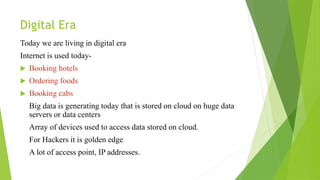
Today we are living in digital era
Internet is used today-
 Booking hotels
 Ordering foods
 Booking cabs
Big data is generating today that is stored on cloud on huge data
servers or data centers
Array of devices used to access data stored on cloud.
For Hackers it is golden edge
A lot of access point, IP addresses.
Introduction
 Cyber security is the practice of protecting information and data from
outside sources on the Internet. Cyber security professionals provide
protection for networks, servers, intranets and computer systems.
 It also ensures that only authorized people have access to that
information.
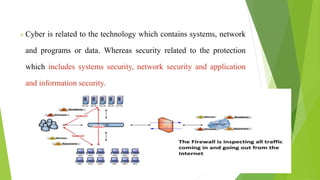
 Cyber is related to the technology which contains systems, network
and programs or data. Whereas security related to the protection
which includes systems security, network security and application
and information security.
Why is cyber security important?
 Cyber security is necessary since it helps in securing data from threats
such as data theft or misuse, also safeguards your system from viruses.
 We all live in a world which is networked together, from internet
banking to government infrastructure, where data is stored on
computers and other devices. A portion of that data can be sensitive
information, whether that be intellectual property, financial data,
personal information, or other types of data for which unauthorized
access or exposure could have negative consequences.
 Cyber-attack is now an international concern and has given many
concerns that hacks and other security attacks could endanger the
global economy. Organizations transmit sensitive data across
networks and to other devices in the course of doing businesses,
and cyber security describes to protect that information and the
systems used to process or store it.
History
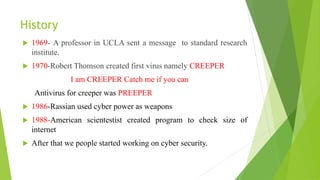
 1969- A professor in UCLA sent a message to standard research
institute.
 1970-Robert Thomson created first virus namely CREEPER
I am CREEPER Catch me if you can
Antivirus for creeper was PREEPER
 1986-Rassian used cyber power as weapons
 1988-American scientestist created program to check size of
internet
 After that we people started working on cyber security.
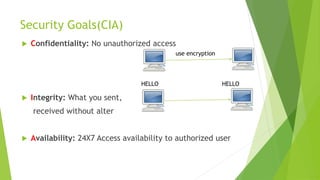
Security Goals(CIA)
 Confidentiality: No unauthorized access
 Integrity: What you sent,
received without alter
 Availability: 24X7 Access availability to authorized user
use encryption
HELLO HELLO
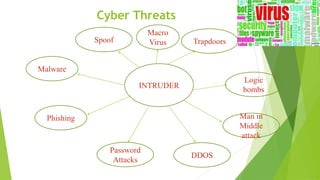
Cyber Threats
INTRUDER
Malware
Phishing
Password
Attacks
Man in
Middle
attack
DDOS
Trapdoors
Logic
bombs
Spoof
Macro
Virus
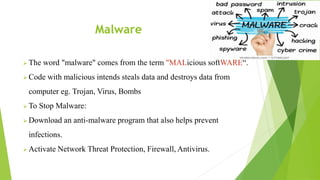
Malware
 The word "malware" comes from the term "MALicious softWARE“.
 Code with malicious intends steals data and destroys data from
computer eg. Trojan, Virus, Bombs
 To Stop Malware:
 Download an anti-malware program that also helps prevent
infections.
 Activate Network Threat Protection, Firewall, Antivirus.
Virus & Worms
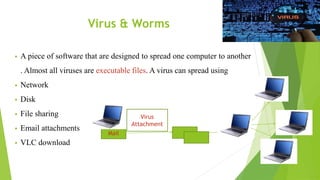
 A piece of software that are designed to spread one computer to another
. Almost all viruses are executable files. A virus can spread using
 Network
 Disk
 File sharing
 Email attachments
 VLC download
Mail
Virus
Attachment
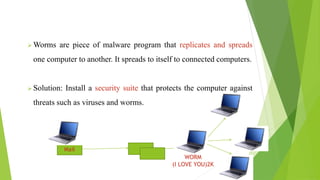
 Worms are piece of malware program that replicates and spreads
one computer to another. It spreads to itself to connected computers.
 Solution: Install a security suite that protects the computer against
threats such as viruses and worms.
Mail
WORM
(I LOVE YOU)2K
Trojan Horse
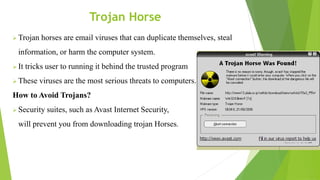
 Trojan horses are email viruses that can duplicate themselves, steal
information, or harm the computer system.
 It tricks user to running it behind the trusted program
 These viruses are the most serious threats to computers.
How to Avoid Trojans?
 Security suites, such as Avast Internet Security,
will prevent you from downloading trojan Horses.
Phishing
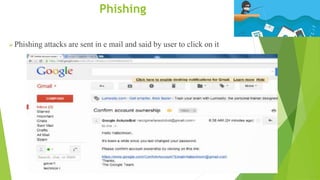
 Phishing attacks are sent in e mail and said by user to click on it
 Password attacks are attacks by hackers that are able to determine
passwords or find passwords to different protected electronic areas and
social network sites.
Securing Password:
 Use always Strong password.
 Never use same password for two different sites.
Password Attack
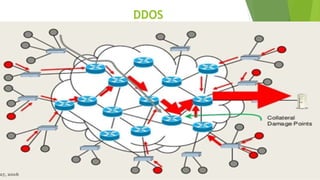
DDOS
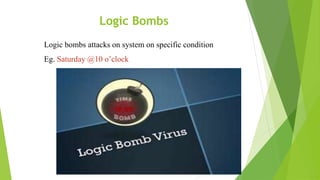
Logic Bombs
Logic bombs attacks on system on specific condition
Eg. Saturday @10 o’clock
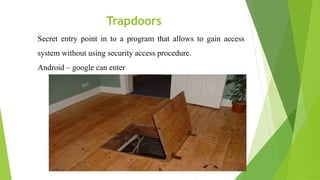
Trapdoors
Secret entry point in to a program that allows to gain access
system without using security access procedure.
Android – google can enter
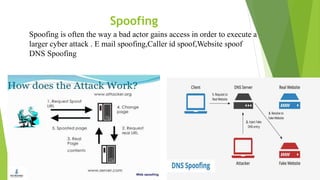
Spoofing
Spoofing is often the way a bad actor gains access in order to execute a
larger cyber attack . E mail spoofing,Caller id spoof,Website spoof
DNS Spoofing
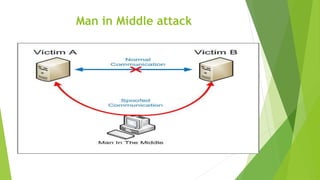
Man in Middle attack
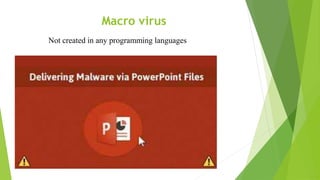
Macro virus
Not created in any programming languages
Cyber Law
 Cyber Law is the law governing cyber space.
 Cyber space includes computers, networks, software's, data storage devices (such
as hard disks, USB disks etc), the Internet, websites, emails and even electronic
devices such as cell phones, ATM machines etc.
Cyber Law Deals with
 Cyber Crimes
 Electronic or Digital Signatures
 Intellectual Property
 Data Protection and Privacy
IT ACT 2000
 The Information Technology Act, 2000 (IT Act), came into force on 17
October 2000.
 The primary purpose of the Act is to provide legal recognition to
electronic commerce and to facilitate filing of electronic records with the
Government.
 Information Technology Act 2000 consisted of 94 sections segregated
into 13 chapters.
 To provide legal recognition for transactions
 To facilitate electronic filing of documents with the Government
agencies.
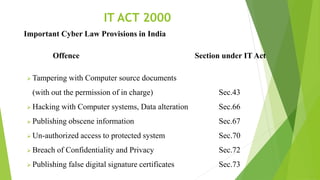
IT ACT 2000
Important Cyber Law Provisions in India
Offence Section under IT Act
 Tampering with Computer source documents
(with out the permission of in charge) Sec.43
 Hacking with Computer systems, Data alteration Sec.66
 Publishing obscene information Sec.67
 Un-authorized access to protected system Sec.70
 Breach of Confidentiality and Privacy Sec.72
 Publishing false digital signature certificates Sec.73
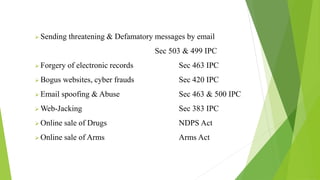
 Sending threatening & Defamatory messages by email
Sec 503 & 499 IPC
 Forgery of electronic records Sec 463 IPC
 Bogus websites, cyber frauds Sec 420 IPC
 Email spoofing & Abuse Sec 463 & 500 IPC
 Web-Jacking Sec 383 IPC
 Online sale of Drugs NDPS Act
 Online sale of Arms Arms Act
If any person uses a computer or system network without
permission of the owner or any other person who is in charge &
Access, download, Copy any data from such computer
 Introduces Computer Virus into any computer.
 Damages any computer network or computer.
Changes Account Settings.
Punishment
He shall be liable to pay damages by the way of compensation not
exceeding 1 Crore to affected person
Eg.-Section 43
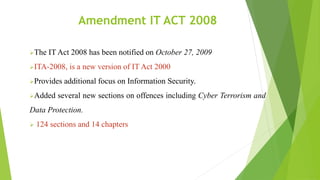
Amendment IT ACT 2008
The IT Act 2008 has been notified on October 27, 2009
ITA-2008, is a new version of IT Act 2000
Provides additional focus on Information Security.
Added several new sections on offences including Cyber Terrorism and
Data Protection.
 124 sections and 14 chapters
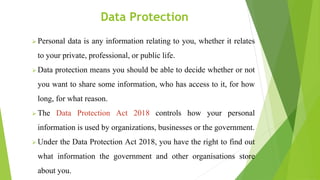
Data Protection
 Personal data is any information relating to you, whether it relates
to your private, professional, or public life.
 Data protection means you should be able to decide whether or not
you want to share some information, who has access to it, for how
long, for what reason.
 The Data Protection Act 2018 controls how your personal
information is used by organizations, businesses or the government.
 Under the Data Protection Act 2018, you have the right to find out
what information the government and other organisations store
about you.
Conclusion
 In this presentation covers cyber security and information security as
well. Further we came to learn what is the need and history of it.
 Next, we learn about threats which are harmful for the data and system
and also came to know about their solutions.
 Finally cyber law and related acts and its sections and brief
introduction about the data protection.
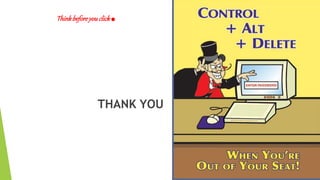
Thinkbeforeyouclick.
THANK YOU

Cyber security & Data Protection

  • 1.
    CYBER SECURITY AND DATA PROTECTION By Dr.Hemant Kumar Singh Associate Professor & Head, Deptt. of Computer Science & Engineering
  • 2.
    INDEX INTRODUCTION IMPORTANCE/NEED OF CYBERSECURITY SECURITY THREATS TO DATA THREATS AND SOLUTIONS CYBER LAW IT ACT 2000/2008 CONCLUSION
  • 4.
    Digital Era Today weare living in digital era Internet is used today-  Booking hotels  Ordering foods  Booking cabs Big data is generating today that is stored on cloud on huge data servers or data centers Array of devices used to access data stored on cloud. For Hackers it is golden edge A lot of access point, IP addresses.
  • 5.
    Introduction  Cyber securityis the practice of protecting information and data from outside sources on the Internet. Cyber security professionals provide protection for networks, servers, intranets and computer systems.  It also ensures that only authorized people have access to that information.
  • 6.
     Cyber isrelated to the technology which contains systems, network and programs or data. Whereas security related to the protection which includes systems security, network security and application and information security.
  • 7.
    Why is cybersecurity important?  Cyber security is necessary since it helps in securing data from threats such as data theft or misuse, also safeguards your system from viruses.  We all live in a world which is networked together, from internet banking to government infrastructure, where data is stored on computers and other devices. A portion of that data can be sensitive information, whether that be intellectual property, financial data, personal information, or other types of data for which unauthorized access or exposure could have negative consequences.
  • 8.
     Cyber-attack isnow an international concern and has given many concerns that hacks and other security attacks could endanger the global economy. Organizations transmit sensitive data across networks and to other devices in the course of doing businesses, and cyber security describes to protect that information and the systems used to process or store it.
  • 9.
    History  1969- Aprofessor in UCLA sent a message to standard research institute.  1970-Robert Thomson created first virus namely CREEPER I am CREEPER Catch me if you can Antivirus for creeper was PREEPER  1986-Rassian used cyber power as weapons  1988-American scientestist created program to check size of internet  After that we people started working on cyber security.
  • 10.
    Security Goals(CIA)  Confidentiality:No unauthorized access  Integrity: What you sent, received without alter  Availability: 24X7 Access availability to authorized user use encryption HELLO HELLO
  • 11.
  • 12.
    Malware  The word"malware" comes from the term "MALicious softWARE“.  Code with malicious intends steals data and destroys data from computer eg. Trojan, Virus, Bombs  To Stop Malware:  Download an anti-malware program that also helps prevent infections.  Activate Network Threat Protection, Firewall, Antivirus.
  • 13.
    Virus & Worms A piece of software that are designed to spread one computer to another . Almost all viruses are executable files. A virus can spread using  Network  Disk  File sharing  Email attachments  VLC download Mail Virus Attachment
  • 14.
     Worms arepiece of malware program that replicates and spreads one computer to another. It spreads to itself to connected computers.  Solution: Install a security suite that protects the computer against threats such as viruses and worms. Mail WORM (I LOVE YOU)2K
  • 15.
    Trojan Horse  Trojanhorses are email viruses that can duplicate themselves, steal information, or harm the computer system.  It tricks user to running it behind the trusted program  These viruses are the most serious threats to computers. How to Avoid Trojans?  Security suites, such as Avast Internet Security, will prevent you from downloading trojan Horses.
  • 16.
    Phishing  Phishing attacksare sent in e mail and said by user to click on it
  • 17.
     Password attacksare attacks by hackers that are able to determine passwords or find passwords to different protected electronic areas and social network sites. Securing Password:  Use always Strong password.  Never use same password for two different sites. Password Attack
  • 18.
  • 19.
    Logic Bombs Logic bombsattacks on system on specific condition Eg. Saturday @10 o’clock
  • 20.
    Trapdoors Secret entry pointin to a program that allows to gain access system without using security access procedure. Android – google can enter
  • 21.
    Spoofing Spoofing is oftenthe way a bad actor gains access in order to execute a larger cyber attack . E mail spoofing,Caller id spoof,Website spoof DNS Spoofing
  • 22.
  • 23.
    Macro virus Not createdin any programming languages
  • 24.
    Cyber Law  CyberLaw is the law governing cyber space.  Cyber space includes computers, networks, software's, data storage devices (such as hard disks, USB disks etc), the Internet, websites, emails and even electronic devices such as cell phones, ATM machines etc. Cyber Law Deals with  Cyber Crimes  Electronic or Digital Signatures  Intellectual Property  Data Protection and Privacy
  • 25.
    IT ACT 2000 The Information Technology Act, 2000 (IT Act), came into force on 17 October 2000.  The primary purpose of the Act is to provide legal recognition to electronic commerce and to facilitate filing of electronic records with the Government.  Information Technology Act 2000 consisted of 94 sections segregated into 13 chapters.  To provide legal recognition for transactions  To facilitate electronic filing of documents with the Government agencies.
  • 26.
    IT ACT 2000 ImportantCyber Law Provisions in India Offence Section under IT Act  Tampering with Computer source documents (with out the permission of in charge) Sec.43  Hacking with Computer systems, Data alteration Sec.66  Publishing obscene information Sec.67  Un-authorized access to protected system Sec.70  Breach of Confidentiality and Privacy Sec.72  Publishing false digital signature certificates Sec.73
  • 27.
     Sending threatening& Defamatory messages by email Sec 503 & 499 IPC  Forgery of electronic records Sec 463 IPC  Bogus websites, cyber frauds Sec 420 IPC  Email spoofing & Abuse Sec 463 & 500 IPC  Web-Jacking Sec 383 IPC  Online sale of Drugs NDPS Act  Online sale of Arms Arms Act
  • 28.
    If any personuses a computer or system network without permission of the owner or any other person who is in charge & Access, download, Copy any data from such computer  Introduces Computer Virus into any computer.  Damages any computer network or computer. Changes Account Settings. Punishment He shall be liable to pay damages by the way of compensation not exceeding 1 Crore to affected person Eg.-Section 43
  • 29.
    Amendment IT ACT2008 The IT Act 2008 has been notified on October 27, 2009 ITA-2008, is a new version of IT Act 2000 Provides additional focus on Information Security. Added several new sections on offences including Cyber Terrorism and Data Protection.  124 sections and 14 chapters
  • 30.
    Data Protection  Personaldata is any information relating to you, whether it relates to your private, professional, or public life.  Data protection means you should be able to decide whether or not you want to share some information, who has access to it, for how long, for what reason.  The Data Protection Act 2018 controls how your personal information is used by organizations, businesses or the government.  Under the Data Protection Act 2018, you have the right to find out what information the government and other organisations store about you.
  • 31.
    Conclusion  In thispresentation covers cyber security and information security as well. Further we came to learn what is the need and history of it.  Next, we learn about threats which are harmful for the data and system and also came to know about their solutions.  Finally cyber law and related acts and its sections and brief introduction about the data protection.
  • 32.

Editor's Notes