Plot no. 38, Kirthar Road, H-9 Islamabad
051-9044250
Government of Pakistan
National Vocational and Technical Training Commission
Prime Minister Hunarmand Pakistan Program,
"Skills for All"
Course Contents/ Lesson Plan
Course Title: Certificate in Cyber Security
Duration: 6 Months
Plot no. 38, Kirthar Road, H-9 Islamabad
051-9044250
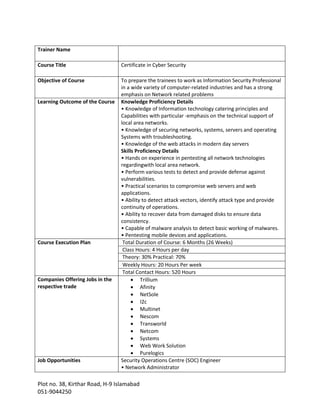
Trainer Name
Course Title Certificate in Cyber Security
Objective of Course To prepare the trainees to work as Information Security Professional
in a wide variety of computer-related industries and has a strong
emphasis on Network related problems
Learning Outcome of the Course Knowledge Proficiency Details
• Knowledge of Information technology catering principles and
Capabilities with particular -emphasis on the technical support of
local area networks.
• Knowledge of securing networks, systems, servers and operating
Systems with troubleshooting.
• Knowledge of the web attacks in modern day servers
Skills Proficiency Details
• Hands on experience in pentesting all network technologies
regardingwith local area network.
• Perform various tests to detect and provide defense against
vulnerabilities.
• Practical scenarios to compromise web servers and web
applications.
• Ability to detect attack vectors, identify attack type and provide
continuity of operations.
• Ability to recover data from damaged disks to ensure data
consistency.
• Capable of malware analysis to detect basic working of malwares.
• Pentesting mobile devices and applications.
Course Execution Plan Total Duration of Course: 6 Months (26 Weeks)
Class Hours: 4 Hours per day
Theory: 30% Practical: 70%
Weekly Hours: 20 Hours Per week
Total Contact Hours: 520 Hours
Companies Offering Jobs in the
respective trade
 Trillium
 Afinity
 NetSole
 I2c
 Multinet
 Nescom
 Transworld
 Netcom
 Systems
 Web Work Solution
 Purelogics
Job Opportunities Security Operations Centre (SOC) Engineer
• Network Administrator
Plot no. 38, Kirthar Road, H-9 Islamabad
051-9044250
• IT Support Officer
• Manager / Assistant Manager IT
• Network support engineer
• Security Analysts
• Penetration tester
No of Students 25
Learning Place Classroom/Lab
ITU
Instructional Resources  Libirary
 Elibrary from HEC
 Digital Libarary of ITU
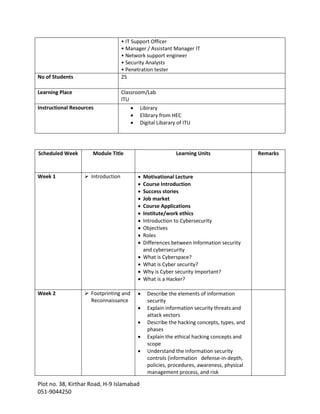
Scheduled Week Module Title Learning Units Remarks
Week 1  Introduction  Motivational Lecture
 Course Introduction
 Success stories
 Job market
 Course Applications
 Institute/work ethics
 Introduction to Cybersecurity
 Objectives
 Roles
 Differences between Information security
and cybersecurity
 What is Cyberspace?
 What is Cyber security?
 Why is Cyber security Important?
 What is a Hacker?
Week 2  Footprinting and
Reconnaissance
 Describe the elements of information
security
 Explain information security threats and
attack vectors
 Describe the hacking concepts, types, and
phases
 Explain the ethical hacking concepts and
scope
 Understand the information security
controls (information defense-in-depth,
policies, procedures, awareness, physical
management process, and risk
Plot no. 38, Kirthar Road, H-9 Islamabad
051-9044250
management etc.)
 Understand the penetration testing
process
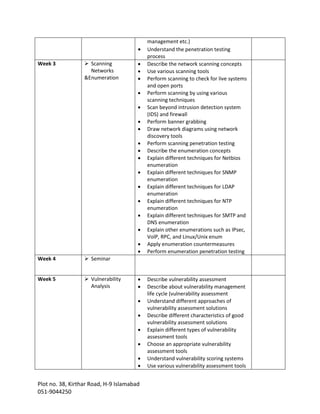
Week 3  Scanning
Networks
&Enumeration
 Describe the network scanning concepts
 Use various scanning tools
 Perform scanning to check for live systems
and open ports
 Perform scanning by using various
scanning techniques
 Scan beyond intrusion detection system
(IDS) and firewall
 Perform banner grabbing
 Draw network diagrams using network
discovery tools
 Perform scanning penetration testing
 Describe the enumeration concepts
 Explain different techniques for Netbios
enumeration
 Explain different techniques for SNMP
enumeration
 Explain different techniques for LDAP
enumeration
 Explain different techniques for NTP
enumeration
 Explain different techniques for SMTP and
DNS enumeration
 Explain other enumerations such as IPsec,
VolP, RPC, and Linux/Unix enum
 Apply enumeration countermeasures
 Perform enumeration penetration testing
Week 4  Seminar
Week 5  Vulnerability
Analysis
 Describe vulnerability assessment
 Describe about vulnerability management
life cycle (vulnerability assessment
 Understand different approaches of
vulnerability assessment solutions
 Describe different characteristics of good
vulnerability assessment solutions
 Explain different types of vulnerability
assessment tools
 Choose an appropriate vulnerability
assessment tools
 Understand vulnerability scoring systems
 Use various vulnerability assessment tools
Plot no. 38, Kirthar Road, H-9 Islamabad
051-9044250
 Generate vulnerability assessment reports
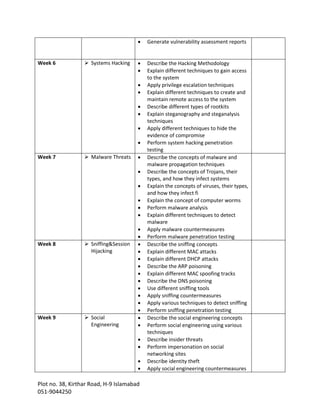
Week 6  Systems Hacking  Describe the Hacking Methodology
 Explain different techniques to gain access
to the system
 Apply privilege escalation techniques
 Explain different techniques to create and
maintain remote access to the system
 Describe different types of rootkits
 Explain steganography and steganalysis
techniques
 Apply different techniques to hide the
evidence of compromise
 Perform system hacking penetration
testing
Week 7  Malware Threats  Describe the concepts of malware and
malware propagation techniques
 Describe the concepts of Trojans, their
types, and how they infect systems
 Explain the concepts of viruses, their types,
and how they infect fi
 Explain the concept of computer worms
 Perform malware analysis
 Explain different techniques to detect
malware
 Apply malware countermeasures
 Perform malware penetration testing
Week 8  Sniffing&Session
Hijacking
 Describe the sniffing concepts
 Explain different MAC attacks
 Explain different DHCP attacks
 Describe the ARP poisoning
 Explain different MAC spoofing tracks
 Describe the DNS poisoning
 Use different sniffing tools
 Apply sniffing countermeasures
 Apply various techniques to detect sniffing
 Perform sniffing penetration testing
Week 9  Social
Engineering
 Describe the social engineering concepts
 Perform social engineering using various
techniques
 Describe insider threats
 Perform impersonation on social
networking sites
 Describe identity theft
 Apply social engineering countermeasures
Plot no. 38, Kirthar Road, H-9 Islamabad
051-9044250
 Apply insider threats and identity theft
countermeasures
 Perform social engineering penetration
testing
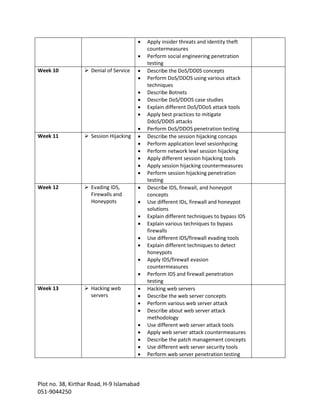
Week 10  Denial of Service  Describe the DoS/DD0S concepts
 Perform DoS/DDOS using various attack
techniques
 Describe Botnets
 Describe DoS/DDOS case studies
 Explain different DoS/DDoS attack tools
 Apply best practices to mitigate
DdoS/DD0S attacks
 Perform DoS/DDOS penetration testing
Week 11  Session Hijacking  Describe the session hijacking concaps
 Perform application level sesionhpcing
 Perform network lewl session hijacking
 Apply different session hijacking tools
 Apply session hijacking countermeasures
 Perform session hijacking penetration
testing
Week 12  Evading IDS,
Firewalls and
Honeypots
 Describe IDS, firewall, and honeypot
concepts
 Use different IDs, firewall and honeypot
solutions
 Explain different techniques to bypass IDS
 Explain various techniques to bypass
firewalls
 Use different IDS/firewall evading tools
 Explain different techniques to detect
honeypots
 Apply IDS/firewall evasion
countermeasures
 Perform IDS and firewall penetration
testing
Week 13  Hacking web
servers
 Hacking web servers
 Describe the web server concepts
 Perform various web server attack
 Describe about web server attack
methodology
 Use different web server attack tools
 Apply web server attack countermeasures
 Describe the patch management concepts
 Use different web server security tools
 Perform web server penetration testing
Plot no. 38, Kirthar Road, H-9 Islamabad
051-9044250
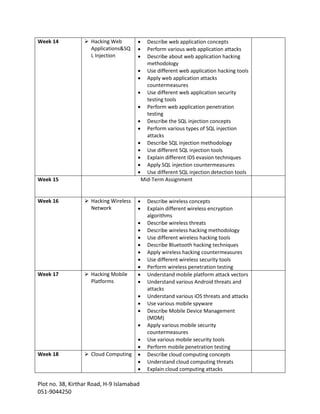
Week 14  Hacking Web
Applications&SQ
L Injection
 Describe web application concepts
 Perform various web application attacks
 Describe about web application hacking
methodology
 Use different web application hacking tools
 Apply web application attacks
countermeasures
 Use different web application security
testing tools
 Perform web application penetration
testing
 Describe the SQL injection concepts
 Perform various types of SQL injection
attacks
 Describe SQL injection methodology
 Use different SQL injection tools
 Explain different IDS evasion techniques
 Apply SQL injection countermeasures
 Use different SQL injection detection tools
Week 15 Mid-Term Assignment
Week 16  Hacking Wireless
Network
 Describe wireless concepts
 Explain different wireless encryption
algorithms
 Describe wireless threats
 Describe wireless hacking methodology
 Use different wireless hacking tools
 Describe Bluetooth hacking techniques
 Apply wireless hacking countermeasures
 Use different wireless security tools
 Perform wireless penetration testing
Week 17  Hacking Mobile
Platforms
 Understand mobile platform attack vectors
 Understand various Android threats and
attacks
 Understand various iOS threats and attacks
 Use various mobile spyware
 Describe Mobile Device Management
(MDM)
 Apply various mobile security
countermeasures
 Use various mobile security tools
 Perform mobile penetration testing
Week 18  Cloud Computing  Describe cloud computing concepts
 Understand cloud computing threats
 Explain cloud computing attacks
Plot no. 38, Kirthar Road, H-9 Islamabad
051-9044250
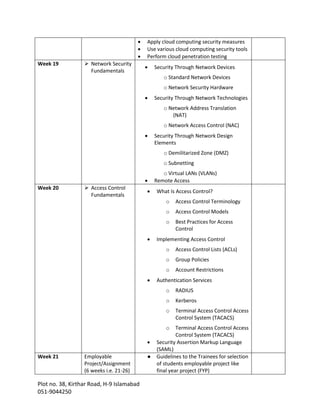
 Apply cloud computing security measures
 Use various cloud computing security tools
 Perform cloud penetration testing
Week 19  Network Security
Fundamentals
 Security Through Network Devices
o Standard Network Devices
o Network Security Hardware
 Security Through Network Technologies
o Network Address Translation
(NAT)
o Network Access Control (NAC)
 Security Through Network Design
Elements
o Demilitarized Zone (DMZ)
o Subnetting
o Virtual LANs (VLANs)
 Remote Access
Week 20  Access Control
Fundamentals
 What Is Access Control?
o Access Control Terminology
o Access Control Models
o Best Practices for Access
Control
 Implementing Access Control
o Access Control Lists (ACLs)
o Group Policies
o Account Restrictions
 Authentication Services
o RADIUS
o Kerberos
o Terminal Access Control Access
Control System (TACACS)
o Terminal Access Control Access
Control System (TACACS)
 Security Assertion Markup Language
(SAML)
Week 21 Employable
Project/Assignment
(6 weeks i.e. 21-26)
● Guidelines to the Trainees for selection
of students employable project like
final year project (FYP)
Plot no. 38, Kirthar Road, H-9 Islamabad
051-9044250
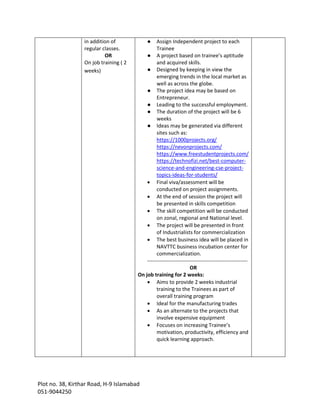
in addition of
regular classes.
OR
On job training ( 2
weeks)
● Assign Independent project to each
Trainee
● A project based on trainee’s aptitude
and acquired skills.
● Designed by keeping in view the
emerging trends in the local market as
well as across the globe.
● The project idea may be based on
Entrepreneur.
● Leading to the successful employment.
● The duration of the project will be 6
weeks
● Ideas may be generated via different
sites such as:
https://1000projects.org/
https://nevonprojects.com/
https://www.freestudentprojects.com/
https://technofizi.net/best-computer-
science-and-engineering-cse-project-
topics-ideas-for-students/
 Final viva/assessment will be
conducted on project assignments.
 At the end of session the project will
be presented in skills competition
 The skill competition will be conducted
on zonal, regional and National level.
 The project will be presented in front
of Industrialists for commercialization
 The best business idea will be placed in
NAVTTC business incubation center for
commercialization.
---------------------------------------------------------
OR
On job training for 2 weeks:
 Aims to provide 2 weeks industrial
training to the Trainees as part of
overall training program
 Ideal for the manufacturing trades
 As an alternate to the projects that
involve expensive equipment
 Focuses on increasing Trainee’s
motivation, productivity, efficiency and
quick learning approach.
Plot no. 38, Kirthar Road, H-9 Islamabad
051-9044250
Week 22  Business
Continuity and
DRP
 What Is Business Continuity?
 Disaster Recovery
o Disaster Recovery Plan (DRP)
o Redundancy and Fault
Tolerance
o Data Backups
 Environmental Controls
o Fire Suppression
o Electromagnetic Interference
(EMI) Shielding
o HVAC
 Incident Response
o Forensics
 Incident Response Procedures
Week 23  Risk
Identification
and Mitigation &
Incident
Handling
 Controlling Risk
o Privilege Management
o Change Management
o Incident Management
o Risk Calculation
 Reducing Risk Through Policies
o What Is a Security Policy?
o Balancing Trust and Control
o Designing a Security Policy
o Types of Security Policies
 Awareness and Training
o Compliance
o User Practices
o Threat Awareness
 Training Techniques
Week 24  Security Audit  Security Auditing (planning,
operations, performance,
evaluation)
 Ethical Hacking / Penetration testing
 Cyber Security Awareness
 Hands-on Lab(s)
o Building a machine for
penetration testing
o Perform vulnerability analysis
Plot no. 38, Kirthar Road, H-9 Islamabad
051-9044250
 Secure configurations of devices and
systems
Week 25  Monitoring and
Logging
 Firewall logs
 System logs
 SIEM logs
Week 26  Entrepreneurship
and Final
Assessment in
project
 Job Market Searching
 Self-employment
 Freelancing sites
 Introduction
 Fundamentals of Business Development
 Entrepreneurship
 Startup Funding
 Business Incubation and Acceleration
 Business Value Statement
 Business Model Canvas
 Sales and Marketing Strategies
 How to Reach Customers and Engage CxOs
 Stakeholders Power Grid
 RACI Model, SWOT Analysis, PEST Analysis
 SMART Objectives
 OKRs
 Cost Management (OPEX, CAPEX, ROCE
etc.)
 Final Assessment

cyber-security course outline

  • 1.
    Plot no. 38,Kirthar Road, H-9 Islamabad 051-9044250 Government of Pakistan National Vocational and Technical Training Commission Prime Minister Hunarmand Pakistan Program, "Skills for All" Course Contents/ Lesson Plan Course Title: Certificate in Cyber Security Duration: 6 Months
  • 2.
    Plot no. 38,Kirthar Road, H-9 Islamabad 051-9044250 Trainer Name Course Title Certificate in Cyber Security Objective of Course To prepare the trainees to work as Information Security Professional in a wide variety of computer-related industries and has a strong emphasis on Network related problems Learning Outcome of the Course Knowledge Proficiency Details • Knowledge of Information technology catering principles and Capabilities with particular -emphasis on the technical support of local area networks. • Knowledge of securing networks, systems, servers and operating Systems with troubleshooting. • Knowledge of the web attacks in modern day servers Skills Proficiency Details • Hands on experience in pentesting all network technologies regardingwith local area network. • Perform various tests to detect and provide defense against vulnerabilities. • Practical scenarios to compromise web servers and web applications. • Ability to detect attack vectors, identify attack type and provide continuity of operations. • Ability to recover data from damaged disks to ensure data consistency. • Capable of malware analysis to detect basic working of malwares. • Pentesting mobile devices and applications. Course Execution Plan Total Duration of Course: 6 Months (26 Weeks) Class Hours: 4 Hours per day Theory: 30% Practical: 70% Weekly Hours: 20 Hours Per week Total Contact Hours: 520 Hours Companies Offering Jobs in the respective trade  Trillium  Afinity  NetSole  I2c  Multinet  Nescom  Transworld  Netcom  Systems  Web Work Solution  Purelogics Job Opportunities Security Operations Centre (SOC) Engineer • Network Administrator
  • 3.
    Plot no. 38,Kirthar Road, H-9 Islamabad 051-9044250 • IT Support Officer • Manager / Assistant Manager IT • Network support engineer • Security Analysts • Penetration tester No of Students 25 Learning Place Classroom/Lab ITU Instructional Resources  Libirary  Elibrary from HEC  Digital Libarary of ITU Scheduled Week Module Title Learning Units Remarks Week 1  Introduction  Motivational Lecture  Course Introduction  Success stories  Job market  Course Applications  Institute/work ethics  Introduction to Cybersecurity  Objectives  Roles  Differences between Information security and cybersecurity  What is Cyberspace?  What is Cyber security?  Why is Cyber security Important?  What is a Hacker? Week 2  Footprinting and Reconnaissance  Describe the elements of information security  Explain information security threats and attack vectors  Describe the hacking concepts, types, and phases  Explain the ethical hacking concepts and scope  Understand the information security controls (information defense-in-depth, policies, procedures, awareness, physical management process, and risk
  • 4.
    Plot no. 38,Kirthar Road, H-9 Islamabad 051-9044250 management etc.)  Understand the penetration testing process Week 3  Scanning Networks &Enumeration  Describe the network scanning concepts  Use various scanning tools  Perform scanning to check for live systems and open ports  Perform scanning by using various scanning techniques  Scan beyond intrusion detection system (IDS) and firewall  Perform banner grabbing  Draw network diagrams using network discovery tools  Perform scanning penetration testing  Describe the enumeration concepts  Explain different techniques for Netbios enumeration  Explain different techniques for SNMP enumeration  Explain different techniques for LDAP enumeration  Explain different techniques for NTP enumeration  Explain different techniques for SMTP and DNS enumeration  Explain other enumerations such as IPsec, VolP, RPC, and Linux/Unix enum  Apply enumeration countermeasures  Perform enumeration penetration testing Week 4  Seminar Week 5  Vulnerability Analysis  Describe vulnerability assessment  Describe about vulnerability management life cycle (vulnerability assessment  Understand different approaches of vulnerability assessment solutions  Describe different characteristics of good vulnerability assessment solutions  Explain different types of vulnerability assessment tools  Choose an appropriate vulnerability assessment tools  Understand vulnerability scoring systems  Use various vulnerability assessment tools
  • 5.
    Plot no. 38,Kirthar Road, H-9 Islamabad 051-9044250  Generate vulnerability assessment reports Week 6  Systems Hacking  Describe the Hacking Methodology  Explain different techniques to gain access to the system  Apply privilege escalation techniques  Explain different techniques to create and maintain remote access to the system  Describe different types of rootkits  Explain steganography and steganalysis techniques  Apply different techniques to hide the evidence of compromise  Perform system hacking penetration testing Week 7  Malware Threats  Describe the concepts of malware and malware propagation techniques  Describe the concepts of Trojans, their types, and how they infect systems  Explain the concepts of viruses, their types, and how they infect fi  Explain the concept of computer worms  Perform malware analysis  Explain different techniques to detect malware  Apply malware countermeasures  Perform malware penetration testing Week 8  Sniffing&Session Hijacking  Describe the sniffing concepts  Explain different MAC attacks  Explain different DHCP attacks  Describe the ARP poisoning  Explain different MAC spoofing tracks  Describe the DNS poisoning  Use different sniffing tools  Apply sniffing countermeasures  Apply various techniques to detect sniffing  Perform sniffing penetration testing Week 9  Social Engineering  Describe the social engineering concepts  Perform social engineering using various techniques  Describe insider threats  Perform impersonation on social networking sites  Describe identity theft  Apply social engineering countermeasures
  • 6.
    Plot no. 38,Kirthar Road, H-9 Islamabad 051-9044250  Apply insider threats and identity theft countermeasures  Perform social engineering penetration testing Week 10  Denial of Service  Describe the DoS/DD0S concepts  Perform DoS/DDOS using various attack techniques  Describe Botnets  Describe DoS/DDOS case studies  Explain different DoS/DDoS attack tools  Apply best practices to mitigate DdoS/DD0S attacks  Perform DoS/DDOS penetration testing Week 11  Session Hijacking  Describe the session hijacking concaps  Perform application level sesionhpcing  Perform network lewl session hijacking  Apply different session hijacking tools  Apply session hijacking countermeasures  Perform session hijacking penetration testing Week 12  Evading IDS, Firewalls and Honeypots  Describe IDS, firewall, and honeypot concepts  Use different IDs, firewall and honeypot solutions  Explain different techniques to bypass IDS  Explain various techniques to bypass firewalls  Use different IDS/firewall evading tools  Explain different techniques to detect honeypots  Apply IDS/firewall evasion countermeasures  Perform IDS and firewall penetration testing Week 13  Hacking web servers  Hacking web servers  Describe the web server concepts  Perform various web server attack  Describe about web server attack methodology  Use different web server attack tools  Apply web server attack countermeasures  Describe the patch management concepts  Use different web server security tools  Perform web server penetration testing
  • 7.
    Plot no. 38,Kirthar Road, H-9 Islamabad 051-9044250 Week 14  Hacking Web Applications&SQ L Injection  Describe web application concepts  Perform various web application attacks  Describe about web application hacking methodology  Use different web application hacking tools  Apply web application attacks countermeasures  Use different web application security testing tools  Perform web application penetration testing  Describe the SQL injection concepts  Perform various types of SQL injection attacks  Describe SQL injection methodology  Use different SQL injection tools  Explain different IDS evasion techniques  Apply SQL injection countermeasures  Use different SQL injection detection tools Week 15 Mid-Term Assignment Week 16  Hacking Wireless Network  Describe wireless concepts  Explain different wireless encryption algorithms  Describe wireless threats  Describe wireless hacking methodology  Use different wireless hacking tools  Describe Bluetooth hacking techniques  Apply wireless hacking countermeasures  Use different wireless security tools  Perform wireless penetration testing Week 17  Hacking Mobile Platforms  Understand mobile platform attack vectors  Understand various Android threats and attacks  Understand various iOS threats and attacks  Use various mobile spyware  Describe Mobile Device Management (MDM)  Apply various mobile security countermeasures  Use various mobile security tools  Perform mobile penetration testing Week 18  Cloud Computing  Describe cloud computing concepts  Understand cloud computing threats  Explain cloud computing attacks
  • 8.
    Plot no. 38,Kirthar Road, H-9 Islamabad 051-9044250  Apply cloud computing security measures  Use various cloud computing security tools  Perform cloud penetration testing Week 19  Network Security Fundamentals  Security Through Network Devices o Standard Network Devices o Network Security Hardware  Security Through Network Technologies o Network Address Translation (NAT) o Network Access Control (NAC)  Security Through Network Design Elements o Demilitarized Zone (DMZ) o Subnetting o Virtual LANs (VLANs)  Remote Access Week 20  Access Control Fundamentals  What Is Access Control? o Access Control Terminology o Access Control Models o Best Practices for Access Control  Implementing Access Control o Access Control Lists (ACLs) o Group Policies o Account Restrictions  Authentication Services o RADIUS o Kerberos o Terminal Access Control Access Control System (TACACS) o Terminal Access Control Access Control System (TACACS)  Security Assertion Markup Language (SAML) Week 21 Employable Project/Assignment (6 weeks i.e. 21-26) ● Guidelines to the Trainees for selection of students employable project like final year project (FYP)
  • 9.
    Plot no. 38,Kirthar Road, H-9 Islamabad 051-9044250 in addition of regular classes. OR On job training ( 2 weeks) ● Assign Independent project to each Trainee ● A project based on trainee’s aptitude and acquired skills. ● Designed by keeping in view the emerging trends in the local market as well as across the globe. ● The project idea may be based on Entrepreneur. ● Leading to the successful employment. ● The duration of the project will be 6 weeks ● Ideas may be generated via different sites such as: https://1000projects.org/ https://nevonprojects.com/ https://www.freestudentprojects.com/ https://technofizi.net/best-computer- science-and-engineering-cse-project- topics-ideas-for-students/  Final viva/assessment will be conducted on project assignments.  At the end of session the project will be presented in skills competition  The skill competition will be conducted on zonal, regional and National level.  The project will be presented in front of Industrialists for commercialization  The best business idea will be placed in NAVTTC business incubation center for commercialization. --------------------------------------------------------- OR On job training for 2 weeks:  Aims to provide 2 weeks industrial training to the Trainees as part of overall training program  Ideal for the manufacturing trades  As an alternate to the projects that involve expensive equipment  Focuses on increasing Trainee’s motivation, productivity, efficiency and quick learning approach.
  • 10.
    Plot no. 38,Kirthar Road, H-9 Islamabad 051-9044250 Week 22  Business Continuity and DRP  What Is Business Continuity?  Disaster Recovery o Disaster Recovery Plan (DRP) o Redundancy and Fault Tolerance o Data Backups  Environmental Controls o Fire Suppression o Electromagnetic Interference (EMI) Shielding o HVAC  Incident Response o Forensics  Incident Response Procedures Week 23  Risk Identification and Mitigation & Incident Handling  Controlling Risk o Privilege Management o Change Management o Incident Management o Risk Calculation  Reducing Risk Through Policies o What Is a Security Policy? o Balancing Trust and Control o Designing a Security Policy o Types of Security Policies  Awareness and Training o Compliance o User Practices o Threat Awareness  Training Techniques Week 24  Security Audit  Security Auditing (planning, operations, performance, evaluation)  Ethical Hacking / Penetration testing  Cyber Security Awareness  Hands-on Lab(s) o Building a machine for penetration testing o Perform vulnerability analysis
  • 11.
    Plot no. 38,Kirthar Road, H-9 Islamabad 051-9044250  Secure configurations of devices and systems Week 25  Monitoring and Logging  Firewall logs  System logs  SIEM logs Week 26  Entrepreneurship and Final Assessment in project  Job Market Searching  Self-employment  Freelancing sites  Introduction  Fundamentals of Business Development  Entrepreneurship  Startup Funding  Business Incubation and Acceleration  Business Value Statement  Business Model Canvas  Sales and Marketing Strategies  How to Reach Customers and Engage CxOs  Stakeholders Power Grid  RACI Model, SWOT Analysis, PEST Analysis  SMART Objectives  OKRs  Cost Management (OPEX, CAPEX, ROCE etc.)  Final Assessment