Warm-up: Day 1 Take a picture from the pile on your way in.  Please sit down at your desk, take out a piece of paper, and begin writing.  Your task is to  describe  the scene in front of you in as much detail as you can. Use  all  five senses. Be ready to share.
 
Question #1:
What is Imagery? It is  description . Factual   (what is actually there) i.e.: the gritty wet sand under her bare feet Figurative  (an object is described when compared to another noun) i.e.: the armies of sand grains advancing across the wood floor of the beach house
What is Imagery? It  USES ALL 5 SENSES , not only visual cues. Sight Sound Smell Taste Touch
What is Imagery? It inspires imagination in readers . Your reader should be able to see, hear, smell, taste, and touch people, objects and scenes that are not physically present.  “ Images are seductive in themselves, but they’re not merely scenery, or shouldn’t be. An image, when it’s doing its full work, can direct a reader toward some insight, bring a poem to an emotional [height], embody an idea.”  –  Kim Addonizio
Question #2:
Which line contains the image? It is best to consider consequences before proceeding.  Look before you leap.
Which line contains the image? Have you hugged your child today? It’s important to reassure your offspring of your affection.
Which line contains the image? Wag the dog. The situation is being manipulated by peripheral interests.
Which line contains the image? I will do everything in my power to over turn this unjust verdict.  I will fall like an ocean on that court! (Arthur Miller,  The Crucible )
Which line contains the image? They are not pigs, they are not even fish, /Though they have a piggy and a fishy air— (Sylvia Plath, “Stillborn”) The verses I am writing have no vitality; they are unattractive and stale.
Question #3:
1. Slow down your writing. In other words, add more detail. Make sure each word is included on purpose. Be certain your reader can imagine what you’re describing.
2. Avoid clichés. Fits like a glove Fight for your life  Walk on eggshells Jump for joy Eat your words Flesh and blood Not my cup of tea
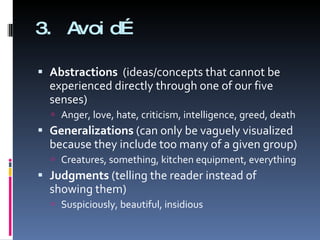
3. Avoid… Abstractions  (ideas/concepts that cannot be experienced directly through one of our five senses) Anger, love, hate, criticism, intelligence, greed, death Generalizations  (can only be vaguely visualized because they include too many of a given group) Creatures, something, kitchen equipment, everything Judgments  (telling the reader instead of showing them) Suspiciously, beautiful, insidious
Generalization -> Specific Domestic animal Dog  Mixed-breed Shepherd Old Sammy asleep on the red rug, his haunches twitching in his dream
Writing Exercise Take the word and generalization “food” and turn it into something specific, something you’ve said on purpose.
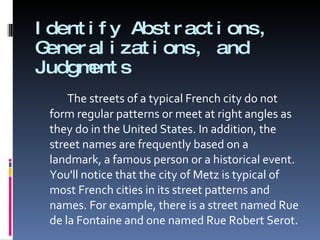
Identify Abstractions, Generalizations, and Judgments The streets of a typical French city do not form regular patterns or meet at right angles as they do in the United States. In addition, the street names are frequently based on a landmark, a famous person or a historical event. You'll notice that the city of Metz is typical of most French cities in its street patterns and names. For example, there is a street named Rue de la Fontaine and one named Rue Robert Serot.
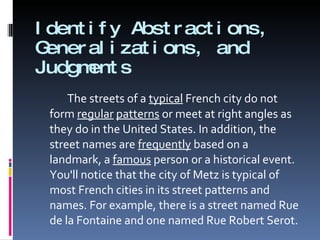
Identify Abstractions, Generalizations, and Judgments The streets of a  typical  French city do not form  regular   patterns  or meet at right angles as they do in the United States. In addition, the street names are  frequently  based on a landmark, a  famous  person or a historical event. You'll notice that the city of Metz is typical of most French cities in its street patterns and names. For example, there is a street named Rue de la Fontaine and one named Rue Robert Serot.
Writing Exercise Using the passage handed to you and your partner, identify the abstractions, generalizations, and judgments made in the passage.  Choose three(3) of these abstractions, generalizations, and judgments.  Invent an image that suggests each word on the list, giving you a total of 3 images.
4. Show, don’t tell. Let your writing be: Concrete  ( there is an image, something that can be seen, heard, smelled, tasted, or touched) Detailed  (there is a degree of focus and specificity) Significant  (the specific image also suggests an abstraction, generalization, or judgment)
Anne Tyler Example See worksheet.
5. Try figures of speech Metaphors A comparison made without using “like” or “as” Similes A comparison made using “like” or “as” Personification Giving human qualities to inanimate objects
Writing Exercise Brainstorm a list of household items, rooms, parts of a house. Make a list on the chalkboard. Now, I’d like each of you to write a poem in which you build your dream house.  Example
“ The more you practice with imagery—recording it in as much vivid detail as you can—the more likely it is that your poetry will  become  an experience for the reader, rather than simply  talk about  an experience. We are surrounded by images daily. Pay attention to those images, and use them to make your [writing shine].” – Kim Addonizio
Homework: (See the Ning)  Bring in an object that is important to you. Read Annie Dillard’s short piece of creative nonfiction in which she describes a single observation during a nature walk.  I’ve posted it in the Class Discussion section of the Ning. Respond to the discussion by commenting on one of the questions I’ve posed and/or by responding to one of your classmates. Your response should be detailed and specific. Don’t cop out!
Warm-up: Day 2 Pick any two contrasting images. (Can you find two as strikingly different as guns and flowers?) Develop each image with specific details, arranging the two images in alternating lines or paragraphs.  What effects do you achieve?
Show and Tell: Step 1 On paper, describe your object: What does it look like? What does it feel like in your hands? Answer these questions in writing: How long have you had this object? Who gave it to you? Who made it? Where did it come from? If you lose it, can you buy another? Does the object have a special meaning for you? Please explain.
Show and Tell: Step 2 Each of us will present our objects to the group and pass them around while we tell our “stories” regarding these objects.  Everyone will take notes on each object in our Writers Notebooks.
Show and Tell: Step 3 Write a short poem of thanks, an ode, to an object of your choice. It could be the object you brought it, or it could be an item that caught your attention during our sharing session.  See the example on the next slide.
To My Flute Thank you for staying with me,  for never complaining when I needed your song.  Thank you, flute, for being strong as the cedar tree  from whose wood you were born.
Thank you for listening to my sadness in your hollow stomach.  Thank you for carrying my father’s voice and the Cheyenne spirit and the wild Oklahoma wind. - Chad Sweeney

Cw Imagery

  • 1.
    Warm-up: Day 1Take a picture from the pile on your way in. Please sit down at your desk, take out a piece of paper, and begin writing. Your task is to describe the scene in front of you in as much detail as you can. Use all five senses. Be ready to share.
  • 2.
  • 3.
  • 4.
    What is Imagery?It is description . Factual (what is actually there) i.e.: the gritty wet sand under her bare feet Figurative (an object is described when compared to another noun) i.e.: the armies of sand grains advancing across the wood floor of the beach house
  • 5.
    What is Imagery?It USES ALL 5 SENSES , not only visual cues. Sight Sound Smell Taste Touch
  • 6.
    What is Imagery?It inspires imagination in readers . Your reader should be able to see, hear, smell, taste, and touch people, objects and scenes that are not physically present. “ Images are seductive in themselves, but they’re not merely scenery, or shouldn’t be. An image, when it’s doing its full work, can direct a reader toward some insight, bring a poem to an emotional [height], embody an idea.” – Kim Addonizio
  • 7.
  • 8.
    Which line containsthe image? It is best to consider consequences before proceeding. Look before you leap.
  • 9.
    Which line containsthe image? Have you hugged your child today? It’s important to reassure your offspring of your affection.
  • 10.
    Which line containsthe image? Wag the dog. The situation is being manipulated by peripheral interests.
  • 11.
    Which line containsthe image? I will do everything in my power to over turn this unjust verdict. I will fall like an ocean on that court! (Arthur Miller, The Crucible )
  • 12.
    Which line containsthe image? They are not pigs, they are not even fish, /Though they have a piggy and a fishy air— (Sylvia Plath, “Stillborn”) The verses I am writing have no vitality; they are unattractive and stale.
  • 13.
  • 14.
    1. Slow downyour writing. In other words, add more detail. Make sure each word is included on purpose. Be certain your reader can imagine what you’re describing.
  • 15.
    2. Avoid clichés.Fits like a glove Fight for your life Walk on eggshells Jump for joy Eat your words Flesh and blood Not my cup of tea
  • 16.
    3. Avoid… Abstractions (ideas/concepts that cannot be experienced directly through one of our five senses) Anger, love, hate, criticism, intelligence, greed, death Generalizations (can only be vaguely visualized because they include too many of a given group) Creatures, something, kitchen equipment, everything Judgments (telling the reader instead of showing them) Suspiciously, beautiful, insidious
  • 17.
    Generalization -> SpecificDomestic animal Dog Mixed-breed Shepherd Old Sammy asleep on the red rug, his haunches twitching in his dream
  • 18.
    Writing Exercise Takethe word and generalization “food” and turn it into something specific, something you’ve said on purpose.
  • 19.
    Identify Abstractions, Generalizations,and Judgments The streets of a typical French city do not form regular patterns or meet at right angles as they do in the United States. In addition, the street names are frequently based on a landmark, a famous person or a historical event. You'll notice that the city of Metz is typical of most French cities in its street patterns and names. For example, there is a street named Rue de la Fontaine and one named Rue Robert Serot.
  • 20.
    Identify Abstractions, Generalizations,and Judgments The streets of a typical French city do not form regular patterns or meet at right angles as they do in the United States. In addition, the street names are frequently based on a landmark, a famous person or a historical event. You'll notice that the city of Metz is typical of most French cities in its street patterns and names. For example, there is a street named Rue de la Fontaine and one named Rue Robert Serot.
  • 21.
    Writing Exercise Usingthe passage handed to you and your partner, identify the abstractions, generalizations, and judgments made in the passage. Choose three(3) of these abstractions, generalizations, and judgments. Invent an image that suggests each word on the list, giving you a total of 3 images.
  • 22.
    4. Show, don’ttell. Let your writing be: Concrete ( there is an image, something that can be seen, heard, smelled, tasted, or touched) Detailed (there is a degree of focus and specificity) Significant (the specific image also suggests an abstraction, generalization, or judgment)
  • 23.
    Anne Tyler ExampleSee worksheet.
  • 24.
    5. Try figuresof speech Metaphors A comparison made without using “like” or “as” Similes A comparison made using “like” or “as” Personification Giving human qualities to inanimate objects
  • 25.
    Writing Exercise Brainstorma list of household items, rooms, parts of a house. Make a list on the chalkboard. Now, I’d like each of you to write a poem in which you build your dream house. Example
  • 26.
    “ The moreyou practice with imagery—recording it in as much vivid detail as you can—the more likely it is that your poetry will become an experience for the reader, rather than simply talk about an experience. We are surrounded by images daily. Pay attention to those images, and use them to make your [writing shine].” – Kim Addonizio
  • 27.
    Homework: (See theNing) Bring in an object that is important to you. Read Annie Dillard’s short piece of creative nonfiction in which she describes a single observation during a nature walk. I’ve posted it in the Class Discussion section of the Ning. Respond to the discussion by commenting on one of the questions I’ve posed and/or by responding to one of your classmates. Your response should be detailed and specific. Don’t cop out!
  • 28.
    Warm-up: Day 2Pick any two contrasting images. (Can you find two as strikingly different as guns and flowers?) Develop each image with specific details, arranging the two images in alternating lines or paragraphs. What effects do you achieve?
  • 29.
    Show and Tell:Step 1 On paper, describe your object: What does it look like? What does it feel like in your hands? Answer these questions in writing: How long have you had this object? Who gave it to you? Who made it? Where did it come from? If you lose it, can you buy another? Does the object have a special meaning for you? Please explain.
  • 30.
    Show and Tell:Step 2 Each of us will present our objects to the group and pass them around while we tell our “stories” regarding these objects. Everyone will take notes on each object in our Writers Notebooks.
  • 31.
    Show and Tell:Step 3 Write a short poem of thanks, an ode, to an object of your choice. It could be the object you brought it, or it could be an item that caught your attention during our sharing session. See the example on the next slide.
  • 32.
    To My FluteThank you for staying with me, for never complaining when I needed your song. Thank you, flute, for being strong as the cedar tree from whose wood you were born.
  • 33.
    Thank you forlistening to my sadness in your hollow stomach. Thank you for carrying my father’s voice and the Cheyenne spirit and the wild Oklahoma wind. - Chad Sweeney