Publishing
Suggestions
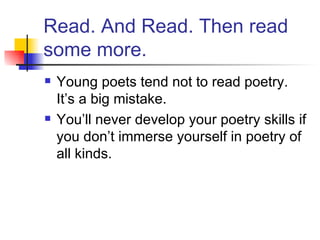
Read. And Read. Then read some more. Young poets tend not to read poetry. It’s a big mistake. You’ll never develop your poetry skills if you don’t immerse yourself in poetry of all kinds.
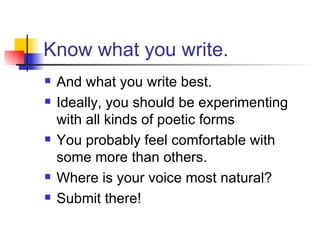
Know what you write. And what you write best. Ideally, you should be experimenting with all kinds of poetic forms You probably feel comfortable with some more than others.  Where is your voice most natural? Submit there!
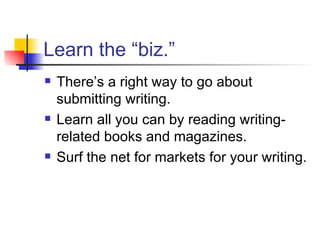
Learn the “biz.” There’s a right way to go about submitting writing. Learn all you can by reading writing-related books and magazines.  Surf the net for markets for your writing.
Research your markets. Gather names, addresses, figures, editorial preferences, and other pertinent information all in one place.  Read their publication to see what they’re publishing. Check out writing samples and  guidelines . If it’s not online, send for guidelines! Consider this inside information!
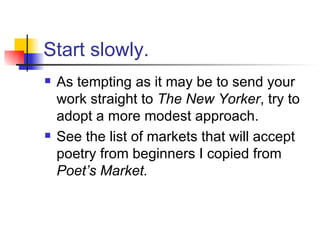
Start slowly. As tempting as it may be to send your work straight to  The New Yorker , try to adopt a more modest approach.  See the list of markets that will accept poetry from beginners I copied from  Poet’s Market.
Be professional! Make it show in your very first submission, from the way you prepare your manuscript to your attitude in communication with the editors. Follow guidelines.  Submit a polished manuscript. Choose works carefully with editor’s needs in mind. Always  include a SASE. Shows respect for editor and yourself.
Format ON PAPER: Do not submit handwritten poems, unless the publisher indicates that this is OK.  Typed, 8.5x11” paper, 1”+ margins, traditional font Use a heading
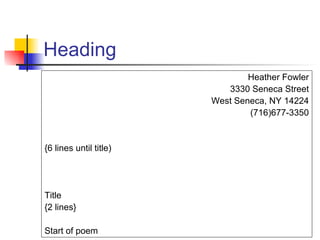
Heading Heather Fowler 3330 Seneca Street West Seneca, NY 14224 (716)677-3350 {6 lines until title) Title {2 lines} Start of poem
Other standards Double space between stanzas One piece per page. For poems longer than one page, type your name in the upper left-hand corner.
Submitting by e-mail In most cases, include your poem in the body of an e-mail. Avoid software issues. Avoid spreading viruses. Other editors prefer attachments.
Cover Letter Your introduction to the editor Discusses yourself and your work Check guidelines to see if it is required; best to send one if it is “preferred”
Keep track of your submissions. Do not send out the only copies of your work.  Keep hard copies. Establish a tracking system.
Learn from rejection A rejection slip is not a permission slip to doubt yourself, condemn your writing, or to give up. If the editor comments on your work, feel lucky (they’re busy!), and pay attention to what they have said. Consider their feedback with an open mind. Try again!
Be careful and leery of anthologies.  The anthologies will cost you (often a lot of) money, and the quality of the work in them is usually disappointing. Weird, false promises. Don’t let your desire to be published allow you to fall into a trap you’ll regret.

To Kill A Mockingbird (1962

  • 1.
  • 2.
  • 3.
    Read. And Read.Then read some more. Young poets tend not to read poetry. It’s a big mistake. You’ll never develop your poetry skills if you don’t immerse yourself in poetry of all kinds.
  • 4.
    Know what youwrite. And what you write best. Ideally, you should be experimenting with all kinds of poetic forms You probably feel comfortable with some more than others. Where is your voice most natural? Submit there!
  • 5.
    Learn the “biz.”There’s a right way to go about submitting writing. Learn all you can by reading writing-related books and magazines. Surf the net for markets for your writing.
  • 6.
    Research your markets.Gather names, addresses, figures, editorial preferences, and other pertinent information all in one place. Read their publication to see what they’re publishing. Check out writing samples and guidelines . If it’s not online, send for guidelines! Consider this inside information!
  • 7.
    Start slowly. Astempting as it may be to send your work straight to The New Yorker , try to adopt a more modest approach. See the list of markets that will accept poetry from beginners I copied from Poet’s Market.
  • 8.
    Be professional! Makeit show in your very first submission, from the way you prepare your manuscript to your attitude in communication with the editors. Follow guidelines. Submit a polished manuscript. Choose works carefully with editor’s needs in mind. Always include a SASE. Shows respect for editor and yourself.
  • 9.
    Format ON PAPER:Do not submit handwritten poems, unless the publisher indicates that this is OK. Typed, 8.5x11” paper, 1”+ margins, traditional font Use a heading
  • 10.
    Heading Heather Fowler3330 Seneca Street West Seneca, NY 14224 (716)677-3350 {6 lines until title) Title {2 lines} Start of poem
  • 11.
    Other standards Doublespace between stanzas One piece per page. For poems longer than one page, type your name in the upper left-hand corner.
  • 12.
    Submitting by e-mailIn most cases, include your poem in the body of an e-mail. Avoid software issues. Avoid spreading viruses. Other editors prefer attachments.
  • 13.
    Cover Letter Yourintroduction to the editor Discusses yourself and your work Check guidelines to see if it is required; best to send one if it is “preferred”
  • 14.
    Keep track ofyour submissions. Do not send out the only copies of your work. Keep hard copies. Establish a tracking system.
  • 15.
    Learn from rejectionA rejection slip is not a permission slip to doubt yourself, condemn your writing, or to give up. If the editor comments on your work, feel lucky (they’re busy!), and pay attention to what they have said. Consider their feedback with an open mind. Try again!
  • 16.
    Be careful andleery of anthologies. The anthologies will cost you (often a lot of) money, and the quality of the work in them is usually disappointing. Weird, false promises. Don’t let your desire to be published allow you to fall into a trap you’ll regret.