


Notes on Descriptive Writing
In this unit you will learn: Types of descriptive words Two types of description How to write a descriptive sentence Organizational patterns for paragraphs Tips for Writing Description Notes on Descriptive Writing
Notes on Descriptive Writing Think of descriptive writing as “writing that  shows  rather than  tells .”
Types of Descriptive Words Concrete Words Polysymbolic Words Emotionally-impacted Words Figures of Speech
Concrete Words Types of Descriptive Words Words that stimulate an impression of one of the five senses
Types of Descriptive Words Polysymbolic Words Words that stimulate multiple impressions of the five senses
Types of Descriptive Words Emotionally-impacted Words Concrete and/or polysymbolic words that also carry significant emotional value(s)
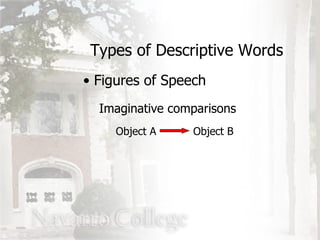
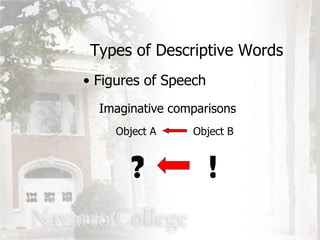
Types of Descriptive Words Figures of Speech Imaginative comparisons Object A Object B
Types of Descriptive Words Figures of Speech Imaginative comparisons Object A Object B ! ?
Types of Descriptive Words Figures of Speech Imaginative comparisons similes metaphors personification anthropomorphism synecdoche
Types of Descriptive Words Similes An indirect comparison using “like” or “as”
Types of Descriptive Words Metaphors A direct comparison suggesting a complete transformation of Object A into Object B
Types of Descriptive Words Types of Metaphors Simple metaphor Collapsed metaphor Abstract metaphor Inverted metaphor Functional metaphor
Types of Descriptive Words Types of Metaphors Simple metaphor John is a fox.
Types of Descriptive Words Types of Metaphors 2. Collapsed metaphor John, the fox
Types of Descriptive Words Types of Metaphors 3. Abstract metaphor _____, “fox”
Types of Descriptive Words Types of Metaphors 4. Inverted metaphor foxy John
Types of Descriptive Words Types of Metaphors 5. Functional metaphor “ That John!  He sure ‘outfoxed’ me!”
Types of Descriptive Words Personification Attributing life-like qualities to inanimate objects/subjects
Types of Descriptive Words Anthropomorphism Attributing specific human-like qualities to inanimate objects/ subjects
Types of Descriptive Words Synecdoche Referencing a part of one object to compare that object with another
Problems with Figures of Speech A Sample Paragraph Cool water flows through the rocky banks of the creek and into a wide pond.  Reeds and cattails surrounding the bank embrace the pond like a mother’s enfolding arms reaching out to caress her sleeping child.  Like a beaming proud mother’s eye, the sun drenches the scene with its loving warmth.  Just beneath the sparkling surface of the water, minnows shoot from rock to rock like silver darts thrust like scattershot by some unseen hand.
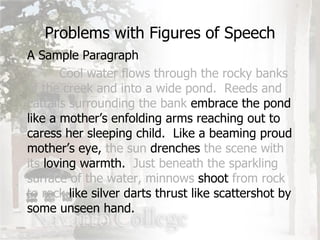
Problems with Figures of Speech A Sample Paragraph Cool water flows through the rocky banks of the creek and into a wide pond.  Reeds and cattails surrounding the bank  embrace the pond like a mother’s enfolding arms reaching out to caress her sleeping child.  Like a beaming proud mother’s eye,  the sun  drenches  the scene with its  loving warmth.  Just beneath the sparkling surface of the water, minnows  shoot  from rock to rock  like silver darts thrust like scattershot by some unseen hand.
Problems with Figures of Speech A Sample Paragraph Cool water flows through the rocky banks of the creek and into a wide pond.  Reeds and cattails surround the bank.  The sun drenches the scene with its warmth.  Just beneath the sparkling surface of the water, like silver darts, minnows shoot from rock to rock.
Objective Description Subjective Description Two Types of Description
Two Types of Description Objective Description “ technical description”
Two Types of Description Objective Description Concrete Words Polysymbolic Words
Two Types of Description Subjective Description “ personal description”
Two Types of Description Subjective Description Concrete Words Polysymbolic Words Emotionally-Impacted Words Figures of Speech
Writing the Descriptive Sentence The descriptive sentence is always   an abstraction with specific details. The descriptive sentence always   focuses on the subject or the   predicate. The descriptive sentence supports   an objective—one part of the    paragraph or another.
The descriptive sentence is always   an abstraction with specific details. Writing the Descriptive Sentence Descriptive sentences never present all the images; each sentence creates a limited picture.
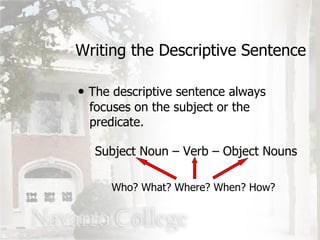
The descriptive sentence always   focuses on the subject or the   predicate. Writing the Descriptive Sentence Subject -- Predicate
The descriptive sentence always   focuses on the subject or the   predicate. Writing the Descriptive Sentence Subject Noun – Verb – Object Nouns Who? What? Where? When? How?
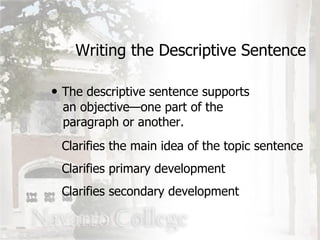
The descriptive sentence supports   an objective—one part of the    paragraph or another. Writing the Descriptive Sentence Clarifies the main idea of the topic sentence Clarifies primary development Clarifies secondary development
Writing the Descriptive Sentence A sample descriptive sentence: The blue-grey laptop computer, perched on the parquet-laminated kitchen table, cluttered with books and papers, displays the PowerPoint abstract background—softly blended graphics that fade into white, punctuated with stiff, black letters.
Writing the Descriptive Sentence A better descriptive sentence: On its two back legs, the blue-grey laptop computer perched on the parquet-laminated kitchen table. (subjective description)
Writing the Descriptive Sentence An alternative descriptive sentence: Raised on back legs, the blue-grey laptop computer was set on the parquet-laminated kitchen table. (objective description)
Basic Patterns for Organizing Effective Description Directional Organization Spatial Organization Psychological Organization
Directional Organization Basic Patterns for Organizing Effective Description Order of the Compass Linear Chronological Sequential
Spatial Organization Basic Patterns for Organizing Effective Description General to Specific/Specific to General Small to Large/Large to Small Front to Back/Back to Front Inside to Outside/Outside to Inside
Psychological Organization Basic Patterns for Organizing Effective Description Most important to least important Least important to most important Associative (familiarity) Non-associative (random)
Facing east, the house rests atop two acres of farmland.  The gated drive begins at the highway and winds in a gentle “S” across the grassy front lawn and ends at the garage to the left of the main house. Behind the house stretches freshly plowed ground, rows ranging from left to right.  A line of oaks crowns the crest of the property. Sample Paragraph #1
Sample Paragraph #2 Resting deeply back in his chair, his feet crossed on the corner of his desk, Dr. Marsh is fast asleep.  The few silver-grey strands of hair sweep back from his receding hairline.  His lips sealed loosely, his wide chin rests comfortably over his neck. A pair of black reading glasses dangle on the end of his nose.  His chest rises and falls as he snores softly in a slow rhythm.  His pulpy hands are folded in his lap over a brown folder of loose pages.
Tips  for  Descriptive Writing Focus the descriptive words on the   subject or predicate. Don’t overwork the detail. Arrange descriptive sentences    consistently, following an organizational   plan. Keep descriptive detail objective in   business communications. Use description along with other    developmental patterns.
 

Description

  • 1.
  • 2.
  • 3.
    In this unityou will learn: Types of descriptive words Two types of description How to write a descriptive sentence Organizational patterns for paragraphs Tips for Writing Description Notes on Descriptive Writing
  • 4.
    Notes on DescriptiveWriting Think of descriptive writing as “writing that shows rather than tells .”
  • 5.
    Types of DescriptiveWords Concrete Words Polysymbolic Words Emotionally-impacted Words Figures of Speech
  • 6.
    Concrete Words Typesof Descriptive Words Words that stimulate an impression of one of the five senses
  • 7.
    Types of DescriptiveWords Polysymbolic Words Words that stimulate multiple impressions of the five senses
  • 8.
    Types of DescriptiveWords Emotionally-impacted Words Concrete and/or polysymbolic words that also carry significant emotional value(s)
  • 9.
    Types of DescriptiveWords Figures of Speech Imaginative comparisons Object A Object B
  • 10.
    Types of DescriptiveWords Figures of Speech Imaginative comparisons Object A Object B ! ?
  • 11.
    Types of DescriptiveWords Figures of Speech Imaginative comparisons similes metaphors personification anthropomorphism synecdoche
  • 12.
    Types of DescriptiveWords Similes An indirect comparison using “like” or “as”
  • 13.
    Types of DescriptiveWords Metaphors A direct comparison suggesting a complete transformation of Object A into Object B
  • 14.
    Types of DescriptiveWords Types of Metaphors Simple metaphor Collapsed metaphor Abstract metaphor Inverted metaphor Functional metaphor
  • 15.
    Types of DescriptiveWords Types of Metaphors Simple metaphor John is a fox.
  • 16.
    Types of DescriptiveWords Types of Metaphors 2. Collapsed metaphor John, the fox
  • 17.
    Types of DescriptiveWords Types of Metaphors 3. Abstract metaphor _____, “fox”
  • 18.
    Types of DescriptiveWords Types of Metaphors 4. Inverted metaphor foxy John
  • 19.
    Types of DescriptiveWords Types of Metaphors 5. Functional metaphor “ That John! He sure ‘outfoxed’ me!”
  • 20.
    Types of DescriptiveWords Personification Attributing life-like qualities to inanimate objects/subjects
  • 21.
    Types of DescriptiveWords Anthropomorphism Attributing specific human-like qualities to inanimate objects/ subjects
  • 22.
    Types of DescriptiveWords Synecdoche Referencing a part of one object to compare that object with another
  • 23.
    Problems with Figuresof Speech A Sample Paragraph Cool water flows through the rocky banks of the creek and into a wide pond. Reeds and cattails surrounding the bank embrace the pond like a mother’s enfolding arms reaching out to caress her sleeping child. Like a beaming proud mother’s eye, the sun drenches the scene with its loving warmth. Just beneath the sparkling surface of the water, minnows shoot from rock to rock like silver darts thrust like scattershot by some unseen hand.
  • 24.
    Problems with Figuresof Speech A Sample Paragraph Cool water flows through the rocky banks of the creek and into a wide pond. Reeds and cattails surrounding the bank embrace the pond like a mother’s enfolding arms reaching out to caress her sleeping child. Like a beaming proud mother’s eye, the sun drenches the scene with its loving warmth. Just beneath the sparkling surface of the water, minnows shoot from rock to rock like silver darts thrust like scattershot by some unseen hand.
  • 25.
    Problems with Figuresof Speech A Sample Paragraph Cool water flows through the rocky banks of the creek and into a wide pond. Reeds and cattails surround the bank. The sun drenches the scene with its warmth. Just beneath the sparkling surface of the water, like silver darts, minnows shoot from rock to rock.
  • 26.
    Objective Description SubjectiveDescription Two Types of Description
  • 27.
    Two Types ofDescription Objective Description “ technical description”
  • 28.
    Two Types ofDescription Objective Description Concrete Words Polysymbolic Words
  • 29.
    Two Types ofDescription Subjective Description “ personal description”
  • 30.
    Two Types ofDescription Subjective Description Concrete Words Polysymbolic Words Emotionally-Impacted Words Figures of Speech
  • 31.
    Writing the DescriptiveSentence The descriptive sentence is always an abstraction with specific details. The descriptive sentence always focuses on the subject or the predicate. The descriptive sentence supports an objective—one part of the paragraph or another.
  • 32.
    The descriptive sentenceis always an abstraction with specific details. Writing the Descriptive Sentence Descriptive sentences never present all the images; each sentence creates a limited picture.
  • 33.
    The descriptive sentencealways focuses on the subject or the predicate. Writing the Descriptive Sentence Subject -- Predicate
  • 34.
    The descriptive sentencealways focuses on the subject or the predicate. Writing the Descriptive Sentence Subject Noun – Verb – Object Nouns Who? What? Where? When? How?
  • 35.
    The descriptive sentencesupports an objective—one part of the paragraph or another. Writing the Descriptive Sentence Clarifies the main idea of the topic sentence Clarifies primary development Clarifies secondary development
  • 36.
    Writing the DescriptiveSentence A sample descriptive sentence: The blue-grey laptop computer, perched on the parquet-laminated kitchen table, cluttered with books and papers, displays the PowerPoint abstract background—softly blended graphics that fade into white, punctuated with stiff, black letters.
  • 37.
    Writing the DescriptiveSentence A better descriptive sentence: On its two back legs, the blue-grey laptop computer perched on the parquet-laminated kitchen table. (subjective description)
  • 38.
    Writing the DescriptiveSentence An alternative descriptive sentence: Raised on back legs, the blue-grey laptop computer was set on the parquet-laminated kitchen table. (objective description)
  • 39.
    Basic Patterns forOrganizing Effective Description Directional Organization Spatial Organization Psychological Organization
  • 40.
    Directional Organization BasicPatterns for Organizing Effective Description Order of the Compass Linear Chronological Sequential
  • 41.
    Spatial Organization BasicPatterns for Organizing Effective Description General to Specific/Specific to General Small to Large/Large to Small Front to Back/Back to Front Inside to Outside/Outside to Inside
  • 42.
    Psychological Organization BasicPatterns for Organizing Effective Description Most important to least important Least important to most important Associative (familiarity) Non-associative (random)
  • 43.
    Facing east, thehouse rests atop two acres of farmland. The gated drive begins at the highway and winds in a gentle “S” across the grassy front lawn and ends at the garage to the left of the main house. Behind the house stretches freshly plowed ground, rows ranging from left to right. A line of oaks crowns the crest of the property. Sample Paragraph #1
  • 44.
    Sample Paragraph #2Resting deeply back in his chair, his feet crossed on the corner of his desk, Dr. Marsh is fast asleep. The few silver-grey strands of hair sweep back from his receding hairline. His lips sealed loosely, his wide chin rests comfortably over his neck. A pair of black reading glasses dangle on the end of his nose. His chest rises and falls as he snores softly in a slow rhythm. His pulpy hands are folded in his lap over a brown folder of loose pages.
  • 45.
    Tips for Descriptive Writing Focus the descriptive words on the subject or predicate. Don’t overwork the detail. Arrange descriptive sentences consistently, following an organizational plan. Keep descriptive detail objective in business communications. Use description along with other developmental patterns.
  • 46.