A report by Carnegie UK Trust
A shareholders’ guide
to rural services
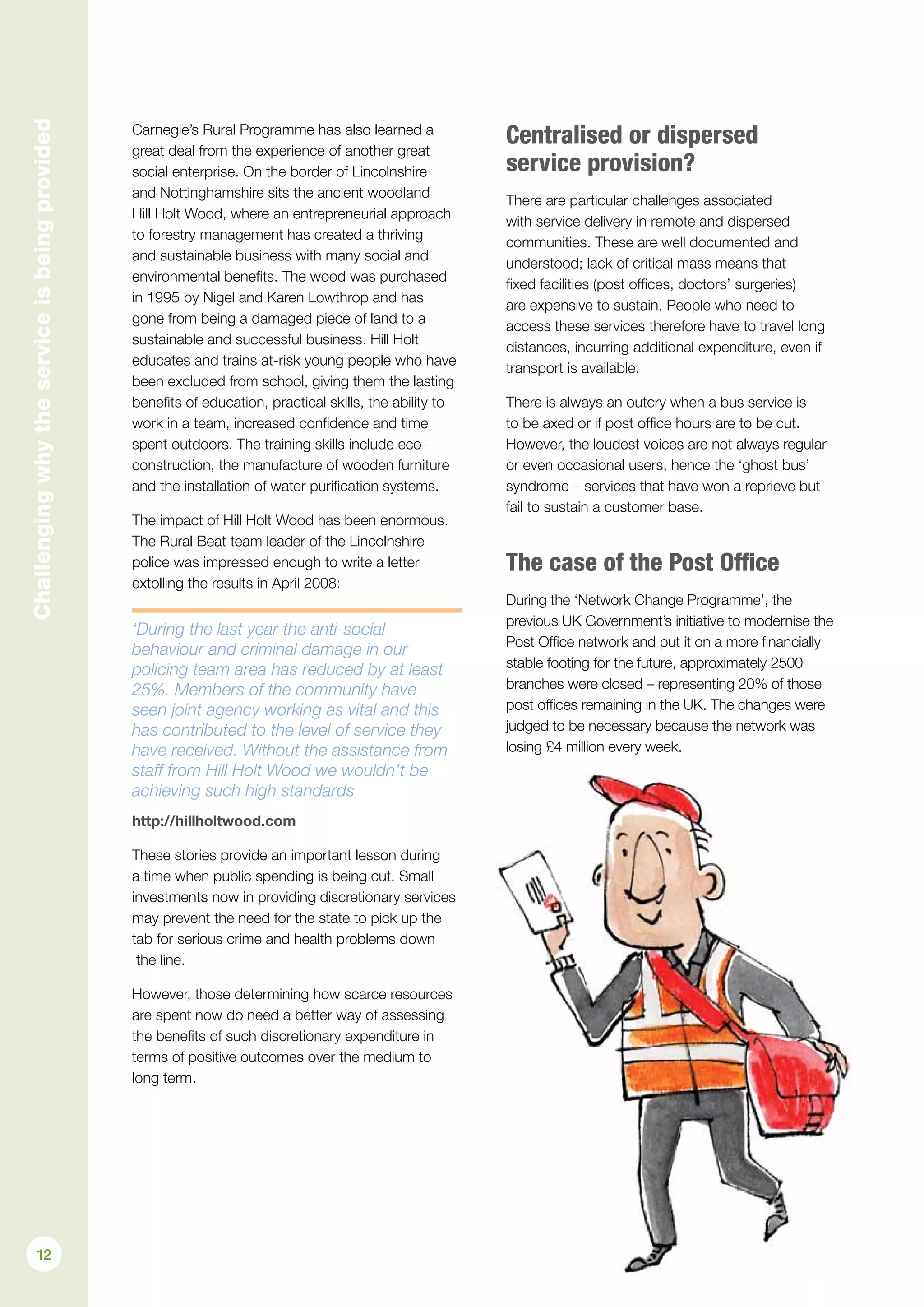
This report is the outcome of action research undertaken by Carnegie UK Trust’s Rural Programme and was
authored by Kate Braithwaite with assistance from participants at Carnegie’s Rural Convention held at Hill Holt
Wood in November 2010. The Rural Team gave invaluable feedback, Geoff Brown copy-edited the text and
Kirsty Tait managed production.
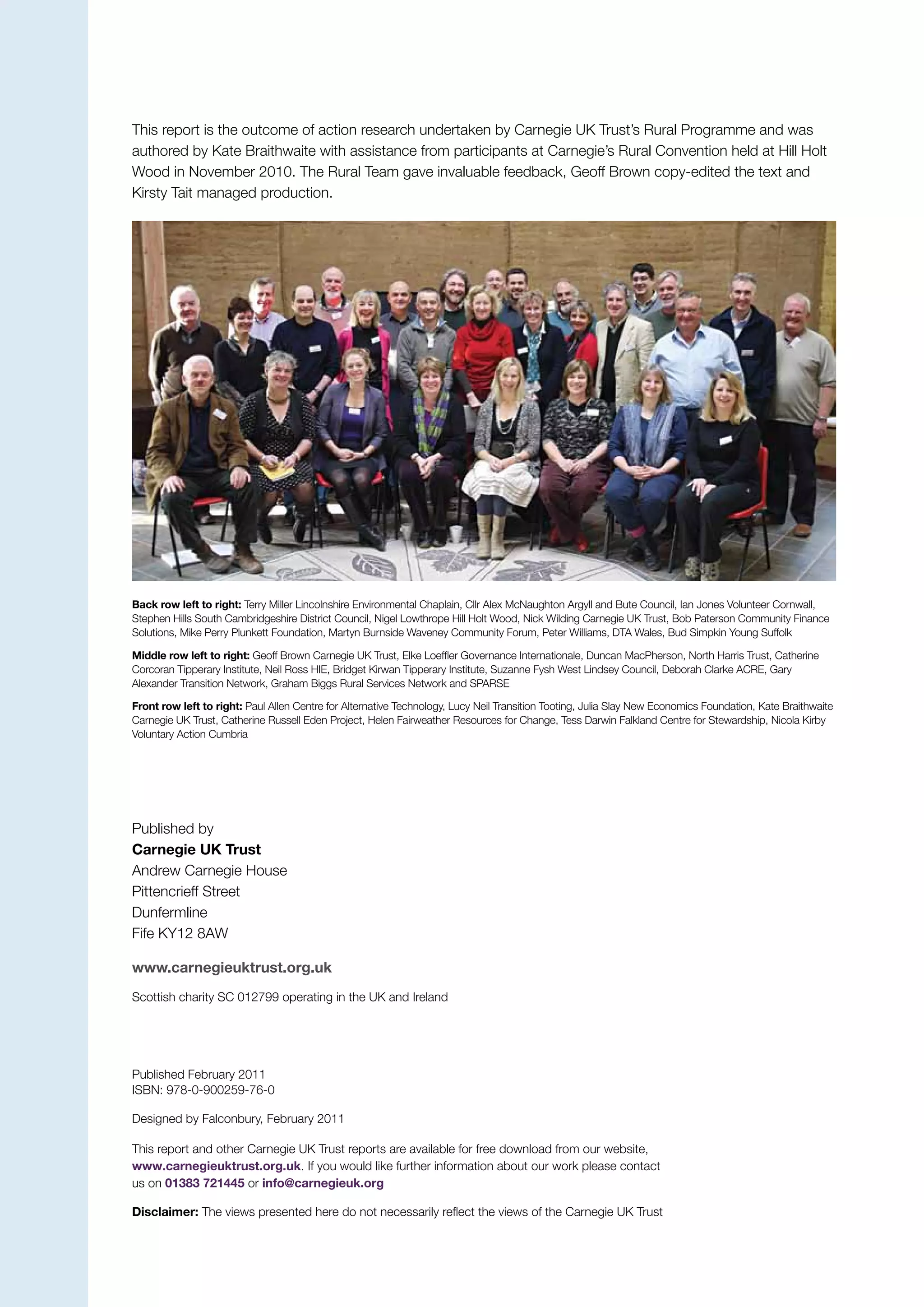
Back row left to right: Terry Miller Lincolnshire Environmental Chaplain, Cllr Alex McNaughton Argyll and Bute Council, Ian Jones Volunteer Cornwall,
Stephen Hills South Cambridgeshire District Council, Nigel Lowthrope Hill Holt Wood, Nick Wilding Carnegie UK Trust, Bob Paterson Community Finance
Solutions, Mike Perry Plunkett Foundation, Martyn Burnside Waveney Community Forum, Peter Williams, DTA Wales, Bud Simpkin Young Suffolk
Middle row left to right: Geoff Brown Carnegie UK Trust, Elke Loeffler Governance Internationale, Duncan MacPherson, North Harris Trust, Catherine
Corcoran Tipperary Institute, Neil Ross HIE, Bridget Kirwan Tipperary Institute, Suzanne Fysh West Lindsey Council, Deborah Clarke ACRE, Gary
Alexander Transition Network, Graham Biggs Rural Services Network and SPARSE
Front row left to right: Paul Allen Centre for Alternative Technology, Lucy Neil Transition Tooting, Julia Slay New Economics Foundation, Kate Braithwaite
Carnegie UK Trust, Catherine Russell Eden Project, Helen Fairweather Resources for Change, Tess Darwin Falkland Centre for Stewardship, Nicola Kirby
Voluntary Action Cumbria
Published by
Carnegie UK Trust
Andrew Carnegie House
Pittencrieff Street
Dunfermline
Fife KY12 8AW
www.carnegieuktrust.org.uk
Scottish charity SC 012799 operating in the UK and Ireland
Published February 2011
ISBN: 978-0-900259-76-0
Designed by Falconbury, February 2011
This report and other Carnegie UK Trust reports are available for free download from our website,
www.carnegieuktrust.org.uk. If you would like further information about our work please contact
us on 01383 721445 or info@carnegieuk.org
Disclaimer: The views presented here do not necessarily reflect the views of the Carnegie UK Trust
1
Contents
Contents
Introduction  2
Better Shape Up: How prepared is your public sector?  3
Step 1: Challenging why the service is being provided  6
Step 2: How are we doing?: Comparing performance with other areas  19
Step 3: We’re all in this together: Engaging with taxpayers,  22
service users, potential service users/providers and stakeholders
about service delivery
Step 4: Develop options for service delivery  25
Step 5: Services of the future  37
Appendix 1: Bright ideas and inspiration: an A to Z of services 42
Introduction
Introduction
Good access to a wide range of services is
one characteristic of a sustainable community.
Over the last decade, however, rural areas have
experienced a gradual withdrawal of services due
to the pressures of centralisation – and serious cuts
in local government finances are looming. There is
a growing awareness that beyond an entitlement
to essential services, rural communities have an
important role to play in determining what else can
be provided. Further, we have started to think about
residents less as passive recipients of services but
more as shareholders, with public sector leaders
‘the Board’.
Evidence gathered during Carnegie’s Rural Action
Research Programme (2005–2009) has enabled us
to have a deeper understanding of the ingredients
of successful community involvement in the delivery
of services. Since then, we have been working
intensively in rural areas: areas that face many
well-documented challenges, mostly related to
geography and demographics (islands; remote
areas; small, ageing and dispersed communities)
and low-paid (often seasonal) employment. We
believe that rural areas will provide a test bed
for innovative solutions to service delivery in
neighbourhoods everywhere. Rural communities
in some places are already contributing actively to
the planning, managing, delivery, evaluation and
monitoring of services; this against a chorus of
alarming headlines in local newspapers about the
likely impact of cuts.
In this publication, we share ideas from the pioneers
about the potential of community organisations and
local social enterprises to respond to the services
challenge, looking in detail at associated funding,
skills, procurement and regulatory issues. We will
challenge the assumption that services have to
be provided in the way that they have since the
creation of the Welfare State. We aim to share
these ideas in this policy booklet with public sector
commissioning bodies, social enterprise service
providers and communities.
Reports in the local press are noting the level of
public sector cuts that must be implemented over
the next few years. The figures are huge – but what
do they really mean?
The squeeze on public sector funding streams
is forcing a rapid assessment by councils and
other bodies of the services that can be afforded.
Heads of Departments are required to produce
service reviews, demonstrating where savings
can be found. This has been the overwhelming
imperative. These managers have to juggle a
number of questions: how can I best look after the
interests of my staff team? Is my own job safe? Will
we be working from a different location the other
side of the county? How will the unions react to
my plans? What are the knock-on effects of my
decision for these communities? It would be a very
natural response to try and preserve as much of
the existing way of doing things but such is the
scale of cuts that this might not be possible. There
has scarcely been time to simultaneously consider
how services can cost less but be even better from
the perspective of the residents, but this is what is
required. Furthermore, the services that are needed
in future may not look very like services today.
2
Bettershapeup
Better shape up:
how prepared is your
public sector?
During the past few years, the public sector in
all areas has undergone reforms that should
mean residents are better informed about service
delivery. Many improvements have centred on a
more joined-up approach, with different parts of
the public sector working together in partnership.
Learning lessons from the successes and failures of
public sector partnerships (community strategies,
Local Area Agreements, Total Place et al) and
their role in determining service priorities is a good
starting point for our investigation.
Readers may be familiar with the bewildering
range of partnerships that have been brought
together over the last few years to promote ‘joined-
up’ thinking when it comes to service delivery.
These include Local Strategic Partnerships and
Community Planning Partnerships. What have these
initiatives achieved? Joined up thinking between
public sector organisations?
There have been attempts to show how an inter-
agency approach to service delivery needs of a
particular area can be considered in a holistic way.
For example, Total Place was an initiative in England
that looked at how a ‘whole area’ approach to public
services might lead to better services at less cost. It
sought to identify and avoid overlap and duplication
between (mainly public sector) organisations –
hopefully delivering both service improvement and
efficiency at the local level. Total Place introduced
management concepts that will be very familiar to
the private sector into use in the public sphere. In
order to work at all, Total Place required leadership
at the highest level within public bodies and a strong
commitment to work together with communities
to find new solutions. But the buy-in has to extend
through organisations to middle managers who are
tussling with the need to cut costs.
Some have criticised Total Place as a local authority
driven, ‘command and control’ exercise. But this
new spirit of collaboration may extend beyond
the public sector, as developments in Suffolk
demonstrate:
Suffolk Leadership
Collaborative
The Suffolk Collaborative is a new grouping of 22
chief executives of public, private and voluntary
sector organisations in Suffolk. This includes
councils, NHS trusts, police, businesses and
umbrella organisations.
The Collaborative was formed as a project to
develop collaboration across organisations in
Suffolk. The Collaborative is bringing an inquiry style
of learning and strategic leadership to the priorities
set out in the community strategy.
The following themes are being explored:
•	 Helping people to help themselves;
•	 Connecting communities;
•	 Demonstrating Suffolk’s aspirations;
•	 Simplifying public services through collaboration.
Watch! ‘The Lives We Lead’ on YouTube
www.youtube.com/watch?v=pL5HytMQSnc
Our action research suggests that these sorts of
partnership structures have been successful in
bringing together different public sector bodies
(particularly education and social services
departments and the NHS) and there are tangible
outcomes such as organisations sharing a Chief
Executive Officer. So progress has been made
in some areas. However, there is a huge amount
of bureaucracy in public services and our action
research suggests that community engagement in
the planning of services is not yet all that it could be.
3
Bettershapeup
Spotting a successful
partnership? How well is your
area doing?
•	 The average man or woman in the street will
know of the partnership’s existence
•	 Community leaders will have been actively
involved in determining the priorities of the
partnership
•	 The partnership has a clear vision for the work
which is widely available
•	 Publishes an implementation plan with SMART
goals (S – specific M – measurable
A – achievable R – realistic T – time-based)
•	 Reports back to the general public on the
achievements
•	 Achieves the active participation of the private
sector, who feel integral to the success of the
strategy
•	 Achieves the active participation of third sector
representatives and through them the wider
community and third sector who feel integral to
the success of the strategy
The good news is that public bodies are getting
better and better at community engagement: these
matters are considered in our sister publication on
community led planning,1
where we demonstrate
how important meaningful engagement with the
community really is. We are not talking about
‘consultation’ (I’ve got a problem, here is my solution,
what do you think about my solution?) but a genuine
exercise in collecting the views of residents.
Who pulls the strings of local
partnership?
During the last decade the ‘target culture’ has
required partnerships to measure their performance
against a wide range of criteria. This culture has
been pushed by central government in an attempt
to drive up service delivery standards.
Were the public at large aware of these targets?
Were these targets helpful in securing better
outcomes for citizens? If parents looked at
children’s test results and noted their school was
under-performing, was there anything that they
could do about it when, especially in rural areas,
there is a monopoly provider?
Should the partnership be accountable to central
government or local people? In England there is a
noticeable move away from ‘Big Government’. It is
now up to local areas to determine priorities:
‘From today, the Government are putting
local areas fully in control of their local area
agreements. This enables local authorities
and their partners to amend or drop any of
the current 4,700 Local Area Agreement
targets without needing ministerial
agreement. Where they choose to keep
the targets, central Government will have
no role in monitoring them. I will also not
be requiring local authorities to prepare
an LAA from April 2011, once the current
agreements expire’.
The Rt. Hon Eric Pickles MP, Secretary of State
for Communities and Local Government, 13th
October 2010
This was a bit of an overstatement by the Secretary
of State as some of the targets are driven by
European legislation and cannot be dropped.
However, in the move from a ‘statist’ policy to one
of ‘localism’ is there an opportunity for services to
be tailored to local priorities or will standards slip in
a postcode lottery?
Where does all the money go?
Partnership working provides an opportunity for the
public sector to assess the total investment in an
area (such as a county) and to gauge the benefits
of this expenditure for residents. When this exercise
is carried out, the results involve eye-watering
amounts of money!
1
	 Carnegie UK Trust (2010) The Power of the Plan
4
Bettershapeup
Case study: Calling and
Counting Cumbria
The Leadership Centre for Local Government and
members of the Cumbria Strategic Partnership were
keen to challenge the status quo and encourage more
effective joint working by refocusing activity on real
people in real places, developing a more accurate
understanding of their needs. Calling Cumbria took a
wide range of (mainly public sector) colleagues out into
the community, and in some cases out of their comfort
zone, to hear stories from residents, and from voluntary
and community sector workers about their lives and
work. This led to broad discussion about how services
are currently delivered and highlighted that in many
cases there could be a better way.
Counting Cumbria provided hard evidence about
how much public sector money is spent in Cumbria
and by whom but most importantly led to questions
about local accountability, potential duplication and
opportunities to debate efficiency.
Fewer than half a million people live in Cumbria.
Total public expenditure in Cumbria in 2006–7 was
£7.1bn, which is £14,200 per head. Of that little over a
quarter, £1.9bn, was controlled by or directed through
Cumbrian bodies. Of national government’s £5.2bn,
non-departmental public bodies spent £2.3bn: more
than Cumbrian bodies.
The largest areas of aggregate expenditure were
social protection £1.5bn, health £880m, economic
affairs £700m (excluding £1.8bn by the Nuclear
Decommissioning Agency), environmental protection
£690m, public order and safety £600m and education
£540m. The largest areas of expenditure by Cumbrian
bodies were health £670m and education £410m.
European direct expenditure (through ERDF Objectives
2 and 3) was about £10m.
Taxation raised in Cumbria was about £3.1bn, of which
£2.9bn was by national means and £200m local.
Source: Cumbria Strategic Partnership
An appreciation of the public money flows within just
one county in England prompted many questions:
•	 What outcomes were achieved for the money? Was
there a measurable improvement in GDP? Were
more businesses or jobs created? Did people live
healthier lives?
•	 Could the money be spent in a way that achieved
better results? Are these options ever considered?
•	 How much say do people in Cumbria have over the
public money spent in their county?
•	 Are the needs of particular groups – for example,
young people – well recognised in the way the
money is spent?
•	 Where many organisations serve a particular
purpose, are their separate administrative overheads
justified? Cumbria was particularly well endowed
with regeneration and business support agencies!
•	 How strong is the link between expenditure in an
area and the capacity to initiate meaningful change?
It is clear, now that the public sector spending cuts
have been announced, that there is an imperative that
these questions be answered in every part of the UK
and Ireland.
We conclude that a good starting point for any
re-engineering of service delivery is a ‘whole-
system’ analysis:
•	 What financial resources are currently available
from national, regional and local sources?
•	 Who determines how this resource can be applied?
•	 What services are being delivered and by whom?
Is there any overlap or convergence?
•	 What do residents expect of service delivery?
•	 Where there are many calls upon limited
resources, what are the priorities (as far as
residents are concerned) for expenditure locally?
Conducting a review of services
and considering options (and
just what are the options?)
Following a process of collaboration with public sector
bodies, the private and third sector and the community,
the next task is a thorough review of each service to
examine the way in which services are provided and
also to ensure that they are of appropriate quality, they
meet local people’s needs and they provide value for
money. We suggest that there are five steps involved in
the review:
•	 Step 1: Challenging why the service is
being provided
•	 Step 2: How good are our services? Could they
be better?
•	 Step 3: Engaging (meaningfully) with taxpayers,
service users, potential service users/ providers
and stakeholders about service delivery
•	 Step 4: Develop options for service delivery
•	 Step 5: Services of the future
5
Step 1:
Challenging why the service
is being provided
6
Challengingwhytheserviceisbeingprovided
A first step might be to ask if it is a statutory duty
to provide this service or is the service provided
at the discretion of the public body? The public
probably expect schools to be provided, social care
to be available and rubbish to be collected, but it
is quite difficult for local authorities to know exactly
what services are mandatory, as Buckinghamshire
County Council found out:
Research carried out early on in the review
identified that very little information is
currently available about the statutory
duties of Councils. A number of
organisations were contacted for more
information (including the Communities
and Local Government department) but it
appears that a conclusive list of statutory
functions does not currently exist.
A Review into Statutory, Mandatory and
Discretionary Services at Buckinghamshire
County Council – November 2009
Even where it seems that the provision of a service
is mandatory, the level to which the service must be
provided is often unclear. For instance, restaurants
do need to be inspected on hygiene grounds
but the individual department may determine the
number of inspection visits. Over time, it is hard to
separate fact from practice!
With this lack of clarity, it is possible for different
areas to experience very different levels of service,
from the Easy Jet ‘no frills’ approach to the gold-
plated service.
Residents living in Barnet, north London
will be able to pay more for improved
services, in a move inspired by airlines
that forced down the cost of air travel by
placing surcharges on non-essential items.
A council spokesman has dubbed the new
policy ‘EasyCouncil’. As part of the radical
approach, people who pay a small fee will
have their planning applications seen more
quickly. The council is already pushing ahead
with plans to give elderly residents a greater
say in how their care budgets are spent.
‘Some things will be cheap and cheerful
and in other areas we will provide complete
services,’ Mike Freer, the council leader and
Tory parliamentary candidate for Finchley
and Golders Green, told The Guardian.
‘This is not about rolling back the frontiers
of the state, but about targeting our
interventions.’
Matthew Moore, Daily Telegraph, 28 Aug 2009
7
Challengingwhytheserviceisbeingprovided
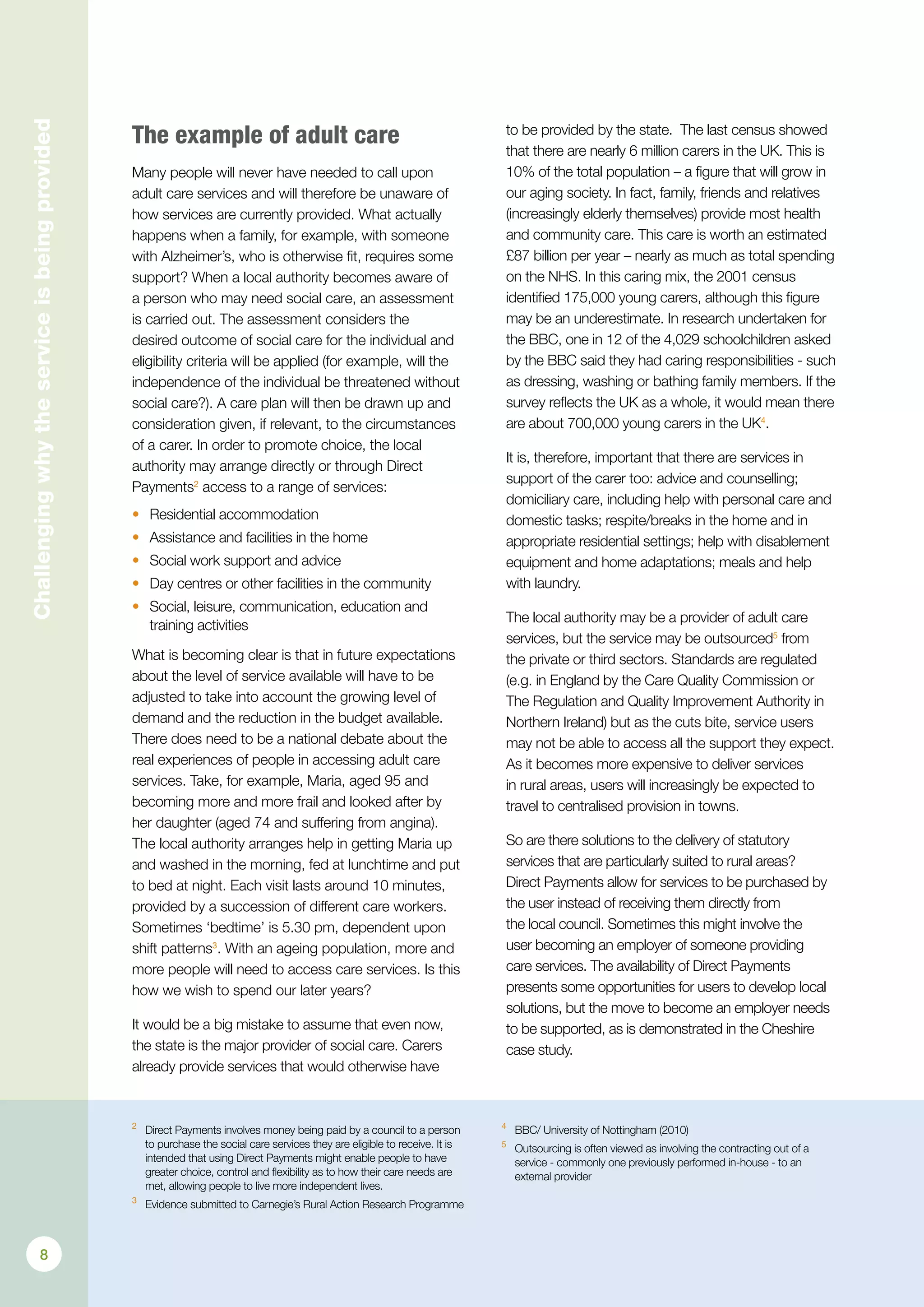
The example of adult care
Many people will never have needed to call upon
adult care services and will therefore be unaware of
how services are currently provided. What actually
happens when a family, for example, with someone
with Alzheimer’s, who is otherwise fit, requires some
support? When a local authority becomes aware of
a person who may need social care, an assessment
is carried out. The assessment considers the
desired outcome of social care for the individual and
eligibility criteria will be applied (for example, will the
independence of the individual be threatened without
social care?). A care plan will then be drawn up and
consideration given, if relevant, to the circumstances
of a carer. In order to promote choice, the local
authority may arrange directly or through Direct
Payments2
access to a range of services:
•	 Residential accommodation
•	 Assistance and facilities in the home
•	 Social work support and advice
•	 Day centres or other facilities in the community
•	 Social, leisure, communication, education and
training activities
What is becoming clear is that in future expectations
about the level of service available will have to be
adjusted to take into account the growing level of
demand and the reduction in the budget available.
There does need to be a national debate about the
real experiences of people in accessing adult care
services. Take, for example, Maria, aged 95 and
becoming more and more frail and looked after by
her daughter (aged 74 and suffering from angina).
The local authority arranges help in getting Maria up
and washed in the morning, fed at lunchtime and put
to bed at night. Each visit lasts around 10 minutes,
provided by a succession of different care workers.
Sometimes ‘bedtime’ is 5.30 pm, dependent upon
shift patterns3
. With an ageing population, more and
more people will need to access care services. Is this
how we wish to spend our later years?
It would be a big mistake to assume that even now,
the state is the major provider of social care. Carers
already provide services that would otherwise have
to be provided by the state. The last census showed
that there are nearly 6 million carers in the UK. This is
10% of the total population – a figure that will grow in
our aging society. In fact, family, friends and relatives
(increasingly elderly themselves) provide most health
and community care. This care is worth an estimated
£87 billion per year – nearly as much as total spending
on the NHS. In this caring mix, the 2001 census
identified 175,000 young carers, although this figure
may be an underestimate. In research undertaken for
the BBC, one in 12 of the 4,029 schoolchildren asked
by the BBC said they had caring responsibilities - such
as dressing, washing or bathing family members. If the
survey reflects the UK as a whole, it would mean there
are about 700,000 young carers in the UK4
.
It is, therefore, important that there are services in
support of the carer too: advice and counselling;
domiciliary care, including help with personal care and
domestic tasks; respite/breaks in the home and in
appropriate residential settings; help with disablement
equipment and home adaptations; meals and help
with laundry.
The local authority may be a provider of adult care
services, but the service may be outsourced5
from
the private or third sectors. Standards are regulated
(e.g. in England by the Care Quality Commission or
The Regulation and Quality Improvement Authority in
Northern Ireland) but as the cuts bite, service users
may not be able to access all the support they expect.
As it becomes more expensive to deliver services
in rural areas, users will increasingly be expected to
travel to centralised provision in towns.
So are there solutions to the delivery of statutory
services that are particularly suited to rural areas?
Direct Payments allow for services to be purchased by
the user instead of receiving them directly from
the local council. Sometimes this might involve the
user becoming an employer of someone providing
care services. The availability of Direct Payments
presents some opportunities for users to develop local
solutions, but the move to become an employer needs
to be supported, as is demonstrated in the Cheshire
case study.
2	
Direct Payments involves money being paid by a council to a person
to purchase the social care services they are eligible to receive. It is
intended that using Direct Payments might enable people to have
greater choice, control and flexibility as to how their care needs are
met, allowing people to live more independent lives.
3	
Evidence submitted to Carnegie’s Rural Action Research Programme
4	
BBC/ University of Nottingham (2010)
5	
Outsourcing is often viewed as involving the contracting out of a
service - commonly one previously performed in-house - to an
external provider
8
Challengingwhytheserviceisbeingprovided
Case Study: Cheshire Centre
for Independent Living Action
Research
Cheshire Centre for Independent Living undertook
action research for Carnegie UK Trust with a sample
of 362 disabled people who were in receipt of Direct
Payments to contract their own care provision.
They found that many disabled people were
interested in working with their peers to provide
employment for trusted local people in the role
of Personal Assistants. However many found
becoming an employer a daunting prospect but
welcomed the opportunity of some support to
achieve this outcome. Prior to this work, very little
peer support existed for those in receipt of Direct
Payments in Cheshire and what did was to be
found mainly in the towns.
In addition, engagement of Personal Assistants
from outside the disabled peoples’ immediate circle,
proved challenging. People (both the disabled and
their potential employees) would benefit
from knowing more about engagement
opportunities, and from having the ability to
‘package up’ jobs from more than one person
for the benefit of all parties.
Cheshire Centre for Independent Living called
upon central government to adopt the proposals
contained in the Chartered Institute of Taxation’s
Low Incomes Tax Reform Group’s report
‘Independent Living; Direct Payments and the
Tax System’ (January 2008.) They considered
that councils should allow extra time for Personal
Assistants to accompany disabled people to Peer
Support meetings, and include this as part of their
care package assessment. Councils should give
consideration to and address any difference in take-
up rates across their area with a view to achieving
the expressed preference of individual customers.
Finally, they recommended that a measure to
benchmark independent living as being able to live
apart from one’s parent(s) be introduced.
This action research by Cheshire Centre for Independent Living provided us with evidence of the real potential
of direct payments, particularly in a rural area:
Benefits and Drawbacks of Direct Payments
Benefits Drawbacks
•	 Freedom to spend money on the services that
matter most to the individual
•	 Ability to ‘top-up’ services from own resources
•	 Potential to create local employment
opportunities for Personal Assistants
•	 Employment of local people, known and trusted
by the employer
•	 Creation of peer support groups to share
employment responsibilities but also to provide
social contact
•	 There is an opportunity for potential Personal
Assistants to work together to share training,
administration and regulatory costs
•	 An injection of finance into the local economy
•	 There may be no one locally who is interested
in becoming a Personal Assistant (especially
in some rural areas where working age people
have effectively been driven out by lack of
affordable housing)
•	 Providing holiday and sick leave cover may be
problematic
•	 It is expensive to provide support for those in
receipt of Direct Payments to employ people
•	 Individual Personal Assistants do not have
access to the range of support and training and
professional development opportunities that
employees of large organisations do
9
Challengingwhytheserviceisbeingprovided
This examination of the provision of just one
‘statutory’ service – adult care – demonstrates that
there are already wide variations in the experience
of the service in different parts of the country and
that these may be greater in future as cuts bite.
Furthermore, the trend to greater centralisation
of service provision in towns is likely to continue.
The experience of users of Direct Payments may
provide rural residents with a possible solution to
tailor-make services and provide clues for the future
provision of other rural services.
What about discretionary
services?
We have seen in relation to adult social care how
difficult it is for councils to budget for services that
are judged to be essential. During times of cuts,
‘discretionary’ services such as community centres,
parks and Christmas lights begin to look like
luxuries we can no longer afford. What principles
might guide decision making about discretionary
services? We suggest that discretionary services
should be assessed according to seven criteria:
1	Is the target group accessing the service or are
‘undeserving’ groups benefiting most from the
service?
2	 Are the service users particularly vulnerable?
3	 Does this service help prevent additional costs
downstream?
4	 Centralised or dispersed service provision?
5	 Is there scope for greater use of new technology
in service delivery?
6	 What is the age profile of users?
7	 Unintended consequences of the withdrawal
of discretionary services
Is the target group accessing
the service or are ‘undeserving’
groups benefiting from the
service?
There has been some debate about rights to
universal services, many of which are under threat
during a period of cuts. Attention is being drawn
to beneficiaries of services who are in someway
‘undeserving’ because they are in a position to pay
for their own provision.
Sure Start is a multi-billion pound programme,
introduced under the last Labour Government to
provide more help with childcare for parents of
toddlers. Sure Start was intended to help tackle
child poverty but is an area-based programme,
which has the advantage that services within a Sure
Start area are universally available, thereby limiting
any stigma that may accrue from
individuals being targeted. There
are now thousands of centres
around the country offering
help with child care and toddler
development. Early research
into the impact of Sure Start
indicated that it was families
with greater ‘social capital’
who were able to take
advantage and
benefit from the
provision and
that the most
disadvantaged
families were
even negatively
impacted6
.
Later research
suggests that
benefits accrue to all
families but these are modest.7
6	
The National Evaluation of Sure Start Research team (2005) Early
Impacts of Sure Start Local Programmes on Children and Families
7	
The National Evaluation of Sure Start Research Team (2008) The
Impact of Sure Start Local Programmes on Three Year Olds and
Their Families
10
Prime Minister David Cameron has said he is a big
supporter of Sure Start, but complained that middle
class parents were using it when it was targeted at
poorer families:
‘We have got to try to make sure we are
focusing on the people who need help
the most. There is a criticism sometimes
with Sure Start that a great new centre is
established and the ‘sharp-elbowed’ middle
classes, like my wife and me, get in there
and get all the services. We need to make
sure the money will be helping the people
whose disadvantage is the greatest. It can’t
just be a service that everyone can jump in
to and get advantage out of. It is really there
for those who are suffering the greatest
disadvantage.’
As yet, there is no consensus yet about the
services that we should all enjoy and those that
should be targeted.
Are the service users
particularly vulnerable?
One way of challenging why a service is provided is to
consider whether the users are particularly vulnerable.
When funds are tight it makes sense to prioritise
expenditure on service users who are most vulnerable.
This might be in relation to income, ability to work or
to find work, to those experiencing ill health or some
form of disability or having responsibility as a carer or
simply because of age.
Once the target groups are identified, any expenditure
has to secure multiple benefits: costs associated with
long-term and persistent exclusion are saved, wider
priority outcomes (such as reducing re-offending
and tackling unemployment) are achieved; the
negative effects of a small number of highly excluded
individuals on the wider community are reduced; and
joint working with service providers such as probation
service, mental health trusts and with the third sector
is improved.
Does this service help prevent
additional costs downstream?
Sometimes small investments applied now go a
long way to reduce expensive interventions by the
state down the line. For example, the modest cost
of a home bathing and nail cutting service (such as
might be provided by a local branch of Age UK) can
help a frail older person enjoy independent living at
home for a longer period of time. The alternative
would mean the early provision of residential care.
In this case, it is fairly easy to predict cost savings
of preventative action. The beneficial effects of
other interventions are far more difficult to quantify
and therefore to justify. This is particularly the case
with young people’s activities, where it is difficult
to say with certainty that this crime or that teenage
pregnancy did not happen because of the dance
group that was established or the advice on drugs
that was given.
Carnegie’s Rural Programme worked with
Pulteneytown People’s Project (PPP) in the north
of Scotland which examined some of the benefits
of preventative action. PPP provides innovative
support for young people - some who are at risk:
who are not attending school or who have been
in trouble with the police. Imaginative learning
programmes are tailor-made to the individual and
these are often work related, even for school age
youngsters. The long term outcomes for these
young people have been positive, demonstrating
that support mechanisms outside the public sector,
that are rooted in a local community can prove to
be very effective.
http://www.pulteneytownpeoplesproject.org.uk Challengingwhytheserviceisbeingprovided
11
Carnegie’s Rural Programme has also learned a
great deal from the experience of another great
social enterprise. On the border of Lincolnshire
and Nottinghamshire sits the ancient woodland
Hill Holt Wood, where an entrepreneurial approach
to forestry management has created a thriving
and sustainable business with many social and
environmental benefits. The wood was purchased
in 1995 by Nigel and Karen Lowthrop and has
gone from being a damaged piece of land to a
sustainable and successful business. Hill Holt
educates and trains at-risk young people who have
been excluded from school, giving them the lasting
benefits of education, practical skills, the ability to
work in a team, increased confidence and time
spent outdoors. The training skills include eco-
construction, the manufacture of wooden furniture
and the installation of water purification systems.
The impact of Hill Holt Wood has been enormous.
The Rural Beat team leader of the Lincolnshire
police was impressed enough to write a letter
extolling the results in April 2008:
‘During the last year the anti-social
behaviour and criminal damage in our
policing team area has reduced by at least
25%. Members of the community have
seen joint agency working as vital and this
has contributed to the level of service they
have received. Without the assistance from
staff from Hill Holt Wood we wouldn’t be
achieving such high standards
http://hillholtwood.com
These stories provide an important lesson during
a time when public spending is being cut. Small
investments now in providing discretionary services
may prevent the need for the state to pick up the
tab for serious crime and health problems down
the line.
However, those determining how scarce resources
are spent now do need a better way of assessing
the benefits of such discretionary expenditure in
terms of positive outcomes over the medium to
long term.
Centralised or dispersed
service provision?
There are particular challenges associated
with service delivery in remote and dispersed
communities. These are well documented and
understood; lack of critical mass means that
fixed facilities (post offices, doctors’ surgeries)
are expensive to sustain. People who need to
access these services therefore have to travel long
distances, incurring additional expenditure, even if
transport is available.
There is always an outcry when a bus service is
to be axed or if post office hours are to be cut.
However, the loudest voices are not always regular
or even occasional users, hence the ‘ghost bus’
syndrome – services that have won a reprieve but
fail to sustain a customer base.
The case of the Post Office
During the ‘Network Change Programme’, the
previous UK Government’s initiative to modernise the
Post Office network and put it on a more financially
stable footing for the future, approximately 2500
branches were closed – representing 20% of those
post offices remaining in the UK. The changes were
judged to be necessary because the network was
losing £4 million every week.
Challengingwhytheserviceisbeingprovided
12
Challengingwhytheserviceisbeingprovided
Threats to rural post offices evoke an
emotive response:
For many people in rural areas the post
office is the symbol of the life of the village
itself. This may be particularly so if the pub
or shop have already closed down. The
building provides a focal point for social
interaction, news and gossip. The sub-
postmistress or master can be the eyes
and ears of the community, noticing when a
regular customer doesn’t come in to collect
their pension or offering an opportunity for
conversation to people who may have few
remaining social contacts.
“If it was not there the village would die.”
However, whilst participants (in the
consultation workshops) were generally
supportive of both the post office network
and their local service, they were not always
frequent users of these services. As noted,
some may use larger branches. But many
services previously exclusive to the post
office are now available elsewhere – for
example, through the Internet. Some felt
that the Internet and other technologies
would contribute to a further decline in
post office usage.
Commission for Rural Communities (2007)
The Future of the Rural Post Office Network)
This example provides a real challenge to service
planners and providers; residents profess a strong
attachment and importance to ‘iconic’ services, yet
in reality many people just do not use them. High-
income groups often choose to obtain services
from nearby towns or cities or on-line (e.g. visiting
supermarkets, downloading movies). The loss
of these potential customers erodes the viability
of local businesses in rural communities. Yet the
real beneficiaries are residents who cannot travel
easily to access facilities in town and who are of a
generation not acquainted with online services.
There are many reasons why more people do not
use rural services like the local post office:
•	 Inconvenient opening times (e.g. open when
many people are out at work)
•	 More convenient provision of a range of services
elsewhere (e.g. supermarkets, online)
•	 Limited range of services or goods available
•	 Higher cost of goods
•	 Public transport that runs at inconvenient times
to places where people do not want to go.
There are also some reasons why rural services like
the village shop or post office thrive in some places:
•	 Services are tailored to the working lives of
residents (for example home deliveries for those
who are out at work)
•	 Multiple services under one roof (returning your
library book, picking up a prescription, buying a last
minute bottle of wine, buying pantomime tickets)
•	 Loyalty rewarded (incentivise frequent visits)
•	 Having a stake in the success of the service
through the purchase of shares or bonds
•	 Volunteers work alongside employees
•	 Suggestions from customers are acted upon
Village post offices need the support of Government
(in ensuring a portfolio of new and existing services
to be delivered via these outlets) and of local people
(as customers, co-owners, volunteers) combined
with entrepreneurial managers in order to thrive.
However, it seems from the previous quote that
many potential users seem to be hankering after
the opportunity for human interaction rather than
postage stamps. This observation is explored further
in step five of this report.
13
8	
Alston Cybermoor and Carnegie UK Trust (2008) Effective Rural
Service Delivery through Community-Led Websites
9	
UK Online Management (UKOM) and Nielsen (2010)
Challengingwhytheserviceisbeingprovided
Is there scope for greater use
of new technology in service
delivery?
Carnegie UK Trust’s Rural Programme worked with
the renowned Alston Cybermoor to explore the
potential for use of technology, especially of the
Internet, to help deliver services to the public. We
concluded that there is huge potential to deliver
services to rural communities using ICT – saving
residents’ time and expense in travelling to council
offices and allowing citizens to carry out transactions
at times that are convenient to them – 24/7.
The infrastructure to deliver these services is now
broadly in place across the rural UK (although
even in 2010, there are still ‘not-spots’): there are
increasing numbers of community-run websites
which focus on local news, events and information
that are capable of delivering relevant content to
their area. UK online centres and local ICT training
initiatives already provide rural residents with
the opportunity to acquire the necessary skills
to access on-line services. Broadband has now
reached 60% of rural households.8
However there are also challenges associated with
online provision of services: how do you target the
36% of households who do not normally access the
Internet?
Communities have demonstrated that this can be
achieved through the provision of interesting local
content (such as reminiscences about local history
and news on local events) that attracts older people
and other users, encouraging them to use the
Internet for the first time. Since May 2009 over 1.9
million Britons have come online for the first time
and 53 per cent of them are over 50.9


Over 50s –
dubbed ‘silver surfers’, now make up the largest
demographic of British people who are online. The
most popular sites among silver surfers are about
health, travel, cooking and genealogy and the rise
in web use has also seen an increase in traffic to
sites such as health site RealAge, video site Flixxy
and community site Saga. It seems the private
sector has already seen the potential of delivering
services to this demographic! This level of Internet
use can act as platform for the delivery of other
on-line services by e-government. Perhaps there
is a need for peripatetic ‘cyber-mentors’ for those
who do not yet use the Internet – and hardware
such as the iPad is easy to use. Apps are being
developed to measure heart rate – useful for GPs
to keep an eye on patients at a distance – and it
is difficult to anticipate just how far reaching future
developments will be.
There are many benefits of capturing the
requirements of a community on one website
– allowing residents and service providers easy
access to information. The website can be used
to collect views on how particular services can
be delivered (to shape plans for collecting rubbish
or prioritising highways work for example) and
for booking GP appointments. The website is
owned and controlled by the community and
provides a space where people feel comfortable
in commenting on the services that are provided.
This instant reaction by a community regarding the
gritting of roads or the reliability of the bus service
can be a bit un-nerving for service providers but
it is a powerful mechanism to register customer
satisfaction or disenchantment.
There are certain preconditions for community
websites to work well: a cross section of residents
in a geographic community need to develop their
capacity to publish content and therefore to create
a sense of ownership. It also requires the public
sector to meet the challenge of working differently
and more openly. Providing these are in place,
engaging people about service delivery, ensuring
they are well briefed and managing a transparent
process are ideally suited to the web. Public
sector providers need to be aware that residents
increasingly access information on websites
(like Mumsnet, for example) and therefore are
increasingly savvy about service delivery standards.
14
Challengingwhytheserviceisbeingprovided
‘The Cybermoor site has shown that there
is a huge appetite to discuss the delivery
of local services in a local forum, be they
delivered by the public, voluntary or private
sector. It gives the chance for those
providing services and implementing policy
to educate residents, set expectations and
improve delivery. However, this approach
requires a step change in how consultation
takes place – rather than being controlled
centrally, feedback is qualitative and
structured by the community as featured
in the Cluetrain Manifesto http://www.
cluetrain.com In a 2 month period, there
were 19,053 visitors (population 1128) and
871 contributors to community discussions
about the delivery of local services, planning
issues and refuse collection in Alston. This
dwarfs representation at public meetings to
discuss the same issues.’
Daniel Heery, Alston Cybermoor
Experience from Alston Cybermoor suggests the
following benefits of community websites:
•	 Instant feedback for providers on a variety
of services
•	 Promoting a safer neighbourhood – in Alston,
residents have access to online ‘cyber cop’
•	 Events calendar – promoting clubs and societies,
recruiting new members and making newcomers
feel at home
•	 Setting up online businesses thus overcoming
remote location
•	 Weather reports and instant information about
driving conditions (the road over Hartside to
Alston is often the first road to be shut when it
snows!)
•	 Local directory of businesses
•	 Arranging car-share lifts to work or for shopping
or booking the community minibus
•	 Dating agency – unattached guys from Alston
attracted national press attention when they
sought girlfriends over the web
•	 Small ads – for sale/exchange/wanted
•	 E-newsletter and discussion groups
•	 Community photo-gallery
Whilst community websites seem to work well in
smaller places, it is becoming evident that others
are awakening to the possibilities of technology in
building social networks in neighbourhoods where
people are feeling isolated. Nowhere is this more
evident than the new ‘circle’ movement for older
people – such as the Southwark Circle. It works
on a very simple principle; it makes connections
between older people who have no family or friends
nearby, encouraging shared interests, promoting
activities and events which are advertised on
their website. It provides helpmates for those
troublesome little jobs that need doing around the
house and even arranges shared telephone calls
for all those interested in music or gardening. It
is such a good idea, and members clearly enjoy
themselves, it is bound to catch on.
‘Since joining Southwark Circle I have had
a Neighbourhood Helper come round to
teach me how to use a drill, which was great
as I now have the confidence to use it by
myself. I also like to meet other members
through the calendar and especially enjoyed
the picnic in the park. It was great to see
that everybody made an effort to bring along
some food to share’.
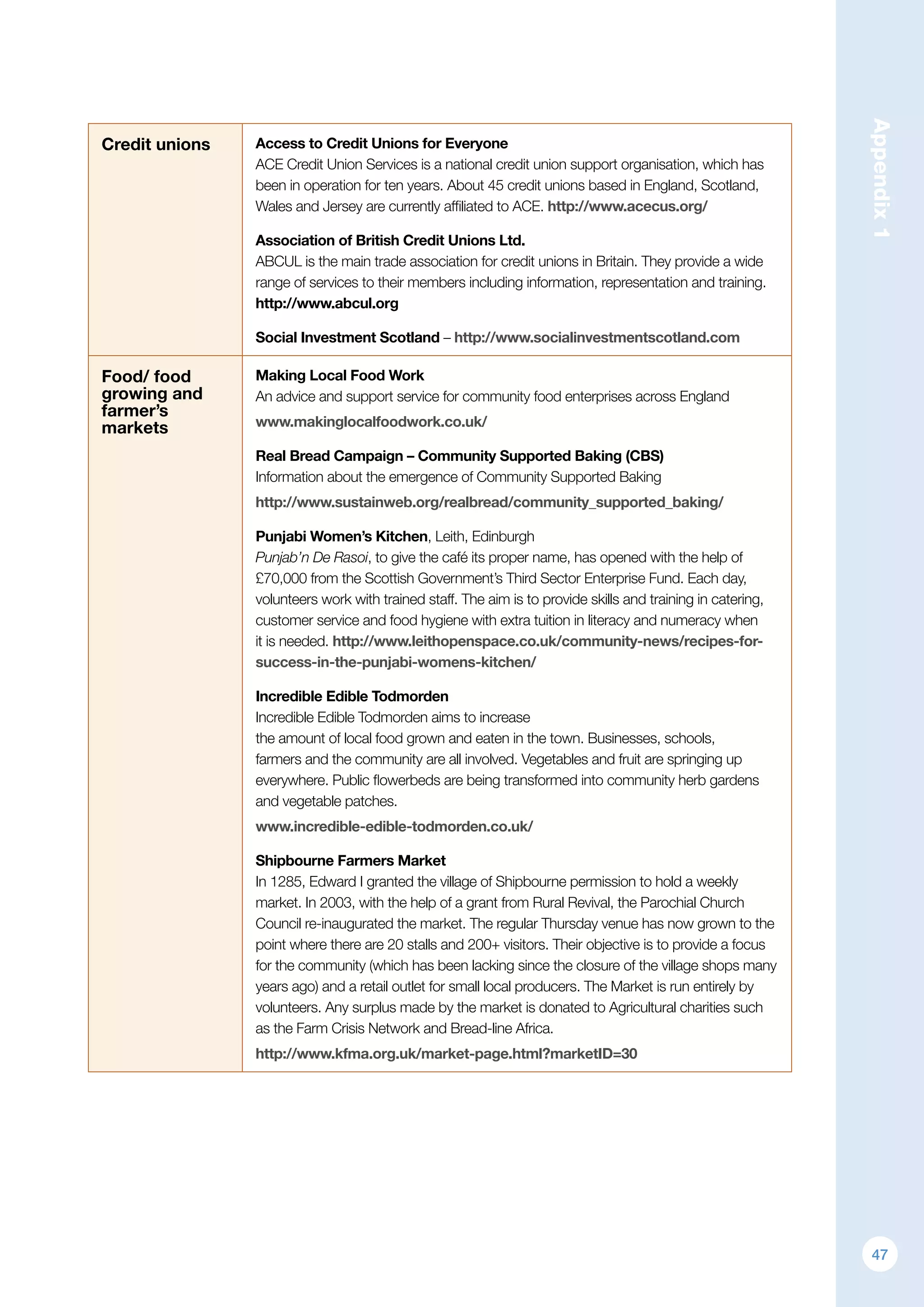
Ivy, member of Southwark Circle
http://www.southwarkcircle.org.uk/index.php
There is a reoccurring theme throughout this
publication – a fundamental need for people to
connect with their communities. We will return to
this issue in step five.
There are other uses for technology: in telemedicine
where remote monitoring enables medical
professionals to monitor a patient remotely. This
is primarily used for managing chronic diseases
such as heart disease, diabetes or asthma. These
services can provide comparable health outcomes
to traditional in-person patient encounters, supply
greater satisfaction to patients, and be cost-
effective. Interactive telemedicine provides real-
time interactions between patient and provider,
to include phone conversations and online
communication.
15
10
	Report for Cabinet Office Social Exclusion Task Force (2009)
Mapping the level of need: Assessing the social exclusion of older
people in rural areas
Challengingwhytheserviceisbeingprovided
Conducting service delivery via the Internet brings
obvious cost savings that can be passed on
to customers. This trend is now so established
that those without Internet access are financially
disadvantaged; they pay more for travel tickets,
utilities and they shoulder the costs of travel to
pay bills.
There is therefore a pressing need to maximise
access to Internet provision – as an essential
of life.
What is the impact of our age
profile on service delivery?
There are two very significant trends in rural
demography that will impact significantly on service
delivery in future years. Firstly, the population in
many rural areas is ageing and secondly, there is
out-migration of young people from rural areas.
Not only are people in rural areas on average older
than their urban counterparts (for example, 23%
of people in rural areas are of pensionable age
compared with 18% of people in urban England),
the population is getting older at a quicker rate.
Between 2001 and 2007, the population of
pensionable age increased by 15% in rural areas
compared with a smaller 4% increase in the
numbers of older people living in urban areas over
the same period. This increased rate is due to two
factors - increased life expectancy and in-migration
of older people to live in rural areas.10
The number of very elderly people (aged 85 and
over) in the countryside is expected to double over
the next twenty years. Whilst older people in rural
areas live healthier lives, increasing years inevitably
take their toll and the need for care provision will
increase – which is something of a demographic
time bomb.
Local authorities are very aware that the influx of
newly retired and very active pensioners (especially
to attractive areas) is initially a great asset to a rural
community. They form an army of volunteers who
sit on committees and organise activities. Over the
years, especially when one partner dies, and with
increasing frailty, there is a danger that the older
person becomes increasingly isolated. Members
of the extended family, who in the past might have
provided care, are living in distant parts of the
country. How will these residents be supported in
future?
We have already noted that Direct Payments may
provide a route for care but only if there is a pool of
potential Personal Assistants in the area. There is a
network of third sector support in rural areas – Age
UK, WRVS, befriending services and luncheon clubs.
Sometimes these organisations have a contract
for the delivery of services but others survive on a
shoestring budget and are run by volunteers. Small
project grants for this work are easy to cut. Service
delivery can therefore be patchy.
The services needed by frail older people are
various:
•	 Adaptations to residential dwellings to ensure
access and to help prevent falls and to increase
security
•	 Domiciliary care services, meals on wheels,
personal hygiene
•	 Access to a range of clinical services
•	 Social activities
•	 Food shopping
Any community-led planning exercise needs to
address the current and future needs of older
residents matched against the provision of services,
with an assessment of the likely effect of cuts.
There is then a need for a community response;
supplementing financial resources (from the
parish council precept for example), encouraging
volunteering and self-help or lobbying for targeted
resources from the public sector.
16
11
	Scottish Government (2010) Factors Influencing Rural Migration
Decisions in Scotland: An Analysis of the Evidence
Challengingwhytheserviceisbeingprovided
However, such is the size of the challenge, some
different approaches may be needed in future.
Some ideas are considered in section of this report.
At the other end of the demographic scale, young
people are choosing not to live in rural areas – for
reasons that are not that surprising. Unless parents
provide transport, they are unable to participate
in after-school activities or social activities in the
evenings. It is very natural for young people to wish
to go to university or college or to travel abroad,
but when they are qualified, there may not be
employment opportunities or affordable housing
back home.
Recent evidence from Scotland (where some
remote areas are managing to buck the trend,
encouraging young people to stay or return)
suggests there are a number of factors involved in
decisions to stay:11
•	 Securing a good job locally
•	 Local family connections
•	 An appreciation of the high quality natural
environment and of having easy access to
outdoor activities available nearby (surfing on
Tiree or skiing in the Cairngorms for example)
•	 The perception that certain rural areas offer
a good quality of life, either economically or
socially. (A good example would be the Hume
sisters who work from Pierowall, on the island of
Westray but who run a high value added textile
enterprise called Hume Sweet Hume)
•	 A sense of attachment to the rural area (long-
term social or hereditary connections in the area)
or simply familiarity with the area. Connected
to this is a sense that one’s own identity is
tied up with the area; the ability to identify with
other people in the community; and a sense of
pride in the region. (We have been impressed
with the achievements of the Fèis movement; a
group of Gaelic arts tuition festivals, mainly for
young people, which now take place throughout
Scotland).
•	 The ambition to start a family in the local
area, often overriding any academic or career
ambitions. This ambition is often accompanied
by the perception that rural areas are a good
place to bring up children.
•	 Education opportunities available locally,
particularly higher education opportunities
such as colleges, universities (e.g. University
of the Highlands and Islands) and good
secondary schools
•	 The perceived safety of some rural areas
particularly compared to urban ones.
•	 A good social network and/or opportunities to
meet and socialise with peers
•	 The perception that young people are a
valued part of a rural community, and that their
involvement in community affairs is encouraged
This research provides evidence that not all young
people wish to move away but that the community
as a whole has an important responsibility to
include them fully, to promote and encourage
leisure activities that are appealing (and may bring
economic as well as leisure opportunities), to ensure
that during their school years a strong sense of
place is cultivated and of course that there is good
mobile phone and broadband connection.
Unintended consequences of
the withdrawal of discretionary
services
Decisions taken in County Halls may seem
straightforward; for example, a very obvious cost
saving can be achieved by contracting with a single
private sector firm for all recycling activities in the
area. However, there may be many unmeasured
benefits (economic, social and environmental)
of small scale and community based recycling
schemes.
•	 Employment in collection, recycling, reuse of
materials
•	 Training and employment opportunities for adults
with learning difficulties
•	 Reduced miles in transporting materials for recycling
•	 Availability of renovated furniture for low income
families
•	 Local income generating potential (for example,
mobile phone cases into restaurant tables, black
plastic from farms into garden furniture)
•	 Education opportunities as local schools compete to
reduce their consumption of valuable materials
17
Decision-making must be well informed, not just
in terms of financial gain, but also of the additional
benefits of the availability of a particular service in a
rural area. There are a number of ways in which this
gain might be assessed: for example, Social Return
On Investment is an approach to understanding
and managing the impacts of a project, organisation
or policy. It is based on stakeholders and puts
financial value on the important impacts identified
by stakeholders that do not have market values.
http://www.sroi-uk.org
Our examination of the factors influencing the
availability and need for discretionary services in
rural areas reveals a number of interesting trends:
•	 Communities should have a plan for their area,
defining the services that are essential (and be
prepared to fight hard to keep them) and to
identify the services that they want but must play
a central role in resourcing/delivering.
•	 Communities are well-placed to identify
the people within their community who are
particularly vulnerable and to consider how
collectively they can provide support.
•	 Communities should develop a keen
understanding of the range of outcomes
they expect to be delivered from the services
delivered in their area.
•	 Communities have a duty, using all available
means, to encourage and promote the use of
local services
•	 Broadband access is an essential of modern life.
It can enliven democracy, keep service providers
on their toes and build solidarity.
•	 Communities should examine population trends
for their area and plan ahead – and not be afraid
to innovate
Challengingwhytheserviceisbeingprovided
18
Step 2:
How are we doing?
Comparing performance
with other areas
19
Nowadays members of the public can access
quite a lot of information about the performance
of the public sector in a particular area. Indeed,
the last decade has seen a growing measurement
culture. For example, in Scotland the Audit Scotland
website shows information on the performance of
all councils, fire and police services.
http://www.audit-scotland.gov.uk/
performance/council/
In Wales, The Local Government (Performance
Indicators and Standards) (Wales) Order 2010
sets out performance indicators and performance
standards across a range of local authority services.
In England, the inspection regime that tested
how all English local authorities were performing
according to information produced by the Audit
Commission and other ‘watchdogs’ in what was
called a Comprehensive Area Assessment, has been
abolished. The new Coalition Government judged
that these assessments were too burdensome and
expensive and the power to judge how services
are performing is now to be placed in the hands
of local people. Along with this new responsibility,
communities are to be given powers to save local
facilities threatened with closure and the right to bid
to take over local state-run services. Local authorities
will be required to provide their communities with
simple to understand data on performance and
residents are credited with the ability to judge how
well services are being delivered.
Communities will need to examine their local services
in a new way; at first there may not be readily available
information but in time this will need to be provided
by public sector bodies. To prompt a debate in your
community here is a checklist to get you started.
Howarewedoing?
20
Howarewedoing?
Services checklist for rural communities
Service Your comments
Water supply
Flood control
Electricity supply
Potential for renewable energy
Telephone (land line and mobile) and broadband
connectivity
Access to primary level education
Access to general health care suited to each stage
of life
Security and public safety – access to police and fire
services.
An accessible and flexible community meeting place
within a reasonable distance
Access to benefits and advice services for those
who are eligible or in need
Housing to buy or to rent that is affordable,
economic to run and suited to the size of the
household
Services for older people
Opportunities for recreation – including self-
improvement, religious activity, arts and hobbies,
physical activity and socialising
Affordable and accessible transport
Social clubs and activities
Access to affordable and healthy food
Involvement in local decision-making
Active and effective parish or town council or
community council
Active and effective ward councillor
Local employment opportunities that provide a living
wage and a sense of achievement
Formal and informal education opportunities
Facilities for waste management and recycling
Allotments
21
Step 3:
22
We’re all in this together:
Engaging with taxpayers, service users,
potential service users/providers and
stakeholders about service delivery
We’reallinthistogether
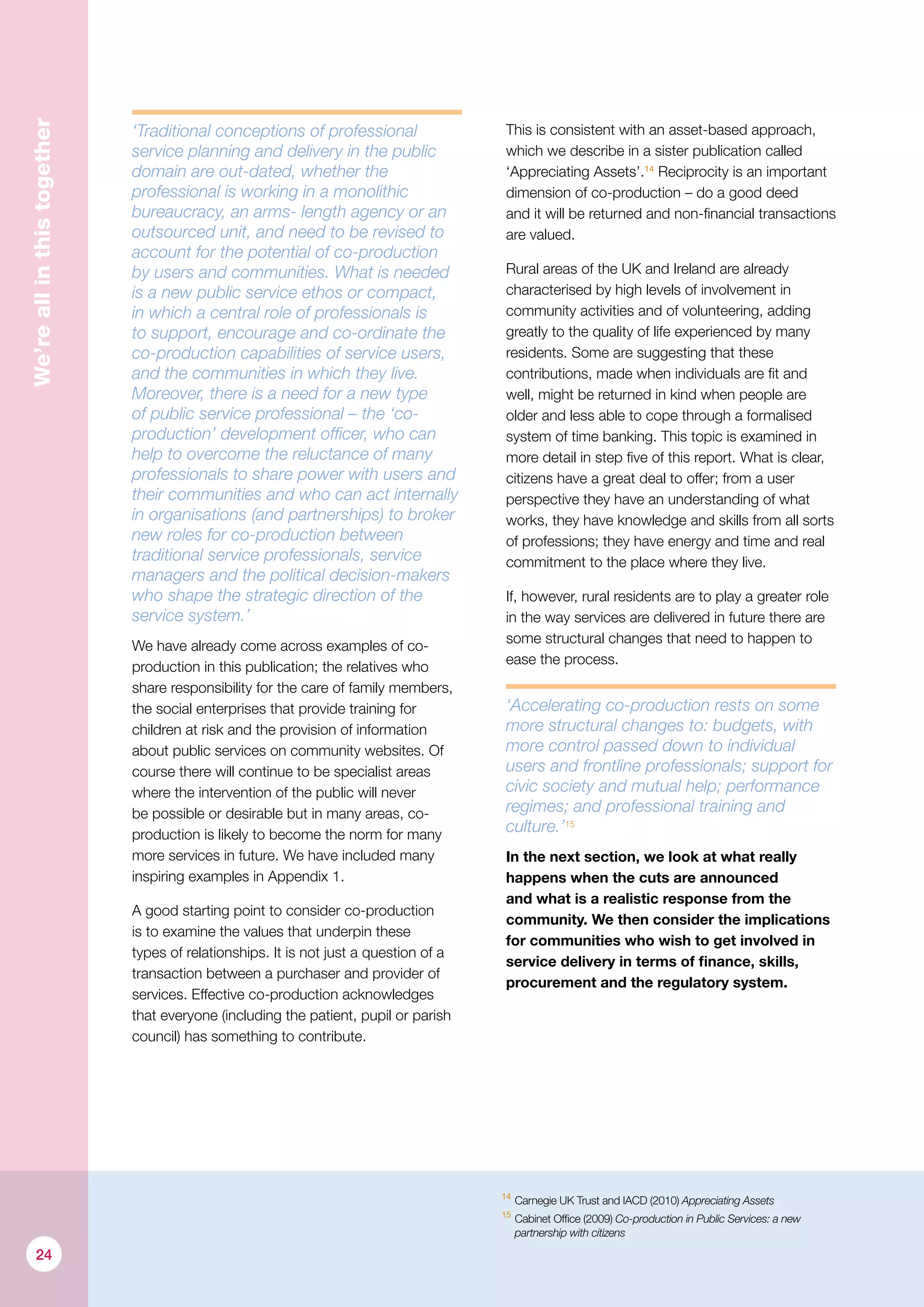
It is clear that the way in which public bodies used
to communicate with residents in the past was not
always effective. Formal meetings in town halls
attract only the ‘usual suspects’. Bodies such as
parish and town councils or community councils
may well respond to written documents or formal
meetings but the man in the street would not. The
debate triggered by the need to cut budgets is too
important and public bodies have to find new ways
of engaging in the debate.
Communities which have already undertaken a
local plan (such as a parish plan or action plan) will
be aware of the service delivery priorities for their
local community; what once seemed a useful way
of identifying initiatives is now an essential tool in
the battle for resources. However in the past these
plans often considered the ‘here and now’ whereas
they really need to be future-proofed. Communities
have been reactive, acting only when closure
of a service was announced. Now they have to
anticipate change (noting for example that school
rolls are dropping or that the postmaster will retire in
five years time). Community-led planning (as we
note in a sister publication called The Power of the
Plan12
) should become a natural part of community
life – something that all citizens contribute to. If this
is to happen, then the planning process has to be
engaging and fun – probably integrated into existing
cultural activities such as fetes and festivals where
everyone is gathered together anyway.
Public servants have to accept that all residents
have a right to debate, discuss and contest service
delivery plans on local radio, on community websites
and in the local press. Residents need to assess
whether the cuts in services are fair, realistic or
arbitrary. How are the impacts of cuts taken into
account in the decision making process? These
hard decisions cannot be made behind closed doors
when communities are to play a much more obvious
role in the way services are designed in future.
Local elected members have an important role
in this debate. Many councillors, not included
in ‘cabinet’ style local government, should feel
reinvigorated by this new challenge. Armed with
evidence from the community led plans in their area,
they are well placed to champion local services.
Councillors have an enhanced responsibility to
represent local circumstances to their peers and
to ensure local priorities are adequately reflected in
strategic plans (such as Community Strategies).
There is a growing awareness that communities
have a role to play in determining how services
are prioritised but their contribution extends
beyond this aspect into other areas of involvement:
into the design, delivery, management, funding
and evaluation of services. The concept of co-
production is entering the vocabulary of every
public body. We see co-­production as a partnership
between citizens and public bodies to achieve
better services and in 2007, Carnegie UK Trust
asked Professor Tony Bovaird13
to explore the
potential of co-production:
12
	Carnegie UK Trust (2010) The Power of the Plan
13
	Bovaird, T (2007) Beyond Engagement and Participation –
User and Community Co-production of Services
23
14
	Carnegie UK Trust and IACD (2010) Appreciating Assets
15
	Cabinet Office (2009) Co-production in Public Services: a new
partnership with citizens
We’reallinthistogether
‘Traditional conceptions of professional
service planning and delivery in the public
domain are out-dated, whether the
professional is working in a monolithic
bureaucracy, an arms- length agency or an
outsourced unit, and need to be revised to
account for the potential of co-production
by users and communities. What is needed
is a new public service ethos or compact,
in which a central role of professionals is
to support, encourage and co-ordinate the
co-production capabilities of service users,
and the communities in which they live.
Moreover, there is a need for a new type
of public service professional – the ‘co-
production’ development officer, who can
help to overcome the reluctance of many
professionals to share power with users and
their communities and who can act internally
in organisations (and partnerships) to broker
new roles for co-production between
traditional service professionals, service
managers and the political decision-makers
who shape the strategic direction of the
service system.’
We have already come across examples of co-
production in this publication; the relatives who
share responsibility for the care of family members,
the social enterprises that provide training for
children at risk and the provision of information
about public services on community websites. Of
course there will continue to be specialist areas
where the intervention of the public will never
be possible or desirable but in many areas, co-
production is likely to become the norm for many
more services in future. We have included many
inspiring examples in Appendix 1.
A good starting point to consider co-production
is to examine the values that underpin these
types of relationships. It is not just a question of a
transaction between a purchaser and provider of
services. Effective co-production acknowledges
that everyone (including the patient, pupil or parish
council) has something to contribute.
This is consistent with an asset-based approach,
which we describe in a sister publication called
‘Appreciating Assets’.14
Reciprocity is an important
dimension of co-production – do a good deed
and it will be returned and non-financial transactions
are valued.
Rural areas of the UK and Ireland are already
characterised by high levels of involvement in
community activities and of volunteering, adding
greatly to the quality of life experienced by many
residents. Some are suggesting that these
contributions, made when individuals are fit and
well, might be returned in kind when people are
older and less able to cope through a formalised
system of time banking. This topic is examined in
more detail in step five of this report. What is clear,
citizens have a great deal to offer; from a user
perspective they have an understanding of what
works, they have knowledge and skills from all sorts
of professions; they have energy and time and real
commitment to the place where they live.
If, however, rural residents are to play a greater role
in the way services are delivered in future there are
some structural changes that need to happen to
ease the process.
‘Accelerating co-­production rests on some
more structural changes to: budgets, with
more control passed down to individual
users and front­line professionals; support for
civic society and mutual help; performance
regimes; and professional training and
culture.’15
In the next section, we look at what really
happens when the cuts are announced
and what is a realistic response from the
community. We then consider the implications
for communities who wish to get involved in
service delivery in terms of finance, skills,
procurement and the regulatory system.
24
Step 4:
Develop options for
service delivery
25
Developoptionsforservicedelivery
What actually happens when
the cuts are reported – can the
community act?
The local papers are full of reports that if facilities
from care homes to ferry boats, from Tourist
Information Centres to libraries, are important to
communities then the communities will have run
them. This press cutting from Lancashire is typical
of front pages right across the UK and Ireland:
PUBLIC toilets, a popular miniature “zoo” and
a country park’s visitor centre have all been
earmarked for closure in the latest round of
cuts announced by Town Hall chiefs.
Popular events such as the firework display and
bonfire at Leverhulme Park and the Kite Festival
at Moss Bank Park, which attracted thousands
of visitors last year, also face the axe under the
spending cuts, which could be implemented as
early as next April.
Almost 30 posts are at risk and all workers across
the Council’s neighbourhood services department
yesterday started a 90-day consultation period over
the impact of the cuts. Town Hall bosses say that if
each of the proposals is implemented, the council
will save more than £1.7 million over three years.
The authority is being told to save 40 per cent of its
annual budget over four years by the government,
as it aims to reduce the national deficit.
If the plans are approved in February next year,
every one of the borough’s public toilets would be
closed, Animal World, at Moss Bank Park, and
Rock Hall Visitor Centre, at Moses Gate Country
Park, would also close and there would be cuts to
the frequency of grass cutting, street cleaning and
routine inspection and maintenance of play areas,
allotments, woodlands and flower beds.
Source: local press
When visitors arrive in town for a day’s shopping, they
naturally will need to pay a visit to the toilets, expecting
them to be clean and pleasant to use. Yet councils
obviously see toilets as a luxury they can no longer
afford to provide. Other assets seem, on the surface,
to be potentially more attractive to the community
– the country park sounds like something worth
keeping. In any case, communities the length and
breadth of the country are being asked to rise to this
challenge – take these assets and services on (even
though some of them may be loss making and indeed
a long-term liability).
Trying hard to preserve a service delivery model
based upon they way we have always done things
is probably not a good starting point. It is difficult for
creative thinking to take place when difficult decisions
are being made in a hurry. But that is what is needed.
So, for example, do visitors really need to visit a
publicly owned and run toilet? Or might they actually
prefer to visit the upgraded toilets in the local pub,
which charges 30p, and by the way, why don’t we
stop for lunch? Moving beyond the outcry in the local
press – is anyone asking the publican if this might be a
really good idea?
Other services cannot be divested so easily. There
might be a highly respected Wildlife Trust, that already
runs successful nature reserves and who would relish
the opportunity of taking over a County Park. Their
rangers may have all the conservation skills needed
to enhance the site. They may already have a catering
arm that could provide café services and a public
liability insurance package in place.
But would the Wildlife Trust be expected to raise
public money to ‘buy’ the Country Park from the
Council? Is this circulation of public (i.e. ‘our’)
money, from one part of the public sector to another
acceptable? Would it be possible to raise funds
through a share issue? How many share issues will
there be within that community? Can local people
afford to become shareholders in a facility that
provides a beautiful space but that is not an essential
of life? Does the Council understand how long it takes
to put the necessary funding together – even when
the potential purchaser is a well-established player?
26
Developoptionsforservicedelivery
However, there may be no Wildlife Trust. There may
just be a group of interested local people, with no
organisation or track record. They would need to
embark upon a long journey to formally constitute
their organisation, demonstrate to people that they
have a range of competencies before fund raising. It
could take years!
Will the council be in a position to provide the
prospective new managers of the site with a
detailed financial breakdown for the facility – in the
case of the Country Park it may be a transfer from
an quasi-independent business unit of the council
but what if a local community were thinking of
taking on a single library – one of fifty or so libraries
in a county. Would the accounts recognise all those
back office functions that get ‘hidden’ in the overall
budgets of councils? Actually – does the Head of
the Library Service really know how much it costs to
run the service in its entirety?
Are the days of single purpose council-run facilities
well and truly over? Might the library be run from the
community hall or could readers collect their chosen
text from the pub? The small fee the publican
receives for each transaction might be all that is
needed to keep his business going. But whilst we
are planning services for the future – and given
technological advances, do we even need books?
Are we planning services for the future based upon
a full appreciation of the assets – tangible and
intangible – that we have at our disposal?
This is the dilemma – the timescale for financial
cuts and the time needed to put in place
considered alternative arrangements (yet
alone to incorporate innovative solutions)
are incompatible.
The important message from these examples
is that transfer of services to the community
takes time and it cannot be achieved in a hurry
when funding has to be assembled, asset
transfer terms agreed and people
skills developed.
Funding services
We have already looked at Direct Payments as
a way of giving users more choice in buying the
care they need but this is just the start of greater
devolution of resources to localities.
A sensible starting point for the community is to get
involved in decision-making about how available
resources are deployed locally – a process called
participatory budgeting. Participatory budgeting
allows the citizens of an area (neighbourhood,
regeneration or local authority area) to participate in
the allocation of part of the local Council’s or other
statutory agency’s (health services, police) available
financial resources. Participatory budgets increase
transparency, accountability, understanding and
social inclusion in local government affairs. Many of
the places that have tried out participatory budgets
have been located in towns and cities but there is
no reason why the process should not work really
well for rural areas too. All that is required is the
commitment of the public body to the process,
clear guidelines about the amount that is up for
discussion and the general areas of expenditure
under debate and the widespread support of a
good cross section of the electorate. Participatory
budgeting can be built into the community-led
planning process.
27
Developoptionsforservicedelivery
If you wish to find out more about participatory
budgeting, visit the following website:
http://www.participatorybudgeting.org.uk/
In England, the Big Society Network and National
Endowment for Science, Technology and the Arts
(NESTA) have selected nine areas to try out a form of
participatory budgeting called ‘Your Local Budget’.
The projects will test a variety of methods for involving
citizens in budget decisions, ranging from working
with service users to trial how pooled personalised
care budgets can be used to provide day centre
activities, to examining how parish councils can use
their local precept – income raised from parishioners
– to support the provision of local services that are at
risk from budget cuts. We will follow the progress of
parish and town councils in Herefordshire pilot area
with great interest.
Participatory budgeting may allow the closer targeting
of financial resources to meet local needs. It is a big
step forward to have the opportunity to influence how
public money is spent in your area. However this does
not guarantee that your community will win resources
when there are many competing demands. Is it
possible to raise money locally to provide services?
There are undoubtedly new opportunities for parish
and town councils (in England) and community
councils (in Wales) to play a more significant role
in service delivery and perhaps to demonstrate to
other parts of the UK and Ireland how the tier of local
government that is closest to the people can rise to
the services challenge. The power that the councils
in England and Wales enjoy is the precept – money
collected through the council tax that can be deployed
for the benefit of local people. To give an idea of how
much might be available, the average Band D parish
precept in England in 2010-11 is £44.55.16
The National Association of Local Councils has
produced an excellent publication called ‘Localism in
Action’ which provides case studies of how parish and
town councils have deployed their precept to support
service delivery.
http://www.nalc.gov.uk/Publications/Booklets_
and_Resources.aspx
Other ways of raising income to support local
services through the local tax system have
been tried. A Business Improvement District
(BID) is a partnership between a local authority
and the local business community to develop
projects and services that will benefit the trading
environment within the boundary of a clearly defined
commercial area. Business Improvement Districts
have been established across England, Wales and
Scotland and legislation has also been passed
in the Republic of Ireland. If local businesses vote in
favour, a levy on the business rates is collected for
specific projects in the BID area. Local Authorities
have an important role to play in the establishment
of a BID in their area as they are charged with legal
responsibilities, including the provision of the ratings
data to calculate the BID levy, the collection and
enforcement of the BID levy via a ring-fenced BID
Revenue Account that is then passed straight to the
BID company, the organisation of the formal BID
ballot, and the preparation and commitment to the
baseline service agreements.
Further information about BIDS can be found on
http://www.ukbids.org/index.php
If financial resources from local government are not
available, how else can services be resourced?
16
	Communities and Local Government (2010) Statistical Release
28
Developoptionsforservicedelivery
Public bodies may have physical assets and services
that they wish to divest, offering the community the
opportunity to take them on and earn an income
from doing so. Communities should be aware of
the publicly-owned assets within their area. Local
authorities keep registers of their assets and these
are available online. The Asset Register is an
accounting tool that has to be maintained by local
authorities and contains all information about the land
and property assets owned or leased by the council.
The register is updated every financial year.
The Asset Register categorises every property
for the purpose of capital accounting. It
gathers information that is used to calculate the
appreciation and depreciation of assets. This
needs to be recorded for sales and purchase
purposes. Valuation of the assets owned is carried
out regularly. An Asset Management Plan sets out
how the local authority will implement its Asset
Management Strategy to ensure that land and
property assets are used effectively and efficiently
and how the asset contributes to the delivery of
quality services to citizens.
Once familiar with the publicly-owned assets in
their area, the community can consider how they
might get involved in the ownership, management
or control of that asset should it become available.
This topic is discussed in our sister publication,
‘Appreciating Assets’.17
Whether a community is presented with the
opportunity of taking on a publicly owned asset
or if a privately owned asset like a shop or pub
comes on the market, there will be a need to raise
finance. Enterprises providing community benefit
such as the delivery of an important service can
be financed through the sale of community shares
or bonds. A share is a legal right to membership
and part-ownership of an organisation in return for
an investment. In order to issue shares the group
should be registered as a Community Interest
Company (CIC), an Industrial and Provident Society
(IPS) or as an ordinary limited company. A bond is a
form of loan that has to date been a less common
form of financing community initiatives. It is a legal
agreement between the issuer of the bond and the
purchaser that usually states the amount of interest
to be paid on set dates on the loan and when the
loan will be repaid in full. If you are interested in
finding out more about the relative merits of shares
and bonds, a good starting point would be the
factsheets produced by the Development Trusts
Association and Co-operatives UK in conjunction
with the Cabinet Office and Department for
Communities and Local Government:
http://www.communityshares.org.uk/
Here we include two examples of renewable energy
schemes that have used share issues in order to
raise finance. Bro Dyfi Community Renewables is a
community energy co-operative registered under the
Industrial and Provident Societies Acts. Established
in 2001 to develop community-owned renewable
energy projects in the Dyfi Valley area in Wales,
the group erected a 75kW wind turbine in 2003,
with money raised from a share offer. Shareholders
receive an annual dividend, and 30% of Bro Dyfi
Community Renewable’s annual profit goes to a
community energy fund used for energy efficiency
measures within the Dyfi Valley. The latest project is a
much larger (500kW) turbine on Mynydd Glandulas.
Again, this project has been funded by a share offer.
Carnegie has a short video case study of this project:
http://www.carnegieuktrust.org.uk
And the initiative has a useful website;
http://www.ecodyfi.org.uk/energy/
energybdcr.htm
Settle Hydro was established as an ‘Industrial and
Provident Society for the Benefit of the Community’
with the specific purpose of owning the Settle Weir
Hydro Electric Scheme. The Society will generate
revenue by selling ‘green’ hydro-electricity. Any
surplus revenue will be used by the Society to
benefit the local community through its twin aims of
regenerating the local economy and promoting the
environmental sustainability of Settle District.
http://www.settlehydro.org.uk/
17
	Carnegie UK Trust and IACD (2010) Appreciating Assets
29
41
	Horn  Webber (2007), New Tools for Resolving Wicked Problems,
MacroVU(r), Inc. and Strategy Kinetics, LLC; Chapman et al, (2009)
Connecting the Dots, Demos
Developoptionsforservicedelivery
There are many services that could be resourced
through a share or bond issue; ones where there
is an expected income stream that is reliable and
where entrepreneurial skills can be applied to
maximise opportunities.
Our examples have been chosen for a reason;
we believe that renewable energy (biomass,
bio-digesters, mini-hydro, wind, solar, tidal or
wave) provides income generating potential for
many rural communities. Income can then be
invested in local services, liberating that place
from dependency on grants. This independence
could provide many benefits; enlivening local
democracy as the community determines
how the money is spent, building in resilience
through distributed energy systems and
reducing dependence on fossil fuels.
Although there is potential for communities to
become more financially independent, public and
private sources of finance and that of charitable
trusts and foundations are still likely to be needed
to support the reform of service delivery. How
should these scarce resources be deployed?
Traditional forms of financing for social and
community enterprises tend to be conservative
and are almost entirely dependent on one form of
finance – the grant, and therefore there is a dearth
of working capital. What progress has been made
in channelling social investment towards social
enterprise and community owned businesses?
The Government’s Social Investment Taskforce
back in 2000 found that financial institutions such
as Community Development Finance Initiatives
(CDFIs) that provide small loans were struggling to
raise sufficient investment even in the context of
exceptional financial sector growth.
The social enterprise sector in rural communities
will not flourish unless it can source finance from
a wider array of innovative providers. The risk
of not stimulating this provision is the stifling of
entrepreneurship and creativity around solutions to
service delivery challenges.
Loan finance can be defined as money lent which
has to be returned to the lender usually with
interest. Equity investment (as explored in relation to
community shares and bonds above) is medium to
long-term finance provided by an investor in return
for taking shares in an organisation. Additionally,
there are variations on the two themes, including
‘patient capital’, a form of investment, which is a
mix of grant and loan or equity, incorporating social
returns often with flexible repayment terms.
For some organisations, the transition to debt
finance is seen as too great a leap and in response
to this, initiatives have been developed with financial
products that bridge the gap between grants
and loans. The Adventure Capital Fund was an
example of specialist finance that worked in this
way, allowing the borrower an extended period
of time before requesting repayment. Similarly,
Communitybuilders provided a mix of grants and
loans for organisations’ enterprising approaches
to the delivery of public services. However, public
funding, designed to catalyse social enterprise, has
been too short term. Trusts, charitable investors and
ethical investment funds lacked proper incentives
and investment channels to address the shortfall.
In mid 2011, the new Big Society Bank will be
launched for England. The bank, which was first
proposed by the Labour government, will use
money from dormant bank accounts and elsewhere
to become a wholesale provider of finance, in
theory making it easier for social enterprises to
access capital.
During the 2010 UK election, almost all political
parties were extolling the virtues of mutuals,
co-operatives and the ‘John Lewis’ business
model. If these routes for service delivery are to be
developed, there needs to be appropriate financial
vehicles to provide investment. We find inspiration
in the Basque Country, where their model of
worker-owned businesses has flourished over
the past 55 years.
30
Developoptionsforservicedelivery
Mondragón Cooperatives was founded in the
1950s with one small worker-owned cooperative
making parts for washing machines. Today, with
120 businesses and 100,000 workers, Mondragón
Cooperatives comprise the largest consortium of
worker-owned businesses in the world with sales of
24 million Euros (2007). In 2009, when twenty-five
percent of all businesses in Spain failed, less than
one percent of businesses failed in the Mondragón
Cooperatives, so they must be doing something right!
The Mondragón Cooperative businesses produce
a wide range of products and services, including
an incubation centre, where they help develop
and fund new projects. The MCC includes its own
cooperatively owned bank, Caja Laboral, with 394
branches throughout Spain. To become a worker
member, an individual must apply for an open job
and invest 14,000 Euros in their company. This sum
can be borrowed from Caja Laboral at 1% interest
over 10 years.
It would seem that the worker owned co-operative
takes time to develop, benefits from attention to
research and development and is best supported
by dedicated investment streams.
During the age of austerity we expect a period
of rapid innovation such as happened in Spain,
and nowhere is this more necessary than in
new rural service delivery mechanisms, where
the combination of a small customer base and
long supply distances makes the substitution of
public services by private provision less likely.
Corresponding financial mechanisms need to be
developed alongside.
One such innovation is the Social Impact Bond;
a contract between a public sector body and
Social Impact Bond investors, in which the former
commits to pay for an improved social outcome.
It is thought that by enabling non-government
investment, Social Impact Bonds will lead to greater
spending on the sort of preventative services that
we have highlighted in Pultneytown and Hill Holt
Wood, that seem to have such a positive impact on
tackling social problems.
Social Impact Bonds are a unique funding
mechanism; payments by the public sector are
calculated so that, if Social Impact Bond-funded
services improve outcomes, these payments will
cover the costs of the interventions. Investors
carry the risk that funded interventions may fail
to improve outcomes. Trusts and foundations,
commercial investors and high net worth individuals
will make investment in Social Impact Bonds in
the expectation that they will receive a ‘blended’
social and financial return on their investment. The
financial return is greatest when the service is most
successful, as the costs that would have been
incurred by the public sector (imprisonment, taking
children into care for example) are saved. Service
providers receive upfront payment for the delivery of
services and are encouraged to innovate in order to
achieve the best possible outcomes for the target
population.
31
Developoptionsforservicedelivery
Our experience in working with Community Land
Trusts demonstrates that there are differing financial
needs at different stages in the project development
cycle: the pre-development stages being particularly
risky. In another example of financial innovation by
leading UK Trusts and Foundations, the Community
Land Trust Fund was launched in October 2008 with
the aim of assisting the development of community-
led affordable housing projects. The aim of the fund
is to help remove barriers to the development of
community land trust projects, including poor access
to risk capital and bank finance.
Pre-development finance may be made available
when a Community Land Trust project has
developed an outline concept for a housing
development including the identification of a target
market for the properties, a potential site and a
project budget. Pre-development finance may then
be needed to fund the costs of conducting site
surveys and employing architects for submission
of a detailed planning application, procuring
construction and raising further finance for the
project. The desired outcome of pre-development
finance would be a scheme ready to go on site.
http://www.cltfund.org.uk/
Within the community-led housing movement there
are other innovations; the involvement of groups
of eventual residents in self-build projects were
they contribute ‘sweat equity’ and the private sale
of housing units within a development in order to
subsidise affordable houses for rent for local people.
There is also a need for new local investment
vehicles, where the resources of wealthy people,
who are prepared to forgo high financial return on
investment for the satisfaction of high social impact
locally, are used to support essential local services.
In this section of our report we have identified some
of the existing ways of funding service delivery but
highlight the need for accelerating innovation in the
development of new investment vehicles. We now
consider the requirements for new skills within the
public sector and by new service delivery bodies.
New skills for those involved in
service design and delivery
We have an expectation that local authorities
will have a reduced role in terms of the delivery
of services whilst retaining an enabling and
commissioning function. For example, Suffolk
County Council has planned a 30% funding cut
by fundamentally reshaping the way it works.
The council has said it will restructure, outsource
some services and trim back-office staff in a
bid to combat a reduction in income from the
Government.
Council leader Jeremy Pembroke said the result
would be a smaller council, working in partnership
with borough and district authorities and with
community groups.
‘We will work much closer with districts
and boroughs and health organisations and
working with the voluntary sector, who have
a big role to play in developing the new
strategic direction’
Although not all local authorities will divest as many
services as Suffolk, many will need to collaborate
more with a range of public, private and third
sector organisations. Heads of Service will have
responsibility for specifying the resources required
for a specific service, setting up mechanism for
procurement, appointing a delivery body, managing
contracts, setting quality standards, monitoring
progress and assessing risk. Whilst already skilled
in project management and expertise in their field,
professional managers will need skills in engaging
with communities, an appreciation of the benefits
and risks of working with new delivery mechanisms
and a fuller understanding of the total costs involved
in the delivery of a service. For those delivering
services from within arms length business units
(or indeed worker co-operatives) there will be an
expectation that managers will be entrepreneurial in
outlook.
32
Developoptionsforservicedelivery
The skills development needs for communities
involved in aspects of service delivery are no
less challenging, requiring as they do a mix of
community development, business planning,
appropriate governance, financial management,
fundraising, marketing, property management,
succession planning, adherence to quality
standards and regulatory frameworks – to name
just a few skills!
The good news is that support is available
through a number of intermediary bodies. The
Development Trusts Association (DTA) is a network
of community enterprise specialists, dedicated
to helping people set up development trusts and
helping existing development trusts learn from each
other and work effectively. They have a wealth of
grassroots expertise and knowledge in community
regeneration, asset development and cultivating
local enterprise and also have a pool of technical
experts including lawyers, architects, planning
designers and surveyors for one-off advice.
http://www.thepooldta.co.uk/index.html
A partnership between the Cabinet Office, Local
Partnerships, Employee Ownership Association
and Co-operatives UK have launched the Mutuals
Information Service to provide a service for staff
in the public sector looking to set up mutuals and
public sector co-operatives such as GP out of
hours co-operatives and co-operative trust schools.
http://www.mutuals.org.uk/
The Plunkett Foundation works with a range of
organisations to develop support programmes for
rural co-operative and social enterprises. 
http://www.plunkett.co.uk/index.cfm
The Social Enterprise Coalition is the UK’s national
body for social enterprise and has a Social
Enterprise Business Support Programme.
http://www.socialenterprise.org.uk/
Community Land Trusts have their own National
Network, with a range of useful resources on
their website:
http://www.communitylandtrusts.org.uk/
Commissioning services
There has been a growing appreciation over the
last decade that more needs to be done to enable
social enterprises to compete for public service
delivery contracts. In England there is some
attention being given to the practical changes
that are needed in terms of commissioning and
procurement if social enterprises are to participate
more fully in service delivery. For instance, a Private
Members Bill, the Public Services (social enterprise
and social value) Bill, if passed, will require the
Secretary of State and local authorities to publish
strategies in connection with promoting social
enterprise; to enable communities to participate
in the formulation and implementation of those
strategies and to require that public sector
contracts include provisions relating to social
outcomes and social value. This could change the
way that public sector services and contracts are
commissioned and delivered.
The government spends £141billion a
year purchasing goods and services. This
includes everything from paper, equipment
and maintenance contracts to many
of our public services. It contracts the
private sector (and to a lesser extent social
enterprises) to provide these goods and
services. Until now most decisions on who
delivers these contracts have been made on
price, capacity and track record. They have
not been made on how they can create jobs,
stimulate local economies, support local
communities, or reduce environmental harm.
Peter Holbrook, CEO of the Social Enterprise
Coalition
33
18
	Performance bonds are required as a guarantee in the event that the
organisation fails to deliver, providing the local authority with a fund to
rescue the service, which may require immediate replacement.
Developoptionsforservicedelivery
Any community group or social enterprise
considering service delivery options should meet
with relevant managers in the public body:
•	 Who manages the service you are interested in?
•	 Who is in charge politically – an executive in the
cabinet or a committee chair?
•	 Check which decisions are delegated to senior
management – does the local authority have a
service director?
•	 Who has responsibility for day-to-day
management?
•	 Is there a specific client or commissioning
officer in charge of letting contracts or buying in
services such as care provision, waste recycling
or construction?
There are a number of steps in the commissioning
of any service: a review will be undertaken and a
political decision made about the overall outcome
desired. A specification is drawn up for the service
and criteria set for judging competing applications.
A pre-tender process often precedes tendering for
service delivery, where the enterprise is required
to include information and documentation on a
number of issues, to demonstrate fitness and
technical ability. This might include evidence of legal
constitution, insurance, CVs and training certificates
of staff and a performance bond.18
When considering the range of alternative delivery
organisations, a commissioning body will normally
carry out an ‘options appraisal’. This process will
look at each possible service delivery mechanism
and judge it against a set of criteria. The following
characteristics are often considered:
1	Design and scope: How each option meets the
organisation’s strategic objectives, how it will be
able to meet current and future needs and how it
incorporates the wishes of users
2	 Accountability, governance and
participation: The implications of each option
for enhancing democratic accountability and
user/community and staff involvement in planning
the service.
3 Financial assessment: Assess whole life and
transaction costs, investment requirements
and funding, affordability, Best Value and risk
assessment.
4 Quality of service: The potential impact on
performance, service integration, continuous
improvement and innovation, flexibility,
responsiveness and accessibility.
5 Local/regional economy and community
well being: Assess impact on jobs, skills,
labour market and local economy, contribution
to regeneration and economic development
strategies, community well being and cohesion.
6 Quality of employment: Ability to retain terms
and conditions, pensions and labour standards,
impact on working practices, workplace training,
access/provision of childcare and health and
safety in workplace and community.
7 Sustainable development: Impact on local/
regional production and supply chains, access
to parks and recreational activities, services and
facilities, environmental impacts and efficient use
of resources.
8 Ability to address social justice and
inequalities: How each option might reduce
health and other inequalities and discrimination
for different equality groups. It should assess the
contribution to building community capacity and
participation.
9 Capability, management and intellectual
knowledge: Effect of each option on retention
of key skills and intellectual knowledge, ability to
manage change and regulatory frameworks and
transferability of skills.
10 Organisational arrangements: Effect
on flexibility, scope for collaboration and
consortia, impact of transfer to arms length
bodies and trusts and capability of third sector
organisations.
11 Added value: Proposals over and above core
requirements and additional community benefits.
34
Developoptionsforservicedelivery
What services can be devolved?
The services A to Z, shown in Appendix 1, shows
how just how wide a range of services is being
delivered somewhere in the UK or Ireland, by
community groups, social enterprises, development
trusts or co-operatives.
Structures for service delivery
One of the particular challenges for small social
enterprises is that public sector bodies will not wish
to contract with many small providers. There are
often good business reasons for the aggregation
of similar, smaller contracts into a larger, more
economical one for a council. Partnering with others
– whether in the private, social enterprise, voluntary
or public sector – can provide opportunities.
Another first step for a social enterprise to get
involved with service delivery is as a sub-contractor,
joining forces with a larger enterprise with the skills
and capacity that you lack.
A useful publication, although published in 2003,
is ‘Public Procurement – a toolkit for social
enterprises’
http://www.s-p-i-n.co.uk/assets/
dtitoolkitforsocialenterprise.pdf
Below we consider some of the available structures
and legal entities for service deliverers:
Community Interest
Company (CIC)
A legal form developed primarily for social
enterprise. It combines the features of the
conventional company form with elements of
charitable organisation, including a lock on assets
to ensure they are held for community benefit. CICs
must also publish an annual social report explaining
how they are serving a specified community of
interest, or locality. They submit annual reports to a
dedicated CIC Regulator. The advantages of a CIC
include the freedom to pursue a business approach
and the asset lock. This means the assets and
profits must be retained within the CIC, and used
solely for community benefit, or transferred to
another organisation that itself has an asset lock.
The model does allow a dividend to be paid to
investors, but the rate is tightly controlled.
Company limited by guarantee
(CLG)
A registered company with members rather than
shareholders. CLG members guarantee a nominal
sum for paying liabilities in the event of insolvent
liquidation. Members may also pay a membership
subscription.
Company limited by shares
(CLS)
A registered company that is controlled by its
shareholders. CLS shares may be privately held,
or in the case of a public company, shares may be
available to trade on the open market.
35
Developoptionsforservicedelivery
36
Industrial and Provident Society
(IPS)
There are two principal legal forms of IPS – an
industrial and provident society for the benefit of
the community (BenCom) and a bona fide co-op.
BenComs reinvest all their profits for the benefit
of their community as defined in their constitution.
Bona fide co-ops are democratically controlled by
their membership, who also share all distributed
profits. Mutuals are organisations whose members
come together for a shared purpose. They are
democratically controlled and members must join
to access the benefits. IPSs are one example, but
mutuals also include friendly societies, building
societies and credit unions.
Charitable status
Charitable status is available to all organisations
with exclusively charitable purposes and activities;
it is not a legal structure in itself. Public benefit
is the legal requirement that all charities must
have charitable purposes that benefit the public.
The Charity Act 2006 has defined a new set of
charitable purposes. Charitable status provides
tax advantages but quite strict trading constraints;
hence it is not appropriate for all social enterprises.
Several ‘charities’ in the voluntary sector have set
up independent social enterprises as trading arms
to generate income to support their charitable aims.
Mutual
In a public sector context, mutuals are businesses
that are owned by their members. They can operate
as employee-owned, co-operative or wider social
enterprises. They can include or participate a
variety of commercial arrangements, including joint
ventures with government or other parties.
Employee Ownership
Employee ownership refers to companies where
employees own a significant or controlling stake in
the business. Employee ownership can involve a
direct shareholding where employees own individual
shares, or indirectly where shares are held in a trust
for the benefit of employees.
Co-operative
Co-operatives are businesses that are fully or
majority owned by their members – who may be
employees, consumers, others in the community or
a mix of these. Co-operatives work on one member,
one vote – rather than one share, one vote – and
sign up to an agreed set of values and principles.
Social Enterprise
A social enterprise is any business or service
with primarily social objectives whose surpluses
are principally reinvested for that purpose in the
community, rather than being driven by the need to
maximise profit for shareholders and owners.
Joint Venture (JV)
The term ‘joint venture’ describes a range of
different commercial arrangements between two or
more separate businesses, organisations or public
bodies. A JV can be a contractual arrangement, or
separate legal entity, under which a new business is
created in which the parties work together, sharing
the risks and benefits arising.
Step 5:
Services of the future
37
Servicesofthefuture
Rural communities all over the UK and Ireland
already successfully deliver a range of services
for their communities, as is demonstrated by the
inspiring examples listed in Appendix 1.
We believe that it is possible for communities to
get involved in delivering services that meet two
important objectives: cost effectiveness and quality.
There are a number of ways in which community-
based organisations can achieve these outcomes:
•	 Locally based Personal Assistants can cut the
time and expense of travel and spend quality time
with the person who needs care
•	 The multiple use of a building such as a
community hall for a range of services can cut
overheads, provide a good environment for inter-
disciplinary working and provide a steady income
stream through rents.
•	 The out-posting of public sector staff can provide
a better quality of life for workers by reducing
commuting times and help put the organisation in
touch with the interests and needs of local people.
•	 The use of volunteers alongside employees
means that running costs are reduced whilst
providing meaningful and satisfying opportunities
for local people to contribute to their community.
•	 Multi-functional, area-based teams from the
council, health service and police can work
alongside residents to ensure local priorities
are met.
•	 The use of Internet technology can provide
savings in transaction costs, reduced travel times
and wins time for professionals to spend time
online or on the phone with those who need the
most attention.
However, we have also noted in this publication, the
urgent need for innovation in the way that services
are designed, funded and delivered in ways that are
cost effective and that meet the expectations of users.
Our recent experience in supporting the development
of Community Land Trusts illustrates also that there
is a need for a cultural change in government and its
institutions if innovation is to flourish.
With new ideas, we always expect that there will
be a series of stages from bright idea, through to
mainstreaming, as shown in the diagram below:
The experience of pioneers in the Community Land
Trust movement has been painful, as seemingly
every conceivable obstacle has been placed in their
path by a range of regulators and quangos. There
needs to be a willingness to embrace new thinking
– a ‘we can do this together’ attitude rather than
a culture that imposes an inappropriately rigorous
regulatory framework. The pioneers need to be
encouraged and supported, with new investment
vehicles and greater collaboration between the
various bodies that look after the interests of
service users.
This is all just the beginning of a revolution in service
delivery; what are the future possibilities?
Phases of innovation from bright idea to scale
Source: Community Finance Solutions
38
Idea Experimentation Early Replication Best Practice
Standardisation
Infrastructure
building
Roll-out Scale
Servicesofthefuture
Could the level of customer demand and the level
of interest expressed directly determine the delivery
of services? For example, over the next five years
BT is rolling out superfast fibre optic broadband
(BT Infinity) across the UK. If you’re not on the
announced roll out plan, The ‘Race to Infinity’ gives
you the opportunity to fast track your area to get
BT Infinity next. The five areas with the largest
percentage of votes by December 31st 2010
will win the chance to bring superfast broadband
to their area. This seems a brutal mechanism,
dependent on numbers rather than the particular
circumstances of communities.
At a number of different stages in this text, we have
identified the clearly expressed need for the human
touch; for people within communities to build a
network of family, friends and neighbours and to
enjoy social interaction. It is this that people miss
when a village post office shuts, when care workers
can only spend ten minutes with an older person
and it is the ingredient that makes a young person
choose to stay. The link between social isolation
and mental health is very strong:
‘Studies done over two decades involving
more than thirty-seven thousand people show
that social isolation – the sense that you have
nobody with whom you can share your private
feelings or have close contact – doubles the
chance of sickness or death. Isolation itself,
a 1987 report in Science concluded, ‘is as
significant to mortality rates as smoking, high
blood pressure, high cholesterol, obesity and
lack of physical exercise.’ Indeed, smoking
increases mortality risk by a factor of just 1.6,
while social isolation does so by a factor of 2.0,
making it a greater health risk.’19
This suggests that in future priority should be
given to those opportunities that exist within rural
communities to reinforce and build social networks,
clubs and activities that bring people together: that
in doing so, the problems that might crop up down
the line are prevented.
Taking this and our other hopes for the development
of service delivery into account, next we imagine four
different scenarios into the not too distant future.
We know that there are ageing populations in rural
communities representing increased demand at a
time when there are fewer public resources. We
have also noted the army of newly retired and very
active people that have moved to live in those
communities. Might their regular volunteering be
acknowledged through a Time Bank? At its most
basic level, Time Banking is simply about spending
an hour doing something for somebody in your
community. That hour goes into the Time Bank as
a credit. Then you have a Time credits to spend on
having someone doing something for you, maybe
in many years’ time when the volunteer needs
assistance. It’s a simple idea, but it has powerful
ripple effects in building community connections.
Time Banking UK is the national umbrella charity
linking and supporting time banks across the
country by providing inspiration, guidance and
mutual help. There are already 93 time banks in
existence and 100 more in the pipeline.
http://www.timebanking.org/index.htm
Carnegie UK Trust has a long association with
libraries and, historically, provided resources for
many to be built across the UK and Ireland. Now,
libraries are coming under threat because of the
cuts. Some libraries have demonstrated how it is
possible to attract many users (for example, by
including coffee shops and crèches) but the library
of the future might look very different: the county
council could have a virtual ‘library in the cloud’,
where readers using Kindles (or similar products)
can access all the books that have ever been
written. This need not be a solitary occupation:
book clubs could meet at the local pub to discuss
the merits of the latest bestseller over a pint; the
writing group could publish their work on-line,
volunteers could read it at the local day centre and
school children could publish local news online.
39
19
	Goleman, D (2006) Social Intelligence: The New Science of Social
Relationships
Servicesofthefuture
What of the future for small rural schools? Why
should a school always be a separate building?
Might lessons be held in the local community
centre supervised by a teaching assistant and with
flat screen TV, interactive white board and video-
conferencing allowing access to the most exciting
teachers and experts from anywhere in the world?
Might much time be spent in the outdoors so
children fully appreciate the environment that
surrounds them and that will provide them with future
employment, food and water and energy? Imagine
the fun when neighbouring schools meet up for
regular camping expeditions, community celebrations
and displays of work.
40
RuralLibraryoftheFuture?RuralSchooloftheFuture?
Servicesofthefuture
41
Back to the greatest challenge that rural
communities face – the care of older residents.
Imagine a Swedish style ‘community house’, owned
and run by the community, where older people can
move when they can no longer live independently;
where they can access as much or as little care as
they need without having to move away to a distant
town; where they can enjoy the independence of a
private apartment but the company of friends that
they have grown up with. Imagine the restaurant
serving excellent meals (whilst catering for visitors
and producing ready meals for busy families) and
the hairdressers and treatment rooms for visiting
clinicians and therapists.
This is an invitation to imagine how your community
will develop services in future. To start you thinking,
here are some inspiring examples.
RuralCareHomeoftheFuture?RuralCommunityoftheFuture?
Appendix1
Appendix 1: Bright ideas and
inspiration: an A to Z of services
Service Examples
Accessibility Sensory Trust
The Sensory Trust makes places more accessible, attractive and useful for everyone
regardless of age, disability or background. They work with developers, architects and
landowners in the UK to integrate social inclusion into the design and development
process. Their work spans urban parks, healthcare and residential environments,
schools, wildlife sites and the wider countryside. http://www.sensorytrust.org.uk
Addiction The Caesars Palace, Great Yarmouth a social enterprise casino
The Caesars Palace arcade is just one part of a seafront complex, which employs
and trains long-term unemployed people in its bars, nightclub and eco-friendly
hotel for people with special needs. Profits from Caesars Palace are used to
fight gambling addictions by funding, training and employing gambling addiction
advisors though another local social enterprise, Count Me Out, and help fund a
gambling and substance misuse support group.
http://www.countmeout.org.uk/
Affordable
Housing
Housing Associations
Housing associations are independent not-for-profit bodies that provide low-cost
social housing for people in housing need
National Housing Federation – http://www.housing.org.uk/
Scottish Federation of Housing Associations – www.sfha.co.uk
Community Housing Cymru – http://www.chcymru.org.uk
Community Land Trusts – A CLT is a non-profit, community-based organisation
committed to the stewardship and affordability of land, housing and other buildings
used for community benefit in perpetuity.
http://www.communitylandtrusts.org.uk
After School
Care/ Family
Centres
Innellan  Toward Family Centre, Argyll and Bute, Scotland
Innellan  Toward Family Centre provides childcare, pre-school education and
children’s clubs for the rural communities south of Dunoon in Cowal. Families are
supported to develop links across the community through events, activities and
fundraising initiatives.
http://www.spanglefish.com/innellanandtowardfamilycentre/
Agenda 21 Dorset Agenda 21 (da21)
Dorset Agenda 21 (da21) is an independent charity that works co-operatively
with local people, communities, businesses, educational bodies, local
government and other organisations to encourage sustainable living in Dorset.
http://www.dorsetagenda21.org.uk
42
Appendix1
AIDS/HIV LASS (Leicestershire AIDS Support Services)
Is an independent voluntary organisation that provides services for people who are
living with or affected by HIV/AIDS, in partnership with other agencies.
http://www.lass.org.uk
Allotments/
Gardens
The National Society of Allotment and Leisure Gardeners
The National Society of Allotment and Leisure Gardeners is the recognised national
representative body for the allotment movement in the U.K. The Society is owned,
managed and funded by its members to protect, promote and preserve allotments for
future generations to enjoy. 
http://www.nsalg.org.uk/index.php
Landshare
Landshare brings together people who have a passion for homegrown food,
connecting those who have land to share with those who need land for cultivating
food. Since its launch through River Cottage in 2009 it has grown into a thriving
community of more than 55,000 growers, sharers and helpers.
http://www.landshare.net/index/
Archaeology Community Archaeology Ltd
Community Archaeology Ltd a private limited company bringing a new approach
to archaeology
http://www.communityarchaeology.co.uk
Arts, Culture
and Heritage
Galeri Caernarfon
Galeri Caernarfon Cyf was set up as an independent Development Trust in 1992
and began by taking on the challenging task of transforming and refurbishing some
of Caernarfon’s biggest eyesores. To date, the Trust has renovated and refurbished
over twenty neglected and vacant properties in the town, which are now occupied by
tenants. The Trust’s busy work programme includes property development, setting up
and managing Galeri’s Arts Project and running the brand new £7.5million Creative
Enterprise Centre at the town’s Victoria Dock.
http://www.galericaernarfon.com/eng/about.aspx
Sirius Arts Centre, Cobh, Ireland
This has been operating as a non-profit, charitable company since 1998 and has been
running as a full time multidisciplinary arts and cultural centre for over a decade. It is
one of the most respected arts centres in Ireland for its innovative and creative arts
programming.
http://www.iol.ie/~cobharts/
Blocked drains
and sewers
The Lengthsman scheme
This is, in essence, the re-incarnation of an old concept; a local person contracted
to maintain roadside verges and drainage, public open space and pathways. The
modern Lengthsman role has now been expanded to tackle small-scale environmental
projects directly or jointly with the local community and the partners involved. See for
example, the scheme in Lancashire:
http://www.lancashire.gov.uk/environment/countryside/lengthsman/
lengthsman.asp
43
Appendix1
Service Examples
Community
Broadband
CBN
CBN is working with a range of clients to help them realise the benefits of Next
Generation broadband networks. They are driven by a variety of motives; some are
driven by the need to find new ways to deliver public services, some by issues of
digital and rural inclusion
http://www.broadband.coop/
Business
Advice
OpportunityKintyre, Argyll and Bute, Scotland
Provide free, confidential business mentoring, following the Sirolli method. We have a
paid Enterprise Facilitator and a panel of around 50 volunteers
Business
Premises
The Melting Pot
The Melting Pot, a unique place in the heart of Edinburgh, providing spaces for
individuals and organisations to work, connect, meet and hold events. The only facility
of its type in Scotland, The Melting Pot is a not-for-profit social enterprise.
http://www.themeltingpotedinburgh.org.uk/
Car Parks All Saints Action Network, Wolverhampton
The All Saints Action Network (ASAN) employs a radical approach to community
development and regeneration that has established a portfolio of businesses whose
profits benefit an inner-city Wolverhampton area. ASAN runs a car park providing its
prime revenue source based at a 100,000 square feet old bus garage secured on
peppercorn rent in 2001.
http://www.asan.org.uk
Carers The Dochas Fund, Argyll and Bute, Scotland
The Dochas Centre is a Carers’ Centre that offers carers a place to come to get advice
and support. They run several support groups and drop in sessions. The centre also
contains a gallery displaying different exhibitions, which also allows people to support
the Fund by purchasing prints and cards of the original artwork.
http://www.dochasfund.org.uk
Care Sunderland Home Care Associates
Margaret Elliott is a veteran of the social enterprise movement, having launched
two co-ops in the 1970s. In 1994 she set up Sunderland Home Care Associates,
which has grown into a massive success (Social Enterprise Of The Year at the 2006
Enterprising Solutions Awards), finding work for almost 200 disadvantaged local
residents while supplying care to over 500 elderly and disabled people. The company
has a turnover of 1.75 million pounds and is fully employee-owned, with staff receiving
above market pay and conditions as well as having a say in all major decisions.
www.sunderlandhomecare.co.uk
44
Appendix1
Children’s play
areas
Eoropie Dunes Park, Lewis, Scotland
This unique play and leisure facility is the inspiration of a group of mothers whose
children had no local playground. Guth Airson Iarrtasan Nis’ (GAIN) is a user-led
voluntary organisation that owns and manages the Eoropie Dunes Park on behalf
parents, children and the wider community. GAIN (Gaelic for ‘A Voice for the Needs
of Ness’) was originally established in 1998 “to enhance play and leisure facilities and
encourage environmental awareness”.
http://www.eoropiedunespark.co.uk/
Common Land
and village
greens
GreenSpace
Greenspace is a registered charity that works to improve parks and green spaces by
raising awareness, involving communities and creating skilled professionals.
http://www.green-space.org.uk
Community
Centres and
Village Halls
Countless community-owned centres and halls in the UK and Ireland – for information
see SCVO or ACRE websites
http://microsites.scvo.org.uk/villagehalls/Home/Home.aspx
http://www.acre.org.uk/communityassets_villagehalls_informationservice.html
Community
Development
Connecting Communities C2
Connecting Communities (C2) is a community development and learning programme
designed to equip participants with the skills and capabilities for effective community
engagement and collaborative working. It uses the powerful medium of narrative to
embed learning. Aimed at people working in service delivery and improvement, C2 is
an Asset Based Community Development (ABCD) Programme delivered as a series of
interactive workshops and site visits. C2 is an evidence-based programme developed
by the Health Complexity Group (HCG) at the Peninsula College of Medicine and
Dentistry, Exeter. Based on community stories of transformational change C2 uses
complexity science as the framework to understand enablers and barriers to change
and improvement.
http://www.healthcomplexity.net/content.php?s=c2c=c2_main.php
Composting Community Composting Network
http://www.communitycompost.org – case studies on the web-site
Conservation
Areas
North Harris
Harris is an island that is mostly in community ownership. In 2003 there was a
community-led buyout of the 55,000-acre North Harris Estate by the North Harris
Trust, the 7,500-acre Seaforth Estate followed and earlier this year crofters on the west
side took the 16,250-acre publicly owned crofting estates of Borve, Luskentyre and
Scaristavore. Discussions have been ongoing about Harris becoming Scotland’s third
National Park and Britain’s first island national park. The North Harris Trust has set
up a Harris National Park Study Group (an one of the first to be partly in community
ownership.) See here for more details:
http://www.heraldscotland.com/life-style/real-lives/national-park-plan-for-
harris-1.1051552
45
Appendix1
Service Examples
Cycling Sustrans – http://www.sustrans.org.uk/
Sustrans online shop – http://www.sustransshop.co.uk/
Debt Advice Citizens Advice Bureau – http://www.citizensadvice.org.uk/
Early Years WCS
WCS runs 15 community childcare centres for children aged 6 months to 5 years old
in the City of Westminster where, despite its apparent wealth, extremely high numbers
of children are classified as being in need. The society is funded through a mixture
of grants and trade, by selling high-quality nursery education both to the council and
directly to families. WCS supports lower income families by providing subsidised
services and helping parents to improve their parenting skills.
http://www.socialenterprise.org.uk/pages/june-osullivan-wcs-chief-
executive.html
Eco-village Cloughjordan
The Cloughjordan Ecovillage is a not-for-profit organisation developing an alternative
model for sustainable living. The eco-village aims to provide a healthy, satisfying and
socially rich lifestyle while minimising ecological impacts. 
The 67-acre site includes beautiful and fertile land for growing food and trees to
promote local food production and biodiversity. The eco-village will also include:
•	 114 low energy homes and 16 live-work units
•	 A solar- and wood-powered community heating system  
•	 Pedestrian pathways lined with fruit and nut trees
•	 A streamside walkway 
•	 50 acres of land for allotments, farming and woodland 
•	 A green enterprise centre and hi-spec broadband 
•	 A centre of education for sustainable living 
•	 An eco-hostel for visitors 
•	 A nearby train station and local car-sharing scheme 
http://www.thevillage.ie
Migrant
workers and
asylum seekers
One World centre, SEEDS
SEEDS was initially established in the spring of 2004. They have a committee of 18
and 490 members from 38 nationalities living and working in the Derry area. Because
inward migration is a relatively new phenomenon to Northern Ireland, the indigenous
communities are coming to terms with the influx of new citizens. This has created
many issues and concerns. Many migrant workers are ill-prepared to live in a society
that is currently coming to terms with centuries of sectarian politics. SEEDS are
working closely with many statutory bodies and community representatives to reduce
the impact of change in a society going through transition.
As a first step in this direction SEEDS has opened a ‘One World Centre’ providing
a range of services and activities promoting integration and meeting unmet needs. 
This is the first One World Centre of its kind in Ireland and now houses seven different
ethnic minority groups as well as the Foyle Language School. http://www.seeds.ie
46
Appendix1
Credit unions Access to Credit Unions for Everyone
ACE Credit Union Services is a national credit union support organisation, which has
been in operation for ten years. About 45 credit unions based in England, Scotland,
Wales and Jersey are currently affiliated to ACE. http://www.acecus.org/
Association of British Credit Unions Ltd.
ABCUL is the main trade association for credit unions in Britain. They provide a wide
range of services to their members including information, representation and training.
http://www.abcul.org
Social Investment Scotland – http://www.socialinvestmentscotland.com
Food/ food
growing and
farmer’s
markets
Making Local Food Work
An advice and support service for community food enterprises across England
www.makinglocalfoodwork.co.uk/
Real Bread Campaign – Community Supported Baking (CBS)
Information about the emergence of Community Supported Baking
http://www.sustainweb.org/realbread/community_supported_baking/
Punjabi Women’s Kitchen, Leith, Edinburgh
Punjab’n De Rasoi, to give the café its proper name, has opened with the help of
£70,000 from the Scottish Government’s Third Sector Enterprise Fund. Each day,
volunteers work with trained staff. The aim is to provide skills and training in catering,
customer service and food hygiene with extra tuition in literacy and numeracy when
it is needed. http://www.leithopenspace.co.uk/community-news/recipes-for-
success-in-the-punjabi-womens-kitchen/
Incredible Edible Todmorden
Incredible Edible Todmorden aims to increase
the amount of local food grown and eaten in the town. Businesses, schools,
farmers and the community are all involved. Vegetables and fruit are springing up
everywhere. Public flowerbeds are being transformed into community herb gardens
and vegetable patches.
www.incredible-edible-todmorden.co.uk/
Shipbourne Farmers Market
In 1285, Edward I granted the village of Shipbourne permission to hold a weekly
market. In 2003, with the help of a grant from Rural Revival, the Parochial Church
Council re-inaugurated the market. The regular Thursday venue has now grown to the
point where there are 20 stalls and 200+ visitors. Their objective is to provide a focus
for the community (which has been lacking since the closure of the village shops many
years ago) and a retail outlet for small local producers. The Market is run entirely by
volunteers. Any surplus made by the market is donated to Agricultural charities such
as the Farm Crisis Network and Bread-line Africa.
http://www.kfma.org.uk/market-page.html?marketID=30
47
Appendix1
Service Examples
Homelessness The Homeless World Cup
The Homeless World Cup is a world-class, annual, international football tournament
that uses football as a catalyst to encourage people who are homeless to change their
lives; and to change the attitudes of governments, media, public and key influencers
to create better solutions to homelessness around the world. Founded by world-
leading social entrepreneur, Big Issue founder Mel Young, this is run from Edinburgh.
http://www.homelessworldcup.org
Hospices Myton Hospices
Each year the Myton Hospices care for over 1700 patients and their families
at hospices in Warwick, Rugby and Coventry. The hospices give support and
reassurance, relieve symptoms and control pain, and help individuals make the most
of every minute of their lives. The Myton Hospices are an independent charity and
all services are provided free of charge but the running costs for the three hospices
amount to more than £5.2million per annum, raised through voluntary donations.
www.mytonhospice.org
Interpreting/
language
school
Columba Centre Islay/ Ionad Chaluim Chille Ìle
Argyll’s only Gaelic Centre, opened in August 2002 as a Centre for Gaelic
Language and Culture. The old fever hospital at Gartnatra was renovated and the
Centre now offers teaching rooms, library, meeting rooms, a broadcasting studio,
computer suite and an exhibition area. The Centre works closely with various
local community groups to enhance the enjoyment, interpretation and learning of
Gaelic Language and culture. Courses through the medium of Gaelic are offered at
different levels, higher education level and community classes.
www.ile.ac.uk
LEADER Local
Action Groups
There is a huge amount of community-led social enterprise being delivered by Local
Action Groups across the UK and Ireland. You can find out about this through the
Rural Development Programme Networks:
England: www.rdpenetwork.org.uk
Scotland: www.ruralgateway.org.uk
Wales: http://wales.gov.uk/topics/environmentcountryside/
farmingandcountryside/ruraldevelopment/walesruralnetwork
Northern Ireland: www.ruralnetworkni.org.uk
Ireland: www.nrn.ie
Leisure
including
swimming
pools
Atlantis Leisure and Mid Argyll Community Pool
A community-owned leisure centres in Argyll and Bute. Atlantis Leisure was a
Carnegie RARP partners and have produced an action research report titled:
‘Community led Service Provision in Rural Areas’ based on their 18 years experience.
http://www.carnegieuktrust.org.uk/publications/steps_to_successful_
community-led_service_provision_in_rural_areas
48
Appendix1
Libraries Chestnut Centre, Deighton
The Chestnut Centre opened in May 2005 containing a nursery, community café,
meeting space, IT suite, Kirklees Neighbourhood Housing (KNH), the police, 6
business units, employment support and family support workers. A library and
information centre was a natural extension to the Chestnut Centre’s existing role,
offering a library service, free internet access, free access to all council services,
council payments and enquiries, help with completing council forms and a reporting
service for council services such as potholes and street lights.
The centre is run by Fresh Horizons, a social enterprise company.
http://www.facebook.com/chestnutlibrary
Bookdonors, Selkirk
Bookdonors is a social enterprise trading in used books to help people, charities and
our environment. http://www.book-donors.co.uk
Litter The CPRE Norfolk Anti-Litter Group
The CPRE Norfolk Anti-Litter Group takes local campaigning action to clean up
Norfolk and prevent the spread of litter and fly tipping across the county. The group
is working with district and county councils to look at fresh ways to tackle the litter
problem, while also engaging with parish councils, community groups and schools
across Norfolk. Litter picking events have been featured on BBC TV and BBC Radio
and volunteers collected over 250 bags of rubbish last year during the annual ‘Clean
Up Norfolk’ event.
http://www.cprenorfolk.org.uk
Meals on
Wheels
Duhallow Community Food Services
Established in 1997, Duhallow Community Food Services is an award winning
community enterprise providing a subsidised meal service to those that are not
in a position to cook for themselves and are isolated because of age, illness, lack
of transport or other disadvantages that result in living in a rural area. In order
to supplement the cost of producing the “meals on wheels” service, Duhallow
Community Food Services expanded the business into two other key facets, bakery
and contract catering. For family and community events, celebrations and gatherings,
Duhallow Community Food Services offer a selection of meal options. Typically this
service is used for christenings, communions, confirmations, home entertaining and
wider community events. http://www.foodinduhallow.com/
Music Festivals Isle of Jura Music Festival
The Isle of Jura Music Festival Organising Committee is a charitable, unincorporated
association. Their purpose is to organise and run a Music Festival on the Isle of Jura,
to provide opportunities for young people to learn/improve their music based skill
and help them refine and develop those skills in the future. By bringing in top class
musicians every year to perform and run workshops, the instruction and inspiration
they provide is invaluable. Through their youth education programme they have been
able to help through a small annual grant, a number of young people to fulfil their
potential and follow their chosen path.
www.juramusicfestival.com
49
Appendix1
Service Examples
Older people –
Services
ILM Highland
ILM (Highland) was set up in 1994 to provide valuable services to benefit the
community, economy and environment of the Scottish Highlands. As a charity and
social enterprise, one of our key aims is to ensure that elderly and more vulnerable
people have access to specific services that will enhance their every-day lives leading
to a more comfortable and cost-saving way of life. http://www.ilmhighland.co.uk
Parks and
gardens
Green Estate
Green Estate is part of the family of third sector organisations that operate from the
Manor and Castle areas in South Sheffield. Their story started in 1998. The inner city
area, like many others, was suffering some of the worst effects of social, economic
and environmental poverty. Although in an appalling state, it was clear that this
area itself had an exceptional history, significant areas of green spaces and a lot of
people that wanted to make a difference. This inspired them to up take on the role of
stewards to their ‘Green Estate’
Today, they weave competitive commercial services together with other landscape,
cultural and social initiatives. 
www.greenestate.org.uk
Post Offices
and shops
Community Retailing Network
From small communities seeking to retain their local shop, post office or petrol pumps
to larger urban areas trying to provide better access to affordable, fresh, healthy food –
community ownership can offer a sustainable, long-term solution.
The Network aims to support and develop community owned retailing
http://www.communityretailing.co.uk/
The Plunkett Foundation – The Village Core Programme
The Village CORE Programme is a dedicated support programme for communities
looking to set up and run a community-owned rural shop.
It provides advisory support along with a £40,000 funding package comprised of a
£20,000 grant matched with a £20,000 loan, which is also matched by the equivalent
community contributions. 
This programme, which will have supported over 50 new community-owned rural
shops by the end of 2009, has recently been renewed for a further three years.
http://www.plunkett.co.uk/whatwedo/core/Core.cfm
50
Appendix1
Public Houses/
brewery
Hesket Newmarket Brewery
The brewery in Hesket Newmarket, Cumbria had become a Mecca for real ale
enthusiasts, its beers winning awards up and down the country. When it came onto
the market, the normal option would have been for private investors to buy the
brewery. But locals rejected this idea when it became apparent that many investors
were more interested in the resale value of the brewery land, rather than the brewery
itself or the economic fortunes of the wider community.
Instead, local people came up with the idea of forming a brewery cooperative, a
community enterprise run on democratic principles through which members who lived
locally or had local connections could own equal shares. Hesket Newmarket Brewery
Co-operative began operating in January 2000
http://www.hesketbrewery.co.uk/
Renewable
Energy
Community Energy Scotland
Scotland’s only national body dedicated to supporting community-based
organisations to benefit from renewable energy. Their aim is to build confidence,
resilience and wealth at community level in Scotland through sustainable
energy development.
http://www.communityenergyscotland.org.uk/
Residential
children’s
homes
Spark of Genius
Spark of Genius is an independent organisation, which works predominantly with
young people, their families and carers, who need a variety of supports to achieve
their true potential. Spark of Genius provides: Spark of Genius has several small
rural residential houses, all within easy reach of major towns and cities. Our houses
provide a therapeutic environment to support children and young people who have a
variety of needs.
http://www.sparkofgenius.com/residential.html
Kibble Centre
The Kibble Centre in Paisley is today one of Scotland’s largest and most thriving social
enterprises, working with young people who have a complex mix of social, emotional,
educational and behavioural problems. They are pioneering social enterprise to deliver
high quality and sustainable services for the public benefit.
http://www.kibble.org
School Meals Local Food Links, Bridport, Dorset
Local Food Links Ltd is a community owned social enterprise based at the Bridport
Centre for Local Food, in West Dorset. Building on a successful soup lunch pilot
project pioneered with Bridport Primary School and St. Mary’s Primary School in
2006 and 2006, Local Food Links has partnered with the eight primary schools in the
Bridport Pyramid to provide a transported hot meals service to children and families.
Four schools in neighbouring pyramids joined the partnership in 2008. In February
2009, Local Food Links took on management of a Dorset County Council owned
kitchen in the Blandford Children’s Centre. Between March and May, full hot school
meal services will be rolled out to the eight schools in the Blandford Pyramid. Parents
and carers of children at a Local Food Links partner school can now choose, order,
and pay for meals online, through myschoolmeals.co.uk
http://www.localfoodlinks.org.uk
51
Appendix1
Service Examples
Training Growing Well
Growing Well is a Soil Association certified social enterprise based at Low Sizergh
Farm, Cumbria, growing and selling superb organic vegetables from a six-acre site.
They train all kinds of people in horticulture and run a programme of educational visits
to the site. They create volunteering placements for local people recovering from
mental health issues, giving everyone opportunities to build their confidence and skills
in a busy work environment. Also run a Cropshare scheme.
http://www.growingwell.co.uk/
Community Opportunities for Participation in Enterprise
C.O.P.E. stands for Community Opportunities for Participation in Enterprise. It was
established in the Shetland Islands in 1997 following a three-year pilot under the local
authority. It is now a limited company with charitable status, employing almost 100
staff and trainees, plus a number of volunteers. 11 of the 50 members of staff have
disabilities, and C.O.P.E. provide placements for an additional 45 people on training
and support programmes. In addition they offer opportunities to 20 volunteers who
work within the programme assisting the trainees and gaining key skills.
http://www.cope.ltd.uk/
STRIDE (SHARP Training, Recycling, and Income Development Enterprise)
STRIDE is an award-winning social enterprise based in Leicester providing work
experience and training in a real business environment.
STRIDE accepts donated furniture and purchase damaged and returned furniture
from catalogue companies for socially disadvantaged trainees to collect, renovate and
deliver to low-income families. Trainees build up skills to return to the labour market,
SHARP meets its social responsibility by providing furniture to beneficiaries of its
charity, and an income is generated by selling the rest of the furniture to the general
public. STRIDE has since opened three factory shops to meet the growing demand
http://www.leicesterstride.co.uk/
Engine Shed
Edinburgh’s famous Engine Shed café, established in 1989, offers training to people
with a range of learning disabilities. Trainees at the café work alongside staff in order
to develop the skills and confidence necessary for a successful transition into the
world of paid work. Training programmes also extend to work experience with local
employers as well as the opportunity to study for relevant vocational qualifications.
Trainees work in the bakery, the food processing unit, the shop and the café as well as
doing external catering.
www.engineshed.org.uk
52
Appendix1
Transport HCT Group (“HCT”)
HCT is an award winning and rapidly growing provider of public transport and related
training services in the UK.  Originally founded in 1982, their vision is social justice
and equality for all. Their transport services are based at six depots in London, two in
Yorkshire, and one in Hull. The company operates mainstream bus routes, education
transport for children with disabilities, social services transport for older and disabled
people, yellow school bus services and a wide range of community transport services.
http://www.hctgroup.org/
Community Transport Association UK
The CTA is a rapidly growing national charity giving voice and providing leadership,
learning and enterprise support to a wide range of organisations delivering innovative
and flexible transport solutions to achieve social change in their communities. 
http://www.ctauk.org/
Travellers Mendip Gypsy and Traveller CLT Project
Mendip Community Land Trust is a new scheme being offered by Mendip District
Council for Gypsies and Travellers to establish, develop and own permanent residential
sites within Mendip. As an alternative to building large-scale Local Authority rented
sites, the scheme offers a way for groups to set up small scale, family sized sites,
which are self-managed and offer high, long-term security for the residents.
http://www.mendip-clt.org.uk/
Trees and
woodland
Community Woodlands Association
The Community Woodlands Association was established in 2003 as the direct
representative body of Scotland’s community woodland groups. We help community
woodland groups across the country achieve their aspirations and potential,
providing advice, assistance and information, facilitating networking and training, and
representing and promoting community woodlands to the wider world.
http://www.communitywoods.org/
Unemployment The Grow Organisation UK Ltd
The Grow Organisation Ltd is an innovative umbrella social enterprise offering
recognised training and qualifications, volunteering opportunities, placements and
professional work experience to individuals farthest removed from the labour market. 
The Grow group consists of individual social enterprises, charities, and national
franchise partners delivering a diverse range of services with the same goals, values
and ethics. Their focus is on people and positive changes. Programmes include Mow
 Grow, Cook for Life, Trade  Grow, Recycle  Grow and Clean  Grow.
http://www.thegroworganisation.org
Forth Sector
Forth Sector is one of the UK’s leading and most innovative social enterprises with
the primary focus to provide employability support to aid the recovery of people with
mental health problems. http://www.forthsector.org.uk/
The WISE Group
The Wise Group is a social enterprise with a reputation built since 1983 on devising
and managing efficient, innovative and flexible ways into work. They increase job and
training opportunities for people, contribute to the regeneration of communities, and
help create a fairer and greener society. http://www.thewisegroup.co.uk/
53
Appendix1
Service Examples
Waste
management/
recycling
MESS (Mull’s Environmentally Sensitive Solutions), Argyll and Bute, Scotland.
A community-led partnership to reduce waste on Mull and Iona, MESS is contracted
to service island recycling banks, and also engages volunteers in the operation of its
two charity shops. Profits generated by the charity shops are distributed amongst
other community groups and projects. MESS also promotes composting, energy
efficiency and produces bio-diesel.
http://www.mict.co.uk
Community Recycling Network for Scotland
The Community Recycling Network for Scotland (CRNS) exists to build a strong
community-recycling sector in Scotland, creating real social, environmental and
economic benefits for local communities. Membership comprises over 130 recycling,
reuse and waste prevention organisations across Scotland. http://www.crns.org.uk
South Shropshire Furniture Scheme
South Shropshire Furniture Scheme (SSFS) started in 1994. It was an informal
network providing domestic furniture to people with low incomes and disadvantaged
backgrounds. It now delivers a variety of reuse services on behalf of South Shropshire
District Council. SSFS has a turnover of over £370,000, with 50 per cent of its income
coming from contracts.
www.furniturescheme.co.uk/
Young People Stramash – Inspiring Life through Adventure/ Scotland’s Outdoor Social
Enterprise, Argyll and Bute, Scotland
Stramash delivers top quality outdoor learning, outdoor activities, expeditions
and outdoor sports development. Being a social enterprise means that Stramash
invests its resources back into communities and individuals, making a real
difference to people’s lives. (Also offers adult courses too.)
http://www.stramash.org.uk
TR14ers, Cornwall
In September 2005 following a chance meeting between Sgt David Aynsley and
internationally renowned choreographer Danny Price, the idea for community
dance workshops was born. Workshops began in October 2005 and have been
successful beyond anyone’s wildest imaginings with over 400 members who now
call themselves the TR 14ERS. Workshops are free and take place over two days
each school holiday and are aimed at young people aged 11–18 years. Between
workshops Danny trains ‘champions’ from the TR14ERS, to keep the momentum
and practice going. http://www.tr14ers.co.uk/
Youth Hostels Papay Community Cooperative – Beltane House, Hostel and Shop
The Papay Community Cooperative provides a licensed general merchants’ shop and
visitor accommodation in Beltane House, a community-run complex created from
a row of 19th century converted farm cottages. Owned and run by the community,
Beltane provides quality self-catering accommodation offering a range of private and
shared hostel rooms.
http://www.papawestray.co.uk
54
Notes
Notes
55
Notes
Notes
56
Notes
Notes
57
The Carnegie UK Trust works to develop evidence based policy to
support beneficial change for people living in the UK and Ireland.
The Trust is one of over twenty foundations worldwide endowed
by Scots American philanthropist Andrew Carnegie.
If you would like to comment on this publication or offer feedback
please email kirsty@carnegieuk.org
If you would like to find out more about the work of the trust please
visit the Carnegie UK Trust website or join our Rural Development
Community of Practice via www.fieryspirits.com
Carnegie UK Trust
Andrew Carnegie House
Pittencrieff Street
Dunfermline
KY12 8AW
Tel: 01383 721445
www.carnegieuktrust.org.uk
Designed by Falconbury

A-Shareholders-Guide-to-Rural-Services

  • 1.
    A report byCarnegie UK Trust A shareholders’ guide to rural services
  • 2.
    This report isthe outcome of action research undertaken by Carnegie UK Trust’s Rural Programme and was authored by Kate Braithwaite with assistance from participants at Carnegie’s Rural Convention held at Hill Holt Wood in November 2010. The Rural Team gave invaluable feedback, Geoff Brown copy-edited the text and Kirsty Tait managed production. Back row left to right: Terry Miller Lincolnshire Environmental Chaplain, Cllr Alex McNaughton Argyll and Bute Council, Ian Jones Volunteer Cornwall, Stephen Hills South Cambridgeshire District Council, Nigel Lowthrope Hill Holt Wood, Nick Wilding Carnegie UK Trust, Bob Paterson Community Finance Solutions, Mike Perry Plunkett Foundation, Martyn Burnside Waveney Community Forum, Peter Williams, DTA Wales, Bud Simpkin Young Suffolk Middle row left to right: Geoff Brown Carnegie UK Trust, Elke Loeffler Governance Internationale, Duncan MacPherson, North Harris Trust, Catherine Corcoran Tipperary Institute, Neil Ross HIE, Bridget Kirwan Tipperary Institute, Suzanne Fysh West Lindsey Council, Deborah Clarke ACRE, Gary Alexander Transition Network, Graham Biggs Rural Services Network and SPARSE Front row left to right: Paul Allen Centre for Alternative Technology, Lucy Neil Transition Tooting, Julia Slay New Economics Foundation, Kate Braithwaite Carnegie UK Trust, Catherine Russell Eden Project, Helen Fairweather Resources for Change, Tess Darwin Falkland Centre for Stewardship, Nicola Kirby Voluntary Action Cumbria Published by Carnegie UK Trust Andrew Carnegie House Pittencrieff Street Dunfermline Fife KY12 8AW www.carnegieuktrust.org.uk Scottish charity SC 012799 operating in the UK and Ireland Published February 2011 ISBN: 978-0-900259-76-0 Designed by Falconbury, February 2011 This report and other Carnegie UK Trust reports are available for free download from our website, www.carnegieuktrust.org.uk. If you would like further information about our work please contact us on 01383 721445 or info@carnegieuk.org Disclaimer: The views presented here do not necessarily reflect the views of the Carnegie UK Trust
  • 3.
    1 Contents Contents Introduction 2 BetterShape Up: How prepared is your public sector? 3 Step 1: Challenging why the service is being provided 6 Step 2: How are we doing?: Comparing performance with other areas 19 Step 3: We’re all in this together: Engaging with taxpayers, 22 service users, potential service users/providers and stakeholders about service delivery Step 4: Develop options for service delivery 25 Step 5: Services of the future 37 Appendix 1: Bright ideas and inspiration: an A to Z of services 42
  • 4.
    Introduction Introduction Good access toa wide range of services is one characteristic of a sustainable community. Over the last decade, however, rural areas have experienced a gradual withdrawal of services due to the pressures of centralisation – and serious cuts in local government finances are looming. There is a growing awareness that beyond an entitlement to essential services, rural communities have an important role to play in determining what else can be provided. Further, we have started to think about residents less as passive recipients of services but more as shareholders, with public sector leaders ‘the Board’. Evidence gathered during Carnegie’s Rural Action Research Programme (2005–2009) has enabled us to have a deeper understanding of the ingredients of successful community involvement in the delivery of services. Since then, we have been working intensively in rural areas: areas that face many well-documented challenges, mostly related to geography and demographics (islands; remote areas; small, ageing and dispersed communities) and low-paid (often seasonal) employment. We believe that rural areas will provide a test bed for innovative solutions to service delivery in neighbourhoods everywhere. Rural communities in some places are already contributing actively to the planning, managing, delivery, evaluation and monitoring of services; this against a chorus of alarming headlines in local newspapers about the likely impact of cuts. In this publication, we share ideas from the pioneers about the potential of community organisations and local social enterprises to respond to the services challenge, looking in detail at associated funding, skills, procurement and regulatory issues. We will challenge the assumption that services have to be provided in the way that they have since the creation of the Welfare State. We aim to share these ideas in this policy booklet with public sector commissioning bodies, social enterprise service providers and communities. Reports in the local press are noting the level of public sector cuts that must be implemented over the next few years. The figures are huge – but what do they really mean? The squeeze on public sector funding streams is forcing a rapid assessment by councils and other bodies of the services that can be afforded. Heads of Departments are required to produce service reviews, demonstrating where savings can be found. This has been the overwhelming imperative. These managers have to juggle a number of questions: how can I best look after the interests of my staff team? Is my own job safe? Will we be working from a different location the other side of the county? How will the unions react to my plans? What are the knock-on effects of my decision for these communities? It would be a very natural response to try and preserve as much of the existing way of doing things but such is the scale of cuts that this might not be possible. There has scarcely been time to simultaneously consider how services can cost less but be even better from the perspective of the residents, but this is what is required. Furthermore, the services that are needed in future may not look very like services today. 2
  • 5.
    Bettershapeup Better shape up: howprepared is your public sector? During the past few years, the public sector in all areas has undergone reforms that should mean residents are better informed about service delivery. Many improvements have centred on a more joined-up approach, with different parts of the public sector working together in partnership. Learning lessons from the successes and failures of public sector partnerships (community strategies, Local Area Agreements, Total Place et al) and their role in determining service priorities is a good starting point for our investigation. Readers may be familiar with the bewildering range of partnerships that have been brought together over the last few years to promote ‘joined- up’ thinking when it comes to service delivery. These include Local Strategic Partnerships and Community Planning Partnerships. What have these initiatives achieved? Joined up thinking between public sector organisations? There have been attempts to show how an inter- agency approach to service delivery needs of a particular area can be considered in a holistic way. For example, Total Place was an initiative in England that looked at how a ‘whole area’ approach to public services might lead to better services at less cost. It sought to identify and avoid overlap and duplication between (mainly public sector) organisations – hopefully delivering both service improvement and efficiency at the local level. Total Place introduced management concepts that will be very familiar to the private sector into use in the public sphere. In order to work at all, Total Place required leadership at the highest level within public bodies and a strong commitment to work together with communities to find new solutions. But the buy-in has to extend through organisations to middle managers who are tussling with the need to cut costs. Some have criticised Total Place as a local authority driven, ‘command and control’ exercise. But this new spirit of collaboration may extend beyond the public sector, as developments in Suffolk demonstrate: Suffolk Leadership Collaborative The Suffolk Collaborative is a new grouping of 22 chief executives of public, private and voluntary sector organisations in Suffolk. This includes councils, NHS trusts, police, businesses and umbrella organisations. The Collaborative was formed as a project to develop collaboration across organisations in Suffolk. The Collaborative is bringing an inquiry style of learning and strategic leadership to the priorities set out in the community strategy. The following themes are being explored: • Helping people to help themselves; • Connecting communities; • Demonstrating Suffolk’s aspirations; • Simplifying public services through collaboration. Watch! ‘The Lives We Lead’ on YouTube www.youtube.com/watch?v=pL5HytMQSnc Our action research suggests that these sorts of partnership structures have been successful in bringing together different public sector bodies (particularly education and social services departments and the NHS) and there are tangible outcomes such as organisations sharing a Chief Executive Officer. So progress has been made in some areas. However, there is a huge amount of bureaucracy in public services and our action research suggests that community engagement in the planning of services is not yet all that it could be. 3
  • 6.
    Bettershapeup Spotting a successful partnership?How well is your area doing? • The average man or woman in the street will know of the partnership’s existence • Community leaders will have been actively involved in determining the priorities of the partnership • The partnership has a clear vision for the work which is widely available • Publishes an implementation plan with SMART goals (S – specific M – measurable A – achievable R – realistic T – time-based) • Reports back to the general public on the achievements • Achieves the active participation of the private sector, who feel integral to the success of the strategy • Achieves the active participation of third sector representatives and through them the wider community and third sector who feel integral to the success of the strategy The good news is that public bodies are getting better and better at community engagement: these matters are considered in our sister publication on community led planning,1 where we demonstrate how important meaningful engagement with the community really is. We are not talking about ‘consultation’ (I’ve got a problem, here is my solution, what do you think about my solution?) but a genuine exercise in collecting the views of residents. Who pulls the strings of local partnership? During the last decade the ‘target culture’ has required partnerships to measure their performance against a wide range of criteria. This culture has been pushed by central government in an attempt to drive up service delivery standards. Were the public at large aware of these targets? Were these targets helpful in securing better outcomes for citizens? If parents looked at children’s test results and noted their school was under-performing, was there anything that they could do about it when, especially in rural areas, there is a monopoly provider? Should the partnership be accountable to central government or local people? In England there is a noticeable move away from ‘Big Government’. It is now up to local areas to determine priorities: ‘From today, the Government are putting local areas fully in control of their local area agreements. This enables local authorities and their partners to amend or drop any of the current 4,700 Local Area Agreement targets without needing ministerial agreement. Where they choose to keep the targets, central Government will have no role in monitoring them. I will also not be requiring local authorities to prepare an LAA from April 2011, once the current agreements expire’. The Rt. Hon Eric Pickles MP, Secretary of State for Communities and Local Government, 13th October 2010 This was a bit of an overstatement by the Secretary of State as some of the targets are driven by European legislation and cannot be dropped. However, in the move from a ‘statist’ policy to one of ‘localism’ is there an opportunity for services to be tailored to local priorities or will standards slip in a postcode lottery? Where does all the money go? Partnership working provides an opportunity for the public sector to assess the total investment in an area (such as a county) and to gauge the benefits of this expenditure for residents. When this exercise is carried out, the results involve eye-watering amounts of money! 1 Carnegie UK Trust (2010) The Power of the Plan 4
  • 7.
    Bettershapeup Case study: Callingand Counting Cumbria The Leadership Centre for Local Government and members of the Cumbria Strategic Partnership were keen to challenge the status quo and encourage more effective joint working by refocusing activity on real people in real places, developing a more accurate understanding of their needs. Calling Cumbria took a wide range of (mainly public sector) colleagues out into the community, and in some cases out of their comfort zone, to hear stories from residents, and from voluntary and community sector workers about their lives and work. This led to broad discussion about how services are currently delivered and highlighted that in many cases there could be a better way. Counting Cumbria provided hard evidence about how much public sector money is spent in Cumbria and by whom but most importantly led to questions about local accountability, potential duplication and opportunities to debate efficiency. Fewer than half a million people live in Cumbria. Total public expenditure in Cumbria in 2006–7 was £7.1bn, which is £14,200 per head. Of that little over a quarter, £1.9bn, was controlled by or directed through Cumbrian bodies. Of national government’s £5.2bn, non-departmental public bodies spent £2.3bn: more than Cumbrian bodies. The largest areas of aggregate expenditure were social protection £1.5bn, health £880m, economic affairs £700m (excluding £1.8bn by the Nuclear Decommissioning Agency), environmental protection £690m, public order and safety £600m and education £540m. The largest areas of expenditure by Cumbrian bodies were health £670m and education £410m. European direct expenditure (through ERDF Objectives 2 and 3) was about £10m. Taxation raised in Cumbria was about £3.1bn, of which £2.9bn was by national means and £200m local. Source: Cumbria Strategic Partnership An appreciation of the public money flows within just one county in England prompted many questions: • What outcomes were achieved for the money? Was there a measurable improvement in GDP? Were more businesses or jobs created? Did people live healthier lives? • Could the money be spent in a way that achieved better results? Are these options ever considered? • How much say do people in Cumbria have over the public money spent in their county? • Are the needs of particular groups – for example, young people – well recognised in the way the money is spent? • Where many organisations serve a particular purpose, are their separate administrative overheads justified? Cumbria was particularly well endowed with regeneration and business support agencies! • How strong is the link between expenditure in an area and the capacity to initiate meaningful change? It is clear, now that the public sector spending cuts have been announced, that there is an imperative that these questions be answered in every part of the UK and Ireland. We conclude that a good starting point for any re-engineering of service delivery is a ‘whole- system’ analysis: • What financial resources are currently available from national, regional and local sources? • Who determines how this resource can be applied? • What services are being delivered and by whom? Is there any overlap or convergence? • What do residents expect of service delivery? • Where there are many calls upon limited resources, what are the priorities (as far as residents are concerned) for expenditure locally? Conducting a review of services and considering options (and just what are the options?) Following a process of collaboration with public sector bodies, the private and third sector and the community, the next task is a thorough review of each service to examine the way in which services are provided and also to ensure that they are of appropriate quality, they meet local people’s needs and they provide value for money. We suggest that there are five steps involved in the review: • Step 1: Challenging why the service is being provided • Step 2: How good are our services? Could they be better? • Step 3: Engaging (meaningfully) with taxpayers, service users, potential service users/ providers and stakeholders about service delivery • Step 4: Develop options for service delivery • Step 5: Services of the future 5
  • 8.
    Step 1: Challenging whythe service is being provided 6
  • 9.
    Challengingwhytheserviceisbeingprovided A first stepmight be to ask if it is a statutory duty to provide this service or is the service provided at the discretion of the public body? The public probably expect schools to be provided, social care to be available and rubbish to be collected, but it is quite difficult for local authorities to know exactly what services are mandatory, as Buckinghamshire County Council found out: Research carried out early on in the review identified that very little information is currently available about the statutory duties of Councils. A number of organisations were contacted for more information (including the Communities and Local Government department) but it appears that a conclusive list of statutory functions does not currently exist. A Review into Statutory, Mandatory and Discretionary Services at Buckinghamshire County Council – November 2009 Even where it seems that the provision of a service is mandatory, the level to which the service must be provided is often unclear. For instance, restaurants do need to be inspected on hygiene grounds but the individual department may determine the number of inspection visits. Over time, it is hard to separate fact from practice! With this lack of clarity, it is possible for different areas to experience very different levels of service, from the Easy Jet ‘no frills’ approach to the gold- plated service. Residents living in Barnet, north London will be able to pay more for improved services, in a move inspired by airlines that forced down the cost of air travel by placing surcharges on non-essential items. A council spokesman has dubbed the new policy ‘EasyCouncil’. As part of the radical approach, people who pay a small fee will have their planning applications seen more quickly. The council is already pushing ahead with plans to give elderly residents a greater say in how their care budgets are spent. ‘Some things will be cheap and cheerful and in other areas we will provide complete services,’ Mike Freer, the council leader and Tory parliamentary candidate for Finchley and Golders Green, told The Guardian. ‘This is not about rolling back the frontiers of the state, but about targeting our interventions.’ Matthew Moore, Daily Telegraph, 28 Aug 2009 7
  • 10.
    Challengingwhytheserviceisbeingprovided The example ofadult care Many people will never have needed to call upon adult care services and will therefore be unaware of how services are currently provided. What actually happens when a family, for example, with someone with Alzheimer’s, who is otherwise fit, requires some support? When a local authority becomes aware of a person who may need social care, an assessment is carried out. The assessment considers the desired outcome of social care for the individual and eligibility criteria will be applied (for example, will the independence of the individual be threatened without social care?). A care plan will then be drawn up and consideration given, if relevant, to the circumstances of a carer. In order to promote choice, the local authority may arrange directly or through Direct Payments2 access to a range of services: • Residential accommodation • Assistance and facilities in the home • Social work support and advice • Day centres or other facilities in the community • Social, leisure, communication, education and training activities What is becoming clear is that in future expectations about the level of service available will have to be adjusted to take into account the growing level of demand and the reduction in the budget available. There does need to be a national debate about the real experiences of people in accessing adult care services. Take, for example, Maria, aged 95 and becoming more and more frail and looked after by her daughter (aged 74 and suffering from angina). The local authority arranges help in getting Maria up and washed in the morning, fed at lunchtime and put to bed at night. Each visit lasts around 10 minutes, provided by a succession of different care workers. Sometimes ‘bedtime’ is 5.30 pm, dependent upon shift patterns3 . With an ageing population, more and more people will need to access care services. Is this how we wish to spend our later years? It would be a big mistake to assume that even now, the state is the major provider of social care. Carers already provide services that would otherwise have to be provided by the state. The last census showed that there are nearly 6 million carers in the UK. This is 10% of the total population – a figure that will grow in our aging society. In fact, family, friends and relatives (increasingly elderly themselves) provide most health and community care. This care is worth an estimated £87 billion per year – nearly as much as total spending on the NHS. In this caring mix, the 2001 census identified 175,000 young carers, although this figure may be an underestimate. In research undertaken for the BBC, one in 12 of the 4,029 schoolchildren asked by the BBC said they had caring responsibilities - such as dressing, washing or bathing family members. If the survey reflects the UK as a whole, it would mean there are about 700,000 young carers in the UK4 . It is, therefore, important that there are services in support of the carer too: advice and counselling; domiciliary care, including help with personal care and domestic tasks; respite/breaks in the home and in appropriate residential settings; help with disablement equipment and home adaptations; meals and help with laundry. The local authority may be a provider of adult care services, but the service may be outsourced5 from the private or third sectors. Standards are regulated (e.g. in England by the Care Quality Commission or The Regulation and Quality Improvement Authority in Northern Ireland) but as the cuts bite, service users may not be able to access all the support they expect. As it becomes more expensive to deliver services in rural areas, users will increasingly be expected to travel to centralised provision in towns. So are there solutions to the delivery of statutory services that are particularly suited to rural areas? Direct Payments allow for services to be purchased by the user instead of receiving them directly from the local council. Sometimes this might involve the user becoming an employer of someone providing care services. The availability of Direct Payments presents some opportunities for users to develop local solutions, but the move to become an employer needs to be supported, as is demonstrated in the Cheshire case study. 2 Direct Payments involves money being paid by a council to a person to purchase the social care services they are eligible to receive. It is intended that using Direct Payments might enable people to have greater choice, control and flexibility as to how their care needs are met, allowing people to live more independent lives. 3 Evidence submitted to Carnegie’s Rural Action Research Programme 4 BBC/ University of Nottingham (2010) 5 Outsourcing is often viewed as involving the contracting out of a service - commonly one previously performed in-house - to an external provider 8
  • 11.
    Challengingwhytheserviceisbeingprovided Case Study: CheshireCentre for Independent Living Action Research Cheshire Centre for Independent Living undertook action research for Carnegie UK Trust with a sample of 362 disabled people who were in receipt of Direct Payments to contract their own care provision. They found that many disabled people were interested in working with their peers to provide employment for trusted local people in the role of Personal Assistants. However many found becoming an employer a daunting prospect but welcomed the opportunity of some support to achieve this outcome. Prior to this work, very little peer support existed for those in receipt of Direct Payments in Cheshire and what did was to be found mainly in the towns. In addition, engagement of Personal Assistants from outside the disabled peoples’ immediate circle, proved challenging. People (both the disabled and their potential employees) would benefit from knowing more about engagement opportunities, and from having the ability to ‘package up’ jobs from more than one person for the benefit of all parties. Cheshire Centre for Independent Living called upon central government to adopt the proposals contained in the Chartered Institute of Taxation’s Low Incomes Tax Reform Group’s report ‘Independent Living; Direct Payments and the Tax System’ (January 2008.) They considered that councils should allow extra time for Personal Assistants to accompany disabled people to Peer Support meetings, and include this as part of their care package assessment. Councils should give consideration to and address any difference in take- up rates across their area with a view to achieving the expressed preference of individual customers. Finally, they recommended that a measure to benchmark independent living as being able to live apart from one’s parent(s) be introduced. This action research by Cheshire Centre for Independent Living provided us with evidence of the real potential of direct payments, particularly in a rural area: Benefits and Drawbacks of Direct Payments Benefits Drawbacks • Freedom to spend money on the services that matter most to the individual • Ability to ‘top-up’ services from own resources • Potential to create local employment opportunities for Personal Assistants • Employment of local people, known and trusted by the employer • Creation of peer support groups to share employment responsibilities but also to provide social contact • There is an opportunity for potential Personal Assistants to work together to share training, administration and regulatory costs • An injection of finance into the local economy • There may be no one locally who is interested in becoming a Personal Assistant (especially in some rural areas where working age people have effectively been driven out by lack of affordable housing) • Providing holiday and sick leave cover may be problematic • It is expensive to provide support for those in receipt of Direct Payments to employ people • Individual Personal Assistants do not have access to the range of support and training and professional development opportunities that employees of large organisations do 9
  • 12.
    Challengingwhytheserviceisbeingprovided This examination ofthe provision of just one ‘statutory’ service – adult care – demonstrates that there are already wide variations in the experience of the service in different parts of the country and that these may be greater in future as cuts bite. Furthermore, the trend to greater centralisation of service provision in towns is likely to continue. The experience of users of Direct Payments may provide rural residents with a possible solution to tailor-make services and provide clues for the future provision of other rural services. What about discretionary services? We have seen in relation to adult social care how difficult it is for councils to budget for services that are judged to be essential. During times of cuts, ‘discretionary’ services such as community centres, parks and Christmas lights begin to look like luxuries we can no longer afford. What principles might guide decision making about discretionary services? We suggest that discretionary services should be assessed according to seven criteria: 1 Is the target group accessing the service or are ‘undeserving’ groups benefiting most from the service? 2 Are the service users particularly vulnerable? 3 Does this service help prevent additional costs downstream? 4 Centralised or dispersed service provision? 5 Is there scope for greater use of new technology in service delivery? 6 What is the age profile of users? 7 Unintended consequences of the withdrawal of discretionary services Is the target group accessing the service or are ‘undeserving’ groups benefiting from the service? There has been some debate about rights to universal services, many of which are under threat during a period of cuts. Attention is being drawn to beneficiaries of services who are in someway ‘undeserving’ because they are in a position to pay for their own provision. Sure Start is a multi-billion pound programme, introduced under the last Labour Government to provide more help with childcare for parents of toddlers. Sure Start was intended to help tackle child poverty but is an area-based programme, which has the advantage that services within a Sure Start area are universally available, thereby limiting any stigma that may accrue from individuals being targeted. There are now thousands of centres around the country offering help with child care and toddler development. Early research into the impact of Sure Start indicated that it was families with greater ‘social capital’ who were able to take advantage and benefit from the provision and that the most disadvantaged families were even negatively impacted6 . Later research suggests that benefits accrue to all families but these are modest.7 6 The National Evaluation of Sure Start Research team (2005) Early Impacts of Sure Start Local Programmes on Children and Families 7 The National Evaluation of Sure Start Research Team (2008) The Impact of Sure Start Local Programmes on Three Year Olds and Their Families 10
  • 13.
    Prime Minister DavidCameron has said he is a big supporter of Sure Start, but complained that middle class parents were using it when it was targeted at poorer families: ‘We have got to try to make sure we are focusing on the people who need help the most. There is a criticism sometimes with Sure Start that a great new centre is established and the ‘sharp-elbowed’ middle classes, like my wife and me, get in there and get all the services. We need to make sure the money will be helping the people whose disadvantage is the greatest. It can’t just be a service that everyone can jump in to and get advantage out of. It is really there for those who are suffering the greatest disadvantage.’ As yet, there is no consensus yet about the services that we should all enjoy and those that should be targeted. Are the service users particularly vulnerable? One way of challenging why a service is provided is to consider whether the users are particularly vulnerable. When funds are tight it makes sense to prioritise expenditure on service users who are most vulnerable. This might be in relation to income, ability to work or to find work, to those experiencing ill health or some form of disability or having responsibility as a carer or simply because of age. Once the target groups are identified, any expenditure has to secure multiple benefits: costs associated with long-term and persistent exclusion are saved, wider priority outcomes (such as reducing re-offending and tackling unemployment) are achieved; the negative effects of a small number of highly excluded individuals on the wider community are reduced; and joint working with service providers such as probation service, mental health trusts and with the third sector is improved. Does this service help prevent additional costs downstream? Sometimes small investments applied now go a long way to reduce expensive interventions by the state down the line. For example, the modest cost of a home bathing and nail cutting service (such as might be provided by a local branch of Age UK) can help a frail older person enjoy independent living at home for a longer period of time. The alternative would mean the early provision of residential care. In this case, it is fairly easy to predict cost savings of preventative action. The beneficial effects of other interventions are far more difficult to quantify and therefore to justify. This is particularly the case with young people’s activities, where it is difficult to say with certainty that this crime or that teenage pregnancy did not happen because of the dance group that was established or the advice on drugs that was given. Carnegie’s Rural Programme worked with Pulteneytown People’s Project (PPP) in the north of Scotland which examined some of the benefits of preventative action. PPP provides innovative support for young people - some who are at risk: who are not attending school or who have been in trouble with the police. Imaginative learning programmes are tailor-made to the individual and these are often work related, even for school age youngsters. The long term outcomes for these young people have been positive, demonstrating that support mechanisms outside the public sector, that are rooted in a local community can prove to be very effective. http://www.pulteneytownpeoplesproject.org.uk Challengingwhytheserviceisbeingprovided 11
  • 14.
    Carnegie’s Rural Programmehas also learned a great deal from the experience of another great social enterprise. On the border of Lincolnshire and Nottinghamshire sits the ancient woodland Hill Holt Wood, where an entrepreneurial approach to forestry management has created a thriving and sustainable business with many social and environmental benefits. The wood was purchased in 1995 by Nigel and Karen Lowthrop and has gone from being a damaged piece of land to a sustainable and successful business. Hill Holt educates and trains at-risk young people who have been excluded from school, giving them the lasting benefits of education, practical skills, the ability to work in a team, increased confidence and time spent outdoors. The training skills include eco- construction, the manufacture of wooden furniture and the installation of water purification systems. The impact of Hill Holt Wood has been enormous. The Rural Beat team leader of the Lincolnshire police was impressed enough to write a letter extolling the results in April 2008: ‘During the last year the anti-social behaviour and criminal damage in our policing team area has reduced by at least 25%. Members of the community have seen joint agency working as vital and this has contributed to the level of service they have received. Without the assistance from staff from Hill Holt Wood we wouldn’t be achieving such high standards http://hillholtwood.com These stories provide an important lesson during a time when public spending is being cut. Small investments now in providing discretionary services may prevent the need for the state to pick up the tab for serious crime and health problems down the line. However, those determining how scarce resources are spent now do need a better way of assessing the benefits of such discretionary expenditure in terms of positive outcomes over the medium to long term. Centralised or dispersed service provision? There are particular challenges associated with service delivery in remote and dispersed communities. These are well documented and understood; lack of critical mass means that fixed facilities (post offices, doctors’ surgeries) are expensive to sustain. People who need to access these services therefore have to travel long distances, incurring additional expenditure, even if transport is available. There is always an outcry when a bus service is to be axed or if post office hours are to be cut. However, the loudest voices are not always regular or even occasional users, hence the ‘ghost bus’ syndrome – services that have won a reprieve but fail to sustain a customer base. The case of the Post Office During the ‘Network Change Programme’, the previous UK Government’s initiative to modernise the Post Office network and put it on a more financially stable footing for the future, approximately 2500 branches were closed – representing 20% of those post offices remaining in the UK. The changes were judged to be necessary because the network was losing £4 million every week. Challengingwhytheserviceisbeingprovided 12
  • 15.
    Challengingwhytheserviceisbeingprovided Threats to ruralpost offices evoke an emotive response: For many people in rural areas the post office is the symbol of the life of the village itself. This may be particularly so if the pub or shop have already closed down. The building provides a focal point for social interaction, news and gossip. The sub- postmistress or master can be the eyes and ears of the community, noticing when a regular customer doesn’t come in to collect their pension or offering an opportunity for conversation to people who may have few remaining social contacts. “If it was not there the village would die.” However, whilst participants (in the consultation workshops) were generally supportive of both the post office network and their local service, they were not always frequent users of these services. As noted, some may use larger branches. But many services previously exclusive to the post office are now available elsewhere – for example, through the Internet. Some felt that the Internet and other technologies would contribute to a further decline in post office usage. Commission for Rural Communities (2007) The Future of the Rural Post Office Network) This example provides a real challenge to service planners and providers; residents profess a strong attachment and importance to ‘iconic’ services, yet in reality many people just do not use them. High- income groups often choose to obtain services from nearby towns or cities or on-line (e.g. visiting supermarkets, downloading movies). The loss of these potential customers erodes the viability of local businesses in rural communities. Yet the real beneficiaries are residents who cannot travel easily to access facilities in town and who are of a generation not acquainted with online services. There are many reasons why more people do not use rural services like the local post office: • Inconvenient opening times (e.g. open when many people are out at work) • More convenient provision of a range of services elsewhere (e.g. supermarkets, online) • Limited range of services or goods available • Higher cost of goods • Public transport that runs at inconvenient times to places where people do not want to go. There are also some reasons why rural services like the village shop or post office thrive in some places: • Services are tailored to the working lives of residents (for example home deliveries for those who are out at work) • Multiple services under one roof (returning your library book, picking up a prescription, buying a last minute bottle of wine, buying pantomime tickets) • Loyalty rewarded (incentivise frequent visits) • Having a stake in the success of the service through the purchase of shares or bonds • Volunteers work alongside employees • Suggestions from customers are acted upon Village post offices need the support of Government (in ensuring a portfolio of new and existing services to be delivered via these outlets) and of local people (as customers, co-owners, volunteers) combined with entrepreneurial managers in order to thrive. However, it seems from the previous quote that many potential users seem to be hankering after the opportunity for human interaction rather than postage stamps. This observation is explored further in step five of this report. 13
  • 16.
    8 Alston Cybermoor andCarnegie UK Trust (2008) Effective Rural Service Delivery through Community-Led Websites 9 UK Online Management (UKOM) and Nielsen (2010) Challengingwhytheserviceisbeingprovided Is there scope for greater use of new technology in service delivery? Carnegie UK Trust’s Rural Programme worked with the renowned Alston Cybermoor to explore the potential for use of technology, especially of the Internet, to help deliver services to the public. We concluded that there is huge potential to deliver services to rural communities using ICT – saving residents’ time and expense in travelling to council offices and allowing citizens to carry out transactions at times that are convenient to them – 24/7. The infrastructure to deliver these services is now broadly in place across the rural UK (although even in 2010, there are still ‘not-spots’): there are increasing numbers of community-run websites which focus on local news, events and information that are capable of delivering relevant content to their area. UK online centres and local ICT training initiatives already provide rural residents with the opportunity to acquire the necessary skills to access on-line services. Broadband has now reached 60% of rural households.8 However there are also challenges associated with online provision of services: how do you target the 36% of households who do not normally access the Internet? Communities have demonstrated that this can be achieved through the provision of interesting local content (such as reminiscences about local history and news on local events) that attracts older people and other users, encouraging them to use the Internet for the first time. Since May 2009 over 1.9 million Britons have come online for the first time and 53 per cent of them are over 50.9 

Over 50s – dubbed ‘silver surfers’, now make up the largest demographic of British people who are online. The most popular sites among silver surfers are about health, travel, cooking and genealogy and the rise in web use has also seen an increase in traffic to sites such as health site RealAge, video site Flixxy and community site Saga. It seems the private sector has already seen the potential of delivering services to this demographic! This level of Internet use can act as platform for the delivery of other on-line services by e-government. Perhaps there is a need for peripatetic ‘cyber-mentors’ for those who do not yet use the Internet – and hardware such as the iPad is easy to use. Apps are being developed to measure heart rate – useful for GPs to keep an eye on patients at a distance – and it is difficult to anticipate just how far reaching future developments will be. There are many benefits of capturing the requirements of a community on one website – allowing residents and service providers easy access to information. The website can be used to collect views on how particular services can be delivered (to shape plans for collecting rubbish or prioritising highways work for example) and for booking GP appointments. The website is owned and controlled by the community and provides a space where people feel comfortable in commenting on the services that are provided. This instant reaction by a community regarding the gritting of roads or the reliability of the bus service can be a bit un-nerving for service providers but it is a powerful mechanism to register customer satisfaction or disenchantment. There are certain preconditions for community websites to work well: a cross section of residents in a geographic community need to develop their capacity to publish content and therefore to create a sense of ownership. It also requires the public sector to meet the challenge of working differently and more openly. Providing these are in place, engaging people about service delivery, ensuring they are well briefed and managing a transparent process are ideally suited to the web. Public sector providers need to be aware that residents increasingly access information on websites (like Mumsnet, for example) and therefore are increasingly savvy about service delivery standards. 14
  • 17.
    Challengingwhytheserviceisbeingprovided ‘The Cybermoor sitehas shown that there is a huge appetite to discuss the delivery of local services in a local forum, be they delivered by the public, voluntary or private sector. It gives the chance for those providing services and implementing policy to educate residents, set expectations and improve delivery. However, this approach requires a step change in how consultation takes place – rather than being controlled centrally, feedback is qualitative and structured by the community as featured in the Cluetrain Manifesto http://www. cluetrain.com In a 2 month period, there were 19,053 visitors (population 1128) and 871 contributors to community discussions about the delivery of local services, planning issues and refuse collection in Alston. This dwarfs representation at public meetings to discuss the same issues.’ Daniel Heery, Alston Cybermoor Experience from Alston Cybermoor suggests the following benefits of community websites: • Instant feedback for providers on a variety of services • Promoting a safer neighbourhood – in Alston, residents have access to online ‘cyber cop’ • Events calendar – promoting clubs and societies, recruiting new members and making newcomers feel at home • Setting up online businesses thus overcoming remote location • Weather reports and instant information about driving conditions (the road over Hartside to Alston is often the first road to be shut when it snows!) • Local directory of businesses • Arranging car-share lifts to work or for shopping or booking the community minibus • Dating agency – unattached guys from Alston attracted national press attention when they sought girlfriends over the web • Small ads – for sale/exchange/wanted • E-newsletter and discussion groups • Community photo-gallery Whilst community websites seem to work well in smaller places, it is becoming evident that others are awakening to the possibilities of technology in building social networks in neighbourhoods where people are feeling isolated. Nowhere is this more evident than the new ‘circle’ movement for older people – such as the Southwark Circle. It works on a very simple principle; it makes connections between older people who have no family or friends nearby, encouraging shared interests, promoting activities and events which are advertised on their website. It provides helpmates for those troublesome little jobs that need doing around the house and even arranges shared telephone calls for all those interested in music or gardening. It is such a good idea, and members clearly enjoy themselves, it is bound to catch on. ‘Since joining Southwark Circle I have had a Neighbourhood Helper come round to teach me how to use a drill, which was great as I now have the confidence to use it by myself. I also like to meet other members through the calendar and especially enjoyed the picnic in the park. It was great to see that everybody made an effort to bring along some food to share’. Ivy, member of Southwark Circle http://www.southwarkcircle.org.uk/index.php There is a reoccurring theme throughout this publication – a fundamental need for people to connect with their communities. We will return to this issue in step five. There are other uses for technology: in telemedicine where remote monitoring enables medical professionals to monitor a patient remotely. This is primarily used for managing chronic diseases such as heart disease, diabetes or asthma. These services can provide comparable health outcomes to traditional in-person patient encounters, supply greater satisfaction to patients, and be cost- effective. Interactive telemedicine provides real- time interactions between patient and provider, to include phone conversations and online communication. 15
  • 18.
    10 Report for CabinetOffice Social Exclusion Task Force (2009) Mapping the level of need: Assessing the social exclusion of older people in rural areas Challengingwhytheserviceisbeingprovided Conducting service delivery via the Internet brings obvious cost savings that can be passed on to customers. This trend is now so established that those without Internet access are financially disadvantaged; they pay more for travel tickets, utilities and they shoulder the costs of travel to pay bills. There is therefore a pressing need to maximise access to Internet provision – as an essential of life. What is the impact of our age profile on service delivery? There are two very significant trends in rural demography that will impact significantly on service delivery in future years. Firstly, the population in many rural areas is ageing and secondly, there is out-migration of young people from rural areas. Not only are people in rural areas on average older than their urban counterparts (for example, 23% of people in rural areas are of pensionable age compared with 18% of people in urban England), the population is getting older at a quicker rate. Between 2001 and 2007, the population of pensionable age increased by 15% in rural areas compared with a smaller 4% increase in the numbers of older people living in urban areas over the same period. This increased rate is due to two factors - increased life expectancy and in-migration of older people to live in rural areas.10 The number of very elderly people (aged 85 and over) in the countryside is expected to double over the next twenty years. Whilst older people in rural areas live healthier lives, increasing years inevitably take their toll and the need for care provision will increase – which is something of a demographic time bomb. Local authorities are very aware that the influx of newly retired and very active pensioners (especially to attractive areas) is initially a great asset to a rural community. They form an army of volunteers who sit on committees and organise activities. Over the years, especially when one partner dies, and with increasing frailty, there is a danger that the older person becomes increasingly isolated. Members of the extended family, who in the past might have provided care, are living in distant parts of the country. How will these residents be supported in future? We have already noted that Direct Payments may provide a route for care but only if there is a pool of potential Personal Assistants in the area. There is a network of third sector support in rural areas – Age UK, WRVS, befriending services and luncheon clubs. Sometimes these organisations have a contract for the delivery of services but others survive on a shoestring budget and are run by volunteers. Small project grants for this work are easy to cut. Service delivery can therefore be patchy. The services needed by frail older people are various: • Adaptations to residential dwellings to ensure access and to help prevent falls and to increase security • Domiciliary care services, meals on wheels, personal hygiene • Access to a range of clinical services • Social activities • Food shopping Any community-led planning exercise needs to address the current and future needs of older residents matched against the provision of services, with an assessment of the likely effect of cuts. There is then a need for a community response; supplementing financial resources (from the parish council precept for example), encouraging volunteering and self-help or lobbying for targeted resources from the public sector. 16
  • 19.
    11 Scottish Government (2010)Factors Influencing Rural Migration Decisions in Scotland: An Analysis of the Evidence Challengingwhytheserviceisbeingprovided However, such is the size of the challenge, some different approaches may be needed in future. Some ideas are considered in section of this report. At the other end of the demographic scale, young people are choosing not to live in rural areas – for reasons that are not that surprising. Unless parents provide transport, they are unable to participate in after-school activities or social activities in the evenings. It is very natural for young people to wish to go to university or college or to travel abroad, but when they are qualified, there may not be employment opportunities or affordable housing back home. Recent evidence from Scotland (where some remote areas are managing to buck the trend, encouraging young people to stay or return) suggests there are a number of factors involved in decisions to stay:11 • Securing a good job locally • Local family connections • An appreciation of the high quality natural environment and of having easy access to outdoor activities available nearby (surfing on Tiree or skiing in the Cairngorms for example) • The perception that certain rural areas offer a good quality of life, either economically or socially. (A good example would be the Hume sisters who work from Pierowall, on the island of Westray but who run a high value added textile enterprise called Hume Sweet Hume) • A sense of attachment to the rural area (long- term social or hereditary connections in the area) or simply familiarity with the area. Connected to this is a sense that one’s own identity is tied up with the area; the ability to identify with other people in the community; and a sense of pride in the region. (We have been impressed with the achievements of the Fèis movement; a group of Gaelic arts tuition festivals, mainly for young people, which now take place throughout Scotland). • The ambition to start a family in the local area, often overriding any academic or career ambitions. This ambition is often accompanied by the perception that rural areas are a good place to bring up children. • Education opportunities available locally, particularly higher education opportunities such as colleges, universities (e.g. University of the Highlands and Islands) and good secondary schools • The perceived safety of some rural areas particularly compared to urban ones. • A good social network and/or opportunities to meet and socialise with peers • The perception that young people are a valued part of a rural community, and that their involvement in community affairs is encouraged This research provides evidence that not all young people wish to move away but that the community as a whole has an important responsibility to include them fully, to promote and encourage leisure activities that are appealing (and may bring economic as well as leisure opportunities), to ensure that during their school years a strong sense of place is cultivated and of course that there is good mobile phone and broadband connection. Unintended consequences of the withdrawal of discretionary services Decisions taken in County Halls may seem straightforward; for example, a very obvious cost saving can be achieved by contracting with a single private sector firm for all recycling activities in the area. However, there may be many unmeasured benefits (economic, social and environmental) of small scale and community based recycling schemes. • Employment in collection, recycling, reuse of materials • Training and employment opportunities for adults with learning difficulties • Reduced miles in transporting materials for recycling • Availability of renovated furniture for low income families • Local income generating potential (for example, mobile phone cases into restaurant tables, black plastic from farms into garden furniture) • Education opportunities as local schools compete to reduce their consumption of valuable materials 17
  • 20.
    Decision-making must bewell informed, not just in terms of financial gain, but also of the additional benefits of the availability of a particular service in a rural area. There are a number of ways in which this gain might be assessed: for example, Social Return On Investment is an approach to understanding and managing the impacts of a project, organisation or policy. It is based on stakeholders and puts financial value on the important impacts identified by stakeholders that do not have market values. http://www.sroi-uk.org Our examination of the factors influencing the availability and need for discretionary services in rural areas reveals a number of interesting trends: • Communities should have a plan for their area, defining the services that are essential (and be prepared to fight hard to keep them) and to identify the services that they want but must play a central role in resourcing/delivering. • Communities are well-placed to identify the people within their community who are particularly vulnerable and to consider how collectively they can provide support. • Communities should develop a keen understanding of the range of outcomes they expect to be delivered from the services delivered in their area. • Communities have a duty, using all available means, to encourage and promote the use of local services • Broadband access is an essential of modern life. It can enliven democracy, keep service providers on their toes and build solidarity. • Communities should examine population trends for their area and plan ahead – and not be afraid to innovate Challengingwhytheserviceisbeingprovided 18
  • 21.
    Step 2: How arewe doing? Comparing performance with other areas 19
  • 22.
    Nowadays members ofthe public can access quite a lot of information about the performance of the public sector in a particular area. Indeed, the last decade has seen a growing measurement culture. For example, in Scotland the Audit Scotland website shows information on the performance of all councils, fire and police services. http://www.audit-scotland.gov.uk/ performance/council/ In Wales, The Local Government (Performance Indicators and Standards) (Wales) Order 2010 sets out performance indicators and performance standards across a range of local authority services. In England, the inspection regime that tested how all English local authorities were performing according to information produced by the Audit Commission and other ‘watchdogs’ in what was called a Comprehensive Area Assessment, has been abolished. The new Coalition Government judged that these assessments were too burdensome and expensive and the power to judge how services are performing is now to be placed in the hands of local people. Along with this new responsibility, communities are to be given powers to save local facilities threatened with closure and the right to bid to take over local state-run services. Local authorities will be required to provide their communities with simple to understand data on performance and residents are credited with the ability to judge how well services are being delivered. Communities will need to examine their local services in a new way; at first there may not be readily available information but in time this will need to be provided by public sector bodies. To prompt a debate in your community here is a checklist to get you started. Howarewedoing? 20
  • 23.
    Howarewedoing? Services checklist forrural communities Service Your comments Water supply Flood control Electricity supply Potential for renewable energy Telephone (land line and mobile) and broadband connectivity Access to primary level education Access to general health care suited to each stage of life Security and public safety – access to police and fire services. An accessible and flexible community meeting place within a reasonable distance Access to benefits and advice services for those who are eligible or in need Housing to buy or to rent that is affordable, economic to run and suited to the size of the household Services for older people Opportunities for recreation – including self- improvement, religious activity, arts and hobbies, physical activity and socialising Affordable and accessible transport Social clubs and activities Access to affordable and healthy food Involvement in local decision-making Active and effective parish or town council or community council Active and effective ward councillor Local employment opportunities that provide a living wage and a sense of achievement Formal and informal education opportunities Facilities for waste management and recycling Allotments 21
  • 24.
    Step 3: 22 We’re allin this together: Engaging with taxpayers, service users, potential service users/providers and stakeholders about service delivery
  • 25.
    We’reallinthistogether It is clearthat the way in which public bodies used to communicate with residents in the past was not always effective. Formal meetings in town halls attract only the ‘usual suspects’. Bodies such as parish and town councils or community councils may well respond to written documents or formal meetings but the man in the street would not. The debate triggered by the need to cut budgets is too important and public bodies have to find new ways of engaging in the debate. Communities which have already undertaken a local plan (such as a parish plan or action plan) will be aware of the service delivery priorities for their local community; what once seemed a useful way of identifying initiatives is now an essential tool in the battle for resources. However in the past these plans often considered the ‘here and now’ whereas they really need to be future-proofed. Communities have been reactive, acting only when closure of a service was announced. Now they have to anticipate change (noting for example that school rolls are dropping or that the postmaster will retire in five years time). Community-led planning (as we note in a sister publication called The Power of the Plan12 ) should become a natural part of community life – something that all citizens contribute to. If this is to happen, then the planning process has to be engaging and fun – probably integrated into existing cultural activities such as fetes and festivals where everyone is gathered together anyway. Public servants have to accept that all residents have a right to debate, discuss and contest service delivery plans on local radio, on community websites and in the local press. Residents need to assess whether the cuts in services are fair, realistic or arbitrary. How are the impacts of cuts taken into account in the decision making process? These hard decisions cannot be made behind closed doors when communities are to play a much more obvious role in the way services are designed in future. Local elected members have an important role in this debate. Many councillors, not included in ‘cabinet’ style local government, should feel reinvigorated by this new challenge. Armed with evidence from the community led plans in their area, they are well placed to champion local services. Councillors have an enhanced responsibility to represent local circumstances to their peers and to ensure local priorities are adequately reflected in strategic plans (such as Community Strategies). There is a growing awareness that communities have a role to play in determining how services are prioritised but their contribution extends beyond this aspect into other areas of involvement: into the design, delivery, management, funding and evaluation of services. The concept of co- production is entering the vocabulary of every public body. We see co-­production as a partnership between citizens and public bodies to achieve better services and in 2007, Carnegie UK Trust asked Professor Tony Bovaird13 to explore the potential of co-production: 12 Carnegie UK Trust (2010) The Power of the Plan 13 Bovaird, T (2007) Beyond Engagement and Participation – User and Community Co-production of Services 23
  • 26.
    14 Carnegie UK Trustand IACD (2010) Appreciating Assets 15 Cabinet Office (2009) Co-production in Public Services: a new partnership with citizens We’reallinthistogether ‘Traditional conceptions of professional service planning and delivery in the public domain are out-dated, whether the professional is working in a monolithic bureaucracy, an arms- length agency or an outsourced unit, and need to be revised to account for the potential of co-production by users and communities. What is needed is a new public service ethos or compact, in which a central role of professionals is to support, encourage and co-ordinate the co-production capabilities of service users, and the communities in which they live. Moreover, there is a need for a new type of public service professional – the ‘co- production’ development officer, who can help to overcome the reluctance of many professionals to share power with users and their communities and who can act internally in organisations (and partnerships) to broker new roles for co-production between traditional service professionals, service managers and the political decision-makers who shape the strategic direction of the service system.’ We have already come across examples of co- production in this publication; the relatives who share responsibility for the care of family members, the social enterprises that provide training for children at risk and the provision of information about public services on community websites. Of course there will continue to be specialist areas where the intervention of the public will never be possible or desirable but in many areas, co- production is likely to become the norm for many more services in future. We have included many inspiring examples in Appendix 1. A good starting point to consider co-production is to examine the values that underpin these types of relationships. It is not just a question of a transaction between a purchaser and provider of services. Effective co-production acknowledges that everyone (including the patient, pupil or parish council) has something to contribute. This is consistent with an asset-based approach, which we describe in a sister publication called ‘Appreciating Assets’.14 Reciprocity is an important dimension of co-production – do a good deed and it will be returned and non-financial transactions are valued. Rural areas of the UK and Ireland are already characterised by high levels of involvement in community activities and of volunteering, adding greatly to the quality of life experienced by many residents. Some are suggesting that these contributions, made when individuals are fit and well, might be returned in kind when people are older and less able to cope through a formalised system of time banking. This topic is examined in more detail in step five of this report. What is clear, citizens have a great deal to offer; from a user perspective they have an understanding of what works, they have knowledge and skills from all sorts of professions; they have energy and time and real commitment to the place where they live. If, however, rural residents are to play a greater role in the way services are delivered in future there are some structural changes that need to happen to ease the process. ‘Accelerating co-­production rests on some more structural changes to: budgets, with more control passed down to individual users and front­line professionals; support for civic society and mutual help; performance regimes; and professional training and culture.’15 In the next section, we look at what really happens when the cuts are announced and what is a realistic response from the community. We then consider the implications for communities who wish to get involved in service delivery in terms of finance, skills, procurement and the regulatory system. 24
  • 27.
    Step 4: Develop optionsfor service delivery 25
  • 28.
    Developoptionsforservicedelivery What actually happenswhen the cuts are reported – can the community act? The local papers are full of reports that if facilities from care homes to ferry boats, from Tourist Information Centres to libraries, are important to communities then the communities will have run them. This press cutting from Lancashire is typical of front pages right across the UK and Ireland: PUBLIC toilets, a popular miniature “zoo” and a country park’s visitor centre have all been earmarked for closure in the latest round of cuts announced by Town Hall chiefs. Popular events such as the firework display and bonfire at Leverhulme Park and the Kite Festival at Moss Bank Park, which attracted thousands of visitors last year, also face the axe under the spending cuts, which could be implemented as early as next April. Almost 30 posts are at risk and all workers across the Council’s neighbourhood services department yesterday started a 90-day consultation period over the impact of the cuts. Town Hall bosses say that if each of the proposals is implemented, the council will save more than £1.7 million over three years. The authority is being told to save 40 per cent of its annual budget over four years by the government, as it aims to reduce the national deficit. If the plans are approved in February next year, every one of the borough’s public toilets would be closed, Animal World, at Moss Bank Park, and Rock Hall Visitor Centre, at Moses Gate Country Park, would also close and there would be cuts to the frequency of grass cutting, street cleaning and routine inspection and maintenance of play areas, allotments, woodlands and flower beds. Source: local press When visitors arrive in town for a day’s shopping, they naturally will need to pay a visit to the toilets, expecting them to be clean and pleasant to use. Yet councils obviously see toilets as a luxury they can no longer afford to provide. Other assets seem, on the surface, to be potentially more attractive to the community – the country park sounds like something worth keeping. In any case, communities the length and breadth of the country are being asked to rise to this challenge – take these assets and services on (even though some of them may be loss making and indeed a long-term liability). Trying hard to preserve a service delivery model based upon they way we have always done things is probably not a good starting point. It is difficult for creative thinking to take place when difficult decisions are being made in a hurry. But that is what is needed. So, for example, do visitors really need to visit a publicly owned and run toilet? Or might they actually prefer to visit the upgraded toilets in the local pub, which charges 30p, and by the way, why don’t we stop for lunch? Moving beyond the outcry in the local press – is anyone asking the publican if this might be a really good idea? Other services cannot be divested so easily. There might be a highly respected Wildlife Trust, that already runs successful nature reserves and who would relish the opportunity of taking over a County Park. Their rangers may have all the conservation skills needed to enhance the site. They may already have a catering arm that could provide café services and a public liability insurance package in place. But would the Wildlife Trust be expected to raise public money to ‘buy’ the Country Park from the Council? Is this circulation of public (i.e. ‘our’) money, from one part of the public sector to another acceptable? Would it be possible to raise funds through a share issue? How many share issues will there be within that community? Can local people afford to become shareholders in a facility that provides a beautiful space but that is not an essential of life? Does the Council understand how long it takes to put the necessary funding together – even when the potential purchaser is a well-established player? 26
  • 29.
    Developoptionsforservicedelivery However, there maybe no Wildlife Trust. There may just be a group of interested local people, with no organisation or track record. They would need to embark upon a long journey to formally constitute their organisation, demonstrate to people that they have a range of competencies before fund raising. It could take years! Will the council be in a position to provide the prospective new managers of the site with a detailed financial breakdown for the facility – in the case of the Country Park it may be a transfer from an quasi-independent business unit of the council but what if a local community were thinking of taking on a single library – one of fifty or so libraries in a county. Would the accounts recognise all those back office functions that get ‘hidden’ in the overall budgets of councils? Actually – does the Head of the Library Service really know how much it costs to run the service in its entirety? Are the days of single purpose council-run facilities well and truly over? Might the library be run from the community hall or could readers collect their chosen text from the pub? The small fee the publican receives for each transaction might be all that is needed to keep his business going. But whilst we are planning services for the future – and given technological advances, do we even need books? Are we planning services for the future based upon a full appreciation of the assets – tangible and intangible – that we have at our disposal? This is the dilemma – the timescale for financial cuts and the time needed to put in place considered alternative arrangements (yet alone to incorporate innovative solutions) are incompatible. The important message from these examples is that transfer of services to the community takes time and it cannot be achieved in a hurry when funding has to be assembled, asset transfer terms agreed and people skills developed. Funding services We have already looked at Direct Payments as a way of giving users more choice in buying the care they need but this is just the start of greater devolution of resources to localities. A sensible starting point for the community is to get involved in decision-making about how available resources are deployed locally – a process called participatory budgeting. Participatory budgeting allows the citizens of an area (neighbourhood, regeneration or local authority area) to participate in the allocation of part of the local Council’s or other statutory agency’s (health services, police) available financial resources. Participatory budgets increase transparency, accountability, understanding and social inclusion in local government affairs. Many of the places that have tried out participatory budgets have been located in towns and cities but there is no reason why the process should not work really well for rural areas too. All that is required is the commitment of the public body to the process, clear guidelines about the amount that is up for discussion and the general areas of expenditure under debate and the widespread support of a good cross section of the electorate. Participatory budgeting can be built into the community-led planning process. 27
  • 30.
    Developoptionsforservicedelivery If you wishto find out more about participatory budgeting, visit the following website: http://www.participatorybudgeting.org.uk/ In England, the Big Society Network and National Endowment for Science, Technology and the Arts (NESTA) have selected nine areas to try out a form of participatory budgeting called ‘Your Local Budget’. The projects will test a variety of methods for involving citizens in budget decisions, ranging from working with service users to trial how pooled personalised care budgets can be used to provide day centre activities, to examining how parish councils can use their local precept – income raised from parishioners – to support the provision of local services that are at risk from budget cuts. We will follow the progress of parish and town councils in Herefordshire pilot area with great interest. Participatory budgeting may allow the closer targeting of financial resources to meet local needs. It is a big step forward to have the opportunity to influence how public money is spent in your area. However this does not guarantee that your community will win resources when there are many competing demands. Is it possible to raise money locally to provide services? There are undoubtedly new opportunities for parish and town councils (in England) and community councils (in Wales) to play a more significant role in service delivery and perhaps to demonstrate to other parts of the UK and Ireland how the tier of local government that is closest to the people can rise to the services challenge. The power that the councils in England and Wales enjoy is the precept – money collected through the council tax that can be deployed for the benefit of local people. To give an idea of how much might be available, the average Band D parish precept in England in 2010-11 is £44.55.16 The National Association of Local Councils has produced an excellent publication called ‘Localism in Action’ which provides case studies of how parish and town councils have deployed their precept to support service delivery. http://www.nalc.gov.uk/Publications/Booklets_ and_Resources.aspx Other ways of raising income to support local services through the local tax system have been tried. A Business Improvement District (BID) is a partnership between a local authority and the local business community to develop projects and services that will benefit the trading environment within the boundary of a clearly defined commercial area. Business Improvement Districts have been established across England, Wales and Scotland and legislation has also been passed in the Republic of Ireland. If local businesses vote in favour, a levy on the business rates is collected for specific projects in the BID area. Local Authorities have an important role to play in the establishment of a BID in their area as they are charged with legal responsibilities, including the provision of the ratings data to calculate the BID levy, the collection and enforcement of the BID levy via a ring-fenced BID Revenue Account that is then passed straight to the BID company, the organisation of the formal BID ballot, and the preparation and commitment to the baseline service agreements. Further information about BIDS can be found on http://www.ukbids.org/index.php If financial resources from local government are not available, how else can services be resourced? 16 Communities and Local Government (2010) Statistical Release 28
  • 31.
    Developoptionsforservicedelivery Public bodies mayhave physical assets and services that they wish to divest, offering the community the opportunity to take them on and earn an income from doing so. Communities should be aware of the publicly-owned assets within their area. Local authorities keep registers of their assets and these are available online. The Asset Register is an accounting tool that has to be maintained by local authorities and contains all information about the land and property assets owned or leased by the council. The register is updated every financial year. The Asset Register categorises every property for the purpose of capital accounting. It gathers information that is used to calculate the appreciation and depreciation of assets. This needs to be recorded for sales and purchase purposes. Valuation of the assets owned is carried out regularly. An Asset Management Plan sets out how the local authority will implement its Asset Management Strategy to ensure that land and property assets are used effectively and efficiently and how the asset contributes to the delivery of quality services to citizens. Once familiar with the publicly-owned assets in their area, the community can consider how they might get involved in the ownership, management or control of that asset should it become available. This topic is discussed in our sister publication, ‘Appreciating Assets’.17 Whether a community is presented with the opportunity of taking on a publicly owned asset or if a privately owned asset like a shop or pub comes on the market, there will be a need to raise finance. Enterprises providing community benefit such as the delivery of an important service can be financed through the sale of community shares or bonds. A share is a legal right to membership and part-ownership of an organisation in return for an investment. In order to issue shares the group should be registered as a Community Interest Company (CIC), an Industrial and Provident Society (IPS) or as an ordinary limited company. A bond is a form of loan that has to date been a less common form of financing community initiatives. It is a legal agreement between the issuer of the bond and the purchaser that usually states the amount of interest to be paid on set dates on the loan and when the loan will be repaid in full. If you are interested in finding out more about the relative merits of shares and bonds, a good starting point would be the factsheets produced by the Development Trusts Association and Co-operatives UK in conjunction with the Cabinet Office and Department for Communities and Local Government: http://www.communityshares.org.uk/ Here we include two examples of renewable energy schemes that have used share issues in order to raise finance. Bro Dyfi Community Renewables is a community energy co-operative registered under the Industrial and Provident Societies Acts. Established in 2001 to develop community-owned renewable energy projects in the Dyfi Valley area in Wales, the group erected a 75kW wind turbine in 2003, with money raised from a share offer. Shareholders receive an annual dividend, and 30% of Bro Dyfi Community Renewable’s annual profit goes to a community energy fund used for energy efficiency measures within the Dyfi Valley. The latest project is a much larger (500kW) turbine on Mynydd Glandulas. Again, this project has been funded by a share offer. Carnegie has a short video case study of this project: http://www.carnegieuktrust.org.uk And the initiative has a useful website; http://www.ecodyfi.org.uk/energy/ energybdcr.htm Settle Hydro was established as an ‘Industrial and Provident Society for the Benefit of the Community’ with the specific purpose of owning the Settle Weir Hydro Electric Scheme. The Society will generate revenue by selling ‘green’ hydro-electricity. Any surplus revenue will be used by the Society to benefit the local community through its twin aims of regenerating the local economy and promoting the environmental sustainability of Settle District. http://www.settlehydro.org.uk/ 17 Carnegie UK Trust and IACD (2010) Appreciating Assets 29
  • 32.
    41 Horn Webber(2007), New Tools for Resolving Wicked Problems, MacroVU(r), Inc. and Strategy Kinetics, LLC; Chapman et al, (2009) Connecting the Dots, Demos Developoptionsforservicedelivery There are many services that could be resourced through a share or bond issue; ones where there is an expected income stream that is reliable and where entrepreneurial skills can be applied to maximise opportunities. Our examples have been chosen for a reason; we believe that renewable energy (biomass, bio-digesters, mini-hydro, wind, solar, tidal or wave) provides income generating potential for many rural communities. Income can then be invested in local services, liberating that place from dependency on grants. This independence could provide many benefits; enlivening local democracy as the community determines how the money is spent, building in resilience through distributed energy systems and reducing dependence on fossil fuels. Although there is potential for communities to become more financially independent, public and private sources of finance and that of charitable trusts and foundations are still likely to be needed to support the reform of service delivery. How should these scarce resources be deployed? Traditional forms of financing for social and community enterprises tend to be conservative and are almost entirely dependent on one form of finance – the grant, and therefore there is a dearth of working capital. What progress has been made in channelling social investment towards social enterprise and community owned businesses? The Government’s Social Investment Taskforce back in 2000 found that financial institutions such as Community Development Finance Initiatives (CDFIs) that provide small loans were struggling to raise sufficient investment even in the context of exceptional financial sector growth. The social enterprise sector in rural communities will not flourish unless it can source finance from a wider array of innovative providers. The risk of not stimulating this provision is the stifling of entrepreneurship and creativity around solutions to service delivery challenges. Loan finance can be defined as money lent which has to be returned to the lender usually with interest. Equity investment (as explored in relation to community shares and bonds above) is medium to long-term finance provided by an investor in return for taking shares in an organisation. Additionally, there are variations on the two themes, including ‘patient capital’, a form of investment, which is a mix of grant and loan or equity, incorporating social returns often with flexible repayment terms. For some organisations, the transition to debt finance is seen as too great a leap and in response to this, initiatives have been developed with financial products that bridge the gap between grants and loans. The Adventure Capital Fund was an example of specialist finance that worked in this way, allowing the borrower an extended period of time before requesting repayment. Similarly, Communitybuilders provided a mix of grants and loans for organisations’ enterprising approaches to the delivery of public services. However, public funding, designed to catalyse social enterprise, has been too short term. Trusts, charitable investors and ethical investment funds lacked proper incentives and investment channels to address the shortfall. In mid 2011, the new Big Society Bank will be launched for England. The bank, which was first proposed by the Labour government, will use money from dormant bank accounts and elsewhere to become a wholesale provider of finance, in theory making it easier for social enterprises to access capital. During the 2010 UK election, almost all political parties were extolling the virtues of mutuals, co-operatives and the ‘John Lewis’ business model. If these routes for service delivery are to be developed, there needs to be appropriate financial vehicles to provide investment. We find inspiration in the Basque Country, where their model of worker-owned businesses has flourished over the past 55 years. 30
  • 33.
    Developoptionsforservicedelivery Mondragón Cooperatives wasfounded in the 1950s with one small worker-owned cooperative making parts for washing machines. Today, with 120 businesses and 100,000 workers, Mondragón Cooperatives comprise the largest consortium of worker-owned businesses in the world with sales of 24 million Euros (2007). In 2009, when twenty-five percent of all businesses in Spain failed, less than one percent of businesses failed in the Mondragón Cooperatives, so they must be doing something right! The Mondragón Cooperative businesses produce a wide range of products and services, including an incubation centre, where they help develop and fund new projects. The MCC includes its own cooperatively owned bank, Caja Laboral, with 394 branches throughout Spain. To become a worker member, an individual must apply for an open job and invest 14,000 Euros in their company. This sum can be borrowed from Caja Laboral at 1% interest over 10 years. It would seem that the worker owned co-operative takes time to develop, benefits from attention to research and development and is best supported by dedicated investment streams. During the age of austerity we expect a period of rapid innovation such as happened in Spain, and nowhere is this more necessary than in new rural service delivery mechanisms, where the combination of a small customer base and long supply distances makes the substitution of public services by private provision less likely. Corresponding financial mechanisms need to be developed alongside. One such innovation is the Social Impact Bond; a contract between a public sector body and Social Impact Bond investors, in which the former commits to pay for an improved social outcome. It is thought that by enabling non-government investment, Social Impact Bonds will lead to greater spending on the sort of preventative services that we have highlighted in Pultneytown and Hill Holt Wood, that seem to have such a positive impact on tackling social problems. Social Impact Bonds are a unique funding mechanism; payments by the public sector are calculated so that, if Social Impact Bond-funded services improve outcomes, these payments will cover the costs of the interventions. Investors carry the risk that funded interventions may fail to improve outcomes. Trusts and foundations, commercial investors and high net worth individuals will make investment in Social Impact Bonds in the expectation that they will receive a ‘blended’ social and financial return on their investment. The financial return is greatest when the service is most successful, as the costs that would have been incurred by the public sector (imprisonment, taking children into care for example) are saved. Service providers receive upfront payment for the delivery of services and are encouraged to innovate in order to achieve the best possible outcomes for the target population. 31
  • 34.
    Developoptionsforservicedelivery Our experience inworking with Community Land Trusts demonstrates that there are differing financial needs at different stages in the project development cycle: the pre-development stages being particularly risky. In another example of financial innovation by leading UK Trusts and Foundations, the Community Land Trust Fund was launched in October 2008 with the aim of assisting the development of community- led affordable housing projects. The aim of the fund is to help remove barriers to the development of community land trust projects, including poor access to risk capital and bank finance. Pre-development finance may be made available when a Community Land Trust project has developed an outline concept for a housing development including the identification of a target market for the properties, a potential site and a project budget. Pre-development finance may then be needed to fund the costs of conducting site surveys and employing architects for submission of a detailed planning application, procuring construction and raising further finance for the project. The desired outcome of pre-development finance would be a scheme ready to go on site. http://www.cltfund.org.uk/ Within the community-led housing movement there are other innovations; the involvement of groups of eventual residents in self-build projects were they contribute ‘sweat equity’ and the private sale of housing units within a development in order to subsidise affordable houses for rent for local people. There is also a need for new local investment vehicles, where the resources of wealthy people, who are prepared to forgo high financial return on investment for the satisfaction of high social impact locally, are used to support essential local services. In this section of our report we have identified some of the existing ways of funding service delivery but highlight the need for accelerating innovation in the development of new investment vehicles. We now consider the requirements for new skills within the public sector and by new service delivery bodies. New skills for those involved in service design and delivery We have an expectation that local authorities will have a reduced role in terms of the delivery of services whilst retaining an enabling and commissioning function. For example, Suffolk County Council has planned a 30% funding cut by fundamentally reshaping the way it works. The council has said it will restructure, outsource some services and trim back-office staff in a bid to combat a reduction in income from the Government. Council leader Jeremy Pembroke said the result would be a smaller council, working in partnership with borough and district authorities and with community groups. ‘We will work much closer with districts and boroughs and health organisations and working with the voluntary sector, who have a big role to play in developing the new strategic direction’ Although not all local authorities will divest as many services as Suffolk, many will need to collaborate more with a range of public, private and third sector organisations. Heads of Service will have responsibility for specifying the resources required for a specific service, setting up mechanism for procurement, appointing a delivery body, managing contracts, setting quality standards, monitoring progress and assessing risk. Whilst already skilled in project management and expertise in their field, professional managers will need skills in engaging with communities, an appreciation of the benefits and risks of working with new delivery mechanisms and a fuller understanding of the total costs involved in the delivery of a service. For those delivering services from within arms length business units (or indeed worker co-operatives) there will be an expectation that managers will be entrepreneurial in outlook. 32
  • 35.
    Developoptionsforservicedelivery The skills developmentneeds for communities involved in aspects of service delivery are no less challenging, requiring as they do a mix of community development, business planning, appropriate governance, financial management, fundraising, marketing, property management, succession planning, adherence to quality standards and regulatory frameworks – to name just a few skills! The good news is that support is available through a number of intermediary bodies. The Development Trusts Association (DTA) is a network of community enterprise specialists, dedicated to helping people set up development trusts and helping existing development trusts learn from each other and work effectively. They have a wealth of grassroots expertise and knowledge in community regeneration, asset development and cultivating local enterprise and also have a pool of technical experts including lawyers, architects, planning designers and surveyors for one-off advice. http://www.thepooldta.co.uk/index.html A partnership between the Cabinet Office, Local Partnerships, Employee Ownership Association and Co-operatives UK have launched the Mutuals Information Service to provide a service for staff in the public sector looking to set up mutuals and public sector co-operatives such as GP out of hours co-operatives and co-operative trust schools. http://www.mutuals.org.uk/ The Plunkett Foundation works with a range of organisations to develop support programmes for rural co-operative and social enterprises.  http://www.plunkett.co.uk/index.cfm The Social Enterprise Coalition is the UK’s national body for social enterprise and has a Social Enterprise Business Support Programme. http://www.socialenterprise.org.uk/ Community Land Trusts have their own National Network, with a range of useful resources on their website: http://www.communitylandtrusts.org.uk/ Commissioning services There has been a growing appreciation over the last decade that more needs to be done to enable social enterprises to compete for public service delivery contracts. In England there is some attention being given to the practical changes that are needed in terms of commissioning and procurement if social enterprises are to participate more fully in service delivery. For instance, a Private Members Bill, the Public Services (social enterprise and social value) Bill, if passed, will require the Secretary of State and local authorities to publish strategies in connection with promoting social enterprise; to enable communities to participate in the formulation and implementation of those strategies and to require that public sector contracts include provisions relating to social outcomes and social value. This could change the way that public sector services and contracts are commissioned and delivered. The government spends £141billion a year purchasing goods and services. This includes everything from paper, equipment and maintenance contracts to many of our public services. It contracts the private sector (and to a lesser extent social enterprises) to provide these goods and services. Until now most decisions on who delivers these contracts have been made on price, capacity and track record. They have not been made on how they can create jobs, stimulate local economies, support local communities, or reduce environmental harm. Peter Holbrook, CEO of the Social Enterprise Coalition 33
  • 36.
    18 Performance bonds arerequired as a guarantee in the event that the organisation fails to deliver, providing the local authority with a fund to rescue the service, which may require immediate replacement. Developoptionsforservicedelivery Any community group or social enterprise considering service delivery options should meet with relevant managers in the public body: • Who manages the service you are interested in? • Who is in charge politically – an executive in the cabinet or a committee chair? • Check which decisions are delegated to senior management – does the local authority have a service director? • Who has responsibility for day-to-day management? • Is there a specific client or commissioning officer in charge of letting contracts or buying in services such as care provision, waste recycling or construction? There are a number of steps in the commissioning of any service: a review will be undertaken and a political decision made about the overall outcome desired. A specification is drawn up for the service and criteria set for judging competing applications. A pre-tender process often precedes tendering for service delivery, where the enterprise is required to include information and documentation on a number of issues, to demonstrate fitness and technical ability. This might include evidence of legal constitution, insurance, CVs and training certificates of staff and a performance bond.18 When considering the range of alternative delivery organisations, a commissioning body will normally carry out an ‘options appraisal’. This process will look at each possible service delivery mechanism and judge it against a set of criteria. The following characteristics are often considered: 1 Design and scope: How each option meets the organisation’s strategic objectives, how it will be able to meet current and future needs and how it incorporates the wishes of users 2 Accountability, governance and participation: The implications of each option for enhancing democratic accountability and user/community and staff involvement in planning the service. 3 Financial assessment: Assess whole life and transaction costs, investment requirements and funding, affordability, Best Value and risk assessment. 4 Quality of service: The potential impact on performance, service integration, continuous improvement and innovation, flexibility, responsiveness and accessibility. 5 Local/regional economy and community well being: Assess impact on jobs, skills, labour market and local economy, contribution to regeneration and economic development strategies, community well being and cohesion. 6 Quality of employment: Ability to retain terms and conditions, pensions and labour standards, impact on working practices, workplace training, access/provision of childcare and health and safety in workplace and community. 7 Sustainable development: Impact on local/ regional production and supply chains, access to parks and recreational activities, services and facilities, environmental impacts and efficient use of resources. 8 Ability to address social justice and inequalities: How each option might reduce health and other inequalities and discrimination for different equality groups. It should assess the contribution to building community capacity and participation. 9 Capability, management and intellectual knowledge: Effect of each option on retention of key skills and intellectual knowledge, ability to manage change and regulatory frameworks and transferability of skills. 10 Organisational arrangements: Effect on flexibility, scope for collaboration and consortia, impact of transfer to arms length bodies and trusts and capability of third sector organisations. 11 Added value: Proposals over and above core requirements and additional community benefits. 34
  • 37.
    Developoptionsforservicedelivery What services canbe devolved? The services A to Z, shown in Appendix 1, shows how just how wide a range of services is being delivered somewhere in the UK or Ireland, by community groups, social enterprises, development trusts or co-operatives. Structures for service delivery One of the particular challenges for small social enterprises is that public sector bodies will not wish to contract with many small providers. There are often good business reasons for the aggregation of similar, smaller contracts into a larger, more economical one for a council. Partnering with others – whether in the private, social enterprise, voluntary or public sector – can provide opportunities. Another first step for a social enterprise to get involved with service delivery is as a sub-contractor, joining forces with a larger enterprise with the skills and capacity that you lack. A useful publication, although published in 2003, is ‘Public Procurement – a toolkit for social enterprises’ http://www.s-p-i-n.co.uk/assets/ dtitoolkitforsocialenterprise.pdf Below we consider some of the available structures and legal entities for service deliverers: Community Interest Company (CIC) A legal form developed primarily for social enterprise. It combines the features of the conventional company form with elements of charitable organisation, including a lock on assets to ensure they are held for community benefit. CICs must also publish an annual social report explaining how they are serving a specified community of interest, or locality. They submit annual reports to a dedicated CIC Regulator. The advantages of a CIC include the freedom to pursue a business approach and the asset lock. This means the assets and profits must be retained within the CIC, and used solely for community benefit, or transferred to another organisation that itself has an asset lock. The model does allow a dividend to be paid to investors, but the rate is tightly controlled. Company limited by guarantee (CLG) A registered company with members rather than shareholders. CLG members guarantee a nominal sum for paying liabilities in the event of insolvent liquidation. Members may also pay a membership subscription. Company limited by shares (CLS) A registered company that is controlled by its shareholders. CLS shares may be privately held, or in the case of a public company, shares may be available to trade on the open market. 35
  • 38.
    Developoptionsforservicedelivery 36 Industrial and ProvidentSociety (IPS) There are two principal legal forms of IPS – an industrial and provident society for the benefit of the community (BenCom) and a bona fide co-op. BenComs reinvest all their profits for the benefit of their community as defined in their constitution. Bona fide co-ops are democratically controlled by their membership, who also share all distributed profits. Mutuals are organisations whose members come together for a shared purpose. They are democratically controlled and members must join to access the benefits. IPSs are one example, but mutuals also include friendly societies, building societies and credit unions. Charitable status Charitable status is available to all organisations with exclusively charitable purposes and activities; it is not a legal structure in itself. Public benefit is the legal requirement that all charities must have charitable purposes that benefit the public. The Charity Act 2006 has defined a new set of charitable purposes. Charitable status provides tax advantages but quite strict trading constraints; hence it is not appropriate for all social enterprises. Several ‘charities’ in the voluntary sector have set up independent social enterprises as trading arms to generate income to support their charitable aims. Mutual In a public sector context, mutuals are businesses that are owned by their members. They can operate as employee-owned, co-operative or wider social enterprises. They can include or participate a variety of commercial arrangements, including joint ventures with government or other parties. Employee Ownership Employee ownership refers to companies where employees own a significant or controlling stake in the business. Employee ownership can involve a direct shareholding where employees own individual shares, or indirectly where shares are held in a trust for the benefit of employees. Co-operative Co-operatives are businesses that are fully or majority owned by their members – who may be employees, consumers, others in the community or a mix of these. Co-operatives work on one member, one vote – rather than one share, one vote – and sign up to an agreed set of values and principles. Social Enterprise A social enterprise is any business or service with primarily social objectives whose surpluses are principally reinvested for that purpose in the community, rather than being driven by the need to maximise profit for shareholders and owners. Joint Venture (JV) The term ‘joint venture’ describes a range of different commercial arrangements between two or more separate businesses, organisations or public bodies. A JV can be a contractual arrangement, or separate legal entity, under which a new business is created in which the parties work together, sharing the risks and benefits arising.
  • 39.
    Step 5: Services ofthe future 37
  • 40.
    Servicesofthefuture Rural communities allover the UK and Ireland already successfully deliver a range of services for their communities, as is demonstrated by the inspiring examples listed in Appendix 1. We believe that it is possible for communities to get involved in delivering services that meet two important objectives: cost effectiveness and quality. There are a number of ways in which community- based organisations can achieve these outcomes: • Locally based Personal Assistants can cut the time and expense of travel and spend quality time with the person who needs care • The multiple use of a building such as a community hall for a range of services can cut overheads, provide a good environment for inter- disciplinary working and provide a steady income stream through rents. • The out-posting of public sector staff can provide a better quality of life for workers by reducing commuting times and help put the organisation in touch with the interests and needs of local people. • The use of volunteers alongside employees means that running costs are reduced whilst providing meaningful and satisfying opportunities for local people to contribute to their community. • Multi-functional, area-based teams from the council, health service and police can work alongside residents to ensure local priorities are met. • The use of Internet technology can provide savings in transaction costs, reduced travel times and wins time for professionals to spend time online or on the phone with those who need the most attention. However, we have also noted in this publication, the urgent need for innovation in the way that services are designed, funded and delivered in ways that are cost effective and that meet the expectations of users. Our recent experience in supporting the development of Community Land Trusts illustrates also that there is a need for a cultural change in government and its institutions if innovation is to flourish. With new ideas, we always expect that there will be a series of stages from bright idea, through to mainstreaming, as shown in the diagram below: The experience of pioneers in the Community Land Trust movement has been painful, as seemingly every conceivable obstacle has been placed in their path by a range of regulators and quangos. There needs to be a willingness to embrace new thinking – a ‘we can do this together’ attitude rather than a culture that imposes an inappropriately rigorous regulatory framework. The pioneers need to be encouraged and supported, with new investment vehicles and greater collaboration between the various bodies that look after the interests of service users. This is all just the beginning of a revolution in service delivery; what are the future possibilities? Phases of innovation from bright idea to scale Source: Community Finance Solutions 38 Idea Experimentation Early Replication Best Practice Standardisation Infrastructure building Roll-out Scale
  • 41.
    Servicesofthefuture Could the levelof customer demand and the level of interest expressed directly determine the delivery of services? For example, over the next five years BT is rolling out superfast fibre optic broadband (BT Infinity) across the UK. If you’re not on the announced roll out plan, The ‘Race to Infinity’ gives you the opportunity to fast track your area to get BT Infinity next. The five areas with the largest percentage of votes by December 31st 2010 will win the chance to bring superfast broadband to their area. This seems a brutal mechanism, dependent on numbers rather than the particular circumstances of communities. At a number of different stages in this text, we have identified the clearly expressed need for the human touch; for people within communities to build a network of family, friends and neighbours and to enjoy social interaction. It is this that people miss when a village post office shuts, when care workers can only spend ten minutes with an older person and it is the ingredient that makes a young person choose to stay. The link between social isolation and mental health is very strong: ‘Studies done over two decades involving more than thirty-seven thousand people show that social isolation – the sense that you have nobody with whom you can share your private feelings or have close contact – doubles the chance of sickness or death. Isolation itself, a 1987 report in Science concluded, ‘is as significant to mortality rates as smoking, high blood pressure, high cholesterol, obesity and lack of physical exercise.’ Indeed, smoking increases mortality risk by a factor of just 1.6, while social isolation does so by a factor of 2.0, making it a greater health risk.’19 This suggests that in future priority should be given to those opportunities that exist within rural communities to reinforce and build social networks, clubs and activities that bring people together: that in doing so, the problems that might crop up down the line are prevented. Taking this and our other hopes for the development of service delivery into account, next we imagine four different scenarios into the not too distant future. We know that there are ageing populations in rural communities representing increased demand at a time when there are fewer public resources. We have also noted the army of newly retired and very active people that have moved to live in those communities. Might their regular volunteering be acknowledged through a Time Bank? At its most basic level, Time Banking is simply about spending an hour doing something for somebody in your community. That hour goes into the Time Bank as a credit. Then you have a Time credits to spend on having someone doing something for you, maybe in many years’ time when the volunteer needs assistance. It’s a simple idea, but it has powerful ripple effects in building community connections. Time Banking UK is the national umbrella charity linking and supporting time banks across the country by providing inspiration, guidance and mutual help. There are already 93 time banks in existence and 100 more in the pipeline. http://www.timebanking.org/index.htm Carnegie UK Trust has a long association with libraries and, historically, provided resources for many to be built across the UK and Ireland. Now, libraries are coming under threat because of the cuts. Some libraries have demonstrated how it is possible to attract many users (for example, by including coffee shops and crèches) but the library of the future might look very different: the county council could have a virtual ‘library in the cloud’, where readers using Kindles (or similar products) can access all the books that have ever been written. This need not be a solitary occupation: book clubs could meet at the local pub to discuss the merits of the latest bestseller over a pint; the writing group could publish their work on-line, volunteers could read it at the local day centre and school children could publish local news online. 39 19 Goleman, D (2006) Social Intelligence: The New Science of Social Relationships
  • 42.
    Servicesofthefuture What of thefuture for small rural schools? Why should a school always be a separate building? Might lessons be held in the local community centre supervised by a teaching assistant and with flat screen TV, interactive white board and video- conferencing allowing access to the most exciting teachers and experts from anywhere in the world? Might much time be spent in the outdoors so children fully appreciate the environment that surrounds them and that will provide them with future employment, food and water and energy? Imagine the fun when neighbouring schools meet up for regular camping expeditions, community celebrations and displays of work. 40 RuralLibraryoftheFuture?RuralSchooloftheFuture?
  • 43.
    Servicesofthefuture 41 Back to thegreatest challenge that rural communities face – the care of older residents. Imagine a Swedish style ‘community house’, owned and run by the community, where older people can move when they can no longer live independently; where they can access as much or as little care as they need without having to move away to a distant town; where they can enjoy the independence of a private apartment but the company of friends that they have grown up with. Imagine the restaurant serving excellent meals (whilst catering for visitors and producing ready meals for busy families) and the hairdressers and treatment rooms for visiting clinicians and therapists. This is an invitation to imagine how your community will develop services in future. To start you thinking, here are some inspiring examples. RuralCareHomeoftheFuture?RuralCommunityoftheFuture?
  • 44.
    Appendix1 Appendix 1: Brightideas and inspiration: an A to Z of services Service Examples Accessibility Sensory Trust The Sensory Trust makes places more accessible, attractive and useful for everyone regardless of age, disability or background. They work with developers, architects and landowners in the UK to integrate social inclusion into the design and development process. Their work spans urban parks, healthcare and residential environments, schools, wildlife sites and the wider countryside. http://www.sensorytrust.org.uk Addiction The Caesars Palace, Great Yarmouth a social enterprise casino The Caesars Palace arcade is just one part of a seafront complex, which employs and trains long-term unemployed people in its bars, nightclub and eco-friendly hotel for people with special needs. Profits from Caesars Palace are used to fight gambling addictions by funding, training and employing gambling addiction advisors though another local social enterprise, Count Me Out, and help fund a gambling and substance misuse support group. http://www.countmeout.org.uk/ Affordable Housing Housing Associations Housing associations are independent not-for-profit bodies that provide low-cost social housing for people in housing need National Housing Federation – http://www.housing.org.uk/ Scottish Federation of Housing Associations – www.sfha.co.uk Community Housing Cymru – http://www.chcymru.org.uk Community Land Trusts – A CLT is a non-profit, community-based organisation committed to the stewardship and affordability of land, housing and other buildings used for community benefit in perpetuity. http://www.communitylandtrusts.org.uk After School Care/ Family Centres Innellan Toward Family Centre, Argyll and Bute, Scotland Innellan Toward Family Centre provides childcare, pre-school education and children’s clubs for the rural communities south of Dunoon in Cowal. Families are supported to develop links across the community through events, activities and fundraising initiatives. http://www.spanglefish.com/innellanandtowardfamilycentre/ Agenda 21 Dorset Agenda 21 (da21) Dorset Agenda 21 (da21) is an independent charity that works co-operatively with local people, communities, businesses, educational bodies, local government and other organisations to encourage sustainable living in Dorset. http://www.dorsetagenda21.org.uk 42
  • 45.
    Appendix1 AIDS/HIV LASS (LeicestershireAIDS Support Services) Is an independent voluntary organisation that provides services for people who are living with or affected by HIV/AIDS, in partnership with other agencies. http://www.lass.org.uk Allotments/ Gardens The National Society of Allotment and Leisure Gardeners The National Society of Allotment and Leisure Gardeners is the recognised national representative body for the allotment movement in the U.K. The Society is owned, managed and funded by its members to protect, promote and preserve allotments for future generations to enjoy.  http://www.nsalg.org.uk/index.php Landshare Landshare brings together people who have a passion for homegrown food, connecting those who have land to share with those who need land for cultivating food. Since its launch through River Cottage in 2009 it has grown into a thriving community of more than 55,000 growers, sharers and helpers. http://www.landshare.net/index/ Archaeology Community Archaeology Ltd Community Archaeology Ltd a private limited company bringing a new approach to archaeology http://www.communityarchaeology.co.uk Arts, Culture and Heritage Galeri Caernarfon Galeri Caernarfon Cyf was set up as an independent Development Trust in 1992 and began by taking on the challenging task of transforming and refurbishing some of Caernarfon’s biggest eyesores. To date, the Trust has renovated and refurbished over twenty neglected and vacant properties in the town, which are now occupied by tenants. The Trust’s busy work programme includes property development, setting up and managing Galeri’s Arts Project and running the brand new £7.5million Creative Enterprise Centre at the town’s Victoria Dock. http://www.galericaernarfon.com/eng/about.aspx Sirius Arts Centre, Cobh, Ireland This has been operating as a non-profit, charitable company since 1998 and has been running as a full time multidisciplinary arts and cultural centre for over a decade. It is one of the most respected arts centres in Ireland for its innovative and creative arts programming. http://www.iol.ie/~cobharts/ Blocked drains and sewers The Lengthsman scheme This is, in essence, the re-incarnation of an old concept; a local person contracted to maintain roadside verges and drainage, public open space and pathways. The modern Lengthsman role has now been expanded to tackle small-scale environmental projects directly or jointly with the local community and the partners involved. See for example, the scheme in Lancashire: http://www.lancashire.gov.uk/environment/countryside/lengthsman/ lengthsman.asp 43
  • 46.
    Appendix1 Service Examples Community Broadband CBN CBN isworking with a range of clients to help them realise the benefits of Next Generation broadband networks. They are driven by a variety of motives; some are driven by the need to find new ways to deliver public services, some by issues of digital and rural inclusion http://www.broadband.coop/ Business Advice OpportunityKintyre, Argyll and Bute, Scotland Provide free, confidential business mentoring, following the Sirolli method. We have a paid Enterprise Facilitator and a panel of around 50 volunteers Business Premises The Melting Pot The Melting Pot, a unique place in the heart of Edinburgh, providing spaces for individuals and organisations to work, connect, meet and hold events. The only facility of its type in Scotland, The Melting Pot is a not-for-profit social enterprise. http://www.themeltingpotedinburgh.org.uk/ Car Parks All Saints Action Network, Wolverhampton The All Saints Action Network (ASAN) employs a radical approach to community development and regeneration that has established a portfolio of businesses whose profits benefit an inner-city Wolverhampton area. ASAN runs a car park providing its prime revenue source based at a 100,000 square feet old bus garage secured on peppercorn rent in 2001. http://www.asan.org.uk Carers The Dochas Fund, Argyll and Bute, Scotland The Dochas Centre is a Carers’ Centre that offers carers a place to come to get advice and support. They run several support groups and drop in sessions. The centre also contains a gallery displaying different exhibitions, which also allows people to support the Fund by purchasing prints and cards of the original artwork. http://www.dochasfund.org.uk Care Sunderland Home Care Associates Margaret Elliott is a veteran of the social enterprise movement, having launched two co-ops in the 1970s. In 1994 she set up Sunderland Home Care Associates, which has grown into a massive success (Social Enterprise Of The Year at the 2006 Enterprising Solutions Awards), finding work for almost 200 disadvantaged local residents while supplying care to over 500 elderly and disabled people. The company has a turnover of 1.75 million pounds and is fully employee-owned, with staff receiving above market pay and conditions as well as having a say in all major decisions. www.sunderlandhomecare.co.uk 44
  • 47.
    Appendix1 Children’s play areas Eoropie DunesPark, Lewis, Scotland This unique play and leisure facility is the inspiration of a group of mothers whose children had no local playground. Guth Airson Iarrtasan Nis’ (GAIN) is a user-led voluntary organisation that owns and manages the Eoropie Dunes Park on behalf parents, children and the wider community. GAIN (Gaelic for ‘A Voice for the Needs of Ness’) was originally established in 1998 “to enhance play and leisure facilities and encourage environmental awareness”. http://www.eoropiedunespark.co.uk/ Common Land and village greens GreenSpace Greenspace is a registered charity that works to improve parks and green spaces by raising awareness, involving communities and creating skilled professionals. http://www.green-space.org.uk Community Centres and Village Halls Countless community-owned centres and halls in the UK and Ireland – for information see SCVO or ACRE websites http://microsites.scvo.org.uk/villagehalls/Home/Home.aspx http://www.acre.org.uk/communityassets_villagehalls_informationservice.html Community Development Connecting Communities C2 Connecting Communities (C2) is a community development and learning programme designed to equip participants with the skills and capabilities for effective community engagement and collaborative working. It uses the powerful medium of narrative to embed learning. Aimed at people working in service delivery and improvement, C2 is an Asset Based Community Development (ABCD) Programme delivered as a series of interactive workshops and site visits. C2 is an evidence-based programme developed by the Health Complexity Group (HCG) at the Peninsula College of Medicine and Dentistry, Exeter. Based on community stories of transformational change C2 uses complexity science as the framework to understand enablers and barriers to change and improvement. http://www.healthcomplexity.net/content.php?s=c2c=c2_main.php Composting Community Composting Network http://www.communitycompost.org – case studies on the web-site Conservation Areas North Harris Harris is an island that is mostly in community ownership. In 2003 there was a community-led buyout of the 55,000-acre North Harris Estate by the North Harris Trust, the 7,500-acre Seaforth Estate followed and earlier this year crofters on the west side took the 16,250-acre publicly owned crofting estates of Borve, Luskentyre and Scaristavore. Discussions have been ongoing about Harris becoming Scotland’s third National Park and Britain’s first island national park. The North Harris Trust has set up a Harris National Park Study Group (an one of the first to be partly in community ownership.) See here for more details: http://www.heraldscotland.com/life-style/real-lives/national-park-plan-for- harris-1.1051552 45
  • 48.
    Appendix1 Service Examples Cycling Sustrans– http://www.sustrans.org.uk/ Sustrans online shop – http://www.sustransshop.co.uk/ Debt Advice Citizens Advice Bureau – http://www.citizensadvice.org.uk/ Early Years WCS WCS runs 15 community childcare centres for children aged 6 months to 5 years old in the City of Westminster where, despite its apparent wealth, extremely high numbers of children are classified as being in need. The society is funded through a mixture of grants and trade, by selling high-quality nursery education both to the council and directly to families. WCS supports lower income families by providing subsidised services and helping parents to improve their parenting skills. http://www.socialenterprise.org.uk/pages/june-osullivan-wcs-chief- executive.html Eco-village Cloughjordan The Cloughjordan Ecovillage is a not-for-profit organisation developing an alternative model for sustainable living. The eco-village aims to provide a healthy, satisfying and socially rich lifestyle while minimising ecological impacts.  The 67-acre site includes beautiful and fertile land for growing food and trees to promote local food production and biodiversity. The eco-village will also include: • 114 low energy homes and 16 live-work units • A solar- and wood-powered community heating system   • Pedestrian pathways lined with fruit and nut trees • A streamside walkway  • 50 acres of land for allotments, farming and woodland  • A green enterprise centre and hi-spec broadband  • A centre of education for sustainable living  • An eco-hostel for visitors  • A nearby train station and local car-sharing scheme  http://www.thevillage.ie Migrant workers and asylum seekers One World centre, SEEDS SEEDS was initially established in the spring of 2004. They have a committee of 18 and 490 members from 38 nationalities living and working in the Derry area. Because inward migration is a relatively new phenomenon to Northern Ireland, the indigenous communities are coming to terms with the influx of new citizens. This has created many issues and concerns. Many migrant workers are ill-prepared to live in a society that is currently coming to terms with centuries of sectarian politics. SEEDS are working closely with many statutory bodies and community representatives to reduce the impact of change in a society going through transition. As a first step in this direction SEEDS has opened a ‘One World Centre’ providing a range of services and activities promoting integration and meeting unmet needs.  This is the first One World Centre of its kind in Ireland and now houses seven different ethnic minority groups as well as the Foyle Language School. http://www.seeds.ie 46
  • 49.
    Appendix1 Credit unions Accessto Credit Unions for Everyone ACE Credit Union Services is a national credit union support organisation, which has been in operation for ten years. About 45 credit unions based in England, Scotland, Wales and Jersey are currently affiliated to ACE. http://www.acecus.org/ Association of British Credit Unions Ltd. ABCUL is the main trade association for credit unions in Britain. They provide a wide range of services to their members including information, representation and training. http://www.abcul.org Social Investment Scotland – http://www.socialinvestmentscotland.com Food/ food growing and farmer’s markets Making Local Food Work An advice and support service for community food enterprises across England www.makinglocalfoodwork.co.uk/ Real Bread Campaign – Community Supported Baking (CBS) Information about the emergence of Community Supported Baking http://www.sustainweb.org/realbread/community_supported_baking/ Punjabi Women’s Kitchen, Leith, Edinburgh Punjab’n De Rasoi, to give the café its proper name, has opened with the help of £70,000 from the Scottish Government’s Third Sector Enterprise Fund. Each day, volunteers work with trained staff. The aim is to provide skills and training in catering, customer service and food hygiene with extra tuition in literacy and numeracy when it is needed. http://www.leithopenspace.co.uk/community-news/recipes-for- success-in-the-punjabi-womens-kitchen/ Incredible Edible Todmorden Incredible Edible Todmorden aims to increase the amount of local food grown and eaten in the town. Businesses, schools, farmers and the community are all involved. Vegetables and fruit are springing up everywhere. Public flowerbeds are being transformed into community herb gardens and vegetable patches. www.incredible-edible-todmorden.co.uk/ Shipbourne Farmers Market In 1285, Edward I granted the village of Shipbourne permission to hold a weekly market. In 2003, with the help of a grant from Rural Revival, the Parochial Church Council re-inaugurated the market. The regular Thursday venue has now grown to the point where there are 20 stalls and 200+ visitors. Their objective is to provide a focus for the community (which has been lacking since the closure of the village shops many years ago) and a retail outlet for small local producers. The Market is run entirely by volunteers. Any surplus made by the market is donated to Agricultural charities such as the Farm Crisis Network and Bread-line Africa. http://www.kfma.org.uk/market-page.html?marketID=30 47
  • 50.
    Appendix1 Service Examples Homelessness TheHomeless World Cup The Homeless World Cup is a world-class, annual, international football tournament that uses football as a catalyst to encourage people who are homeless to change their lives; and to change the attitudes of governments, media, public and key influencers to create better solutions to homelessness around the world. Founded by world- leading social entrepreneur, Big Issue founder Mel Young, this is run from Edinburgh. http://www.homelessworldcup.org Hospices Myton Hospices Each year the Myton Hospices care for over 1700 patients and their families at hospices in Warwick, Rugby and Coventry. The hospices give support and reassurance, relieve symptoms and control pain, and help individuals make the most of every minute of their lives. The Myton Hospices are an independent charity and all services are provided free of charge but the running costs for the three hospices amount to more than £5.2million per annum, raised through voluntary donations. www.mytonhospice.org Interpreting/ language school Columba Centre Islay/ Ionad Chaluim Chille Ìle Argyll’s only Gaelic Centre, opened in August 2002 as a Centre for Gaelic Language and Culture. The old fever hospital at Gartnatra was renovated and the Centre now offers teaching rooms, library, meeting rooms, a broadcasting studio, computer suite and an exhibition area. The Centre works closely with various local community groups to enhance the enjoyment, interpretation and learning of Gaelic Language and culture. Courses through the medium of Gaelic are offered at different levels, higher education level and community classes. www.ile.ac.uk LEADER Local Action Groups There is a huge amount of community-led social enterprise being delivered by Local Action Groups across the UK and Ireland. You can find out about this through the Rural Development Programme Networks: England: www.rdpenetwork.org.uk Scotland: www.ruralgateway.org.uk Wales: http://wales.gov.uk/topics/environmentcountryside/ farmingandcountryside/ruraldevelopment/walesruralnetwork Northern Ireland: www.ruralnetworkni.org.uk Ireland: www.nrn.ie Leisure including swimming pools Atlantis Leisure and Mid Argyll Community Pool A community-owned leisure centres in Argyll and Bute. Atlantis Leisure was a Carnegie RARP partners and have produced an action research report titled: ‘Community led Service Provision in Rural Areas’ based on their 18 years experience. http://www.carnegieuktrust.org.uk/publications/steps_to_successful_ community-led_service_provision_in_rural_areas 48
  • 51.
    Appendix1 Libraries Chestnut Centre,Deighton The Chestnut Centre opened in May 2005 containing a nursery, community café, meeting space, IT suite, Kirklees Neighbourhood Housing (KNH), the police, 6 business units, employment support and family support workers. A library and information centre was a natural extension to the Chestnut Centre’s existing role, offering a library service, free internet access, free access to all council services, council payments and enquiries, help with completing council forms and a reporting service for council services such as potholes and street lights. The centre is run by Fresh Horizons, a social enterprise company. http://www.facebook.com/chestnutlibrary Bookdonors, Selkirk Bookdonors is a social enterprise trading in used books to help people, charities and our environment. http://www.book-donors.co.uk Litter The CPRE Norfolk Anti-Litter Group The CPRE Norfolk Anti-Litter Group takes local campaigning action to clean up Norfolk and prevent the spread of litter and fly tipping across the county. The group is working with district and county councils to look at fresh ways to tackle the litter problem, while also engaging with parish councils, community groups and schools across Norfolk. Litter picking events have been featured on BBC TV and BBC Radio and volunteers collected over 250 bags of rubbish last year during the annual ‘Clean Up Norfolk’ event. http://www.cprenorfolk.org.uk Meals on Wheels Duhallow Community Food Services Established in 1997, Duhallow Community Food Services is an award winning community enterprise providing a subsidised meal service to those that are not in a position to cook for themselves and are isolated because of age, illness, lack of transport or other disadvantages that result in living in a rural area. In order to supplement the cost of producing the “meals on wheels” service, Duhallow Community Food Services expanded the business into two other key facets, bakery and contract catering. For family and community events, celebrations and gatherings, Duhallow Community Food Services offer a selection of meal options. Typically this service is used for christenings, communions, confirmations, home entertaining and wider community events. http://www.foodinduhallow.com/ Music Festivals Isle of Jura Music Festival The Isle of Jura Music Festival Organising Committee is a charitable, unincorporated association. Their purpose is to organise and run a Music Festival on the Isle of Jura, to provide opportunities for young people to learn/improve their music based skill and help them refine and develop those skills in the future. By bringing in top class musicians every year to perform and run workshops, the instruction and inspiration they provide is invaluable. Through their youth education programme they have been able to help through a small annual grant, a number of young people to fulfil their potential and follow their chosen path. www.juramusicfestival.com 49
  • 52.
    Appendix1 Service Examples Older people– Services ILM Highland ILM (Highland) was set up in 1994 to provide valuable services to benefit the community, economy and environment of the Scottish Highlands. As a charity and social enterprise, one of our key aims is to ensure that elderly and more vulnerable people have access to specific services that will enhance their every-day lives leading to a more comfortable and cost-saving way of life. http://www.ilmhighland.co.uk Parks and gardens Green Estate Green Estate is part of the family of third sector organisations that operate from the Manor and Castle areas in South Sheffield. Their story started in 1998. The inner city area, like many others, was suffering some of the worst effects of social, economic and environmental poverty. Although in an appalling state, it was clear that this area itself had an exceptional history, significant areas of green spaces and a lot of people that wanted to make a difference. This inspired them to up take on the role of stewards to their ‘Green Estate’ Today, they weave competitive commercial services together with other landscape, cultural and social initiatives.  www.greenestate.org.uk Post Offices and shops Community Retailing Network From small communities seeking to retain their local shop, post office or petrol pumps to larger urban areas trying to provide better access to affordable, fresh, healthy food – community ownership can offer a sustainable, long-term solution. The Network aims to support and develop community owned retailing http://www.communityretailing.co.uk/ The Plunkett Foundation – The Village Core Programme The Village CORE Programme is a dedicated support programme for communities looking to set up and run a community-owned rural shop. It provides advisory support along with a £40,000 funding package comprised of a £20,000 grant matched with a £20,000 loan, which is also matched by the equivalent community contributions.  This programme, which will have supported over 50 new community-owned rural shops by the end of 2009, has recently been renewed for a further three years. http://www.plunkett.co.uk/whatwedo/core/Core.cfm 50
  • 53.
    Appendix1 Public Houses/ brewery Hesket NewmarketBrewery The brewery in Hesket Newmarket, Cumbria had become a Mecca for real ale enthusiasts, its beers winning awards up and down the country. When it came onto the market, the normal option would have been for private investors to buy the brewery. But locals rejected this idea when it became apparent that many investors were more interested in the resale value of the brewery land, rather than the brewery itself or the economic fortunes of the wider community. Instead, local people came up with the idea of forming a brewery cooperative, a community enterprise run on democratic principles through which members who lived locally or had local connections could own equal shares. Hesket Newmarket Brewery Co-operative began operating in January 2000 http://www.hesketbrewery.co.uk/ Renewable Energy Community Energy Scotland Scotland’s only national body dedicated to supporting community-based organisations to benefit from renewable energy. Their aim is to build confidence, resilience and wealth at community level in Scotland through sustainable energy development. http://www.communityenergyscotland.org.uk/ Residential children’s homes Spark of Genius Spark of Genius is an independent organisation, which works predominantly with young people, their families and carers, who need a variety of supports to achieve their true potential. Spark of Genius provides: Spark of Genius has several small rural residential houses, all within easy reach of major towns and cities. Our houses provide a therapeutic environment to support children and young people who have a variety of needs. http://www.sparkofgenius.com/residential.html Kibble Centre The Kibble Centre in Paisley is today one of Scotland’s largest and most thriving social enterprises, working with young people who have a complex mix of social, emotional, educational and behavioural problems. They are pioneering social enterprise to deliver high quality and sustainable services for the public benefit. http://www.kibble.org School Meals Local Food Links, Bridport, Dorset Local Food Links Ltd is a community owned social enterprise based at the Bridport Centre for Local Food, in West Dorset. Building on a successful soup lunch pilot project pioneered with Bridport Primary School and St. Mary’s Primary School in 2006 and 2006, Local Food Links has partnered with the eight primary schools in the Bridport Pyramid to provide a transported hot meals service to children and families. Four schools in neighbouring pyramids joined the partnership in 2008. In February 2009, Local Food Links took on management of a Dorset County Council owned kitchen in the Blandford Children’s Centre. Between March and May, full hot school meal services will be rolled out to the eight schools in the Blandford Pyramid. Parents and carers of children at a Local Food Links partner school can now choose, order, and pay for meals online, through myschoolmeals.co.uk http://www.localfoodlinks.org.uk 51
  • 54.
    Appendix1 Service Examples Training GrowingWell Growing Well is a Soil Association certified social enterprise based at Low Sizergh Farm, Cumbria, growing and selling superb organic vegetables from a six-acre site. They train all kinds of people in horticulture and run a programme of educational visits to the site. They create volunteering placements for local people recovering from mental health issues, giving everyone opportunities to build their confidence and skills in a busy work environment. Also run a Cropshare scheme. http://www.growingwell.co.uk/ Community Opportunities for Participation in Enterprise C.O.P.E. stands for Community Opportunities for Participation in Enterprise. It was established in the Shetland Islands in 1997 following a three-year pilot under the local authority. It is now a limited company with charitable status, employing almost 100 staff and trainees, plus a number of volunteers. 11 of the 50 members of staff have disabilities, and C.O.P.E. provide placements for an additional 45 people on training and support programmes. In addition they offer opportunities to 20 volunteers who work within the programme assisting the trainees and gaining key skills. http://www.cope.ltd.uk/ STRIDE (SHARP Training, Recycling, and Income Development Enterprise) STRIDE is an award-winning social enterprise based in Leicester providing work experience and training in a real business environment. STRIDE accepts donated furniture and purchase damaged and returned furniture from catalogue companies for socially disadvantaged trainees to collect, renovate and deliver to low-income families. Trainees build up skills to return to the labour market, SHARP meets its social responsibility by providing furniture to beneficiaries of its charity, and an income is generated by selling the rest of the furniture to the general public. STRIDE has since opened three factory shops to meet the growing demand http://www.leicesterstride.co.uk/ Engine Shed Edinburgh’s famous Engine Shed café, established in 1989, offers training to people with a range of learning disabilities. Trainees at the café work alongside staff in order to develop the skills and confidence necessary for a successful transition into the world of paid work. Training programmes also extend to work experience with local employers as well as the opportunity to study for relevant vocational qualifications. Trainees work in the bakery, the food processing unit, the shop and the café as well as doing external catering. www.engineshed.org.uk 52
  • 55.
    Appendix1 Transport HCT Group(“HCT”) HCT is an award winning and rapidly growing provider of public transport and related training services in the UK.  Originally founded in 1982, their vision is social justice and equality for all. Their transport services are based at six depots in London, two in Yorkshire, and one in Hull. The company operates mainstream bus routes, education transport for children with disabilities, social services transport for older and disabled people, yellow school bus services and a wide range of community transport services. http://www.hctgroup.org/ Community Transport Association UK The CTA is a rapidly growing national charity giving voice and providing leadership, learning and enterprise support to a wide range of organisations delivering innovative and flexible transport solutions to achieve social change in their communities.  http://www.ctauk.org/ Travellers Mendip Gypsy and Traveller CLT Project Mendip Community Land Trust is a new scheme being offered by Mendip District Council for Gypsies and Travellers to establish, develop and own permanent residential sites within Mendip. As an alternative to building large-scale Local Authority rented sites, the scheme offers a way for groups to set up small scale, family sized sites, which are self-managed and offer high, long-term security for the residents. http://www.mendip-clt.org.uk/ Trees and woodland Community Woodlands Association The Community Woodlands Association was established in 2003 as the direct representative body of Scotland’s community woodland groups. We help community woodland groups across the country achieve their aspirations and potential, providing advice, assistance and information, facilitating networking and training, and representing and promoting community woodlands to the wider world. http://www.communitywoods.org/ Unemployment The Grow Organisation UK Ltd The Grow Organisation Ltd is an innovative umbrella social enterprise offering recognised training and qualifications, volunteering opportunities, placements and professional work experience to individuals farthest removed from the labour market.  The Grow group consists of individual social enterprises, charities, and national franchise partners delivering a diverse range of services with the same goals, values and ethics. Their focus is on people and positive changes. Programmes include Mow Grow, Cook for Life, Trade Grow, Recycle Grow and Clean Grow. http://www.thegroworganisation.org Forth Sector Forth Sector is one of the UK’s leading and most innovative social enterprises with the primary focus to provide employability support to aid the recovery of people with mental health problems. http://www.forthsector.org.uk/ The WISE Group The Wise Group is a social enterprise with a reputation built since 1983 on devising and managing efficient, innovative and flexible ways into work. They increase job and training opportunities for people, contribute to the regeneration of communities, and help create a fairer and greener society. http://www.thewisegroup.co.uk/ 53
  • 56.
    Appendix1 Service Examples Waste management/ recycling MESS (Mull’sEnvironmentally Sensitive Solutions), Argyll and Bute, Scotland. A community-led partnership to reduce waste on Mull and Iona, MESS is contracted to service island recycling banks, and also engages volunteers in the operation of its two charity shops. Profits generated by the charity shops are distributed amongst other community groups and projects. MESS also promotes composting, energy efficiency and produces bio-diesel. http://www.mict.co.uk Community Recycling Network for Scotland The Community Recycling Network for Scotland (CRNS) exists to build a strong community-recycling sector in Scotland, creating real social, environmental and economic benefits for local communities. Membership comprises over 130 recycling, reuse and waste prevention organisations across Scotland. http://www.crns.org.uk South Shropshire Furniture Scheme South Shropshire Furniture Scheme (SSFS) started in 1994. It was an informal network providing domestic furniture to people with low incomes and disadvantaged backgrounds. It now delivers a variety of reuse services on behalf of South Shropshire District Council. SSFS has a turnover of over £370,000, with 50 per cent of its income coming from contracts. www.furniturescheme.co.uk/ Young People Stramash – Inspiring Life through Adventure/ Scotland’s Outdoor Social Enterprise, Argyll and Bute, Scotland Stramash delivers top quality outdoor learning, outdoor activities, expeditions and outdoor sports development. Being a social enterprise means that Stramash invests its resources back into communities and individuals, making a real difference to people’s lives. (Also offers adult courses too.) http://www.stramash.org.uk TR14ers, Cornwall In September 2005 following a chance meeting between Sgt David Aynsley and internationally renowned choreographer Danny Price, the idea for community dance workshops was born. Workshops began in October 2005 and have been successful beyond anyone’s wildest imaginings with over 400 members who now call themselves the TR 14ERS. Workshops are free and take place over two days each school holiday and are aimed at young people aged 11–18 years. Between workshops Danny trains ‘champions’ from the TR14ERS, to keep the momentum and practice going. http://www.tr14ers.co.uk/ Youth Hostels Papay Community Cooperative – Beltane House, Hostel and Shop The Papay Community Cooperative provides a licensed general merchants’ shop and visitor accommodation in Beltane House, a community-run complex created from a row of 19th century converted farm cottages. Owned and run by the community, Beltane provides quality self-catering accommodation offering a range of private and shared hostel rooms. http://www.papawestray.co.uk 54
  • 57.
  • 58.
  • 59.
  • 60.
    The Carnegie UKTrust works to develop evidence based policy to support beneficial change for people living in the UK and Ireland. The Trust is one of over twenty foundations worldwide endowed by Scots American philanthropist Andrew Carnegie. If you would like to comment on this publication or offer feedback please email kirsty@carnegieuk.org If you would like to find out more about the work of the trust please visit the Carnegie UK Trust website or join our Rural Development Community of Practice via www.fieryspirits.com Carnegie UK Trust Andrew Carnegie House Pittencrieff Street Dunfermline KY12 8AW Tel: 01383 721445 www.carnegieuktrust.org.uk Designed by Falconbury