A HEALTH EDUCATION
ON
CEREBROVASCULAR
ACCIDENT (STROKE)
By:
Airon Vince Calica
Stephanie Mickey Advincula
BSN- V SAINT PADRE PIO OF PIETRECLINA 2019
Opening
Prayer…
OBJECTIVES:
At the end of the 30-minute health education session, the
student nurses will be able to:
To inform the employees about cerebrovascular accident
(stroke) its epidemiology, types, risk factors, prevention, and
management.
To promote awareness on the lifestyle modifications to
prevent the occurrence of cerebrovascular accident (stroke).
To evaluate employees’ understanding about
cerebrovascular accident (stroke).
INTRODUCTION
Cerebrovascular accident
/brain attack is a sudden loss of
function resulting from disruption
of the blood supply to a part of
the brain. It also defined as a
death of an area of brain tissue
(cerebral infarction) resulting
from an inadequate supply of
blood and oxygen to the brain
due to blockage of an artery.
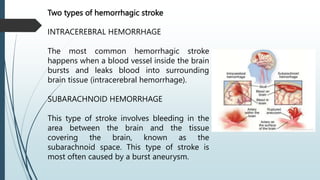
Two types of hemorrhagic stroke
INTRACEREBRAL HEMORRHAGE
The most common hemorrhagic stroke
happens when a blood vessel inside the brain
bursts and leaks blood into surrounding
brain tissue (intracerebral hemorrhage).
SUBARACHNOID HEMORRHAGE
This type of stroke involves bleeding in the
area between the brain and the tissue
covering the brain, known as the
subarachnoid space. This type of stroke is
most often caused by a burst aneurysm.
EPIDEMIOLOGY
Stroke is the Philippines' second leading cause
of death. It has a prevalence of 0·9%; ischemic
stroke comprises 70% while hemorrhagic stroke
comprises 30%. Age-adjusted hypertension
prevalence is 20·6%, diabetes 6·0%,
dyslipidemia 72·0%, smoking 31%, and obesity
4·9%.
Source: Navarro J., Baroque A., Lokin J., Venketasubramanian, N., (May 20, 2014) The real
stroke burden in the Philippines. https://doi.org/10.1111/ijs.12287
Stroke in the Philippines (May 2014)
Deaths Percentag
e
Rate World
Rank
63,261 12.14 119.21 54
According to the latest WHO data published in May 2014,
stroke deaths in Philippines reached 63,261 or 12.14% of total
deaths. The age adjusted Death Rate is 119.21 per 100,000 of
population ranks Philippines #54 in the world.
Source: Stroke in Philippines. (May 2014). Retrieved March 29, 2018, from http://www.worldlifeexpectancy.com/philippines-stroke
In the world
Stroke and Cerebrovascular Disease when considered
separately from other CVDs, stroke ranks No. 5
among all causes of death, behind diseases of the
heart, cancer, chronic lower respiratory disease, and
unintentional injuries/accidents.
Globally, in 2013 there were 6.5 million stroke deaths,
making stroke the second-leading cause of death
behind ischemic heart disease.
Source: Benjamin E., Blaha M., Chiuve S., et al., (March 7, 2017) Heart Disease and Stroke Statistics- 2017 Update. A Report from the American Heart
Association. doi: 10.1161/CIR.0000000000000485
In the world
Approximately 795 000 strokes occur in the United
States each year. On average, every 40 seconds,
someone in the United States has a stroke, and on
average, every 4 minutes, someone dies of a stroke.
Approximately 60% of stroke deaths occurred outside
of an acute care hospital.
A review of recent clinical trials identified the benefit
of intense BP reduction, which reduced risks of stroke
outcomes.
Source: Benjamin E., Blaha M., Chiuve S., et al., (March 7, 2017) Heart Disease and Stroke Statistics- 2017 Update. A Report from the American Heart
Association. doi: 10.1161/CIR.0000000000000485
RISK FACTORS
PRECIPITATING FACTORS
1.High blood pressure
2.Smoking
3.Diabetes
4.High cholesterol
5.Physical inactivity and obesity.
Source: American Stroke Association (November 17, 2016). Retrieved March 29, 2018, from http://www.strokeassociation.org/STROKEORG/AboutStroke/Lets-
Talk-About-Stroke-Patient-Information-Sheets_UCM_310731_Article.jsp#.WrxlPohubIU
RISK FACTORS
PRECIPITATING FACTORS
6. Carotid or other artery disease
7. Transient ischemic attacks (TIAs)
8. Atrial fibrillation (AFib) or other heart
disease
9. Certain blood disorders
10. Excessive alcohol intake.
11. Illegal drug use.
12. Sleep apnea.
Source: American Stroke Association (November 17, 2016). Retrieved March 29, 2018, from http://www.strokeassociation.org/STROKEORG/AboutStroke/Lets-
Talk-About-Stroke-Patient-Information-Sheets_UCM_310731_Article.jsp#.WrxlPohubIU
How hypertension impacts on your heart and
blood vessels:
Hypertension stresses your body’s blood vessels, causing
them to clog or weaken.
Hypertension can lead to atherosclerosis and narrowing
of the blood vessels making them more likely to block
from blood clots or bits of fatty material breaking off
from the lining of the blood vessel wall.
Damage to the arteries can also create weak places that
rupture easily or thin spots that balloon out the artery
wall resulting in an aneurysm.
RISK FACTORS
PREDISPOSING FACTORS
1. Age
2. Family history
3. Race
4. Gender
5. Prior stroke or heart attack
Source: American Stroke Association (November 17, 2016). Retrieved March 29, 2018, from
http://www.strokeassociation.org/STROKEORG/AboutStroke/Lets-Talk-About-Stroke-Patient-Information-Sheets_UCM_310731_Article.jsp#.WrxlPohubIU
Comparison of Left and Right Hemispheric Strokes
Left Hemispheric Stoke Right Hemispheric Stoke
- Paralysis/weakness on right
side of the body
-Right visual field deficit
- Aphasia (expressive,
receptive, or global)
- Altered intellectual ability
- Slow, cautious behavior
- Paralysis/weakness on left
side of body
- Left visual field deficit
- Spatial-perceptual deficits
- Increased distractibility
- Impulsive behavior and
poor judgement
- Lack of awareness of
deficits
Assessment and Diagnostics
 History and Complete Physical and Neurologic examination
 Computed Tomography Scan (Initial Diagnostic test)
 12-lead Electrocardiogram (ECG)
 CT angiography/CT perfusion
 Magnetic resonance Imaging (MRI)
 Magnetic resonance angiography of brain and neck vessels
Prevention
Smoking Cessation
Maintaining a Healthy Weight
Following a Healthy Diet
Modest Alcohol Consumption
Regular Exercise
Dietary Approaches to Stop Hypertension diet
(DASH)
Medical Management
 Anticoagulants such as aspirin
 Platelet inhibiting medications: Aspirin, Extended-release
dipyridamole plus aspirin (Aggrenox), and Clopidogrel (Plavix)
 Statins
 Thrombolytic Therapy
ANY QUESTIONS OR
CLARIFICATIONS?
REFERENCES:
BOOKS:
 Brunner, L. S., Suddarth, D. S., & Smeltzer, S. C. 0. (2008). Brunner &
Suddarth's textbook of medical-surgical nursing (12th ed.). Philadelphia
Lippincott Williams & Wilkins.
 Doenges, Marilyn E. et al. Nurse's Pocket Guide: Diagnoses, Prioritized
Interventions, and Rationales, 12th Edition. F.A. Favis Company
 Seeley, Stephens. Essentials of Anatomy and Physiology, 8th Edition.
McGraw-Hill
 Porth, C. M. Essentials of Pathophysiology, 3rd Edition. Lippincott Williams
& Wilkins
 Schull, P. D. Nursing Spectrum Drug Handbook McGraw-Hill Kozier, et al.
Kozier & Erb's Fundamentals of Nursing, Eight Edition.
REFERENCES:
ELECTRONIC RESOURCES:
[1] Cerebrovascular Accident (Stroke) Nursing Care and Management: A Study Guide. (2017, September 26).
Retrieved March 29, 2018, from https://nurseslabs.com/cerebrovascular-accident-stroke/
[2] Navarro J., Baroque A., Lokin J., Venketasubramanian, N., (May 20, 2014) The real stroke burden in the Philippines.
https://doi.org/10.1111/ijs.12287
[3] Stroke in Philippines. (May 2014). Retrieved March 29, 2018, from
http://www.worldlifeexpectancy.com/philippines-stroke
[4] Benjamin E., Blaha M., Chiuve S., et al., (March 7, 2017) Heart Disease and Stroke Statistics- 2017 Update. A Report
from the American Heart Association. doi: 10.1161/CIR.0000000000000485
[5] American Stroke Association (November 17, 2016). Retrieved March 29, 2018, from
http://www.strokeassociation.org/STROKEORG/AboutStroke/Lets-Talk-About-Stroke-Patient-Information-
Sheets_UCM_310731_Article.jsp#.WrxlPohubIU
[6] “Stroke: Risk Factors.” (2018) WJMC - West Jefferson Medical Center, www.wjmc.org/strokecare/WJMC-
Neuroscience-Stroke-Risk-Factors.aspx.
[7] Anatomy of the Brain. (n.d.). Retrieved March 31, 2018, from https://www.mayfieldclinic.com/PE-AnatBrain.htm
[8] Neurogistics. (n.d.). Retrieved March 31, 2018, from https://www.neurogistics.com/the-science/what-are-
neurotransmitters
Closing Prayer…
CVA HEALTH EDUCATION SESSION PRC.pptx

CVA HEALTH EDUCATION SESSION PRC.pptx

  • 1.
    A HEALTH EDUCATION ON CEREBROVASCULAR ACCIDENT(STROKE) By: Airon Vince Calica Stephanie Mickey Advincula BSN- V SAINT PADRE PIO OF PIETRECLINA 2019
  • 2.
  • 3.
    OBJECTIVES: At the endof the 30-minute health education session, the student nurses will be able to: To inform the employees about cerebrovascular accident (stroke) its epidemiology, types, risk factors, prevention, and management. To promote awareness on the lifestyle modifications to prevent the occurrence of cerebrovascular accident (stroke). To evaluate employees’ understanding about cerebrovascular accident (stroke).
  • 4.
    INTRODUCTION Cerebrovascular accident /brain attackis a sudden loss of function resulting from disruption of the blood supply to a part of the brain. It also defined as a death of an area of brain tissue (cerebral infarction) resulting from an inadequate supply of blood and oxygen to the brain due to blockage of an artery.
  • 6.
    Two types ofhemorrhagic stroke INTRACEREBRAL HEMORRHAGE The most common hemorrhagic stroke happens when a blood vessel inside the brain bursts and leaks blood into surrounding brain tissue (intracerebral hemorrhage). SUBARACHNOID HEMORRHAGE This type of stroke involves bleeding in the area between the brain and the tissue covering the brain, known as the subarachnoid space. This type of stroke is most often caused by a burst aneurysm.
  • 9.
    EPIDEMIOLOGY Stroke is thePhilippines' second leading cause of death. It has a prevalence of 0·9%; ischemic stroke comprises 70% while hemorrhagic stroke comprises 30%. Age-adjusted hypertension prevalence is 20·6%, diabetes 6·0%, dyslipidemia 72·0%, smoking 31%, and obesity 4·9%. Source: Navarro J., Baroque A., Lokin J., Venketasubramanian, N., (May 20, 2014) The real stroke burden in the Philippines. https://doi.org/10.1111/ijs.12287
  • 10.
    Stroke in thePhilippines (May 2014) Deaths Percentag e Rate World Rank 63,261 12.14 119.21 54 According to the latest WHO data published in May 2014, stroke deaths in Philippines reached 63,261 or 12.14% of total deaths. The age adjusted Death Rate is 119.21 per 100,000 of population ranks Philippines #54 in the world. Source: Stroke in Philippines. (May 2014). Retrieved March 29, 2018, from http://www.worldlifeexpectancy.com/philippines-stroke
  • 11.
    In the world Strokeand Cerebrovascular Disease when considered separately from other CVDs, stroke ranks No. 5 among all causes of death, behind diseases of the heart, cancer, chronic lower respiratory disease, and unintentional injuries/accidents. Globally, in 2013 there were 6.5 million stroke deaths, making stroke the second-leading cause of death behind ischemic heart disease. Source: Benjamin E., Blaha M., Chiuve S., et al., (March 7, 2017) Heart Disease and Stroke Statistics- 2017 Update. A Report from the American Heart Association. doi: 10.1161/CIR.0000000000000485
  • 12.
    In the world Approximately795 000 strokes occur in the United States each year. On average, every 40 seconds, someone in the United States has a stroke, and on average, every 4 minutes, someone dies of a stroke. Approximately 60% of stroke deaths occurred outside of an acute care hospital. A review of recent clinical trials identified the benefit of intense BP reduction, which reduced risks of stroke outcomes. Source: Benjamin E., Blaha M., Chiuve S., et al., (March 7, 2017) Heart Disease and Stroke Statistics- 2017 Update. A Report from the American Heart Association. doi: 10.1161/CIR.0000000000000485
  • 13.
    RISK FACTORS PRECIPITATING FACTORS 1.Highblood pressure 2.Smoking 3.Diabetes 4.High cholesterol 5.Physical inactivity and obesity. Source: American Stroke Association (November 17, 2016). Retrieved March 29, 2018, from http://www.strokeassociation.org/STROKEORG/AboutStroke/Lets- Talk-About-Stroke-Patient-Information-Sheets_UCM_310731_Article.jsp#.WrxlPohubIU
  • 14.
    RISK FACTORS PRECIPITATING FACTORS 6.Carotid or other artery disease 7. Transient ischemic attacks (TIAs) 8. Atrial fibrillation (AFib) or other heart disease 9. Certain blood disorders 10. Excessive alcohol intake. 11. Illegal drug use. 12. Sleep apnea. Source: American Stroke Association (November 17, 2016). Retrieved March 29, 2018, from http://www.strokeassociation.org/STROKEORG/AboutStroke/Lets- Talk-About-Stroke-Patient-Information-Sheets_UCM_310731_Article.jsp#.WrxlPohubIU
  • 15.
    How hypertension impactson your heart and blood vessels: Hypertension stresses your body’s blood vessels, causing them to clog or weaken. Hypertension can lead to atherosclerosis and narrowing of the blood vessels making them more likely to block from blood clots or bits of fatty material breaking off from the lining of the blood vessel wall. Damage to the arteries can also create weak places that rupture easily or thin spots that balloon out the artery wall resulting in an aneurysm.
  • 16.
    RISK FACTORS PREDISPOSING FACTORS 1.Age 2. Family history 3. Race 4. Gender 5. Prior stroke or heart attack Source: American Stroke Association (November 17, 2016). Retrieved March 29, 2018, from http://www.strokeassociation.org/STROKEORG/AboutStroke/Lets-Talk-About-Stroke-Patient-Information-Sheets_UCM_310731_Article.jsp#.WrxlPohubIU
  • 17.
    Comparison of Leftand Right Hemispheric Strokes Left Hemispheric Stoke Right Hemispheric Stoke - Paralysis/weakness on right side of the body -Right visual field deficit - Aphasia (expressive, receptive, or global) - Altered intellectual ability - Slow, cautious behavior - Paralysis/weakness on left side of body - Left visual field deficit - Spatial-perceptual deficits - Increased distractibility - Impulsive behavior and poor judgement - Lack of awareness of deficits
  • 18.
    Assessment and Diagnostics History and Complete Physical and Neurologic examination  Computed Tomography Scan (Initial Diagnostic test)  12-lead Electrocardiogram (ECG)  CT angiography/CT perfusion  Magnetic resonance Imaging (MRI)  Magnetic resonance angiography of brain and neck vessels
  • 20.
    Prevention Smoking Cessation Maintaining aHealthy Weight Following a Healthy Diet Modest Alcohol Consumption Regular Exercise Dietary Approaches to Stop Hypertension diet (DASH)
  • 22.
    Medical Management  Anticoagulantssuch as aspirin  Platelet inhibiting medications: Aspirin, Extended-release dipyridamole plus aspirin (Aggrenox), and Clopidogrel (Plavix)  Statins  Thrombolytic Therapy
  • 23.
  • 24.
    REFERENCES: BOOKS:  Brunner, L.S., Suddarth, D. S., & Smeltzer, S. C. 0. (2008). Brunner & Suddarth's textbook of medical-surgical nursing (12th ed.). Philadelphia Lippincott Williams & Wilkins.  Doenges, Marilyn E. et al. Nurse's Pocket Guide: Diagnoses, Prioritized Interventions, and Rationales, 12th Edition. F.A. Favis Company  Seeley, Stephens. Essentials of Anatomy and Physiology, 8th Edition. McGraw-Hill  Porth, C. M. Essentials of Pathophysiology, 3rd Edition. Lippincott Williams & Wilkins  Schull, P. D. Nursing Spectrum Drug Handbook McGraw-Hill Kozier, et al. Kozier & Erb's Fundamentals of Nursing, Eight Edition.
  • 25.
    REFERENCES: ELECTRONIC RESOURCES: [1] CerebrovascularAccident (Stroke) Nursing Care and Management: A Study Guide. (2017, September 26). Retrieved March 29, 2018, from https://nurseslabs.com/cerebrovascular-accident-stroke/ [2] Navarro J., Baroque A., Lokin J., Venketasubramanian, N., (May 20, 2014) The real stroke burden in the Philippines. https://doi.org/10.1111/ijs.12287 [3] Stroke in Philippines. (May 2014). Retrieved March 29, 2018, from http://www.worldlifeexpectancy.com/philippines-stroke [4] Benjamin E., Blaha M., Chiuve S., et al., (March 7, 2017) Heart Disease and Stroke Statistics- 2017 Update. A Report from the American Heart Association. doi: 10.1161/CIR.0000000000000485 [5] American Stroke Association (November 17, 2016). Retrieved March 29, 2018, from http://www.strokeassociation.org/STROKEORG/AboutStroke/Lets-Talk-About-Stroke-Patient-Information- Sheets_UCM_310731_Article.jsp#.WrxlPohubIU [6] “Stroke: Risk Factors.” (2018) WJMC - West Jefferson Medical Center, www.wjmc.org/strokecare/WJMC- Neuroscience-Stroke-Risk-Factors.aspx. [7] Anatomy of the Brain. (n.d.). Retrieved March 31, 2018, from https://www.mayfieldclinic.com/PE-AnatBrain.htm [8] Neurogistics. (n.d.). Retrieved March 31, 2018, from https://www.neurogistics.com/the-science/what-are- neurotransmitters
  • 26.

Editor's Notes

  • #6 Ischemic stroke - This is the loss of function in the brain as a result of a disrupted blood supply. Hemorrhagic stroke - Hemorrhagic strokes are caused by bleeding into the brain tissue, the ventricles, or the subarachnoid space. Hemorrhagic strokes are less common, in fact only 15 percent of all strokes are hemorrhagic, but they are responsible for about 40 percent of all stroke deaths. A hemorrhagic stroke is either a brain aneurysm burst or a weakened blood vessel leak. Blood spills into or around the brain and creates swelling and pressure, damaging cells and tissue in the brain.
  • #7 Two types of hemorrhagic stroke   INTRACEREBRAL HEMORRHAGE   The most common hemorrhagic stroke happens when a blood vessel inside the brain bursts and leaks blood into surrounding brain tissue (intracerebral hemorrhage). The bleeding causes brain cells to die and the affected part of the brain stops working correctly. High blood pressure and aging blood vessels are the most common causes of this type of stroke.   Sometimes intracerebral hemorrhagic stroke can be caused by an arteriovenous malformation (AVM). AVM is a genetic condition of abnormal connection between arteries and veins and most often occurs in the brain or spine. If AVM occurs in the brain, vessels can break and bleed into the brain. The cause of AVM is unclear but once diagnosed it can be treated successfully.   SUBARACHNOID HEMORRHAGE   This type of stroke involves bleeding in the area between the brain and the tissue covering the brain, known as the subarachnoid space. This type of stroke is most often caused by a burst aneurysm. Other causes include: AVM Bleeding disorders Head injury Blood thinners
  • #8 Two types of hemorrhagic stroke   INTRACEREBRAL HEMORRHAGE   The most common hemorrhagic stroke happens when a blood vessel inside the brain bursts and leaks blood into surrounding brain tissue (intracerebral hemorrhage). The bleeding causes brain cells to die and the affected part of the brain stops working correctly. High blood pressure and aging blood vessels are the most common causes of this type of stroke.   Sometimes intracerebral hemorrhagic stroke can be caused by an arteriovenous malformation (AVM). AVM is a genetic condition of abnormal connection between arteries and veins and most often occurs in the brain or spine. If AVM occurs in the brain, vessels can break and bleed into the brain. The cause of AVM is unclear but once diagnosed it can be treated successfully.   SUBARACHNOID HEMORRHAGE   This type of stroke involves bleeding in the area between the brain and the tissue covering the brain, known as the subarachnoid space. This type of stroke is most often caused by a burst aneurysm. Other causes include: AVM Bleeding disorders Head injury Blood thinners
  • #14 High blood pressure. This is the single most important risk factor for stroke because it’s the leading cause of stroke. Know your blood pressure and have it checked every year. Normal blood pressure is below 120/80. Smoking. Smoking damages blood vessels. This can lead to blockages within those blood vessels, causing a stroke. Diabetes. Having diabetes more than doubles your risk of stroke. High cholesterol. High cholesterol increases the risk of blocked arteries. If an artery leading to the brain becomes blocked, a stroke can result. Physical inactivity and obesity. Being inactive, obese, or both, can increase your risk of heart disease and stroke. Carotid or other artery disease. The carotid arteries in your neck supply most of the blood to your brain. A carotid artery damaged by a fatty buildup of plaque inside the artery wall may become blocked by a blood clot. This causes a stroke. Transient ischemic attacks (TIAs). Recognizing and treating TIAs can reduce the risk of a major stroke. TIAs produce stroke-like symptoms but most have no lasting effects. Atrial fibrillation (AFib) or other heart disease. In AFib the heart’s upper chambers quiver (like a bowl of gelatin) rather than beating in an organized, rhythmic way. This can cause the blood to pool and clot, increasing the risk of stroke. AFib increases risk of stroke five times. People with other types of heart disease have a higher risk of stroke, too. Certain blood disorders. A high red blood cell count makes clots more likely, raising the risk of stroke. Sickle cell anemia increases stroke risk because the “sickled” cells stick to blood vessel walls and may block arteries. Excessive alcohol intake. Drinking an average of more than one drink per day for women or more than two drinks a day for men can raise blood pressure. Binge drinking can lead to stroke. Illegal drug use. Drugs including cocaine, ecstasy amphetamines, and heroin are associated with an increased risk of stroke. Sleep apnea. Sleep disordered breathing contributes to risk of stroke. Increasing sleep apnea severity is associated with increasing risk.
  • #15 High blood pressure. This is the single most important risk factor for stroke because it’s the leading cause of stroke. Know your blood pressure and have it checked every year. Normal blood pressure is below 120/80. Smoking. Smoking damages blood vessels. This can lead to blockages within those blood vessels, causing a stroke. Diabetes. Having diabetes more than doubles your risk of stroke. High cholesterol. High cholesterol increases the risk of blocked arteries. If an artery leading to the brain becomes blocked, a stroke can result. Physical inactivity and obesity. Being inactive, obese, or both, can increase your risk of heart disease and stroke. Carotid or other artery disease. The carotid arteries in your neck supply most of the blood to your brain. A carotid artery damaged by a fatty buildup of plaque inside the artery wall may become blocked by a blood clot. This causes a stroke. Transient ischemic attacks (TIAs). Recognizing and treating TIAs can reduce the risk of a major stroke. TIAs produce stroke-like symptoms but most have no lasting effects. Atrial fibrillation (AFib) or other heart disease. In AFib the heart’s upper chambers quiver (like a bowl of gelatin) rather than beating in an organized, rhythmic way. This can cause the blood to pool and clot, increasing the risk of stroke. AFib increases risk of stroke five times. People with other types of heart disease have a higher risk of stroke, too. Certain blood disorders. A high red blood cell count makes clots more likely, raising the risk of stroke. Sickle cell anemia increases stroke risk because the “sickled” cells stick to blood vessel walls and may block arteries. Excessive alcohol intake. Drinking an average of more than one drink per day for women or more than two drinks a day for men can raise blood pressure. Binge drinking can lead to stroke. Illegal drug use. Drugs including cocaine, ecstasy amphetamines, and heroin are associated with an increased risk of stroke. Sleep apnea. Sleep disordered breathing contributes to risk of stroke. Increasing sleep apnea severity is associated with increasing risk.
  • #16 Elevated blood pressure leads to the thickening of the blood vessel walls. When combined with cholesterol deposits in the blood vessels, the risk of heart attacks and stroke increases.
  • #17 Predisposing factors: Age matters. The likelihood of having a stroke nearly doubles every 10 years after age 55. Although stroke is more common among the elderly, a lot of people under 65 also have strokes.  A family history of stroke can raise your risk. If your parent, grandparent, sister or brother has had a stroke — especially before reaching age 65 — you may be at greater risk. Race can make a difference. Statistics show that African-Americans have a much higher risk of death from a stroke than Caucasians do. This is partly because blacks have higher risks of high blood pressure, diabetes and obesity. Your sex (gender) can affect your risks. Each year, women have more strokes than men, and stroke kills more women than men, too. Factors that may increase stroke risks for women include: pregnancy, history of preeclampsia/eclampsia or gestational diabetes, oral contraceptive use (especially when combined with smoking) and post-menopausal hormone therapy. Prior stroke, TIA or heart attack can raise your risk. A person who has had a prior stroke has a much higher risk of having another stroke than a person who has never had one. Transient ischemic attacks (TIAs) or are also strong predictors of stroke. TIAs are smaller, temporary blockages in the brain that can produce milder forms of stroke-like symptoms but may not leave lasting damage. A person who's had one or more TIAs is almost 10 times more likely to have a stroke than someone of the same age and sex who hasn't. Recognizing and treating TIAs can reduce your risk of a major stroke. TIA should be considered a medical emergency and followed up immediately with a healthcare professional. If you've had a prior heart attack, you're at higher risk of having a stroke, too. A heart attack is a plaque buildup that causes blockages in the blood vessels to the heart. Similarly, most strokes are caused by buildups of plaque that cause blockages in the brain.  
  • #21 The DASH diet eating plan is a diet rich in fruits, vegetables, low fat or nonfat dairy. It also includes mostly whole grains; lean meats, fish and poultry; nuts and beans. It is high fiber and low to moderate in fat. It is a plan that follows US guidelines for sodium content, along with vitamins and minerals. In addition to lowering blood pressure, the DASH eating plan lowers cholesterol and makes it easy to lose weight. It is a healthy way of eating, designed to be flexible enough to meet the lifestyle and food preferences of most people.