CUTTING FLUIDS
QUESTIONS 
1. What is cutting fluids? 
2. What are the functions of a cutting fluid ? 
3. How are they categorised ? 
4. How should the fluid be applied to the work area ? 
5. What are the properties?
THE PRIMARY FUNCTIONS OF CUTTING 
FLUIDS IN MACHINING ARE… 
 Lubricating the cutting process at low cutting speed. 
 Cooling the work piece at high cutting speed. 
 and flushing away chips from the cutting zone.
SECONDARY FUNCTIONS 
INCLUDE… 
Corrosion protection of the machined surface 
enabling part handling by cooling the hot 
surface
4 CATEGORIES 
1. Straight oils 
2. Soluble oils 
3. Semi-synthetic fluids 
4. Synthetic fluids
STRAIGHT OILS 
 are the oldest class of engineered metal removal fluids 
 used in machining operations in an undiluted form. 
 They are composed of a base mineral or petroleum oil and often 
contains polar lubricants such as fats, 
 vegetable oils and esters as well as extreme pressure additives 
such as Chlorine, Sulphur and Phosphorus. 
 Straight oils provide the best lubrication and the poorest cooling 
characteristics among cutting fluids.
SOLUBLE OIL 
 form an emulsion when mixed with water. 
 The concentrate consists of a base mineral oil and emulsifiers 
to help produce a stable emulsion. 
 They are used in a diluted form (usual concentration = 3 to 
10%) 
 provide good lubrication and heat transfer performance. 
 They are widely used in industry and are the least expensive 
among all cutting fluids.
SYNTHETIC FLUIDS 
 contain no petroleum or mineral oil base 
 are formulated from alkaline inorganic and organic 
compounds 
 They are generally used in a diluted form (usual 
concentration = 3 to 10%). 
 Synthetic fluids often provide the best cooling 
performance among all cutting fluids.
SEMI-SYNTHETIC FLUIDS 
 are essentially combination of synthetic and soluble oil 
fluids 
 and have characteristics common to both types. 
 The cost and heat transfer performance of semi-synthetic 
fluids lie between those of synthetic and soluble oil fluids.
PROPERTIES OF CUTTING FLUID.. 
 It should posses good lubricating properties to 
reduce the frictional force 
 It should be non-toxic. 
 It should be chemically inactive. 
 It should not very easily flammable. 
 It should be stable in use and storage. 
 High heat conductivity.
CUTTING FLUID APPLICATION 
 The principal methods of cutting fluid application 
include…
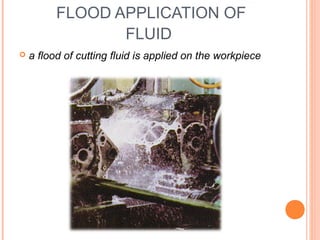
FLOOD APPLICATION OF 
FLUID 
 a flood of cutting fluid is applied on the workpiece
JET APPLICATION OF FLUID 
a jet of cutting fluid is applied on the 
workpiece
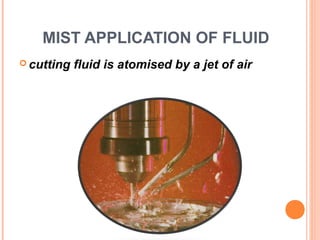
MIST APPLICATION OF FLUID 
cutting fluid is atomised by a jet of air
BENEFITS ACHIEVED WITH THE USE OF 
CUTTING FLUID 
 improving tool life, 
 Lower tool force , 
 improving surface finish, 
 Finished surfaces are protected from corrosion
CUTTING FLUID HEALTH HAZARDS 
 Workers are exposed to metal cutting fluids via three 
routes 
1. Skin exposure 
2. Aerial exposure 
3. Ingestion
 Skin exposure is the main problem – 80% 
 Main cause of occupational contact dermatitis 
Solution ???? 
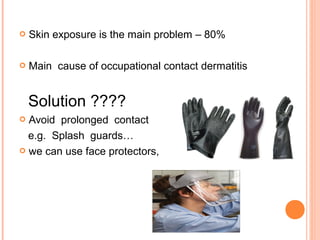
 Avoid prolonged contact 
e.g. Splash guards… 
 we can use face protectors,
Thank you

Cutting fluids,Uses,Effects over humans

  • 1.
  • 4.
    QUESTIONS 1. Whatis cutting fluids? 2. What are the functions of a cutting fluid ? 3. How are they categorised ? 4. How should the fluid be applied to the work area ? 5. What are the properties?
  • 5.
    THE PRIMARY FUNCTIONSOF CUTTING FLUIDS IN MACHINING ARE…  Lubricating the cutting process at low cutting speed.  Cooling the work piece at high cutting speed.  and flushing away chips from the cutting zone.
  • 6.
    SECONDARY FUNCTIONS INCLUDE… Corrosion protection of the machined surface enabling part handling by cooling the hot surface
  • 7.
    4 CATEGORIES 1.Straight oils 2. Soluble oils 3. Semi-synthetic fluids 4. Synthetic fluids
  • 8.
    STRAIGHT OILS are the oldest class of engineered metal removal fluids  used in machining operations in an undiluted form.  They are composed of a base mineral or petroleum oil and often contains polar lubricants such as fats,  vegetable oils and esters as well as extreme pressure additives such as Chlorine, Sulphur and Phosphorus.  Straight oils provide the best lubrication and the poorest cooling characteristics among cutting fluids.
  • 9.
    SOLUBLE OIL form an emulsion when mixed with water.  The concentrate consists of a base mineral oil and emulsifiers to help produce a stable emulsion.  They are used in a diluted form (usual concentration = 3 to 10%)  provide good lubrication and heat transfer performance.  They are widely used in industry and are the least expensive among all cutting fluids.
  • 10.
    SYNTHETIC FLUIDS contain no petroleum or mineral oil base  are formulated from alkaline inorganic and organic compounds  They are generally used in a diluted form (usual concentration = 3 to 10%).  Synthetic fluids often provide the best cooling performance among all cutting fluids.
  • 11.
    SEMI-SYNTHETIC FLUIDS are essentially combination of synthetic and soluble oil fluids  and have characteristics common to both types.  The cost and heat transfer performance of semi-synthetic fluids lie between those of synthetic and soluble oil fluids.
  • 12.
    PROPERTIES OF CUTTINGFLUID..  It should posses good lubricating properties to reduce the frictional force  It should be non-toxic.  It should be chemically inactive.  It should not very easily flammable.  It should be stable in use and storage.  High heat conductivity.
  • 13.
    CUTTING FLUID APPLICATION  The principal methods of cutting fluid application include…
  • 14.
    FLOOD APPLICATION OF FLUID  a flood of cutting fluid is applied on the workpiece
  • 15.
    JET APPLICATION OFFLUID a jet of cutting fluid is applied on the workpiece
  • 16.
    MIST APPLICATION OFFLUID cutting fluid is atomised by a jet of air
  • 17.
    BENEFITS ACHIEVED WITHTHE USE OF CUTTING FLUID  improving tool life,  Lower tool force ,  improving surface finish,  Finished surfaces are protected from corrosion
  • 18.
    CUTTING FLUID HEALTHHAZARDS  Workers are exposed to metal cutting fluids via three routes 1. Skin exposure 2. Aerial exposure 3. Ingestion
  • 19.
     Skin exposureis the main problem – 80%  Main cause of occupational contact dermatitis Solution ????  Avoid prolonged contact e.g. Splash guards…  we can use face protectors,
  • 20.