CUTTING FLUIDS—TYPES
AND APPLICATIONS
Presented by-
SANDEEP PATEL
M.Tech (Manufacturing)
NIT Warangal, India
1
CUTTING FLUIDS
 Essential in metal-cutting operations to reduce heat
and friction
 Centuries ago, water used on grindstones
 100 years ago, tallow used (did not cool)
 Lard oils came later but turned rancid
 Early 20th century saw soap added to water
 Soluble oils came in 1936
 Chemical cutting fluids introduced in 1944
2
ECONOMIC ADVANTAGES TO USING
CUTTING FLUIDS
 Reduction of tool costs
 Reduce tool wear, tools last longer
 Increased speed of production
 Reduce heat and friction so higher cutting speeds
 Reduction of labor costs
 Tools last longer and require less regrinding, less
downtime, reducing cost per part
 Reduction of power costs
 Friction reduced so less power required by machining
3
HEAT GENERATED DURING MACHINING
 Heat finds its way into one of three places
 Workpiece, tool and chips
4
Too much, work
will expand
Too much, cutting edge
will break down rapidly,
reducing tool life
Act as disposable
heat sink
HEAT DISSIPATION
 Ideally most heat taken off in chips
 Indicated by change in chip color as heat causes
chips to oxidize
 Cutting fluids assist taking away heat
 Can dissipate at least 50% of heat created during
machining
5
CHARACTERISTICS OF A GOOD CUTTING
FLUID
6
1. Good cooling
capacity
2. Good lubricating
qualities
3. Resistance to
rancidity
4. Relatively low
viscosity
5. Stability (long life)
6. Rust resistance
7. Nontoxic
8. Transparent
9. Nonflammable
10. Anti-welding
TYPES OF CUTTING FLUIDS
 Most commonly used cutting fluids
 Either aqueous based solutions or cutting oils
 Fall into three categories
 Cutting oils
 Emulsifiable oils
 Chemical (synthetic) cutting fluids
7
CUTTING OILS
 Two classifications
 Active
 Inactive
 Terms relate to oil's chemical activity or ability to
react with metal surface
 Elevated temperatures
 Improve cutting action
 Protect surface
8
ACTIVE CUTTING OILS
 Those that will darken copper strip immersed for 3
hours at temperature of 212ºF
 Dark or transparent
 Better for heavy-duty jobs
 Three categories
 Sulfurized mineral oils
 Sulfochlorinated mineral oils
 Sulfochlorinated fatty oil blends
9
INACTIVE CUTTING OILS
 Oils will not darken copper strip immersed in
them for 3 hours at 212ºF
 Contained sulfur is natural
 Termed inactive because sulfur so firmly attached to
oil – very little released
 Four general categories
 Straight mineral oils, fatty oils, fatty and mineral oil
blends, sulfurized fatty-mineral oil blend
10
EMULSIFIABLE (WATER SOLUBLE) OILS
 Mineral oils containing soaplike material that
makes them soluble in water and causes them to
adhere to workpiece
 Emulsifiers break oil into minute particles and keep
them separated in water
 Supplied in concentrated form (1-5 /100 water)
 Good cooling and lubricating qualities
 Used at high cutting speeds, low cutting pressures
11
CHEMICAL CUTTING FLUIDS
 Also called synthetic fluids
 Introduced about 1945
 Stable, preformed emulsions
 Contain very little oil and mix easily with water
 Extreme-pressure (EP) lubricants added
 React with freshly machined metal under heat and
pressure of a cut to form solid lubricant
 Reduce heat of friction and heat caused by plastic
deformation of metal
12
ADVANTAGES OF SYNTHETIC FLUIDS
1. Good rust control
2. Resistance to rancidity for long periods of
time
3. Reduction of amount of heat generated during
cutting
4. Excellent cooling qualities
13
5. Longer durability than cutting or soluble oils
6. Nonflammable - nonsmoking
7. Nontoxic??????
8. Easy separation from work and chips
9. Quick settling of grit and fine chips so they are
not recirculated in cooling system
10. No clogging of machine cooling system due to
detergent action of fluid
11. Can leave a residue on parts and tools.
14
CAUTION
15
Chemical cutting fluids widely accepted
and generally used on ferrous metals. They
are not recommended for use on alloys of
magnesium, zinc, cadmium, or lead. They
can mar machine's appearance and dissolve
paint on the surface.
FUNCTIONS OF A CUTTING FLUID
 Prime functions
 Provide cooling at relatively high cutting speed.
 Provide lubrication at relatively low cutting speed.
 Other functions
 Prolong cutting-tool life
 Provide rust control
 Chip disposal.
 Prevent corrosion.
16
FUNCTIONS OF A CUTTING FLUID:
COOLING
 Heat has definite bearing on cutting-tool wear
 Small reduction will greatly extend tool life
 Two sources of heat during cutting action
 Plastic deformation of metal
 Occurs immediately ahead of cutting tool
 Accounts for 2/3 to 3/4 of heat
 Friction from chip sliding along cutting-tool face
17
FUNCTIONS OF A CUTTING FLUID:
COOLING
 Water most effective for reducing heat by will
promote oxidation (rust)
 Decrease the temperature at the chip-tool interface
by 50 degrees F, and it retains the hardness of
cutting tool thereby increase tool life by up to 5
times.
 In addition removal of heat from the cutting zone
reduces thermal distortion of work.
18
FUNCTIONS OF A CUTTING FLUID:
LUBRICATION
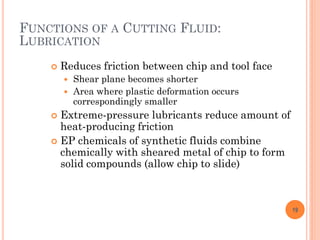
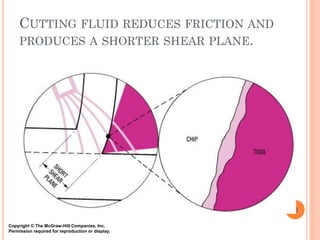
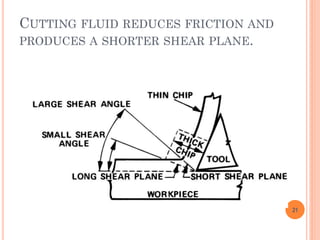
 Reduces friction between chip and tool face
 Shear plane becomes shorter
 Area where plastic deformation occurs
correspondingly smaller
 Extreme-pressure lubricants reduce amount of
heat-producing friction
 EP chemicals of synthetic fluids combine
chemically with sheared metal of chip to form
solid compounds (allow chip to slide)
19
CUTTING FLUID REDUCES FRICTION AND
PRODUCES A SHORTER SHEAR PLANE.
20
Copyright © The McGraw-Hill Companies, Inc.
Permission required for reproduction or display.
CUTTING FLUID REDUCES FRICTION AND
PRODUCES A SHORTER SHEAR PLANE.
21
CUTTING-TOOL LIFE
 Heat and friction prime causes of cutting-tool
breakdown
 Reduce temperature by as little as 50ºF, life of
cutting tool increases fivefold
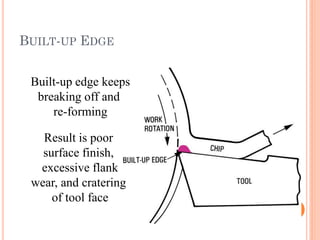
 Built-up edge
 Pieces of metal weld themselves to tool face
 Becomes large and flat along tool face, effective rake
angle of cutting tool decreased
22
BUILT-UP EDGE
23
Built-up edge keeps
breaking off and
re-forming
Result is poor
surface finish,
excessive flank
wear, and cratering
of tool face
CUTTING FLUID'S EFFECT ON CUTTING
TOOL ACTION
1. Lowers heat created by plastic deformation of
metal
2. Friction at chip-tool interface decreased
3. Less power is required for machining because of
reduced friction
4. Prevents built-up edge from forming
5. Surface finish of work greatly improved
24
RUST CONTROL
 Water best and most economical coolant
 Causes parts to rust
 Rust is oxidized iron
 Chemical cutting fluids contain rust inhibitors
 Polar film
 Passivating film
25
RANCIDITY CONTROL
 Rancidity caused by bacteria and other
microscopic organisms, growing and eventually
causing bad odors to form
 Most cutting fluids contain bactericides that
control growth of bacteria and make fluids more
resistant to rancidity
26
APPLICATION OF CUTTING FLUIDS
 Cutting-tool life and machining operations
influenced by way cutting fluid applied
 Copious stream under low pressure so work and
tool well covered
 Inside diameter of supply nozzle ¾ width of cutting
tool
 Applied to where chip being formed
27
REFRIGERATED AIR SYSTEM
 Another way to cool chip-tool interface
 Effective, inexpensive and readily available
 Used where dry machining is necessary
 Uses compressed air that enters vortex generation
chamber
 Cooled 100ºF below incoming air
 Air directed to interface and blow chips away
28

Cutting fluids presentation about cutting

  • 1.
    CUTTING FLUIDS—TYPES AND APPLICATIONS Presentedby- SANDEEP PATEL M.Tech (Manufacturing) NIT Warangal, India 1
  • 2.
    CUTTING FLUIDS  Essentialin metal-cutting operations to reduce heat and friction  Centuries ago, water used on grindstones  100 years ago, tallow used (did not cool)  Lard oils came later but turned rancid  Early 20th century saw soap added to water  Soluble oils came in 1936  Chemical cutting fluids introduced in 1944 2
  • 3.
    ECONOMIC ADVANTAGES TOUSING CUTTING FLUIDS  Reduction of tool costs  Reduce tool wear, tools last longer  Increased speed of production  Reduce heat and friction so higher cutting speeds  Reduction of labor costs  Tools last longer and require less regrinding, less downtime, reducing cost per part  Reduction of power costs  Friction reduced so less power required by machining 3
  • 4.
    HEAT GENERATED DURINGMACHINING  Heat finds its way into one of three places  Workpiece, tool and chips 4 Too much, work will expand Too much, cutting edge will break down rapidly, reducing tool life Act as disposable heat sink
  • 5.
    HEAT DISSIPATION  Ideallymost heat taken off in chips  Indicated by change in chip color as heat causes chips to oxidize  Cutting fluids assist taking away heat  Can dissipate at least 50% of heat created during machining 5
  • 6.
    CHARACTERISTICS OF AGOOD CUTTING FLUID 6 1. Good cooling capacity 2. Good lubricating qualities 3. Resistance to rancidity 4. Relatively low viscosity 5. Stability (long life) 6. Rust resistance 7. Nontoxic 8. Transparent 9. Nonflammable 10. Anti-welding
  • 7.
    TYPES OF CUTTINGFLUIDS  Most commonly used cutting fluids  Either aqueous based solutions or cutting oils  Fall into three categories  Cutting oils  Emulsifiable oils  Chemical (synthetic) cutting fluids 7
  • 8.
    CUTTING OILS  Twoclassifications  Active  Inactive  Terms relate to oil's chemical activity or ability to react with metal surface  Elevated temperatures  Improve cutting action  Protect surface 8
  • 9.
    ACTIVE CUTTING OILS Those that will darken copper strip immersed for 3 hours at temperature of 212ºF  Dark or transparent  Better for heavy-duty jobs  Three categories  Sulfurized mineral oils  Sulfochlorinated mineral oils  Sulfochlorinated fatty oil blends 9
  • 10.
    INACTIVE CUTTING OILS Oils will not darken copper strip immersed in them for 3 hours at 212ºF  Contained sulfur is natural  Termed inactive because sulfur so firmly attached to oil – very little released  Four general categories  Straight mineral oils, fatty oils, fatty and mineral oil blends, sulfurized fatty-mineral oil blend 10
  • 11.
    EMULSIFIABLE (WATER SOLUBLE)OILS  Mineral oils containing soaplike material that makes them soluble in water and causes them to adhere to workpiece  Emulsifiers break oil into minute particles and keep them separated in water  Supplied in concentrated form (1-5 /100 water)  Good cooling and lubricating qualities  Used at high cutting speeds, low cutting pressures 11
  • 12.
    CHEMICAL CUTTING FLUIDS Also called synthetic fluids  Introduced about 1945  Stable, preformed emulsions  Contain very little oil and mix easily with water  Extreme-pressure (EP) lubricants added  React with freshly machined metal under heat and pressure of a cut to form solid lubricant  Reduce heat of friction and heat caused by plastic deformation of metal 12
  • 13.
    ADVANTAGES OF SYNTHETICFLUIDS 1. Good rust control 2. Resistance to rancidity for long periods of time 3. Reduction of amount of heat generated during cutting 4. Excellent cooling qualities 13
  • 14.
    5. Longer durabilitythan cutting or soluble oils 6. Nonflammable - nonsmoking 7. Nontoxic?????? 8. Easy separation from work and chips 9. Quick settling of grit and fine chips so they are not recirculated in cooling system 10. No clogging of machine cooling system due to detergent action of fluid 11. Can leave a residue on parts and tools. 14
  • 15.
    CAUTION 15 Chemical cutting fluidswidely accepted and generally used on ferrous metals. They are not recommended for use on alloys of magnesium, zinc, cadmium, or lead. They can mar machine's appearance and dissolve paint on the surface.
  • 16.
    FUNCTIONS OF ACUTTING FLUID  Prime functions  Provide cooling at relatively high cutting speed.  Provide lubrication at relatively low cutting speed.  Other functions  Prolong cutting-tool life  Provide rust control  Chip disposal.  Prevent corrosion. 16
  • 17.
    FUNCTIONS OF ACUTTING FLUID: COOLING  Heat has definite bearing on cutting-tool wear  Small reduction will greatly extend tool life  Two sources of heat during cutting action  Plastic deformation of metal  Occurs immediately ahead of cutting tool  Accounts for 2/3 to 3/4 of heat  Friction from chip sliding along cutting-tool face 17
  • 18.
    FUNCTIONS OF ACUTTING FLUID: COOLING  Water most effective for reducing heat by will promote oxidation (rust)  Decrease the temperature at the chip-tool interface by 50 degrees F, and it retains the hardness of cutting tool thereby increase tool life by up to 5 times.  In addition removal of heat from the cutting zone reduces thermal distortion of work. 18
  • 19.
    FUNCTIONS OF ACUTTING FLUID: LUBRICATION  Reduces friction between chip and tool face  Shear plane becomes shorter  Area where plastic deformation occurs correspondingly smaller  Extreme-pressure lubricants reduce amount of heat-producing friction  EP chemicals of synthetic fluids combine chemically with sheared metal of chip to form solid compounds (allow chip to slide) 19
  • 20.
    CUTTING FLUID REDUCESFRICTION AND PRODUCES A SHORTER SHEAR PLANE. 20 Copyright © The McGraw-Hill Companies, Inc. Permission required for reproduction or display.
  • 21.
    CUTTING FLUID REDUCESFRICTION AND PRODUCES A SHORTER SHEAR PLANE. 21
  • 22.
    CUTTING-TOOL LIFE  Heatand friction prime causes of cutting-tool breakdown  Reduce temperature by as little as 50ºF, life of cutting tool increases fivefold  Built-up edge  Pieces of metal weld themselves to tool face  Becomes large and flat along tool face, effective rake angle of cutting tool decreased 22
  • 23.
    BUILT-UP EDGE 23 Built-up edgekeeps breaking off and re-forming Result is poor surface finish, excessive flank wear, and cratering of tool face
  • 24.
    CUTTING FLUID'S EFFECTON CUTTING TOOL ACTION 1. Lowers heat created by plastic deformation of metal 2. Friction at chip-tool interface decreased 3. Less power is required for machining because of reduced friction 4. Prevents built-up edge from forming 5. Surface finish of work greatly improved 24
  • 25.
    RUST CONTROL  Waterbest and most economical coolant  Causes parts to rust  Rust is oxidized iron  Chemical cutting fluids contain rust inhibitors  Polar film  Passivating film 25
  • 26.
    RANCIDITY CONTROL  Ranciditycaused by bacteria and other microscopic organisms, growing and eventually causing bad odors to form  Most cutting fluids contain bactericides that control growth of bacteria and make fluids more resistant to rancidity 26
  • 27.
    APPLICATION OF CUTTINGFLUIDS  Cutting-tool life and machining operations influenced by way cutting fluid applied  Copious stream under low pressure so work and tool well covered  Inside diameter of supply nozzle ¾ width of cutting tool  Applied to where chip being formed 27
  • 28.
    REFRIGERATED AIR SYSTEM Another way to cool chip-tool interface  Effective, inexpensive and readily available  Used where dry machining is necessary  Uses compressed air that enters vortex generation chamber  Cooled 100ºF below incoming air  Air directed to interface and blow chips away 28