Indian Banking IndustryAn analysisInstitute for Technology and Management, KhargharAugust 2010
AgendaSection IBanking industry overviewGlobal banking industry overview Indian banking industry overviewIndian Banks SegmentationGrowth Drivers and Challenges Competitive LandscapeBanking regulationSection IIICICI bank profileCompany business description  and segmentationCompany history and detailsCompany milestonesCompany financials and trends
Section I: Banking Industry overviewGlobal Banking overview
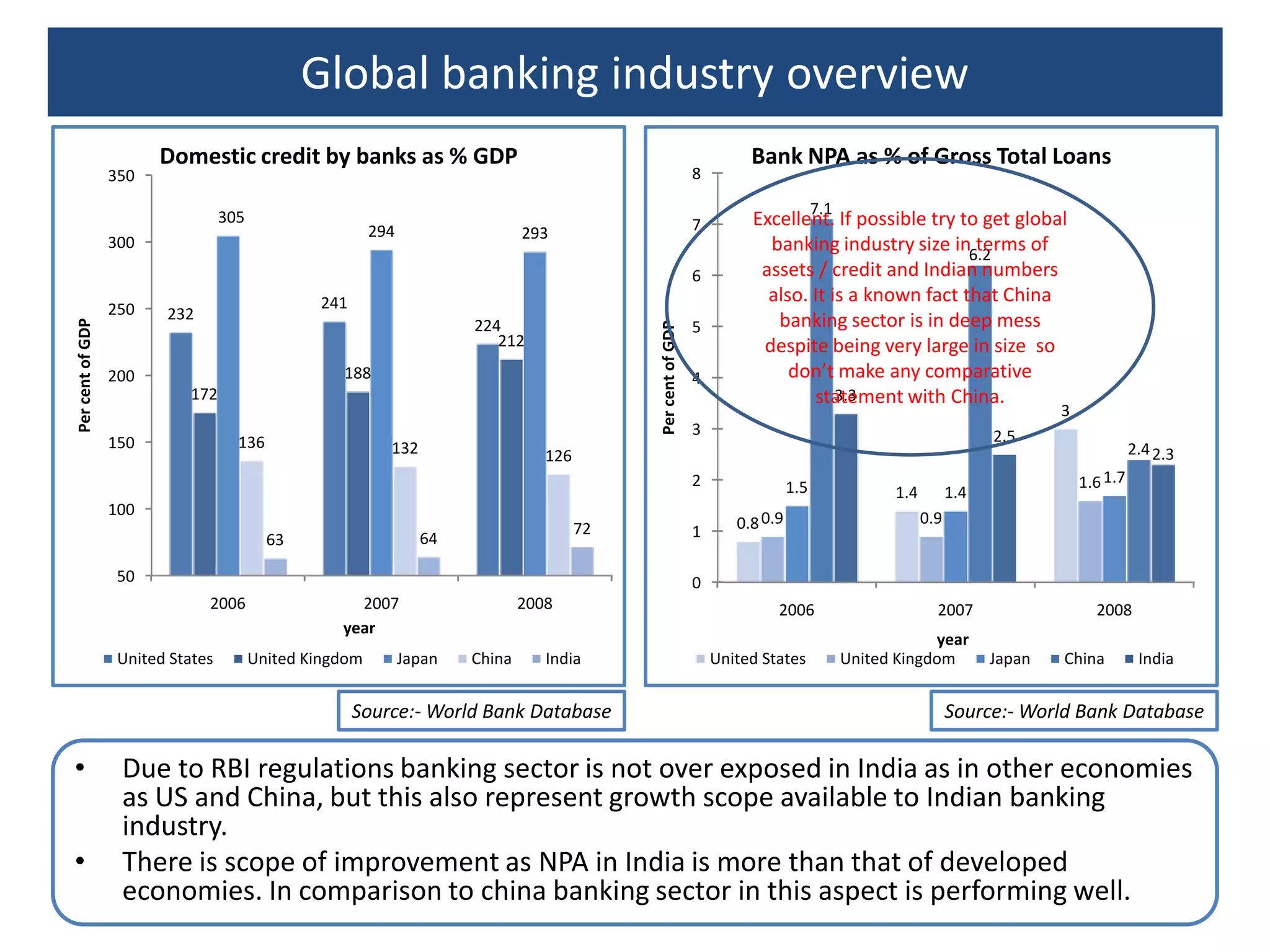
Global banking industry overviewExcellent. If possible try to get global banking industry size in terms of assets / credit and Indian numbers also. It is a known fact that China banking sector is in deep mess despite being very large in size  so don’t make any comparative statement with China.Source:- World Bank DatabaseSource:- World Bank DatabaseDue to RBI regulations banking sector is not over exposed in India as in other economies as US and China, but this also represent growth scope available to Indian banking industry.There is scope of improvement as NPA in India is more than that of developed economies. In comparison to china banking sector in this aspect is performing well.
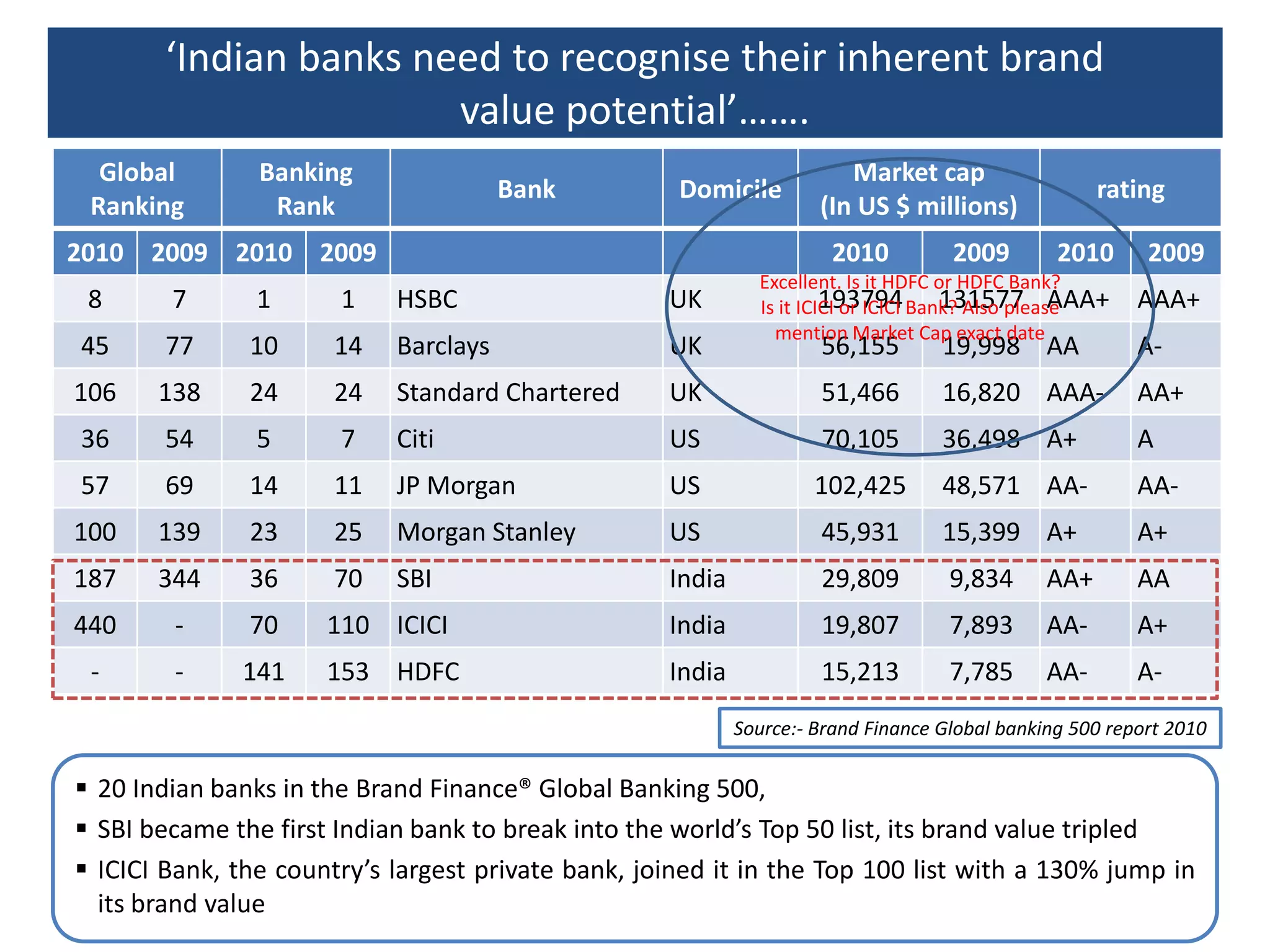
‘Indian banks need to recognise their inherent brandvalue potential’…….Excellent. Is it HDFC or HDFC Bank? Is it ICICI or ICICI Bank? Also please mention Market Cap exact dateSource:- Brand Finance Global banking 500 report 201020 Indian banks in the Brand Finance® Global Banking 500,
SBI became the first Indian bank to break into the world’s Top 50 list, its brand value tripled
ICICI Bank, the country’s largest private bank, joined it in the Top 100 list with a 130% jump in its brand valueIndian Banking overview
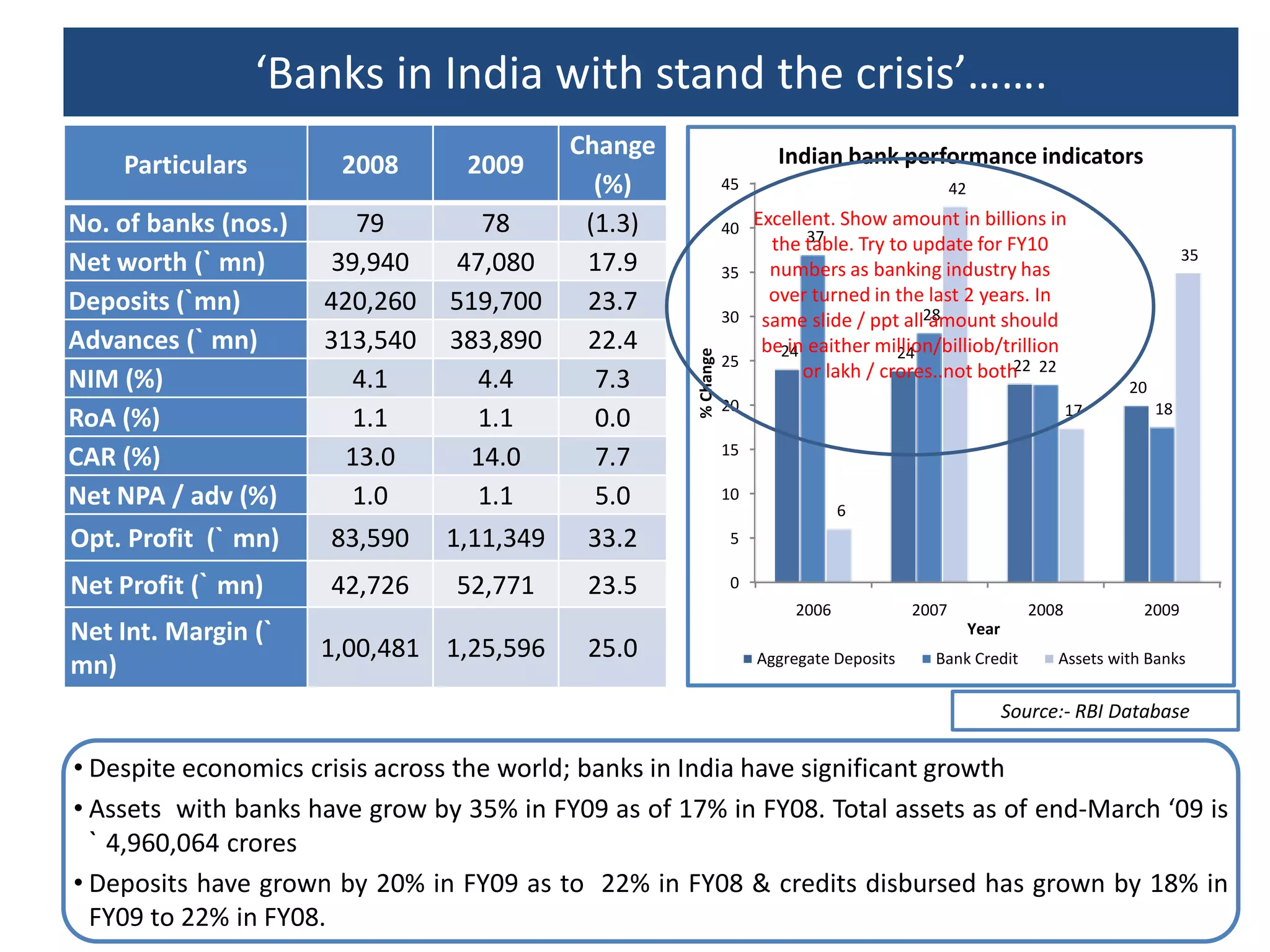
‘Banks in India with stand the crisis’…….Excellent. Show amount in billions in the table. Try to update for FY10 numbers as banking industry has over turned in the last 2 years. In same slide / ppt all amount should be in eaither million/billiob/trillion or lakh / crores..not bothSource:- RBI DatabaseDespite economics crisis across the world; banks in India have significant growthAssets  with banks have grow by 35% in FY09 as of 17% in FY08. Total assets as of end-March ‘09 is  ` 4,960,064 croresDeposits have grown by 20% in FY09 as to  22% in FY08 & credits disbursed has grown by 18% in FY09 to 22% in FY08.
Economic overview
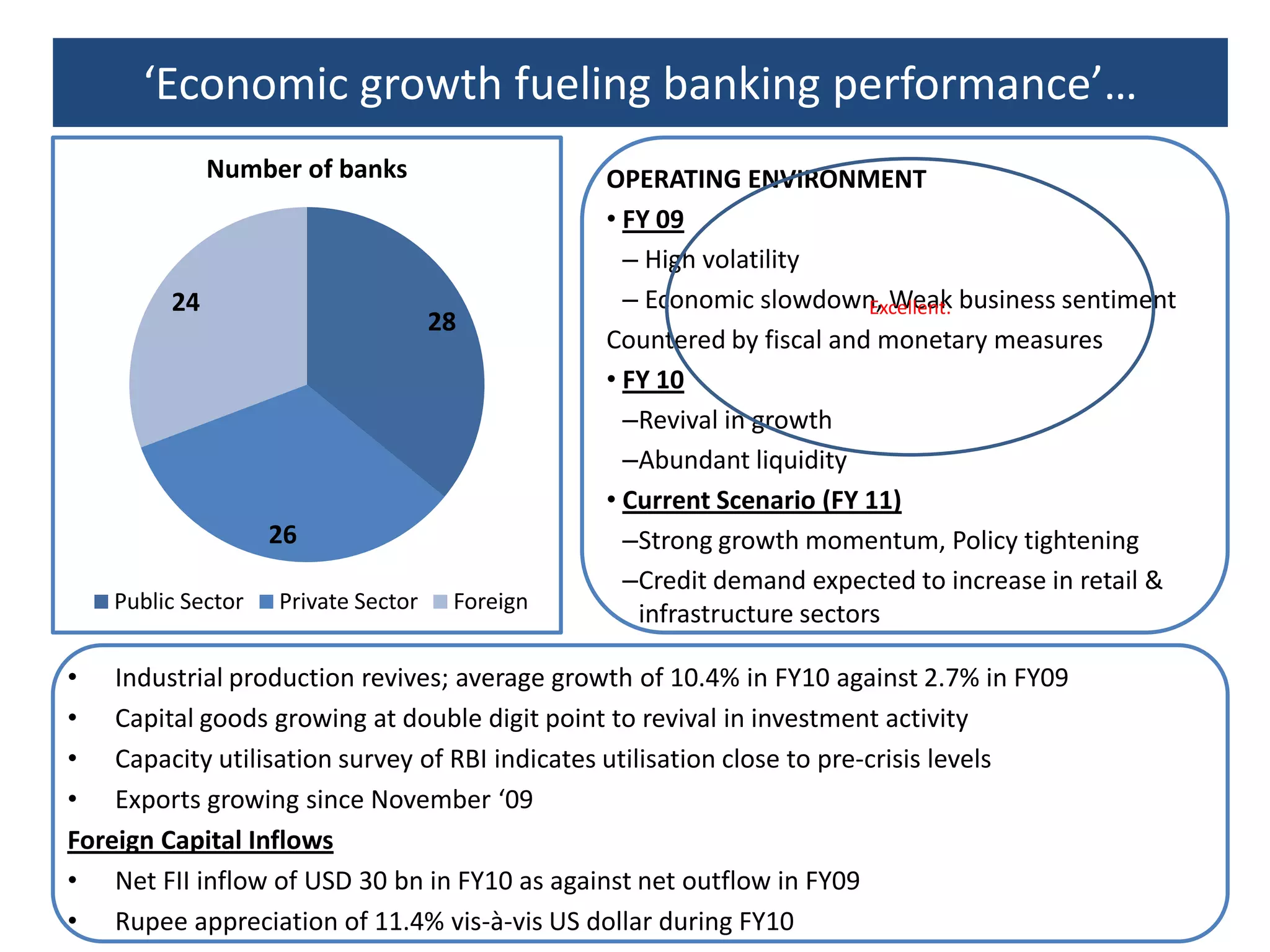
Industrial production revives; average growth of 10.4% in FY10 against 2.7% in FY09Capital goods growing at double digit point to revival in investment activityCapacity utilisation survey of RBI indicates utilisation close to pre-crisis levelsExports growing since November ‘09Foreign Capital InflowsNet FII inflow of USD 30 bn in FY10 as against net outflow in FY09Rupee appreciation of 11.4% vis-à-vis US dollar during FY10‘Economic growth fueling banking performance’…OPERATING ENVIRONMENTFY 09
 High volatility
 Economic slowdown, Weak business sentimentCountered by fiscal and monetary measuresFY 10
Revival in growth
Abundant liquidity
Current Scenario (FY 11)
Strong growth momentum, Policy tightening
Credit demand expected to increase in retail & infrastructure sectorsExcellent.
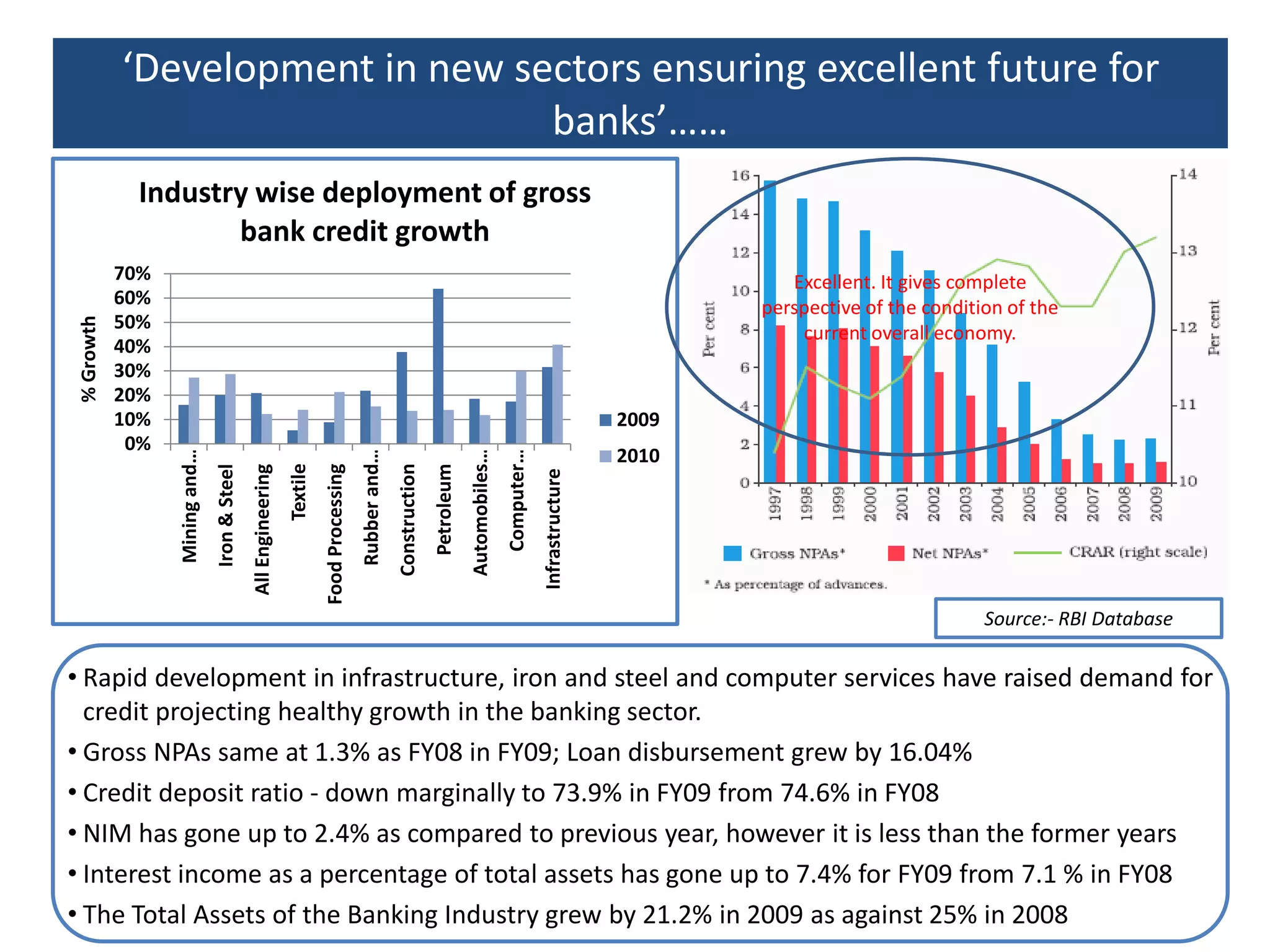
‘Development in new sectors ensuring excellent future for banks’……Excellent. It gives complete perspective of the condition of the current overall economy.Source:- RBI DatabaseRapid development in infrastructure, iron and steel and computer services have raised demand for credit projecting healthy growth in the banking sector.Gross NPAs same at 1.3% as FY08 in FY09; Loan disbursement grew by 16.04%Credit deposit ratio - down marginally to 73.9% in FY09 from 74.6% in FY08NIM has gone up to 2.4% as compared to previous year, however it is less than the former yearsInterest income as a percentage of total assets has gone up to 7.4% for FY09 from 7.1 % in FY08The Total Assets of the Banking Industry grew by 21.2% in 2009 as against 25% in 2008
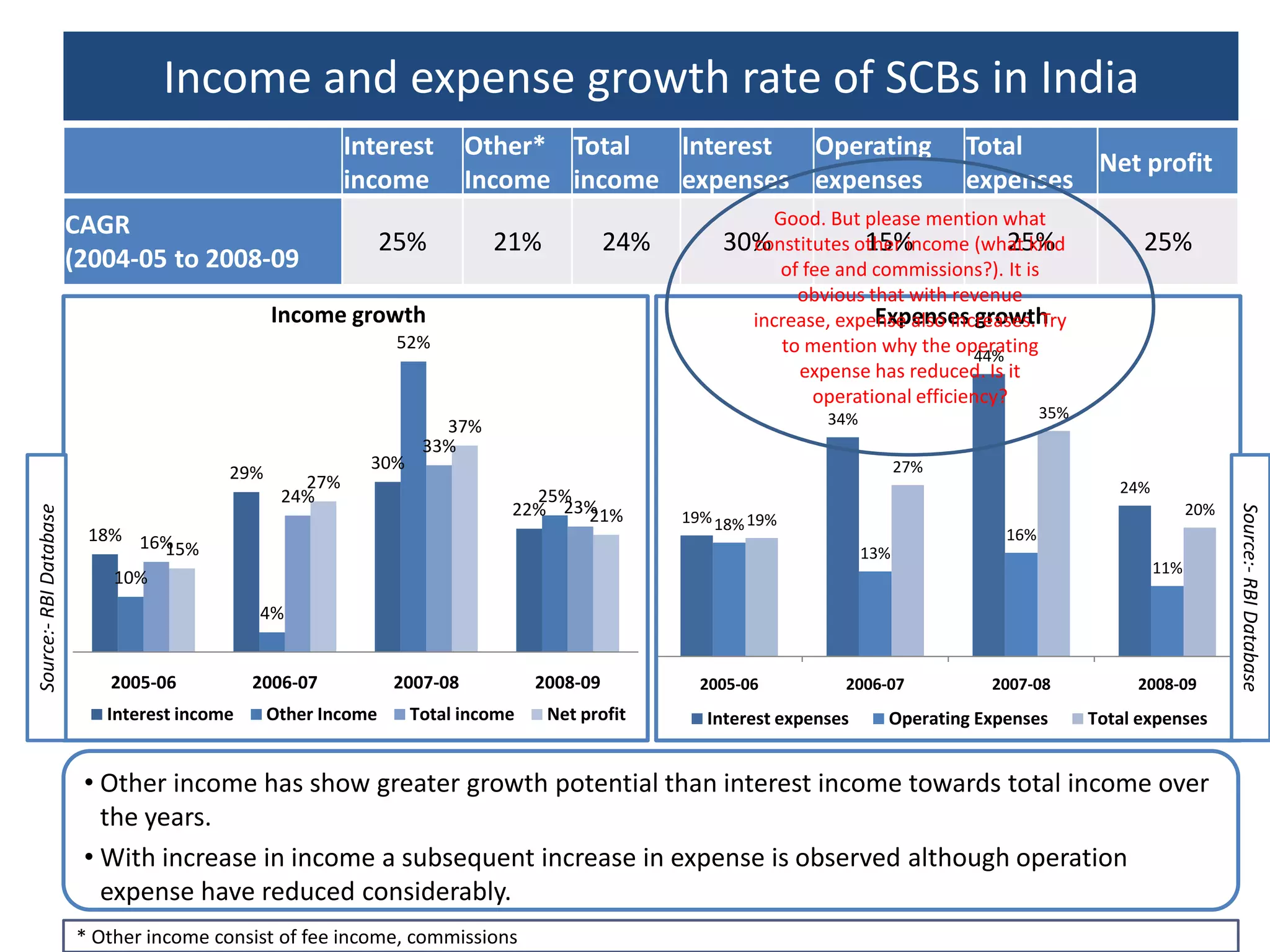
Income and expense growth rate of SCBs in IndiaGood. But please mention what constitutes other income (what kind of fee and commissions?). It is obvious that with revenue increase, expense also increases. Try to mention why the operating expense has reduced. Is it operational efficiency?Source:- RBI DatabaseSource:- RBI DatabaseOther income has show greater growth potential than interest income towards total income over the years.With increase in income a subsequent increase in expense is observed although operation expense have reduced considerably.* Other income consist of fee income, commissions
Banking Segmention
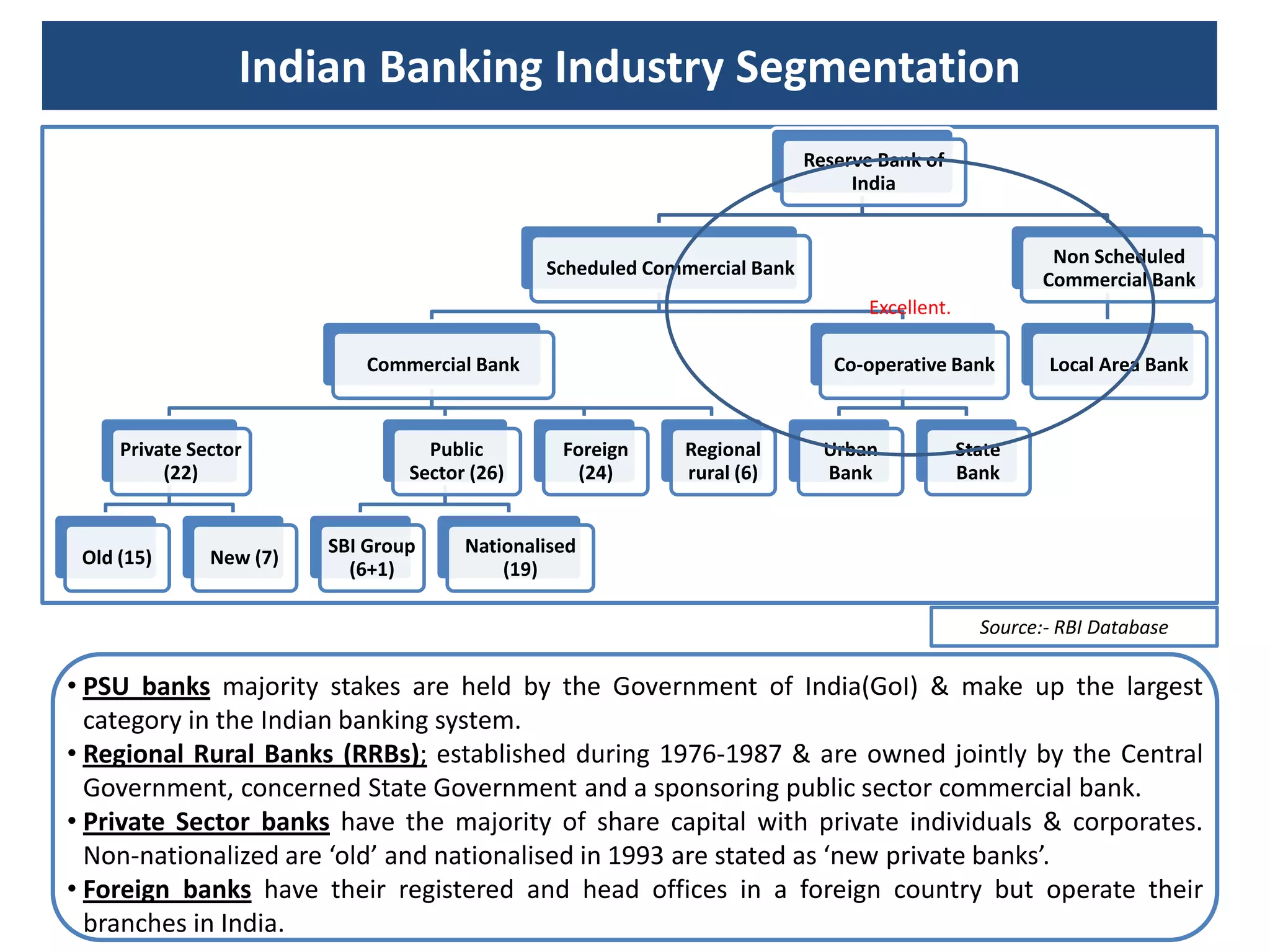
Indian Banking Industry SegmentationExcellent. Source:- RBI DatabasePSU banks majority stakes are held by the Government of India(GoI) & make up the largest category in the Indian banking system.
Regional Rural Banks (RRBs); established during 1976-1987 & are owned jointly by the Central Government, concerned State Government and a sponsoring public sector commercial bank.
Private Sector banks have the majority of share capital with private individuals & corporates.  Non-nationalized are ‘old’ and nationalised in 1993 are stated as ‘new private banks’.
Foreign banks have their registered and head offices in a foreign country but operate their branches in India.Growth Drivers
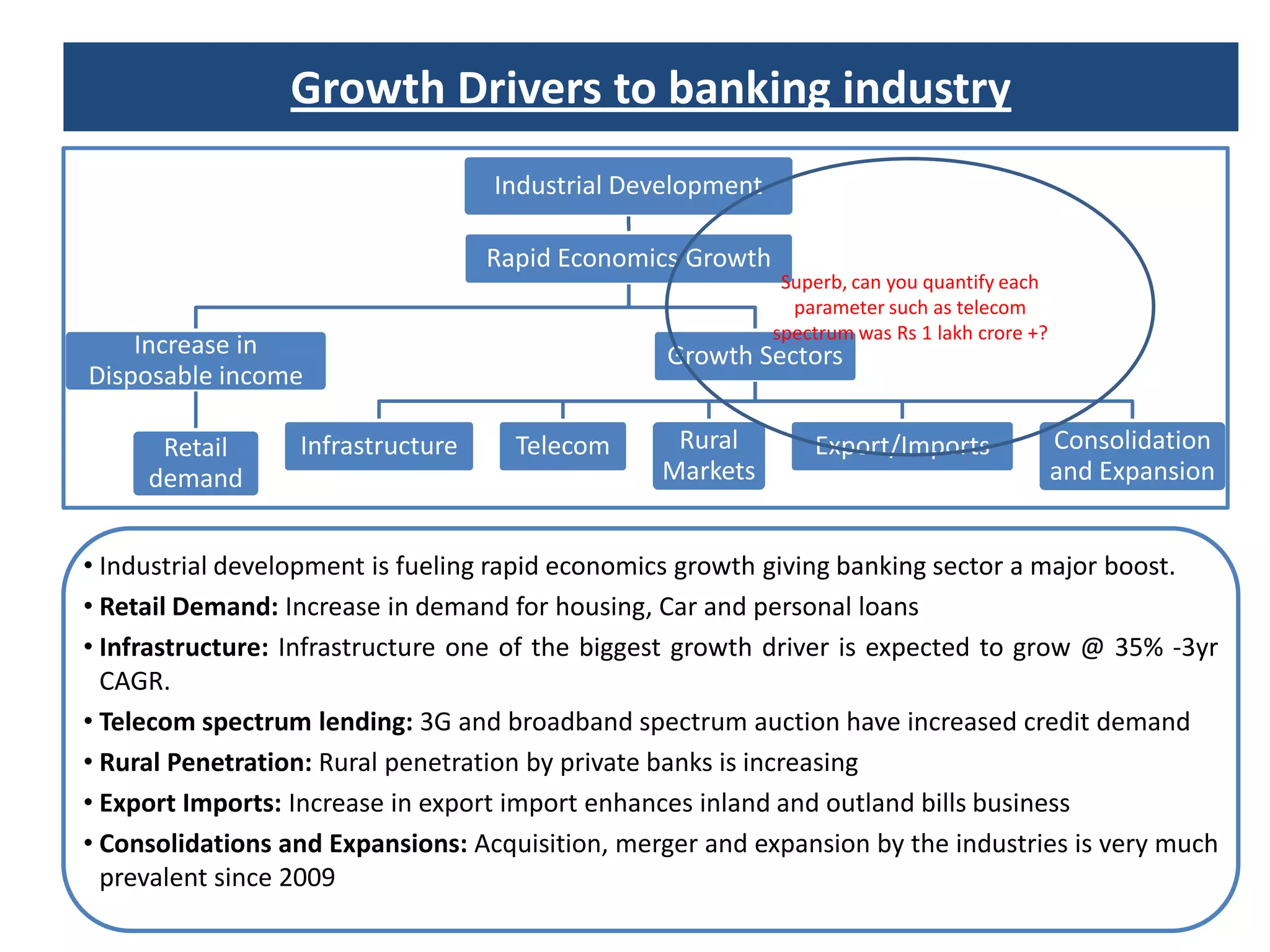
Growth Drivers to banking industrySuperb, can you quantify each parameter such as telecom spectrum was Rs 1 lakhcrore +?Industrial development is fueling rapid economics growth giving banking sector a major boost.Retail Demand: Increase in demand for housing, Car and personal loansInfrastructure: Infrastructure one of the biggest growth driver is expected to grow @ 35% -3yrCAGR.Telecom spectrum lending: 3G and broadband spectrum auction have increased credit demandRural Penetration: Rural penetration by private banks is increasingExport Imports: Increase in export import enhances inland and outland bills businessConsolidations and Expansions: Acquisition, merger and expansion by the industries is very much prevalent since 2009
Competitive Landscape
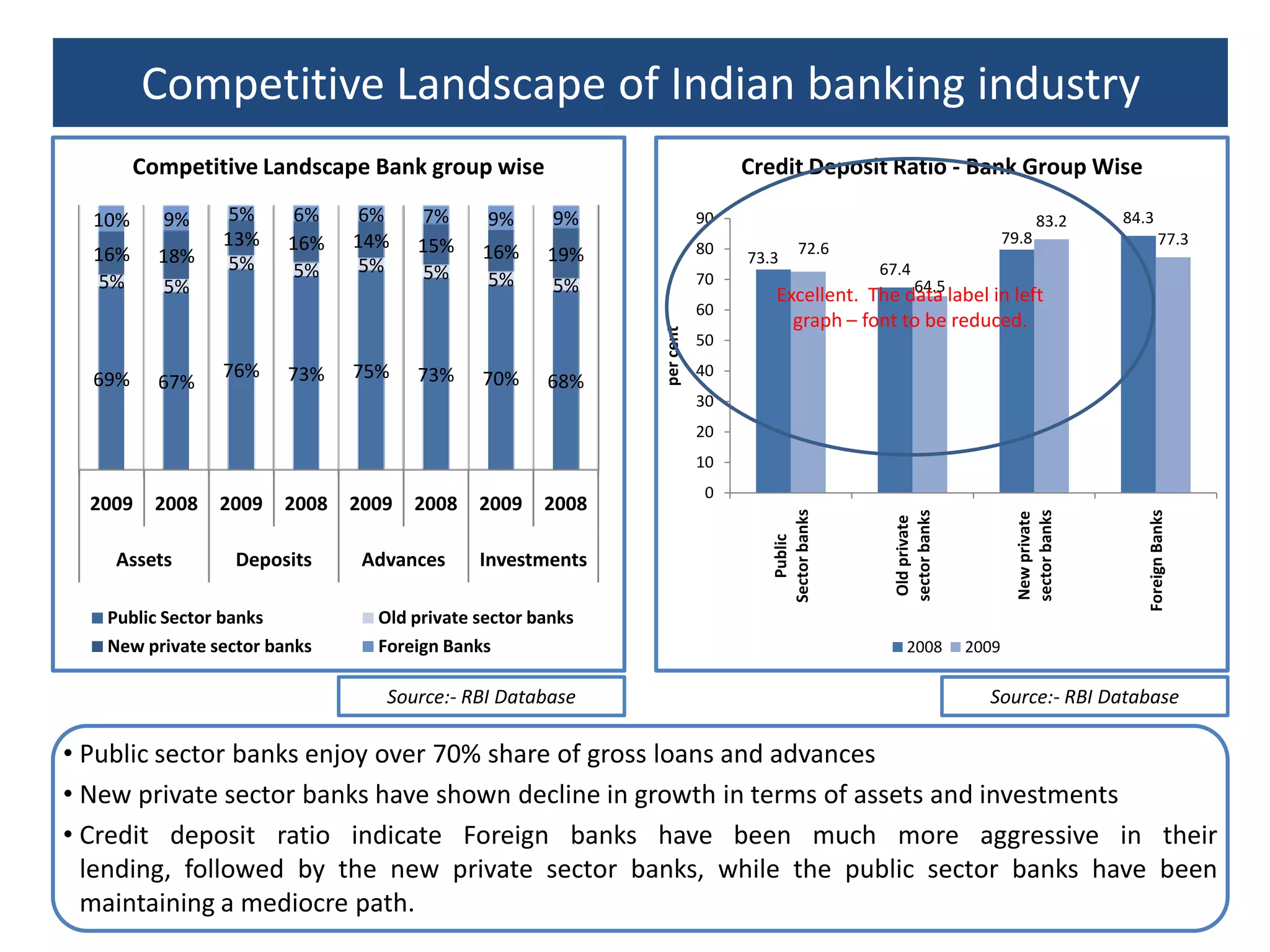
Competitive Landscape of Indian banking industryExcellent.  The data label in left graph – font to be reduced.Source:- RBI DatabaseSource:- RBI DatabasePublic sector banks enjoy over 70% share of gross loans and advancesNew private sector banks have shown decline in growth in terms of assets and investmentsCredit deposit ratio indicate Foreign banks have been much more aggressive in their lending, followed by the new private sector banks, while the public sector banks have been maintaining a mediocre path.
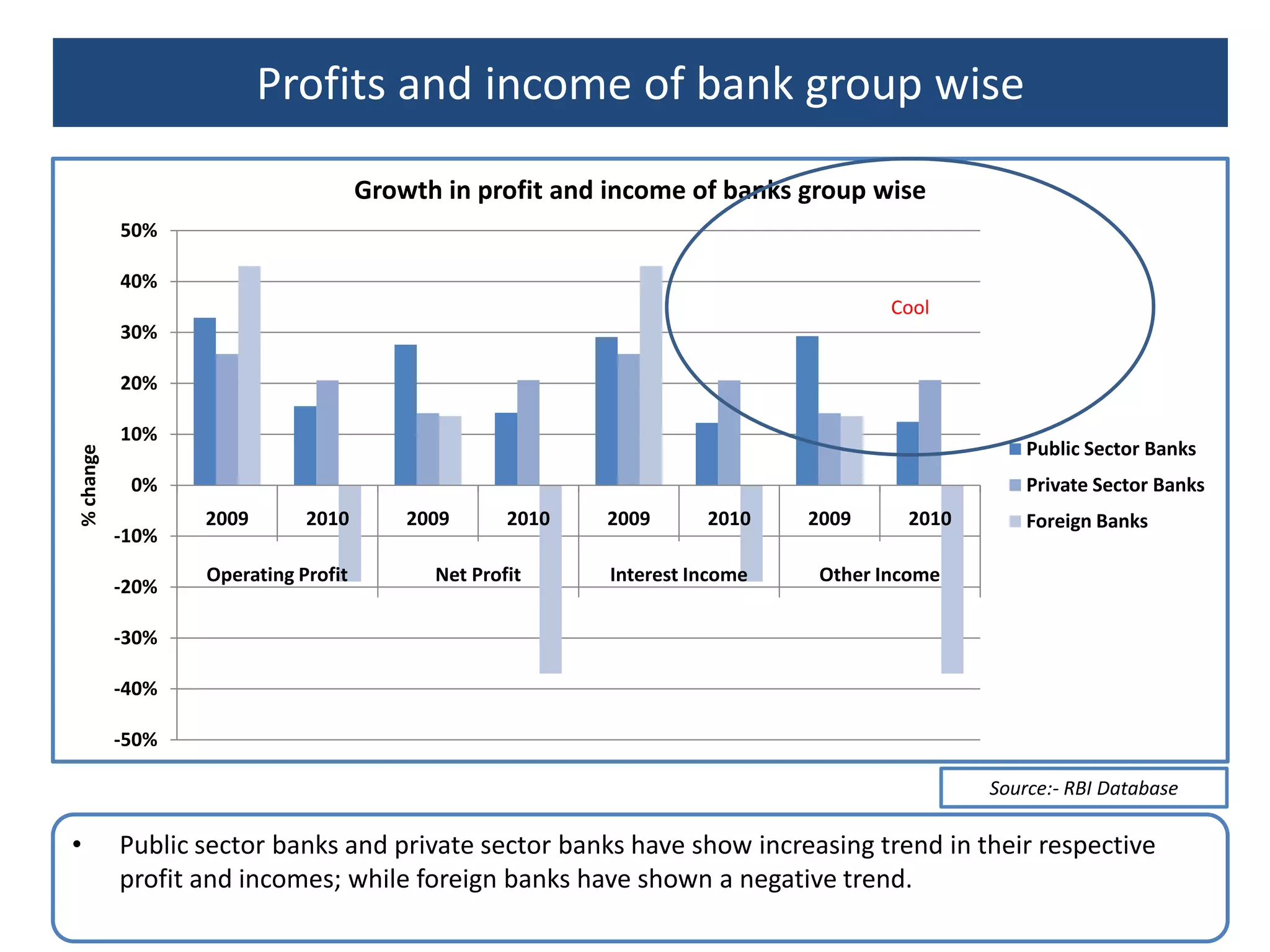
Public sector banks and private sector banks have show increasing trend in their respective profit and incomes; while foreign banks have shown a negative trend.Profits and income of bank group wiseCoolSource:- RBI Database
Banking Regulation
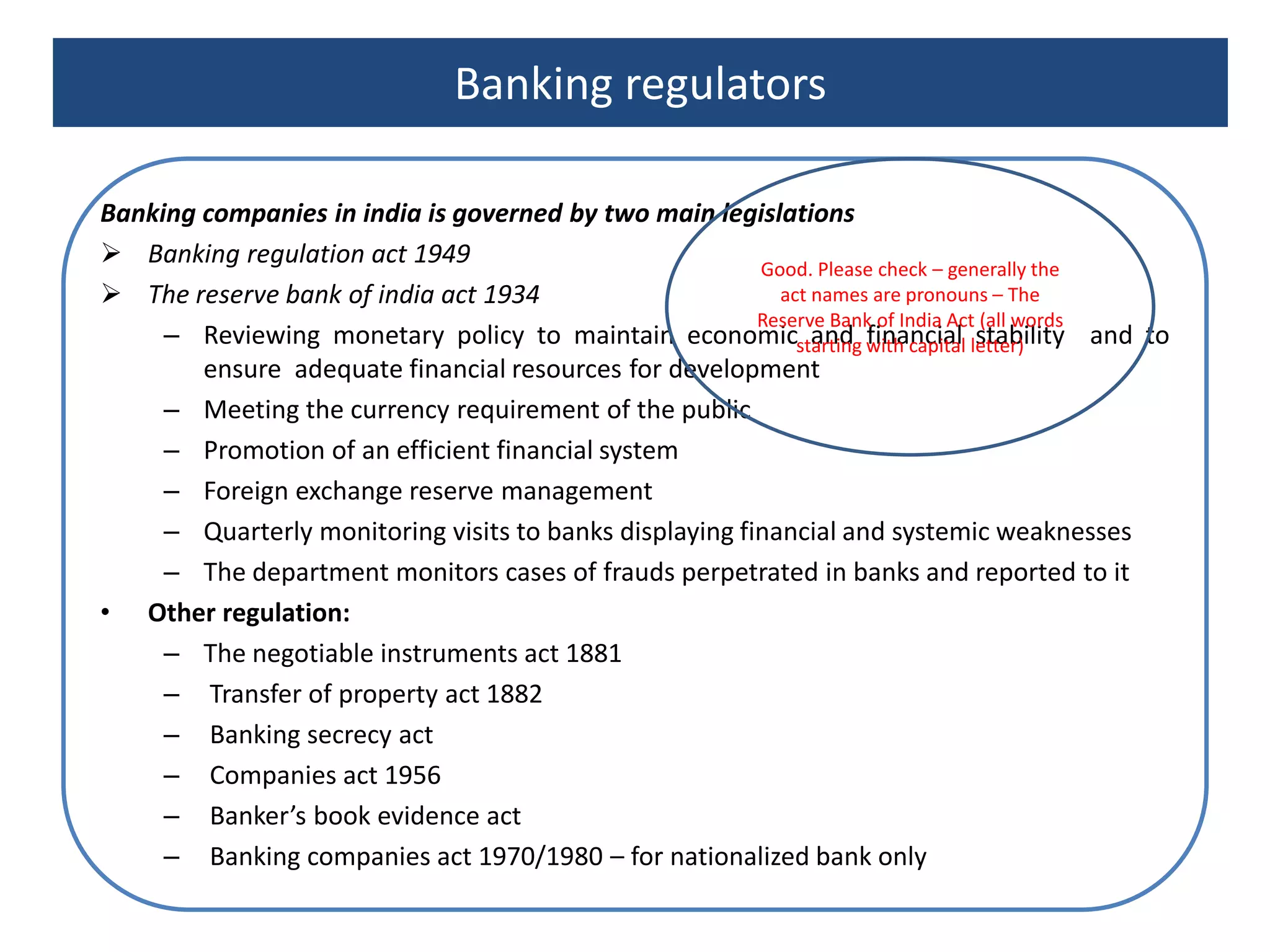
Banking regulatorsBanking companies in india is governed by two main legislations Banking regulation act 1949
The reserve bank of india act 1934Reviewing monetary policy to maintain economic and financial stability  and to ensure  adequate financial resources for developmentMeeting the currency requirement of the publicPromotion of an efficient financial systemForeign exchange reserve managementQuarterly monitoring visits to banks displaying financial and systemic weaknessesThe department monitors cases of frauds perpetrated in banks and reported to itOther regulation:The negotiable instruments act 1881 Transfer of property act 1882 Banking secrecy act Companies act 1956 Banker’s book evidence act Banking companies act 1970/1980 – for nationalized bank onlyGood. Please check – generally the act names are pronouns – The Reserve Bank of India Act (all words starting with capital letter)
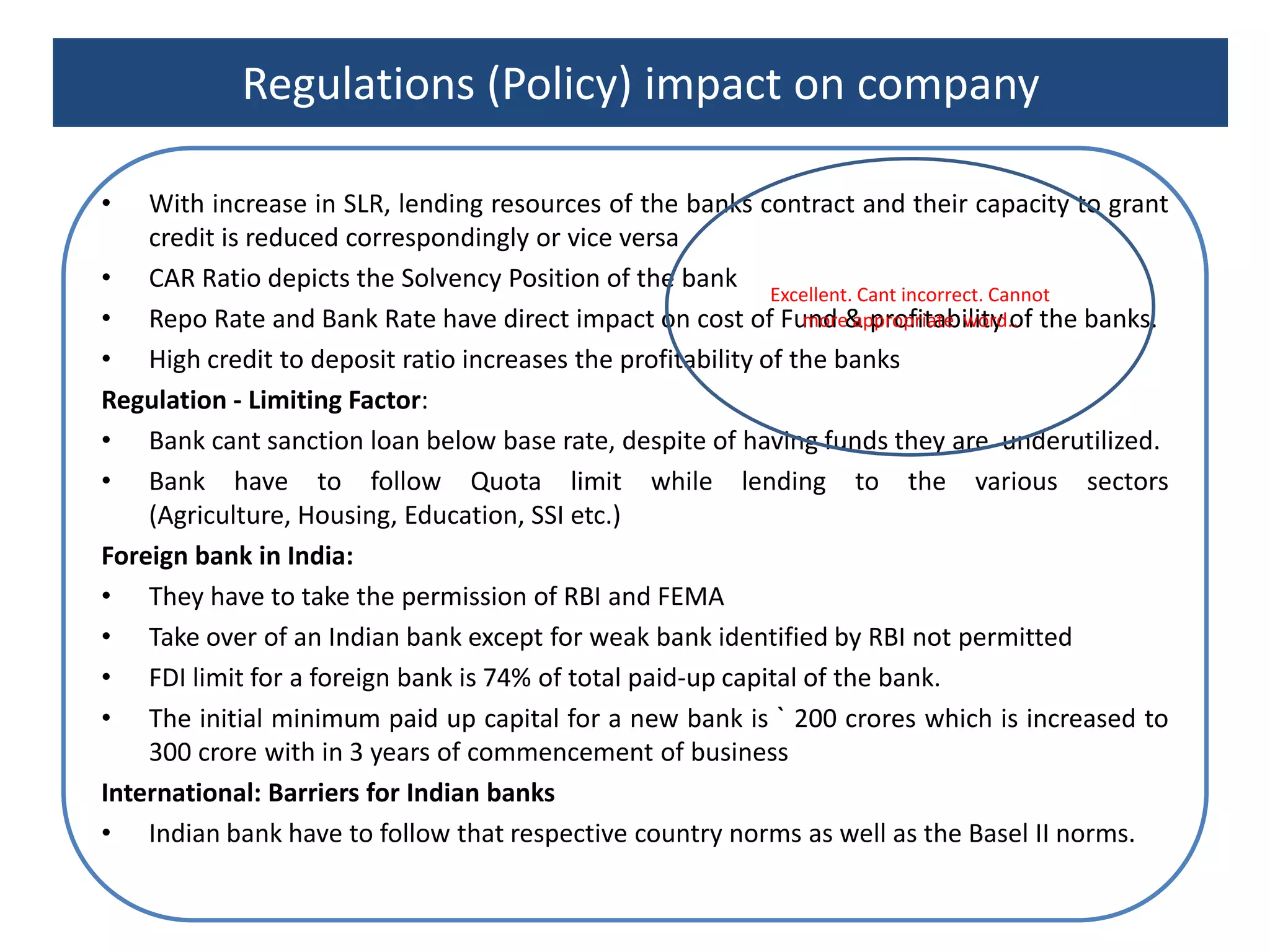
Regulations (Policy) impact on company With increase in SLR, lending resources of the banks contract and their capacity to grant credit is reduced correspondingly or vice versaCAR Ratio depicts the Solvency Position of the bankRepo Rate and Bank Rate have direct impact on cost of Fund & profitability of the banks.High credit to deposit ratio increases the profitability of the banksRegulation - Limiting Factor:Bank cant sanction loan below base rate, despite of having funds they are  underutilized.Bank have to follow Quota limit while lending to the various sectors (Agriculture, Housing, Education, SSI etc.) Foreign bank in India:They have to take the permission of RBI and FEMATake over of an Indian bank except for weak bank identified by RBI not permittedFDI limit for a foreign bank is 74% of total paid-up capital of the bank.The initial minimum paid up capital for a new bank is ` 200 crores which is increased to 300 crore with in 3 years of commencement of businessInternational: Barriers for Indian banksIndian bank have to follow that respective country norms as well as the Basel II norms.Excellent. Cant incorrect. Cannot more appropriate  word..
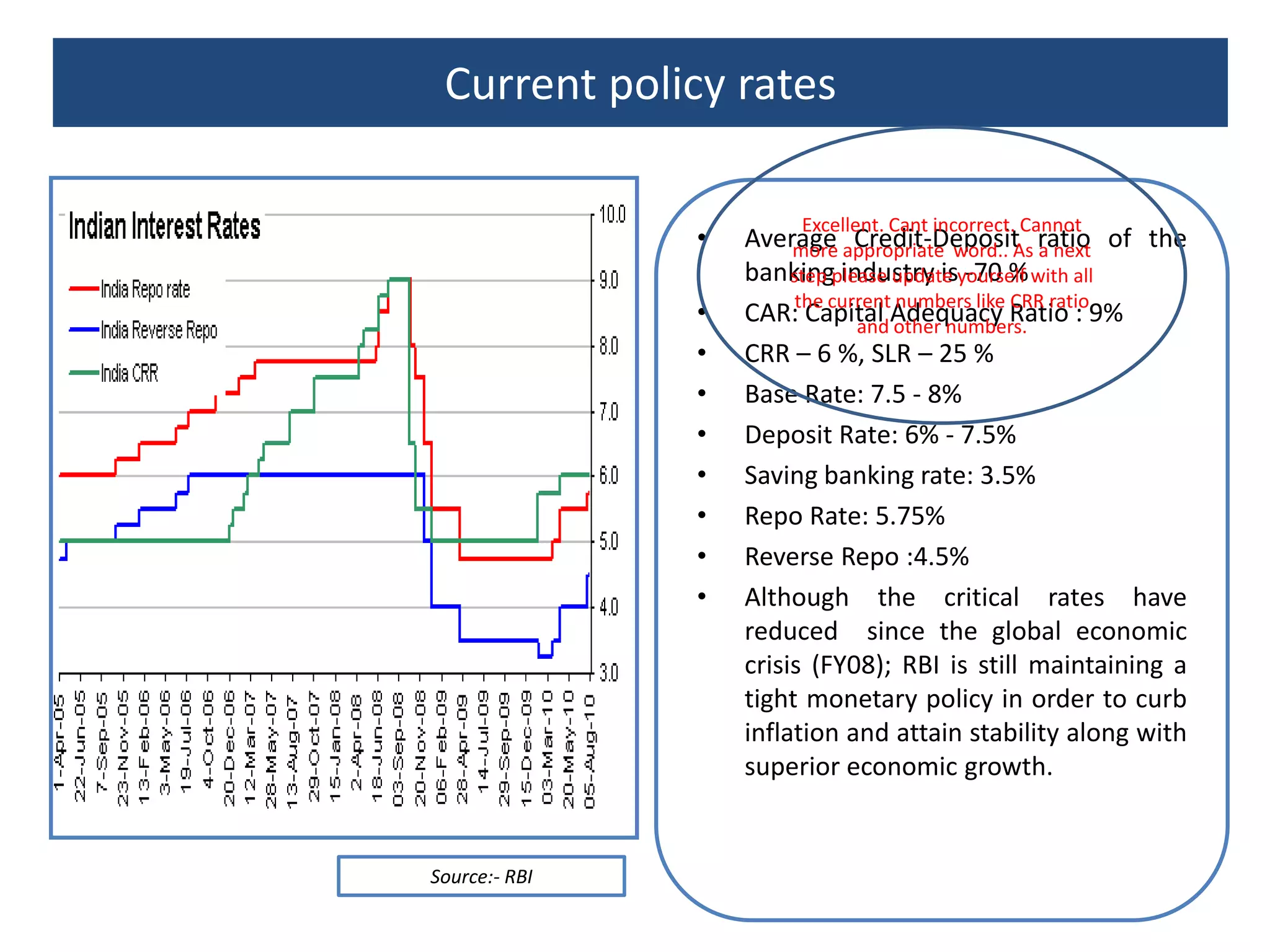
Average Credit-Deposit ratio of the banking industry is -70 %CAR: Capital Adequacy Ratio : 9%CRR – 6 %, SLR – 25 %Base Rate: 7.5 - 8%Deposit Rate: 6% - 7.5%Saving banking rate: 3.5%Repo Rate: 5.75%Reverse Repo :4.5%Although the critical rates have reduced  since the global economic crisis (FY08); RBI is still maintaining a tight monetary policy in order to curb inflation and attain stability along with superior economic growth.Current policy ratesExcellent. Cant incorrect. Cannot more appropriate  word.. As a next step please update yourself with all the current numbers like CRR ratio and other numbers.Source:- RBI
AgendaSection IBanking industry overviewGlobal banking industry overview Indian banking industry overviewIndian Banks SegmentationGrowth Drivers and Challenges Competitive LandscapeSection IIICICI bank profileCompany business description  and segmentationCompany history and milestonesCompany detailsCompany peer group  comparisonCompany financials and trends
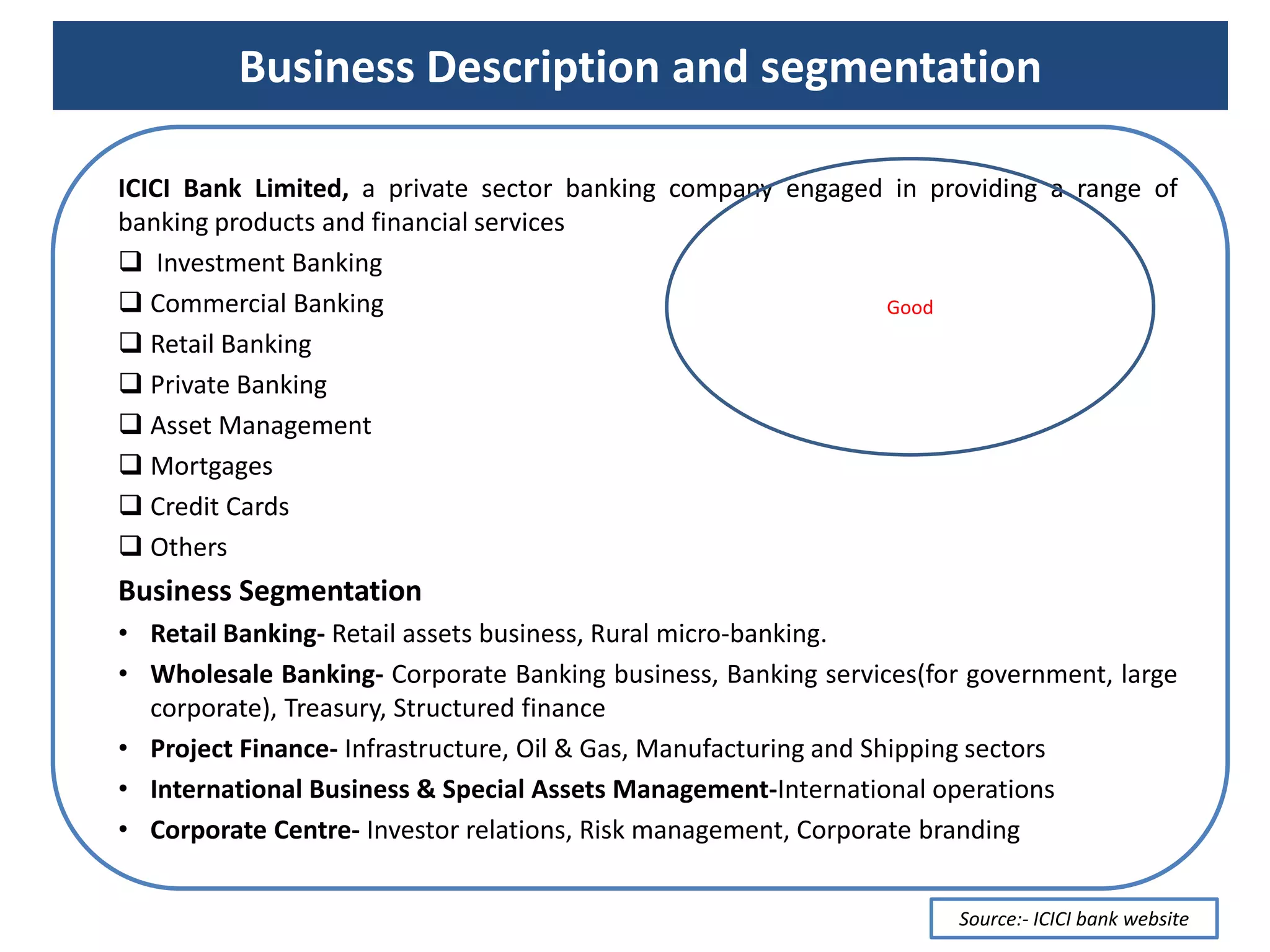
Business Description and segmentationICICI Bank Limited, a private sector banking company engaged in providing a range of banking products and financial services  Investment Banking
Commercial Banking
Retail Banking
Private Banking
Asset Management
Mortgages
Credit Cards
OthersBusiness SegmentationRetail Banking- Retail assets business, Rural micro-banking.Wholesale Banking- Corporate Banking business, Banking services(for government, large corporate), Treasury, Structured financeProject Finance- Infrastructure, Oil & Gas, Manufacturing and Shipping sectorsInternational Business & Special Assets Management-International operationsCorporate Centre- Investor relations, Risk management, Corporate brandingGoodSource:- ICICI bank website
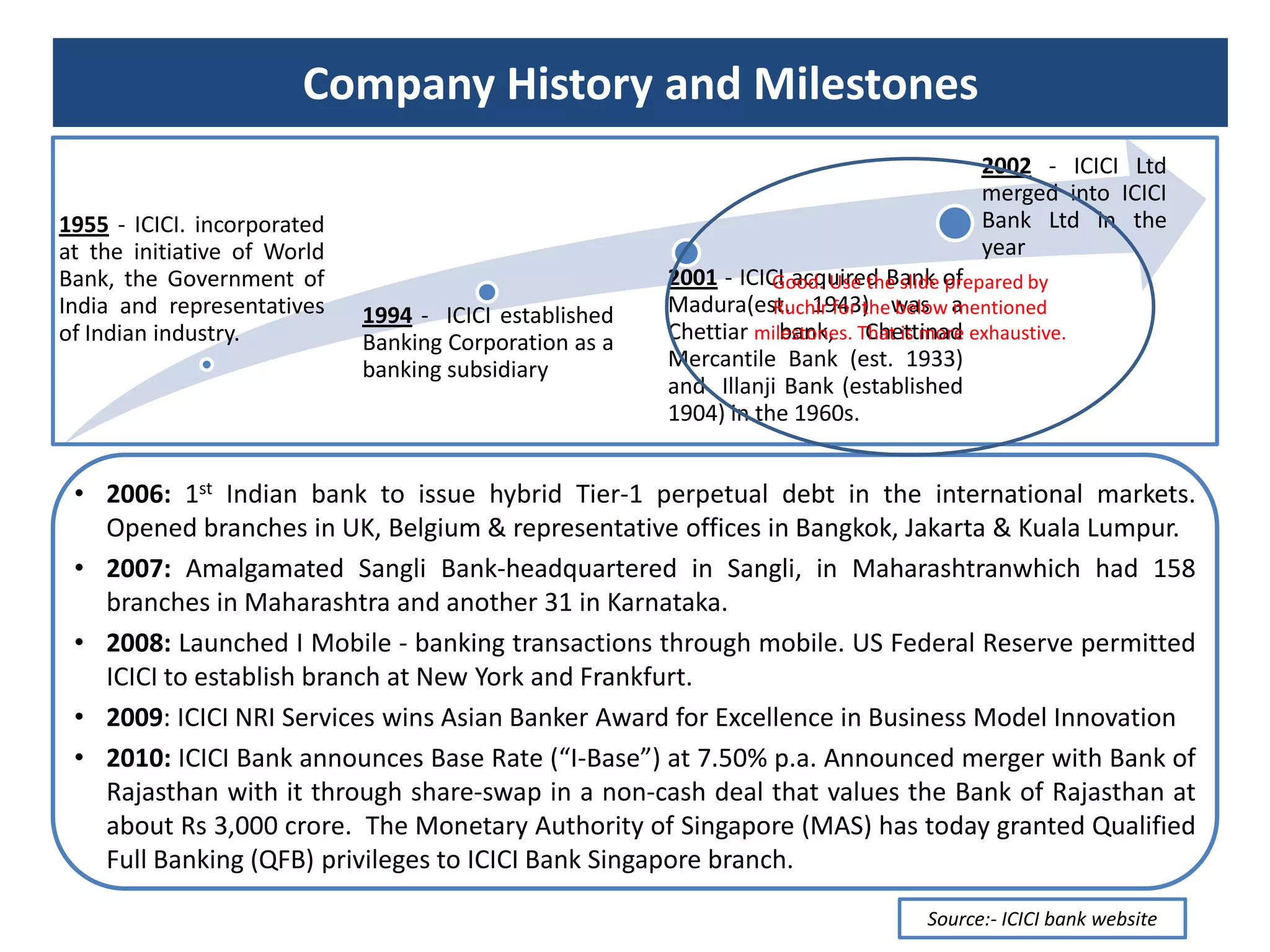
Company History and MilestonesGood. Use the slide prepared by Ruchir for the below mentioned milestones. That is more exhaustive.2006: 1st Indian bank to issue hybrid Tier-1 perpetual debt in the international markets. Opened branches in UK, Belgium & representative offices in Bangkok, Jakarta & Kuala Lumpur.2007: Amalgamated Sangli Bank-headquartered in Sangli, in Maharashtranwhich had 158 branches in Maharashtra and another 31 in Karnataka.2008: Launched I Mobile - banking transactions through mobile. US Federal Reserve permitted ICICI to establish branch at New York and Frankfurt.2009: ICICI NRI Services wins Asian Banker Award for Excellence in Business Model Innovation2010: ICICI Bank announces Base Rate (“I-Base”) at 7.50% p.a. Announced merger with Bank of Rajasthan with it through share-swap in a non-cash deal that values the Bank of Rajasthan at about Rs 3,000 crore.  The Monetary Authority of Singapore (MAS) has today granted Qualified Full Banking (QFB) privileges to ICICI Bank Singapore branch.Source:- ICICI bank website

I C I C I Bank - Presentation

  • 1.
    Indian Banking IndustryAnanalysisInstitute for Technology and Management, KhargharAugust 2010
  • 2.
    AgendaSection IBanking industryoverviewGlobal banking industry overview Indian banking industry overviewIndian Banks SegmentationGrowth Drivers and Challenges Competitive LandscapeBanking regulationSection IIICICI bank profileCompany business description and segmentationCompany history and detailsCompany milestonesCompany financials and trends
  • 3.
    Section I: BankingIndustry overviewGlobal Banking overview
  • 4.
    Global banking industryoverviewExcellent. If possible try to get global banking industry size in terms of assets / credit and Indian numbers also. It is a known fact that China banking sector is in deep mess despite being very large in size so don’t make any comparative statement with China.Source:- World Bank DatabaseSource:- World Bank DatabaseDue to RBI regulations banking sector is not over exposed in India as in other economies as US and China, but this also represent growth scope available to Indian banking industry.There is scope of improvement as NPA in India is more than that of developed economies. In comparison to china banking sector in this aspect is performing well.
  • 5.
    ‘Indian banks needto recognise their inherent brandvalue potential’…….Excellent. Is it HDFC or HDFC Bank? Is it ICICI or ICICI Bank? Also please mention Market Cap exact dateSource:- Brand Finance Global banking 500 report 201020 Indian banks in the Brand Finance® Global Banking 500,
  • 6.
    SBI became thefirst Indian bank to break into the world’s Top 50 list, its brand value tripled
  • 7.
    ICICI Bank, thecountry’s largest private bank, joined it in the Top 100 list with a 130% jump in its brand valueIndian Banking overview
  • 8.
    ‘Banks in Indiawith stand the crisis’…….Excellent. Show amount in billions in the table. Try to update for FY10 numbers as banking industry has over turned in the last 2 years. In same slide / ppt all amount should be in eaither million/billiob/trillion or lakh / crores..not bothSource:- RBI DatabaseDespite economics crisis across the world; banks in India have significant growthAssets with banks have grow by 35% in FY09 as of 17% in FY08. Total assets as of end-March ‘09 is ` 4,960,064 croresDeposits have grown by 20% in FY09 as to 22% in FY08 & credits disbursed has grown by 18% in FY09 to 22% in FY08.
  • 9.
  • 10.
    Industrial production revives;average growth of 10.4% in FY10 against 2.7% in FY09Capital goods growing at double digit point to revival in investment activityCapacity utilisation survey of RBI indicates utilisation close to pre-crisis levelsExports growing since November ‘09Foreign Capital InflowsNet FII inflow of USD 30 bn in FY10 as against net outflow in FY09Rupee appreciation of 11.4% vis-à-vis US dollar during FY10‘Economic growth fueling banking performance’…OPERATING ENVIRONMENTFY 09
  • 11.
  • 12.
    Economic slowdown,Weak business sentimentCountered by fiscal and monetary measuresFY 10
  • 13.
  • 14.
  • 15.
  • 16.
    Strong growth momentum,Policy tightening
  • 17.
    Credit demand expectedto increase in retail & infrastructure sectorsExcellent.
  • 18.
    ‘Development in newsectors ensuring excellent future for banks’……Excellent. It gives complete perspective of the condition of the current overall economy.Source:- RBI DatabaseRapid development in infrastructure, iron and steel and computer services have raised demand for credit projecting healthy growth in the banking sector.Gross NPAs same at 1.3% as FY08 in FY09; Loan disbursement grew by 16.04%Credit deposit ratio - down marginally to 73.9% in FY09 from 74.6% in FY08NIM has gone up to 2.4% as compared to previous year, however it is less than the former yearsInterest income as a percentage of total assets has gone up to 7.4% for FY09 from 7.1 % in FY08The Total Assets of the Banking Industry grew by 21.2% in 2009 as against 25% in 2008
  • 19.
    Income and expensegrowth rate of SCBs in IndiaGood. But please mention what constitutes other income (what kind of fee and commissions?). It is obvious that with revenue increase, expense also increases. Try to mention why the operating expense has reduced. Is it operational efficiency?Source:- RBI DatabaseSource:- RBI DatabaseOther income has show greater growth potential than interest income towards total income over the years.With increase in income a subsequent increase in expense is observed although operation expense have reduced considerably.* Other income consist of fee income, commissions
  • 20.
  • 21.
    Indian Banking IndustrySegmentationExcellent. Source:- RBI DatabasePSU banks majority stakes are held by the Government of India(GoI) & make up the largest category in the Indian banking system.
  • 22.
    Regional Rural Banks(RRBs); established during 1976-1987 & are owned jointly by the Central Government, concerned State Government and a sponsoring public sector commercial bank.
  • 23.
    Private Sector bankshave the majority of share capital with private individuals & corporates. Non-nationalized are ‘old’ and nationalised in 1993 are stated as ‘new private banks’.
  • 24.
    Foreign banks havetheir registered and head offices in a foreign country but operate their branches in India.Growth Drivers
  • 25.
    Growth Drivers tobanking industrySuperb, can you quantify each parameter such as telecom spectrum was Rs 1 lakhcrore +?Industrial development is fueling rapid economics growth giving banking sector a major boost.Retail Demand: Increase in demand for housing, Car and personal loansInfrastructure: Infrastructure one of the biggest growth driver is expected to grow @ 35% -3yrCAGR.Telecom spectrum lending: 3G and broadband spectrum auction have increased credit demandRural Penetration: Rural penetration by private banks is increasingExport Imports: Increase in export import enhances inland and outland bills businessConsolidations and Expansions: Acquisition, merger and expansion by the industries is very much prevalent since 2009
  • 26.
  • 27.
    Competitive Landscape ofIndian banking industryExcellent. The data label in left graph – font to be reduced.Source:- RBI DatabaseSource:- RBI DatabasePublic sector banks enjoy over 70% share of gross loans and advancesNew private sector banks have shown decline in growth in terms of assets and investmentsCredit deposit ratio indicate Foreign banks have been much more aggressive in their lending, followed by the new private sector banks, while the public sector banks have been maintaining a mediocre path.
  • 28.
    Public sector banksand private sector banks have show increasing trend in their respective profit and incomes; while foreign banks have shown a negative trend.Profits and income of bank group wiseCoolSource:- RBI Database
  • 29.
  • 30.
    Banking regulatorsBanking companiesin india is governed by two main legislations Banking regulation act 1949
  • 31.
    The reserve bankof india act 1934Reviewing monetary policy to maintain economic and financial stability and to ensure adequate financial resources for developmentMeeting the currency requirement of the publicPromotion of an efficient financial systemForeign exchange reserve managementQuarterly monitoring visits to banks displaying financial and systemic weaknessesThe department monitors cases of frauds perpetrated in banks and reported to itOther regulation:The negotiable instruments act 1881 Transfer of property act 1882 Banking secrecy act Companies act 1956 Banker’s book evidence act Banking companies act 1970/1980 – for nationalized bank onlyGood. Please check – generally the act names are pronouns – The Reserve Bank of India Act (all words starting with capital letter)
  • 32.
    Regulations (Policy) impacton company With increase in SLR, lending resources of the banks contract and their capacity to grant credit is reduced correspondingly or vice versaCAR Ratio depicts the Solvency Position of the bankRepo Rate and Bank Rate have direct impact on cost of Fund & profitability of the banks.High credit to deposit ratio increases the profitability of the banksRegulation - Limiting Factor:Bank cant sanction loan below base rate, despite of having funds they are underutilized.Bank have to follow Quota limit while lending to the various sectors (Agriculture, Housing, Education, SSI etc.) Foreign bank in India:They have to take the permission of RBI and FEMATake over of an Indian bank except for weak bank identified by RBI not permittedFDI limit for a foreign bank is 74% of total paid-up capital of the bank.The initial minimum paid up capital for a new bank is ` 200 crores which is increased to 300 crore with in 3 years of commencement of businessInternational: Barriers for Indian banksIndian bank have to follow that respective country norms as well as the Basel II norms.Excellent. Cant incorrect. Cannot more appropriate word..
  • 33.
    Average Credit-Deposit ratioof the banking industry is -70 %CAR: Capital Adequacy Ratio : 9%CRR – 6 %, SLR – 25 %Base Rate: 7.5 - 8%Deposit Rate: 6% - 7.5%Saving banking rate: 3.5%Repo Rate: 5.75%Reverse Repo :4.5%Although the critical rates have reduced since the global economic crisis (FY08); RBI is still maintaining a tight monetary policy in order to curb inflation and attain stability along with superior economic growth.Current policy ratesExcellent. Cant incorrect. Cannot more appropriate word.. As a next step please update yourself with all the current numbers like CRR ratio and other numbers.Source:- RBI
  • 34.
    AgendaSection IBanking industryoverviewGlobal banking industry overview Indian banking industry overviewIndian Banks SegmentationGrowth Drivers and Challenges Competitive LandscapeSection IIICICI bank profileCompany business description and segmentationCompany history and milestonesCompany detailsCompany peer group comparisonCompany financials and trends
  • 35.
    Business Description andsegmentationICICI Bank Limited, a private sector banking company engaged in providing a range of banking products and financial services Investment Banking
  • 36.
  • 37.
  • 38.
  • 39.
  • 40.
  • 41.
  • 42.
    OthersBusiness SegmentationRetail Banking-Retail assets business, Rural micro-banking.Wholesale Banking- Corporate Banking business, Banking services(for government, large corporate), Treasury, Structured financeProject Finance- Infrastructure, Oil & Gas, Manufacturing and Shipping sectorsInternational Business & Special Assets Management-International operationsCorporate Centre- Investor relations, Risk management, Corporate brandingGoodSource:- ICICI bank website
  • 43.
    Company History andMilestonesGood. Use the slide prepared by Ruchir for the below mentioned milestones. That is more exhaustive.2006: 1st Indian bank to issue hybrid Tier-1 perpetual debt in the international markets. Opened branches in UK, Belgium & representative offices in Bangkok, Jakarta & Kuala Lumpur.2007: Amalgamated Sangli Bank-headquartered in Sangli, in Maharashtranwhich had 158 branches in Maharashtra and another 31 in Karnataka.2008: Launched I Mobile - banking transactions through mobile. US Federal Reserve permitted ICICI to establish branch at New York and Frankfurt.2009: ICICI NRI Services wins Asian Banker Award for Excellence in Business Model Innovation2010: ICICI Bank announces Base Rate (“I-Base”) at 7.50% p.a. Announced merger with Bank of Rajasthan with it through share-swap in a non-cash deal that values the Bank of Rajasthan at about Rs 3,000 crore. The Monetary Authority of Singapore (MAS) has today granted Qualified Full Banking (QFB) privileges to ICICI Bank Singapore branch.Source:- ICICI bank website
  • 44.
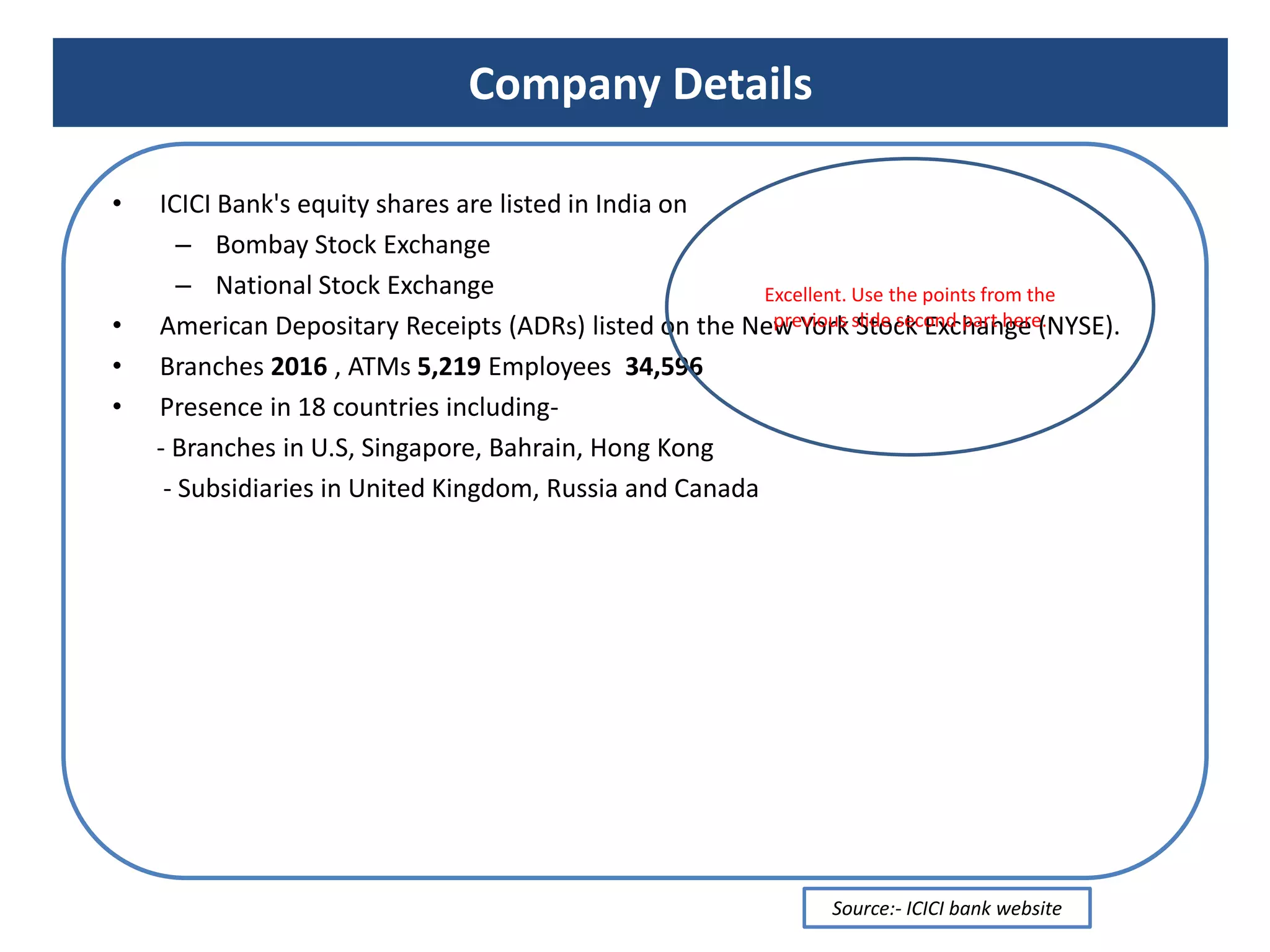
    Company DetailsICICI Bank'sequity shares are listed in India on Bombay Stock Exchange National Stock Exchange American Depositary Receipts (ADRs) listed on the New York Stock Exchange (NYSE).Branches 2016 , ATMs 5,219 Employees 34,596Presence in 18 countries including- - Branches in U.S, Singapore, Bahrain, Hong Kong - Subsidiaries in United Kingdom, Russia and CanadaExcellent. Use the points from the previous slide second part here.Source:- ICICI bank website
  • 45.
  • 46.
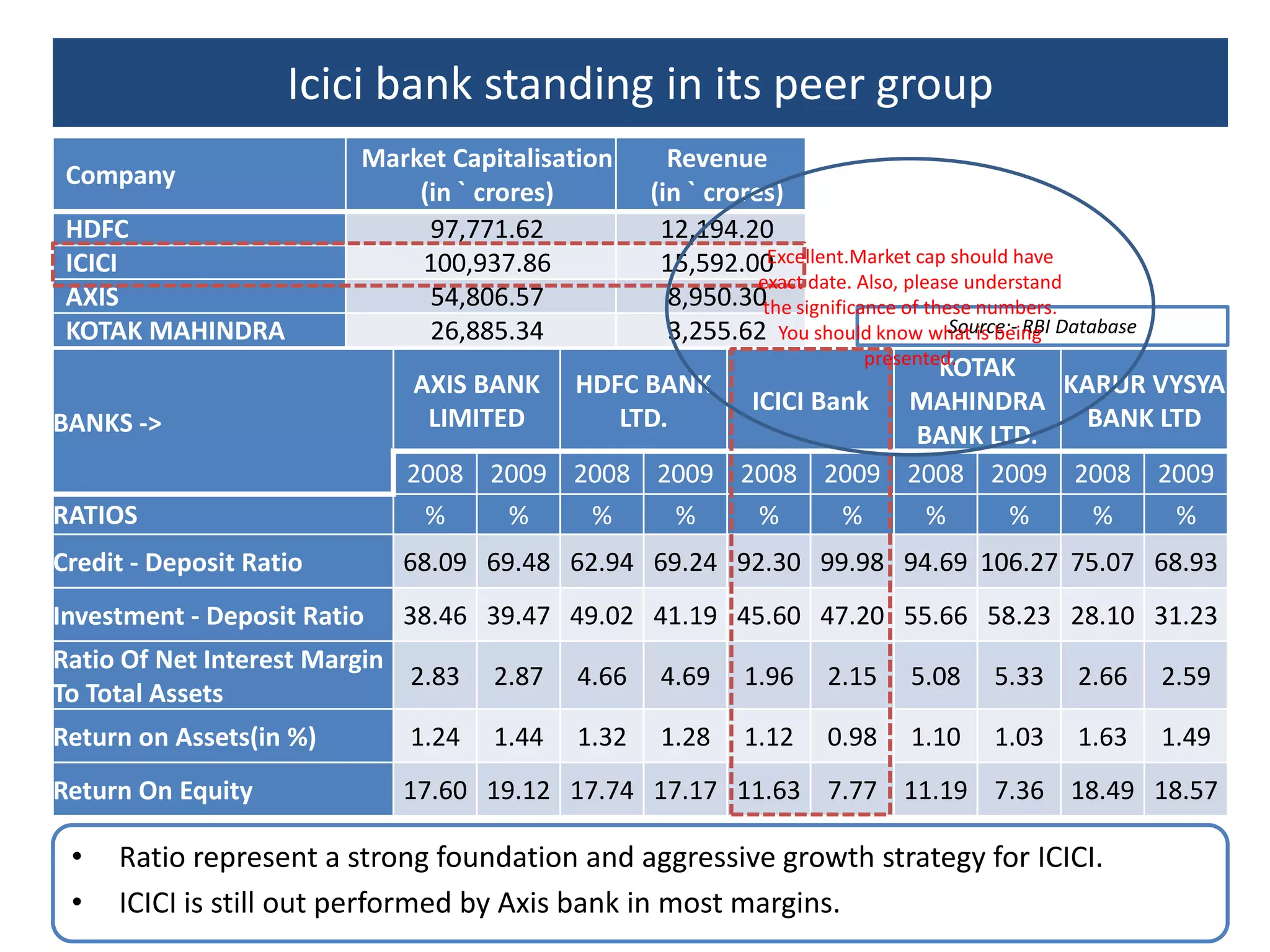
    Icici bank standingin its peer groupExcellent.Market cap should have exact date. Also, please understand the significance of these numbers. You should know what is being presented.Source:- RBI DatabaseRatio represent a strong foundation and aggressive growth strategy for ICICI.ICICI is still out performed by Axis bank in most margins.
  • 47.
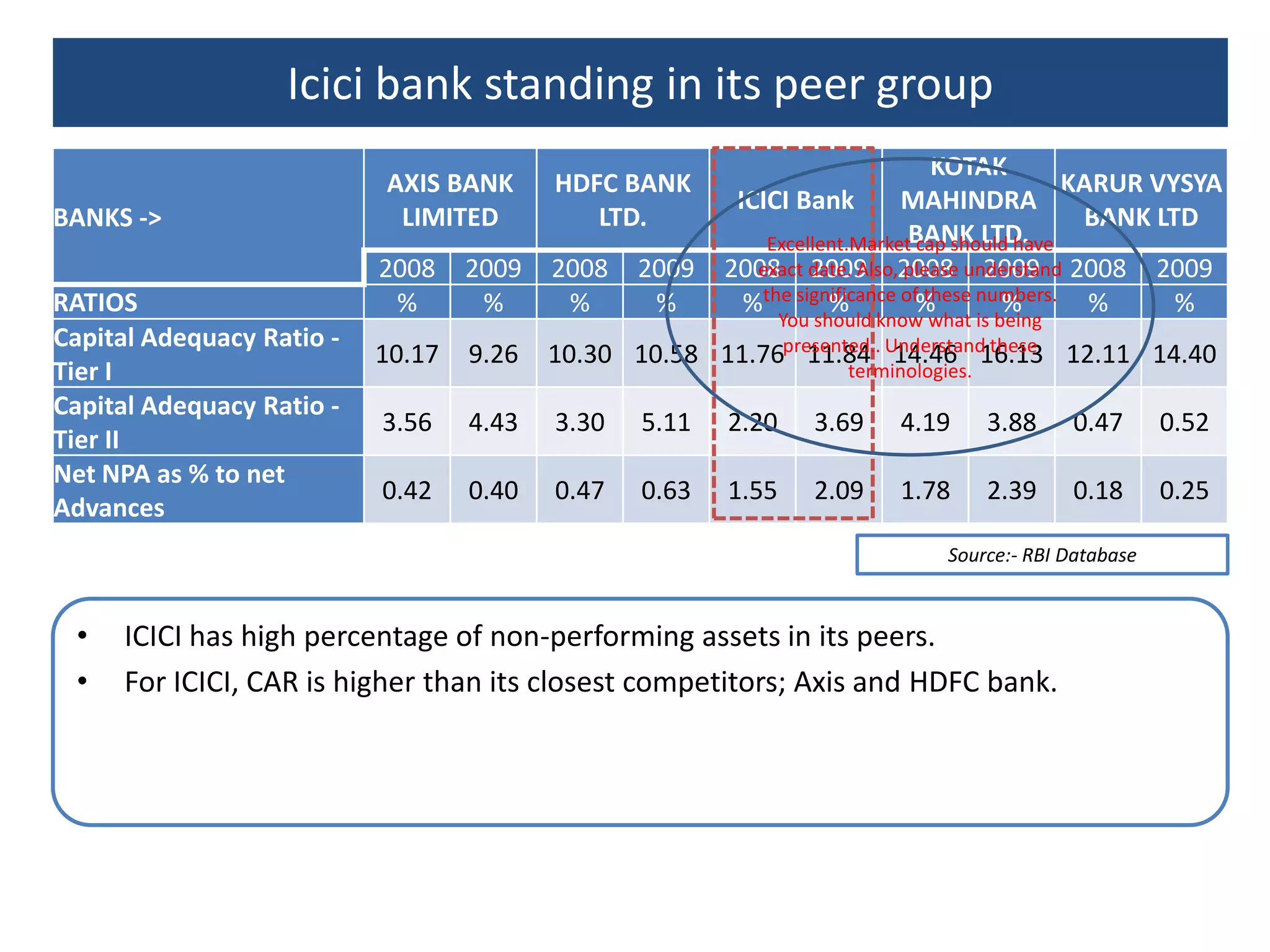
    Icici bank standingin its peer groupExcellent.Market cap should have exact date. Also, please understand the significance of these numbers. You should know what is being presented.. Understand these terminologies.Source:- RBI DatabaseICICI has high percentage of non-performing assets in its peers. For ICICI, CAR is higher than its closest competitors; Axis and HDFC bank.
  • 48.
  • 49.
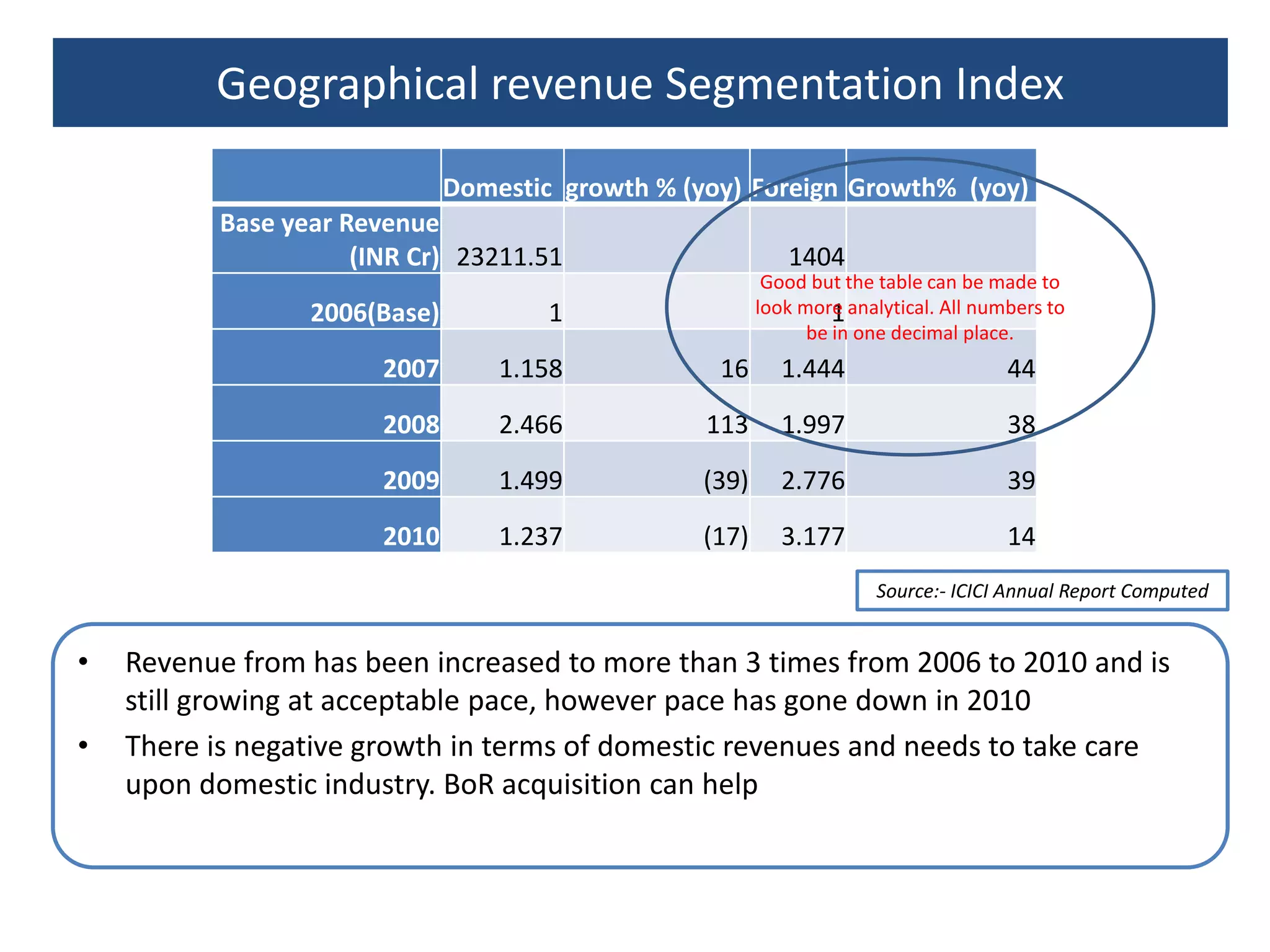
    Revenue from hasbeen increased to more than 3 times from 2006 to 2010 and is still growing at acceptable pace, however pace has gone down in 2010 There is negative growth in terms of domestic revenues and needs to take care upon domestic industry. BoR acquisition can helpGeographical revenue Segmentation IndexGood but the table can be made to look more analytical. All numbers to be in one decimal place.Source:- ICICI Annual Report Computed
  • 50.
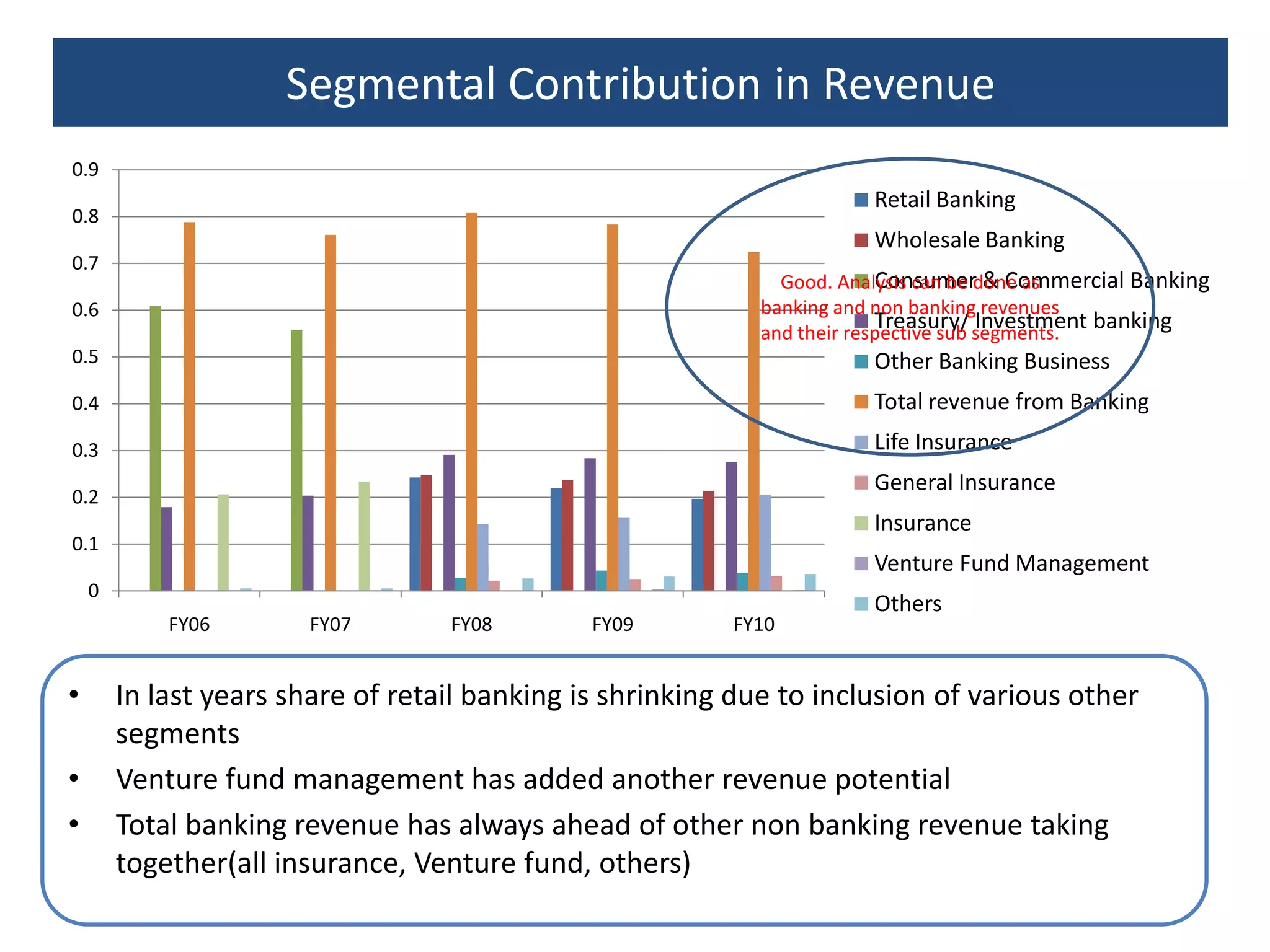
    In last yearsshare of retail banking is shrinking due to inclusion of various other segmentsVenture fund management has added another revenue potentialTotal banking revenue has always ahead of other non banking revenue taking together(all insurance, Venture fund, others)Segmental Contribution in RevenueGood. Analysis can be done as banking and non banking revenues and their respective sub segments.
  • 51.
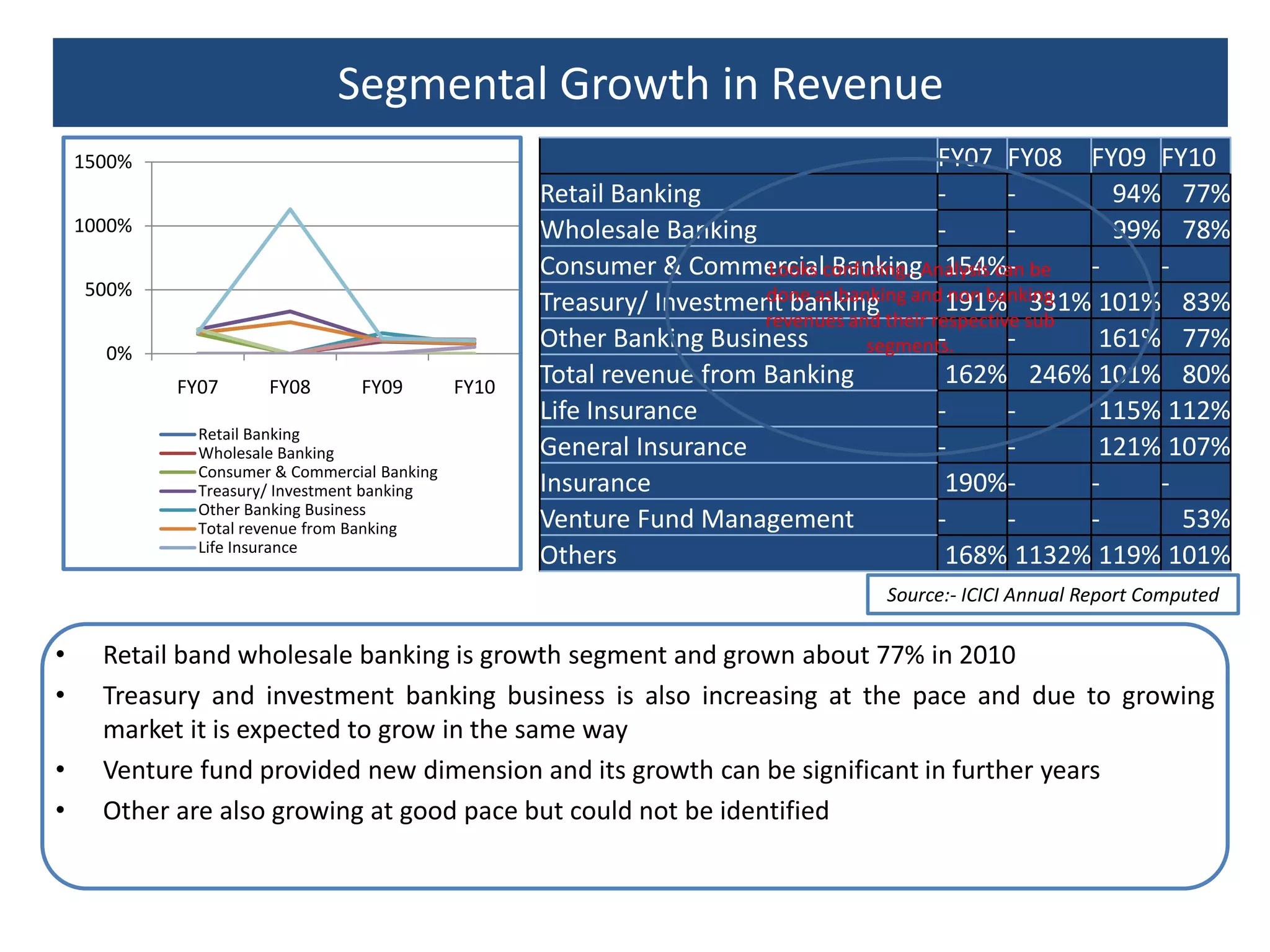
    Retail band wholesalebanking is growth segment and grown about 77% in 2010Treasury and investment banking business is also increasing at the pace and due to growing market it is expected to grow in the same wayVenture fund provided new dimension and its growth can be significant in further yearsOther are also growing at good pace but could not be identifiedSegmental Growth in RevenueLooks confusing.. Analysis can be done as banking and non banking revenues and their respective sub segments.Source:- ICICI Annual Report Computed
  • 52.
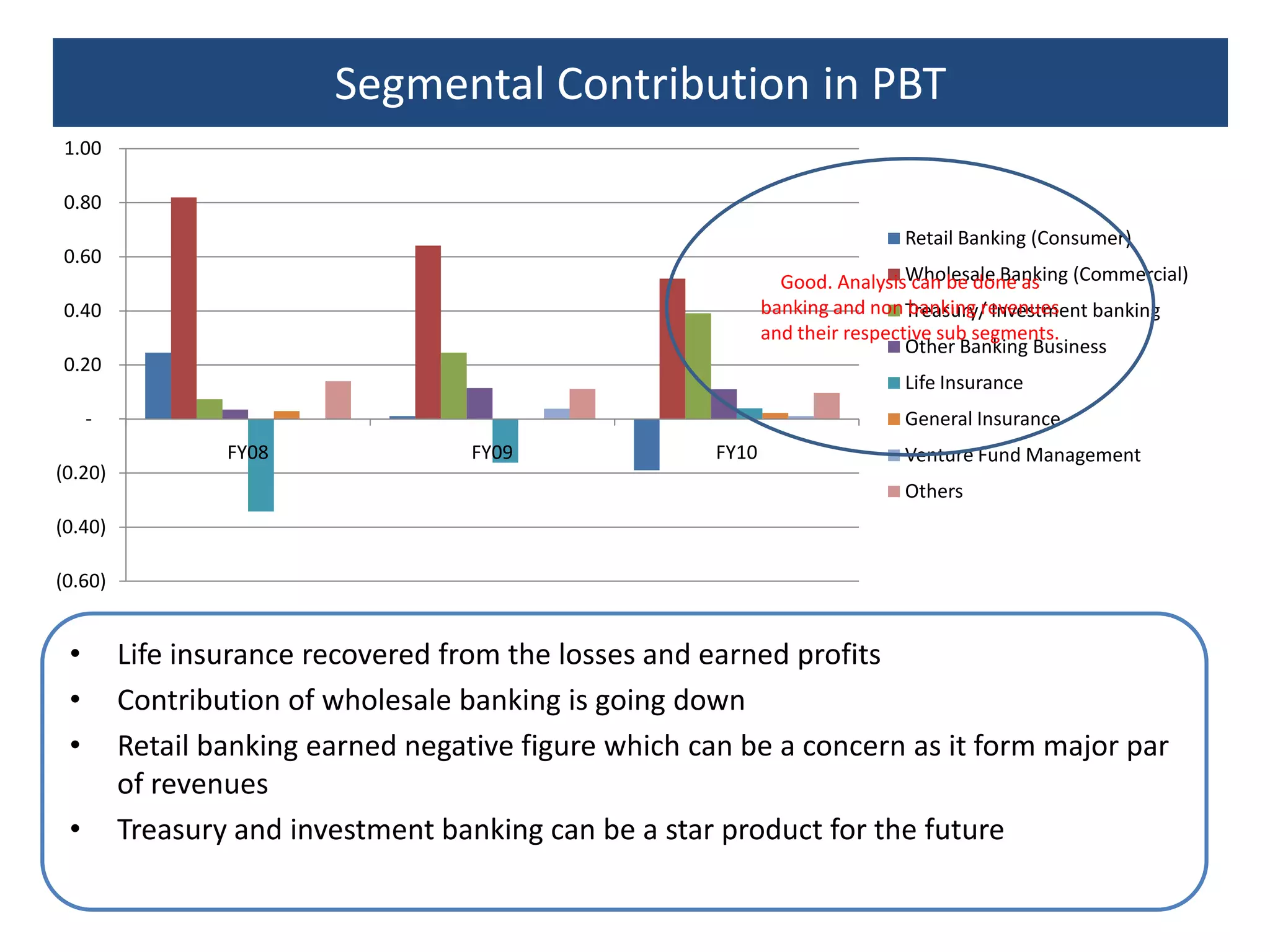
    Life insurance recoveredfrom the losses and earned profitsContribution of wholesale banking is going downRetail banking earned negative figure which can be a concern as it form major par of revenuesTreasury and investment banking can be a star product for the futureSegmental Contribution in PBTGood. Analysis can be done as banking and non banking revenues and their respective sub segments.
  • 53.
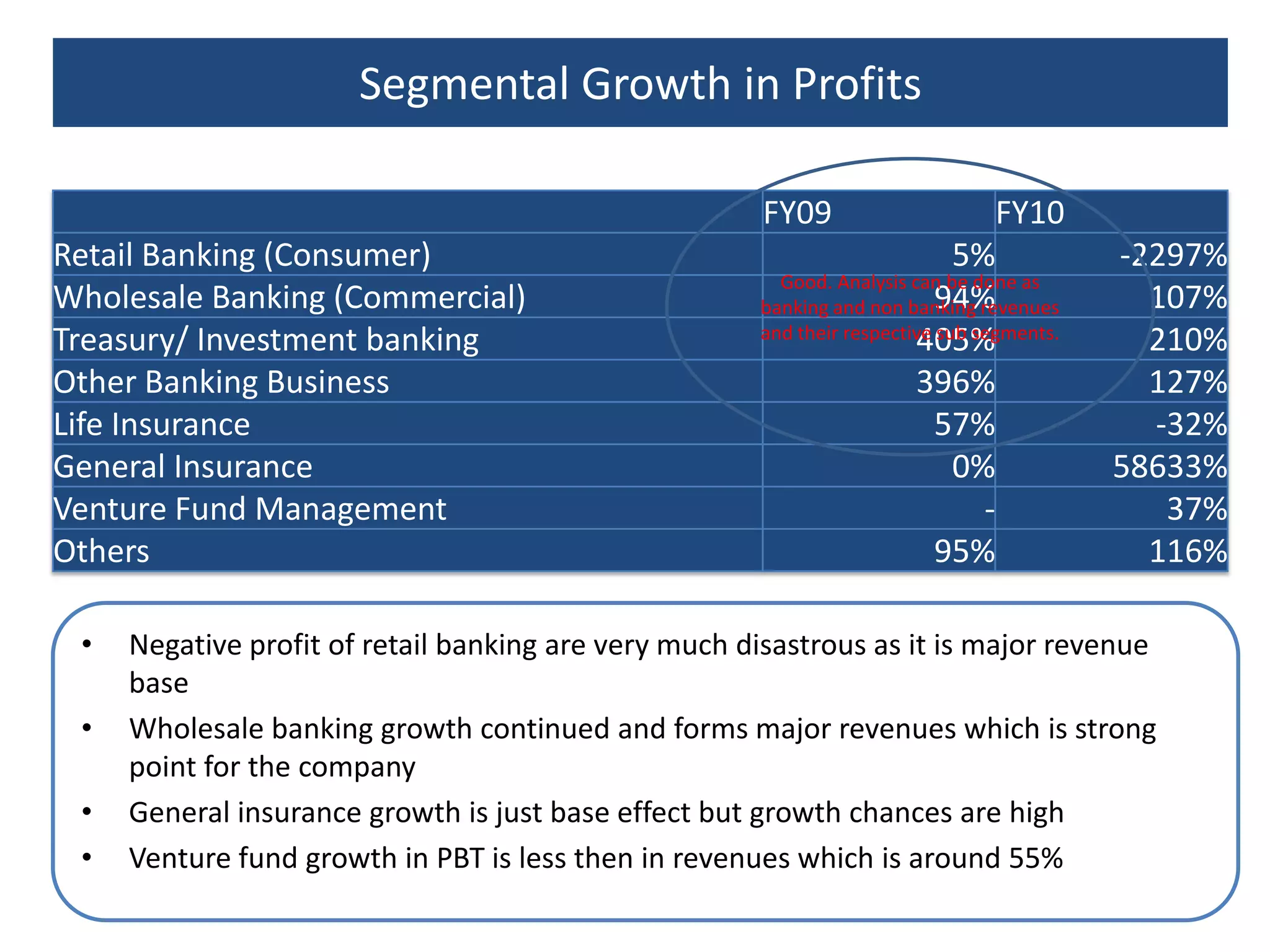
    Negative profit ofretail banking are very much disastrous as it is major revenue baseWholesale banking growth continued and forms major revenues which is strong point for the companyGeneral insurance growth is just base effect but growth chances are highVenture fund growth in PBT is less then in revenues which is around 55%Segmental Growth in ProfitsGood. Analysis can be done as banking and non banking revenues and their respective sub segments.
  • 54.
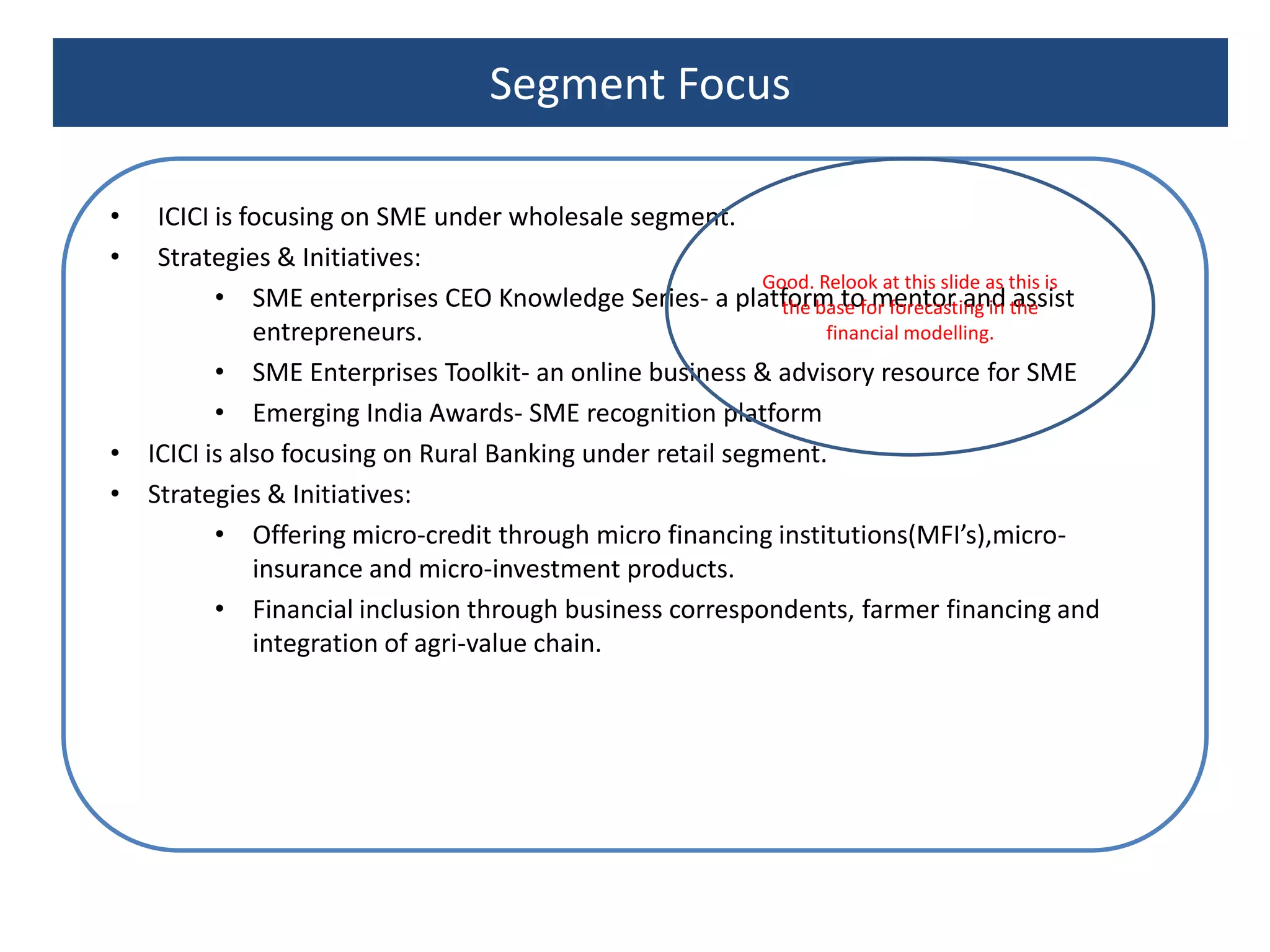
    Segment FocusICICI isfocusing on SME under wholesale segment. Strategies & Initiatives:SME enterprises CEO Knowledge Series- a platform to mentor and assist entrepreneurs.SME Enterprises Toolkit- an online business & advisory resource for SMEEmerging India Awards- SME recognition platformICICI is also focusing on Rural Banking under retail segment.Strategies & Initiatives:Offering micro-credit through micro financing institutions(MFI’s),micro-insurance and micro-investment products.Financial inclusion through business correspondents, farmer financing and integration of agri-value chain.Good. Relook at this slide as this is the base for forecasting in the financial modelling.
  • 55.
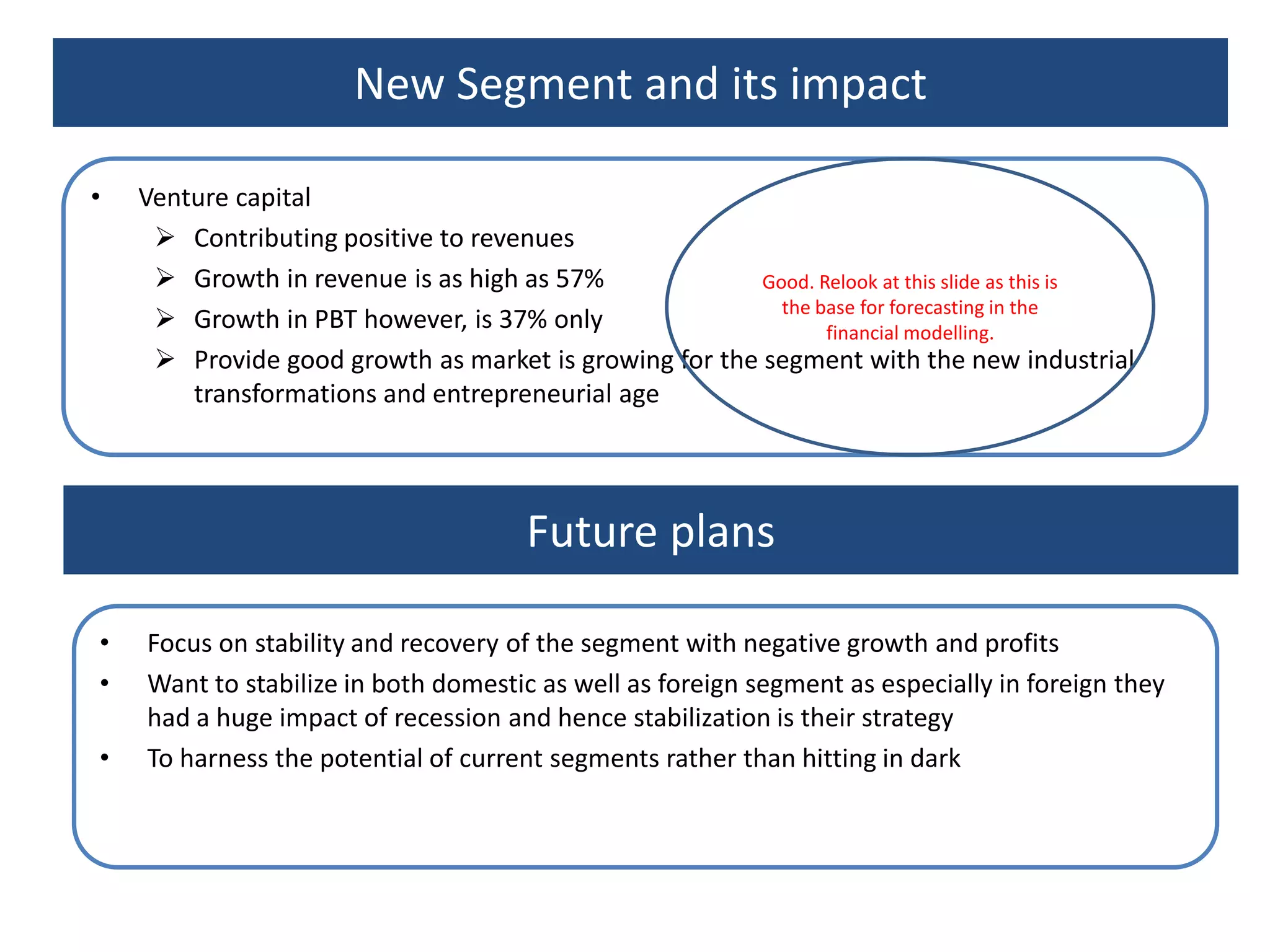
    New Segment andits impactGood. Relook at this slide as this is the base for forecasting in the financial modelling.Venture capitalContributing positive to revenues
  • 56.
    Growth in revenueis as high as 57%
  • 57.
    Growth in PBThowever, is 37% only
  • 58.
    Provide good growthas market is growing for the segment with the new industrial transformations and entrepreneurial ageFuture plansFocus on stability and recovery of the segment with negative growth and profits
  • 59.
    Want to stabilizein both domestic as well as foreign segment as especially in foreign they had a huge impact of recession and hence stabilization is their strategy
  • 60.
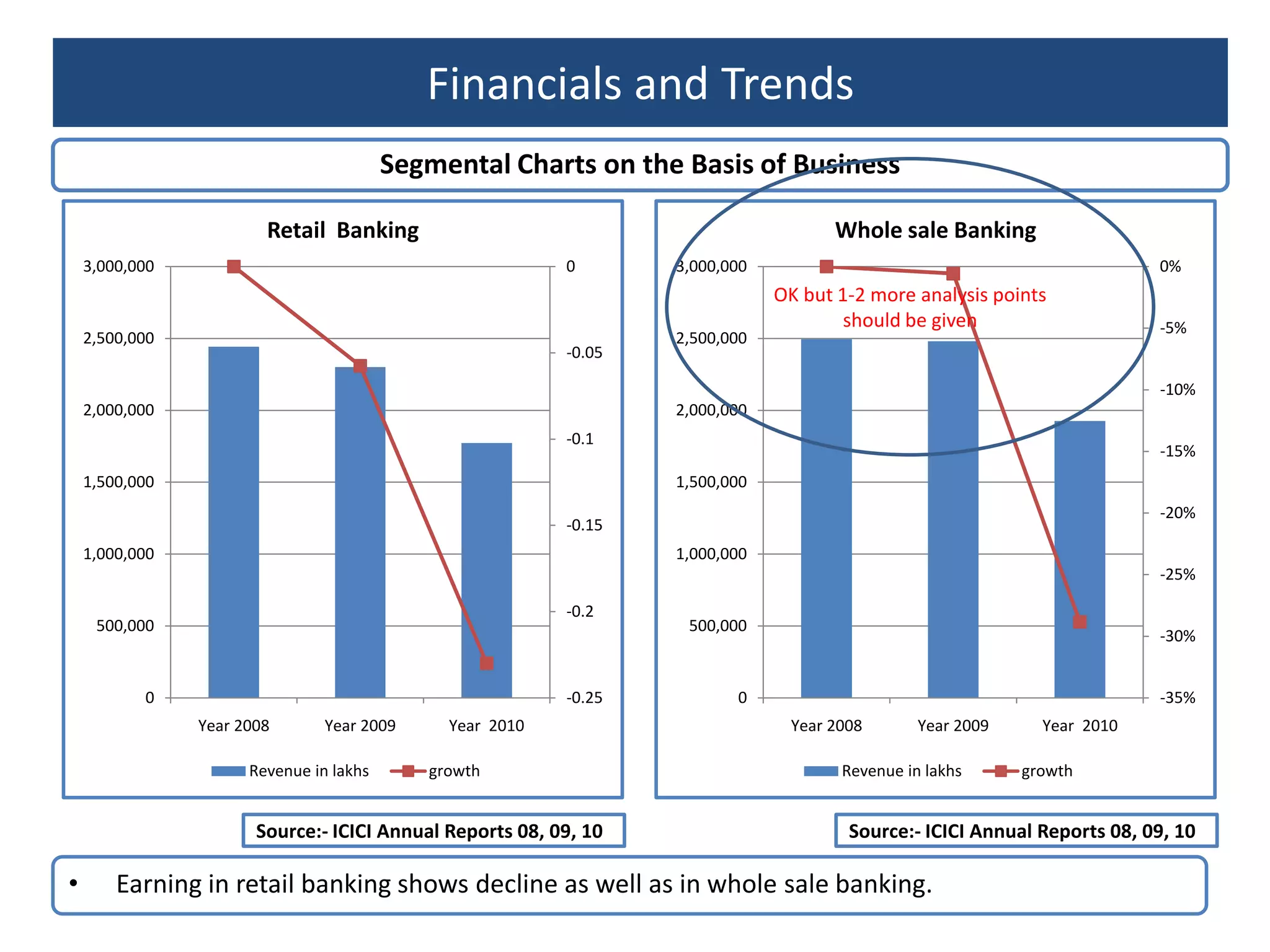
    To harness thepotential of current segments rather than hitting in darkSegmental Charts on the Basis of BusinessFinancials and TrendsOK but 1-2 more analysis points should be givenSource:- ICICI Annual Reports 08, 09, 10Source:- ICICI Annual Reports 08, 09, 10Earning in retail banking shows decline as well as in whole sale banking.
  • 61.
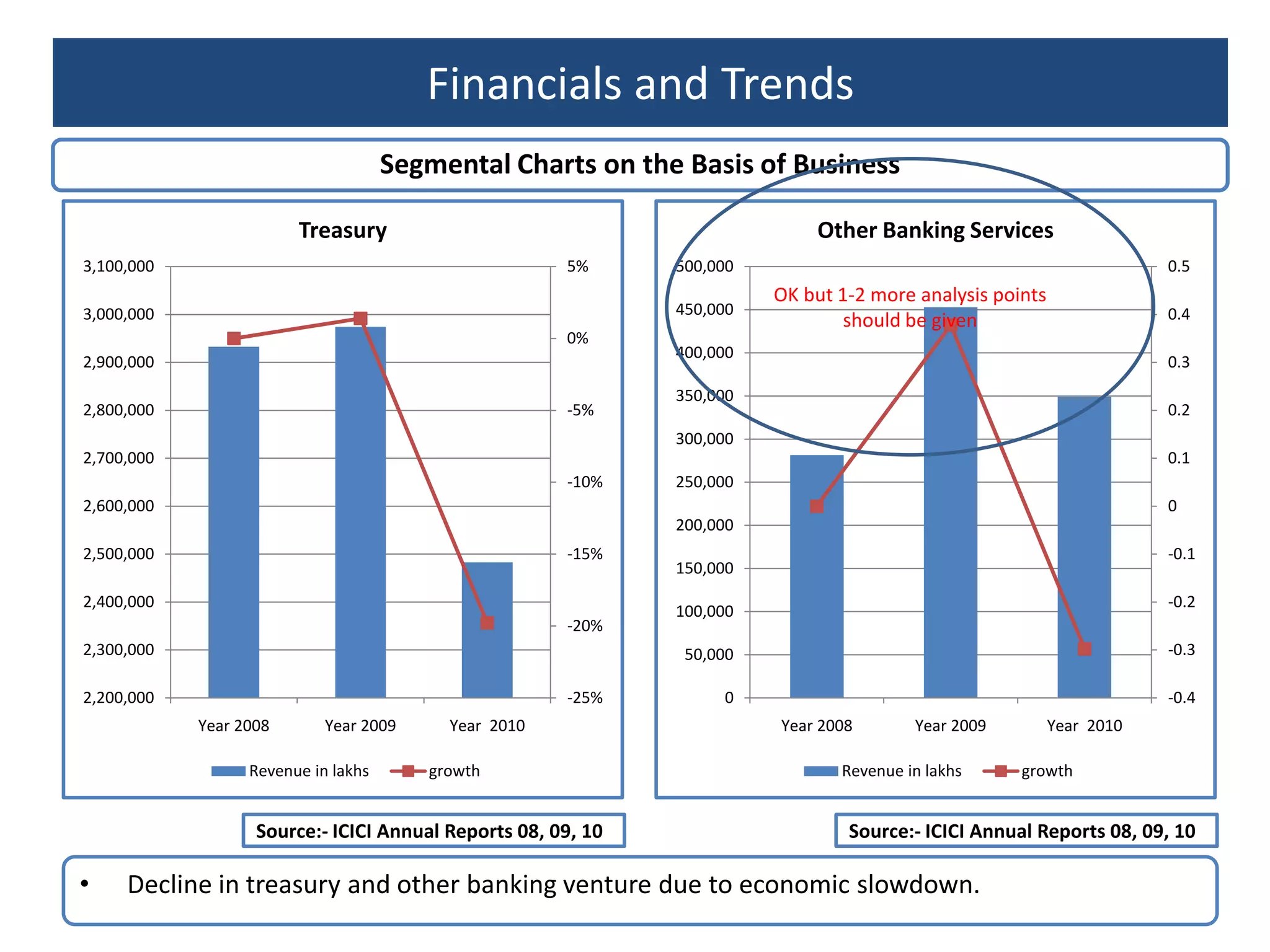
    Financials and TrendsSegmentalCharts on the Basis of BusinessOK but 1-2 more analysis points should be givenSource:- ICICI Annual Reports 08, 09, 10Source:- ICICI Annual Reports 08, 09, 10Decline in treasury and other banking venture due to economic slowdown.
  • 62.
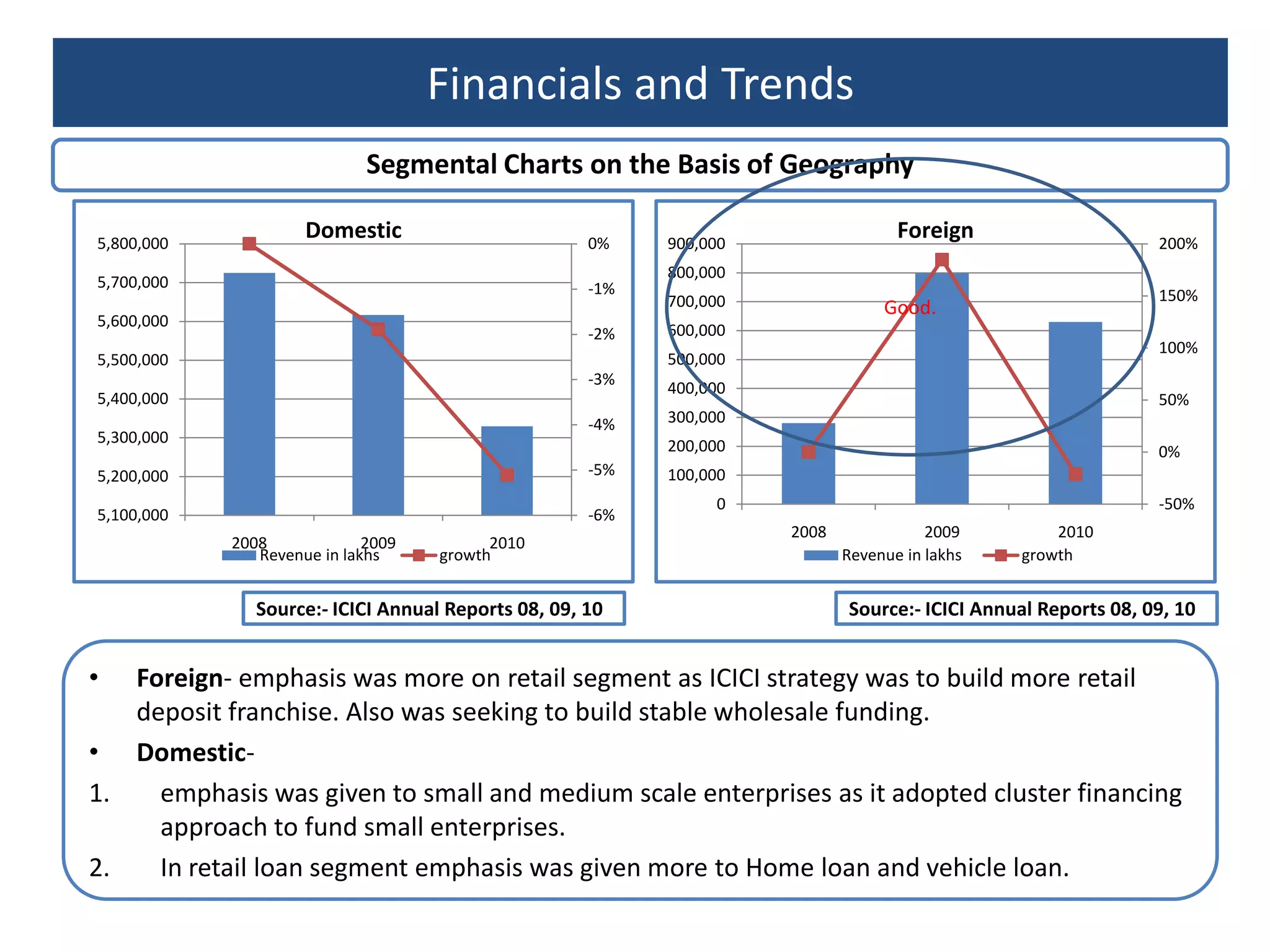
    Financials and TrendsSegmentalCharts on the Basis of GeographyGood. Source:- ICICI Annual Reports 08, 09, 10Source:- ICICI Annual Reports 08, 09, 10Foreign- emphasis was more on retail segment as ICICI strategy was to build more retail deposit franchise. Also was seeking to build stable wholesale funding.Domestic- emphasis was given to small and medium scale enterprises as it adopted cluster financing approach to fund small enterprises.In retail loan segment emphasis was given more to Home loan and vehicle loan.
  • 63.
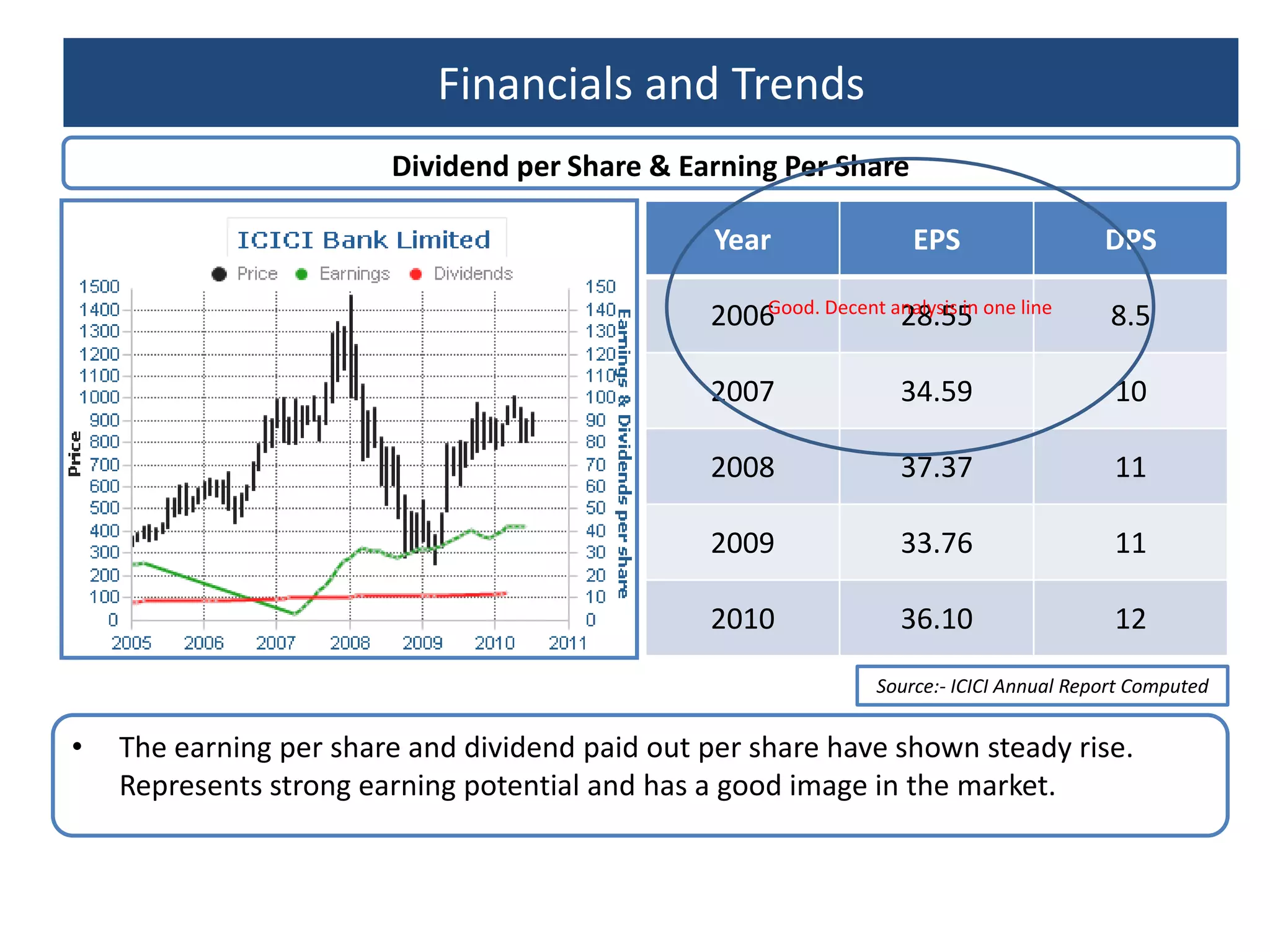
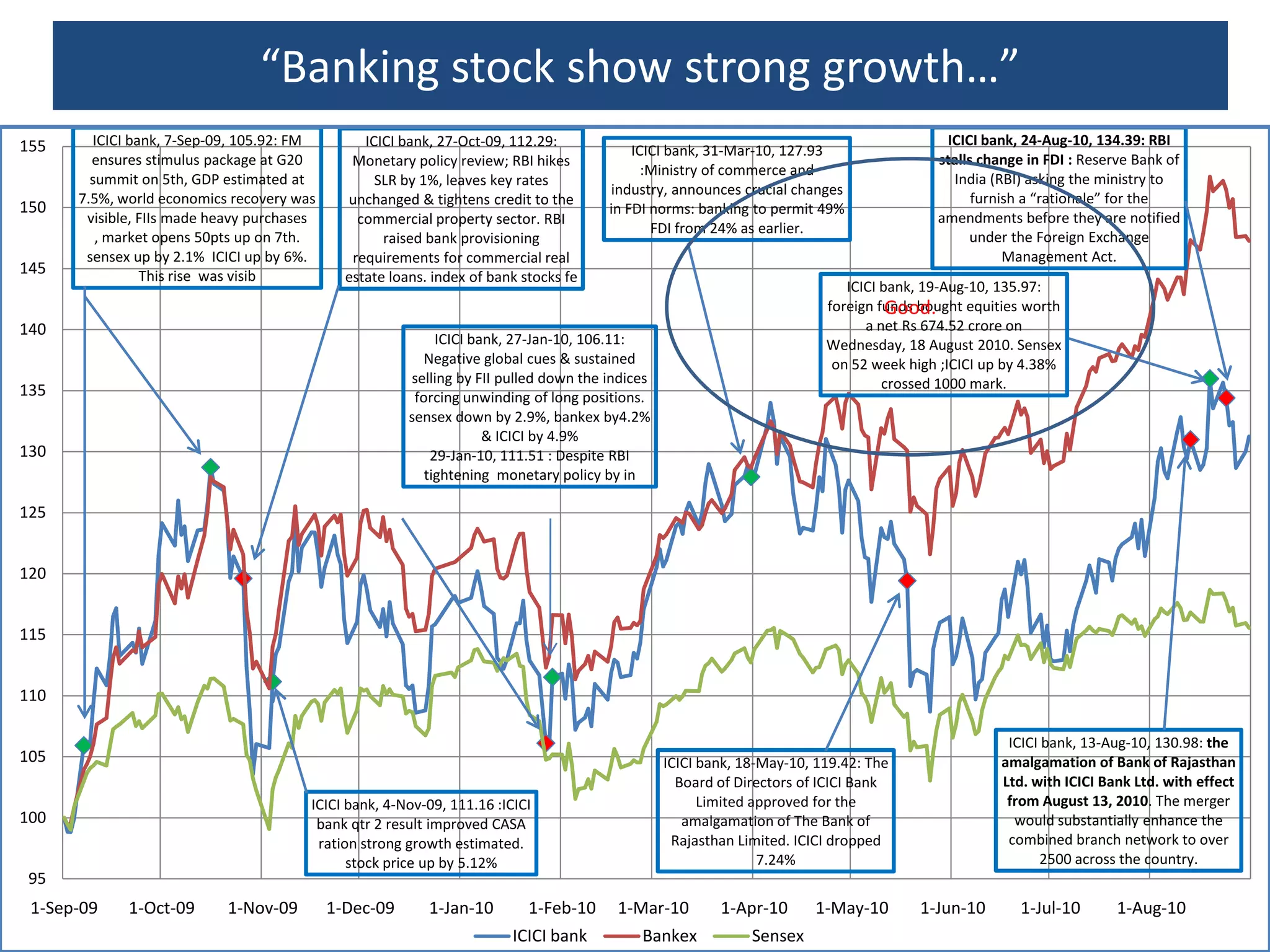
    Financials and TrendsDividendper Share & Earning Per ShareGood. Decent analysis in one lineSource:- ICICI Annual Report ComputedThe earning per share and dividend paid out per share have shown steady rise. Represents strong earning potential and has a good image in the market.“Banking stock show strong growth…”Good.
  • 64.
  • 65.
  • 66.
  • 67.
  • 68.
  • 69.
  • 70.
  • 71.
  • 72.
  • 73.