CUSTOMER DRIVEN SUPPLY
MAKING SUPPLY A COMMERCIAL COMPETITIVE EDGE


                                  CHRIS POOLE
By way of introduction


 I’m Chris Poole
  23 years at Procter &Gamble, working in
    – sales / customer service / physical distribution
  Head of Supply Chain at PA Consulting
  Director of Value Chain at B&Q
So what to cover


                   What leading edge companies are already doing
                   in Supply Chain
                   How they have made supply chain a commercial
                   competitive edge
                   What this means in real life – tips on what you
                   can do to get started
What leading edge companies are already doing…


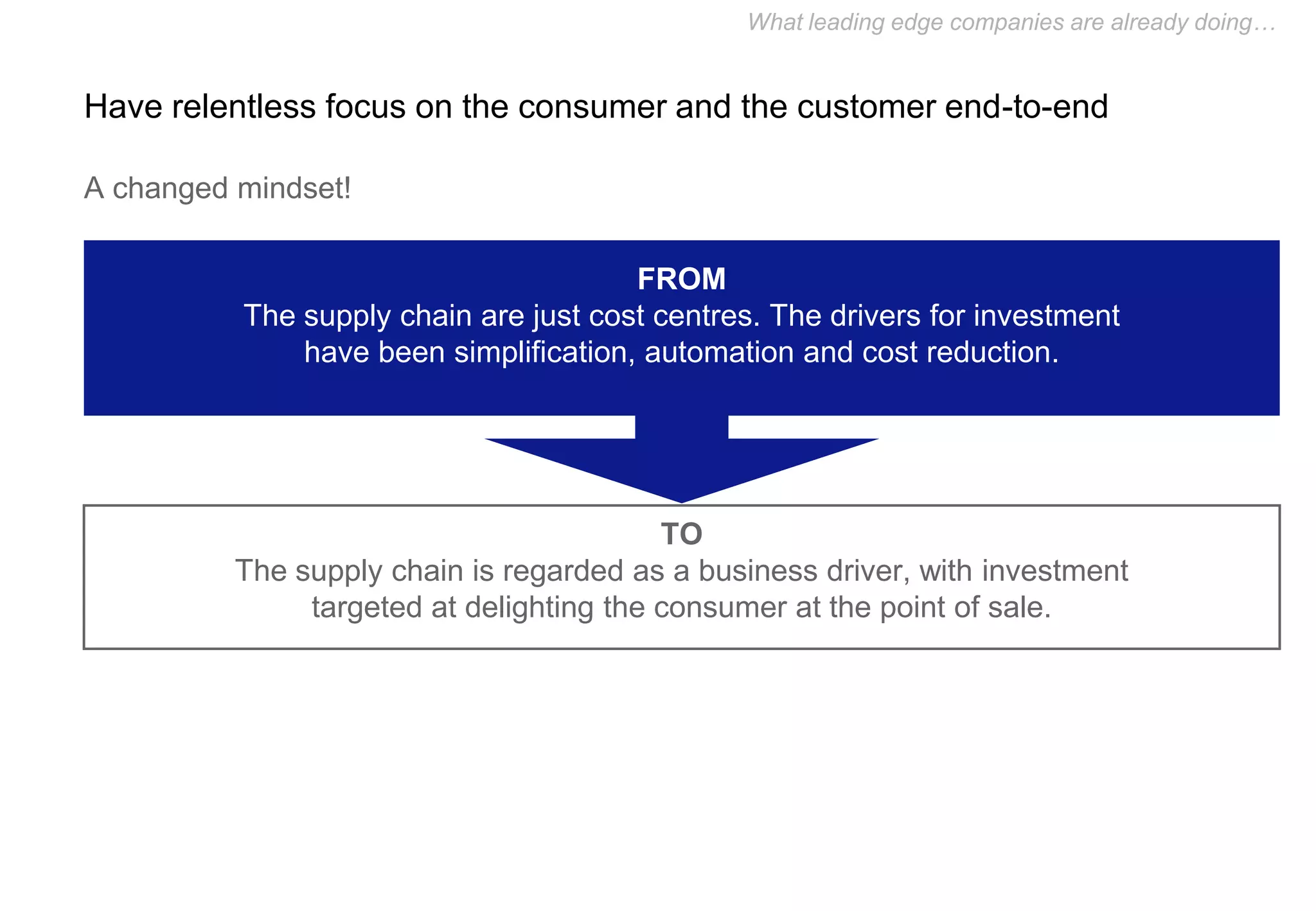
Have relentless focus on the consumer and the customer end-to-end

A changed mindset!


                                       FROM
          The supply chain are just cost centres. The drivers for investment
              have been simplification, automation and cost reduction.


                                          TO
          The supply chain is regarded as a business driver, with investment
               targeted at delighting the consumer at the point of sale.
What leading edge companies are already doing…


Have relentless focus on the consumer and the customer end-to-end


                                   Consumer is boss
                              win at two moments of truth


              In-store                             At home
              Right price                          Delivers on
              Right quality                        usage promise
              Right place
              Right time
              Right product
What leading edge companies are already doing…


Have relentless focus on the consumer and the customer end-to-end

Design the entire supply chain from the shelf back – invest in what it takes to win with
consumers and with customers (to get to consumers).
 Invest in the supply chain to make product and service differentiations which build
  top line growth
 Line up all supply chain stakeholders to focus on winning with consumers – ensure
  that they know how they contribute.
 Collaborate with customers and suppliers
 Get senior business management active leadership


           Procter and Gamble initiated their consumer driven supply chain initiative
           six years ago. It was only successful when led directly from the highest
           levels within the organisation. As a result, Procter and Gamble have seen
           a 17% improvement in perfect order performance.
What leading edge companies are already doing…


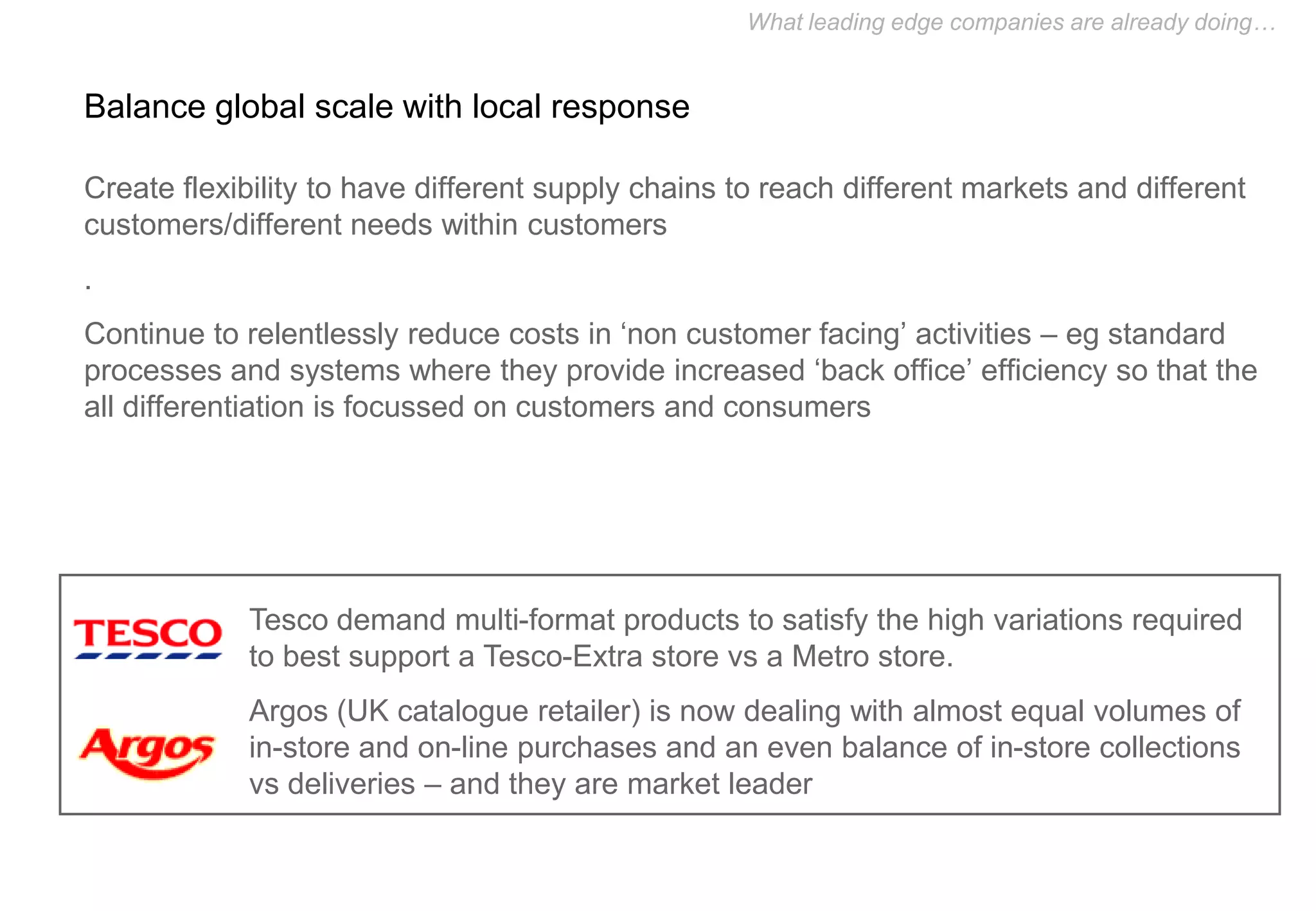
Balance global scale with local response

Create flexibility to have different supply chains to reach different markets and different
customers/different needs within customers
.
Continue to relentlessly reduce costs in ‘non customer facing’ activities – eg standard
processes and systems where they provide increased ‘back office’ efficiency so that the
all differentiation is focussed on customers and consumers


            Tesco demand multi-format products to satisfy the high variations required
            to best support a Tesco-Extra store vs a Metro store.
            Argos (UK catalogue retailer) is now dealing with almost equal volumes of
            in-store and on-line purchases and an even balance of in-store collections
            vs deliveries – and they are market leader
So what to cover


                   What leading edge companies are already doing
                   in Supply Chain
                   How they have made supply chain a commercial
                   competitive edge
                   What this means in real life – tips on what you
                   can do to get started
A commercial competitive edge…
                                                                                  …

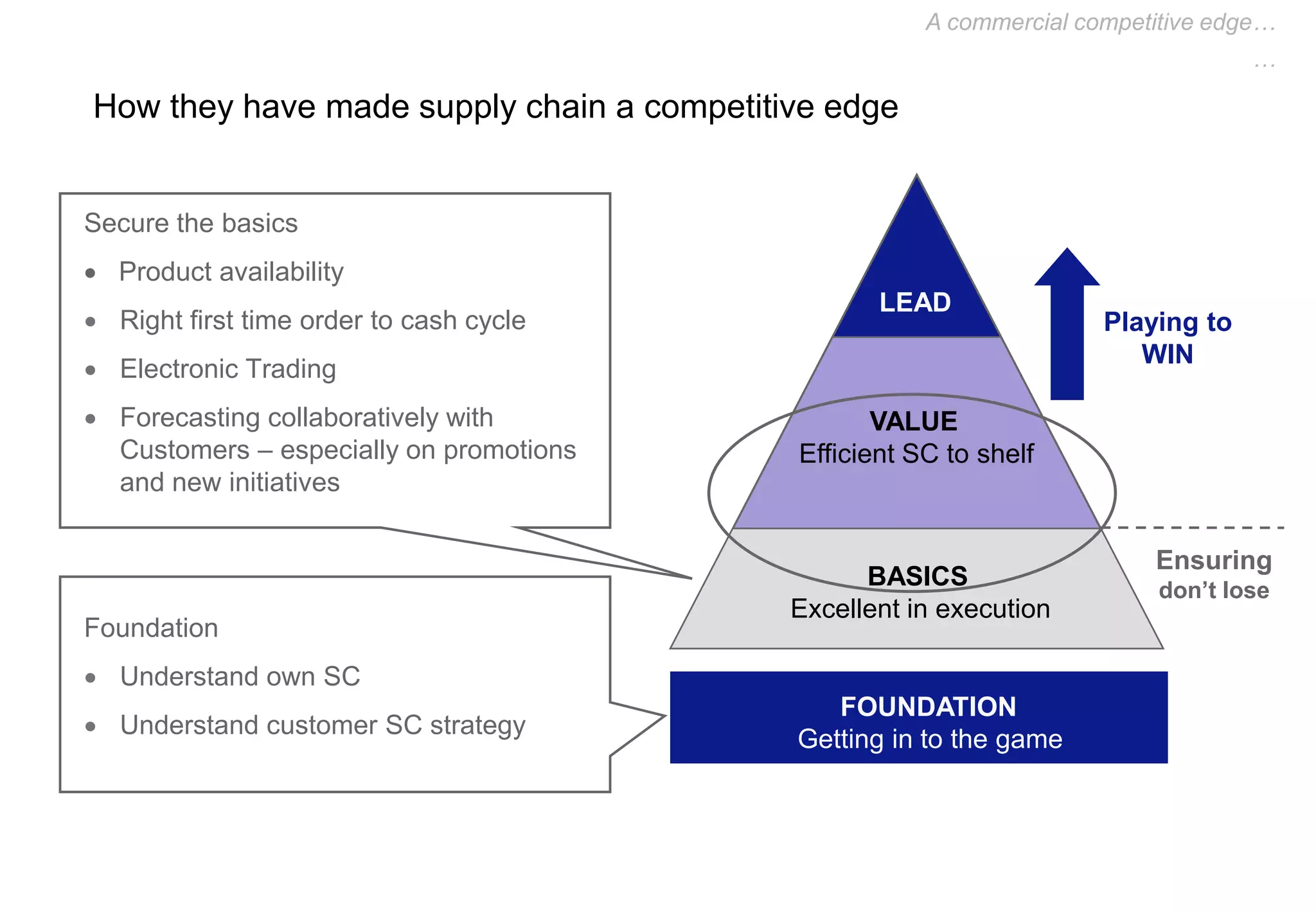
How they have made supply chain a competitive edge


Secure the basics
 Product availability
                                                  LEAD
 Right first time order to cash cycle                               Playing to
                                                                        WIN
 Electronic Trading
 Forecasting collaboratively with                VALUE
  Customers – especially on promotions     Efficient SC to shelf
  and new initiatives

                                                                         Ensuring
                                                 BASICS                  don’t lose
                                           Excellent in execution
Foundation
 Understand own SC
                                              FOUNDATION
 Understand customer SC strategy
                                           Getting in to the game
A commercial competitive edge…
                                                                                    …

How they have made supply chain a competitive edge

Customer service innovation
 Lead Customers – create templates for
others to follow
                                                    LEAD
                                                                       Playing to
                                                                          WIN

                                                    VALUE
To maximise value                            Efficient SC to shelf
 Efficient product portfolio / complexity
  management
                                                                           Ensuring
                                                   BASICS
 Differentiated product and services        Excellent in execution
                                                                           don’t lose

 Shelf ready packaging
 Focus on shelf availability                   FOUNDATION
                                             Getting in to the game
 Cost effective replenishment process
A commercial competitive edge…
                                                                                                           …

How they have made supply chain a competitive edge


                                         External focus
                                       measures aligned with
                                     customers and consumers


       Synchronisation                                                   Flawless Execution
     Real time information flow                                            get the basics right


                                  Consumer driven supply


                                                                             Joint supply chain
      Loss elimination                                                         value creation
 Take out non value added time,                                             working with customers to
    inventory and complexity                                             improve service and reduce cost
                                         Responsiveness
                                  Product and service differentiations
So what to cover


                   What leading edge companies are already doing
                   in Supply Chain
                   How they have made supply chain a commercial
                   competitive edge
                   What this means in real life – tips to get started
What this means in real life


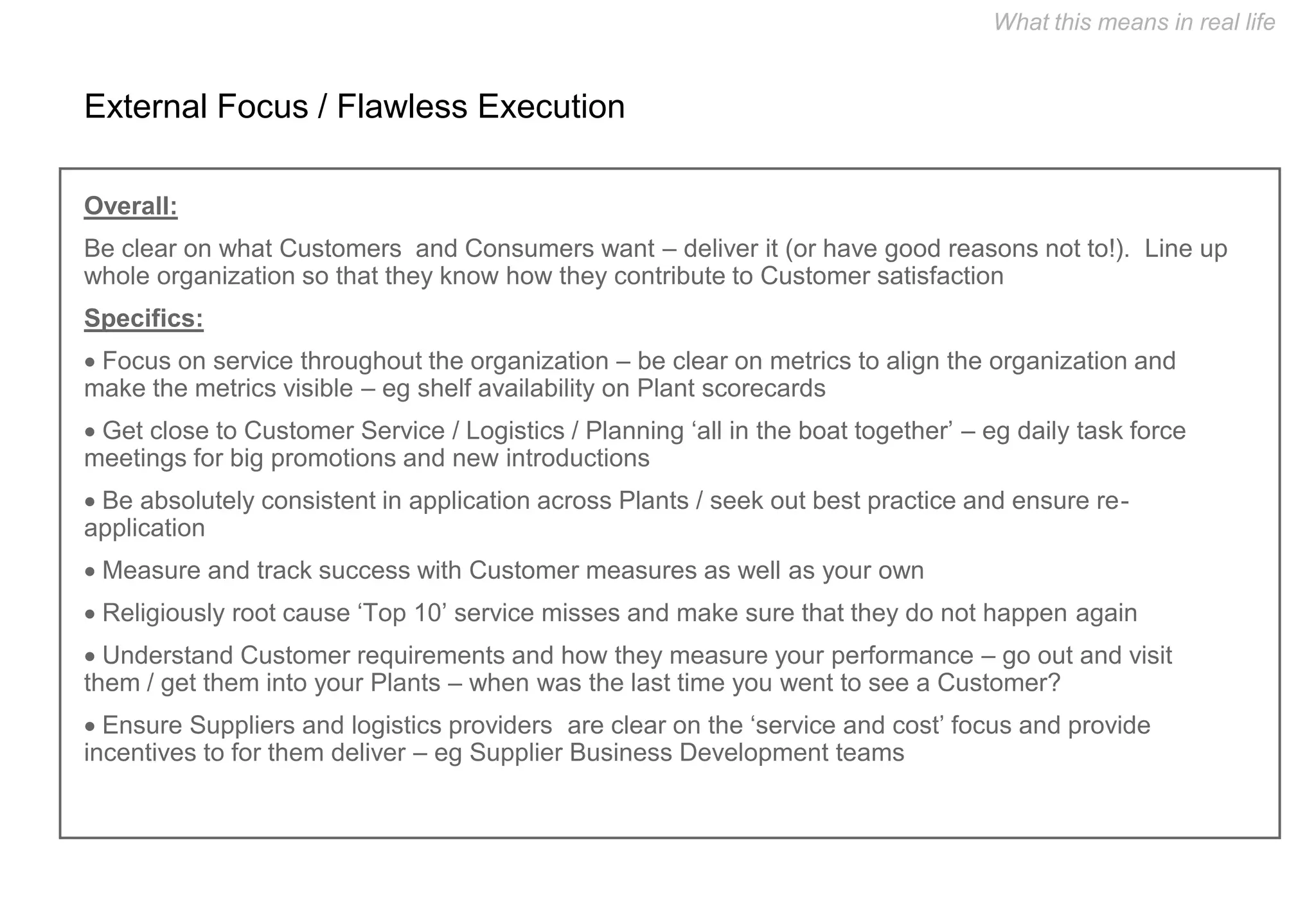
External Focus / Flawless Execution

Overall:
Be clear on what Customers and Consumers want – deliver it (or have good reasons not to!). Line up
whole organization so that they know how they contribute to Customer satisfaction
Specifics:
 Focus on service throughout the organization – be clear on metrics to align the organization and
make the metrics visible – eg shelf availability on Plant scorecards
 Get close to Customer Service / Logistics / Planning ‘all in the boat together’ – eg daily task force
meetings for big promotions and new introductions
 Be absolutely consistent in application across Plants / seek out best practice and ensure re-
application
 Measure and track success with Customer measures as well as your own
 Religiously root cause ‘Top 10’ service misses and make sure that they do not happen again
 Understand Customer requirements and how they measure your performance – go out and visit
them / get them into your Plants – when was the last time you went to see a Customer?
 Ensure Suppliers and logistics providers are clear on the ‘service and cost’ focus and provide
incentives to for them deliver – eg Supplier Business Development teams
What this means in real life


Joint Supply Chain Value Creation / Responsiveness

Overall:
Be flexible and responsive = better service which means more business / more flexibility means more
commercial opportunities
Specifics:
 Work closely with Customer Service to align expectations – eg Go to Market and Operating
Strategies aligned at start of year – gaps identified and worked through up front
 Accept that forecasts will be wrong – and work to provide manufacturing flexibility within defined
parameters
 Provide capability to be able to efficiently execute product and service differentiations which can
build volume – eg special packs / pallet height differentiation / pack stickers - these are here already
and will only stay and increase
 Have the manufacturing flexibility to take advantage of business opportunities – eg power sku’s
 Be flexible to make more sku’s every day – produce to demand rather than to forecast
 Find ways of making smaller batches more frequently – eg through faster changeovers.
 Be open to make changes to your delivery ‘method’ – full pallets / layers / trays / cases and
manufacture and pack these on the line
What this means in real life


Loss Elimination / Synchronization

Overall:
Absolutely continue to keep rigorous control of costs and ensure that any flexibility is rigidly justified.
Where possible synchronize information flow up the supply chain and product flow down – in order to
ensure end to end visibility
Specifics:
 Continue what you undoubtedly already do on waste and cost elimination – BUT not at the expense
of service!
 Ensure best practice is identified and spread across the network – eg horizontal process teams led
by line managers
 Flag inefficiencies to the business – especially those which come from the service approach – this is
not ‘open season’ for Sales and Marketing – ensure that extra cost is transparent so that return on
investment is clear
 Have a relentless and disciplined approach to Obsoletes elimination – you have to make room for
the new co-differentiation
 Track the location and amount of product and raw materials in the Supply Chain to ensure eliminate
buffers / deliver in line with demand
These are the important things:


These are the important things:


• Start with mindset change – be clear that Consumer is Boss and Service is the start
point for all you do
 Not rocket science – ensure strong execution of the basics – be disciplined on
process deployment
 Disciplined adherence to agreed processes and ‘zero tolerance’ tracking to ensure
adherence
 Ensure single processes across the business

Customer Driven Supply

  • 1.
    CUSTOMER DRIVEN SUPPLY MAKINGSUPPLY A COMMERCIAL COMPETITIVE EDGE CHRIS POOLE
  • 2.
    By way ofintroduction I’m Chris Poole  23 years at Procter &Gamble, working in – sales / customer service / physical distribution  Head of Supply Chain at PA Consulting  Director of Value Chain at B&Q
  • 3.
    So what tocover What leading edge companies are already doing in Supply Chain How they have made supply chain a commercial competitive edge What this means in real life – tips on what you can do to get started
  • 4.
    What leading edgecompanies are already doing… Have relentless focus on the consumer and the customer end-to-end A changed mindset! FROM The supply chain are just cost centres. The drivers for investment have been simplification, automation and cost reduction. TO The supply chain is regarded as a business driver, with investment targeted at delighting the consumer at the point of sale.
  • 5.
    What leading edgecompanies are already doing… Have relentless focus on the consumer and the customer end-to-end Consumer is boss win at two moments of truth In-store At home Right price Delivers on Right quality usage promise Right place Right time Right product
  • 6.
    What leading edgecompanies are already doing… Have relentless focus on the consumer and the customer end-to-end Design the entire supply chain from the shelf back – invest in what it takes to win with consumers and with customers (to get to consumers).  Invest in the supply chain to make product and service differentiations which build top line growth  Line up all supply chain stakeholders to focus on winning with consumers – ensure that they know how they contribute.  Collaborate with customers and suppliers  Get senior business management active leadership Procter and Gamble initiated their consumer driven supply chain initiative six years ago. It was only successful when led directly from the highest levels within the organisation. As a result, Procter and Gamble have seen a 17% improvement in perfect order performance.
  • 7.
    What leading edgecompanies are already doing… Balance global scale with local response Create flexibility to have different supply chains to reach different markets and different customers/different needs within customers . Continue to relentlessly reduce costs in ‘non customer facing’ activities – eg standard processes and systems where they provide increased ‘back office’ efficiency so that the all differentiation is focussed on customers and consumers Tesco demand multi-format products to satisfy the high variations required to best support a Tesco-Extra store vs a Metro store. Argos (UK catalogue retailer) is now dealing with almost equal volumes of in-store and on-line purchases and an even balance of in-store collections vs deliveries – and they are market leader
  • 8.
    So what tocover What leading edge companies are already doing in Supply Chain How they have made supply chain a commercial competitive edge What this means in real life – tips on what you can do to get started
  • 9.
    A commercial competitiveedge… … How they have made supply chain a competitive edge Secure the basics  Product availability LEAD  Right first time order to cash cycle Playing to WIN  Electronic Trading  Forecasting collaboratively with VALUE Customers – especially on promotions Efficient SC to shelf and new initiatives Ensuring BASICS don’t lose Excellent in execution Foundation  Understand own SC FOUNDATION  Understand customer SC strategy Getting in to the game
  • 10.
    A commercial competitiveedge… … How they have made supply chain a competitive edge Customer service innovation  Lead Customers – create templates for others to follow LEAD Playing to WIN VALUE To maximise value Efficient SC to shelf  Efficient product portfolio / complexity management Ensuring BASICS  Differentiated product and services Excellent in execution don’t lose  Shelf ready packaging  Focus on shelf availability FOUNDATION Getting in to the game  Cost effective replenishment process
  • 11.
    A commercial competitiveedge… … How they have made supply chain a competitive edge External focus measures aligned with customers and consumers Synchronisation Flawless Execution Real time information flow get the basics right Consumer driven supply Joint supply chain Loss elimination value creation Take out non value added time, working with customers to inventory and complexity improve service and reduce cost Responsiveness Product and service differentiations
  • 12.
    So what tocover What leading edge companies are already doing in Supply Chain How they have made supply chain a commercial competitive edge What this means in real life – tips to get started
  • 13.
    What this meansin real life External Focus / Flawless Execution Overall: Be clear on what Customers and Consumers want – deliver it (or have good reasons not to!). Line up whole organization so that they know how they contribute to Customer satisfaction Specifics:  Focus on service throughout the organization – be clear on metrics to align the organization and make the metrics visible – eg shelf availability on Plant scorecards  Get close to Customer Service / Logistics / Planning ‘all in the boat together’ – eg daily task force meetings for big promotions and new introductions  Be absolutely consistent in application across Plants / seek out best practice and ensure re- application  Measure and track success with Customer measures as well as your own  Religiously root cause ‘Top 10’ service misses and make sure that they do not happen again  Understand Customer requirements and how they measure your performance – go out and visit them / get them into your Plants – when was the last time you went to see a Customer?  Ensure Suppliers and logistics providers are clear on the ‘service and cost’ focus and provide incentives to for them deliver – eg Supplier Business Development teams
  • 14.
    What this meansin real life Joint Supply Chain Value Creation / Responsiveness Overall: Be flexible and responsive = better service which means more business / more flexibility means more commercial opportunities Specifics:  Work closely with Customer Service to align expectations – eg Go to Market and Operating Strategies aligned at start of year – gaps identified and worked through up front  Accept that forecasts will be wrong – and work to provide manufacturing flexibility within defined parameters  Provide capability to be able to efficiently execute product and service differentiations which can build volume – eg special packs / pallet height differentiation / pack stickers - these are here already and will only stay and increase  Have the manufacturing flexibility to take advantage of business opportunities – eg power sku’s  Be flexible to make more sku’s every day – produce to demand rather than to forecast  Find ways of making smaller batches more frequently – eg through faster changeovers.  Be open to make changes to your delivery ‘method’ – full pallets / layers / trays / cases and manufacture and pack these on the line
  • 15.
    What this meansin real life Loss Elimination / Synchronization Overall: Absolutely continue to keep rigorous control of costs and ensure that any flexibility is rigidly justified. Where possible synchronize information flow up the supply chain and product flow down – in order to ensure end to end visibility Specifics:  Continue what you undoubtedly already do on waste and cost elimination – BUT not at the expense of service!  Ensure best practice is identified and spread across the network – eg horizontal process teams led by line managers  Flag inefficiencies to the business – especially those which come from the service approach – this is not ‘open season’ for Sales and Marketing – ensure that extra cost is transparent so that return on investment is clear  Have a relentless and disciplined approach to Obsoletes elimination – you have to make room for the new co-differentiation  Track the location and amount of product and raw materials in the Supply Chain to ensure eliminate buffers / deliver in line with demand
  • 16.
    These are theimportant things: These are the important things: • Start with mindset change – be clear that Consumer is Boss and Service is the start point for all you do  Not rocket science – ensure strong execution of the basics – be disciplined on process deployment  Disciplined adherence to agreed processes and ‘zero tolerance’ tracking to ensure adherence  Ensure single processes across the business