EDU560-Curriculum Studies &
Practices in Secondary Education
Week 9 Lecture
Cyclical / Rational models (Process)
• Wheeler (1967) and Nicholls models (1976)
(revision)
Cyclical / Rational models (Process)
• Wheeler (1967) and Nicholls models (1976)
• Views the curriculum process as circular or a
continuing activity/ a process.
• The Cyclical model is responsive to needs,
• Are on-going, necessitating constant updating
of the curriculum process.
• They are flexible.
(revision)
Cyclical / Rational models (Process)
• These models view elements of the
curriculum as interrelated and
interdependent.
• Unlike the objectives model, this model does
not consider objectives to be important.
• Content has its own value. Therefore, it
(content) should not be selected on the basis
of the achievement of objectives.
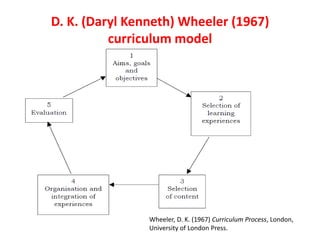
D. K. (Daryl Kenneth) Wheeler (1967)
curriculum model
Wheeler, D. K. (1967) Curriculum Process, London,
University of London Press.
Wheeler’s (1967)Model
• Wheeler’s model for curriculum design is an
improvement upon Tyler’s model.
• Instead of a linear model, Wheeler developed a
cyclical model (process).
• Evaluation in Wheeler’s model is NOT terminal
but the beginning of the cycle.
• Findings from the evaluation are fed back into
the objectives and the goals, which influence
other stages.
Wheeler’s (1967)Model
Wheeler pointed out that:
• Aims should be discussed as behaviours referring to the
end product of learning which produces the ultimate
goals.
• These ultimate goals are the outcomes.
• Aims are formulated from the general to the specific in
curriculum planning.
• This results in the formulation of objectives at both an
enabling and a terminal level (at the end).
• Content is distinguished from the learning experiences
which determine that content.
Strengths of Wheelers model
• Provide logical sequence
• Provide baseline data for objectives
• Able to cope with changing circumstances
• Provide flexibility (and relevant to school
situations and more appropriate to current
development by teachers)
Weakness of Wheelers model
• Evaluation will be time consuming.
• Difficult and time consuming to identify
problems during the cycle.
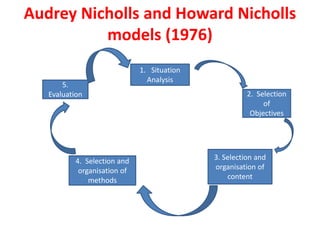
Audrey Nicholls and Howard Nicholls
models (1976)
5.
Evaluation
1. Situation
Analysis
2. Selection
of
Objectives
4. Selection and
organisation of
methods
3. Selection and
organisation of
content
Nicholls and Nicholls models (1976)
• Is a cyclic model that is responsive to needs
that are on going.
• The cyclic model allows for constant update of
the curriculum.
• Are flexible.
• Views the element as independent and
related.
• Involves situation analysis.
Nicholls and Nicholls models (1976)
• Nicholls and Nicholls (1974, p.65) refer to the process
of situation analysis when explaining the beginning
of curriculum development.
• “A situation which is made up of a number of factors
such as pupils” home and background, school, its
climate, its staff, facilities and equipment.
• Analysis of those factors, together with a self analysis,
followed by study of their implications for curriculum
planning constitutes one step towards the rational
approach of curriculum”.
Nicholls and Nicholls models (1976)
• The situation analysis
can take place at any
point on the cycle.
• Conducting a situational
analysis is fundamental
principle of effective
curriculum
development.
Analysis of factors which constitute the
situation:
• Cultural and social changes and expectations including
parental expectations, employer requirements,
community assumption and value, changing
relationships (e.g. between adults and children) and
ideology.
• Educational system requirements and challenges, e.g.
policy statements, examinations, local authority
expirations or demands or pressures, curriculum
projects, education research.
• The changing nature of the subject matter to be
taught.
• The potential contribution of teacher-support systems,
e.g. teacher training college, research institutes,
professional developments.
Analysis of factors which constitute the
situation:
• Flow of resources into the school, funding's, sponsors.
• Material resources including plant, equipment, and
potential for enhancing these.
• Pupils: aptitudes, abilities and defined education
needs.
• Teachers: value, attitudes, skills knowledge,
experience, social strengths and weaknesses, roles.
• School ethos and political structure: Common
assumptions and expectations including power
conformity to norms and dealing with deviance.
• Perceived and felt problems and shortcomings in
existing curriculum.
Nicholls and Nicholls models (1976)
• Developers commencing their task should ask
important questions such as, what do we
know about the context the students,
teachers, school environment – of this
curriculum and why it is a need?
• This provided then with an information base
to pose an even more fundamental question:
what do our learners need?
Approach to conduct a situational
analysis
• A recommended approach to conduct a
situational analysis involves four steps
• i) identify problems in contents;
• ii) select approach factors;
• iii) data collection; and analysis
• iv) make recommendations
Thank you

EDU560 Week 9 Lecture.pptx on cyclic model

  • 1.
    EDU560-Curriculum Studies & Practicesin Secondary Education Week 9 Lecture Cyclical / Rational models (Process) • Wheeler (1967) and Nicholls models (1976)
  • 2.
    (revision) Cyclical / Rationalmodels (Process) • Wheeler (1967) and Nicholls models (1976) • Views the curriculum process as circular or a continuing activity/ a process. • The Cyclical model is responsive to needs, • Are on-going, necessitating constant updating of the curriculum process. • They are flexible.
  • 3.
    (revision) Cyclical / Rationalmodels (Process) • These models view elements of the curriculum as interrelated and interdependent. • Unlike the objectives model, this model does not consider objectives to be important. • Content has its own value. Therefore, it (content) should not be selected on the basis of the achievement of objectives.
  • 4.
    D. K. (DarylKenneth) Wheeler (1967) curriculum model Wheeler, D. K. (1967) Curriculum Process, London, University of London Press.
  • 5.
    Wheeler’s (1967)Model • Wheeler’smodel for curriculum design is an improvement upon Tyler’s model. • Instead of a linear model, Wheeler developed a cyclical model (process). • Evaluation in Wheeler’s model is NOT terminal but the beginning of the cycle. • Findings from the evaluation are fed back into the objectives and the goals, which influence other stages.
  • 6.
    Wheeler’s (1967)Model Wheeler pointedout that: • Aims should be discussed as behaviours referring to the end product of learning which produces the ultimate goals. • These ultimate goals are the outcomes. • Aims are formulated from the general to the specific in curriculum planning. • This results in the formulation of objectives at both an enabling and a terminal level (at the end). • Content is distinguished from the learning experiences which determine that content.
  • 7.
    Strengths of Wheelersmodel • Provide logical sequence • Provide baseline data for objectives • Able to cope with changing circumstances • Provide flexibility (and relevant to school situations and more appropriate to current development by teachers)
  • 8.
    Weakness of Wheelersmodel • Evaluation will be time consuming. • Difficult and time consuming to identify problems during the cycle.
  • 9.
    Audrey Nicholls andHoward Nicholls models (1976) 5. Evaluation 1. Situation Analysis 2. Selection of Objectives 4. Selection and organisation of methods 3. Selection and organisation of content
  • 10.
    Nicholls and Nichollsmodels (1976) • Is a cyclic model that is responsive to needs that are on going. • The cyclic model allows for constant update of the curriculum. • Are flexible. • Views the element as independent and related. • Involves situation analysis.
  • 11.
    Nicholls and Nichollsmodels (1976) • Nicholls and Nicholls (1974, p.65) refer to the process of situation analysis when explaining the beginning of curriculum development. • “A situation which is made up of a number of factors such as pupils” home and background, school, its climate, its staff, facilities and equipment. • Analysis of those factors, together with a self analysis, followed by study of their implications for curriculum planning constitutes one step towards the rational approach of curriculum”.
  • 12.
    Nicholls and Nichollsmodels (1976) • The situation analysis can take place at any point on the cycle. • Conducting a situational analysis is fundamental principle of effective curriculum development.
  • 13.
    Analysis of factorswhich constitute the situation: • Cultural and social changes and expectations including parental expectations, employer requirements, community assumption and value, changing relationships (e.g. between adults and children) and ideology. • Educational system requirements and challenges, e.g. policy statements, examinations, local authority expirations or demands or pressures, curriculum projects, education research. • The changing nature of the subject matter to be taught. • The potential contribution of teacher-support systems, e.g. teacher training college, research institutes, professional developments.
  • 14.
    Analysis of factorswhich constitute the situation: • Flow of resources into the school, funding's, sponsors. • Material resources including plant, equipment, and potential for enhancing these. • Pupils: aptitudes, abilities and defined education needs. • Teachers: value, attitudes, skills knowledge, experience, social strengths and weaknesses, roles. • School ethos and political structure: Common assumptions and expectations including power conformity to norms and dealing with deviance. • Perceived and felt problems and shortcomings in existing curriculum.
  • 15.
    Nicholls and Nichollsmodels (1976) • Developers commencing their task should ask important questions such as, what do we know about the context the students, teachers, school environment – of this curriculum and why it is a need? • This provided then with an information base to pose an even more fundamental question: what do our learners need?
  • 16.
    Approach to conducta situational analysis • A recommended approach to conduct a situational analysis involves four steps • i) identify problems in contents; • ii) select approach factors; • iii) data collection; and analysis • iv) make recommendations
  • 17.