CAVITE COMMUNITY ACADEMY, INC.
New Public Market Rd. Ibayo Silangan
Naic, Cavite
Government Recognition No. 461 Series of 1947
“The Center of Academic Excellence through Holistic Development”
Curriculum Map (CMAP)
Science 7
1st
Quarter
A.Y. 2024-2025
AYLEEN R. BARREDO
Subject Teacher
CAVITE COMMUNITY ACADEMY, INC.
New Public Market Rd. Ibayo Silangan Naic, Cavite
Government Recognition No. 461 Series of 1947
Center of Academic Excellence through Holistic Development
CURRICULUM MAP IN SCIENCE 7
Phase 1: SUBJECT COURSE DESCRIPTION
At the end of Grade 7, learners use models to describe the Particle theory of matter. They use diagrams and illustrations to explain the motion and arrangement of particles
during changes of state. They explain the role of solute and solvent in solutions and the factors that affect solubility. They demonstrate skills to plan and conduct a scientific
investigation making accurate measurements and using standard units. Learners describe the parts and function of a compound microscope and use this to identify cell
structure.They describe the cell as the basic unit of life and that some organisms are unicellular and some multicellular. They explain that there are two types of cell division,
and that reproduction can occur through sexual or asexual processes. They use diagrams to make connections between organisms and their environment at various levels of
organization. They explain the process of energy transfer through trophic levels in food chains. Learners use systems to analyze and explain natural phenomena and explain
the dynamics of faults and earthquakes. They identify and assess the earthquake risks for their local communities using authentic and reliable secondary data. They use
national and local disaster Page 21 of 69 awareness and risk reduction management plans to identify and explain to others what to do in the event of an earthquake and/or
tsunami. Learners explain the cause and effects of secondary impacts that some coastal communities may experience should a tsunami be produced by either a local or
distant earthquake. Learners identify and explain how Solar energy influences the atmosphere and weather systems of the Earth and that these are the dominant processes
that influence the climate of the country.
Learners employ scientific techniques, concepts, and models to investigate forces and motion, and describe their findings using scientific language, force diagrams,and
distance-time graphs. They use their curiosity, knowledge and understanding, and skills to propose solutions to problems related to motion and energy. They use scientific
investigations to describe the properties of heat energy. They apply their knowledge and problem-solving skills in everyday situations and explore how modern technologies
may be used to overcome current global energy concerns.
Prepared by: Checked by: Noted by: Approved by:
AYLEEN R. BARREDO Fe M. Alcantara MARY JOYCE C. TANILON, LPT SANNY L. SUMULAT, LPT WILFREDO I. MADLANGBAYAN, MA Ed, LPT
Subject Teacher Dept. Head Academic Head School Vice Principal School Principal
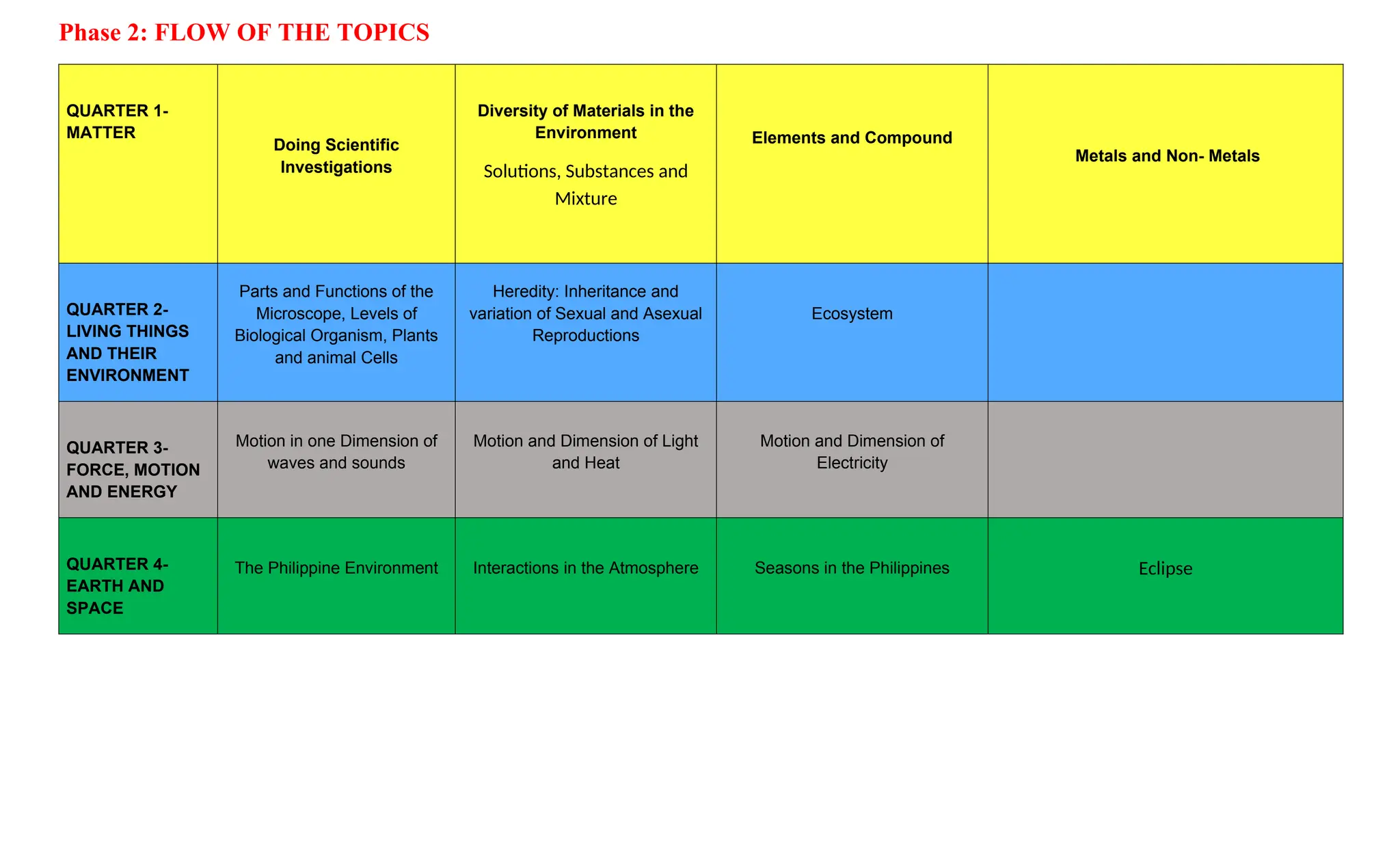
Phase 2: FLOW OF THE TOPICS
QUARTER 1-
MATTER
Doing Scientific
Investigations
Diversity of Materials in the
Environment
Solutions, Substances and
Mixture
Elements and Compound
Metals and Non- Metals
QUARTER 2-
LIVING THINGS
AND THEIR
ENVIRONMENT
Parts and Functions of the
Microscope, Levels of
Biological Organism, Plants
and animal Cells
Heredity: Inheritance and
variation of Sexual and Asexual
Reproductions
Ecosystem
QUARTER 3-
FORCE, MOTION
AND ENERGY
Motion in one Dimension of
waves and sounds
Motion and Dimension of Light
and Heat
Motion and Dimension of
Electricity
QUARTER 4-
EARTH AND
SPACE
The Philippine Environment Interactions in the Atmosphere Seasons in the Philippines Eclipse
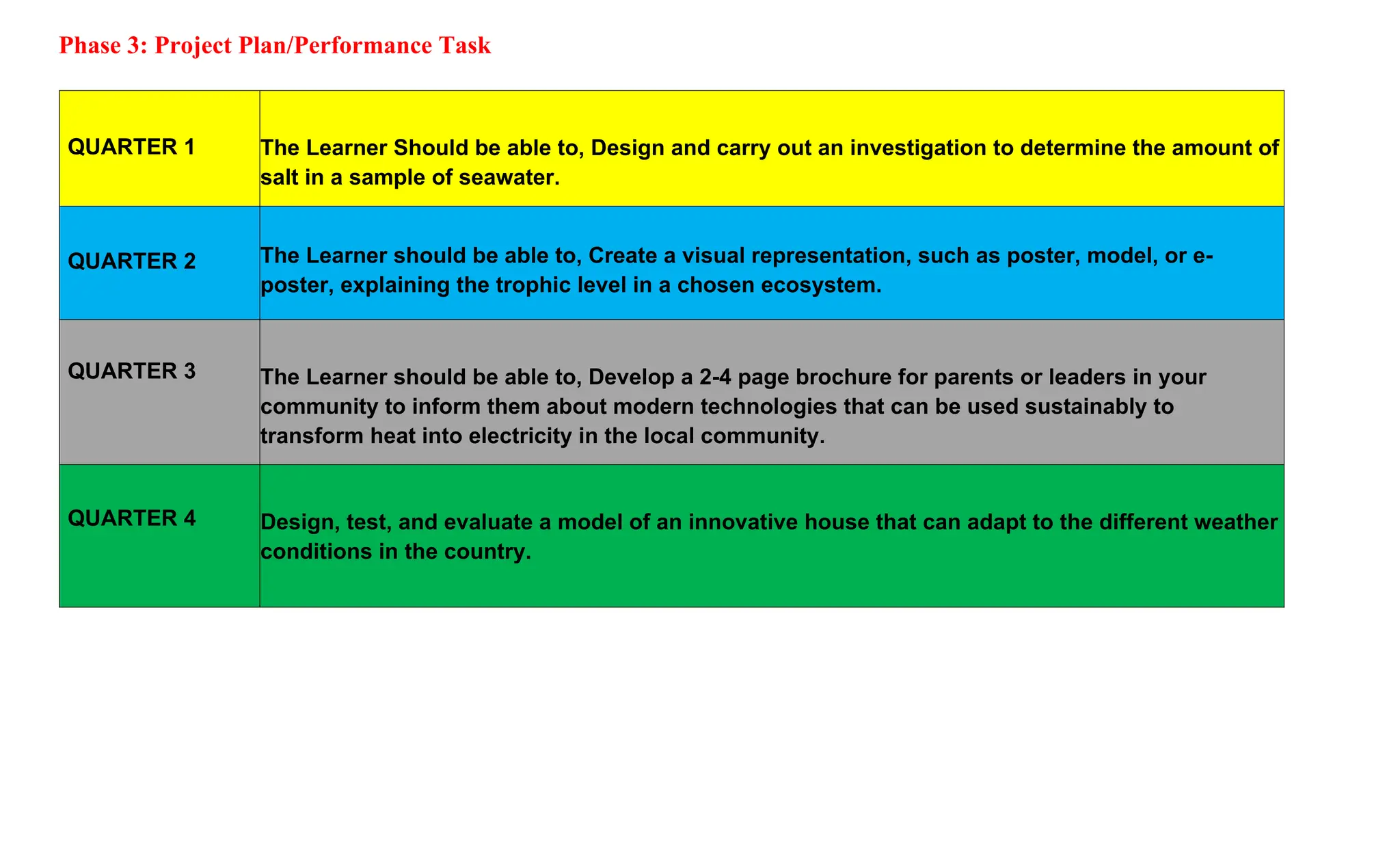
Phase 3: Project Plan/Performance Task
QUARTER 1 The Learner Should be able to, Design and carry out an investigation to determine the amount of
salt in a sample of seawater.
QUARTER 2 The Learner should be able to, Create a visual representation, such as poster, model, or e-
poster, explaining the trophic level in a chosen ecosystem.
QUARTER 3 The Learner should be able to, Develop a 2-4 page brochure for parents or leaders in your
community to inform them about modern technologies that can be used sustainably to
transform heat into electricity in the local community.
QUARTER 4 Design, test, and evaluate a model of an innovative house that can adapt to the different weather
conditions in the country.
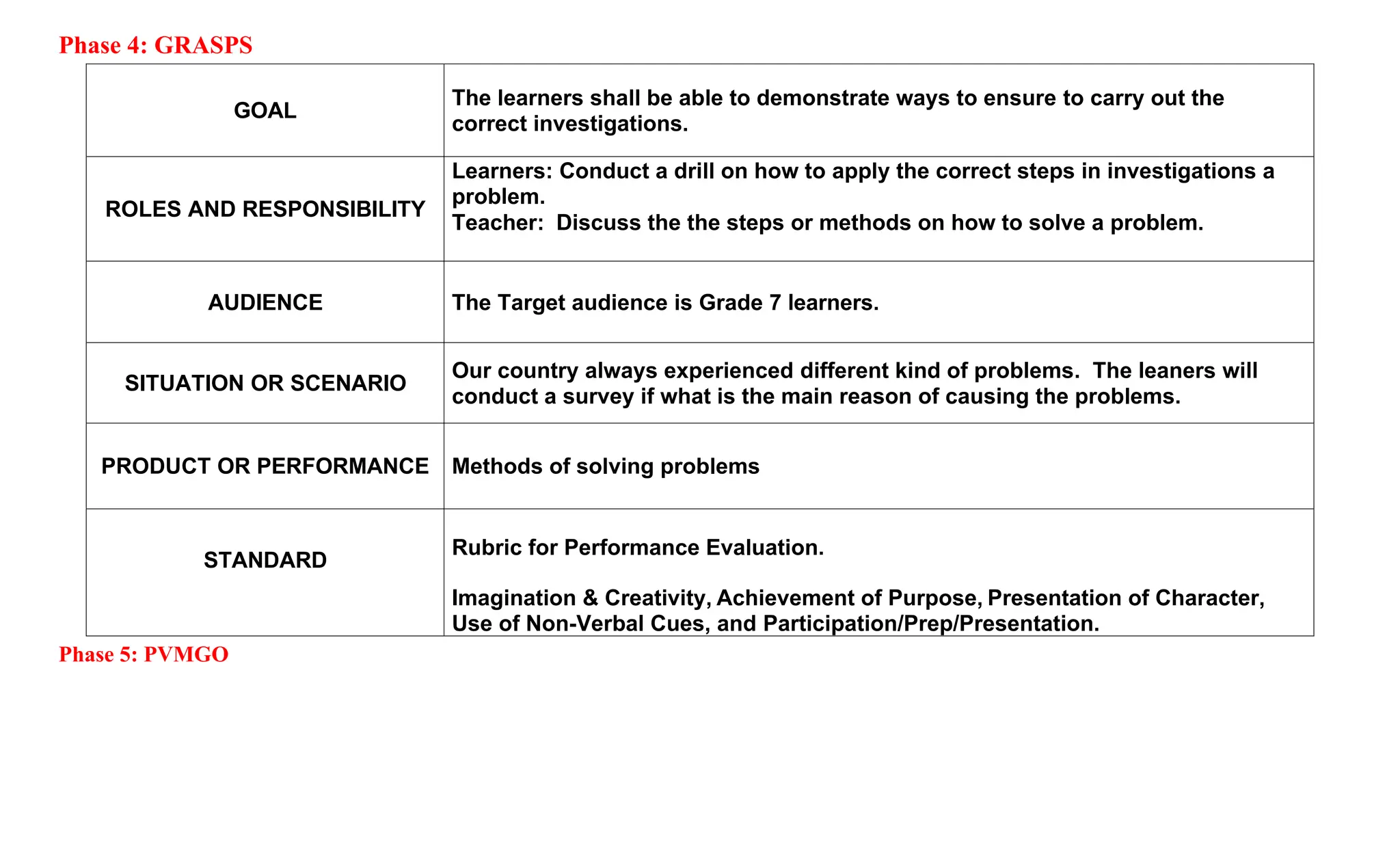
Phase 4: GRASPS
Phase 5: PVMGO
GOAL
The learners shall be able to demonstrate ways to ensure to carry out the
correct investigations.
ROLES AND RESPONSIBILITY
Learners: Conduct a drill on how to apply the correct steps in investigations a
problem.
Teacher: Discuss the the steps or methods on how to solve a problem.
AUDIENCE The Target audience is Grade 7 learners.
SITUATION OR SCENARIO
Our country always experienced different kind of problems. The leaners will
conduct a survey if what is the main reason of causing the problems.
PRODUCT OR PERFORMANCE Methods of solving problems
STANDARD
Rubric for Performance Evaluation.
Imagination & Creativity, Achievement of Purpose, Presentation of Character,
Use of Non-Verbal Cues, and Participation/Prep/Presentation.
Phase 6: CURRICULUM MAP
SUBJECT: SCIENCE
GRADE LEVEL: GRADE 7
CURRICULUM MAP IN SCIENCE 7
CAVITE COMMUNITY ACADEMY INC.
Naic, Cavite
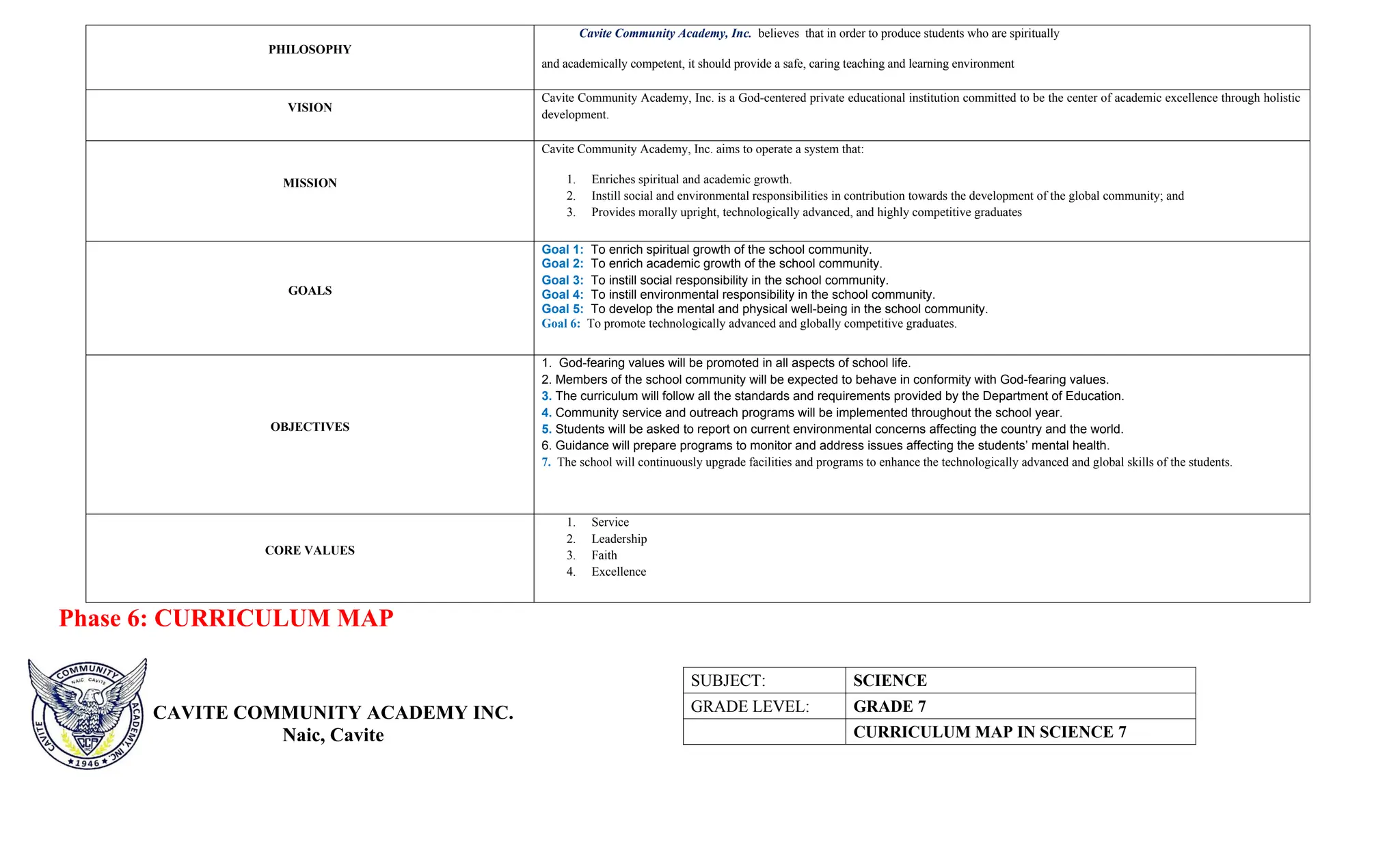
PHILOSOPHY
Cavite Community Academy, Inc. believes that in order to produce students who are spiritually
and academically competent, it should provide a safe, caring teaching and learning environment
VISION
Cavite Community Academy, Inc. is a God-centered private educational institution committed to be the center of academic excellence through holistic
development.
MISSION
Cavite Community Academy, Inc. aims to operate a system that:
1. Enriches spiritual and academic growth.
2. Instill social and environmental responsibilities in contribution towards the development of the global community; and
3. Provides morally upright, technologically advanced, and highly competitive graduates
GOALS
Goal 1: To enrich spiritual growth of the school community.
Goal 2: To enrich academic growth of the school community.
Goal 3: To instill social responsibility in the school community.
Goal 4: To instill environmental responsibility in the school community.
Goal 5: To develop the mental and physical well-being in the school community.
Goal 6: To promote technologically advanced and globally competitive graduates.
OBJECTIVES
1. God-fearing values will be promoted in all aspects of school life.
2. Members of the school community will be expected to behave in conformity with God-fearing values.
3. The curriculum will follow all the standards and requirements provided by the Department of Education.
4. Community service and outreach programs will be implemented throughout the school year.
5. Students will be asked to report on current environmental concerns affecting the country and the world.
6. Guidance will prepare programs to monitor and address issues affecting the students’ mental health.
7. The school will continuously upgrade facilities and programs to enhance the technologically advanced and global skills of the students.
CORE VALUES
1. Service
2. Leadership
3. Faith
4. Excellence
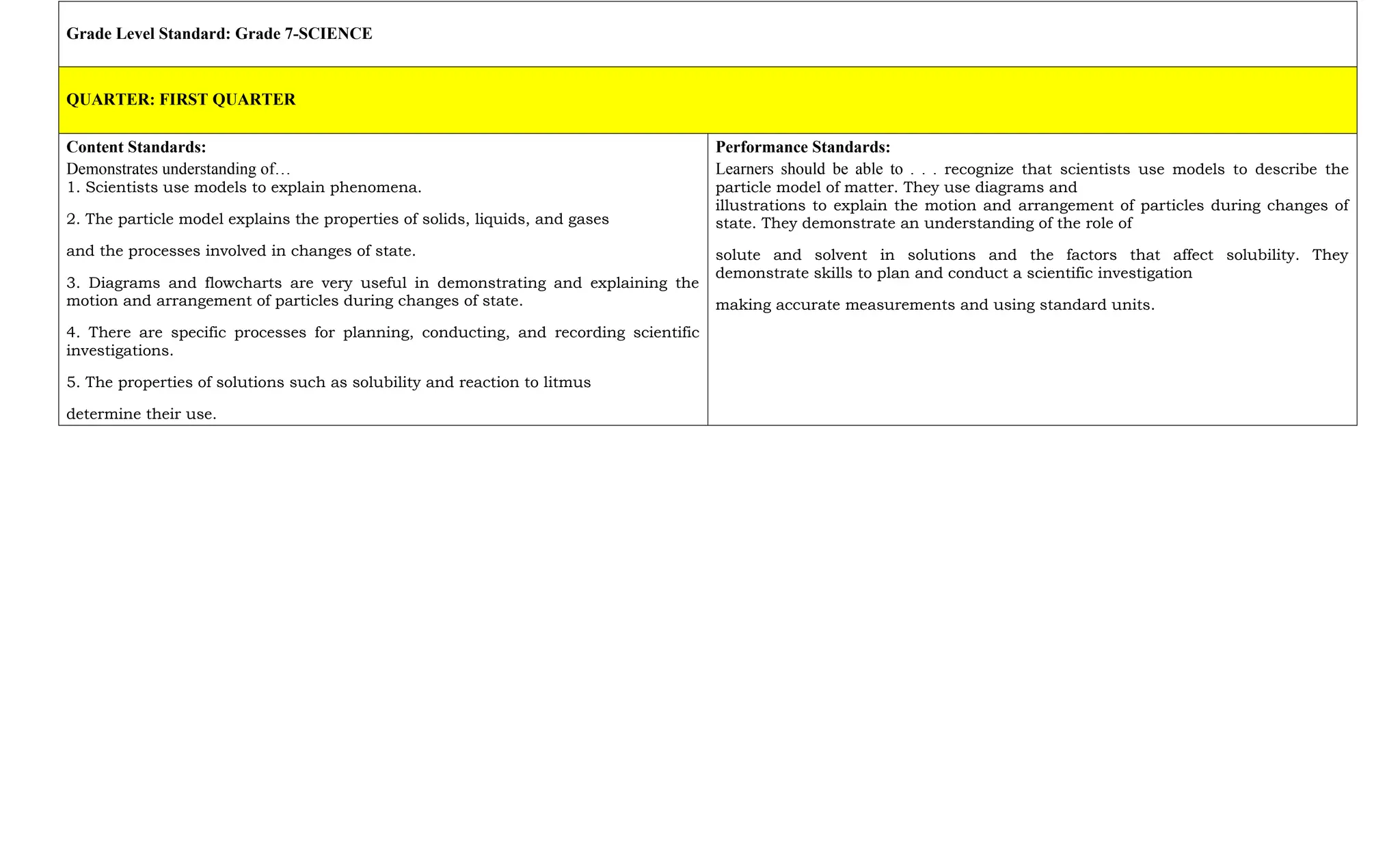
Grade Level Standard: Grade 7-SCIENCE
QUARTER: FIRST QUARTER
Content Standards:
Demonstrates understanding of…
1. Scientists use models to explain phenomena.
2. The particle model explains the properties of solids, liquids, and gases
and the processes involved in changes of state.
3. Diagrams and flowcharts are very useful in demonstrating and explaining the
motion and arrangement of particles during changes of state.
4. There are specific processes for planning, conducting, and recording scientific
investigations.
5. The properties of solutions such as solubility and reaction to litmus
determine their use.
Performance Standards:
Learners should be able to . . . recognize that scientists use models to describe the
particle model of matter. They use diagrams and
illustrations to explain the motion and arrangement of particles during changes of
state. They demonstrate an understanding of the role of
solute and solvent in solutions and the factors that affect solubility. They
demonstrate skills to plan and conduct a scientific investigation
making accurate measurements and using standard units.
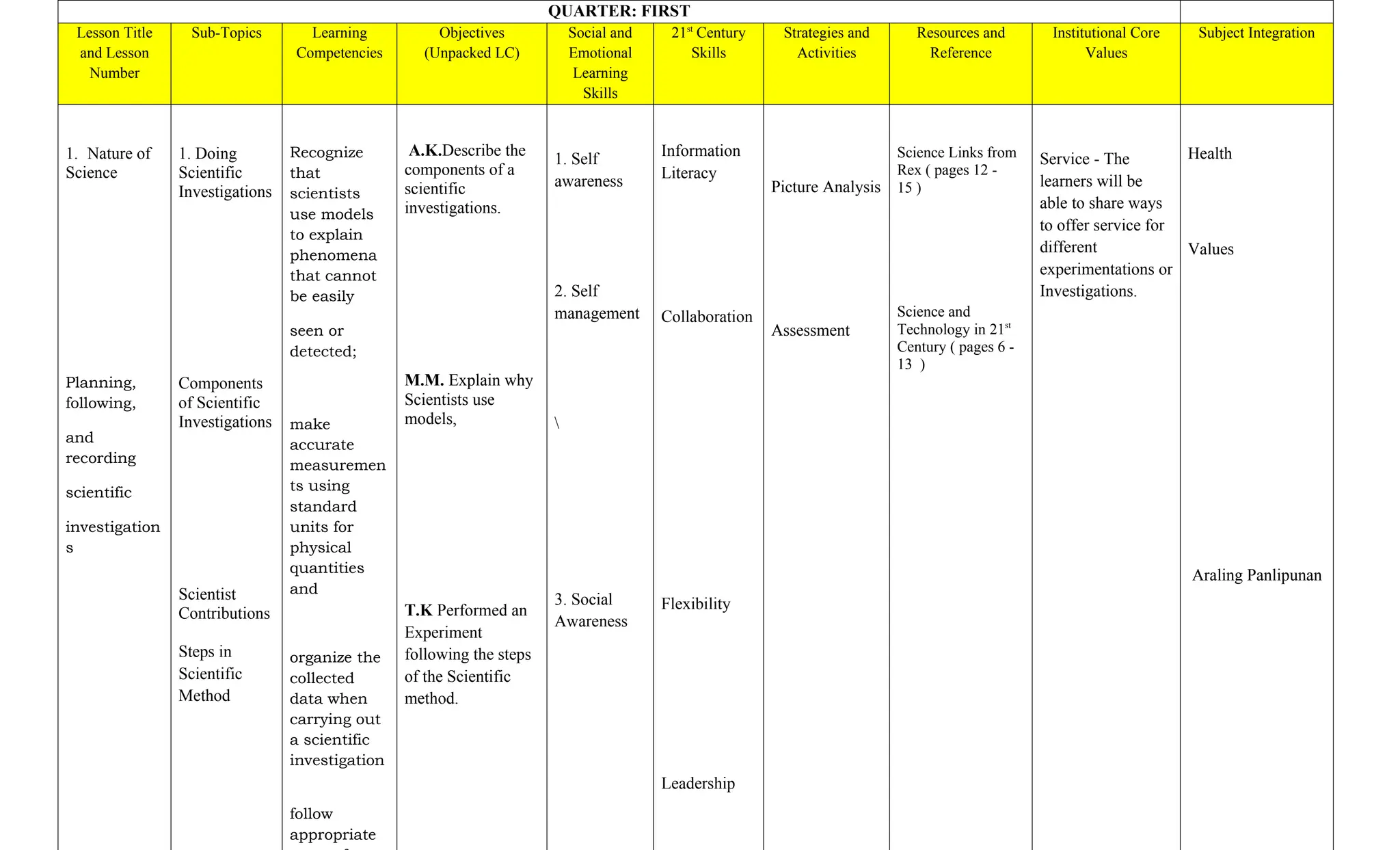
QUARTER: FIRST
Lesson Title
and Lesson
Number
Sub-Topics Learning
Competencies
Objectives
(Unpacked LC)
Social and
Emotional
Learning
Skills
21st
Century
Skills
Strategies and
Activities
Resources and
Reference
Institutional Core
Values
Subject Integration
1. Nature of
Science
Planning,
following,
and
recording
scientific
investigation
s
1. Doing
Scientific
Investigations
Components
of Scientific
Investigations
Scientist
Contributions
Steps in
Scientific
Method
Recognize
that
scientists
use models
to explain
phenomena
that cannot
be easily
seen or
detected;
make
accurate
measuremen
ts using
standard
units for
physical
quantities
and
organize the
collected
data when
carrying out
a scientific
investigation
follow
appropriate
A.K.Describe the
components of a
scientific
investigations.
M.M. Explain why
Scientists use
models,
T.K Performed an
Experiment
following the steps
of the Scientific
method.
1. Self
awareness
2. Self
management

3. Social
Awareness
Information
Literacy
Collaboration
Flexibility
Leadership
Picture Analysis
Assessment
Science Links from
Rex ( pages 12 -
15 )
Science and
Technology in 21st
Century ( pages 6 -
13 )
Service - The
learners will be
able to share ways
to offer service for
different
experimentations or
Investigations.
Health
Values
Araling Panlipunan
QUARTER: FIRST
Lesson Title
and Lesson
Number
Sub-Topics Learning
Competencies
Objectives
(Unpacked LC)
Social and
Emotional
Learning
Skills
21st
Century
Skills
Strategies and
Activities
Resources and
Reference
Institutional Core
Values
Subject Integration
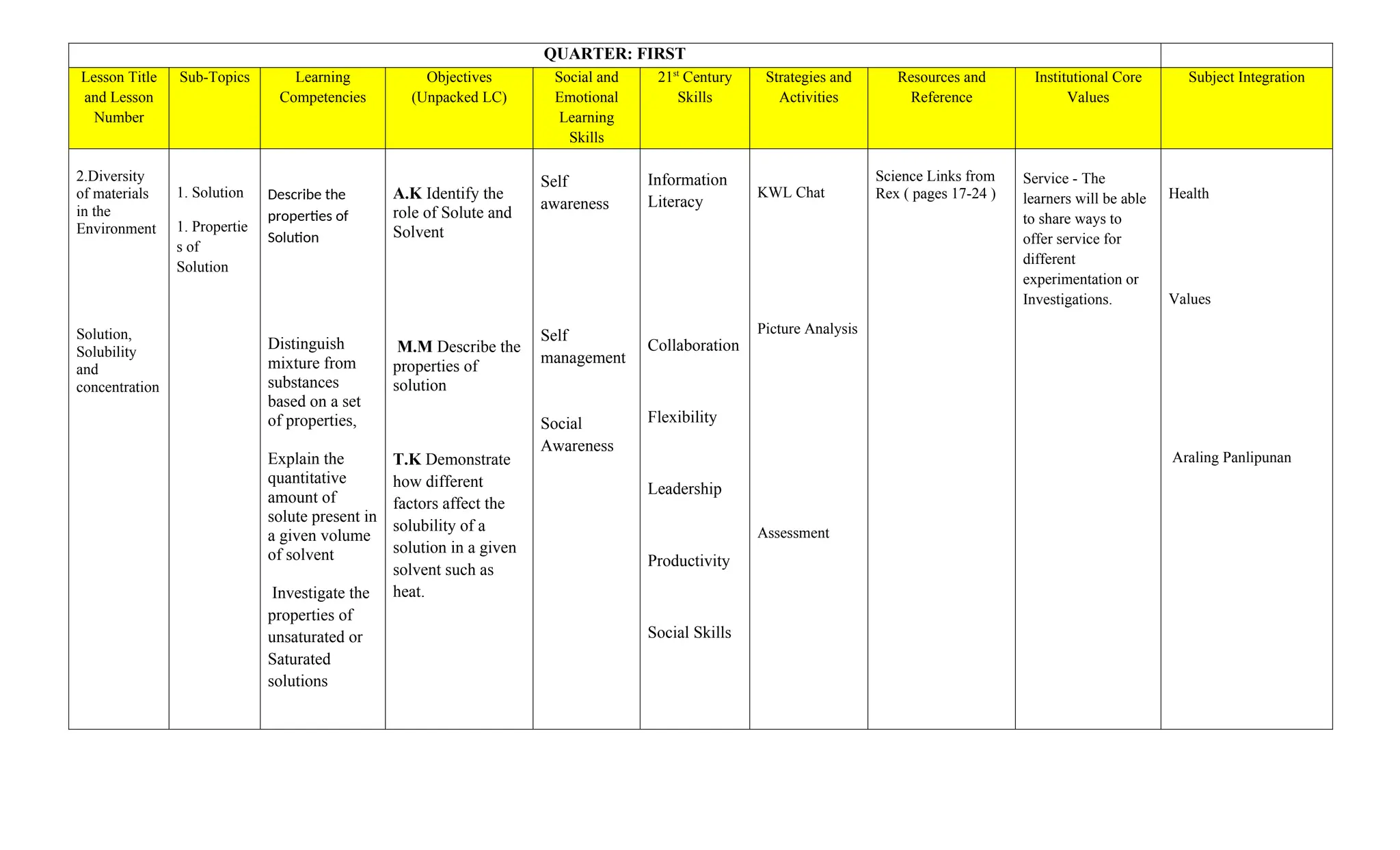
2.Diversity
of materials
in the
Environment
Solution,
Solubility
and
concentration
1. Solution
1. Propertie
s of
Solution
Describe the
properties of
Solution
Distinguish
mixture from
substances
based on a set
of properties,
Explain the
quantitative
amount of
solute present in
a given volume
of solvent
Investigate the
properties of
unsaturated or
Saturated
solutions
A.K Identify the
role of Solute and
Solvent
M.M Describe the
properties of
solution
T.K Demonstrate
how different
factors affect the
solubility of a
solution in a given
solvent such as
heat.
Self
awareness
Self
management
Social
Awareness
Information
Literacy
Collaboration
Flexibility
Leadership
Productivity
Social Skills
KWL Chat
Picture Analysis
Assessment
Science Links from
Rex ( pages 17-24 )
Service - The
learners will be able
to share ways to
offer service for
different
experimentation or
Investigations.
Health
Values
Araling Panlipunan
QUARTER: FIRST
Lesson Title
and Lesson
Number
Sub-Topics Learning
Competencies
Objectives
(Unpacked LC)
Social and
Emotional
Learning
Skills
21st
Century
Skills
Strategies and
Activities
Resources and
Reference
Institutional Core
Values
Subject Integration
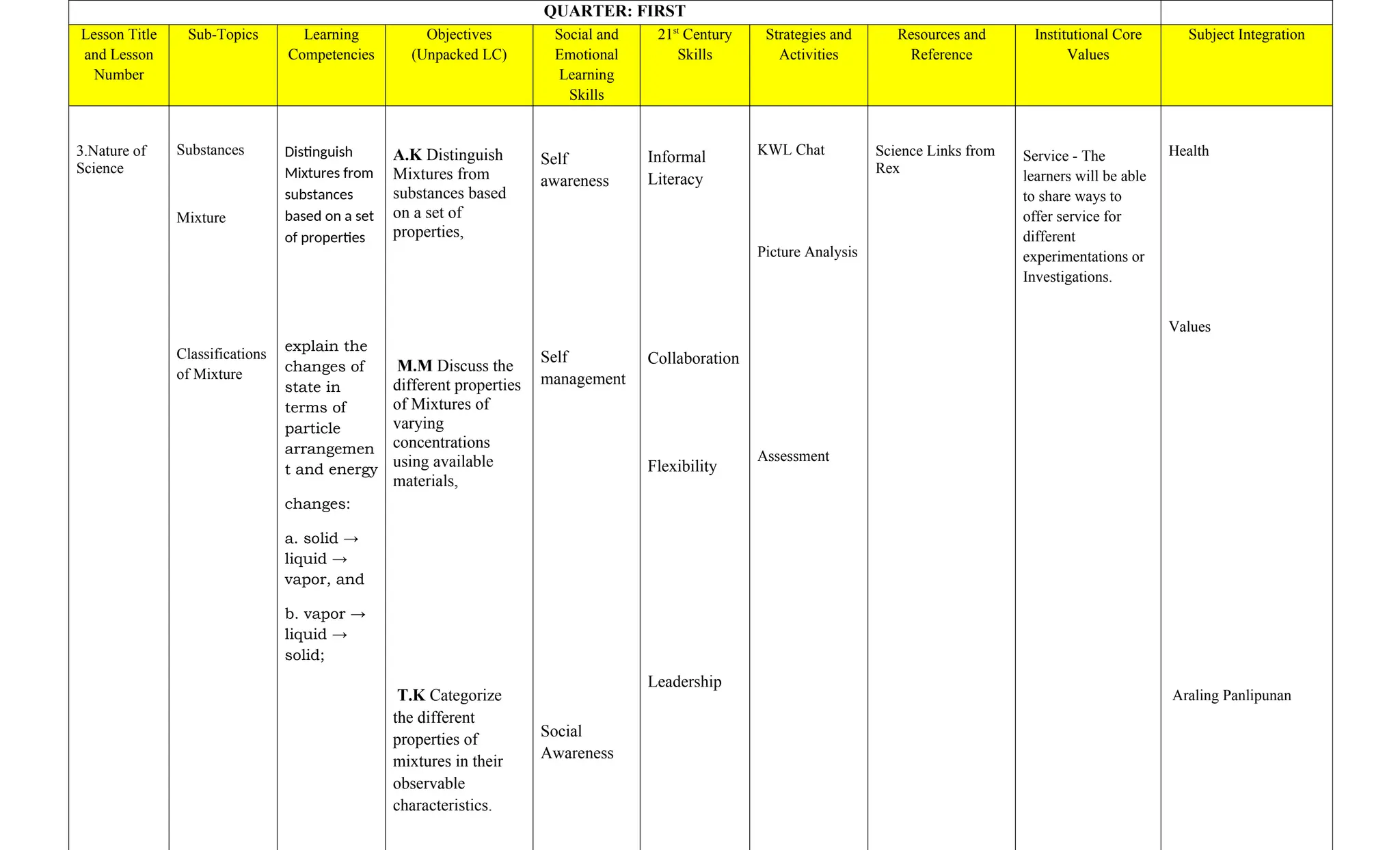
3.Nature of
Science
Substances
Mixture
Classifications
of Mixture
Distinguish
Mixtures from
substances
based on a set
of properties
explain the
changes of
state in
terms of
particle
arrangemen
t and energy
changes:
a. solid →
liquid →
vapor, and
b. vapor →
liquid →
solid;
A.K Distinguish
Mixtures from
substances based
on a set of
properties,
M.M Discuss the
different properties
of Mixtures of
varying
concentrations
using available
materials,
T.K Categorize
the different
properties of
mixtures in their
observable
characteristics.
Self
awareness
Self
management
Social
Awareness
Informal
Literacy
Collaboration
Flexibility
Leadership
KWL Chat
Picture Analysis
Assessment
Science Links from
Rex
Service - The
learners will be able
to share ways to
offer service for
different
experimentations or
Investigations.
Health
Values
Araling Panlipunan
QUARTER: FIRST
Lesson Title
and Lesson
Number
Sub-Topics Learning
Competencies
Objectives
(Unpacked LC)
Social and
Emotional
Learning
Skills
21st
Century
Skills
Strategies and
Activities
Resources and
Reference
Institutional Core
Values
Subject Integration
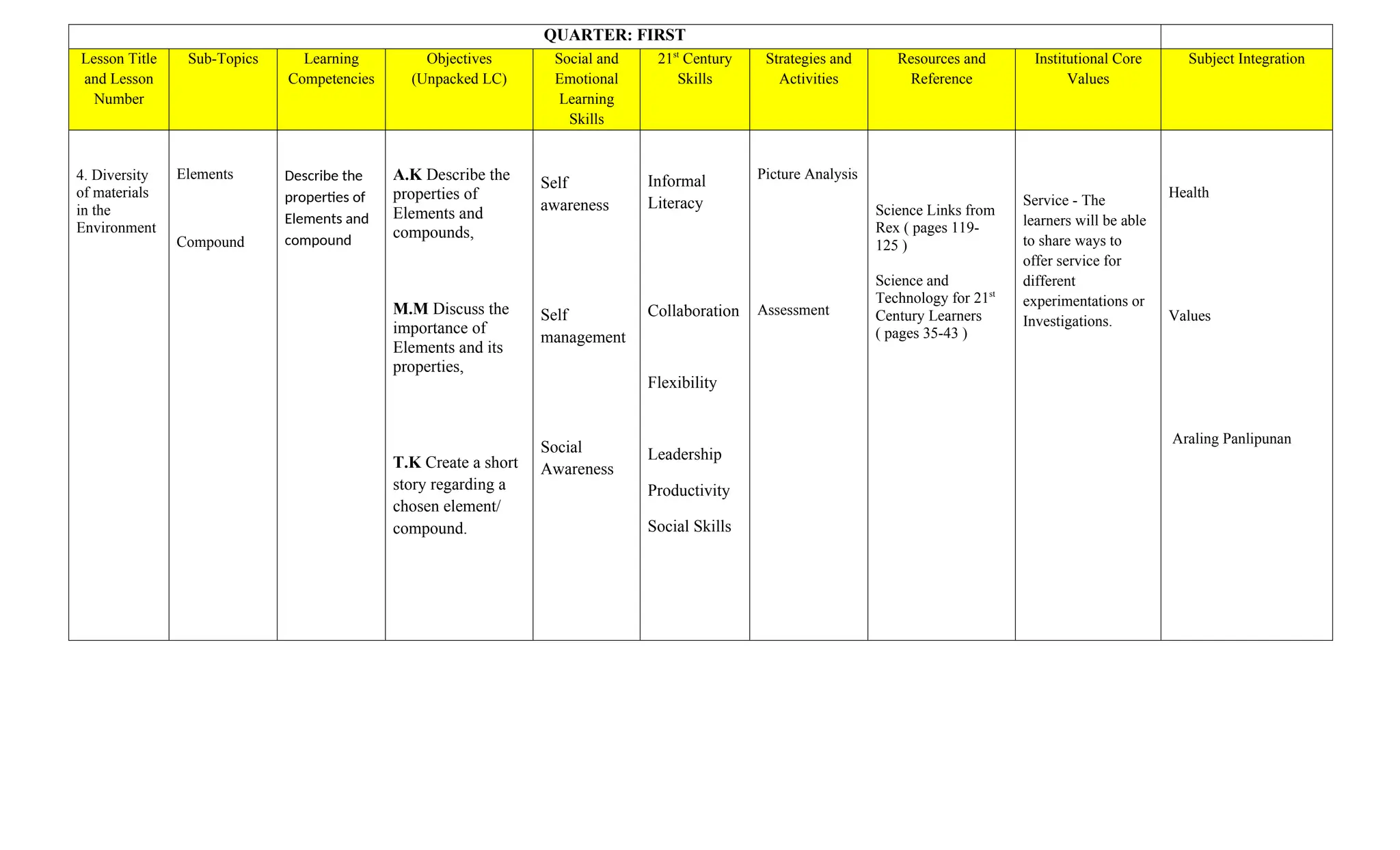
4. Diversity
of materials
in the
Environment
Elements
Compound
Describe the
properties of
Elements and
compound
A.K Describe the
properties of
Elements and
compounds,
M.M Discuss the
importance of
Elements and its
properties,
T.K Create a short
story regarding a
chosen element/
compound.
Self
awareness
Self
management
Social
Awareness
Informal
Literacy
Collaboration
Flexibility
Leadership
Productivity
Social Skills
Picture Analysis
Assessment
Science Links from
Rex ( pages 119-
125 )
Science and
Technology for 21st
Century Learners
( pages 35-43 )
Service - The
learners will be able
to share ways to
offer service for
different
experimentations or
Investigations.
Health
Values
Araling Panlipunan
QUARTER: FIRST
Lesson Title
and Lesson
Number
Sub-Topics Learning
Competencies
Objectives
(Unpacked LC)
Social and
Emotional
Learning
Skills
21st
Century
Skills
Strategies and
Activities
Resources and
Reference
Institutional Core
Values
Subject Integration
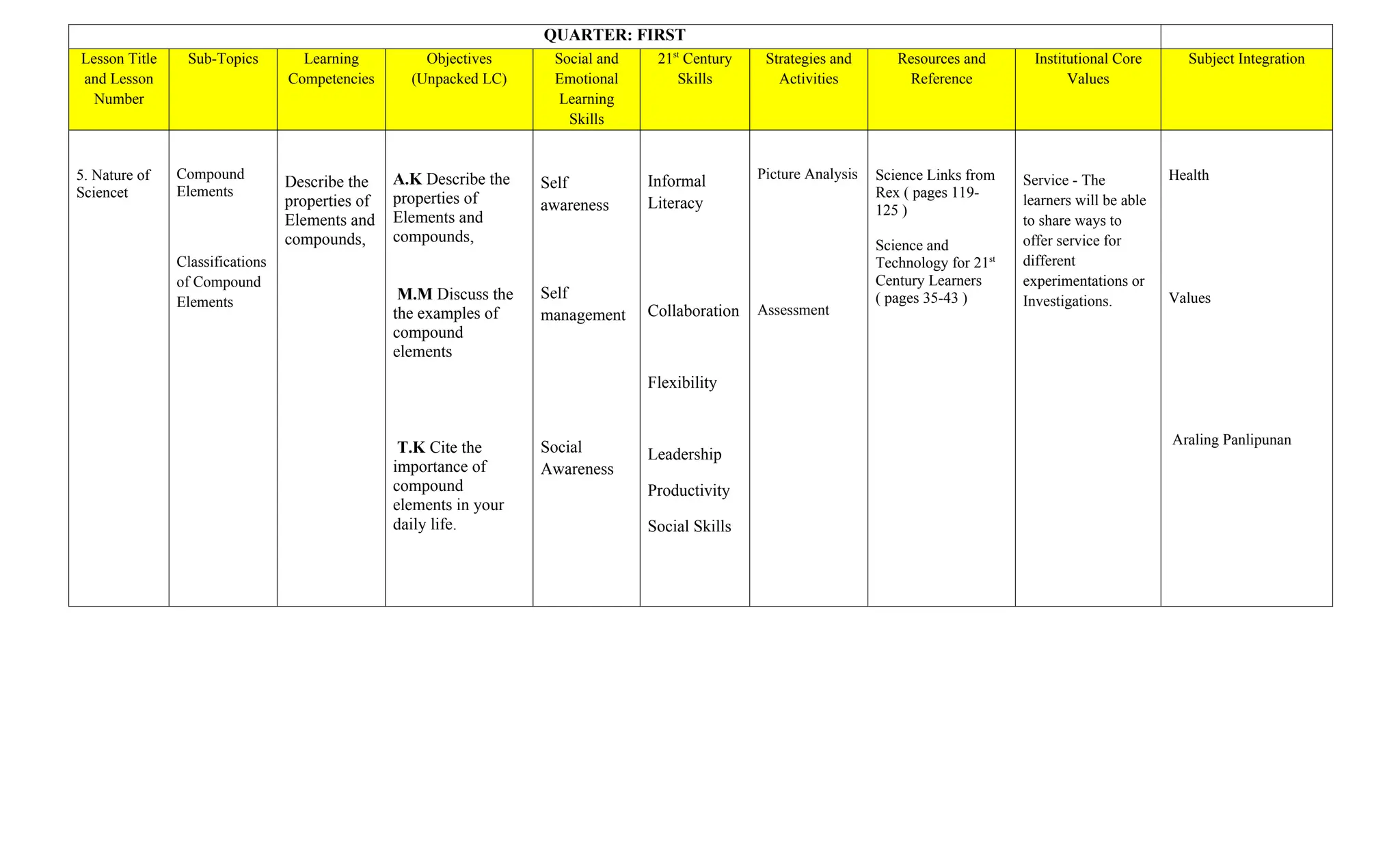
5. Nature of
Sciencet
Compound
Elements
Classifications
of Compound
Elements
Describe the
properties of
Elements and
compounds,
A.K Describe the
properties of
Elements and
compounds,
M.M Discuss the
the examples of
compound
elements
T.K Cite the
importance of
compound
elements in your
daily life.
Self
awareness
Self
management
Social
Awareness
Informal
Literacy
Collaboration
Flexibility
Leadership
Productivity
Social Skills
Picture Analysis
Assessment
Science Links from
Rex ( pages 119-
125 )
Science and
Technology for 21st
Century Learners
( pages 35-43 )
Service - The
learners will be able
to share ways to
offer service for
different
experimentations or
Investigations.
Health
Values
Araling Panlipunan
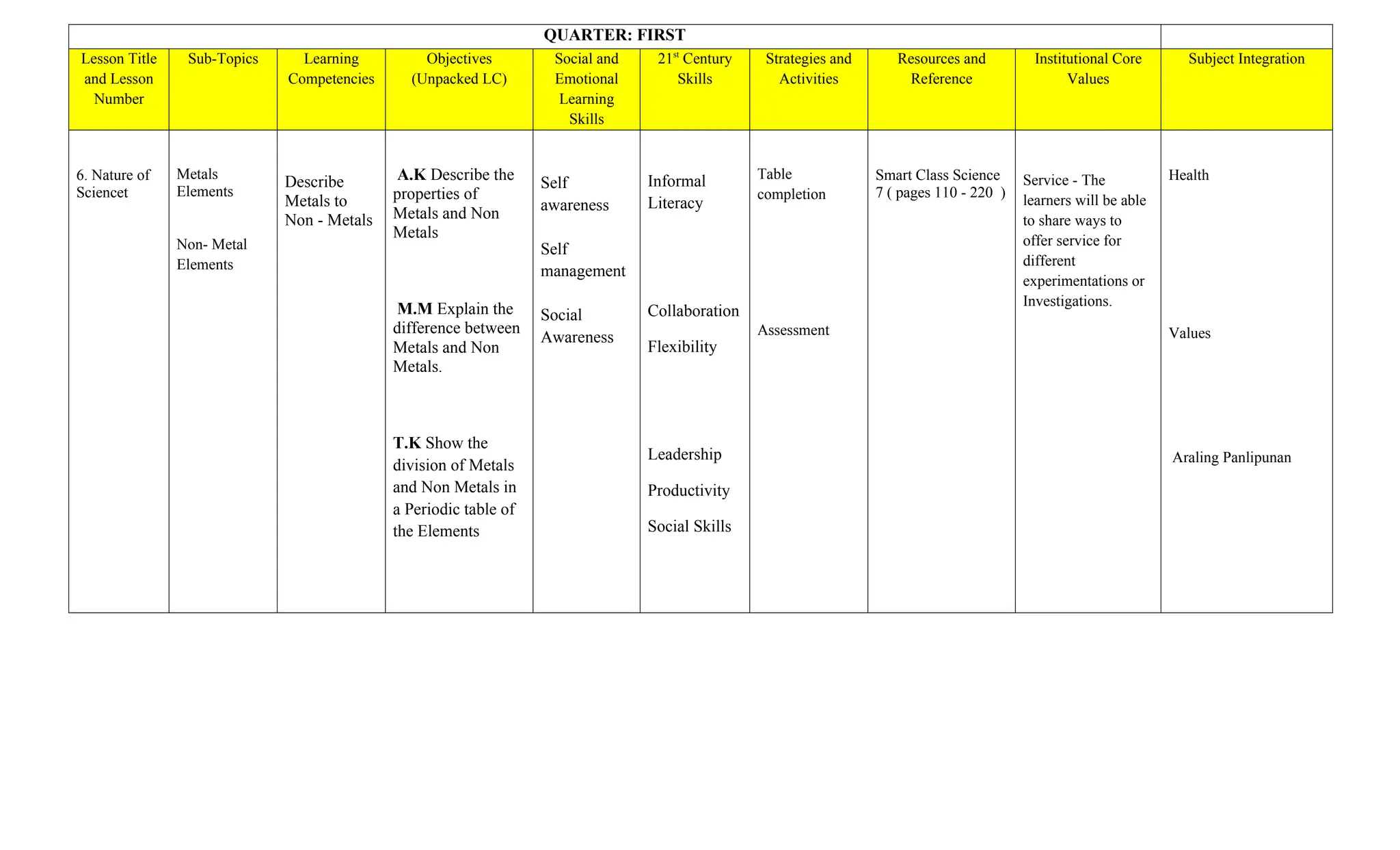
QUARTER: FIRST
Lesson Title
and Lesson
Number
Sub-Topics Learning
Competencies
Objectives
(Unpacked LC)
Social and
Emotional
Learning
Skills
21st
Century
Skills
Strategies and
Activities
Resources and
Reference
Institutional Core
Values
Subject Integration
6. Nature of
Sciencet
Metals
Elements
Non- Metal
Elements
Describe
Metals to
Non - Metals
A.K Describe the
properties of
Metals and Non
Metals
M.M Explain the
difference between
Metals and Non
Metals.
T.K Show the
division of Metals
and Non Metals in
a Periodic table of
the Elements
Self
awareness
Self
management
Social
Awareness
Informal
Literacy
Collaboration
Flexibility
Leadership
Productivity
Social Skills
Table
completion
Assessment
Smart Class Science
7 ( pages 110 - 220 )
Service - The
learners will be able
to share ways to
offer service for
different
experimentations or
Investigations.
Health
Values
Araling Panlipunan

Curriculum Mapping SCIENCE G7 Quarter 1

  • 1.
    CAVITE COMMUNITY ACADEMY,INC. New Public Market Rd. Ibayo Silangan Naic, Cavite Government Recognition No. 461 Series of 1947 “The Center of Academic Excellence through Holistic Development” Curriculum Map (CMAP) Science 7 1st Quarter A.Y. 2024-2025 AYLEEN R. BARREDO Subject Teacher CAVITE COMMUNITY ACADEMY, INC. New Public Market Rd. Ibayo Silangan Naic, Cavite Government Recognition No. 461 Series of 1947
  • 2.
    Center of AcademicExcellence through Holistic Development CURRICULUM MAP IN SCIENCE 7 Phase 1: SUBJECT COURSE DESCRIPTION At the end of Grade 7, learners use models to describe the Particle theory of matter. They use diagrams and illustrations to explain the motion and arrangement of particles during changes of state. They explain the role of solute and solvent in solutions and the factors that affect solubility. They demonstrate skills to plan and conduct a scientific investigation making accurate measurements and using standard units. Learners describe the parts and function of a compound microscope and use this to identify cell structure.They describe the cell as the basic unit of life and that some organisms are unicellular and some multicellular. They explain that there are two types of cell division, and that reproduction can occur through sexual or asexual processes. They use diagrams to make connections between organisms and their environment at various levels of organization. They explain the process of energy transfer through trophic levels in food chains. Learners use systems to analyze and explain natural phenomena and explain the dynamics of faults and earthquakes. They identify and assess the earthquake risks for their local communities using authentic and reliable secondary data. They use national and local disaster Page 21 of 69 awareness and risk reduction management plans to identify and explain to others what to do in the event of an earthquake and/or tsunami. Learners explain the cause and effects of secondary impacts that some coastal communities may experience should a tsunami be produced by either a local or distant earthquake. Learners identify and explain how Solar energy influences the atmosphere and weather systems of the Earth and that these are the dominant processes that influence the climate of the country. Learners employ scientific techniques, concepts, and models to investigate forces and motion, and describe their findings using scientific language, force diagrams,and distance-time graphs. They use their curiosity, knowledge and understanding, and skills to propose solutions to problems related to motion and energy. They use scientific investigations to describe the properties of heat energy. They apply their knowledge and problem-solving skills in everyday situations and explore how modern technologies may be used to overcome current global energy concerns. Prepared by: Checked by: Noted by: Approved by: AYLEEN R. BARREDO Fe M. Alcantara MARY JOYCE C. TANILON, LPT SANNY L. SUMULAT, LPT WILFREDO I. MADLANGBAYAN, MA Ed, LPT Subject Teacher Dept. Head Academic Head School Vice Principal School Principal
  • 3.
    Phase 2: FLOWOF THE TOPICS QUARTER 1- MATTER Doing Scientific Investigations Diversity of Materials in the Environment Solutions, Substances and Mixture Elements and Compound Metals and Non- Metals QUARTER 2- LIVING THINGS AND THEIR ENVIRONMENT Parts and Functions of the Microscope, Levels of Biological Organism, Plants and animal Cells Heredity: Inheritance and variation of Sexual and Asexual Reproductions Ecosystem QUARTER 3- FORCE, MOTION AND ENERGY Motion in one Dimension of waves and sounds Motion and Dimension of Light and Heat Motion and Dimension of Electricity QUARTER 4- EARTH AND SPACE The Philippine Environment Interactions in the Atmosphere Seasons in the Philippines Eclipse
  • 4.
    Phase 3: ProjectPlan/Performance Task QUARTER 1 The Learner Should be able to, Design and carry out an investigation to determine the amount of salt in a sample of seawater. QUARTER 2 The Learner should be able to, Create a visual representation, such as poster, model, or e- poster, explaining the trophic level in a chosen ecosystem. QUARTER 3 The Learner should be able to, Develop a 2-4 page brochure for parents or leaders in your community to inform them about modern technologies that can be used sustainably to transform heat into electricity in the local community. QUARTER 4 Design, test, and evaluate a model of an innovative house that can adapt to the different weather conditions in the country.
  • 5.
    Phase 4: GRASPS Phase5: PVMGO GOAL The learners shall be able to demonstrate ways to ensure to carry out the correct investigations. ROLES AND RESPONSIBILITY Learners: Conduct a drill on how to apply the correct steps in investigations a problem. Teacher: Discuss the the steps or methods on how to solve a problem. AUDIENCE The Target audience is Grade 7 learners. SITUATION OR SCENARIO Our country always experienced different kind of problems. The leaners will conduct a survey if what is the main reason of causing the problems. PRODUCT OR PERFORMANCE Methods of solving problems STANDARD Rubric for Performance Evaluation. Imagination & Creativity, Achievement of Purpose, Presentation of Character, Use of Non-Verbal Cues, and Participation/Prep/Presentation.
  • 6.
    Phase 6: CURRICULUMMAP SUBJECT: SCIENCE GRADE LEVEL: GRADE 7 CURRICULUM MAP IN SCIENCE 7 CAVITE COMMUNITY ACADEMY INC. Naic, Cavite PHILOSOPHY Cavite Community Academy, Inc. believes that in order to produce students who are spiritually and academically competent, it should provide a safe, caring teaching and learning environment VISION Cavite Community Academy, Inc. is a God-centered private educational institution committed to be the center of academic excellence through holistic development. MISSION Cavite Community Academy, Inc. aims to operate a system that: 1. Enriches spiritual and academic growth. 2. Instill social and environmental responsibilities in contribution towards the development of the global community; and 3. Provides morally upright, technologically advanced, and highly competitive graduates GOALS Goal 1: To enrich spiritual growth of the school community. Goal 2: To enrich academic growth of the school community. Goal 3: To instill social responsibility in the school community. Goal 4: To instill environmental responsibility in the school community. Goal 5: To develop the mental and physical well-being in the school community. Goal 6: To promote technologically advanced and globally competitive graduates. OBJECTIVES 1. God-fearing values will be promoted in all aspects of school life. 2. Members of the school community will be expected to behave in conformity with God-fearing values. 3. The curriculum will follow all the standards and requirements provided by the Department of Education. 4. Community service and outreach programs will be implemented throughout the school year. 5. Students will be asked to report on current environmental concerns affecting the country and the world. 6. Guidance will prepare programs to monitor and address issues affecting the students’ mental health. 7. The school will continuously upgrade facilities and programs to enhance the technologically advanced and global skills of the students. CORE VALUES 1. Service 2. Leadership 3. Faith 4. Excellence
  • 7.
    Grade Level Standard:Grade 7-SCIENCE QUARTER: FIRST QUARTER Content Standards: Demonstrates understanding of… 1. Scientists use models to explain phenomena. 2. The particle model explains the properties of solids, liquids, and gases and the processes involved in changes of state. 3. Diagrams and flowcharts are very useful in demonstrating and explaining the motion and arrangement of particles during changes of state. 4. There are specific processes for planning, conducting, and recording scientific investigations. 5. The properties of solutions such as solubility and reaction to litmus determine their use. Performance Standards: Learners should be able to . . . recognize that scientists use models to describe the particle model of matter. They use diagrams and illustrations to explain the motion and arrangement of particles during changes of state. They demonstrate an understanding of the role of solute and solvent in solutions and the factors that affect solubility. They demonstrate skills to plan and conduct a scientific investigation making accurate measurements and using standard units.
  • 8.
    QUARTER: FIRST Lesson Title andLesson Number Sub-Topics Learning Competencies Objectives (Unpacked LC) Social and Emotional Learning Skills 21st Century Skills Strategies and Activities Resources and Reference Institutional Core Values Subject Integration 1. Nature of Science Planning, following, and recording scientific investigation s 1. Doing Scientific Investigations Components of Scientific Investigations Scientist Contributions Steps in Scientific Method Recognize that scientists use models to explain phenomena that cannot be easily seen or detected; make accurate measuremen ts using standard units for physical quantities and organize the collected data when carrying out a scientific investigation follow appropriate A.K.Describe the components of a scientific investigations. M.M. Explain why Scientists use models, T.K Performed an Experiment following the steps of the Scientific method. 1. Self awareness 2. Self management 3. Social Awareness Information Literacy Collaboration Flexibility Leadership Picture Analysis Assessment Science Links from Rex ( pages 12 - 15 ) Science and Technology in 21st Century ( pages 6 - 13 ) Service - The learners will be able to share ways to offer service for different experimentations or Investigations. Health Values Araling Panlipunan
  • 9.
    QUARTER: FIRST Lesson Title andLesson Number Sub-Topics Learning Competencies Objectives (Unpacked LC) Social and Emotional Learning Skills 21st Century Skills Strategies and Activities Resources and Reference Institutional Core Values Subject Integration 2.Diversity of materials in the Environment Solution, Solubility and concentration 1. Solution 1. Propertie s of Solution Describe the properties of Solution Distinguish mixture from substances based on a set of properties, Explain the quantitative amount of solute present in a given volume of solvent Investigate the properties of unsaturated or Saturated solutions A.K Identify the role of Solute and Solvent M.M Describe the properties of solution T.K Demonstrate how different factors affect the solubility of a solution in a given solvent such as heat. Self awareness Self management Social Awareness Information Literacy Collaboration Flexibility Leadership Productivity Social Skills KWL Chat Picture Analysis Assessment Science Links from Rex ( pages 17-24 ) Service - The learners will be able to share ways to offer service for different experimentation or Investigations. Health Values Araling Panlipunan
  • 10.
    QUARTER: FIRST Lesson Title andLesson Number Sub-Topics Learning Competencies Objectives (Unpacked LC) Social and Emotional Learning Skills 21st Century Skills Strategies and Activities Resources and Reference Institutional Core Values Subject Integration 3.Nature of Science Substances Mixture Classifications of Mixture Distinguish Mixtures from substances based on a set of properties explain the changes of state in terms of particle arrangemen t and energy changes: a. solid → liquid → vapor, and b. vapor → liquid → solid; A.K Distinguish Mixtures from substances based on a set of properties, M.M Discuss the different properties of Mixtures of varying concentrations using available materials, T.K Categorize the different properties of mixtures in their observable characteristics. Self awareness Self management Social Awareness Informal Literacy Collaboration Flexibility Leadership KWL Chat Picture Analysis Assessment Science Links from Rex Service - The learners will be able to share ways to offer service for different experimentations or Investigations. Health Values Araling Panlipunan
  • 12.
    QUARTER: FIRST Lesson Title andLesson Number Sub-Topics Learning Competencies Objectives (Unpacked LC) Social and Emotional Learning Skills 21st Century Skills Strategies and Activities Resources and Reference Institutional Core Values Subject Integration 4. Diversity of materials in the Environment Elements Compound Describe the properties of Elements and compound A.K Describe the properties of Elements and compounds, M.M Discuss the importance of Elements and its properties, T.K Create a short story regarding a chosen element/ compound. Self awareness Self management Social Awareness Informal Literacy Collaboration Flexibility Leadership Productivity Social Skills Picture Analysis Assessment Science Links from Rex ( pages 119- 125 ) Science and Technology for 21st Century Learners ( pages 35-43 ) Service - The learners will be able to share ways to offer service for different experimentations or Investigations. Health Values Araling Panlipunan
  • 13.
    QUARTER: FIRST Lesson Title andLesson Number Sub-Topics Learning Competencies Objectives (Unpacked LC) Social and Emotional Learning Skills 21st Century Skills Strategies and Activities Resources and Reference Institutional Core Values Subject Integration 5. Nature of Sciencet Compound Elements Classifications of Compound Elements Describe the properties of Elements and compounds, A.K Describe the properties of Elements and compounds, M.M Discuss the the examples of compound elements T.K Cite the importance of compound elements in your daily life. Self awareness Self management Social Awareness Informal Literacy Collaboration Flexibility Leadership Productivity Social Skills Picture Analysis Assessment Science Links from Rex ( pages 119- 125 ) Science and Technology for 21st Century Learners ( pages 35-43 ) Service - The learners will be able to share ways to offer service for different experimentations or Investigations. Health Values Araling Panlipunan
  • 14.
    QUARTER: FIRST Lesson Title andLesson Number Sub-Topics Learning Competencies Objectives (Unpacked LC) Social and Emotional Learning Skills 21st Century Skills Strategies and Activities Resources and Reference Institutional Core Values Subject Integration 6. Nature of Sciencet Metals Elements Non- Metal Elements Describe Metals to Non - Metals A.K Describe the properties of Metals and Non Metals M.M Explain the difference between Metals and Non Metals. T.K Show the division of Metals and Non Metals in a Periodic table of the Elements Self awareness Self management Social Awareness Informal Literacy Collaboration Flexibility Leadership Productivity Social Skills Table completion Assessment Smart Class Science 7 ( pages 110 - 220 ) Service - The learners will be able to share ways to offer service for different experimentations or Investigations. Health Values Araling Panlipunan