(ED.222)
CURRICULUM
DEVELOPMENT
20/10/2022
ROME MORALISTA, PhD
Professor
20/10/2022
Summer S.Y. 2019-2020
REPORTERS
20/10/2022
LAILA C. PAMPAG KRISTINE CHARMEE D. LISBO RAIAN R. DURAN
20/10/2022
CURRICULUM: Overview
Chapter 1: Changing Concepts, Nature,
Purpose and Types of Curriculum
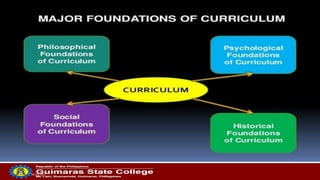
Chapter 2: Major Foundation of Curriculum
The concept of curriculum is as dynamic as the changes that occur in society.
In its narrow sense, curriculum is viewed merely as a listing of subject to be
taught in school. In a broader sense, it refers to the total learning experiences
of individuals not only in schools butin society as well
20/10/2022
⚫ What iscurriculum?
⚫ What is its purpose?
⚫ What is its nature?
Theseare the fundamental questions thatwill
be addressed in this lesson.
20/10/2022
Curriculum from Different Pointsof View
There are many definitions of curriculum. Because of this, the
concept of curriculum is sometimes characterized as fragmentary,
elusive and confusing. The definitions are influenced by modes of
thoughts, pedagogies, political as well as cultural experiences
20/10/2022
1. Traditional Pointsof Viewof Curriculum
In the early years of 20th century, the traditional
concepts held of the “curriculum is that it is a body of subjects or
subject matter prepared by the teachers for the students to learn”.
It was synonymousto the “courseof study” and “syllabus”
Robert M. Hutchins views curriculum as “permanent
studies” where the rule of grammar, reading, rhetoric and
logic and mathematics forbasic education are emphasized.
20/10/2022
Basic Education should emphasize the 3 Rs andcollegeeducationshould be
grounded on liberaleducation. On the other hand, Arthur Bestor as an
essentialist, believe that the mission of the school should be intellectual
training, hence curriculum should focus on the fundamental intellectual
disciplines of grammar, literature and writing. It should also include
mathematics, science, history and foreign language.
20/10/2022
2. Progressive Points of View of Curriculum
On the other hand, to a progressivist, a listing of school, subjects, syllabi, course
of study, and list ofcourses or specific discipline do not make a curriculum.
These can only be called curriculum if the written materials are actualized by
the learner.Broadly speaking, curriculum is defined as the totallearning
experiences of the individual.
20/10/2022
This definition is anchored on John Dewey’s definition of experience
and education. He believed that reflective thinking is a means that unifies
curricular elements. Thought is not derived from action but tested by
application.
Caswell and Campbell viewed curriculum as “all experiences children
have under the guidance of teachers”. This definition is shared by Smith,
Stanley and Shores when they defined “curriculum as a sequence of potential
experiences set up in the schools for the purpose of disciplining children and
youth in group ways of thinking and acting”
20/10/2022
Marsh and Willis on the other hand view curriculum as all the
“experiences in the classroom which are planned and enacted by the
teacher, and also learned by the students.
Points of View on Curriculum Development
From the various definitions and concepts presented, it is clear that
curriculum is a dynamic process.Development connotes changes which are
systematic. A change for the better means any alteration, modification or
improvement of existing condition. To produce positivechanges,
development should be purposeful, planned andprogressive. This is how
curriculum evolves.
Professor
20/10/2022
Types of Curriculum Operating in Schools
From the various concepts given, Allan Glatthorn (2000) describes seven types
of curriculum operating in the schools.
1) Recommended curriculum- proposed by scholars and professional
organizations.
2) Written curriculum- appears in school, district,division or country documents.
3) Taught curriculum- what teachers implementordeliver in the classrooms and
schools.
Professor
20/10/2022
4. Supported curriculum- resources textbook computers, audio visual
materials which supportand help in the implementationof the
curriculum.
5. Assessed curriculum- thatwhich is tested andevaluated.
6.Learned curriculum- what the students actually learn and
what is measured and
7. Hidden curriculum- theunintended curriculum.
Professor
20/10/2022
Professor
20/10/2022
Professor
20/10/2022
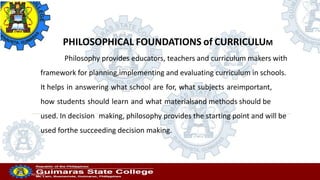
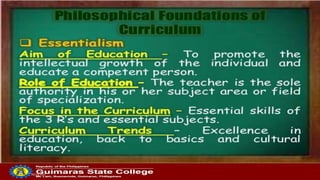
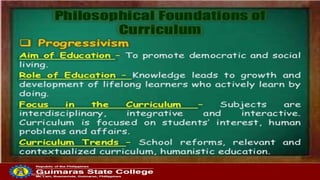
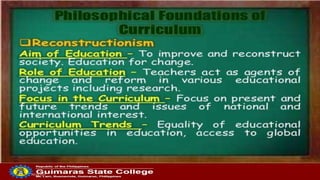
PHILOSOPHICAL FOUNDATIONS of CURRICULUM
Philosophy provides educators, teachers and curriculum makers with
framework for planning,implementing and evaluating curriculum in schools.
It helps in answering what school are for, what subjects areimportant,
how students should learn and what materialsand methods should be
used. In decision making, philosophy provides the starting point and will be
used forthe succeeding decision making.
Professor
20/10/2022
Professor
20/10/2022
Professor
20/10/2022
Professor
20/10/2022
Professor
20/10/2022
Professor
20/10/2022
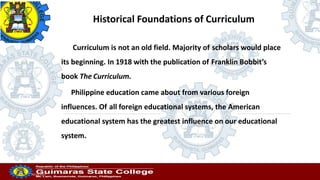
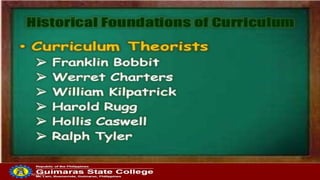
Historical Foundations of Curriculum
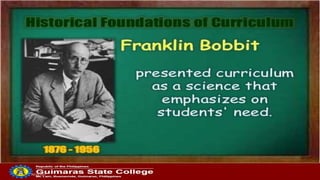
Curriculum is not an old field. Majority of scholars would place
its beginning. In 1918 with the publication of Franklin Bobbit’s
book The Curriculum.
Philippine education came about from various foreign
influences. Of all foreign educational systems, the American
educational system has the greatest influence on our educational
system.
Professor
20/10/2022
Professor
20/10/2022
Professor
20/10/2022
Professor
20/10/2022
Professor
20/10/2022
Professor
20/10/2022
Professor
20/10/2022
Professor
20/10/2022
Professor
20/10/2022
Professor
20/10/2022
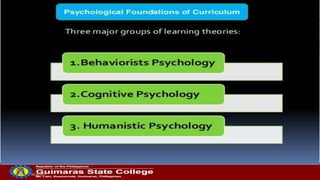
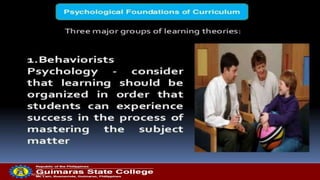
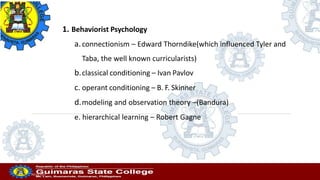
1. Behaviorist Psychology
a.connectionism – Edward Thorndike(which influenced Tyler and
Taba, the well known curricularists)
b.classical conditioning – Ivan Pavlov
c. operant conditioning – B. F. Skinner
d.modeling and observation theory –(Bandura)
e. hierarchical learning – Robert Gagne
Professor
20/10/2022
Professor
20/10/2022
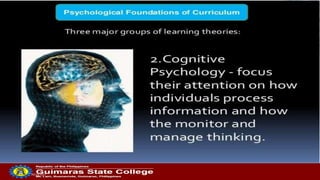
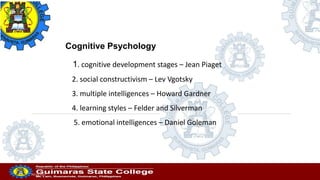
Cognitive Psychology
1. cognitive development stages – Jean Piaget
2. social constructivism – Lev Vgotsky
3. multiple intelligences – Howard Gardner
4. learning styles – Felder and Silverman
5. emotional intelligences – Daniel Goleman
Professor
20/10/2022
Professor
20/10/2022
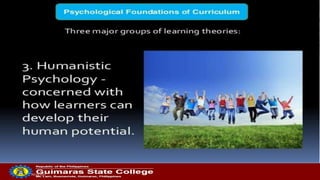
Humanistic Psychology
Humanist psychologist are concernedwith how learners can
develop their human potential.
a.Gestalt theory
b.theory of human needs and for self actualizing persons -
Maslow
c. Carl Roger’s non directive lives
Professor
20/10/2022
Professor
20/10/2022
Professor
20/10/2022
20/10/2022
Thank you very much!

CURRICULUM_An Overview.pptx

  • 1.
  • 2.
  • 3.
    REPORTERS 20/10/2022 LAILA C. PAMPAGKRISTINE CHARMEE D. LISBO RAIAN R. DURAN
  • 4.
    20/10/2022 CURRICULUM: Overview Chapter 1:Changing Concepts, Nature, Purpose and Types of Curriculum Chapter 2: Major Foundation of Curriculum
  • 5.
    The concept ofcurriculum is as dynamic as the changes that occur in society. In its narrow sense, curriculum is viewed merely as a listing of subject to be taught in school. In a broader sense, it refers to the total learning experiences of individuals not only in schools butin society as well 20/10/2022 ⚫ What iscurriculum? ⚫ What is its purpose? ⚫ What is its nature? Theseare the fundamental questions thatwill be addressed in this lesson.
  • 6.
    20/10/2022 Curriculum from DifferentPointsof View There are many definitions of curriculum. Because of this, the concept of curriculum is sometimes characterized as fragmentary, elusive and confusing. The definitions are influenced by modes of thoughts, pedagogies, political as well as cultural experiences
  • 7.
    20/10/2022 1. Traditional PointsofViewof Curriculum In the early years of 20th century, the traditional concepts held of the “curriculum is that it is a body of subjects or subject matter prepared by the teachers for the students to learn”. It was synonymousto the “courseof study” and “syllabus” Robert M. Hutchins views curriculum as “permanent studies” where the rule of grammar, reading, rhetoric and logic and mathematics forbasic education are emphasized.
  • 8.
    20/10/2022 Basic Education shouldemphasize the 3 Rs andcollegeeducationshould be grounded on liberaleducation. On the other hand, Arthur Bestor as an essentialist, believe that the mission of the school should be intellectual training, hence curriculum should focus on the fundamental intellectual disciplines of grammar, literature and writing. It should also include mathematics, science, history and foreign language.
  • 9.
    20/10/2022 2. Progressive Pointsof View of Curriculum On the other hand, to a progressivist, a listing of school, subjects, syllabi, course of study, and list ofcourses or specific discipline do not make a curriculum. These can only be called curriculum if the written materials are actualized by the learner.Broadly speaking, curriculum is defined as the totallearning experiences of the individual.
  • 10.
    20/10/2022 This definition isanchored on John Dewey’s definition of experience and education. He believed that reflective thinking is a means that unifies curricular elements. Thought is not derived from action but tested by application. Caswell and Campbell viewed curriculum as “all experiences children have under the guidance of teachers”. This definition is shared by Smith, Stanley and Shores when they defined “curriculum as a sequence of potential experiences set up in the schools for the purpose of disciplining children and youth in group ways of thinking and acting”
  • 11.
    20/10/2022 Marsh and Willison the other hand view curriculum as all the “experiences in the classroom which are planned and enacted by the teacher, and also learned by the students.
  • 12.
    Points of Viewon Curriculum Development From the various definitions and concepts presented, it is clear that curriculum is a dynamic process.Development connotes changes which are systematic. A change for the better means any alteration, modification or improvement of existing condition. To produce positivechanges, development should be purposeful, planned andprogressive. This is how curriculum evolves. Professor 20/10/2022
  • 13.
    Types of CurriculumOperating in Schools From the various concepts given, Allan Glatthorn (2000) describes seven types of curriculum operating in the schools. 1) Recommended curriculum- proposed by scholars and professional organizations. 2) Written curriculum- appears in school, district,division or country documents. 3) Taught curriculum- what teachers implementordeliver in the classrooms and schools. Professor 20/10/2022
  • 14.
    4. Supported curriculum-resources textbook computers, audio visual materials which supportand help in the implementationof the curriculum. 5. Assessed curriculum- thatwhich is tested andevaluated. 6.Learned curriculum- what the students actually learn and what is measured and 7. Hidden curriculum- theunintended curriculum. Professor 20/10/2022
  • 15.
  • 16.
    Professor 20/10/2022 PHILOSOPHICAL FOUNDATIONS ofCURRICULUM Philosophy provides educators, teachers and curriculum makers with framework for planning,implementing and evaluating curriculum in schools. It helps in answering what school are for, what subjects areimportant, how students should learn and what materialsand methods should be used. In decision making, philosophy provides the starting point and will be used forthe succeeding decision making.
  • 17.
  • 18.
  • 19.
  • 20.
  • 21.
  • 22.
    Professor 20/10/2022 Historical Foundations ofCurriculum Curriculum is not an old field. Majority of scholars would place its beginning. In 1918 with the publication of Franklin Bobbit’s book The Curriculum. Philippine education came about from various foreign influences. Of all foreign educational systems, the American educational system has the greatest influence on our educational system.
  • 23.
  • 24.
  • 25.
  • 26.
  • 27.
  • 28.
  • 29.
  • 30.
  • 31.
  • 32.
    Professor 20/10/2022 1. Behaviorist Psychology a.connectionism– Edward Thorndike(which influenced Tyler and Taba, the well known curricularists) b.classical conditioning – Ivan Pavlov c. operant conditioning – B. F. Skinner d.modeling and observation theory –(Bandura) e. hierarchical learning – Robert Gagne
  • 33.
  • 34.
    Professor 20/10/2022 Cognitive Psychology 1. cognitivedevelopment stages – Jean Piaget 2. social constructivism – Lev Vgotsky 3. multiple intelligences – Howard Gardner 4. learning styles – Felder and Silverman 5. emotional intelligences – Daniel Goleman
  • 35.
  • 36.
    Professor 20/10/2022 Humanistic Psychology Humanist psychologistare concernedwith how learners can develop their human potential. a.Gestalt theory b.theory of human needs and for self actualizing persons - Maslow c. Carl Roger’s non directive lives
  • 37.
  • 38.
  • 39.
  • 40.