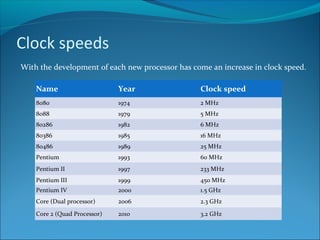
Clock speeds
Name Year Clock speed
8080 1974 2 MHz
8088 1979 5 MHz
80286 1982 6 MHz
80386 1985 16 MHz
80486 1989 25 MHz
Pentium 1993 60 MHz
Pentium II 1997 233 MHz
Pentium III 1999 450 MHz
Pentium IV 2000 1.5 GHz
Core (Dual processor) 2006 2.3 GHz
Core 2 (Quad Processor) 2010 3.2 GHz
With the development of each new processor has come an increase in clock speed.
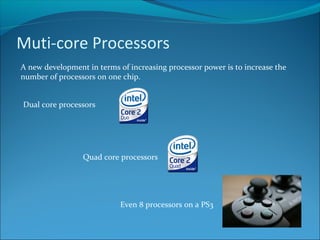
Muti-core Processors
A new development in terms of increasing processor power is to increase the
number of processors on one chip.
Dual core processors
Quad core processors
Even 8 processors on a PS3
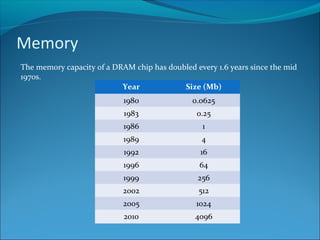
Memory
The memory capacity of a DRAM chip has doubled every 1.6 years since the mid
1970s.
Year Size (Mb)
1980 0.0625
1983 0.25
1986 1
1989 4
1992 16
1996 64
1999 256
2002 512
2005 1024
2010 4096
Backing Storage
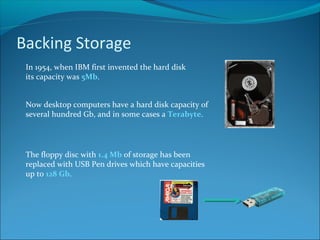
In 1954, when IBM first invented the hard disk
its capacity was 5Mb.
Now desktop computers have a hard disk capacity of
several hundred Gb, and in some cases a Terabyte.
The floppy disc with 1.4 Mb of storage has been
replaced with USB Pen drives which have capacities
up to 128 Gb.
Backing Storage
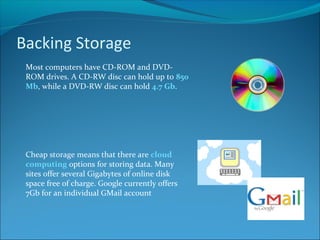
Most computers have CD-ROM and DVD-
ROM drives. A CD-RW disc can hold up to 850
Mb, while a DVD-RW disc can hold 4.7 Gb.
Cheap storage means that there are cloud
computing options for storing data. Many
sites offer several Gigabytes of online disk
space free of charge. Google currently offers
7Gb for an individual GMail account
Credits
Higher Computing – Computer Structure – Current Trends
Produced by P. Greene for the City of Edinburgh Council 2004
Adapted by M. Cunningham 2010
All images licenced under Creative Commons 3.0
• PS3 controller by Declan Jewell (DeclanTM on Flickr)
• Hard disc drive assembled by Crispin Semmens (conskeptical on Flickr)
• Floppy Diskovery By Pete Birkinshaw (BinaryApe on Flickr)
• CD_autolev_crop.jpg by Ubern00b, retouched by Dzucconi
• cloud computing by Bruce Clay, Inc

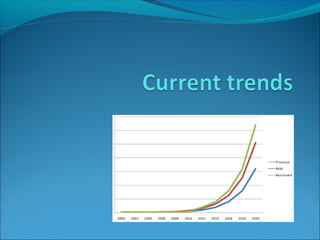
Current Trends

  • 2.
    Clock speeds Name YearClock speed 8080 1974 2 MHz 8088 1979 5 MHz 80286 1982 6 MHz 80386 1985 16 MHz 80486 1989 25 MHz Pentium 1993 60 MHz Pentium II 1997 233 MHz Pentium III 1999 450 MHz Pentium IV 2000 1.5 GHz Core (Dual processor) 2006 2.3 GHz Core 2 (Quad Processor) 2010 3.2 GHz With the development of each new processor has come an increase in clock speed.
  • 3.
    Muti-core Processors A newdevelopment in terms of increasing processor power is to increase the number of processors on one chip. Dual core processors Quad core processors Even 8 processors on a PS3
  • 4.
    Memory The memory capacityof a DRAM chip has doubled every 1.6 years since the mid 1970s. Year Size (Mb) 1980 0.0625 1983 0.25 1986 1 1989 4 1992 16 1996 64 1999 256 2002 512 2005 1024 2010 4096
  • 5.
    Backing Storage In 1954,when IBM first invented the hard disk its capacity was 5Mb. Now desktop computers have a hard disk capacity of several hundred Gb, and in some cases a Terabyte. The floppy disc with 1.4 Mb of storage has been replaced with USB Pen drives which have capacities up to 128 Gb.
  • 6.
    Backing Storage Most computershave CD-ROM and DVD- ROM drives. A CD-RW disc can hold up to 850 Mb, while a DVD-RW disc can hold 4.7 Gb. Cheap storage means that there are cloud computing options for storing data. Many sites offer several Gigabytes of online disk space free of charge. Google currently offers 7Gb for an individual GMail account
  • 7.
    Credits Higher Computing –Computer Structure – Current Trends Produced by P. Greene for the City of Edinburgh Council 2004 Adapted by M. Cunningham 2010 All images licenced under Creative Commons 3.0 • PS3 controller by Declan Jewell (DeclanTM on Flickr) • Hard disc drive assembled by Crispin Semmens (conskeptical on Flickr) • Floppy Diskovery By Pete Birkinshaw (BinaryApe on Flickr) • CD_autolev_crop.jpg by Ubern00b, retouched by Dzucconi • cloud computing by Bruce Clay, Inc