MAKHANLAL CHATURVEDI RASHTRIYA PATRAKARITA
EVAM SANCHAR VISHWAVIDYALAYA
2017-19
PRINCIPLES AND PRACTICES OF MANAGEMENT
ASSIGNMENT WORK
LEADERSHIP
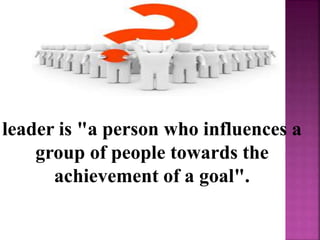
leader is "a person who influences a
group of people towards the
achievement of a goal".
LEADERSHIP
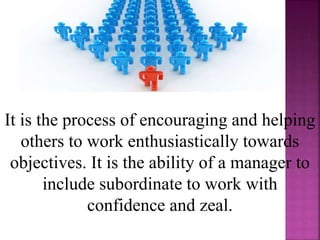
It is the process of encouraging and helping
others to work enthusiastically towards
objectives. It is the ability of a manager to
include subordinate to work with
confidence and zeal.
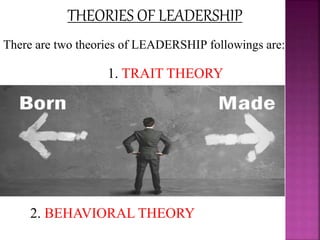
THEORIES OF LEADERSHIP
There are two theories of LEADERSHIP followings are:
1. TRAIT THEORY
2. BEHAVIORAL THEORY
BEHAVIORAL THEORY
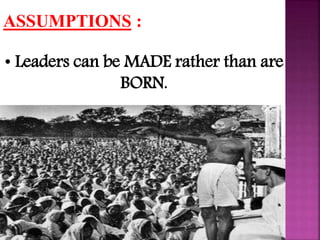
ASSUMPTIONS :
• Leaders can be MADE rather than are
BORN.
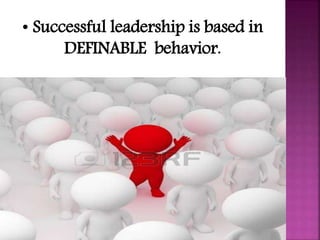
• Successful leadership is based in
DEFINABLE behavior.
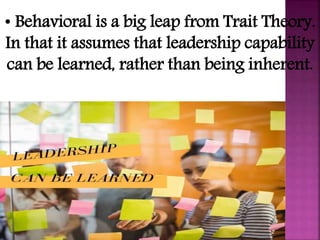
• Behavioral is a big leap from Trait Theory.
In that it assumes that leadership capability
can be learned, rather than being inherent.
Theories Of Behavioral Leadership
There are two most common theories
will come up every time we talk
about Behavioral Leadership
Theories:
Michigan Leadership Studies
Job-Centred Leadership
Job-centred leaders "closely supervise
subordinates to make sure they perform
their tasks following the specified
procedures. This type of leader relies on
reward, punishment, and legitimate power
to influence the behaviour of followers". It
was proposed by Renis Likert .
employee-centred leader
The employee-centred leader, on the
other hand, believes in delegating
decision-making and in helping
followers satisfy their needs by
providing a supportive work
environment (Likert, 1967).
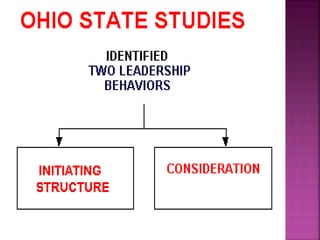
Ohio State Leadership Studies
Initiating Structure Behaviour
The behavior of leaders
who define the leader-
subordinate role so that
everyone knows what is
expected, establish
formal lines of
communication, and
determine how tasks
will be performed.
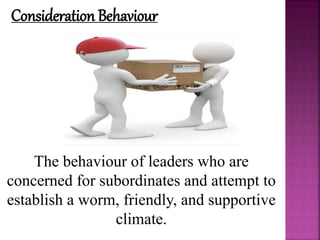
Consideration Behaviour
The behaviour of leaders who are
concerned for subordinates and attempt to
establish a worm, friendly, and supportive
climate.
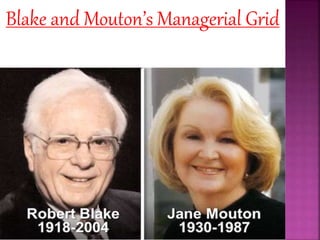
Blake and Mouton’s Managerial Grid
Robert Blake and Jane Mouton (1960s)
proposed a graphic portrayal of leadership
styles through a managerial
grid (sometimes called leadership grid).
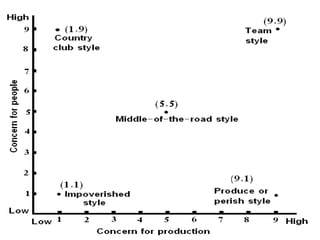
The grid depicted two dimensions of leader
behaviour, concern for
people (accommodating people’s needs
and giving them priority) on y-axis
and concern for production (keeping tight
schedules) on x-axis,
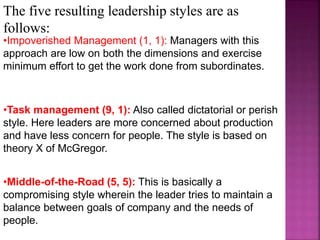
The five resulting leadership styles are as
follows:
•Impoverished Management (1, 1): Managers with this
approach are low on both the dimensions and exercise
minimum effort to get the work done from subordinates.
•Task management (9, 1): Also called dictatorial or perish
style. Here leaders are more concerned about production
and have less concern for people. The style is based on
theory X of McGregor.
•Middle-of-the-Road (5, 5): This is basically a
compromising style wherein the leader tries to maintain a
balance between goals of company and the needs of
people.
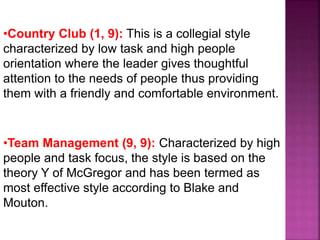
•Country Club (1, 9): This is a collegial style
characterized by low task and high people
orientation where the leader gives thoughtful
attention to the needs of people thus providing
them with a friendly and comfortable environment.
•Team Management (9, 9): Characterized by high
people and task focus, the style is based on the
theory Y of McGregor and has been termed as
most effective style according to Blake and
Mouton.
It’s Free
Leadership

Leadership

  • 1.
    MAKHANLAL CHATURVEDI RASHTRIYAPATRAKARITA EVAM SANCHAR VISHWAVIDYALAYA 2017-19 PRINCIPLES AND PRACTICES OF MANAGEMENT ASSIGNMENT WORK LEADERSHIP
  • 3.
    leader is "aperson who influences a group of people towards the achievement of a goal".
  • 4.
  • 5.
    It is theprocess of encouraging and helping others to work enthusiastically towards objectives. It is the ability of a manager to include subordinate to work with confidence and zeal.
  • 6.
    THEORIES OF LEADERSHIP Thereare two theories of LEADERSHIP followings are: 1. TRAIT THEORY 2. BEHAVIORAL THEORY
  • 7.
  • 8.
    ASSUMPTIONS : • Leaderscan be MADE rather than are BORN.
  • 9.
    • Successful leadershipis based in DEFINABLE behavior.
  • 10.
    • Behavioral isa big leap from Trait Theory. In that it assumes that leadership capability can be learned, rather than being inherent.
  • 11.
  • 12.
    There are twomost common theories will come up every time we talk about Behavioral Leadership Theories:
  • 13.
  • 15.
    Job-Centred Leadership Job-centred leaders"closely supervise subordinates to make sure they perform their tasks following the specified procedures. This type of leader relies on reward, punishment, and legitimate power to influence the behaviour of followers". It was proposed by Renis Likert .
  • 17.
    employee-centred leader The employee-centredleader, on the other hand, believes in delegating decision-making and in helping followers satisfy their needs by providing a supportive work environment (Likert, 1967).
  • 19.
  • 21.
    Initiating Structure Behaviour Thebehavior of leaders who define the leader- subordinate role so that everyone knows what is expected, establish formal lines of communication, and determine how tasks will be performed.
  • 22.
    Consideration Behaviour The behaviourof leaders who are concerned for subordinates and attempt to establish a worm, friendly, and supportive climate.
  • 23.
    Blake and Mouton’sManagerial Grid
  • 24.
    Robert Blake andJane Mouton (1960s) proposed a graphic portrayal of leadership styles through a managerial grid (sometimes called leadership grid). The grid depicted two dimensions of leader behaviour, concern for people (accommodating people’s needs and giving them priority) on y-axis and concern for production (keeping tight schedules) on x-axis,
  • 26.
    The five resultingleadership styles are as follows: •Impoverished Management (1, 1): Managers with this approach are low on both the dimensions and exercise minimum effort to get the work done from subordinates. •Task management (9, 1): Also called dictatorial or perish style. Here leaders are more concerned about production and have less concern for people. The style is based on theory X of McGregor. •Middle-of-the-Road (5, 5): This is basically a compromising style wherein the leader tries to maintain a balance between goals of company and the needs of people.
  • 27.
    •Country Club (1,9): This is a collegial style characterized by low task and high people orientation where the leader gives thoughtful attention to the needs of people thus providing them with a friendly and comfortable environment. •Team Management (9, 9): Characterized by high people and task focus, the style is based on the theory Y of McGregor and has been termed as most effective style according to Blake and Mouton.
  • 28.