Current Division Rule
SlideMake.com
1
Introduction
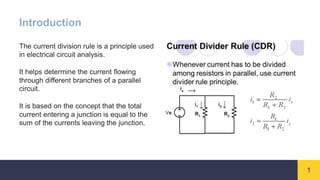
The current division rule is a principle used
in electrical circuit analysis.
It helps determine the current flowing
through different branches of a parallel
circuit.
It is based on the concept that the total
current entering a junction is equal to the
sum of the currents leaving the junction.
2
Parallel Circuits
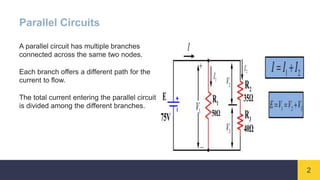
A parallel circuit has multiple branches
connected across the same two nodes.
Each branch offers a different path for the
current to flow.
The total current entering the parallel circuit
is divided among the different branches.
3
Current Division Rule Formula
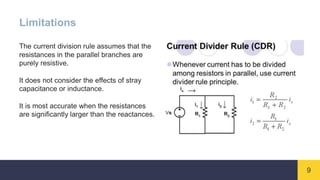
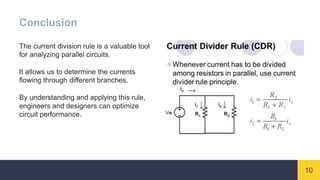
The current division rule is mathematically
represented as follows:
- I1 = (I
R2) / (R1 + R2)
- I2 = (I
R1) / (R1 + R2)
- I1 and I2 represent the currents flowing
through R1 and R2 respectively.
- I is the total current entering the parallel
circuit.
- R1 and R2 are the resistances of the
respective branches.
4
Applying the Current Division Rule
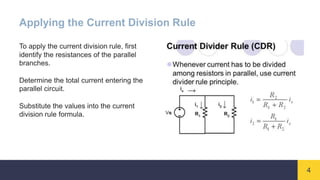
To apply the current division rule, first
identify the resistances of the parallel
branches.
Determine the total current entering the
parallel circuit.
Substitute the values into the current
division rule formula.
5
Example Problem
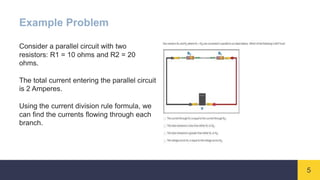
Consider a parallel circuit with two
resistors: R1 = 10 ohms and R2 = 20
ohms.
The total current entering the parallel circuit
is 2 Amperes.
Using the current division rule formula, we
can find the currents flowing through each
branch.
6
Applying the Formula
Substituting the given values into the
current division rule formula:
- I1 = (2
20) / (10 + 20) = 0.8 Amperes
- I2 = (2
10) / (10 + 20) = 1.2 Amperes
7
Results
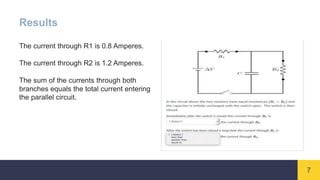
The current through R1 is 0.8 Amperes.
The current through R2 is 1.2 Amperes.
The sum of the currents through both
branches equals the total current entering
the parallel circuit.
8
Practical Applications
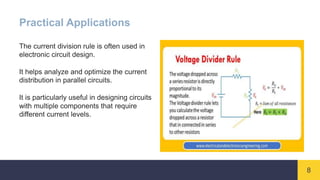
The current division rule is often used in
electronic circuit design.
It helps analyze and optimize the current
distribution in parallel circuits.
It is particularly useful in designing circuits
with multiple components that require
different current levels.
9
Limitations
The current division rule assumes that the
resistances in the parallel branches are
purely resistive.
It does not consider the effects of stray
capacitance or inductance.
It is most accurate when the resistances
are significantly larger than the reactances.
10
Conclusion
The current division rule is a valuable tool
for analyzing parallel circuits.
It allows us to determine the currents
flowing through different branches.
By understanding and applying this rule,
engineers and designers can optimize
circuit performance.

Current Division Rule.pptx

  • 1.
  • 2.
    1 Introduction The current divisionrule is a principle used in electrical circuit analysis. It helps determine the current flowing through different branches of a parallel circuit. It is based on the concept that the total current entering a junction is equal to the sum of the currents leaving the junction.
  • 3.
    2 Parallel Circuits A parallelcircuit has multiple branches connected across the same two nodes. Each branch offers a different path for the current to flow. The total current entering the parallel circuit is divided among the different branches.
  • 4.
    3 Current Division RuleFormula The current division rule is mathematically represented as follows: - I1 = (I R2) / (R1 + R2) - I2 = (I R1) / (R1 + R2) - I1 and I2 represent the currents flowing through R1 and R2 respectively. - I is the total current entering the parallel circuit. - R1 and R2 are the resistances of the respective branches.
  • 5.
    4 Applying the CurrentDivision Rule To apply the current division rule, first identify the resistances of the parallel branches. Determine the total current entering the parallel circuit. Substitute the values into the current division rule formula.
  • 6.
    5 Example Problem Consider aparallel circuit with two resistors: R1 = 10 ohms and R2 = 20 ohms. The total current entering the parallel circuit is 2 Amperes. Using the current division rule formula, we can find the currents flowing through each branch.
  • 7.
    6 Applying the Formula Substitutingthe given values into the current division rule formula: - I1 = (2 20) / (10 + 20) = 0.8 Amperes - I2 = (2 10) / (10 + 20) = 1.2 Amperes
  • 8.
    7 Results The current throughR1 is 0.8 Amperes. The current through R2 is 1.2 Amperes. The sum of the currents through both branches equals the total current entering the parallel circuit.
  • 9.
    8 Practical Applications The currentdivision rule is often used in electronic circuit design. It helps analyze and optimize the current distribution in parallel circuits. It is particularly useful in designing circuits with multiple components that require different current levels.
  • 10.
    9 Limitations The current divisionrule assumes that the resistances in the parallel branches are purely resistive. It does not consider the effects of stray capacitance or inductance. It is most accurate when the resistances are significantly larger than the reactances.
  • 11.
    10 Conclusion The current divisionrule is a valuable tool for analyzing parallel circuits. It allows us to determine the currents flowing through different branches. By understanding and applying this rule, engineers and designers can optimize circuit performance.