CURRENCY
DERIVATIVES
Shamseer P

Currency is a generally accepted form of money, including coins and paper notes,
which is issued by a government and circulated within an economy. Used as a
medium of exchange for goods and services, currency is the basis for trade.
Generally speaking, each country has its own currency. For example,
Switzerland's official currency is the Swiss franc, and Japan's official currency is
the yen. An exception would be the euro, which is used as the currency for several
European countries.
While these currencies can be specific to a nation, other countries have declared
foreign currency to be legal tender in their own country. For example, El Salvador
and Panama allow the use of the U.S. dollar as legal tender, and immediately after
the founding of the U.S. mint in 1792, U.S. residents used Spanish coins because
they were heavier.
WHAT IS A CURRENCY?

Derivatives are instruments for hedging risk they are risk
transferring instruments. They are called as derivatives because
they derive their value from the value of some underlying assets.
The underlying assets may be share, bond, currency or any other
security. Thus derivative financial instruments are financial
products or contracts whose values are derived from the values of
their underlying assets. They have no intrinsic value of their own.
DERIVATIVES

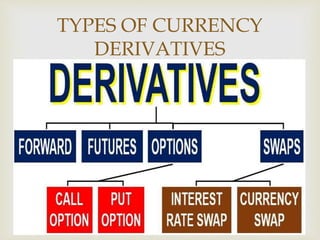
 Currency Derivatives are Future and Options
contracts which you can buy or sell specific quantity
of a particular currency pair at a future date. It is
similar to the Stock Futures and Options but the
underlying happens to be currency pair (i.e.
USDINR, EURINR, JPYINR OR GBPINR) instead of
Stocks.
CURRENCY DERIVATIVE

TYPES OF CURRENCY
DERIVATIVES

 Since all transactions related to derivatives take place in future it provides individuals
with better opportunities because an individual who want to short some stock for long
time can do it only in futures or options hence the biggest benefit of this is that it gives
numerous options to an investor or trader to execute all sorts of strategies.
 In derivatives market people can transact huge transactions with small amounts and
therefore it gives the benefit of leverage and hence even people who have less amount
of money can enter into this market.
 Intraday traders get the benefit of liquidity as these contracts are very liquid and also
the costs such as basis expense, brokerage are less as compared to cash market.
 It is a great risk management tool and if applied judiciously it can produce good results
and benefit its user.
ADVANTAGES

 Leverage is a double edged sword and therefore if you do not get it right
chances are you wound end up losing huge amount of money because
these contracts have specific maturities and on that date they get expired
unlike cash market where you can hold on to stocks for long period of
time.
 Since its inception many critics have been blaming derivatives for huge
fall which keeps happening frequently after the introduction of derivatives
and many people say that it increases unnecessary speculation in the
market which is not good for the small retail investors who are the
backbone of stock market.
 It is quite complex and various strategies of derivatives can be
implemented only by an expert and therefore for a layman it is difficult to
use this and therefore it limits its usefulness.
DISADVANTAGES
 The derivative markets let people buy and sell risk. Speculators take on more
risk for a higher expected reward while normal companies pay a premium to
have less risk. This is incredibly important because it allows different entities
to "normalize" their risk exposure based on their different preferences. Think
of the derivatives market as a gigantic distributed insurance company.
 The simplest sort of derivative is the futures contract. All this is is a contract
to buy or sell some asset (like, say, oil) at a specified point in the future and a
given price. The person buying the future locks-in a specific price now for
something they actually need in the future. The person selling the future is
essentially speculating on the price of the asset; however, since selling the
future is a service that's useful to the buyer, the expected value of the
speculation is positive.
HOW DO DERIVATIVE MARKETS
IMPACTS THE REAL ECONOMY?
 Futures are actually very important in a whole bunch of industries, especially
ones which depend on a steady supply of raw materials. A great example is
fuel hedging by airlines. An airline's operating expenses are heavily
influenced by the price of oil, and if the price of oil goes up they would either
have to drastically raise ticket prices or operate at a loss. Instead, the airline
can buy futures contracts for fuel, which lock in a price ahead of time, such
that they can charge a reasonable ticket fee. Now they are no longer affected
by the price of fuel since they have a guaranteed sale in the future. The futures
are priced in a way that's, on expectation, worse than the actual price of oil,
but it's valuable for the airlines because it removes the risk of catastrophic
failure due to jumps in the price of fuel.
 Other kinds of derivatives can be used to offset the risk of existing stock
market investments. For example, employees with restricted stock from a
company (which they can't sell) generally want to get some liquid money up
front and also diversify their holdings. They can accomplish all this by buying
the right sort of derivatives—take a look at the idea of an options collar.
CONTINUATION....

 More generally, pretty much all kinds of derivatives exist primarily to shuffle
risk around. This lets people with low risk tolerance (i.e. "real" companies)
pay people with high risk tolerance (speculators) to unload their own risk.
While you could call what the speculators are doing "gambling", this is not
fair in two ways: for one, since they're taking on other people's risk, it has a
very direct social benefit; for two, since they are the ones pricing the
contracts, they can actually make money in expectation which makes it a
sustainable business.
CONTINUATION...


Currency derivatives

  • 1.
  • 2.
     Currency is agenerally accepted form of money, including coins and paper notes, which is issued by a government and circulated within an economy. Used as a medium of exchange for goods and services, currency is the basis for trade. Generally speaking, each country has its own currency. For example, Switzerland's official currency is the Swiss franc, and Japan's official currency is the yen. An exception would be the euro, which is used as the currency for several European countries. While these currencies can be specific to a nation, other countries have declared foreign currency to be legal tender in their own country. For example, El Salvador and Panama allow the use of the U.S. dollar as legal tender, and immediately after the founding of the U.S. mint in 1792, U.S. residents used Spanish coins because they were heavier. WHAT IS A CURRENCY?
  • 3.
     Derivatives are instrumentsfor hedging risk they are risk transferring instruments. They are called as derivatives because they derive their value from the value of some underlying assets. The underlying assets may be share, bond, currency or any other security. Thus derivative financial instruments are financial products or contracts whose values are derived from the values of their underlying assets. They have no intrinsic value of their own. DERIVATIVES
  • 4.
      Currency Derivativesare Future and Options contracts which you can buy or sell specific quantity of a particular currency pair at a future date. It is similar to the Stock Futures and Options but the underlying happens to be currency pair (i.e. USDINR, EURINR, JPYINR OR GBPINR) instead of Stocks. CURRENCY DERIVATIVE
  • 5.
  • 6.
      Since alltransactions related to derivatives take place in future it provides individuals with better opportunities because an individual who want to short some stock for long time can do it only in futures or options hence the biggest benefit of this is that it gives numerous options to an investor or trader to execute all sorts of strategies.  In derivatives market people can transact huge transactions with small amounts and therefore it gives the benefit of leverage and hence even people who have less amount of money can enter into this market.  Intraday traders get the benefit of liquidity as these contracts are very liquid and also the costs such as basis expense, brokerage are less as compared to cash market.  It is a great risk management tool and if applied judiciously it can produce good results and benefit its user. ADVANTAGES
  • 7.
      Leverage isa double edged sword and therefore if you do not get it right chances are you wound end up losing huge amount of money because these contracts have specific maturities and on that date they get expired unlike cash market where you can hold on to stocks for long period of time.  Since its inception many critics have been blaming derivatives for huge fall which keeps happening frequently after the introduction of derivatives and many people say that it increases unnecessary speculation in the market which is not good for the small retail investors who are the backbone of stock market.  It is quite complex and various strategies of derivatives can be implemented only by an expert and therefore for a layman it is difficult to use this and therefore it limits its usefulness. DISADVANTAGES
  • 8.
     The derivativemarkets let people buy and sell risk. Speculators take on more risk for a higher expected reward while normal companies pay a premium to have less risk. This is incredibly important because it allows different entities to "normalize" their risk exposure based on their different preferences. Think of the derivatives market as a gigantic distributed insurance company.  The simplest sort of derivative is the futures contract. All this is is a contract to buy or sell some asset (like, say, oil) at a specified point in the future and a given price. The person buying the future locks-in a specific price now for something they actually need in the future. The person selling the future is essentially speculating on the price of the asset; however, since selling the future is a service that's useful to the buyer, the expected value of the speculation is positive. HOW DO DERIVATIVE MARKETS IMPACTS THE REAL ECONOMY?
  • 9.
     Futures areactually very important in a whole bunch of industries, especially ones which depend on a steady supply of raw materials. A great example is fuel hedging by airlines. An airline's operating expenses are heavily influenced by the price of oil, and if the price of oil goes up they would either have to drastically raise ticket prices or operate at a loss. Instead, the airline can buy futures contracts for fuel, which lock in a price ahead of time, such that they can charge a reasonable ticket fee. Now they are no longer affected by the price of fuel since they have a guaranteed sale in the future. The futures are priced in a way that's, on expectation, worse than the actual price of oil, but it's valuable for the airlines because it removes the risk of catastrophic failure due to jumps in the price of fuel.  Other kinds of derivatives can be used to offset the risk of existing stock market investments. For example, employees with restricted stock from a company (which they can't sell) generally want to get some liquid money up front and also diversify their holdings. They can accomplish all this by buying the right sort of derivatives—take a look at the idea of an options collar. CONTINUATION....
  • 10.
      More generally,pretty much all kinds of derivatives exist primarily to shuffle risk around. This lets people with low risk tolerance (i.e. "real" companies) pay people with high risk tolerance (speculators) to unload their own risk. While you could call what the speculators are doing "gambling", this is not fair in two ways: for one, since they're taking on other people's risk, it has a very direct social benefit; for two, since they are the ones pricing the contracts, they can actually make money in expectation which makes it a sustainable business. CONTINUATION...
  • 11.