WARRANTS
Warrants are securities that give holders the right,
but not the obligation, to buy share of common
stock directly from a company at fixed price for a
given period of time. Each warrants specifies the
number of share of stock that the holder can buy.
The exercise price and the expiration date.
   Warrants are also refers to as equity kickers
because they are usually issued in combination
with privately placed bonds. Sometimes warrants
can be detachable.
Types of warrants
•Warrants with Common Stock or Bonds

•Debt Warrants
Allow investors to purchase additional debt
Warranted bond usually has same coupon & maturity as host bond

•Harmless Warrants:
Variant of debt warrants
Warrant not exercisable until host bond becomes callable
If warrants exercised bonds will be called, so no increase in debt
Types of warrants
Covered Warrants
Synthetic warrants issued by third party
e.g. Japanese debt warrants: BT issued identical warrants in local
currency for Swiss investors

Put Warrants
Right to sell company’s common stock
Typically used as part of share repo program
e.g. company wants to hedge employee share options
Takes in option premium

Asset Warrants
Based on any asset, e.g. currency, Nikkei 225
Features of Warrant
•Expiry date
•Exercise style
•Deliverable or cash settled
•Call or put warrants
•Conversion ratio
•Underlying instrument
Convertible Bonds
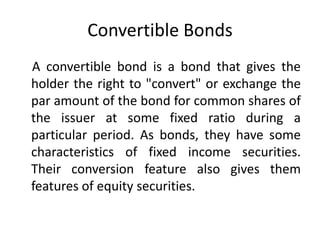
A convertible bond is a bond that gives the
holder the right to "convert" or exchange the
par amount of the bond for common shares of
the issuer at some fixed ratio during a
particular period. As bonds, they have some
characteristics of fixed income securities.
Their conversion feature also gives them
features of equity securities.
Features of convertible Bonds
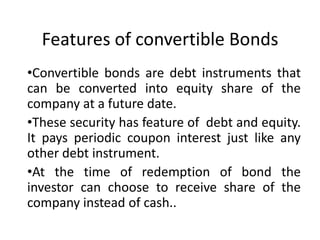
•Convertible bonds are debt instruments that
can be converted into equity share of the
company at a future date.
•These security has feature of debt and equity.
It pays periodic coupon interest just like any
other debt instrument.
•At the time of redemption of bond the
investor can choose to receive share of the
company instead of cash..
Call option
A call option gives the holder the right, but
not the obligation, to purchase shares of a
particular underlying stock at a specified strike
price with in specified period of time.
Difference between warrants and
               convertibles
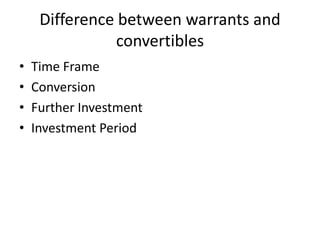
•   Time Frame
•   Conversion
•   Further Investment
•   Investment Period
Difference between call option and
               warrants
• Call option are issued by individuals and
  warrants are issued by firms
• Each time warrants is exercised, the number
  of share outstanding increases. When call
  option is exercised, one investor gains and
  other loses. The number of share outstanding
  remains the same.
Difference between call option and
             convertibles
• Call option gives the owner right to buy an
  asset at a fixed price during a particular time
  period. A convertible bond gives the holder
  the right to exchange it for a given number of
  share of stock at any time up to an including
  the maturity date of the bond.

Warrants (1)

  • 1.
    WARRANTS Warrants are securitiesthat give holders the right, but not the obligation, to buy share of common stock directly from a company at fixed price for a given period of time. Each warrants specifies the number of share of stock that the holder can buy. The exercise price and the expiration date. Warrants are also refers to as equity kickers because they are usually issued in combination with privately placed bonds. Sometimes warrants can be detachable.
  • 2.
    Types of warrants •Warrantswith Common Stock or Bonds •Debt Warrants Allow investors to purchase additional debt Warranted bond usually has same coupon & maturity as host bond •Harmless Warrants: Variant of debt warrants Warrant not exercisable until host bond becomes callable If warrants exercised bonds will be called, so no increase in debt
  • 3.
    Types of warrants CoveredWarrants Synthetic warrants issued by third party e.g. Japanese debt warrants: BT issued identical warrants in local currency for Swiss investors Put Warrants Right to sell company’s common stock Typically used as part of share repo program e.g. company wants to hedge employee share options Takes in option premium Asset Warrants Based on any asset, e.g. currency, Nikkei 225
  • 4.
    Features of Warrant •Expirydate •Exercise style •Deliverable or cash settled •Call or put warrants •Conversion ratio •Underlying instrument
  • 5.
    Convertible Bonds A convertiblebond is a bond that gives the holder the right to "convert" or exchange the par amount of the bond for common shares of the issuer at some fixed ratio during a particular period. As bonds, they have some characteristics of fixed income securities. Their conversion feature also gives them features of equity securities.
  • 6.
    Features of convertibleBonds •Convertible bonds are debt instruments that can be converted into equity share of the company at a future date. •These security has feature of debt and equity. It pays periodic coupon interest just like any other debt instrument. •At the time of redemption of bond the investor can choose to receive share of the company instead of cash..
  • 7.
    Call option A calloption gives the holder the right, but not the obligation, to purchase shares of a particular underlying stock at a specified strike price with in specified period of time.
  • 8.
    Difference between warrantsand convertibles • Time Frame • Conversion • Further Investment • Investment Period
  • 9.
    Difference between calloption and warrants • Call option are issued by individuals and warrants are issued by firms • Each time warrants is exercised, the number of share outstanding increases. When call option is exercised, one investor gains and other loses. The number of share outstanding remains the same.
  • 10.
    Difference between calloption and convertibles • Call option gives the owner right to buy an asset at a fixed price during a particular time period. A convertible bond gives the holder the right to exchange it for a given number of share of stock at any time up to an including the maturity date of the bond.