Quality Cancer Care for All
An Equity Toolkit
Bob Gardner
Signature Event: Removing Barriers to Cancer Care
for All
Cancer Quality Council of Ontario
November, 2013
Problem to Solve → What Success Looks
Like
Social determinants of health:
 Inequitable gradient of prevalence &
burden
 Inequitable personal/community resources
to cope with cancers
Inequitable care/patient experience:
 Discrimination
 Inequitable rates of screening
 Inequitable barriers along the patient
journey:
screening, diagnosis, treatment, posttreatment support
 Specific barriers: language, costs of
medication, transportation & ancillary
services
Inequitable gaps in continuity of care:
 Availability
 Continuum of care
 Integration of services
 Provider Awareness of options available to
patients

no inequitable access
barriers
• all along the patient
trajectory
• all across an integrated
system
best quality for all
• and geared to
different/greater needs
of health disadvantaged
populations
→ best outcomes for all
2
Towards Solutions
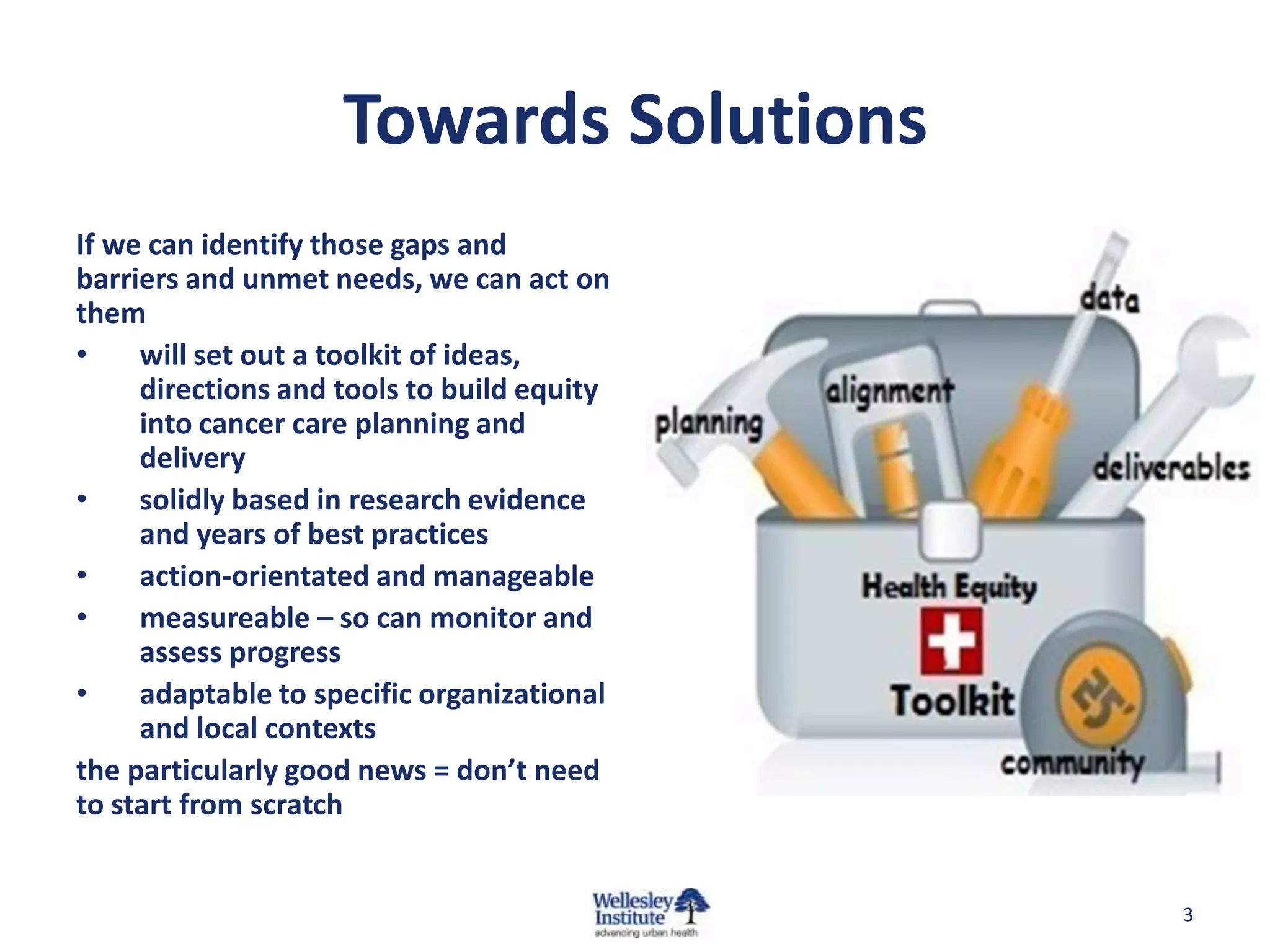
If we can identify those gaps and
barriers and unmet needs, we can act on
them
•
will set out a toolkit of ideas,
directions and tools to build equity
into cancer care planning and
delivery
•
solidly based in research evidence
and years of best practices
•
action-orientated and manageable
•
measureable – so can monitor and
assess progress
•
adaptable to specific organizational
and local contexts
the particularly good news = don’t need
to start from scratch

3
1. Start from Solid Foundations
• high-performing healthcare systems – whether
cancer care or province-wide -- build equity into all
planning and service delivery
•
•

doesn’t mean all programs are all about equity
does mean all programs and planning need to take equity
into account

• need clear strategic commitment to build equity into
system as a whole
•
•

cascading throughout all providers and programs so that
equity becomes part of working culture across the system
commitment has to be backed up by resources for equity
planning and operationalization

| www.wellesleyinstitute.com

4
2. Into Practice Through Equity-Focused
Planning
• addressing disparities in access to or quality of cancer care
requires a solid understanding of:
• the contours and scale of inequitable outcomes
• the specific needs of health-disadvantaged populations
• gaps in available services for these populations
• key barriers to equitable access to high quality care along
patient journey
• at delivery level = considering equity in all program planning
• e.g. given importance of communications and understanding to
quality care → need to ensure cultural competence, access to
interpretation wherever needed, etc.
• need effective and practical equity-focused planning tools

5
3. Collect Equity Data
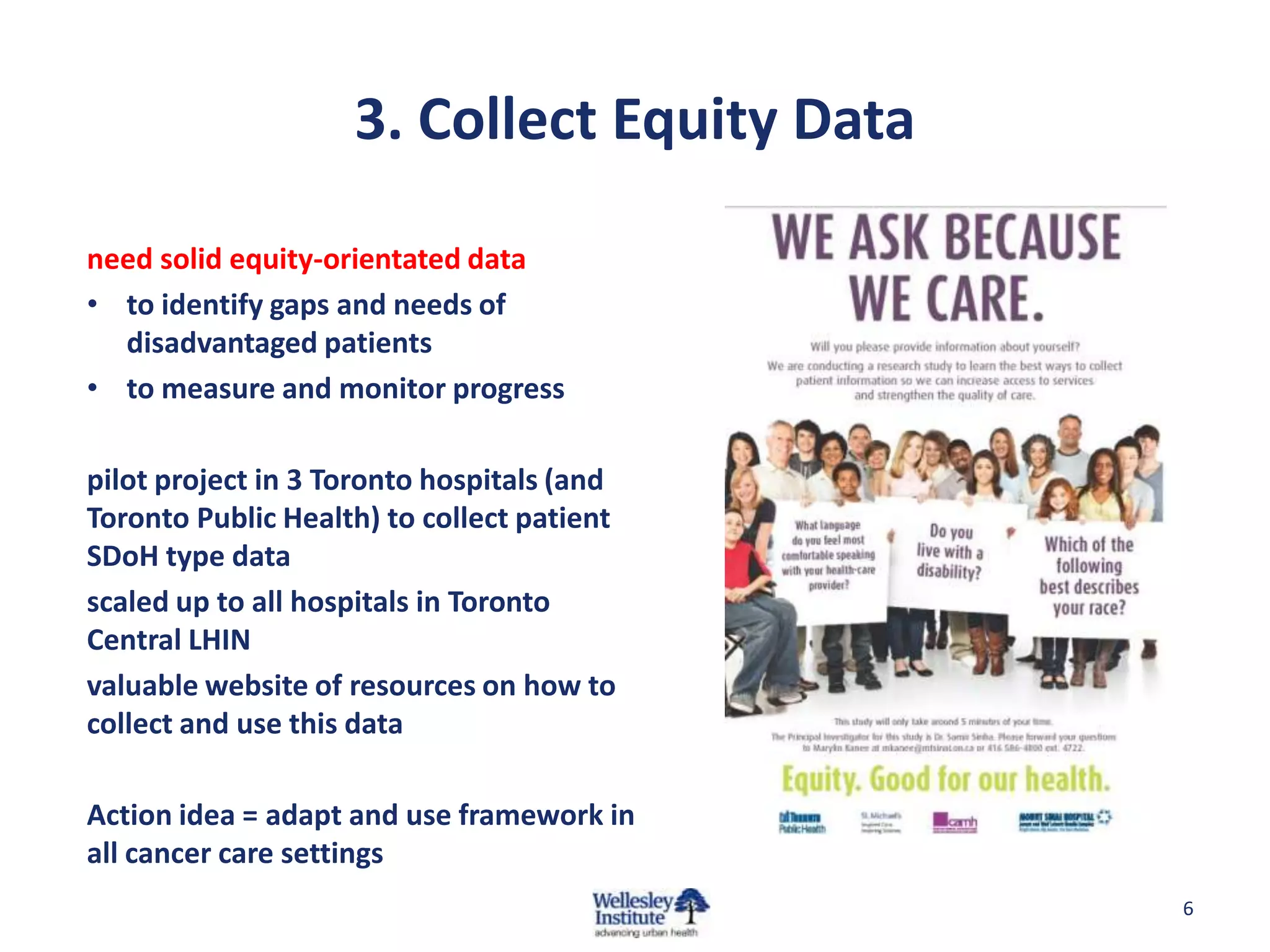
need solid equity-orientated data
• to identify gaps and needs of
disadvantaged patients
• to measure and monitor progress
pilot project in 3 Toronto hospitals (and
Toronto Public Health) to collect patient
SDoH type data
scaled up to all hospitals in Toronto
Central LHIN
valuable website of resources on how to
collect and use this data
Action idea = adapt and use framework in
all cancer care settings
6
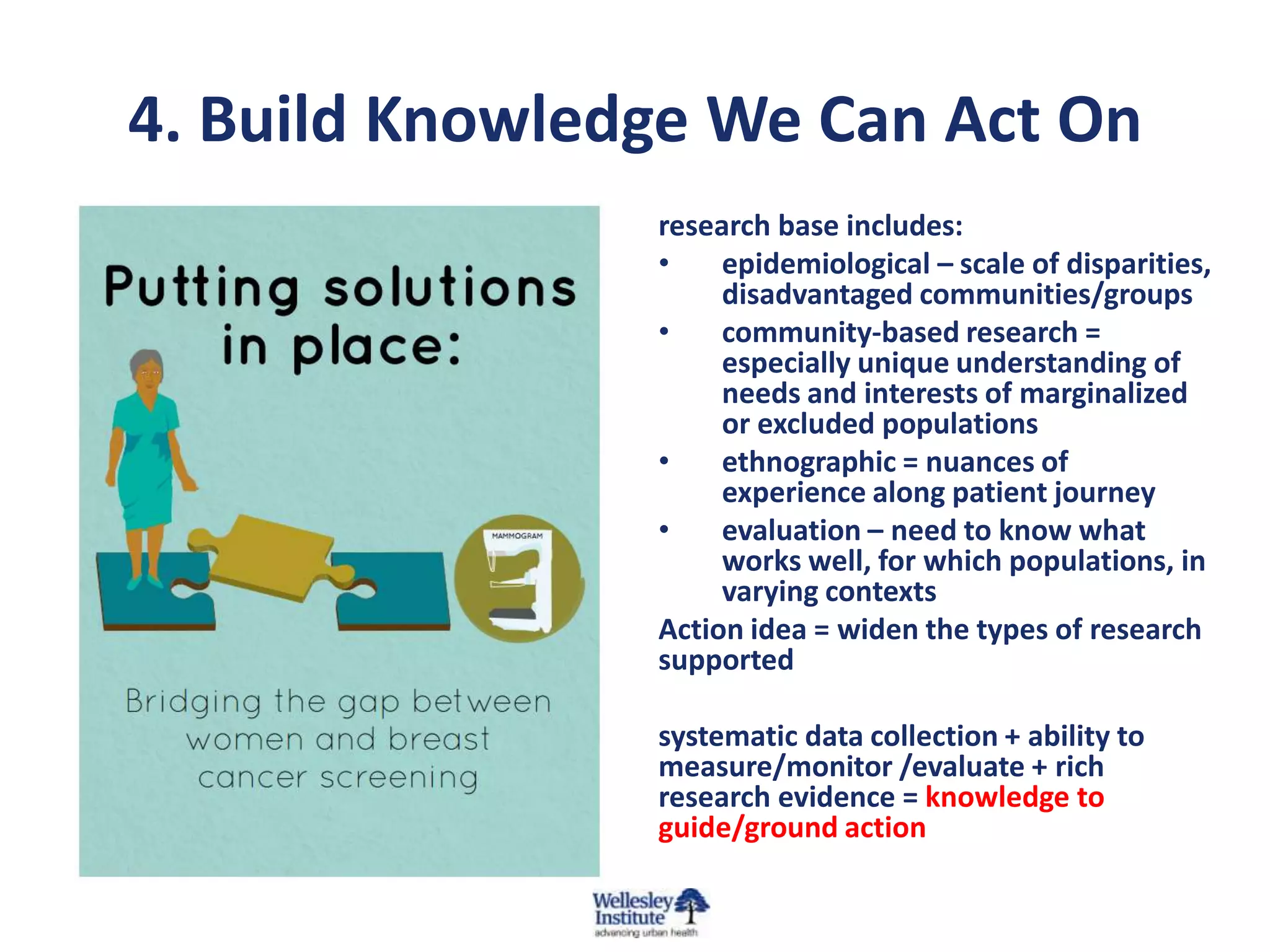
4. Build Knowledge We Can Act On
research base includes:
•
epidemiological – scale of disparities,
disadvantaged communities/groups
•
community-based research =
especially unique understanding of
needs and interests of marginalized
or excluded populations
•
ethnographic = nuances of
experience along patient journey
•
evaluation – need to know what
works well, for which populations, in
varying contexts
Action idea = widen the types of research
supported
systematic data collection + ability to
measure/monitor /evaluate + rich
research evidence = knowledge to
guide/ground action
5. Beyond Planning: Embed Equity Into
Targets, Deliverables and Performance
Management
• clear consensus from research and policy literature, and
consistent feature in comprehensive health equity policies
from other jurisdictions:
• developing realistic and actionable indicators for more
equitable service delivery and outcomes
• setting targets for reducing access differentials, improving
health outcomes of particular populations, etc
• monitoring progress against the targets and indicators
• disseminating the results widely for public scrutiny
• aligning performance with funding incentives and resource
allocation
• Action idea = embed equity into comprehensive
performance measurement and management strategy
8
5 a. Success Condition = Effective Equity Targets
• innovative work underway to develop equity indicators – but
don’t need to wait
• pick what is most relevant to your context:
• do rates of post-treatment recovery and hospitalization
vary inequitably – by geography, ethno-cultural
background, socio-economic status?
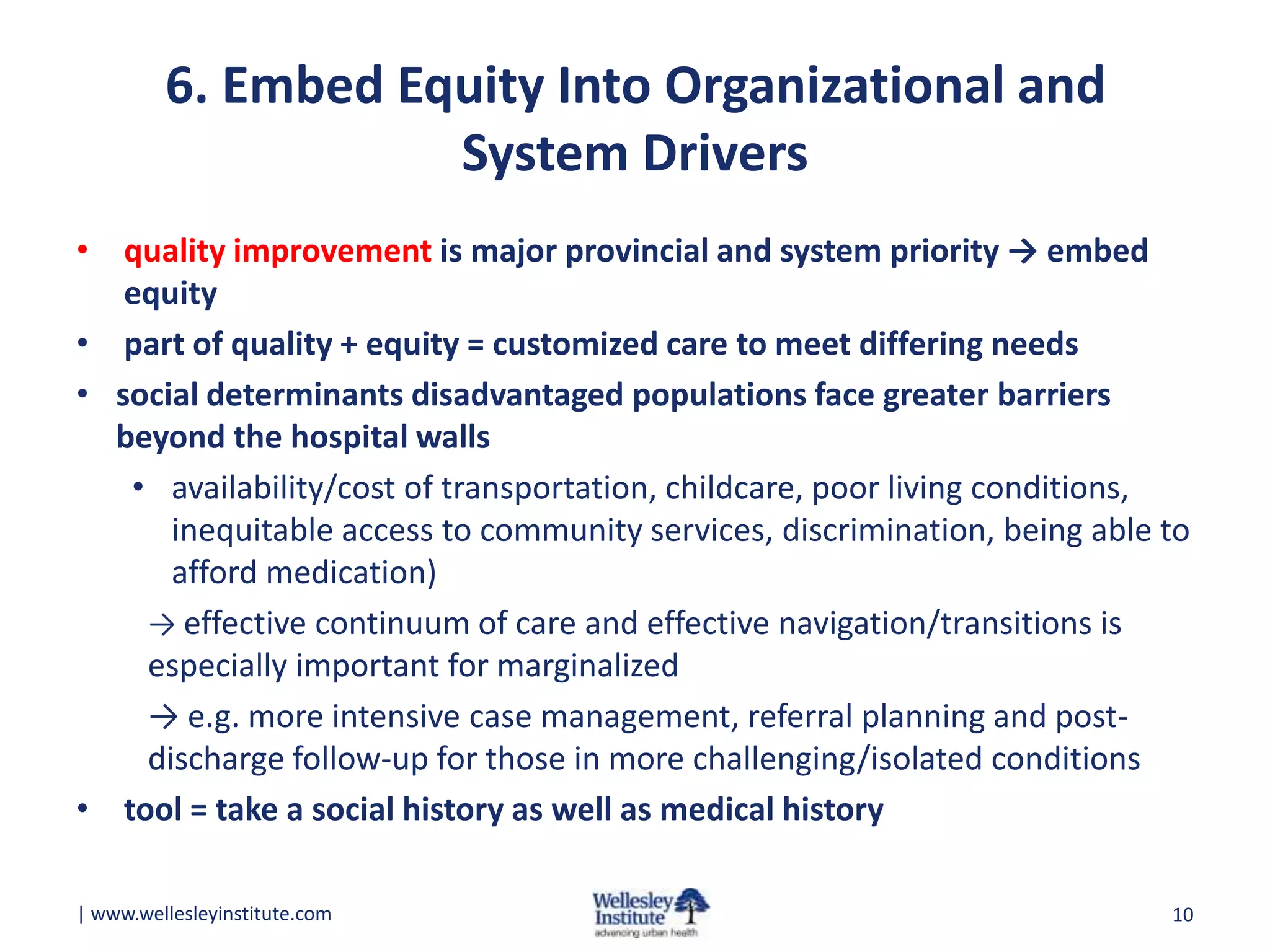
→ equity target = reduce inequitable differences
• build equity into existing targets:
• e.g. increasing rates of screening and reducing wait times
between diagnosis and treatment are system goals
→ equity target = reduce inequitable differences in rates
between different populations or areas
9
6. Embed Equity Into Organizational and
System Drivers
• quality improvement is major provincial and system priority → embed
equity
• part of quality + equity = customized care to meet differing needs
• social determinants disadvantaged populations face greater barriers
beyond the hospital walls
• availability/cost of transportation, childcare, poor living conditions,
inequitable access to community services, discrimination, being able to
afford medication)
→ effective continuum of care and effective navigation/transitions is
especially important for marginalized
→ e.g. more intensive case management, referral planning and postdischarge follow-up for those in more challenging/isolated conditions
• tool = take a social history as well as medical history
| www.wellesleyinstitute.com

10
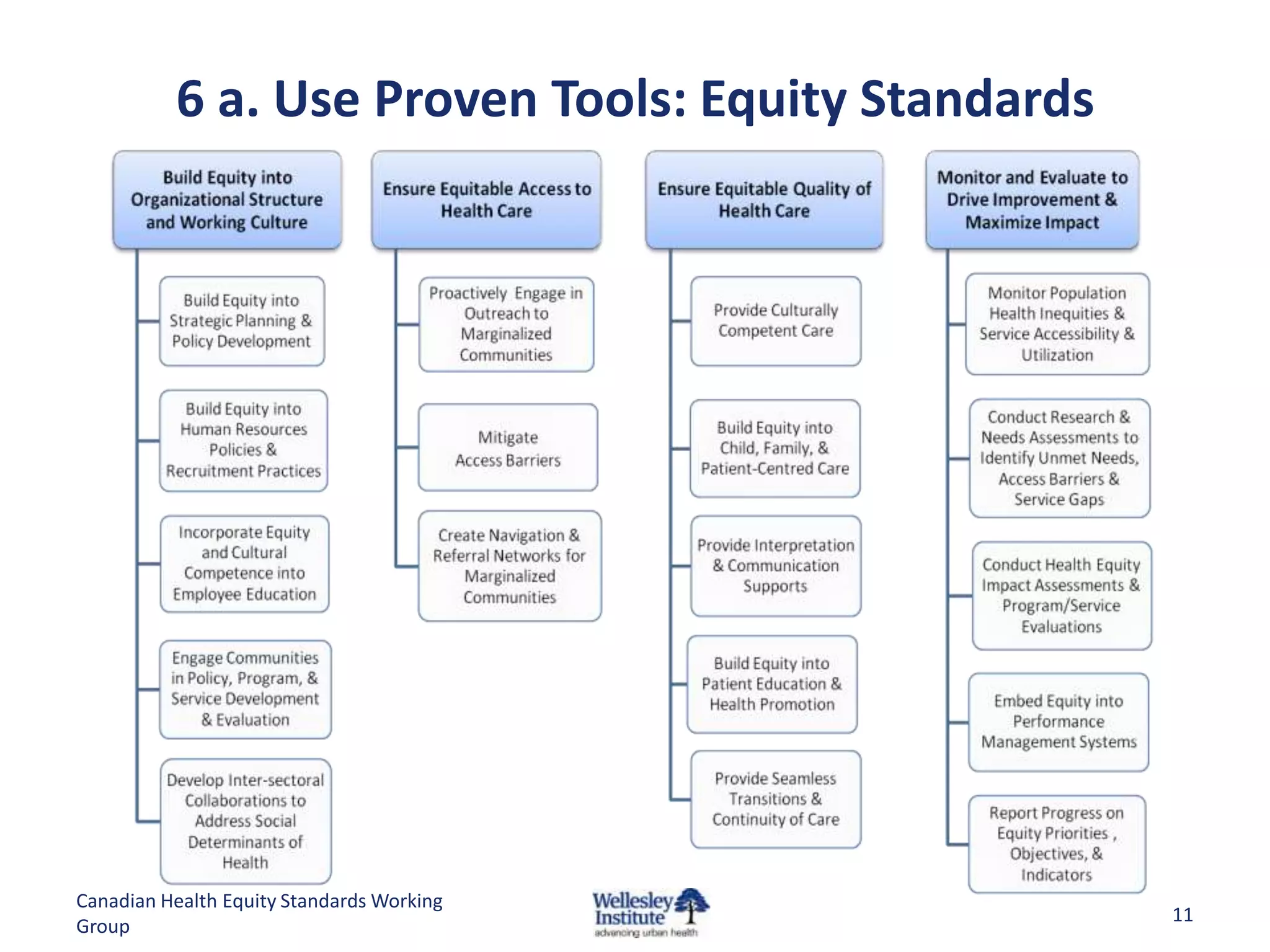
6 a. Use Proven Tools: Equity Standards

Canadian Health Equity Standards Working
Group

11
6 b. Indispensable Foundation for Equity Into
Quality = Cultural Competence
• in an increasingly diverse society, high quality care = culturally
competent care
• means building equity and diversity into all facets of service
delivery:
• means customizing care to address language and other barriers people may
face and to their cultural preferences and needs
= where structural analysis and knowing your patients meets quality care
• not just service delivery, but everywhere – e.g. security, receptionists

•

+ organizational commitment
• supported by resources – esp. for training
• linked into concrete performance expectations and deliverables
• diversity equity and other ‘soft’ services can be vulnerable in tough fiscal
times

•

Action idea: ensure cultural competence strategy, resources and
targets work well across the cancer care system

| www.wellesleyinstitute.com

12
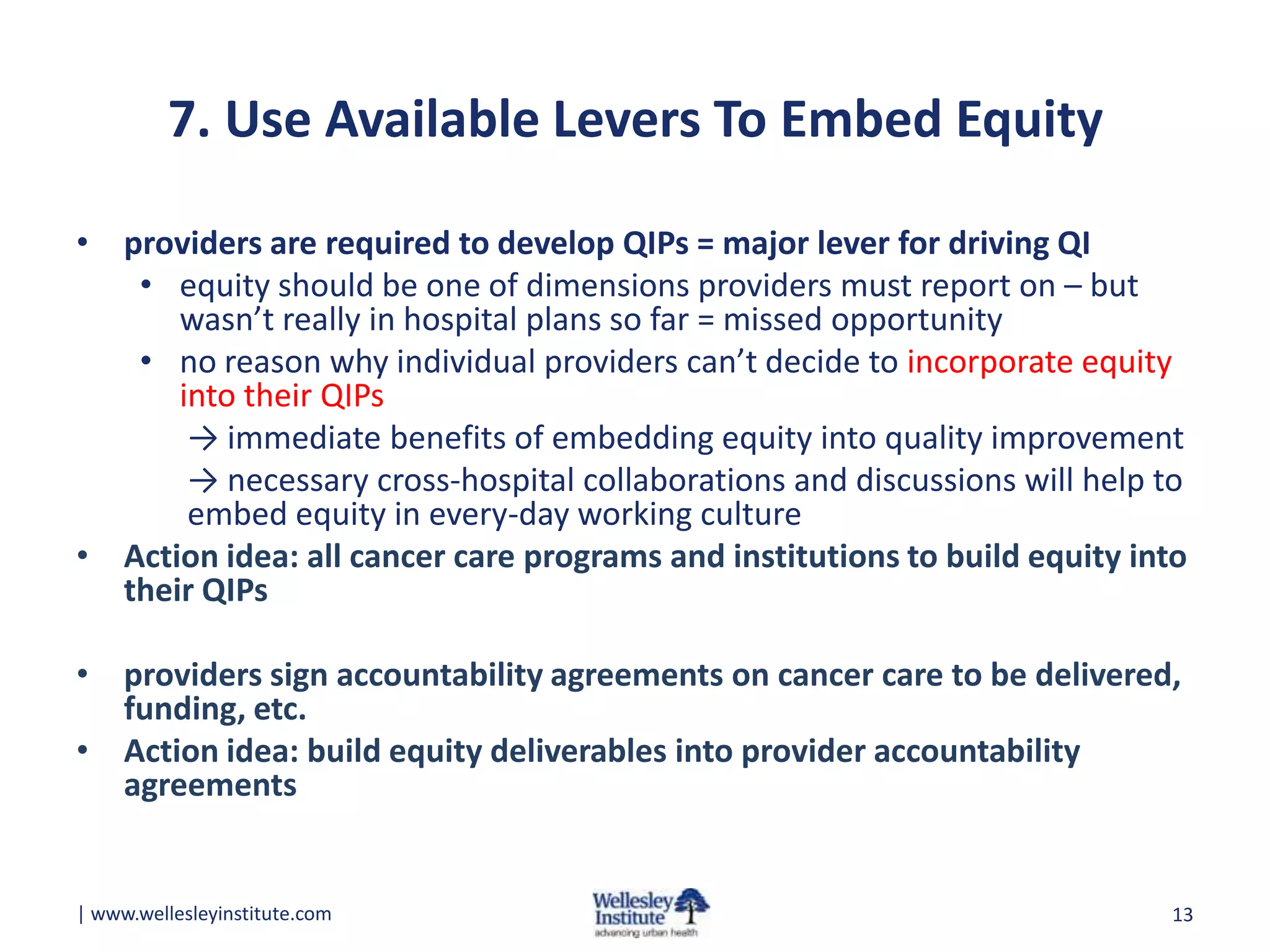
7. Use Available Levers To Embed Equity
• providers are required to develop QIPs = major lever for driving QI
• equity should be one of dimensions providers must report on – but
wasn’t really in hospital plans so far = missed opportunity
• no reason why individual providers can’t decide to incorporate equity
into their QIPs
→ immediate benefits of embedding equity into quality improvement
→ necessary cross-hospital collaborations and discussions will help to
embed equity in every-day working culture
• Action idea: all cancer care programs and institutions to build equity into
their QIPs
• providers sign accountability agreements on cancer care to be delivered,
funding, etc.
• Action idea: build equity deliverables into provider accountability
agreements

| www.wellesleyinstitute.com

13
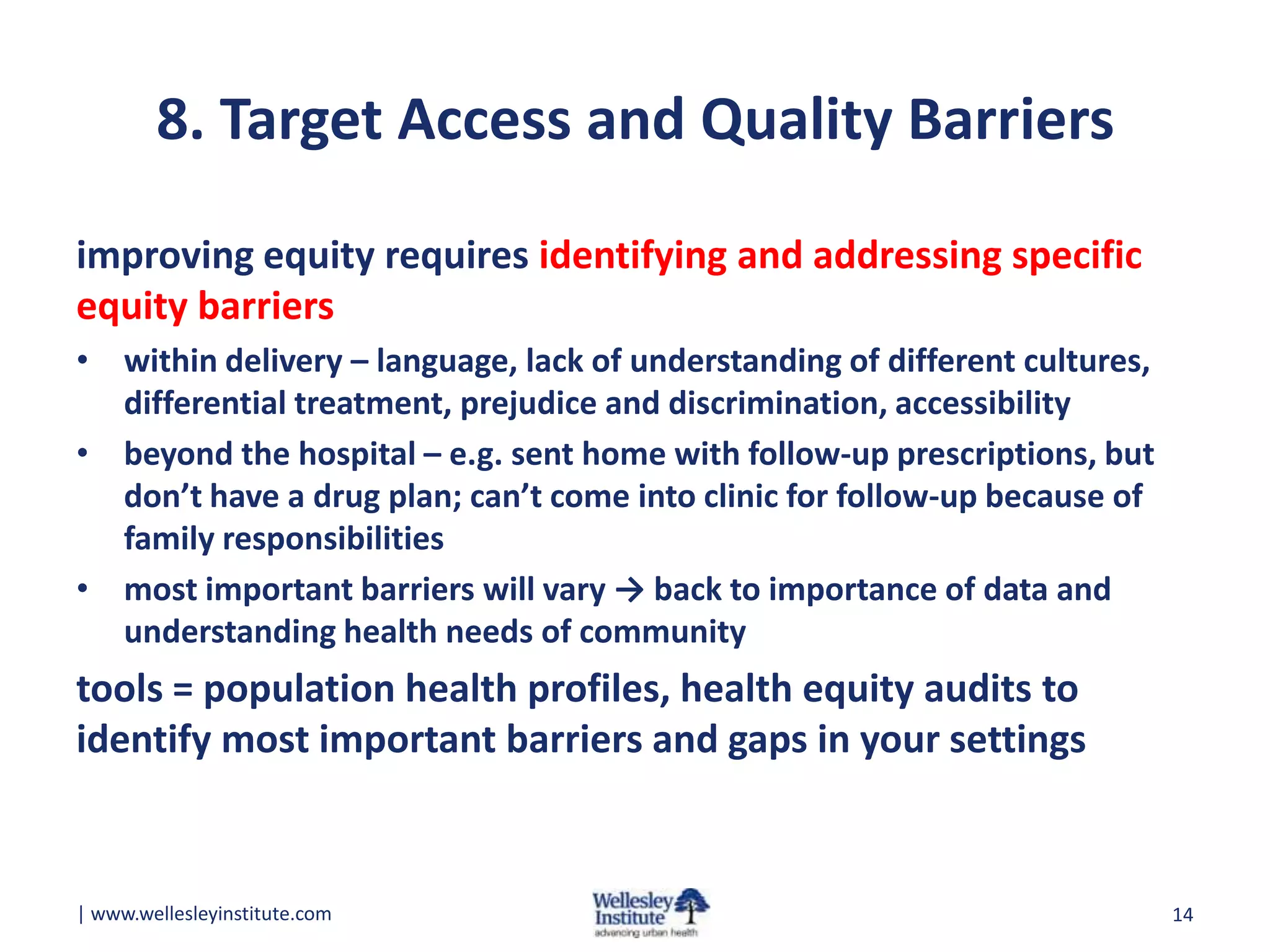
8. Target Access and Quality Barriers
improving equity requires identifying and addressing specific
equity barriers
• within delivery – language, lack of understanding of different cultures,
differential treatment, prejudice and discrimination, accessibility
• beyond the hospital – e.g. sent home with follow-up prescriptions, but
don’t have a drug plan; can’t come into clinic for follow-up because of
family responsibilities
• most important barriers will vary → back to importance of data and
understanding health needs of community

tools = population health profiles, health equity audits to
identify most important barriers and gaps in your settings

| www.wellesleyinstitute.com

14
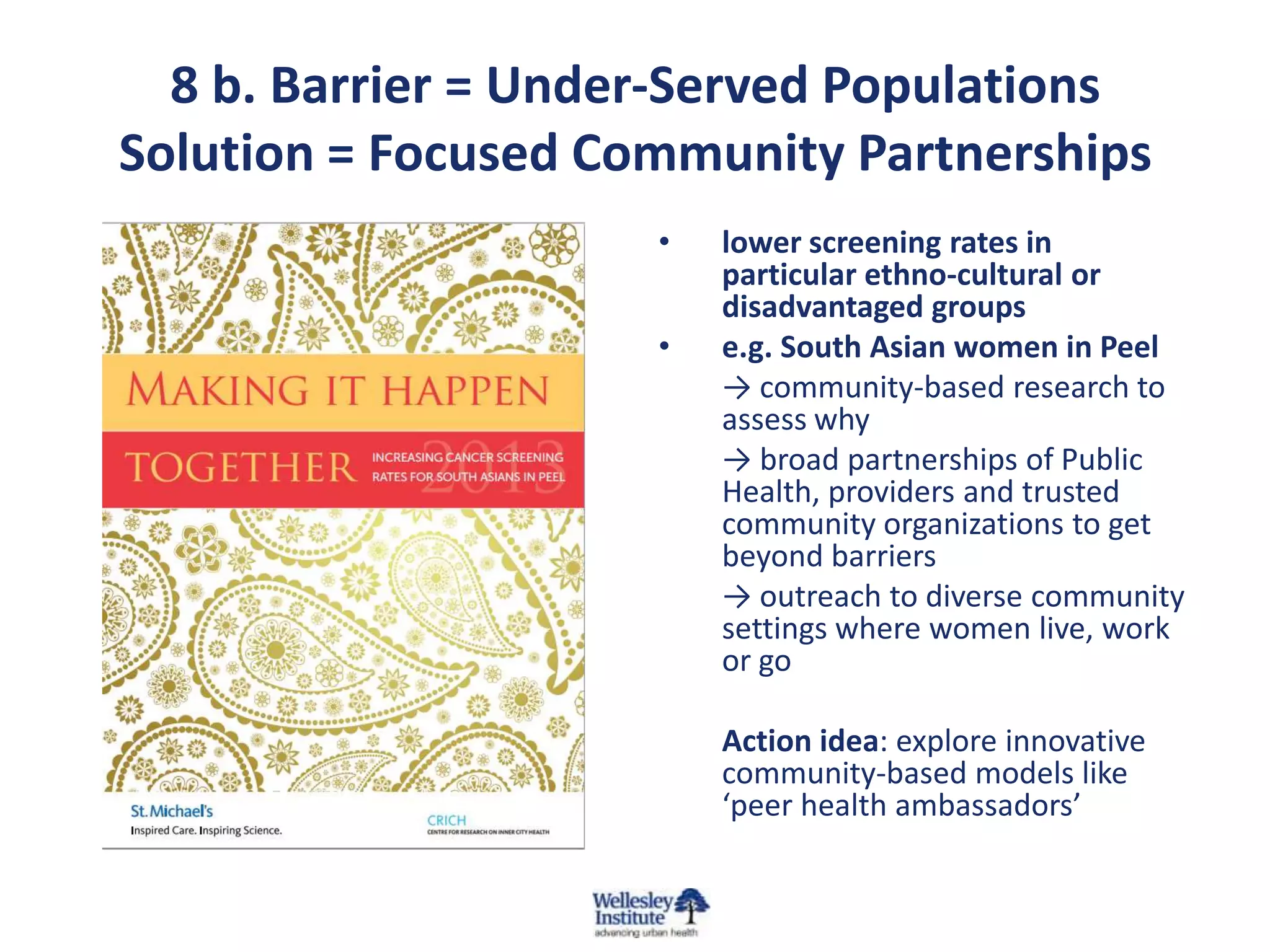
8 b. Barrier = Under-Served Populations
Solution = Focused Community Partnerships
•
•

lower screening rates in
particular ethno-cultural or
disadvantaged groups
e.g. South Asian women in Peel
→ community-based research to
assess why
→ broad partnerships of Public
Health, providers and trusted
community organizations to get
beyond barriers
→ outreach to diverse community
settings where women live, work
or go
Action idea: explore innovative
community-based models like
‘peer health ambassadors’
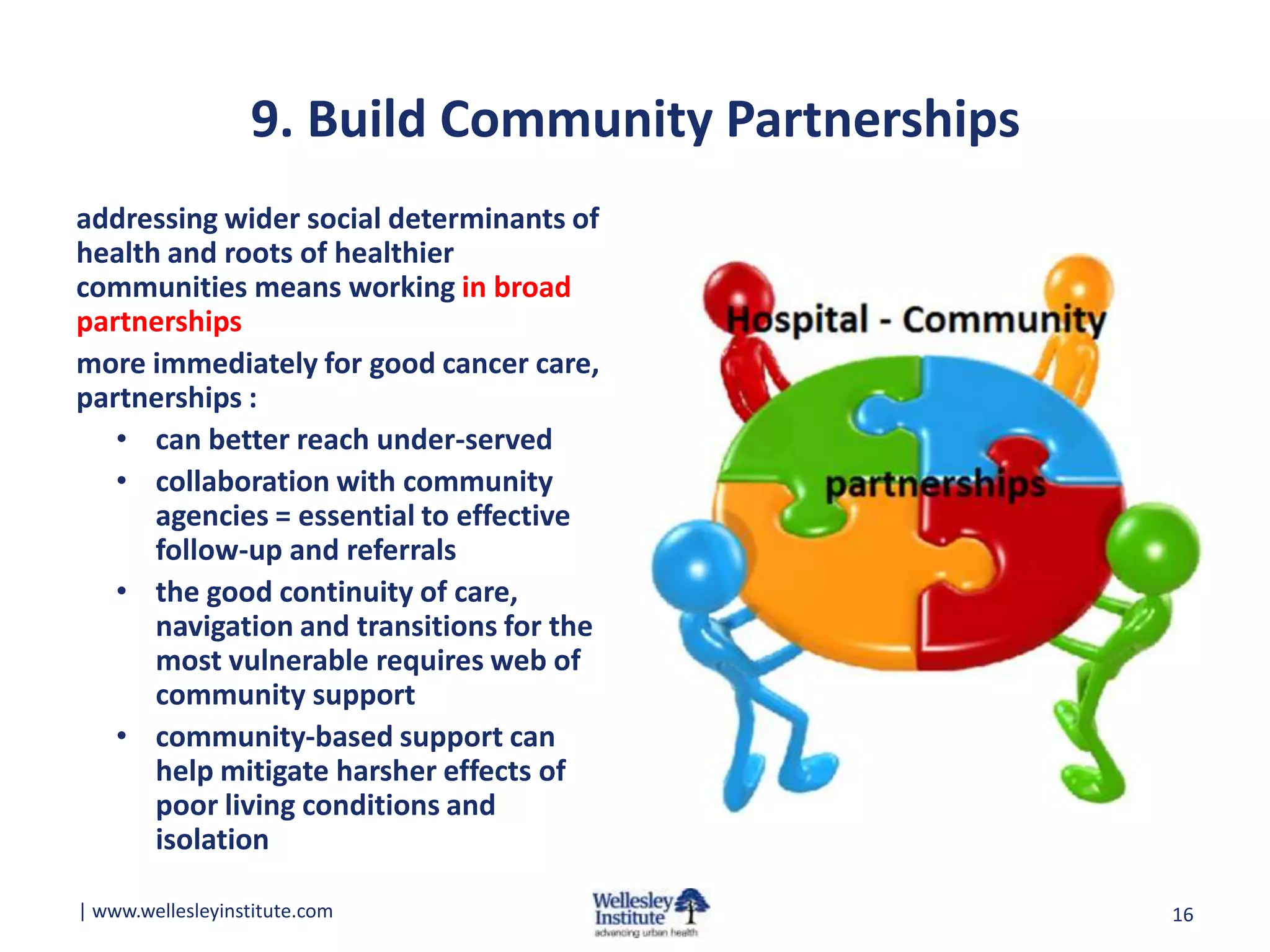
9. Build Community Partnerships
addressing wider social determinants of
health and roots of healthier
communities means working in broad
partnerships
more immediately for good cancer care,
partnerships :
• can better reach under-served
• collaboration with community
agencies = essential to effective
follow-up and referrals
• the good continuity of care,
navigation and transitions for the
most vulnerable requires web of
community support
• community-based support can
help mitigate harsher effects of
poor living conditions and
isolation
| www.wellesleyinstitute.com

16
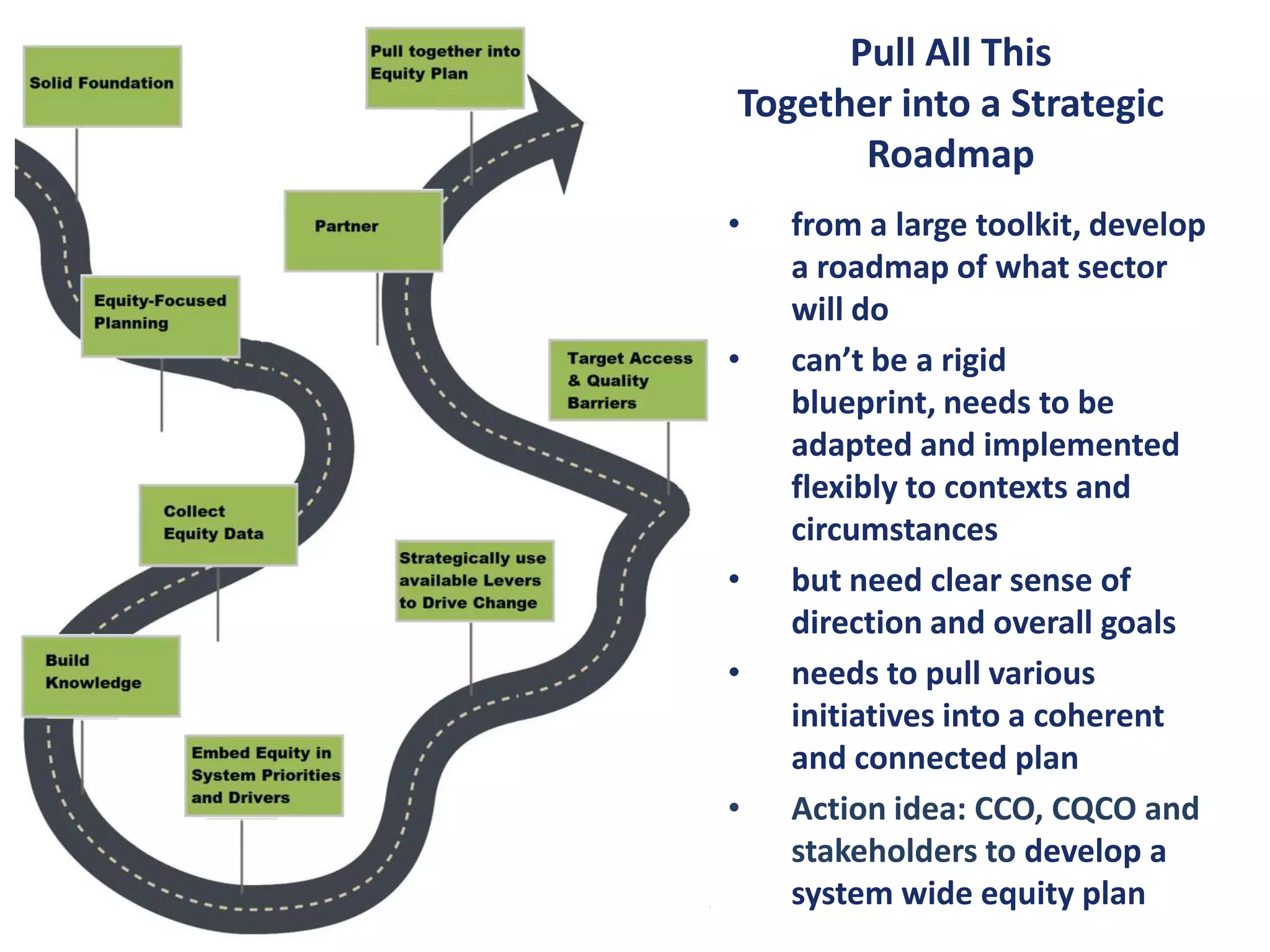
Pull All This
Together into a Strategic
Roadmap
•

•

•
•

•

from a large toolkit, develop
a roadmap of what sector
will do
can’t be a rigid
blueprint, needs to be
adapted and implemented
flexibly to contexts and
circumstances
but need clear sense of
direction and overall goals
needs to pull various
initiatives into a coherent
and connected plan
Action idea: CCO, CQCO and
stakeholders to develop a
system wide equity plan
Goal Today: Land on Action Initiatives
1. adapt and implement equity-relevant cancer care data
→systematically collect across the system
→build into measurement and monitoring

2. build equity into system and provider performance
management
•
•

adapt most relevant indicators, deliverables and incentives for
this context
use proven tools like standards, HEIA to operationalize

3. build community partnerships
•

•

to address access barriers, unmet needs and populations left
behind
to build a web of support for people with cancer

| www.wellesleyinstitute.com

18

Quality Cancer Care for All: An Equity Toolkit

  • 1.
    Quality Cancer Carefor All An Equity Toolkit Bob Gardner Signature Event: Removing Barriers to Cancer Care for All Cancer Quality Council of Ontario November, 2013
  • 2.
    Problem to Solve→ What Success Looks Like Social determinants of health:  Inequitable gradient of prevalence & burden  Inequitable personal/community resources to cope with cancers Inequitable care/patient experience:  Discrimination  Inequitable rates of screening  Inequitable barriers along the patient journey: screening, diagnosis, treatment, posttreatment support  Specific barriers: language, costs of medication, transportation & ancillary services Inequitable gaps in continuity of care:  Availability  Continuum of care  Integration of services  Provider Awareness of options available to patients no inequitable access barriers • all along the patient trajectory • all across an integrated system best quality for all • and geared to different/greater needs of health disadvantaged populations → best outcomes for all 2
  • 3.
    Towards Solutions If wecan identify those gaps and barriers and unmet needs, we can act on them • will set out a toolkit of ideas, directions and tools to build equity into cancer care planning and delivery • solidly based in research evidence and years of best practices • action-orientated and manageable • measureable – so can monitor and assess progress • adaptable to specific organizational and local contexts the particularly good news = don’t need to start from scratch 3
  • 4.
    1. Start fromSolid Foundations • high-performing healthcare systems – whether cancer care or province-wide -- build equity into all planning and service delivery • • doesn’t mean all programs are all about equity does mean all programs and planning need to take equity into account • need clear strategic commitment to build equity into system as a whole • • cascading throughout all providers and programs so that equity becomes part of working culture across the system commitment has to be backed up by resources for equity planning and operationalization | www.wellesleyinstitute.com 4
  • 5.
    2. Into PracticeThrough Equity-Focused Planning • addressing disparities in access to or quality of cancer care requires a solid understanding of: • the contours and scale of inequitable outcomes • the specific needs of health-disadvantaged populations • gaps in available services for these populations • key barriers to equitable access to high quality care along patient journey • at delivery level = considering equity in all program planning • e.g. given importance of communications and understanding to quality care → need to ensure cultural competence, access to interpretation wherever needed, etc. • need effective and practical equity-focused planning tools 5
  • 6.
    3. Collect EquityData need solid equity-orientated data • to identify gaps and needs of disadvantaged patients • to measure and monitor progress pilot project in 3 Toronto hospitals (and Toronto Public Health) to collect patient SDoH type data scaled up to all hospitals in Toronto Central LHIN valuable website of resources on how to collect and use this data Action idea = adapt and use framework in all cancer care settings 6
  • 7.
    4. Build KnowledgeWe Can Act On research base includes: • epidemiological – scale of disparities, disadvantaged communities/groups • community-based research = especially unique understanding of needs and interests of marginalized or excluded populations • ethnographic = nuances of experience along patient journey • evaluation – need to know what works well, for which populations, in varying contexts Action idea = widen the types of research supported systematic data collection + ability to measure/monitor /evaluate + rich research evidence = knowledge to guide/ground action
  • 8.
    5. Beyond Planning:Embed Equity Into Targets, Deliverables and Performance Management • clear consensus from research and policy literature, and consistent feature in comprehensive health equity policies from other jurisdictions: • developing realistic and actionable indicators for more equitable service delivery and outcomes • setting targets for reducing access differentials, improving health outcomes of particular populations, etc • monitoring progress against the targets and indicators • disseminating the results widely for public scrutiny • aligning performance with funding incentives and resource allocation • Action idea = embed equity into comprehensive performance measurement and management strategy 8
  • 9.
    5 a. SuccessCondition = Effective Equity Targets • innovative work underway to develop equity indicators – but don’t need to wait • pick what is most relevant to your context: • do rates of post-treatment recovery and hospitalization vary inequitably – by geography, ethno-cultural background, socio-economic status? → equity target = reduce inequitable differences • build equity into existing targets: • e.g. increasing rates of screening and reducing wait times between diagnosis and treatment are system goals → equity target = reduce inequitable differences in rates between different populations or areas 9
  • 10.
    6. Embed EquityInto Organizational and System Drivers • quality improvement is major provincial and system priority → embed equity • part of quality + equity = customized care to meet differing needs • social determinants disadvantaged populations face greater barriers beyond the hospital walls • availability/cost of transportation, childcare, poor living conditions, inequitable access to community services, discrimination, being able to afford medication) → effective continuum of care and effective navigation/transitions is especially important for marginalized → e.g. more intensive case management, referral planning and postdischarge follow-up for those in more challenging/isolated conditions • tool = take a social history as well as medical history | www.wellesleyinstitute.com 10
  • 11.
    6 a. UseProven Tools: Equity Standards Canadian Health Equity Standards Working Group 11
  • 12.
    6 b. IndispensableFoundation for Equity Into Quality = Cultural Competence • in an increasingly diverse society, high quality care = culturally competent care • means building equity and diversity into all facets of service delivery: • means customizing care to address language and other barriers people may face and to their cultural preferences and needs = where structural analysis and knowing your patients meets quality care • not just service delivery, but everywhere – e.g. security, receptionists • + organizational commitment • supported by resources – esp. for training • linked into concrete performance expectations and deliverables • diversity equity and other ‘soft’ services can be vulnerable in tough fiscal times • Action idea: ensure cultural competence strategy, resources and targets work well across the cancer care system | www.wellesleyinstitute.com 12
  • 13.
    7. Use AvailableLevers To Embed Equity • providers are required to develop QIPs = major lever for driving QI • equity should be one of dimensions providers must report on – but wasn’t really in hospital plans so far = missed opportunity • no reason why individual providers can’t decide to incorporate equity into their QIPs → immediate benefits of embedding equity into quality improvement → necessary cross-hospital collaborations and discussions will help to embed equity in every-day working culture • Action idea: all cancer care programs and institutions to build equity into their QIPs • providers sign accountability agreements on cancer care to be delivered, funding, etc. • Action idea: build equity deliverables into provider accountability agreements | www.wellesleyinstitute.com 13
  • 14.
    8. Target Accessand Quality Barriers improving equity requires identifying and addressing specific equity barriers • within delivery – language, lack of understanding of different cultures, differential treatment, prejudice and discrimination, accessibility • beyond the hospital – e.g. sent home with follow-up prescriptions, but don’t have a drug plan; can’t come into clinic for follow-up because of family responsibilities • most important barriers will vary → back to importance of data and understanding health needs of community tools = population health profiles, health equity audits to identify most important barriers and gaps in your settings | www.wellesleyinstitute.com 14
  • 15.
    8 b. Barrier= Under-Served Populations Solution = Focused Community Partnerships • • lower screening rates in particular ethno-cultural or disadvantaged groups e.g. South Asian women in Peel → community-based research to assess why → broad partnerships of Public Health, providers and trusted community organizations to get beyond barriers → outreach to diverse community settings where women live, work or go Action idea: explore innovative community-based models like ‘peer health ambassadors’
  • 16.
    9. Build CommunityPartnerships addressing wider social determinants of health and roots of healthier communities means working in broad partnerships more immediately for good cancer care, partnerships : • can better reach under-served • collaboration with community agencies = essential to effective follow-up and referrals • the good continuity of care, navigation and transitions for the most vulnerable requires web of community support • community-based support can help mitigate harsher effects of poor living conditions and isolation | www.wellesleyinstitute.com 16
  • 17.
    Pull All This Togetherinto a Strategic Roadmap • • • • • from a large toolkit, develop a roadmap of what sector will do can’t be a rigid blueprint, needs to be adapted and implemented flexibly to contexts and circumstances but need clear sense of direction and overall goals needs to pull various initiatives into a coherent and connected plan Action idea: CCO, CQCO and stakeholders to develop a system wide equity plan
  • 18.
    Goal Today: Landon Action Initiatives 1. adapt and implement equity-relevant cancer care data →systematically collect across the system →build into measurement and monitoring 2. build equity into system and provider performance management • • adapt most relevant indicators, deliverables and incentives for this context use proven tools like standards, HEIA to operationalize 3. build community partnerships • • to address access barriers, unmet needs and populations left behind to build a web of support for people with cancer | www.wellesleyinstitute.com 18

Editor's Notes

  • #3 POWER data age-standardized % of adults 2005overall patterns – 3 X as many low income as high report health to be only fair or poor self-reported = good proxy for clinical outcomes but exactly the point here, capturing people’s experience of their health
  • #4 will illustrate with examples relevant to cancer care – and more will come throughout the daydon’t know cancer care system as well as everybody in this room – you will know best how to adaptbut do want to set out fairly full repertoire of strategies and programs – and success conditions for implementing
  • #5 e.g. cost of drugsesp. given trends to more oral chemo delivered out of hospital = meds are no longer free = barriercommitment is easy – theme of walk the talk
  • #6 need to match tools to purpose
  • #7 2 things about cover: equity = good for health and why data is neededquandary again: don’t get paralyzed by inconsistent/inadequate datastart to collectthink of base of data that will be available in 5 yearsif time permits: having equity needs data will be impt as MOHLTC moves to more quality or performance-based funding
  • #8 OWHN inclusion research model – peer
  • #9 idea of leveling upOut: recognizing that what gets measured, matters
  • #10 satisfaction/ communications is anotherenable all voices to be heard e.g. NRC Picker survey has been translated into several languages
  • #11 all the organizational and delivery changes needed to drive QI = potential to transform healthcare systemkey challenge = how to ensure that quality improvement really does deliver For Allincludes taking patients’ social circumstances and living conditions into account
  • #12 background on project – WHO, pilots here, this was Cdn Consortium, starting with hospitals, symposium in spring join uptool toidentify key directions and levers for operationalizing equity plan – what needs to be lined up to drive change across all these fronts? how to dovetail constituent projects?monitor – develop indicators and targets for each componentfor facilitating equity conversations -- how well are we doing on these key components?
  • #13 some don’t use term – concern that it stops at just meaning cultureneed to talk about racism discrimination and avoidable institutionalized barriers – talk about powerand need to build into performance expectationsagain – don’t reinvent – lots of local resources developed by leading hospitals and others
  • #14 theme = use existing leversnot just high-level planning, also need training and resources so all staff can build equity into their daily practice
  • #15 compounding and complex: from Christinadiagnosis delayed because of assumptions about people with mental illnessolder people forego treatment because of accessibility problems – choice, but constraintsall these barriers also suggest solutionslonger opening hours of clinicschildcare in hospitalsproviding care in people’s homes or community settings
  • #17 not just better care, but in hospital self-interestbetter community support and follow-up for complex patients can help reduce re-admission ratespioneered by CHCs, public health and many community providers – compliments traditional nurse navigator modelall this partnership and community engagement through an equity lens:ensuring good links to organizations serving/representing the most vulnerable populations