Introduction to the C3 tool
(CHW Coverage and Capacity) to
strengthen CHW policy and programming
Core Group Spring Conference April 2017
Presented by Dr. Ochi Ibe
With Melanie Morrow and Bill Winfrey
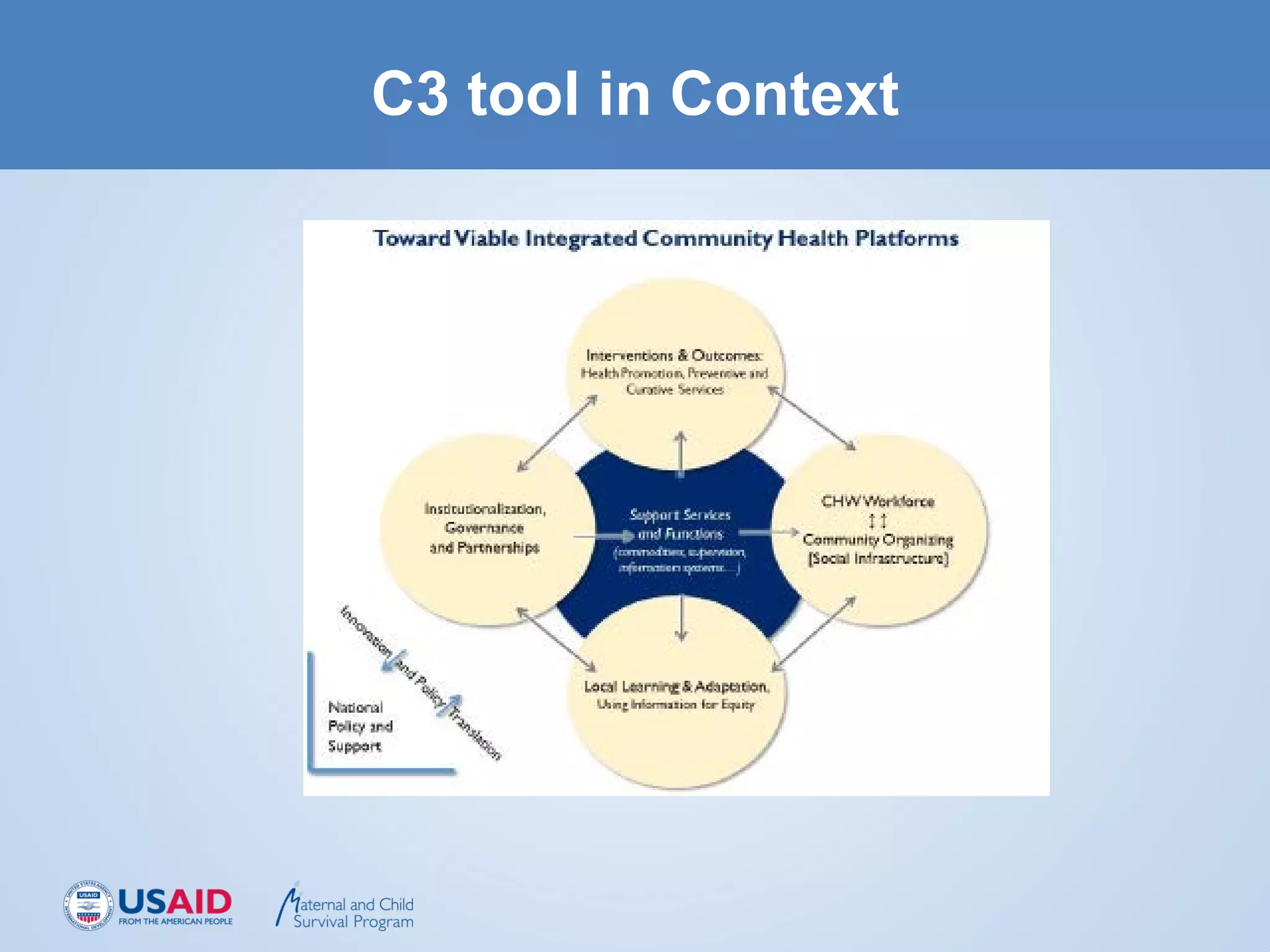
C3 tool in Context
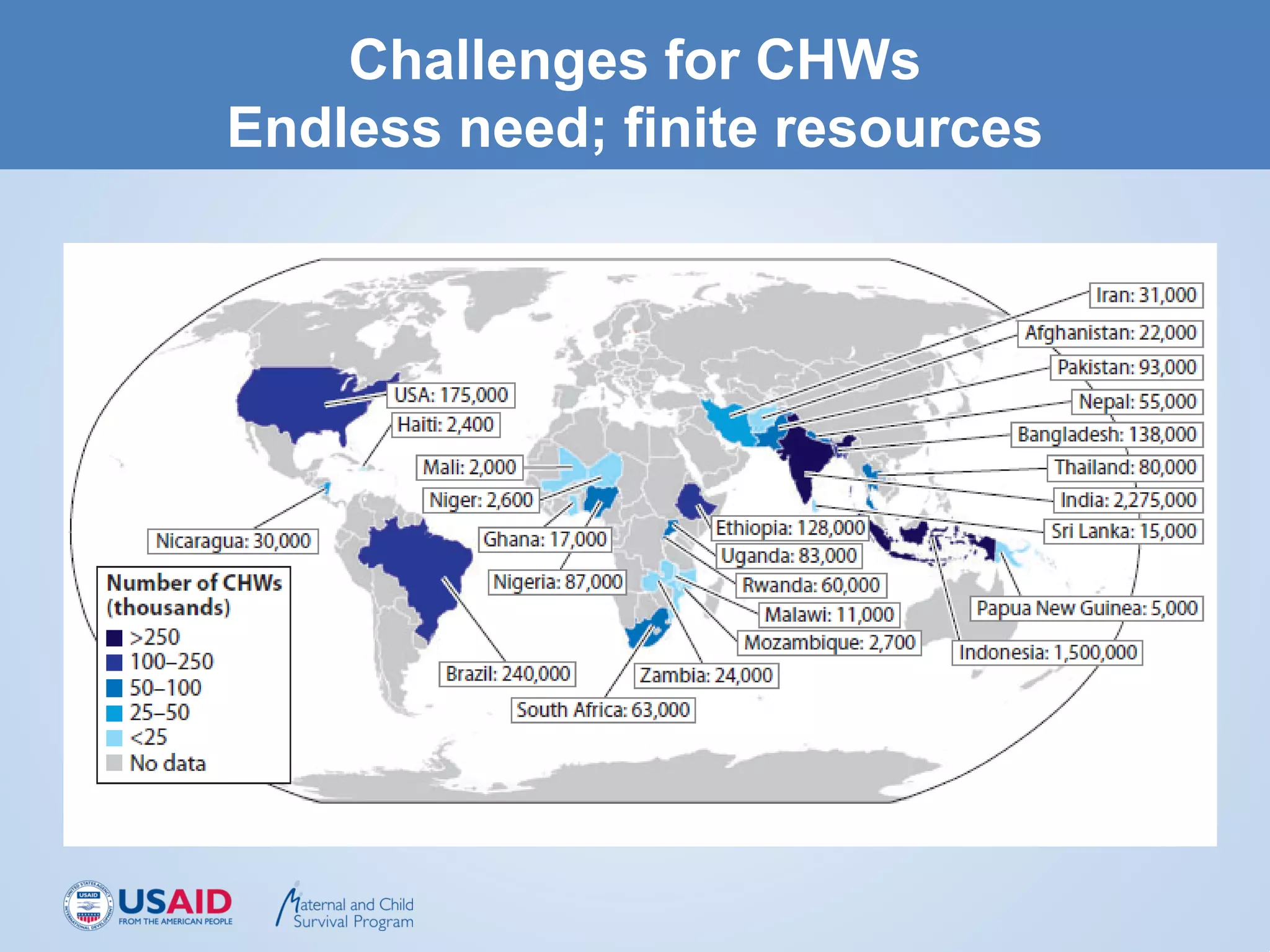
Challenges for CHWs
Endless need; finite resources
What is the C3 Tool?
• An Excel-based tool for examining options of CHW
allocation and engagement
• A step toward rational planning for CHW
programming
: CHWW
Coverage
(and) Capacity
C3
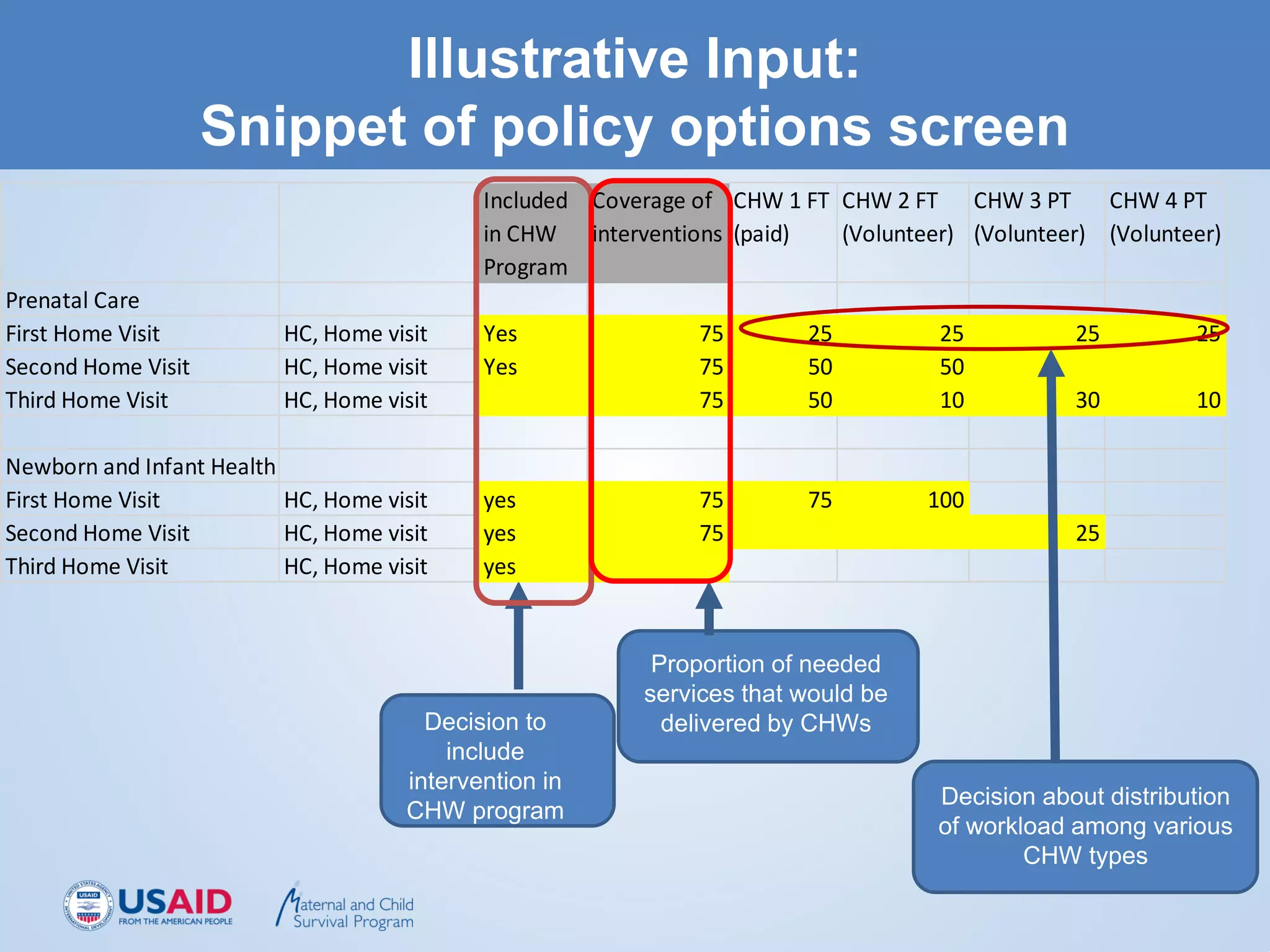
Illustrative Input:
Snippet of policy options screen
Decision to
include
intervention in
CHW program
Proportion of needed
services that would be
delivered by CHWs
Decision about distribution
of workload among various
CHW types
Included
in CHW
Program
Coverage of
interventions
CHW 1 FT
(paid)
CHW 2 FT
(Volunteer)
CHW 3 PT
(Volunteer)
CHW 4 PT
(Volunteer)
Prenatal Care
First Home Visit HC, Home visit Yes 75 25 25 25 25
Second Home Visit HC, Home visit Yes 75 50 50
Third Home Visit HC, Home visit 75 50 10 30 10
Newborn and Infant Health
First Home Visit HC, Home visit yes 75 75 100
Second Home Visit HC, Home visit yes 75 25
Third Home Visit HC, Home visit yes
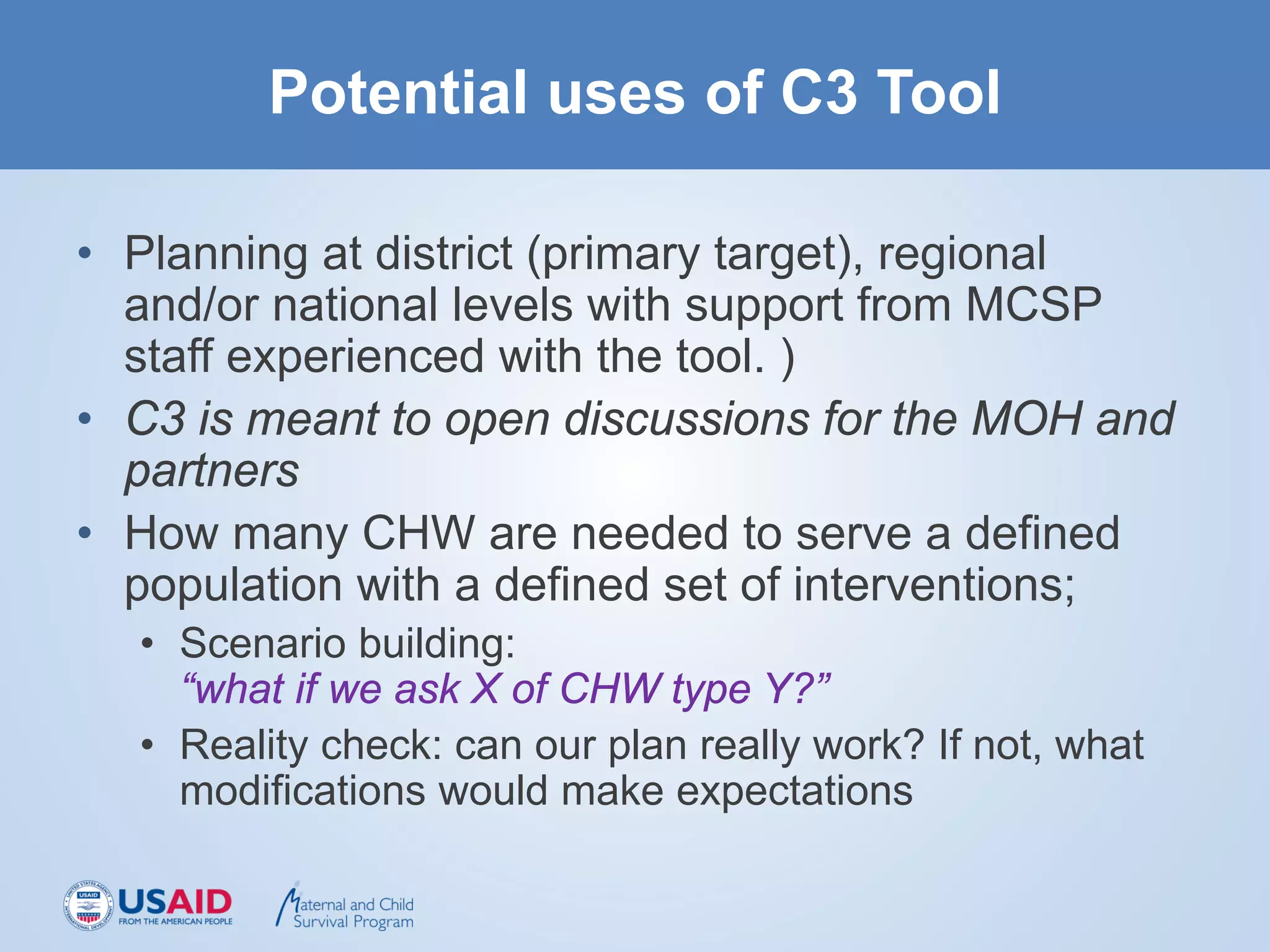
Potential uses of C3 Tool
• Planning at district (primary target), regional
and/or national levels with support from MCSP
staff experienced with the tool. )
• C3 is meant to open discussions for the MOH and
partners
• How many CHW are needed to serve a defined
population with a defined set of interventions;
• Scenario building:
“what if we ask X of CHW type Y?”
• Reality check: can our plan really work? If not, what
modifications would make expectations
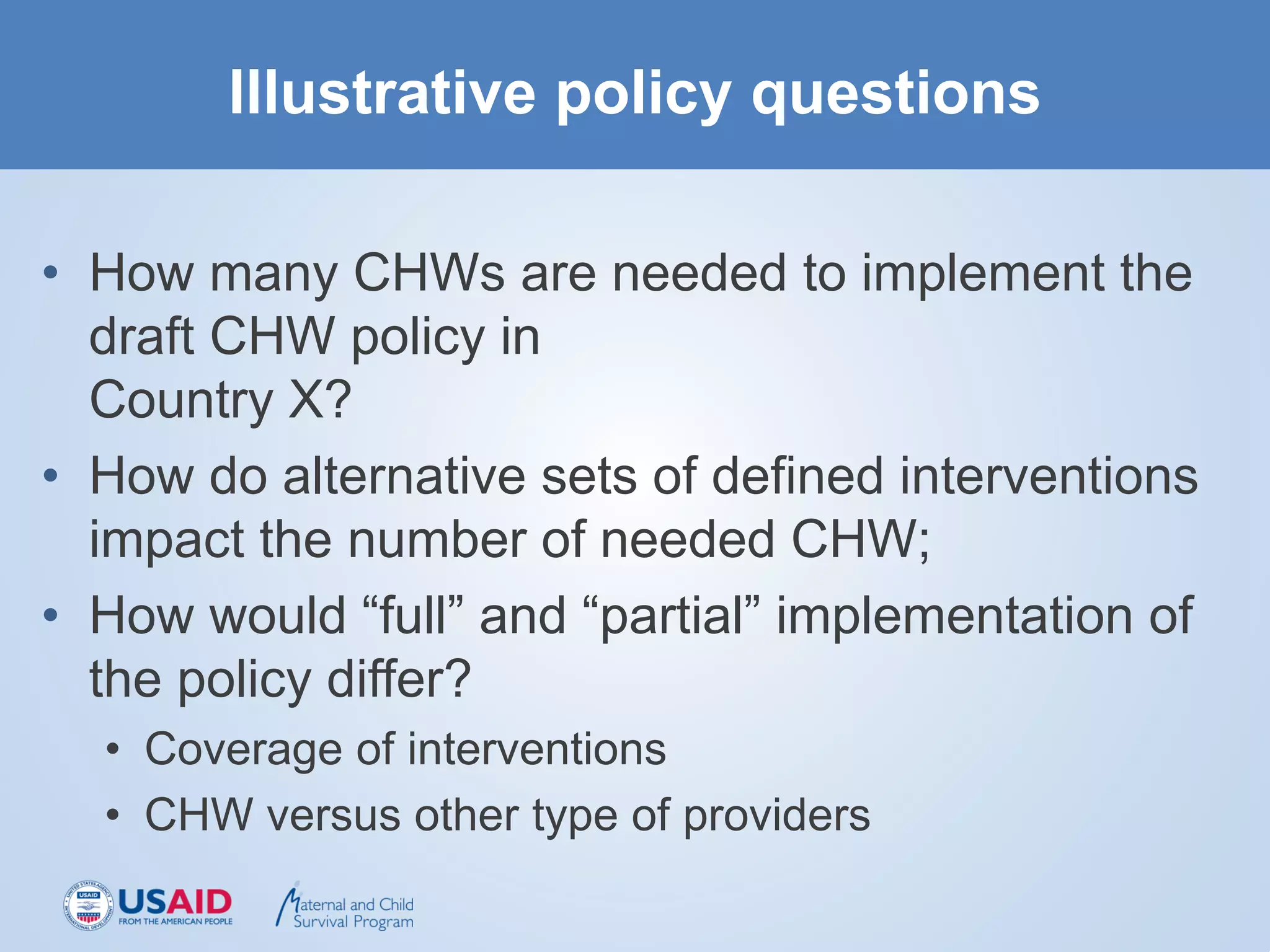
Illustrative policy questions
• How many CHWs are needed to implement the
draft CHW policy in
Country X?
• How do alternative sets of defined interventions
impact the number of needed CHW;
• How would “full” and “partial” implementation of
the policy differ?
• Coverage of interventions
• CHW versus other type of providers
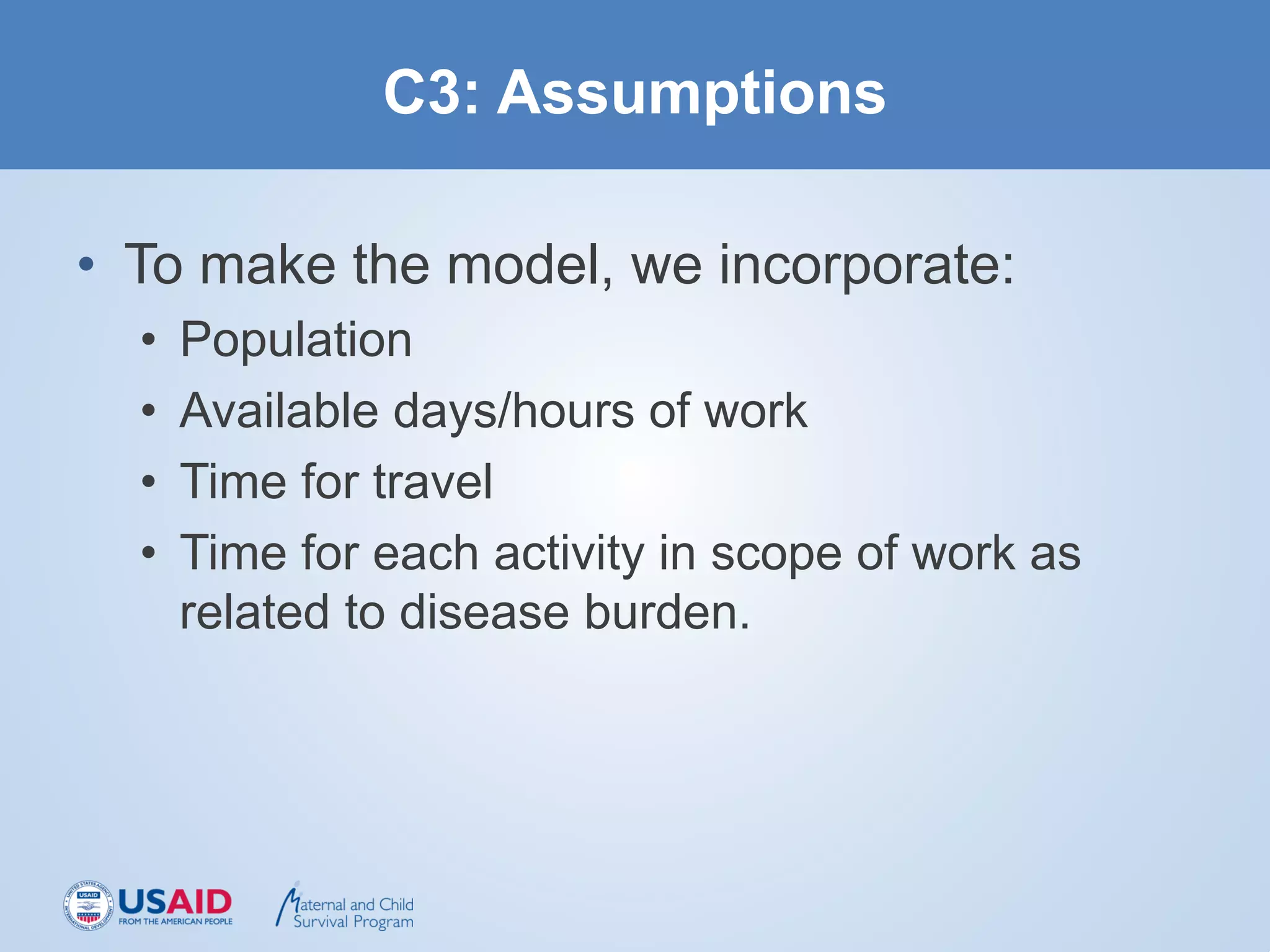
C3: Assumptions
• To make the model, we incorporate:
• Population
• Available days/hours of work
• Time for travel
• Time for each activity in scope of work as
related to disease burden.
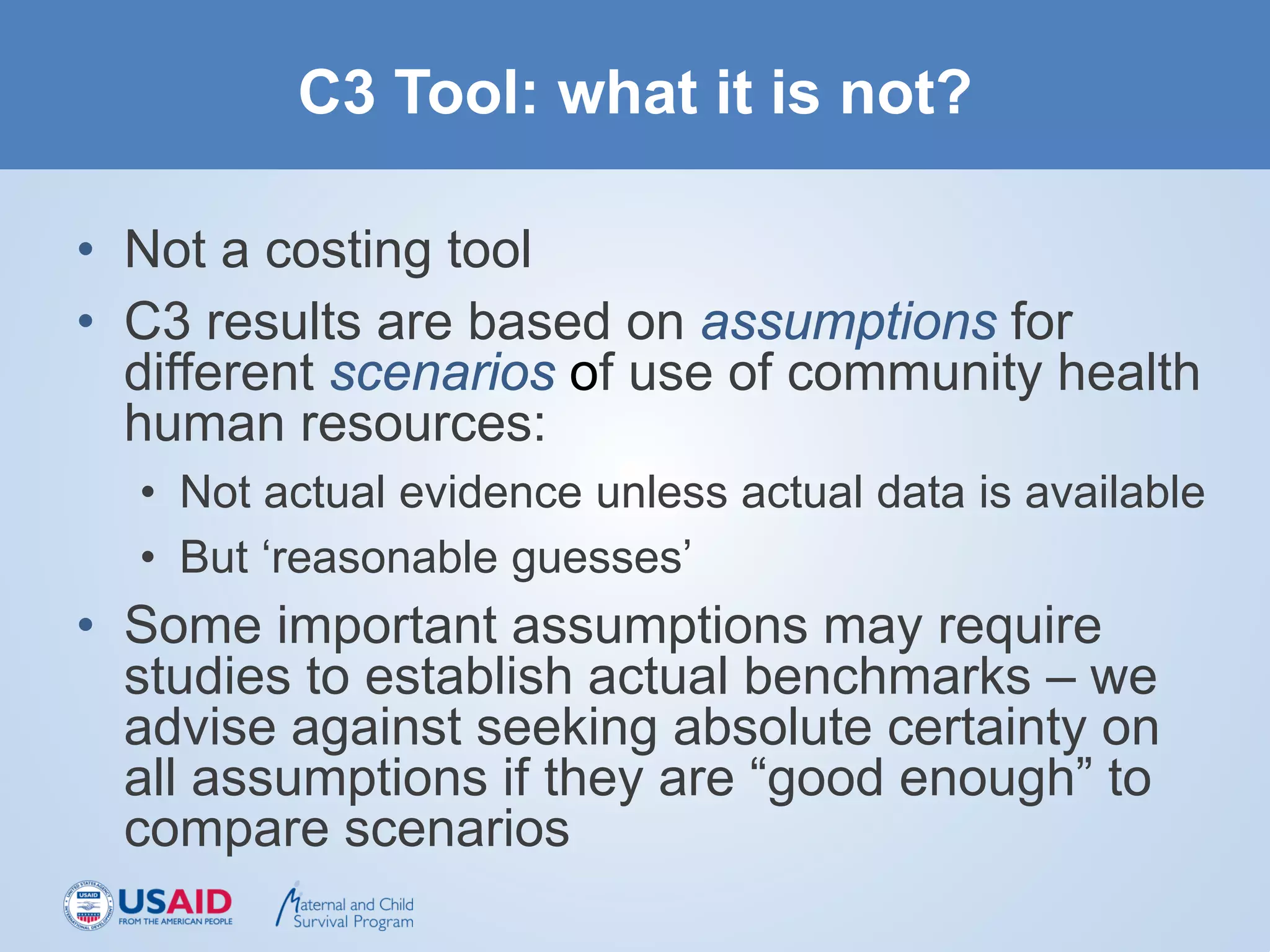
C3 Tool: what it is not?
• Not a costing tool
• C3 results are based on assumptions for
different scenarios of use of community health
human resources:
• Not actual evidence unless actual data is available
• But ‘reasonable guesses’
• Some important assumptions may require
studies to establish actual benchmarks – we
advise against seeking absolute certainty on
all assumptions if they are “good enough” to
compare scenarios
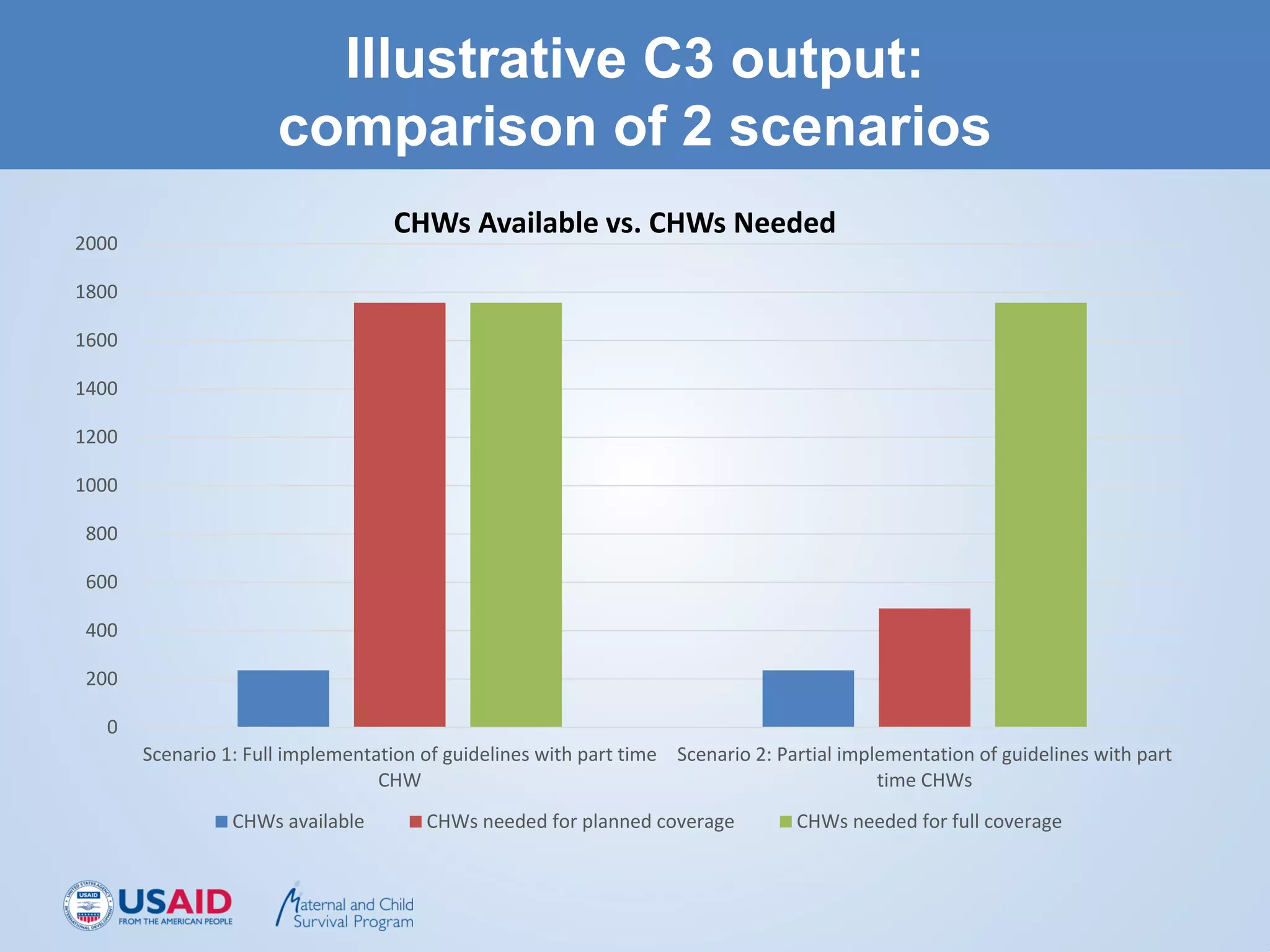
Illustrative C3 output:
comparison of 2 scenarios
0
200
400
600
800
1000
1200
1400
1600
1800
2000
Scenario 1: Full implementation of guidelines with part time
CHW
Scenario 2: Partial implementation of guidelines with part
time CHWs
CHWs available CHWs needed for planned coverage CHWs needed for full coverage
CHWs Available vs. CHWs Needed
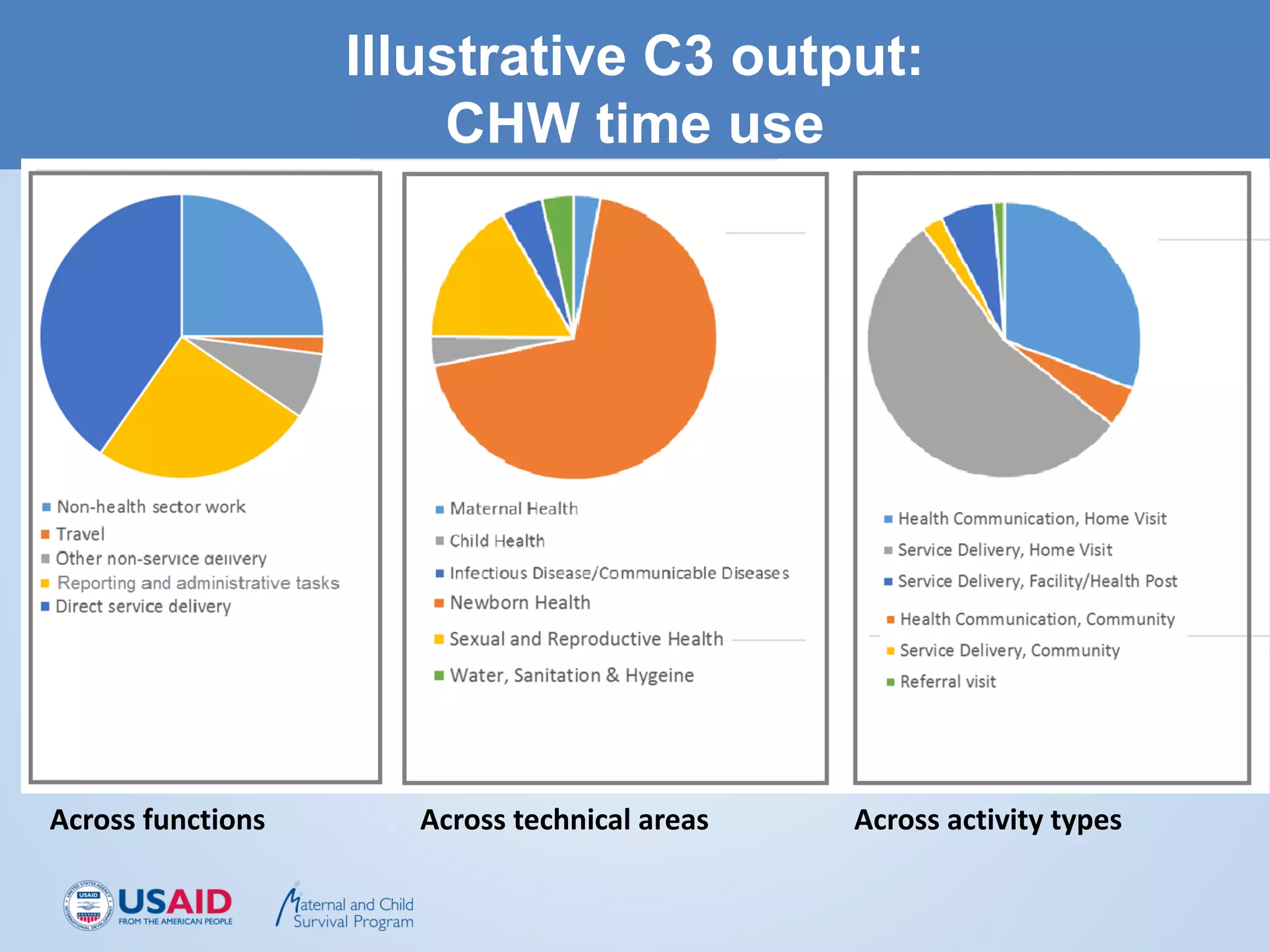
Illustrative C3 output:
CHW time use
Across functions Across technical areas Across activity types
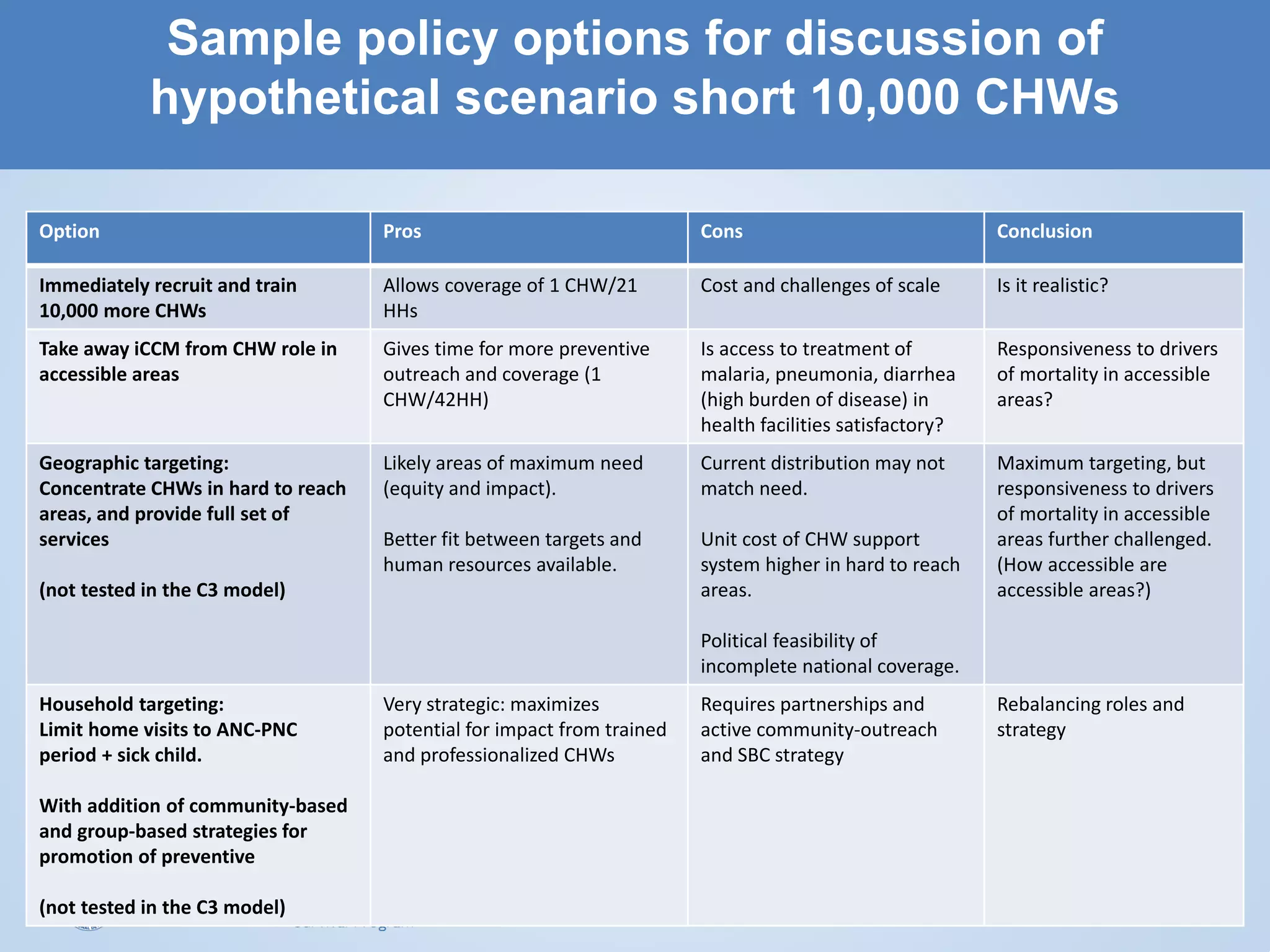
Sample policy options for discussion of
hypothetical scenario short 10,000 CHWs
Option Pros Cons Conclusion
Immediately recruit and train
10,000 more CHWs
Allows coverage of 1 CHW/21
HHs
Cost and challenges of scale Is it realistic?
Take away iCCM from CHW role in
accessible areas
Gives time for more preventive
outreach and coverage (1
CHW/42HH)
Is access to treatment of
malaria, pneumonia, diarrhea
(high burden of disease) in
health facilities satisfactory?
Responsiveness to drivers
of mortality in accessible
areas?
Geographic targeting:
Concentrate CHWs in hard to reach
areas, and provide full set of
services
(not tested in the C3 model)
Likely areas of maximum need
(equity and impact).
Better fit between targets and
human resources available.
Current distribution may not
match need.
Unit cost of CHW support
system higher in hard to reach
areas.
Political feasibility of
incomplete national coverage.
Maximum targeting, but
responsiveness to drivers
of mortality in accessible
areas further challenged.
(How accessible are
accessible areas?)
Household targeting:
Limit home visits to ANC-PNC
period + sick child.
With addition of community-based
and group-based strategies for
promotion of preventive
(not tested in the C3 model)
Very strategic: maximizes
potential for impact from trained
and professionalized CHWs
Requires partnerships and
active community-outreach
and SBC strategy
Rebalancing roles and
strategy
For more information, please visit
www.mcsprogram.org
This presentation was made possible by the generous support of the American people through
the United States Agency for International Development (USAID), under the terms of the
Cooperative Agreement AID-OAA-A-14-00028.The contents are the responsibility of the authors
and do not necessarily reflect the views of USAID or the United States Government.

Strengthening the Building Blocks of Health Systems Doing Better, Reaching More -- Ibe

  • 1.
    Introduction to theC3 tool (CHW Coverage and Capacity) to strengthen CHW policy and programming Core Group Spring Conference April 2017 Presented by Dr. Ochi Ibe With Melanie Morrow and Bill Winfrey
  • 2.
    C3 tool inContext
  • 3.
    Challenges for CHWs Endlessneed; finite resources
  • 4.
    What is theC3 Tool? • An Excel-based tool for examining options of CHW allocation and engagement • A step toward rational planning for CHW programming : CHWW Coverage (and) Capacity C3
  • 5.
    Illustrative Input: Snippet ofpolicy options screen Decision to include intervention in CHW program Proportion of needed services that would be delivered by CHWs Decision about distribution of workload among various CHW types Included in CHW Program Coverage of interventions CHW 1 FT (paid) CHW 2 FT (Volunteer) CHW 3 PT (Volunteer) CHW 4 PT (Volunteer) Prenatal Care First Home Visit HC, Home visit Yes 75 25 25 25 25 Second Home Visit HC, Home visit Yes 75 50 50 Third Home Visit HC, Home visit 75 50 10 30 10 Newborn and Infant Health First Home Visit HC, Home visit yes 75 75 100 Second Home Visit HC, Home visit yes 75 25 Third Home Visit HC, Home visit yes
  • 6.
    Potential uses ofC3 Tool • Planning at district (primary target), regional and/or national levels with support from MCSP staff experienced with the tool. ) • C3 is meant to open discussions for the MOH and partners • How many CHW are needed to serve a defined population with a defined set of interventions; • Scenario building: “what if we ask X of CHW type Y?” • Reality check: can our plan really work? If not, what modifications would make expectations
  • 7.
    Illustrative policy questions •How many CHWs are needed to implement the draft CHW policy in Country X? • How do alternative sets of defined interventions impact the number of needed CHW; • How would “full” and “partial” implementation of the policy differ? • Coverage of interventions • CHW versus other type of providers
  • 8.
    C3: Assumptions • Tomake the model, we incorporate: • Population • Available days/hours of work • Time for travel • Time for each activity in scope of work as related to disease burden.
  • 9.
    C3 Tool: whatit is not? • Not a costing tool • C3 results are based on assumptions for different scenarios of use of community health human resources: • Not actual evidence unless actual data is available • But ‘reasonable guesses’ • Some important assumptions may require studies to establish actual benchmarks – we advise against seeking absolute certainty on all assumptions if they are “good enough” to compare scenarios
  • 10.
    Illustrative C3 output: comparisonof 2 scenarios 0 200 400 600 800 1000 1200 1400 1600 1800 2000 Scenario 1: Full implementation of guidelines with part time CHW Scenario 2: Partial implementation of guidelines with part time CHWs CHWs available CHWs needed for planned coverage CHWs needed for full coverage CHWs Available vs. CHWs Needed
  • 11.
    Illustrative C3 output: CHWtime use Across functions Across technical areas Across activity types
  • 12.
    Sample policy optionsfor discussion of hypothetical scenario short 10,000 CHWs Option Pros Cons Conclusion Immediately recruit and train 10,000 more CHWs Allows coverage of 1 CHW/21 HHs Cost and challenges of scale Is it realistic? Take away iCCM from CHW role in accessible areas Gives time for more preventive outreach and coverage (1 CHW/42HH) Is access to treatment of malaria, pneumonia, diarrhea (high burden of disease) in health facilities satisfactory? Responsiveness to drivers of mortality in accessible areas? Geographic targeting: Concentrate CHWs in hard to reach areas, and provide full set of services (not tested in the C3 model) Likely areas of maximum need (equity and impact). Better fit between targets and human resources available. Current distribution may not match need. Unit cost of CHW support system higher in hard to reach areas. Political feasibility of incomplete national coverage. Maximum targeting, but responsiveness to drivers of mortality in accessible areas further challenged. (How accessible are accessible areas?) Household targeting: Limit home visits to ANC-PNC period + sick child. With addition of community-based and group-based strategies for promotion of preventive (not tested in the C3 model) Very strategic: maximizes potential for impact from trained and professionalized CHWs Requires partnerships and active community-outreach and SBC strategy Rebalancing roles and strategy
  • 13.
    For more information,please visit www.mcsprogram.org This presentation was made possible by the generous support of the American people through the United States Agency for International Development (USAID), under the terms of the Cooperative Agreement AID-OAA-A-14-00028.The contents are the responsibility of the authors and do not necessarily reflect the views of USAID or the United States Government.