Mrs. Comstock
 Culture is created by a sense of shared
 beliefs and values of a group: the
 beliefs, customs, practices, and social
 behavior of a particular nation or people.
 There  is a difference between examining
 traits of cultural groups and stereotyping a
 group. You need to understand that not all
 groups of people have the same cultural
 beliefs. You are going to represent an
 “aspect” of a cultural group you choose.
 How can an artwork from a selected
 culture or historical time period
 represent that culture or time period?
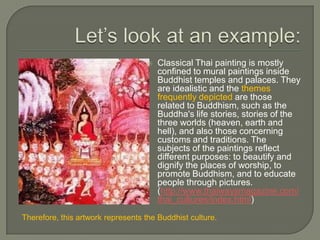
   Classical Thai painting is mostly
                                        confined to mural paintings inside
                                        Buddhist temples and palaces. They
                                        are idealistic and the themes
                                        frequently depicted are those
                                        related to Buddhism, such as the
                                        Buddha's life stories, stories of the
                                        three worlds (heaven, earth and
                                        hell), and also those concerning
                                        customs and traditions. The
                                        subjects of the paintings reflect
                                        different purposes: to beautify and
                                        dignify the places of worship, to
                                        promote Buddhism, and to educate
                                        people through pictures.
                                        (http://www.thaiwaysmagazine.com/
                                        thai_cultures/index.html)
Therefore, this artwork represents the Buddhist culture.
What do you think this artwork represents?

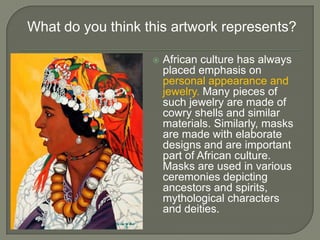
                      African culture has always
                       placed emphasis on
                       personal appearance and
                       jewelry. Many pieces of
                       such jewelry are made of
                       cowry shells and similar
                       materials. Similarly, masks
                       are made with elaborate
                       designs and are important
                       part of African culture.
                       Masks are used in various
                       ceremonies depicting
                       ancestors and spirits,
                       mythological characters
                       and deities.
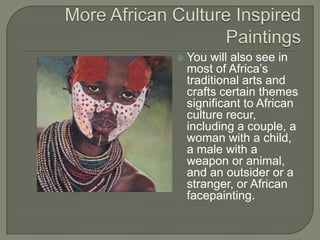
   You will also see in
    most of Africa’s
    traditional arts and
    crafts certain themes
    significant to African
    culture recur,
    including a couple, a
    woman with a child,
    a male with a
    weapon or animal,
    and an outsider or a
    stranger, or African
    facepainting.
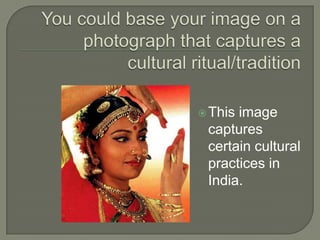
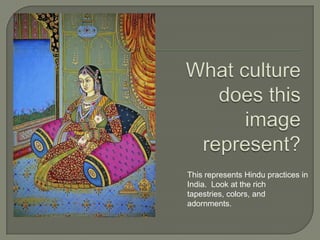
 Thisimage
 captures
 certain cultural
 practices in
 India.
This represents Hindu practices in
India. Look at the rich
tapestries, colors, and
adornments.
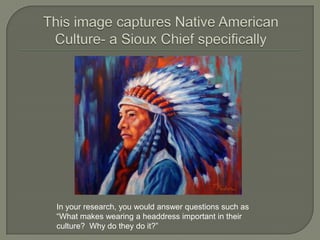
In your research, you would answer questions such as
“What makes wearing a headdress important in their
culture? Why do they do it?”
 How  do perceptions in art reflect cultural
 beliefs and values?

 Let’s   look at the next slide and see…
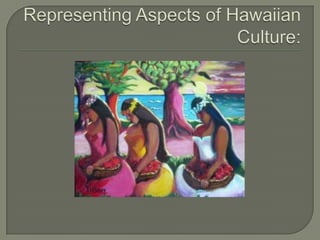
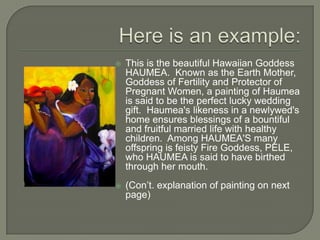
   This is the beautiful Hawaiian Goddess
    HAUMEA. Known as the Earth Mother,
    Goddess of Fertility and Protector of
    Pregnant Women, a painting of Haumea
    is said to be the perfect lucky wedding
    gift. Haumea's likeness in a newlywed's
    home ensures blessings of a bountiful
    and fruitful married life with healthy
    children. Among HAUMEA'S many
    offspring is feisty Fire Goddess, PELE,
    who HAUMEA is said to have birthed
    through her mouth.
   (Con’t. explanation of painting on next
    page)
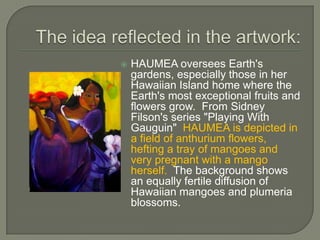
   HAUMEA oversees Earth's
    gardens, especially those in her
    Hawaiian Island home where the
    Earth's most exceptional fruits and
    flowers grow. From Sidney
    Filson's series "Playing With
    Gauguin" HAUMEA is depicted in
    a field of anthurium flowers,
    hefting a tray of mangoes and
    very pregnant with a mango
    herself. The background shows
    an equally fertile diffusion of
    Hawaiian mangoes and plumeria
    blossoms.
 How do responses to works of art differ
 based on whether the viewer is a member
 of the culture in which the art was
 created?
 Createan original artwork that expresses
 a culture (PP3B-HSL2)

 Createan original artwork that
 communicates ideas through the
 following themes (cultural identity, social
 commentary, ceremony/ritual, myth/legend
 ) (PP3C-HSL2)
While you are doing
this project, you will
also be covering the
following objectives:
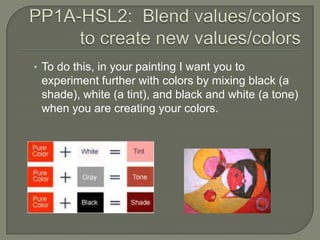
• To do this, in your painting I want you to
 experiment further with colors by mixing black (a
 shade), white (a tint), and black and white (a tone)
 when you are creating your colors.
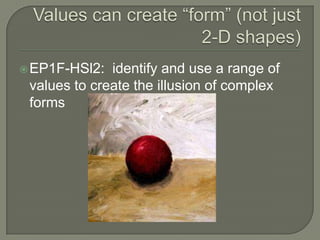
 EP1F-HSl2:  identify and use a range of
 values to create the illusion of complex
 forms
 Firstyou will research a few cultures and
  decide which one you want to focus on.
  You can do this by searching for images of
  cultural artwork and then researching the
  culture that inspired that image.
 OR- you can decide on a culture you are
  interested in and then search for specific
  images about that culture.
 You will be writing about the culture you
 select and how it is illustrated in the image
 you select. This needs to be a minimum of
 one page long (typed) or two pages
 (handwritten). IF it is handwritten, it must
 be legible.
 Be descriptive about the culture you select
 and how the image illustrates aspects of
 that culture. Someone who sees your
 image should be able to understand
 (without reading your research) that you
 are communicating through ART about a
 culture.
 We   will spend our first two days in the
  library, researching cultures and images
  that inspire you. I will be answering your
  questions in addition to asking you
  questions about the cultures you choose.
 Once we have sufficient research, we will
  begin the process of prepping our canvas
  boards.
 Questions??? Let’s do this 

Cultural expression painting

  • 1.
  • 2.
     Culture iscreated by a sense of shared beliefs and values of a group: the beliefs, customs, practices, and social behavior of a particular nation or people.  There is a difference between examining traits of cultural groups and stereotyping a group. You need to understand that not all groups of people have the same cultural beliefs. You are going to represent an “aspect” of a cultural group you choose.
  • 3.
     How canan artwork from a selected culture or historical time period represent that culture or time period?
  • 4.
    Classical Thai painting is mostly confined to mural paintings inside Buddhist temples and palaces. They are idealistic and the themes frequently depicted are those related to Buddhism, such as the Buddha's life stories, stories of the three worlds (heaven, earth and hell), and also those concerning customs and traditions. The subjects of the paintings reflect different purposes: to beautify and dignify the places of worship, to promote Buddhism, and to educate people through pictures. (http://www.thaiwaysmagazine.com/ thai_cultures/index.html) Therefore, this artwork represents the Buddhist culture.
  • 5.
    What do youthink this artwork represents?  African culture has always placed emphasis on personal appearance and jewelry. Many pieces of such jewelry are made of cowry shells and similar materials. Similarly, masks are made with elaborate designs and are important part of African culture. Masks are used in various ceremonies depicting ancestors and spirits, mythological characters and deities.
  • 6.
    You will also see in most of Africa’s traditional arts and crafts certain themes significant to African culture recur, including a couple, a woman with a child, a male with a weapon or animal, and an outsider or a stranger, or African facepainting.
  • 7.
     Thisimage captures certain cultural practices in India.
  • 8.
    This represents Hindupractices in India. Look at the rich tapestries, colors, and adornments.
  • 11.
    In your research,you would answer questions such as “What makes wearing a headdress important in their culture? Why do they do it?”
  • 12.
     How do perceptions in art reflect cultural beliefs and values?  Let’s look at the next slide and see…
  • 13.
    This is the beautiful Hawaiian Goddess HAUMEA. Known as the Earth Mother, Goddess of Fertility and Protector of Pregnant Women, a painting of Haumea is said to be the perfect lucky wedding gift. Haumea's likeness in a newlywed's home ensures blessings of a bountiful and fruitful married life with healthy children. Among HAUMEA'S many offspring is feisty Fire Goddess, PELE, who HAUMEA is said to have birthed through her mouth.  (Con’t. explanation of painting on next page)
  • 14.
    HAUMEA oversees Earth's gardens, especially those in her Hawaiian Island home where the Earth's most exceptional fruits and flowers grow. From Sidney Filson's series "Playing With Gauguin" HAUMEA is depicted in a field of anthurium flowers, hefting a tray of mangoes and very pregnant with a mango herself. The background shows an equally fertile diffusion of Hawaiian mangoes and plumeria blossoms.
  • 15.
     How doresponses to works of art differ based on whether the viewer is a member of the culture in which the art was created?
  • 16.
     Createan originalartwork that expresses a culture (PP3B-HSL2)  Createan original artwork that communicates ideas through the following themes (cultural identity, social commentary, ceremony/ritual, myth/legend ) (PP3C-HSL2)
  • 17.
    While you aredoing this project, you will also be covering the following objectives:
  • 19.
    • To dothis, in your painting I want you to experiment further with colors by mixing black (a shade), white (a tint), and black and white (a tone) when you are creating your colors.
  • 20.
     EP1F-HSl2: identify and use a range of values to create the illusion of complex forms
  • 22.
     Firstyou willresearch a few cultures and decide which one you want to focus on. You can do this by searching for images of cultural artwork and then researching the culture that inspired that image.  OR- you can decide on a culture you are interested in and then search for specific images about that culture.
  • 23.
     You willbe writing about the culture you select and how it is illustrated in the image you select. This needs to be a minimum of one page long (typed) or two pages (handwritten). IF it is handwritten, it must be legible.
  • 24.
     Be descriptiveabout the culture you select and how the image illustrates aspects of that culture. Someone who sees your image should be able to understand (without reading your research) that you are communicating through ART about a culture.
  • 25.
     We will spend our first two days in the library, researching cultures and images that inspire you. I will be answering your questions in addition to asking you questions about the cultures you choose.  Once we have sufficient research, we will begin the process of prepping our canvas boards.  Questions??? Let’s do this 