LESSON 7: ART HISTORY
(The Beginnings of Arts, Western and Asian Art)
THE BEGINNINGS OF ART
•It begins around 44,000 years ago with the first
known cave paintings in Sulawesi, Indonesia that
predate writing in the journey of human race
•It can tell us stories, express the condition and
beliefs of an era, and lets us connect to the people
who lived ahead of us
WESTERN AND ASIAN ART
PRE-HISTORIC AND ANCIENT ART
• Pre-historic and ancient art were around 44,000 B.C.E. It can be
considered as the art period that includes cave paintings, fertility
statues and bone flutes to approximately the end of the Roman
Empire. A variety of art styles were produced over this lasting
period. Thia Art period includes those prehistory to the ancient
civilizations of Mesopotamia, Egypt, and the nomadic tribes
PRE-HISTORIC ART
• Pre-historic cave art in Sulawesi, Indonesia was discovered in the
1950’s. This art is indigenous mammals; a small water buffalo, a
warty pig, and pig-deer, and hand stenciled. Archeologists
discovered their age to be around forty thousand years, at least
same age as the oldest known in Europe
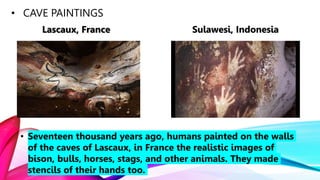
• CAVE PAINTINGS
Lascaux, France Sulawesi, Indonesia
• Seventeen thousand years ago, humans painted on the walls
of the caves of Lascaux, in France the realistic images of
bison, bulls, horses, stags, and other animals. They made
stencils of their hands too.
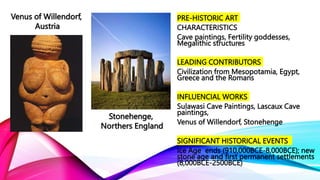
PRE-HISTORIC ART
CHARACTERISTICS
Cave paintings, Fertility goddesses,
Megalithic structures
LEADING CONTRIBUTORS
Civilization from Mesopotamia, Egypt,
Greece and the Romans
INFLUENCIAL WORKS
Sulawasi Cave Paintings, Lascaux Cave
paintings,
Venus of Willendorf, Stonehenge
SIGNIFICANT HISTORICAL EVENTS
Ice Age ends (910,000BCE-8,000BCE); new
stone age and first permanent settlements
(8,000BCE-2500BCE)
Venus of Willendorf,
Austria
Stonehenge,
Northers England
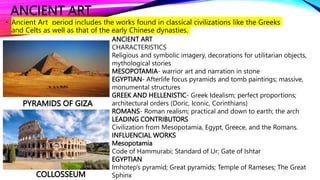
ANCIENT ART
• Ancient Art period includes the works found in classical civilizations like the Greeks
and Celts as well as that of the early Chinese dynasties.
ANCIENT ART
CHARACTERISTICS
Religious and symbolic imagery, decorations for utilitarian objects,
mythological stories
MESOPOTAMIA- warrior art and narration in stone
EGYPTIAN- Afterlife focus pyramids and tomb paintings; massive,
monumental structures
GREEK AND HELLENISTIC- Greek Idealism; perfect proportions;
architectural orders (Doric, Iconic, Corinthians)
ROMANS- Roman realism; practical and down to earth; the arch
LEADING CONTRIBUTORS
Civilization from Mesopotamia, Egypt, Greece, and the Romans.
INFLUENCIAL WORKS
Mesopotamia
Code of Hammurabi; Standard of Ur; Gate of Ishtar
EGYPTIAN
Imhotep’s pyramid; Great pyramids; Temple of Rameses; The Great
Sphinx
PYRAMIDS OF GIZA
COLLOSSEUM
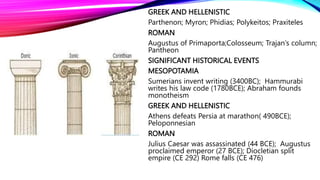
GREEK AND HELLENISTIC
Parthenon; Myron; Phidias; Polykeitos; Praxiteles
ROMAN
Augustus of Primaporta;Colosseum; Trajan’s column;
Pantheon
SIGNIFICANT HISTORICAL EVENTS
MESOPOTAMIA
Sumerians invent writing (3400BC); Hammurabi
writes his law code (1780BCE); Abraham founds
monotheism
GREEK AND HELLENISTIC
Athens defeats Persia at marathon( 490BCE);
Peloponnesian
ROMAN
Julius Caesar was assassinated (44 BCE); Augustus
proclaimed emperor (27 BCE); Diocletian split
empire (CE 292) Rome falls (CE 476)
ASIAN ART
Hindu Art
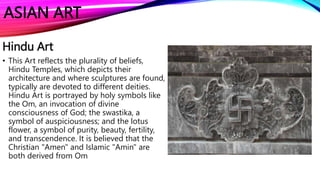
• This Art reflects the plurality of beliefs,
Hindu Temples, which depicts their
architecture and where sculptures are found,
typically are devoted to different deities.
Hindu Art is portrayed by holy symbols like
the Om, an invocation of divine
consciousness of God; the swastika, a
symbol of auspiciousness; and the lotus
flower, a symbol of purity, beauty, fertility,
and transcendence. It is believed that the
Christian "Amen" and Islamic "Amin" are
both derived from Om
CHINESE ART
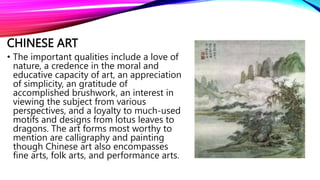
• The important qualities include a love of
nature, a credence in the moral and
educative capacity of art, an appreciation
of simplicity, an gratitude of
accomplished brushwork, an interest in
viewing the subject from various
perspectives, and a loyalty to much-used
motifs and designs from lotus leaves to
dragons. The art forms most worthy to
mention are calligraphy and painting
though Chinese art also encompasses
fine arts, folk arts, and performance arts.
JAPANESE ART
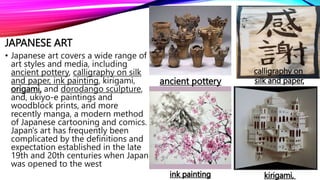
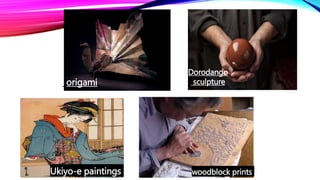
• Japanese art covers a wide range of
art styles and media, including
ancient pottery, calligraphy on silk
and paper, ink painting, kirigami,
origami, and dorodango sculpture,
and, ukiyo-e paintings and
woodblock prints, and more
recently manga, a modern method
of Japanese cartooning and comics.
Japan's art has frequently been
complicated by the definitions and
expectation established in the late
19th and 20th centuries when Japan
was opened to the west
ancient pottery
calligraphy on
silk and paper,
ink painting kirigami,
origami
Dorodango
sculpture
Ukiyo-e paintings woodblock prints
THANKYOU
PREPARED BY : GROUP 5

Lesson-7-ART-HISTORY-PT.-1 (2).pptx

  • 1.
    LESSON 7: ARTHISTORY (The Beginnings of Arts, Western and Asian Art)
  • 2.
    THE BEGINNINGS OFART •It begins around 44,000 years ago with the first known cave paintings in Sulawesi, Indonesia that predate writing in the journey of human race •It can tell us stories, express the condition and beliefs of an era, and lets us connect to the people who lived ahead of us
  • 3.
    WESTERN AND ASIANART PRE-HISTORIC AND ANCIENT ART • Pre-historic and ancient art were around 44,000 B.C.E. It can be considered as the art period that includes cave paintings, fertility statues and bone flutes to approximately the end of the Roman Empire. A variety of art styles were produced over this lasting period. Thia Art period includes those prehistory to the ancient civilizations of Mesopotamia, Egypt, and the nomadic tribes PRE-HISTORIC ART • Pre-historic cave art in Sulawesi, Indonesia was discovered in the 1950’s. This art is indigenous mammals; a small water buffalo, a warty pig, and pig-deer, and hand stenciled. Archeologists discovered their age to be around forty thousand years, at least same age as the oldest known in Europe
  • 4.
    • CAVE PAINTINGS Lascaux,France Sulawesi, Indonesia • Seventeen thousand years ago, humans painted on the walls of the caves of Lascaux, in France the realistic images of bison, bulls, horses, stags, and other animals. They made stencils of their hands too.
  • 5.
    PRE-HISTORIC ART CHARACTERISTICS Cave paintings,Fertility goddesses, Megalithic structures LEADING CONTRIBUTORS Civilization from Mesopotamia, Egypt, Greece and the Romans INFLUENCIAL WORKS Sulawasi Cave Paintings, Lascaux Cave paintings, Venus of Willendorf, Stonehenge SIGNIFICANT HISTORICAL EVENTS Ice Age ends (910,000BCE-8,000BCE); new stone age and first permanent settlements (8,000BCE-2500BCE) Venus of Willendorf, Austria Stonehenge, Northers England
  • 6.
    ANCIENT ART • AncientArt period includes the works found in classical civilizations like the Greeks and Celts as well as that of the early Chinese dynasties. ANCIENT ART CHARACTERISTICS Religious and symbolic imagery, decorations for utilitarian objects, mythological stories MESOPOTAMIA- warrior art and narration in stone EGYPTIAN- Afterlife focus pyramids and tomb paintings; massive, monumental structures GREEK AND HELLENISTIC- Greek Idealism; perfect proportions; architectural orders (Doric, Iconic, Corinthians) ROMANS- Roman realism; practical and down to earth; the arch LEADING CONTRIBUTORS Civilization from Mesopotamia, Egypt, Greece, and the Romans. INFLUENCIAL WORKS Mesopotamia Code of Hammurabi; Standard of Ur; Gate of Ishtar EGYPTIAN Imhotep’s pyramid; Great pyramids; Temple of Rameses; The Great Sphinx PYRAMIDS OF GIZA COLLOSSEUM
  • 7.
    GREEK AND HELLENISTIC Parthenon;Myron; Phidias; Polykeitos; Praxiteles ROMAN Augustus of Primaporta;Colosseum; Trajan’s column; Pantheon SIGNIFICANT HISTORICAL EVENTS MESOPOTAMIA Sumerians invent writing (3400BC); Hammurabi writes his law code (1780BCE); Abraham founds monotheism GREEK AND HELLENISTIC Athens defeats Persia at marathon( 490BCE); Peloponnesian ROMAN Julius Caesar was assassinated (44 BCE); Augustus proclaimed emperor (27 BCE); Diocletian split empire (CE 292) Rome falls (CE 476)
  • 8.
    ASIAN ART Hindu Art •This Art reflects the plurality of beliefs, Hindu Temples, which depicts their architecture and where sculptures are found, typically are devoted to different deities. Hindu Art is portrayed by holy symbols like the Om, an invocation of divine consciousness of God; the swastika, a symbol of auspiciousness; and the lotus flower, a symbol of purity, beauty, fertility, and transcendence. It is believed that the Christian "Amen" and Islamic "Amin" are both derived from Om
  • 9.
    CHINESE ART • Theimportant qualities include a love of nature, a credence in the moral and educative capacity of art, an appreciation of simplicity, an gratitude of accomplished brushwork, an interest in viewing the subject from various perspectives, and a loyalty to much-used motifs and designs from lotus leaves to dragons. The art forms most worthy to mention are calligraphy and painting though Chinese art also encompasses fine arts, folk arts, and performance arts.
  • 10.
    JAPANESE ART • Japaneseart covers a wide range of art styles and media, including ancient pottery, calligraphy on silk and paper, ink painting, kirigami, origami, and dorodango sculpture, and, ukiyo-e paintings and woodblock prints, and more recently manga, a modern method of Japanese cartooning and comics. Japan's art has frequently been complicated by the definitions and expectation established in the late 19th and 20th centuries when Japan was opened to the west ancient pottery calligraphy on silk and paper, ink painting kirigami,
  • 11.
  • 12.