SOUTH, CENTRAL AND WEST
ASIAN ARTS
Lesson 1:
PERIODS OF
INDIAN ART
ANCIENT PERIOD (3900 BCE - 1200 CE)
AJANTA CAVES OF MAHARASHTRA
The Ajanta Caves of Maharashtra,
India are 30 rock-cut cave
monuments that date back from the
2nd century BCE to the 600 CE,
including paintings and sculptures
considered to be masterpieces of
Buddhist religious art, as well as
frescos that are reminiscent of the
Sigiriya paintings in Sri Lanka.
AJANTA CAVES OF MAHARASHTRA
Classical Period ( 5th to 6th Centuries)
SHIVA (The Destroyer)
A four-armed figure, where one hand
holds the fire with which he destroys,
another holds a drum, which is the
first sound heard in the world during
creation, then the third arm points up
in a reassuring gesture, and a fourth
arm points down to the dwarf in
which he dances to.
SHIVA (The Destroyer)
This was the period of evolution from Vedism into
Hinduism or Brahmanism.
The two great Indian epics emerged in this
period:
1.MAHABHARATA
2.RAMAYANA
Taj Majal
Taj Majal
Taj Majal was built in 1632 by
Shah Jahan in memory of his wife,
Mumtaz Mahal, who died during
childbirth.
Diwali
Diwali
Celebrated by Hindus in India and all around the world in
October or November. It is the Hindu New Year and is either a 3-
day or 5-day holiday depending on where you come from.
Diwali
It is a very exciting and colorful holiday, where homes are
cleaned to welcome the New Year and windows are
opened so that the Hindu goddess of wealth, Lakshmi,
can enter.
Hindus believed that she cannot enter a house which is
not lit up, so every household burns special Diwali clay
lamps (Diyas) to light the way for the goddess, which is
why the holiday is also known as the 'Festival of Lights'.
Lesson 2:
RANGOLI
One of the most beautiful and most pleasing art forms of India.
Comprised of two words: 'rang' meaning 'color’ and 'aavalli'
meaning 'colored creepers' or ‘row of colors’.
The art of making designs or patterns on the walls or the floor of
the house, uses finely ground white powder along with different
colors.
RANGOLI
Lesson 3:
PAKISTAN
Pakistan Architecture is divided into 4 recognized
periods:
1. Pre-Islamic
2. Islamic
3. Colonial
4. Post-Colonial
PAKISTAN
MOHENJO DARO
 "Mound of the Dead" is an ancient
Indus Valley Civilization city that
flourished between 2600 and 1900
BCE.
 Located on the bank of Indus River in
the southern province of Sindh,
Mohenjo Daro was built around 2400
BC. It was destroyed at least seven
times by the floods and rebuilt on the
top of ruins each time.
KOT DIJI
 The Kot Diji Fort was built by
Mir Sohrab Khan Talpur,
between 1785 and 1795. The
site sits on a hill at the
southern end of the Rohri Hills
and sits above a prehistoric
mound of the same name,
where remains of a pre-
Harappan civilization have
been found.
TRUCK ART OF PAKISTAN
Brightly colored flamboyant
trucks, painted with images
of idealized landscapes,
famous personalities,
flowers, and trees, etc.
Lesson 4:
UZBEKISTAN, KAZAKHSTAN,
and TAJIKISTAN
Known for making printed cloth. Printed table-cloths,
curtains, bed-spreads, shawls and various coverlets
were utilitarian and served as a daily-round ornament
as well.
UZBEKISTAN
In ancient times, nomads used to draw on rocks
and, today, these petroglyphs can be found
throughout Kazakhstan.
KAZAKHSTAN
Tajiks have been making
fabrics, utensils, musical
instruments, carpets,
furniture, jewelry, and many
other things for many
centuries. The art of
decorative carving is very
important for local residents.
TAJIKISTAN
Lesson 5:
TURKMENISTAN
and
KYRGYZSTAN
The most unique and beautiful carpets in the world are
produced by Turkmenistan. These vary in shape and
purpose. carpet weaving is an ancient art, in each tribe
developed its own distinctive pattern.
Turkmen carpets have been traditionally woven out of
wool, cotton, and silk by women using horizontal looms.
the method of weaving has been modernized, but the
beauty and quality of the fabrics remain.
TURKMENISTAN
TURKMENISTAN CARPETS
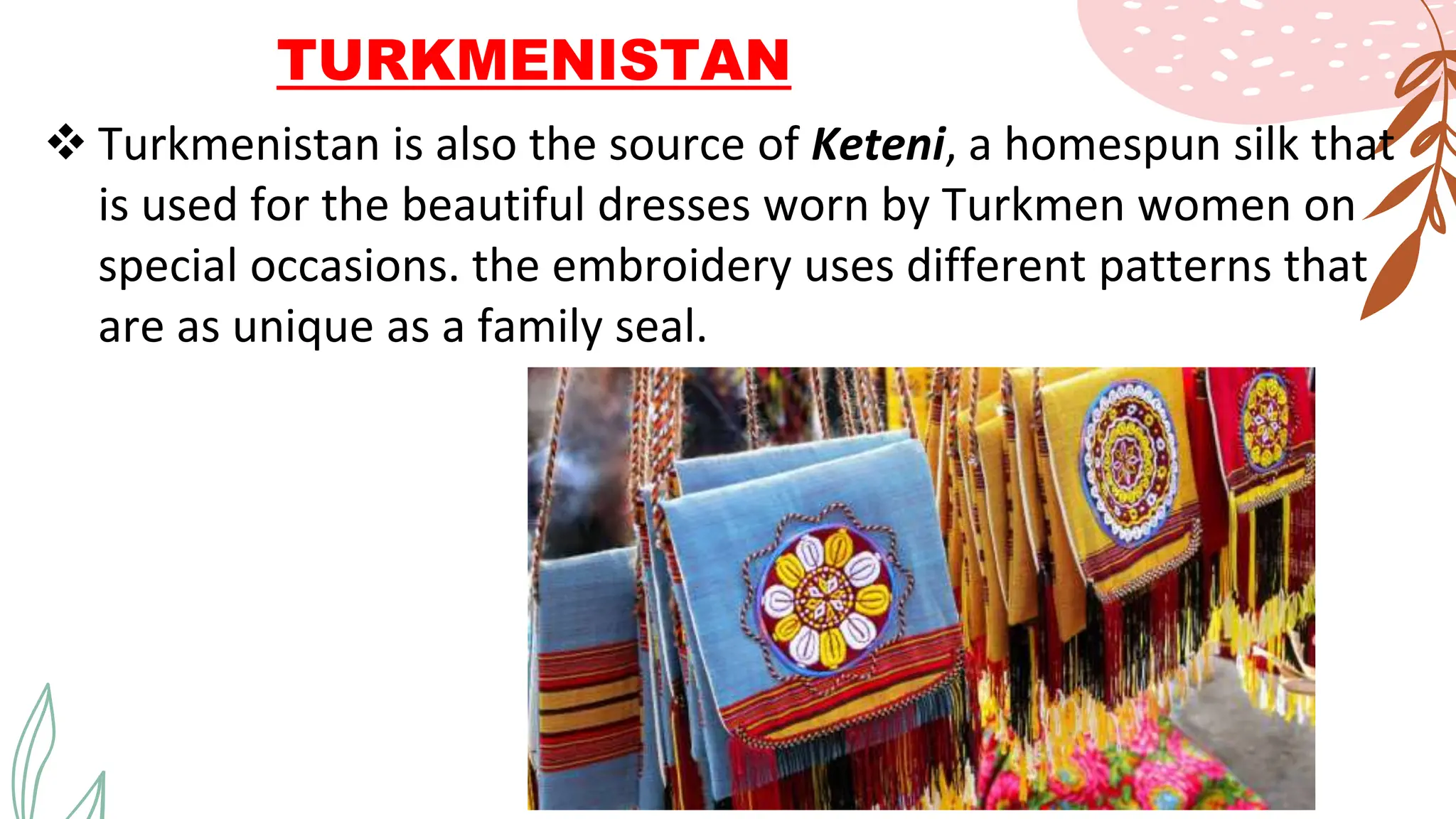
 Turkmenistan is also the source of Keteni, a homespun silk that
is used for the beautiful dresses worn by Turkmen women on
special occasions. the embroidery uses different patterns that
are as unique as a family seal.
TURKMENISTAN
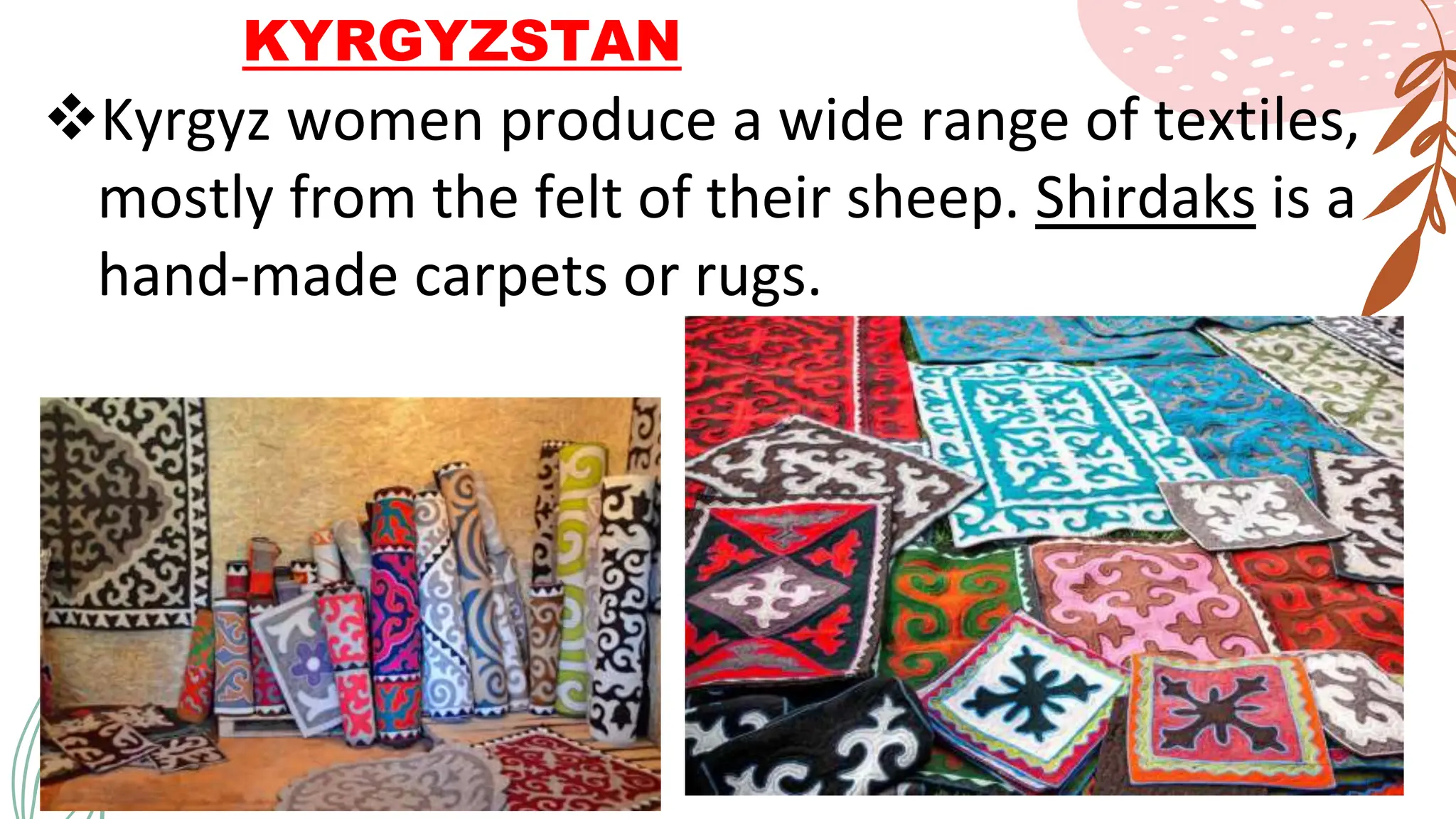
Kyrgyz women produce a wide range of textiles,
mostly from the felt of their sheep. Shirdaks is a
hand-made carpets or rugs.
KYRGYZSTAN
• Large elaborately embroidered wall hangings called
Tush Kyiz are traditionally made in Kyrgyzstan and
Kazakhstan, by elder women to commemorate the
marriage of a son or daughter.
KYRGYZSTAN
Lesson 6:
ARTS AND CRAFTS OF
WEST ASIA
 West Asia is rich in cultural heritage. This is clearly evident in the
variety and quality of regional arts and crafts.
 typical artistic forms from the region include:
WEST ASIA (Arts and Crafts)
Embroidery
Ceramics
Wood carving
Hammered metal work
Calligraphy
Inlaid wood designs
Blown glass works
 Although these are some of the most acclaimed art forms
contributed by the West Asia, their aesthetic can be seen in
almost any product from the region even including such things
as handmade soap from Syria or Lebanon.
WEST ASIA (Arts and Crafts)
Answer the following questions:
1. The art of making designs or patterns on the walls or floors of
houses.
2. Hindu goddess of wealth.
3. A four-armed dancing Hindu-goddess.
4. India’s Festival of Lights.
5. Clay Lamp to light the way of the goddess of wealth.
Keteni Rangoli Lakshmi
Shirdak Tush Kyiz Diyas
Diwali Shiva Petroglyphs
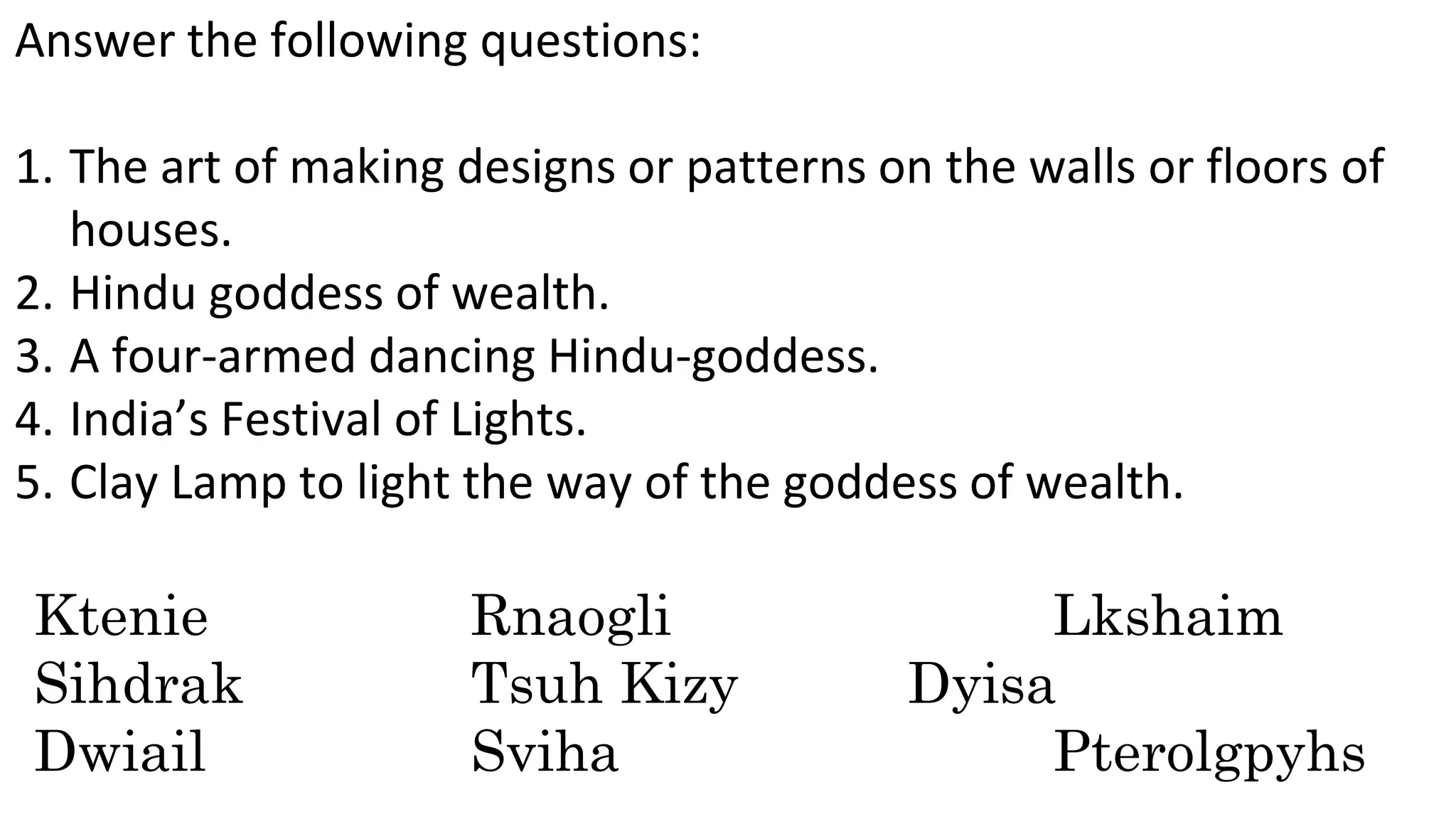
Answer the following questions:
1. The art of making designs or patterns on the walls or floors of
houses.
2. Hindu goddess of wealth.
3. A four-armed dancing Hindu-goddess.
4. India’s Festival of Lights.
5. Clay Lamp to light the way of the goddess of wealth.
Ktenie Rnaogli Lkshaim
Sihdrak Tsuh Kizy Dyisa
Dwiail Sviha Pterolgpyhs

arts quarter 3 for grade 8 lesson slideshow

  • 1.
    SOUTH, CENTRAL ANDWEST ASIAN ARTS
  • 2.
  • 3.
    ANCIENT PERIOD (3900BCE - 1200 CE) AJANTA CAVES OF MAHARASHTRA
  • 4.
    The Ajanta Cavesof Maharashtra, India are 30 rock-cut cave monuments that date back from the 2nd century BCE to the 600 CE, including paintings and sculptures considered to be masterpieces of Buddhist religious art, as well as frescos that are reminiscent of the Sigiriya paintings in Sri Lanka. AJANTA CAVES OF MAHARASHTRA
  • 5.
    Classical Period (5th to 6th Centuries) SHIVA (The Destroyer)
  • 6.
    A four-armed figure,where one hand holds the fire with which he destroys, another holds a drum, which is the first sound heard in the world during creation, then the third arm points up in a reassuring gesture, and a fourth arm points down to the dwarf in which he dances to. SHIVA (The Destroyer)
  • 7.
    This was theperiod of evolution from Vedism into Hinduism or Brahmanism. The two great Indian epics emerged in this period: 1.MAHABHARATA 2.RAMAYANA
  • 8.
  • 9.
    Taj Majal Taj Majalwas built in 1632 by Shah Jahan in memory of his wife, Mumtaz Mahal, who died during childbirth.
  • 10.
  • 11.
    Diwali Celebrated by Hindusin India and all around the world in October or November. It is the Hindu New Year and is either a 3- day or 5-day holiday depending on where you come from.
  • 12.
    Diwali It is avery exciting and colorful holiday, where homes are cleaned to welcome the New Year and windows are opened so that the Hindu goddess of wealth, Lakshmi, can enter. Hindus believed that she cannot enter a house which is not lit up, so every household burns special Diwali clay lamps (Diyas) to light the way for the goddess, which is why the holiday is also known as the 'Festival of Lights'.
  • 13.
  • 14.
    One of themost beautiful and most pleasing art forms of India. Comprised of two words: 'rang' meaning 'color’ and 'aavalli' meaning 'colored creepers' or ‘row of colors’. The art of making designs or patterns on the walls or the floor of the house, uses finely ground white powder along with different colors. RANGOLI
  • 15.
  • 16.
    Pakistan Architecture isdivided into 4 recognized periods: 1. Pre-Islamic 2. Islamic 3. Colonial 4. Post-Colonial PAKISTAN
  • 17.
    MOHENJO DARO  "Moundof the Dead" is an ancient Indus Valley Civilization city that flourished between 2600 and 1900 BCE.  Located on the bank of Indus River in the southern province of Sindh, Mohenjo Daro was built around 2400 BC. It was destroyed at least seven times by the floods and rebuilt on the top of ruins each time.
  • 18.
    KOT DIJI  TheKot Diji Fort was built by Mir Sohrab Khan Talpur, between 1785 and 1795. The site sits on a hill at the southern end of the Rohri Hills and sits above a prehistoric mound of the same name, where remains of a pre- Harappan civilization have been found.
  • 19.
    TRUCK ART OFPAKISTAN
  • 20.
    TRUCK ART OFPAKISTAN Brightly colored flamboyant trucks, painted with images of idealized landscapes, famous personalities, flowers, and trees, etc.
  • 21.
  • 22.
    Known for makingprinted cloth. Printed table-cloths, curtains, bed-spreads, shawls and various coverlets were utilitarian and served as a daily-round ornament as well. UZBEKISTAN
  • 23.
    In ancient times,nomads used to draw on rocks and, today, these petroglyphs can be found throughout Kazakhstan. KAZAKHSTAN
  • 24.
    Tajiks have beenmaking fabrics, utensils, musical instruments, carpets, furniture, jewelry, and many other things for many centuries. The art of decorative carving is very important for local residents. TAJIKISTAN
  • 25.
  • 26.
    The most uniqueand beautiful carpets in the world are produced by Turkmenistan. These vary in shape and purpose. carpet weaving is an ancient art, in each tribe developed its own distinctive pattern. Turkmen carpets have been traditionally woven out of wool, cotton, and silk by women using horizontal looms. the method of weaving has been modernized, but the beauty and quality of the fabrics remain. TURKMENISTAN
  • 27.
  • 28.
     Turkmenistan isalso the source of Keteni, a homespun silk that is used for the beautiful dresses worn by Turkmen women on special occasions. the embroidery uses different patterns that are as unique as a family seal. TURKMENISTAN
  • 29.
    Kyrgyz women producea wide range of textiles, mostly from the felt of their sheep. Shirdaks is a hand-made carpets or rugs. KYRGYZSTAN
  • 30.
    • Large elaboratelyembroidered wall hangings called Tush Kyiz are traditionally made in Kyrgyzstan and Kazakhstan, by elder women to commemorate the marriage of a son or daughter. KYRGYZSTAN
  • 31.
    Lesson 6: ARTS ANDCRAFTS OF WEST ASIA
  • 32.
     West Asiais rich in cultural heritage. This is clearly evident in the variety and quality of regional arts and crafts.  typical artistic forms from the region include: WEST ASIA (Arts and Crafts) Embroidery Ceramics Wood carving Hammered metal work Calligraphy Inlaid wood designs Blown glass works
  • 33.
     Although theseare some of the most acclaimed art forms contributed by the West Asia, their aesthetic can be seen in almost any product from the region even including such things as handmade soap from Syria or Lebanon. WEST ASIA (Arts and Crafts)
  • 34.
    Answer the followingquestions: 1. The art of making designs or patterns on the walls or floors of houses. 2. Hindu goddess of wealth. 3. A four-armed dancing Hindu-goddess. 4. India’s Festival of Lights. 5. Clay Lamp to light the way of the goddess of wealth. Keteni Rangoli Lakshmi Shirdak Tush Kyiz Diyas Diwali Shiva Petroglyphs
  • 35.
    Answer the followingquestions: 1. The art of making designs or patterns on the walls or floors of houses. 2. Hindu goddess of wealth. 3. A four-armed dancing Hindu-goddess. 4. India’s Festival of Lights. 5. Clay Lamp to light the way of the goddess of wealth. Ktenie Rnaogli Lkshaim Sihdrak Tsuh Kizy Dyisa Dwiail Sviha Pterolgpyhs