Create Globally.  Educate Locally. Jonathan  Emmons Community Development Specialist [email_address] 713.348.2392
Open Educational Resources “ OER are teaching, learning and research resources that reside in the public domain or have been released under an intellectual property license that permits their free use or re-purposing by others. Open educational resources include full courses, course materials, modules, textbooks, streaming videos, tests, software, and any other tools, materials or techniques used to support access to knowledge.”   William and Flora Hewlett Foundation
Open Education – Keys to Success Availability  - Anyone and everyone should have access to it, anywhere and any time Durability (Permanence)   - The content should be available indefinitely Community  - Everyone must be able to contribute to knowledge creation process Reusability  - Everyone should be able to re-use the materials in any way they choose Quality  – Content quality, accuracy, and pedagogical value must be demonstrably high Affordability  – The cost, measured in both time and effort, must be low Usability  – Tools for creating and using content must be user friendly Discoverability  -Teachers and students must be able to find high quality materials using terminology and categories that make sense in their community of practice Sustainability  - The cost to create and maintain the repository must be affordable so it becomes part of the education infrastructure Flexibility  - Teachers, learners and authors must be able to use the materials in a convenient format and location
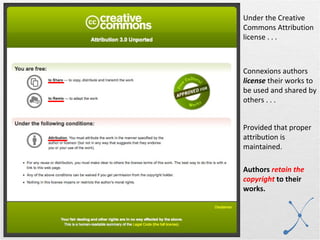
Under the Creative Commons Attribution license . . . Connexions authors  license  their works to be used and shared by others . . . Provided that proper attribution is maintained. Authors  retain the copyright  to their works.
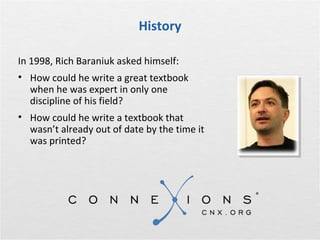
History In 1998, Rich Baraniuk asked himself: How could he write a great textbook when he was expert in only one discipline of his field? How could he write a textbook that wasn’t already out of date by the time it was printed?
Problems with Textbooks The traditional publishing model fails for: Rapidly changing fields Advanced/special topics Lab courses Underserved populations Minority opinions Ideas that are not profitable
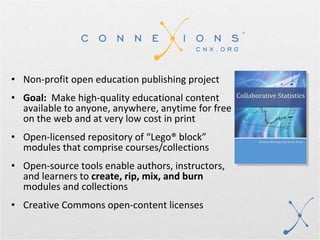
Non-profit open education publishing project Goal:   Make high-quality educational content available to anyone, anywhere, anytime for free on the web and at very low cost in print Open-licensed repository of “Lego® block”  modules that comprise courses/collections Open-source tools enable authors, instructors, and learners to  create, rip, mix, and burn  modules and collections Creative Commons open-content licenses
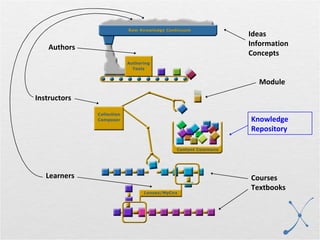
Ideas Information Concepts Module Courses Textbooks Authors Instructors Learners Knowledge Repository
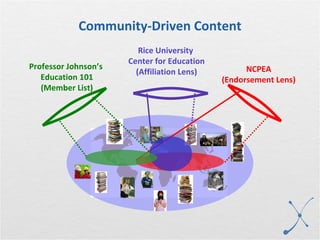
Community-Driven Content Rice University  Center for Education (Affiliation Lens) Professor Johnson’s  Education 101 (Member List) NCPEA (Endorsement Lens)
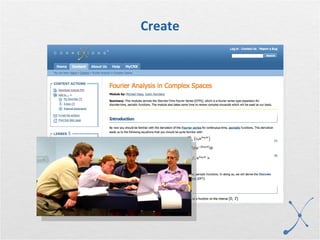
Create
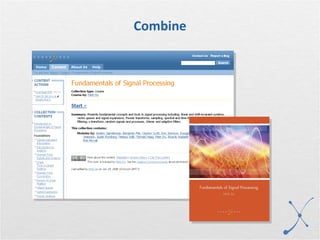
Combine
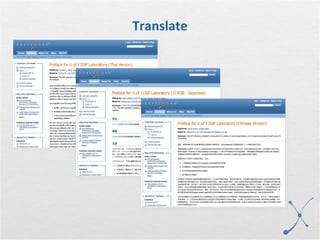
Translate
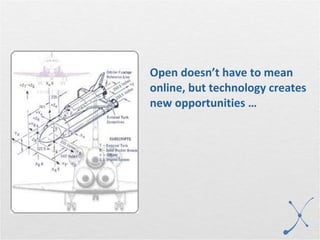
Open doesn’t have to mean online, but technology creates new opportunities …
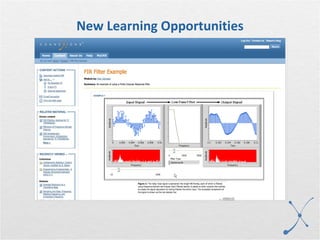
New Learning Opportunities
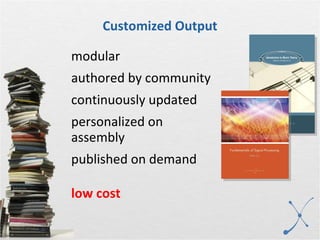
Customized Output modular authored by community continuously updated personalized on assembly published on demand low cost
Connexions  http://cnx .org Jonathan Emmons [email_address] 713-348-2392 Supported by: Hewlett Foundation Maxfield Foundation

CNXDemo

  • 1.
    Create Globally. Educate Locally. Jonathan Emmons Community Development Specialist [email_address] 713.348.2392
  • 2.
    Open Educational Resources“ OER are teaching, learning and research resources that reside in the public domain or have been released under an intellectual property license that permits their free use or re-purposing by others. Open educational resources include full courses, course materials, modules, textbooks, streaming videos, tests, software, and any other tools, materials or techniques used to support access to knowledge.”   William and Flora Hewlett Foundation
  • 3.
    Open Education –Keys to Success Availability - Anyone and everyone should have access to it, anywhere and any time Durability (Permanence) - The content should be available indefinitely Community - Everyone must be able to contribute to knowledge creation process Reusability - Everyone should be able to re-use the materials in any way they choose Quality – Content quality, accuracy, and pedagogical value must be demonstrably high Affordability – The cost, measured in both time and effort, must be low Usability – Tools for creating and using content must be user friendly Discoverability -Teachers and students must be able to find high quality materials using terminology and categories that make sense in their community of practice Sustainability - The cost to create and maintain the repository must be affordable so it becomes part of the education infrastructure Flexibility - Teachers, learners and authors must be able to use the materials in a convenient format and location
  • 4.
    Under the CreativeCommons Attribution license . . . Connexions authors license their works to be used and shared by others . . . Provided that proper attribution is maintained. Authors retain the copyright to their works.
  • 5.
    History In 1998,Rich Baraniuk asked himself: How could he write a great textbook when he was expert in only one discipline of his field? How could he write a textbook that wasn’t already out of date by the time it was printed?
  • 6.
    Problems with TextbooksThe traditional publishing model fails for: Rapidly changing fields Advanced/special topics Lab courses Underserved populations Minority opinions Ideas that are not profitable
  • 7.
    Non-profit open educationpublishing project Goal: Make high-quality educational content available to anyone, anywhere, anytime for free on the web and at very low cost in print Open-licensed repository of “Lego® block” modules that comprise courses/collections Open-source tools enable authors, instructors, and learners to create, rip, mix, and burn modules and collections Creative Commons open-content licenses
  • 8.
    Ideas Information ConceptsModule Courses Textbooks Authors Instructors Learners Knowledge Repository
  • 9.
    Community-Driven Content RiceUniversity Center for Education (Affiliation Lens) Professor Johnson’s Education 101 (Member List) NCPEA (Endorsement Lens)
  • 10.
  • 11.
  • 12.
  • 13.
    Open doesn’t haveto mean online, but technology creates new opportunities …
  • 14.
  • 15.
    Customized Output modularauthored by community continuously updated personalized on assembly published on demand low cost
  • 16.
    Connexions http://cnx.org Jonathan Emmons [email_address] 713-348-2392 Supported by: Hewlett Foundation Maxfield Foundation

Editor's Notes

  • #9 Content Organization Modular, Reusable Basic unit of content is a module -- small “chunks” of knowledge, addressing one topic or a single aspect of a complex topic Sounds, movies, animations, images, equations, and more can be included in modules Multiple modules can be organized into a course or textbook Combine modules from different authors to build a course or collection to fit your needs
  • #10 Lenses are owned by organizations like TED, professional societies, publishers, even individuals. Each lens focuses on the part of the KC deemed “high quality”. Let’s EVERYONE become an editor and reviewer. WILL SEE INCREASING USE OF SOCIAL SOFTWARE, EVEN IN ACADEMICS, BECAUSE… Traditional peer review process is broken – will be replaced by “reputation” systems like this, social software, post-publication peer review
  • #11 Imagine you could do this. Then engineering professors from around the world could create a community to write a massive “supertextbook” for their field and is completely up to date and can be shared across their various institutions