An Introduction to
Think of the song playing during the
opening slide. What song was it and
by what artist?
a form of protection … to the
authors of “original works”
Reason for Copyright
In groups, try to decide why
copyright laws exist.
Reason for Copyright
Copyright laws are based on the
belief that if people are compensated
for their original work, that the
compensation will encourage more
creative, original works, and that
society as a whole benefits from this
(Starr, 2010).
What is Copyrighted?
Create two columns on a page and
label one as items that can be
copyrighted and label the other as
items that cannot be copyrighted.
Fill in each column with as many
items as you can think of and be
prepared to share.
Why do all copyright lawyers like
kings and queens?
Because they are big fans of royalties.
(Copyrightgirl, 2011)
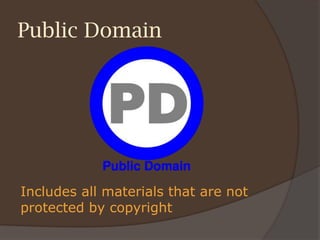
Public Domain
Includes all materials that are not
protected by copyright
Internet and Copyright
Copyright law governs most
of the material on the
internet (Harper, 2007).
Most material on the
internet is not in the public
domain.
Fair Use
Fair use offers
educators, researchers, and others to
make reasonable and limited uses of
copyrighted materials
(Scholarship, n.d.).
Fair Use Checklist
The following checklist is a guide to
determining fair use:
http://copyright.columbia.edu/copyri
ght/files/2009/10/fairusechecklist.pdf
http://www.courtoons.net/2009/03/16/copyr
ight/
General Guidelines for Educators
Under most circumstances, educators may copy:
a single chapter
an excerpt not exceeding two pages or 10 percent of
the work
up to 250 words or 10 percent of a longer work
a single chart, graph, diagram, drawing, cartoon, or
picture
(Starr, 2010)
General Guidelines for Educators
Educators may NOT:
make multiple copies as a substitute for purchase
copy the same works for more than one semester or
course
copy the same work more than nine times in a single
semester
use copyrighted work for commercial purposes
use copyrighted work without attributing the author.
(Starr, 2010).
US Copyright Basics Video
http://www.youtube.com/watch?feature=pl
ayer_embedded&v=q9t8MZOB_tc&noredir
ect=1#!
Two General Rules to Remember
1. If you are not sure, ask for
permission.
2. If you are taking away revenue
from someone, you are probably
violating copyright (although you can
violate copyright without taking away
revenue).
References Cited
Copyright. (2001). Rock machine. On The Hidden World. AMG.
Copyrightgirl. (2011). Copyright (for) jokes? Copyright For Education.
Retrieved June 17, 2013, from
http://copyright4education.blogspot.com/2011/04/copyright-for-
jokes.html
ELearningExpert. (2012). U.S. copyright basics. Youtube. Retrieved
June 6, 2013, from
http://www.youtube.com/watch?feature=player_embedded&v=q9
t8MZOB_tc#!
Esoderberg. (2011). Copyright - all rights reserved image. Wikimedia
Commons. Retrieved June 24, 2013, from
http://en.m.wikipedia.org/wiki/File:Copyright-
_all_rights_reserved.png
Harper, G. K. (2007). Copyright crash course. University of Texas
Libraries. Retrieved May 29, 2013, from
http://copyright.lib.utexas.edu/
Mills, D. (2009). Copyright. Courtoons. Retrieved June 17, 2013, from
http://www.courtoons.net/2009/03/16/copyright/
Office, U. S. C. (2012). Copyright basics. Retrieved June 6, 2013, from
http://www.copyright.gov/circs/circ01.pdf
Rock. (1997). Internet image. Wikimedia Commons. Retrieved June
24, 2013, from
http://commons.wikimedia.org/wiki/File:Internet1.jpgScholarship, C.
for D. R. and. (n.d.). Copyright, fair use, and education. Columbia
University Library. Retrieved June 6, 2013, from
http://copyright.columbia.edu/copyright/
Scindo. (2006). Copyright crystal black image. Retrieved June
10, 2013, from
http://upload.wikimedia.org/wikipedia/commons/c/c8/Copyright_cryst
al_black.png
Starr, L. (2010). The educator’s guide to copyright and fair use. Education
World. Retrieved June 6, 2013, from
http://www.educationworld.com/a_curr/curr280.shtml
Teaching copyright. (n.d.). Retrieved May 29, 2013, from
http://www.teachingcopyright.org/
Unknown. (2012). Public domain image. Retrieved June 10, 2013, from
http://pixabay.com/en/computer-icon-blue-copyright-31188/

An Intro to Copyright for Educators v4

  • 1.
  • 2.
    Think of thesong playing during the opening slide. What song was it and by what artist?
  • 3.
    a form ofprotection … to the authors of “original works”
  • 4.
    Reason for Copyright Ingroups, try to decide why copyright laws exist.
  • 5.
    Reason for Copyright Copyrightlaws are based on the belief that if people are compensated for their original work, that the compensation will encourage more creative, original works, and that society as a whole benefits from this (Starr, 2010).
  • 6.
    What is Copyrighted? Createtwo columns on a page and label one as items that can be copyrighted and label the other as items that cannot be copyrighted. Fill in each column with as many items as you can think of and be prepared to share.
  • 7.
    Why do allcopyright lawyers like kings and queens? Because they are big fans of royalties. (Copyrightgirl, 2011)
  • 8.
    Public Domain Includes allmaterials that are not protected by copyright
  • 9.
    Internet and Copyright Copyrightlaw governs most of the material on the internet (Harper, 2007). Most material on the internet is not in the public domain.
  • 10.
    Fair Use Fair useoffers educators, researchers, and others to make reasonable and limited uses of copyrighted materials (Scholarship, n.d.).
  • 11.
    Fair Use Checklist Thefollowing checklist is a guide to determining fair use: http://copyright.columbia.edu/copyri ght/files/2009/10/fairusechecklist.pdf
  • 12.
  • 13.
    General Guidelines forEducators Under most circumstances, educators may copy: a single chapter an excerpt not exceeding two pages or 10 percent of the work up to 250 words or 10 percent of a longer work a single chart, graph, diagram, drawing, cartoon, or picture (Starr, 2010)
  • 14.
    General Guidelines forEducators Educators may NOT: make multiple copies as a substitute for purchase copy the same works for more than one semester or course copy the same work more than nine times in a single semester use copyrighted work for commercial purposes use copyrighted work without attributing the author. (Starr, 2010).
  • 15.
    US Copyright BasicsVideo http://www.youtube.com/watch?feature=pl ayer_embedded&v=q9t8MZOB_tc&noredir ect=1#!
  • 16.
    Two General Rulesto Remember 1. If you are not sure, ask for permission. 2. If you are taking away revenue from someone, you are probably violating copyright (although you can violate copyright without taking away revenue).
  • 17.
    References Cited Copyright. (2001).Rock machine. On The Hidden World. AMG. Copyrightgirl. (2011). Copyright (for) jokes? Copyright For Education. Retrieved June 17, 2013, from http://copyright4education.blogspot.com/2011/04/copyright-for- jokes.html ELearningExpert. (2012). U.S. copyright basics. Youtube. Retrieved June 6, 2013, from http://www.youtube.com/watch?feature=player_embedded&v=q9 t8MZOB_tc#! Esoderberg. (2011). Copyright - all rights reserved image. Wikimedia Commons. Retrieved June 24, 2013, from http://en.m.wikipedia.org/wiki/File:Copyright- _all_rights_reserved.png Harper, G. K. (2007). Copyright crash course. University of Texas Libraries. Retrieved May 29, 2013, from http://copyright.lib.utexas.edu/
  • 18.
    Mills, D. (2009).Copyright. Courtoons. Retrieved June 17, 2013, from http://www.courtoons.net/2009/03/16/copyright/ Office, U. S. C. (2012). Copyright basics. Retrieved June 6, 2013, from http://www.copyright.gov/circs/circ01.pdf Rock. (1997). Internet image. Wikimedia Commons. Retrieved June 24, 2013, from http://commons.wikimedia.org/wiki/File:Internet1.jpgScholarship, C. for D. R. and. (n.d.). Copyright, fair use, and education. Columbia University Library. Retrieved June 6, 2013, from http://copyright.columbia.edu/copyright/ Scindo. (2006). Copyright crystal black image. Retrieved June 10, 2013, from http://upload.wikimedia.org/wikipedia/commons/c/c8/Copyright_cryst al_black.png Starr, L. (2010). The educator’s guide to copyright and fair use. Education World. Retrieved June 6, 2013, from http://www.educationworld.com/a_curr/curr280.shtml Teaching copyright. (n.d.). Retrieved May 29, 2013, from http://www.teachingcopyright.org/ Unknown. (2012). Public domain image. Retrieved June 10, 2013, from http://pixabay.com/en/computer-icon-blue-copyright-31188/