CTSI – Global Health Program Providing more solutions in more countries for more researchers Clinical and Translational Science Institute /   CTSI at the University of California, San Francisco
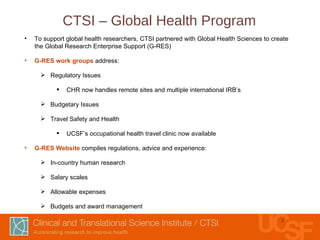
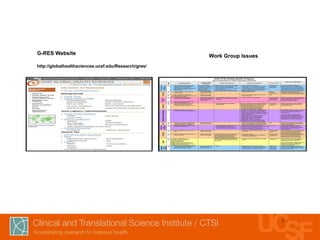
CTSI – Global Health Program To support global health researchers, CTSI partnered with Global Health Sciences to create the Global Research Enterprise Support (G-RES) G-RES work groups  address: Regulatory Issues CHR now handles remote sites and multiple international IRB’s Budgetary Issues Travel Safety and Health UCSF’s occupational health travel clinic now available G-RES Website  compiles regulations, advice and experience: In-country human research Salary scales Allowable expenses Budgets and award management
G-RES Website  http://globalhealthsciences.ucsf.edu/Research/gres/ Work Group Issues
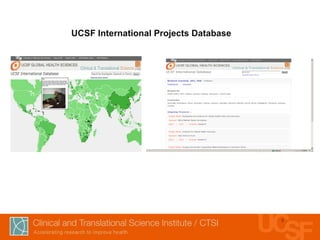
CTSI – Global Health Program UCSF International Projects Database A central repository of information that can be mined for collaboration, communication, expertise, and development of new proposals Face page is an interactive heat map with clickable dots highlighting projects in different geographical locations Search function keys to principal investigator name, keywords, or country Search results include links to CTSI Profiles, department descriptions or research pages Lists extramurally funded projects, funding source, start and end dates of funded projects Currently includes more than 3,000 extramurally funded projects awarded to more than 600 UCSF investigators, working in more than 100 countries on 6 continents.  International projects total more than $80 million in annual funding.
UCSF International Projects Database
A Focus on Faculty Needs! Its most recent work group, the  International Research Advisory Council (IRAC)  brings more than 20 faculty (and membership is open!) from across all four schools to work on common solutions for the international researcher.  Based on their feedback we will: Build “Global Health Community Connections” Create linkages between the International Projects Database and Profiles Break down barriers through shared problem solving and common solutions Build global health research at UCSF through increased opportunities to meet and collaborate
Real Time Solutions! Issue Raised at March 2011 IRAC Meeting Issue:  NIH grants now require IRB approvals before releasing funds. However, IRBs in foreign countries (Uganda) require payment of IRB application fees before releasing the initial review approval. For our research NGO that does not have working capital, it is a problem to have any funds available to pay these IRB fees up front. This impacts both large grants (RO1, UO1, PO1, etc) as well as jr investigator projects such as those through CFAR. What solutions have been found or could be found at UCSF to solve this catch-22 problem?  Solution:  NIH allows for funding of project related expenses up to 90 days prior to the start of the award.  If approved for award, the IRB application fees would be allowed as a pre-award costs.  In addition, UCSF has a process in place for the setup of the fund prior to award setup with approval from the Department.  Guidelines for Fund advance request and setup can be found at  http://or.ucsf.edu/cg/9142-DSY.html  
Next Steps Link International Projects Database more effectively with Profiles  to enrich global health content Expand IRAC to provide safe space for active global investigators  to share ideas, expand collaborations and invite active participation of Jaime Sepulveda to solidify GHS partnership Create social networking tools  as community-building process Provide administrative support  for visiting international scholars  

CTSI – Global Health Program: Providing more solutions in more countries for more researchers

  • 1.
    CTSI – GlobalHealth Program Providing more solutions in more countries for more researchers Clinical and Translational Science Institute / CTSI at the University of California, San Francisco
  • 2.
    CTSI – GlobalHealth Program To support global health researchers, CTSI partnered with Global Health Sciences to create the Global Research Enterprise Support (G-RES) G-RES work groups address: Regulatory Issues CHR now handles remote sites and multiple international IRB’s Budgetary Issues Travel Safety and Health UCSF’s occupational health travel clinic now available G-RES Website compiles regulations, advice and experience: In-country human research Salary scales Allowable expenses Budgets and award management
  • 3.
    G-RES Website http://globalhealthsciences.ucsf.edu/Research/gres/ Work Group Issues
  • 4.
    CTSI – GlobalHealth Program UCSF International Projects Database A central repository of information that can be mined for collaboration, communication, expertise, and development of new proposals Face page is an interactive heat map with clickable dots highlighting projects in different geographical locations Search function keys to principal investigator name, keywords, or country Search results include links to CTSI Profiles, department descriptions or research pages Lists extramurally funded projects, funding source, start and end dates of funded projects Currently includes more than 3,000 extramurally funded projects awarded to more than 600 UCSF investigators, working in more than 100 countries on 6 continents. International projects total more than $80 million in annual funding.
  • 5.
  • 6.
    A Focus onFaculty Needs! Its most recent work group, the International Research Advisory Council (IRAC) brings more than 20 faculty (and membership is open!) from across all four schools to work on common solutions for the international researcher. Based on their feedback we will: Build “Global Health Community Connections” Create linkages between the International Projects Database and Profiles Break down barriers through shared problem solving and common solutions Build global health research at UCSF through increased opportunities to meet and collaborate
  • 7.
    Real Time Solutions!Issue Raised at March 2011 IRAC Meeting Issue: NIH grants now require IRB approvals before releasing funds. However, IRBs in foreign countries (Uganda) require payment of IRB application fees before releasing the initial review approval. For our research NGO that does not have working capital, it is a problem to have any funds available to pay these IRB fees up front. This impacts both large grants (RO1, UO1, PO1, etc) as well as jr investigator projects such as those through CFAR. What solutions have been found or could be found at UCSF to solve this catch-22 problem?  Solution: NIH allows for funding of project related expenses up to 90 days prior to the start of the award. If approved for award, the IRB application fees would be allowed as a pre-award costs. In addition, UCSF has a process in place for the setup of the fund prior to award setup with approval from the Department. Guidelines for Fund advance request and setup can be found at http://or.ucsf.edu/cg/9142-DSY.html  
  • 8.
    Next Steps LinkInternational Projects Database more effectively with Profiles to enrich global health content Expand IRAC to provide safe space for active global investigators to share ideas, expand collaborations and invite active participation of Jaime Sepulveda to solidify GHS partnership Create social networking tools as community-building process Provide administrative support for visiting international scholars